In Newport, Rhode Island, where summer evenings could turn a single whisper into the talk of every drawing room from Bellevue Avenue to the harbor, one masked kiss was about to become far more dangerous than anyone imagined.
By the time the garden party began, the summer sun had settled warmly over Newport, Rhode Island, turning the lawns bright beneath a cloudless American sky. The gardens were immaculate, the tables dressed in white linen, and every detail of the afternoon appeared designed to reassure the guests that nothing in their carefully arranged world could possibly go wrong.
Yet Julian Ashkcom knew better.
He stood at the edge of the gathering, watching the guests mingle beneath the trees. He could hear fragments of conversation drifting across the lawn, most of them harmless on the surface.
But every so often, a name passed between two lowered voices.
Evangeline.
Rosalind.
Camille.
Then his own.
Julian lowered his gaze.
He had heard enough during the past few days to understand what his wager had become. It was no longer a foolish story from a masquerade. It had become a question of reputation, trust, and three women whose futures had been arranged long before he had stepped carelessly into their lives.
Evangeline arrived first.
She wore a quiet expression, but Julian noticed the tension in her shoulders almost immediately. She greeted the others politely, exactly as she was expected to do, yet there was something different about her now.
She no longer looked at him.
That small detail hurt more than he expected.
Rosalind arrived soon after, accompanied by the confidence she always seemed to carry in public. But even she could not entirely hide the uncertainty that had settled around her.
Camille followed.
For a moment, the three women stood within sight of one another, each aware that the others had become part of the same uncomfortable story.
None of them spoke about it.
Not yet.
The guests continued to smile.
Music drifted through the garden.
Glasses were raised.
The afternoon carried on as though nothing had happened.
But beneath the pleasant surface, everyone seemed to be waiting.
Julian knew why.
The rumors had grown because silence had allowed them to grow.
He had thought staying quiet would protect everyone.
Instead, it had done the opposite.
At first, he had convinced himself that the confusion would disappear on its own. Someone would remember the masquerade differently. The gossip would find another subject. The women would return to their engagements, and the foolish wager would become nothing more than an embarrassing memory.
It had not happened.
Instead, each new whisper had created another question.
Each question had created another suspicion.
And each suspicion had begun to affect the three women differently.
Evangeline had become distant.
Rosalind had grown defensive.
Camille had begun avoiding conversations altogether.
Julian finally understood the cruelty of what he had done.
He had treated the entire affair like a game because, to him, it had been a game.
But the consequences had never belonged to him alone.
He looked toward Evangeline again.
She was standing near the garden steps, listening politely to someone speaking beside her. Her expression was composed, but Julian remembered the woman he had seen before the masquerade—the woman who had laughed without hesitation and spoken with a warmth that had made the room around her seem less formal.
He had been careless with that woman.
And now she was paying for it.
A sudden hush moved through the gathering.
Someone had mentioned the masquerade.
Julian felt his stomach tighten.
The conversation was not loud, but the subject spread quickly. A few guests turned their heads. Then more.
Rosalind’s expression changed.
Camille looked toward the lawn.
Evangeline finally looked directly at Julian.
There was no anger in her eyes.
That somehow made it worse.
There was disappointment.
Julian knew then that waiting any longer would be another form of cowardice.
He stepped forward.
The conversations gradually faded.
He did not wait for someone to ask him a question.
“I owe all of you the truth,” he said.
The garden became completely silent.
Julian looked first at Evangeline, then at Rosalind, then at Camille.
“The story you have heard is not the truth.”
A murmur moved through the guests.
He continued before anyone could interrupt.
“At the masquerade, I made a reckless wager. It was thoughtless, arrogant, and entirely my responsibility. I was supposed to kiss an engaged woman without revealing her identity.”
The silence deepened.
Rosalind’s eyes widened.
Camille looked down.
Evangeline remained still.
Julian took a breath.
“The mistake was mine. The confusion that followed was also made worse by my silence.”
He could feel the weight of every person watching him.
“But none of these women should carry the blame for what I did.”
Someone in the crowd asked which woman he had intended to kiss.
Julian did not answer immediately.
He knew the question was coming.
He had feared it from the beginning.
Then he said quietly, “I intended to kiss Evangeline.”
A sharp silence followed.
Evangeline looked at him.
Rosalind closed her eyes briefly, as though some final piece of a puzzle had fallen into place.
Camille exhaled.
Julian continued.
“But I want one thing understood clearly. Evangeline did not encourage me. She did not ask for the attention. She did not create the rumors. She did nothing wrong.”
His voice became firmer.
“And neither did Rosalind or Camille.”
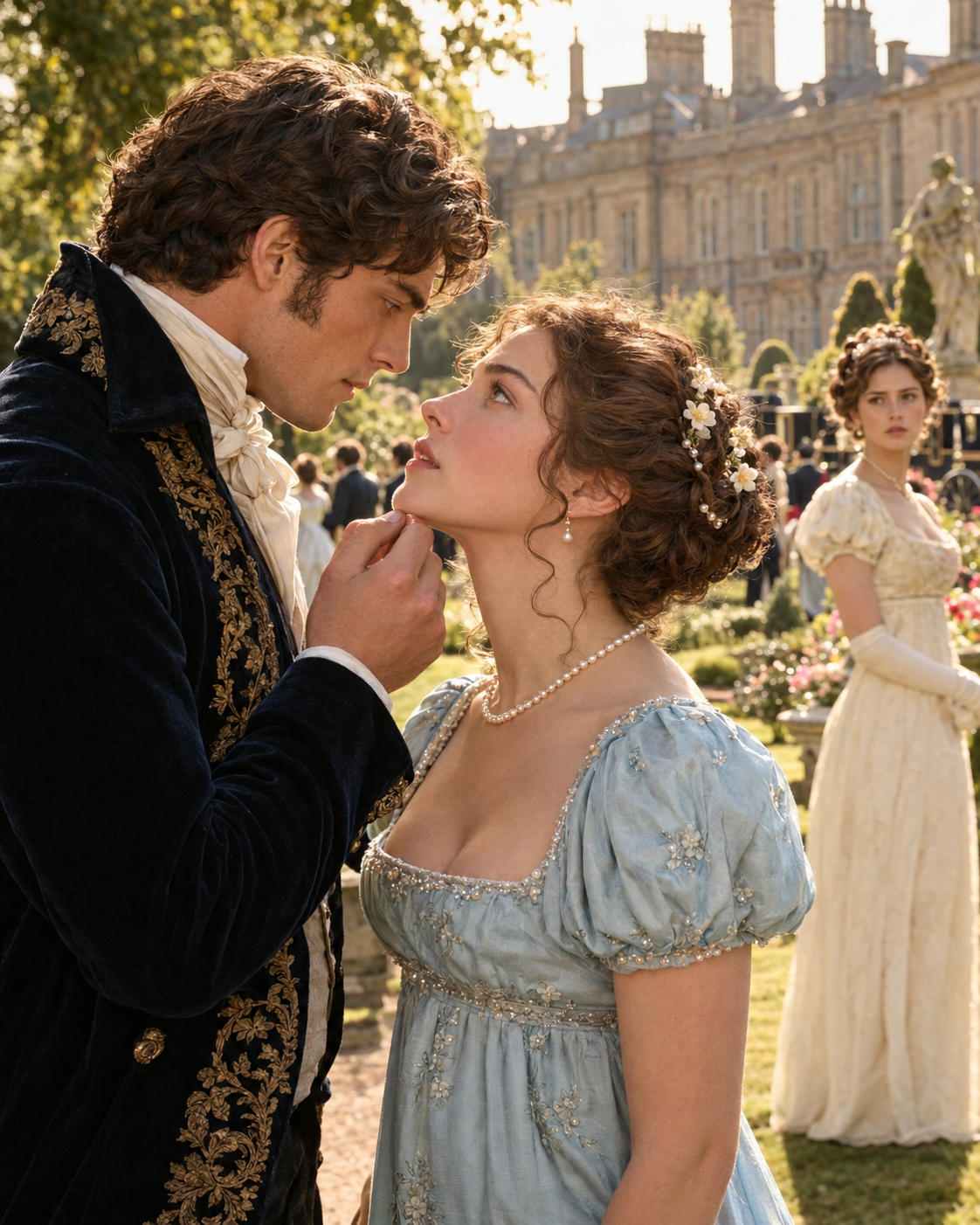
For the first time, the three women looked at one another without suspicion.
The truth had finally separated them from the rumor.
But it did not repair everything.
In fact, it revealed another problem.
Their engagements had already been weakened by the scandal.
The garden party had not created the fractures.
It had merely exposed them.
Rosalind was the first to speak.
“I suppose we should have known before now,” she said softly.
Camille looked at her.
“Known what?”
“That we were all trying to defend marriages we were not certain we wanted.”
The words hung in the air.
Neither woman contradicted her.
Evangeline remained quiet.
She had spent days worrying that the scandal would destroy her future. Now she began to realize something unexpected.
Perhaps the future she had been defending was never truly hers to begin with.
One by one, the three women confronted the reality of their engagements.
There had been expectations.
There had been family pressure.
There had been plans.
But there had not always been honesty.
Rosalind admitted that she had accepted her engagement because it seemed sensible and secure.
Camille acknowledged that she had been more afraid of disappointing others than of entering a marriage she did not fully believe in.
Evangeline said little.
When she finally spoke, her voice was quiet.
“I thought if the rumor ruined my engagement, then my life would be ruined with it.”
She looked across the garden.
“But now I wonder whether losing something that was never truly right for me can really be called losing.”
No one answered.
There was nothing to add.
The three engagements were eventually dissolved.
Not because Julian had taken anything from them.
Not because the gossip had defeated them.
But because the women and the men involved could no longer pretend that a relationship built on expectation alone was enough.
The revelations were painful.
There were difficult conversations.
There were tears, anger, and uncomfortable silences.
But there was also relief.
For Rosalind and Camille, the ending of their engagements gave them the freedom to build lives that belonged to them rather than to other people’s expectations.
For Evangeline, however, another question remained.
Julian.
After the garden party, she avoided him.
Not because she hated him.
Because she needed time.
He understood that.
For once, Julian did not attempt to force the situation into the shape he wanted.
He waited.
Days passed.
Then weeks.
Newport slowly returned to its ordinary rhythm.
The rumors faded as new conversations replaced them.
The same society that had once treated the masquerade as the most fascinating story of the season eventually found something else to discuss.
Julian did not chase the attention.
He did not try to rewrite what had happened.
Instead, he did the one thing he should have done from the beginning.
He told the truth.
When Evangeline finally agreed to see him, they met in the garden where so much of the confusion had come to light.
There was no masquerade.
No music.
No wager.
No audience.
Only two people standing beneath the open sky.
“I owe you another apology,” Julian said.
Evangeline looked at him.
“You have already apologized.”
“Not properly.”
She waited.
“I thought charm could excuse carelessness,” he continued. “I thought because I could laugh about something, everyone else would laugh too. I was wrong.”
Evangeline looked toward the garden.
“You were.”
Julian nodded.
“I know.”
That answer surprised her.
He did not defend himself.
He did not make excuses.
He did not tell her that the wager had been harmless.
He simply accepted the truth.
For the first time, Evangeline felt that she was speaking to the man behind the title.
Not the Duke of Renwick.
Not the man people watched at parties.
Just Julian.
“I was angry with you,” she admitted.
“I know.”
“I was embarrassed.”
“I know.”
“I thought you had turned my life into a joke.”
Julian looked down.
“I understand why.”
Evangeline was quiet for several moments.
Then she said, “But you changed after that garden party.”
“I had to.”
“No,” she replied. “You chose to.”
Julian looked at her.
That distinction mattered.
She could see that he understood it.
Their relationship did not become a romance overnight.
There was no dramatic declaration beneath the moonlight.
There was no sudden promise that erased everything that had happened.
Instead, they began again.
Slowly.
Honestly.
They talked.
Sometimes about the masquerade.
Sometimes about ordinary things.
They learned what the other truly wanted instead of assuming.
Julian learned that affection was not permission.
Evangeline learned that trust could not be demanded simply because someone claimed to love her.
They both discovered that honesty was not always comfortable.
Sometimes it hurt.
Sometimes it revealed differences they would rather not face.
But it also gave them something the masquerade had never offered them.
Choice.
Months later, when Julian asked Evangeline to marry him, he did not do it in front of a crowd.
There was no wager.
No performance.
No hidden challenge.
He simply asked.
Evangeline smiled.
“Are you certain?”
“I have never been more certain of anything.”
“And if I say no?”
“I will accept it.”
She looked at him for a long moment.
Then she said yes.
Their marriage did not begin with a perfect story.
It began with an imperfect one.
Perhaps that was why it lasted.
They knew exactly what dishonesty could cost.
They had seen how quickly a careless moment could become a rumor, how easily a rumor could become suspicion, and how dangerously suspicion could reshape people’s lives.
So they made a promise to each other.
No games.
No hidden intentions.
No silence when the truth mattered.
Years later, people would remember the masquerade differently.
Some would remember it as the scandal that nearly destroyed three engagements.
Others would remember the garden party where the truth was finally spoken.
But Julian and Evangeline remembered something else.
They remembered the moment when a foolish wager stopped being a story about a stolen kiss and became a lesson about honesty.
Because love was not built from perfect behavior.
It was built from what two people chose to do after they had made mistakes.
Julian had entered the masquerade believing that a reckless game could be harmless.
He left that chapter of his life understanding something far more valuable.
A secret might protect pride for a moment, but truth protects relationships in the long run.
And sometimes, the life that begins after a mistake can become more meaningful than the life that existed before it.
The masks had come off.
The rumors had faded.
The engagements that were never meant to last had ended.
And in the quiet that followed, Julian and Evangeline finally had something no masquerade could offer them.
A life chosen freely.
A love spoken honestly.
And a future that belonged to them alone.
The years that followed were quieter than the season that had brought them together.
For Julian and Evangeline, that quiet was not empty.
It was something they had both learned to value.
They settled into a life that was far removed from the glittering rooms where their story had begun. There were still formal dinners, visits from old acquaintances, long afternoons in Newport, and invitations that arrived embossed with elegant lettering. But their home became a place where neither of them needed to perform.
They could disagree without fearing that disagreement meant the end.
They could speak honestly without wondering how their words would be repeated.
And most importantly, they could trust that the person standing across the room was telling them the truth.
Evangeline sometimes thought about the woman she had been before the masquerade.
She had believed that a respectable future meant accepting whatever future had already been prepared for her.
She had believed that keeping everyone comfortable was the same as keeping herself safe.
She no longer believed either.
One autumn afternoon, years after the garden party, she received a letter from Rosalind.
The handwriting was familiar.
The message was simple.
Rosalind had married someone she had met after her engagement ended. It had not been an arrangement made by their families. It had begun with friendship, then affection, then a decision they had made together.
Camille had also found her own path.
She had moved away from Newport for a time, traveled, and eventually established a life she had once been too frightened to imagine.
Neither woman blamed Julian for what had happened.
Neither pretended the scandal had been pleasant.
But both had come to understand that the truth revealed that summer had given them something they had been afraid to ask for themselves.
Freedom.
Evangeline folded Rosalind’s letter and placed it beside the window.
Julian entered the room carrying two cups of tea.
“You look thoughtful.”
“I was thinking about the masquerade.”
He stopped.
“Should I be worried?”
She smiled.
“No.”
Julian handed her the cup.
“Then what were you thinking?”
“That one foolish night changed four lives.”
“Three,” he corrected gently.
“Four.”
He looked at her.
Evangeline continued.
“You changed too.”
Julian was quiet.
He knew she was right.
Before the masquerade, he had believed responsibility was something that belonged to other people. His title had protected him from consequences. His charm had often allowed him to turn mistakes into stories.
But the night everything went wrong had taken that illusion away.
He had learned that privilege did not make consequences disappear.
It only made it easier to postpone them.
“I sometimes wonder,” Evangeline said, “whether we would ever have found each other without that night.”
Julian sat beside her.
“Perhaps not.”
“Does that make you grateful for it?”
He considered the question carefully.
“No.”
Evangeline looked surprised.
“I am grateful for what we built afterward,” he said. “But I would never be grateful for hurting you.”
She smiled faintly.
“That is a very different answer from the man I met at the masquerade.”
“I hope so.”
They sat together in silence.
Outside, the trees had begun to lose their leaves.
The garden that had once been filled with summer flowers was becoming quiet again.
Julian reached for her hand.
“I would change it if I could.”
“I know.”
“But then I wouldn’t know what I know now.”
“You don’t have to keep hurting yourself over it.”
“I don’t.”
He looked at her.
“I simply don’t want to forget.”
Evangeline squeezed his hand.
“Then don’t.”
There was something deeply peaceful in that answer.
Not forgiveness that erased the past.
Not forgiveness that pretended nothing had happened.
Forgiveness that allowed the past to remain where it belonged—behind them, but not forgotten.
Years later, when their children asked how their parents had met, Julian and Evangeline told them a carefully edited version.
They spoke of a masquerade.
They spoke of mistaken identities.
They spoke of a garden party.
But they did not begin with the wager.
Not at first.
One evening, however, when their eldest daughter was old enough to understand the difference between a mistake and an excuse, she asked her father a question.
“Were you really the reason everyone was talking about Mother?”
Julian glanced at Evangeline.
She raised an eyebrow.
“You promised honesty,” she reminded him.
Julian laughed.
“I did.”
He sat beside his daughter and told her the truth.
Not every detail.
Some things belonged only to him and Evangeline.
But enough.
He explained that he had made a foolish decision because he wanted to impress other people.
He explained that he had allowed embarrassment to keep him silent.
And he explained what he had learned.
His daughter listened carefully.
“Were you afraid?”
“Yes.”
“Of telling the truth?”
“Yes.”
“Why did you tell it?”
Julian looked toward Evangeline.
“Because eventually I was more afraid of what silence would do than what the truth would cost.”
His daughter thought about that.
Then she nodded.
Evangeline watched them from across the room.
For a moment, she saw the entire journey at once.
The masquerade.
The whispers.
The uncertainty.
The garden party.
The broken engagements.
The difficult conversations.
The slow rebuilding of trust.
The proposal.
The wedding.
The years that followed.
None of it had happened according to plan.
And perhaps that was the greatest lesson of all.
A life could be carefully arranged and still be wrong.
A mistake could disrupt everything and still lead someone toward the truth.
But the mistake itself was never the miracle.
The miracle was what people chose to do afterward.
The following spring, Julian and Evangeline returned to Newport.
The town looked almost exactly as it had years before.
The harbor was busy.
The streets were filled with carriages and automobiles.
The grand houses stood behind their gates, their windows catching the afternoon light.
They walked together through the same gardens where their lives had once changed direction.
Evangeline paused near the place where Julian had confessed everything.
“Do you remember?”
“I could never forget.”
She looked around.
“It feels smaller now.”
Julian smiled.
“Perhaps we were smaller then.”
She considered that.
“Perhaps.”
They continued walking.
A breeze moved through the trees.
There were no reporters.
No curious guests.
No whispers following them.
Just the two of them.
Julian stopped beneath a flowering tree.
“I have something for you.”
Evangeline turned.
He reached into his coat and produced a small velvet box.
She stared at it.
“Julian.”
“Open it.”
Inside was a simple necklace.
At its center was a small pendant shaped like a key.
Evangeline looked at him questioningly.
“It isn’t an engagement gift,” he said.
She laughed.
“I was about to say that we are already married.”
“I know.”
“Then what is it?”
“A reminder.”
“Of what?”
“That you never owe anyone a version of yourself simply because they expect it.”
Evangeline touched the pendant.
“And what does the key open?”
Julian smiled.
“Whatever door you choose.”
Her eyes softened.
She leaned toward him.
“You really did learn something.”
“I had a good teacher.”
“I don’t remember teaching you.”
“You taught me by refusing to let me hide behind my excuses.”
She shook her head.
“You make me sound far more noble than I was.”
“You were never supposed to be noble.”
“What was I supposed to be?”
“Honest.”
She smiled.
“Then perhaps we both learned the same lesson.”
They walked back toward the house as the sun began to lower over Newport Harbor.
Behind them was the garden where a scandal had once threatened three futures.
Ahead of them was a life they had chosen together.
And that distinction mattered.
Because love, they eventually learned, was not simply about finding the right person at the right moment.
It was about becoming honest enough to recognize what was real when it finally appeared.
The masquerade had begun with masks.
Their marriage endured without them.
And perhaps that was the simplest way to understand everything that had happened.
The night Julian first kissed Evangeline had been built on a foolish wager.
The life they created afterward was built on something completely different.
Truth.
Not the easy truth.
Not the convenient truth.
The truth that sometimes embarrassed them.
The truth that sometimes forced them to apologize.
The truth that sometimes required them to admit they were wrong.
But it was theirs.
Years after the scandal had disappeared from society’s memory, Julian occasionally received invitations to masquerades.
He always declined.
Evangeline would tease him about it.
“You still don’t like masks?”
“Not particularly.”
“Why?”
“Because I’ve already learned what happens when people hide too much.”
She would smile.
“And yet you married me.”
Julian would take her hand.
“I married the woman who made me take the mask off.”
That was how their story was remembered by the people who truly knew them.
Not as the scandal of three engagements.
Not as the foolish wager of a duke.
Not even as the garden party where a secret was exposed.
It became a story about choices.
About the courage to tell the truth when a lie would be easier.
About understanding that reputation can be repaired, but trust must be rebuilt carefully.
And about realizing that sometimes the future we fear losing is not the future we were meant to have.
Rosalind found happiness beyond the engagement she had once believed she could never escape.
Camille built a life according to her own decisions.
Evangeline found a love she had never expected.
And Julian became a man who understood that love was not a game and honesty was not a weakness.
The old rumor eventually disappeared.
The names were forgotten.
The details became distorted with time.
But the lesson remained.
A mask can hide a face.
It cannot hide consequences forever.
A secret can delay a difficult conversation.
It cannot guarantee that the truth will never emerge.
And a mistake does not have to define an entire life.
What defines a person is what they do once they understand the mistake.
On their final evening in Newport that summer, Julian and Evangeline stood together overlooking the harbor.
The sky was turning gold.
Lights were beginning to appear across the water.
Evangeline rested her head against his shoulder.
“Do you ever wish we had met differently?”
Julian looked at the horizon.
“All the time.”
She smiled.
“Then why are you smiling?”
“Because I don’t wish we were different people.”
She lifted her head.
He turned toward her.
“We became who we needed to become.”
For a moment, neither spoke.
Then Evangeline took his hand.
Together, they walked home.
There was no music.
No audience.
No mask.
No wager.
Only the quiet certainty of two people who had finally learned that the strongest promises were not made before a crowd.
They were made in private, kept in difficult moments, and proven over time.
And as the last light disappeared over Newport Harbor, the story that had begun with a reckless kiss finally came to its true ending.
Not with scandal.
Not with gossip.
Not with a perfect fairy tale.
But with something better.
Two people who had once been separated by misunderstanding had learned to build a life where nothing important needed to be hidden.
And sometimes, that is what a happy ending really looks like.
Not a life without mistakes.
A life honest enough to survive them.
THE END.