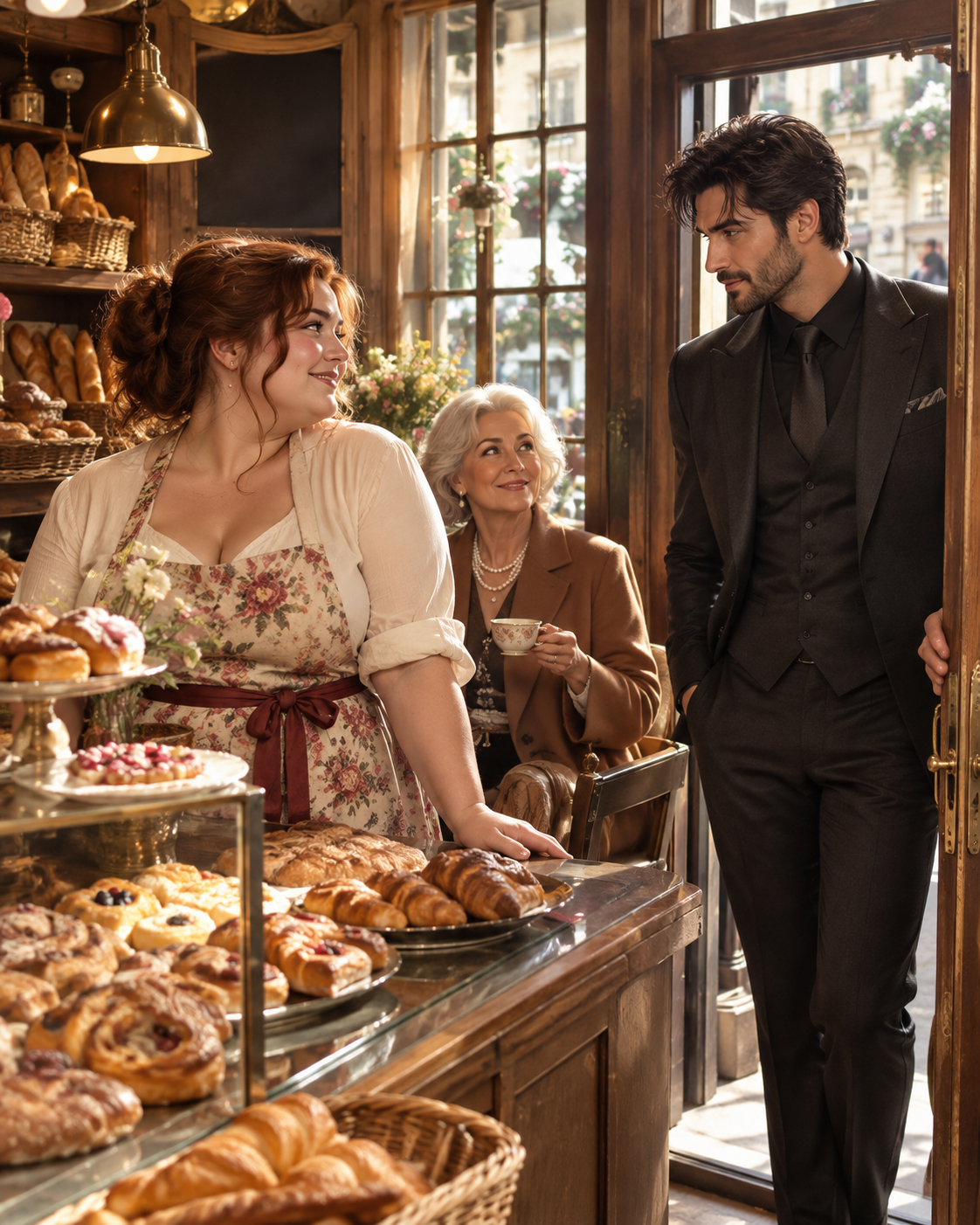
In a quiet corner of an American city, where the morning air carried the smell of fresh coffee and warm bread through the streets, there was a little bakery that seemed ordinary to everyone who passed by.
Eta stared at the small square of paper on the bakery counter.
For a moment, she couldn’t understand why it mattered.
It was only a napkin.
A plain, cream-colored wholesale paper napkin with a faint blue line running along one edge.
She had seen hundreds of them.
Then she remembered Nona Victoria’s hands.
The old woman had folded the napkin carefully that afternoon, long before anyone knew she would disappear. Eta could still picture her sitting by the window, drinking coffee and pretending to complain about the weather.
At the time, Eta had laughed.
Now she wasn’t laughing.
She picked up the napkin and turned it over.
There, almost invisible beneath the fold, was a tiny blue warehouse mark.
Eta’s heart began to beat faster.
She knew that mark.
Not because it belonged to the bakery.
Because she had seen it on delivery invoices.
“Paper Harbor Supply,” she whispered.
The company operated in a warehouse district on the industrial edge of the city.
Eta knew the area well. The bakery received flour, sugar, boxes, and paper products from several suppliers there. But Paper Harbor had stopped making direct deliveries to small bakeries years ago.
There was only one reason Nona would have chosen that particular napkin.
Eta reached for her phone.
Her first instinct was to call Enzo.
Her second was to stop herself.
If Nona had been taken by someone who understood Enzo, then the kidnappers were probably expecting him to react exactly as he always did—fast, angry, and without thinking about the consequences.
Eta looked again at the napkin.
Nona had not left it for Enzo.
She had left it for her.
That realization changed everything.
Eta called Enzo.
He answered before the first ring had fully finished.
“Where are you?”
“At the bakery.”
“Stay there.”
“Enzo—”
“Eta, listen to me. Stay inside. Lock the door.”
His voice was different.
There was no warmth in it now.
No hesitation.
Only fear disguised as command.
“Your grandmother left me something.”
Silence.
“What?”
“A napkin.”
Another silence.
Eta could almost hear him thinking.
“Tell me everything.”
She did.
When she finished, Enzo didn’t immediately answer.
Then he said quietly, “I know the district.”
“I figured.”
“There are dozens of warehouses.”
“I know.”
“So do I.”
“Then you also know we can’t just walk into one.”
“I wasn’t planning to.”
Eta looked at the bakery windows.
The street outside was nearly empty.
“Enzo,” she said, “Nona wanted me to find her.”
“I know.”
“No. I don’t think you do.”
He went silent.
“She could have left a phone number. A note. Your ring. Something obvious.”
“I know my grandmother.”
“No,” Eta said softly. “You know the woman who raised you. I think I’m beginning to know the woman she became.”
There was something almost like a breath of laughter on the other end.
Even now.
Even with Nona missing.
“Fair enough,” he said.
Eta folded the napkin.
“What are we doing?”
“We’re bringing her home.”
It was the simplest sentence he had spoken all night.
And somehow, it was enough.
Two hours earlier, Nona Victoria had been sitting in a cold room with three men who were rapidly discovering that kidnapping an eighty-one-year-old woman was considerably more complicated than they had imagined.
She sat in a wooden chair with her handbag on her lap.
Her captors had expected tears.
They got complaints.
“This chair is terrible.”
The tallest man frowned.
“Lady, you’re a hostage.”
“I noticed.”
“You should be scared.”
“I am.”
He blinked.
“You don’t look scared.”
“Because I was raised properly.”
The youngest man tried not to smile.
The older one noticed.
“Nobody is laughing.”
Nona looked at him.
“I’m not laughing either.”
“You’re impossible.”
“I’ve been told.”
She adjusted her coat.
“Do you have tea?”
“No.”
“Coffee?”
“No.”
“Water?”
He pointed toward a bottle.
Nona examined it.
“Room temperature?”
“Yes.”
“Terrible.”
The youngest man finally laughed.
The older man turned sharply.
Nona smiled.
There it was.
The first crack.
She had spent eighty-one years learning that frightened people were often the easiest to understand.
The men who had taken her weren’t fearless.
They were men trying very hard to appear fearless.
And one of them, she noticed, kept glancing at the door.
Another kept checking his phone.
The youngest one had a photograph of a little girl tucked into his wallet.
Nona saw it when he reached for a cigarette.
“You have a daughter.”
His hand froze.
“How do you know?”
“The picture.”
He put the wallet away.
“Don’t worry. I won’t tell anyone.”
He stared at her.
“You think this is funny?”
“No.”
Nona’s expression softened.
“I think you are young enough to still become someone your daughter can be proud of.”
The room became quiet.
Outside, a truck rolled past the warehouse.
Nona looked toward the sound.
She had already noticed something else.
The men had brought her here in a hurry.
They had not searched her carefully.
They had taken her handbag but never examined the lining.
That was useful.
Because her ransom ring was still on her finger.
The ring itself was valuable.
But the value wasn’t what mattered.
Nona had chosen it because of the tiny engraving inside.
A private family symbol.
And now she needed a way to make sure someone found it.
She glanced at the youngest man.
“Could you get me another napkin?”
“Why?”
“Because this one is filthy.”
He hesitated.
Then he brought her one.
It was the same kind used throughout the warehouse district.
Nona smiled.
“Thank you, dear.”
She removed the ring.
For several seconds, she held it in her palm.
Then she wrapped it carefully inside the napkin.
The youngest man looked away.
He never saw what she did next.
She folded the napkin twice, then pressed it into the pocket of her coat.
She knew that eventually someone would search her again.
She only needed to make sure the napkin stayed visible enough to be found.
Back at the bakery, Eta was studying a map spread across the counter.
Enzo stood opposite her.
He had arrived alone.
No entourage.
No dramatic entrance.
Just a dark coat, tired eyes, and a face that looked older than it had that morning.
Eta noticed immediately.
“You haven’t slept.”
“Neither have you.”
“I wasn’t the one whose grandmother was kidnapped.”
“That makes two of us.”
Eta looked up.
“What does that mean?”
“It means you’re part of my family now.”
The words came out before he could stop them.
Neither spoke for several seconds.
Then Eta looked down at the map.
“We have a problem.”
Enzo nodded.
“There are fourteen warehouses connected to Paper Harbor.”
“Which one?”
“I’m still working on it.”
Eta tapped the napkin.
“Not just Paper Harbor.”
Enzo looked closer.
“There.”
A faint number had been printed beneath the blue mark.
“That’s not a warehouse number,” he said.
“No.”
Eta pointed to another symbol.
“It’s a shipping route.”
Enzo stared.
She continued.
“Your grandmother used to come here every week. She always asked me about deliveries.”
“Why?”
“I thought she was making conversation.”
“She was never making conversation.”
Eta smiled despite herself.
“I know that now.”
Enzo leaned over the map.
The route connected three warehouses.
One of them had been closed for nearly six months.
“That’s it,” he said.
“You’re sure?”
“No.”
Eta looked at him.
“For once, that’s the right answer.”
A small smile appeared.
It disappeared quickly.
They both knew what came next.
“We can’t rush in,” Eta said.
Enzo nodded.
“No.”
“We need to know who’s inside.”
“I have people who can watch the place.”
“Quietly.”
“Yes.”
“And no one gets hurt.”
Enzo looked at her.
“That’s a difficult promise.”
“Make it anyway.”
He held her gaze.
Then he nodded.
“I promise.”
They spent the next hour gathering information.
The warehouse sat at the end of a dead industrial street beside an abandoned rail spur.
No customers.
No workers.
No reason for anyone to be there after midnight.
But lights were visible through two upper windows.
A delivery van had arrived earlier.
The license plate had been reported stolen.
That was enough.
Enzo made a call.
He spoke for less than a minute.
Then he put the phone away.
“It’s confirmed.”
Eta swallowed.
“She’s there.”
“Yes.”
“What happens now?”
“We go in.”
Eta shook her head.
“No.”
Enzo frowned.
“You stay here.”
“Absolutely not.”
“Eta—”
“Nona left the clue for me.”
“That doesn’t mean you’re going into a warehouse where armed men might be waiting.”
“She trusted me.”
“And I trust you.”
“Then don’t leave me behind.”
Enzo stared at her for a long time.
Finally, his shoulders dropped.
“You are incredibly stubborn.”
“I learned from the best.”
For the first time that night, he smiled.
“Nona would be proud.”
They didn’t storm the warehouse.
That was the part their enemies hadn’t expected.
Enzo had a reputation for force, and the men holding Nona had planned around it.
They expected shouting.
They expected threats.
They expected a violent confrontation.
Instead, the first thing that happened was a phone call.
One of the kidnappers answered.
A calm voice spoke on the other end.
“You have Victoria Ferraro.”
The man looked toward Nona.
She raised one eyebrow.
“Yes.”
“Then you know who you’re dealing with.”
“We do.”
“No one wants a fight.”
The kidnapper laughed.
“You expect us to believe that?”
“No. I expect you to understand it.”
The line went quiet.
Then the voice continued.
“You’ve made a mistake.”
“What mistake?”
“You thought taking an old woman would give you power.”
The kidnapper glanced at Nona.
She smiled sweetly.
“She has more power than all of you.”
The man hung up.
Nona looked pleased.
“I like that boy.”
The youngest kidnapper stared at her.
“You know who that was?”
“My grandson.”
“You aren’t scared of him.”
“No.”
“Why?”
Nona smiled.
“Because I know what he’s like when nobody is watching.”
Outside, Eta and Enzo waited.
Minutes passed.
Then a side door opened.
A man stepped out.
He looked around.
No one approached.
Instead, he found a small package on the ground.
Inside was a key and a handwritten note.
The note contained only four words.
“You are already surrounded.”
The man went pale.
He looked toward the dark street.
Nothing moved.
That was the trick.
Enzo had no intention of showing them how many people were watching.
The kidnappers began arguing inside.
Eta could hear raised voices through the wall.
Then another man came outside.
Then another.
One by one, they realized the situation had changed.
Their phones stopped working.
Their escape vehicles were blocked.
Their identities were already known.
And yet nobody had been touched.
The oldest kidnapper finally understood.
They had lost.
Not because someone had overpowered them.
Because they had been made to believe they were already powerless.
He walked back inside.
“Nobody move.”
Nona looked up.
“Too late.”
The warehouse door opened again.
Enzo stepped inside.
Eta followed him.
The room went silent.
For several seconds, nobody moved.
Enzo looked at his grandmother.
“Nona.”
“Enzo.”
“You’re all right?”
“I’ve had worse dinners.”
He closed his eyes briefly.
Then he walked toward her.
Nona stood.
For one moment, the feared crime boss disappeared completely.
He was simply a grandson seeing his grandmother alive.
He hugged her.
Tightly.
Nona patted his back.
“I told you I was fine.”
“You were kidnapped.”
“I was inconvenienced.”
Eta laughed softly.
Nona looked past Enzo.
“And there she is.”
Eta stepped forward.
Nona smiled.
“My clever girl.”
“You left me a napkin.”
“I knew you’d understand.”
Enzo looked between them.
“What exactly did you two plan?”
“Nothing,” Nona said.
Eta answered at the same time.
“Everything.”
Nona laughed.
The youngest kidnapper lowered his eyes.
He looked embarrassed now rather than dangerous.
Nona noticed.
She walked toward him.
“You.”
He looked up.
“Yes, ma’am.”
“You have a daughter.”
He nodded.
“Go home to her.”
He swallowed.
“What about him?”
He looked toward Enzo.
Nona glanced at her grandson.
“That depends on what you do next.”
Enzo said nothing.
The young man slowly removed the weapon from his waistband and placed it on the floor.
Then he stepped away.
The others followed.
There was no gunfire.
No bodies.
No dramatic final confrontation.
Just a group of men realizing they had gambled everything on fear and discovered that fear could be taken away without a single shot.
Outside, the night air was cold.
Nona walked between Eta and Enzo.
For several minutes, nobody spoke.
Then Nona stopped.
“I suppose this means I should stop pretending to be lost.”
Eta smiled.
“I was wondering when you’d admit it.”
Enzo looked confused.
“Pretending?”
Nona shrugged.
“I needed a reason to visit the bakery.”
“You deliberately got lost?”
“Repeatedly.”
Enzo stared at her.
“All those times?”
“Every single one.”
“You knew exactly where you were?”
“Of course.”
He looked at Eta.
Eta tried not to laugh.
“You knew?”
“Not at first.”
Nona looked delighted.
“You see? She learns quickly.”
Enzo shook his head.
“I cannot believe this.”
Nona reached up and touched his cheek.
“You needed someone to remind you that you’re allowed to be happy.”
His expression changed.
“I’m not sure I know how.”
Nona looked at Eta.
“Yes, you do.”
Then she walked away.
Enzo stood beside Eta beneath the yellow streetlight.
For once, neither of them had anything clever to say.
The city stretched around them.
Cars moved in the distance.
A train horn sounded somewhere beyond the warehouses.
Eta looked at him.
“You promised me no one would get hurt.”
“No one did.”
“You kept your promise.”
“I had a good reason.”
“What reason?”
He looked at her.
“You.”
Eta smiled.
“You’re very dramatic.”
“I learned from my grandmother.”
They returned to the bakery just before sunrise.
The city was beginning to wake.
Delivery trucks moved along the streets.
Coffee shops opened their doors.
And Eta unlocked the bakery.
Inside, everything looked exactly as it had the night before.
The same ovens.
The same wooden counter.
The same handwritten menu.
But somehow, everything felt different.
Enzo took off his coat and rolled up his sleeves.
“What are you doing?”
“Helping.”
“You don’t know how to bake.”
“I can learn.”
Eta handed him a bowl.
“Then start with that.”
“What is it?”
“Dough.”
He looked suspiciously at it.
Nona appeared in the doorway.
“Don’t ruin it.”
Enzo looked offended.
“I won’t.”
Eta laughed.
And for the first time in years, Nona Victoria watched her grandson doing something she had wanted for him long before he understood it himself.
He was not surrounded by men waiting for orders.
He was not sitting in a dark office counting risks.
He was standing in a small American bakery with flour on his hands.
And he was smiling.
Weeks passed.
The story of the kidnapping slowly faded from the newspapers.
There were no sensational headlines.
No public spectacle.
The men involved disappeared from the neighborhood, and the warehouse was eventually closed for good.
Enzo began changing his life in ways few people noticed at first.
He stepped away from old business relationships.
He refused opportunities that required fear.
He started investing in legitimate businesses.
The bakery became one of them.
Not because Eta needed saving.
She didn’t.
Because Enzo wanted to build something that would remain after he was gone.
Something that didn’t depend on people being afraid of him.
One morning, Nona arrived at the bakery.
She stopped at the door.
Eta looked up.
“Lost again?”
Nona smiled.
“Terribly.”
Enzo appeared from the kitchen.
“You know the way here.”
“I know.”
“You’ve been coming here for months.”
“I know.”
“Then why do you keep pretending?”
Nona looked at him.
“Because some traditions should never disappear.”
Eta placed a cup of coffee in front of her.
Nona took one sip.
“Perfect.”
Enzo sat beside Eta.
Nona looked between them.
“You two look happy.”
Eta smiled.
“We are.”
Nona nodded.
“That is all I wanted.”
Enzo reached across the table and took Eta’s hand.
For a moment, Nona said nothing.
Then she leaned back in her chair.
“I suppose I can finally retire.”
Eta laughed.
“From what?”
“Matchmaking.”
Enzo groaned.
“Please don’t start again.”
Nona smiled innocently.
“I already have someone in mind.”
“No.”
“You don’t even know who.”
“I know you.”
Eta laughed so hard she nearly dropped her coffee.
The bakery filled with the sound of their voices.
Outside, the American city moved at its usual pace.
People hurried to work.
Buses stopped at corners.
Delivery trucks carried bread through neighborhoods.
Life continued.
But inside that little bakery, something had changed permanently.
Eta had learned that kindness did not make a person weak.
Enzo had learned that strength did not have to look like fear.
And Nona had proven what she had known all along: sometimes the most powerful person in the room is the one nobody thinks to fear.
She had never really been lost.
Not once.
Every wrong turn had been deliberate.
Every visit had been planned.
Every pastry had been part of a larger scheme.
And perhaps that was the greatest lesson she could leave behind.
Love rarely arrives in the form we expect.
Sometimes it enters through an ordinary bakery door.
Sometimes it wears a frightened expression and carries an old handbag.
Sometimes it looks like a dangerous man learning how to knead dough.
And sometimes, all it takes to change someone’s life is one person brave enough to see the softness hiding underneath the armor.
Years later, Eta would still keep that old paper napkin.
She framed it and hung it behind the bakery counter.
Customers often asked what it meant.
Eta would smile.
“It reminds me that the most important things aren’t always obvious.”
And whenever someone asked about the woman in the old photograph beside it, Eta always gave the same answer.
“That is Nona Victoria.”
“The woman who saved you?”
Eta would smile.
“No.”
“The woman who brought us together.”
Then, from somewhere in the kitchen, Enzo would call her name.
The ovens would ring.
The smell of fresh bread would fill the room.
And outside, the city would keep moving.
But inside the little bakery, the family Nona had carefully created would remain exactly where she had always wanted them to be.
Together.
The years that followed were quieter than anyone had expected.
For Enzo, quiet had once meant danger.
It meant waiting for a phone call, watching the door, wondering which old enemy had decided to return.
But now, quiet meant something entirely different.
It meant the sound of Eta moving around the kitchen before sunrise.
It meant the soft hum of the ovens warming up.
It meant Nona Victoria complaining that everyone was working too hard.
It meant ordinary mornings.
And Enzo had discovered that ordinary mornings could be more precious than anything he had ever owned.
The bakery grew slowly.
Eta refused to turn it into some enormous chain.
She wanted to keep the old wooden counter, the handwritten signs, and the little bell above the door.
She said people came for the bread, but they stayed because the place felt like home.
Enzo agreed.
For once, he didn’t want something bigger.
He wanted something real.
Every Saturday morning, Nona claimed the corner table by the window.
She would arrive with her handbag, her walking cane, and an expression suggesting that she had personally inspected the entire neighborhood before deciding the bakery deserved another visit.
One particular Saturday, she arrived earlier than usual.
Eta was arranging pastries in the display case when the bell above the door rang.
She looked up.
“Nona?”
The old woman smiled.
“Good morning, darling.”
“You’re early.”
“I have business.”
Eta immediately became suspicious.
“What kind of business?”
Nona walked to her usual table.
“Important business.”
Enzo entered from the kitchen carrying a tray.
He stopped when he saw his grandmother.
“Nona.”
“Yes?”
“You’re plotting something.”
She placed a hand over her heart.
“How could you accuse an old woman of plotting?”
“Because I’ve known you for thirty years.”
“Only thirty?”
“You know what I mean.”
Nona smiled.
Eta looked between them.
“What is going on?”
“Nothing,” Nona said.
“Everything,” Enzo said at the same time.
Nona pointed at him.
“See? He is becoming suspicious again.”
“He learned from you.”
“Then I have done my job.”
She reached into her handbag.
Enzo immediately frowned.
“What do you have?”
Nona pulled out an envelope.
She placed it on the table.
Eta noticed the handwriting.
It was Nona’s.
“What is that?” she asked.
“A letter.”
“For whom?”
Nona looked at Enzo.
“For my grandson.”
Enzo stared at the envelope.
“Why are you giving me a letter when you’re sitting right here?”
“Because there are things people say more honestly when they don’t have to watch the other person’s face.”
The smile disappeared from her expression.
For the first time that morning, she looked old.
Not weak.
Just old.
Enzo took the envelope.
He opened it carefully.
Inside was a single sheet of paper.
He read the first line.
Then the second.
His expression changed.
Eta watched him silently.
He finished reading.
For several seconds, he said nothing.
Then he folded the letter and placed it on the table.
“Nona.”
“Yes?”
“You’re leaving.”
She smiled.
“Not today.”
“But soon.”
“I think so.”
Eta’s heart sank.
Nona had never spoken about death dramatically.
She never treated it like a tragedy waiting behind every corner.
She treated it like another appointment she would eventually have to keep.
Still, hearing her say it made the bakery suddenly feel smaller.
Enzo reached for her hand.
“I don’t like this.”
“I know.”
“I don’t want you to go.”
“I know that too.”
“You always say you know everything.”
“Because I usually do.”
He laughed despite himself.
Nona squeezed his hand.
“Enzo, listen to me.”
He looked at her.
“You spent too many years believing your job was to protect everyone.”
“I had to.”
“No.”
Her voice was gentle.
“You believed you had to.”
He looked away.
“You cannot protect people from every painful thing in life.”
“I know.”
“No, you don’t.”
She touched his cheek.
“That’s why you still try.”
Eta quietly wiped her eyes.
Nona turned toward her.
“And you.”
Eta swallowed.
“Yes?”
“You were never supposed to save him.”
Eta smiled through her tears.
“I know.”
“You were supposed to remind him that he could save himself.”
The bakery became completely silent.
Nona looked at them both.
“That is why I chose you.”
Eta took her hand.
“You chose me before you even knew me.”
“I knew enough.”
“How?”
Nona smiled.
“You gave me an extra pastry on the first day.”
Eta laughed softly.
“That was because you looked hungry.”
“Exactly.”
Enzo shook his head.
“You manipulated both of us with pastries.”
“Of course.”
She looked offended that he even had to ask.
“Pastries are very persuasive.”
They laughed together.
For the next few months, Nona remained part of the bakery.
She came less often.
She complained more.
She slept longer.
But whenever she came through the door, the entire room seemed to brighten.
Then, one autumn morning, she didn’t come.
Eta waited.
Noon came.
Still nothing.
Enzo called her.
No answer.
He called again.
Still nothing.
This time, the fear that had once ruled his life returned.
He stood motionless beside the bakery counter.
Eta came around and took his hand.
“Let’s go.”
They drove together.
Nona was at home, sitting peacefully in her favorite chair beside the window.
She wasn’t alone.
A nurse sat nearby.
When she saw Enzo and Eta enter, she smiled.
“You took your time.”
Enzo rushed toward her.
“Nona.”
“I told you not to look so frightened.”
He knelt beside her chair.
“I thought—”
“I know.”
He lowered his head.
Nona placed her hand on his hair.
“Look at me.”
He did.
“You are happy?”
He struggled to answer.
“Yes.”
“Are you loved?”
“Yes.”
“Do you have something worth waking up for?”
He looked toward Eta.
“Yes.”
“Then stop being afraid of tomorrow.”
Those were the last words she said to him that morning.
She fell asleep peacefully.
She never woke again.
The funeral was small.
Nona had made it very clear that she wanted no grand ceremony.
She wanted flowers, coffee, and people telling funny stories.
So that’s what they did.
Eta told everyone about the first time Nona pretended to be lost.
Enzo told the story of the napkin.
Someone laughed when he described how Nona had complained about the hostage chair.
Even in grief, there was laughter.
That was exactly how Nona wanted it.
When everyone had gone, Enzo and Eta remained at the cemetery.
The sky above them was gray.
Enzo held a folded piece of paper in his hand.
Nona’s letter.
He had read it dozens of times.
He opened it again.
There was one final paragraph he had never shown Eta.
He read it silently.
Then he handed it to her.
Eta read:
“My dear Enzo,
If you are reading this, then I have finally stopped interfering in your life, although I suspect you will continue blaming me for everything good that happens to you.
Do not spend your life mourning the woman I was.
Build the life I wanted you to have.
Love without fear.
Choose peace even when anger feels easier.
And when you are uncertain, go back to the bakery.
Eta will remind you who you are.
She always has.
P.S. I was never lost.
I knew exactly where I was going.”
Eta smiled through her tears.
Enzo laughed softly.
“She really had to have the last word.”
“She did.”
He looked toward the grave.
“I don’t know how to do this without her.”
Eta slipped her hand into his.
“You don’t have to.”
They stood there together.
The wind moved gently through the trees.
For the first time, Enzo understood something his grandmother had been trying to teach him for years.
Love did not mean preventing loss.
It meant making the time before loss meaningful.
He folded the letter carefully.
Then he looked at Eta.
“Let’s go home.”
They returned to the bakery.
The next morning, they opened as usual.
The bell above the door rang.
Customers came in.
Coffee was poured.
Bread came out of the oven.
A little boy pressed his face against the glass to look at the pastries.
Eta laughed.
Enzo carried a tray to the counter.
For a moment, he looked toward Nona’s empty chair.
Then he smiled.
The chair remained there.
They never replaced it.
Years later, people would ask why.
Eta always gave the same answer.
“Because someone special still sits there.”
The bakery became known throughout the neighborhood.
Not because of Enzo’s past.
Not because of rumors.
Not because of the strange story about an eighty-one-year-old woman who had once disappeared from a warehouse.
It became known because people felt safe there.
A firefighter could sit beside a schoolteacher.
A construction worker could share a table with a lawyer.
A lonely elderly man could drink coffee for two hours without anyone asking him to leave.
And every morning, Eta placed one extra pastry on the counter.
For Nona.
Enzo never asked why.
He knew.
One winter morning, years after Nona’s death, Eta found Enzo standing beside the old framed napkin.
He was staring at it.
“What are you thinking about?”
He smiled.
“Her.”
“Me too.”
“She changed everything.”
Eta nodded.
“No.”
He turned toward her.
“She didn’t change everything.”
“What then?”
“She showed us what was already there.”
Eta walked closer.
Enzo took her hand.
“You know what I learned?”
“What?”
“That I spent most of my life trying to become someone people couldn’t hurt.”
Eta waited.
“And then I met you.”
He smiled.
“I realized being loved was much stronger than being feared.”
Eta leaned against him.
“And what did you learn about yourself?”
“That I still can’t bake properly.”
She laughed.
“That is absolutely true.”
“I’ve improved.”
“You set off the smoke alarm last Tuesday.”
“It was a complicated recipe.”
“It was toast.”
He smiled.
“Still complicated.”
Their laughter filled the bakery.
Outside, snow began falling over the American city.
Cars moved slowly along the street.
People hurried home.
The world remained imperfect.
There were still difficult days.
There were still losses.
There were still things neither of them could control.
But inside the bakery, the light remained warm.
And beside the old framed napkin was a photograph of Nona Victoria.
She was smiling directly at the camera, wearing the expression of a woman who knew a secret everyone else would eventually discover.
Beneath the photograph was a small handwritten sentence:
“She was never lost.”
Visitors sometimes asked what it meant.
Eta would explain the story.
She would tell them about the old woman who repeatedly pretended not to know the way.
She would tell them about the feared man who became gentle around one woman.
She would tell them about a bakery, a paper napkin, a warehouse, and a kidnapping that ended without the violence everyone expected.
But she always ended the story the same way.
“Nona believed that people spend too much time protecting their hearts from pain.”
Then Eta would look toward Enzo.
“She wanted us to learn that a protected heart may survive.”
She would smile.
“But an open heart gets to live.”
And that became the real legacy of Nona Victoria.
Not the money.
Not the family name.
Not the influence she once carried.
Not even the elaborate plan that brought Eta and Enzo together.
Her greatest gift was teaching two people who had spent their lives hiding behind different kinds of walls that happiness required courage too.
Enzo had once believed strength meant never showing fear.
Eta had once believed kindness meant giving everything without asking anyone to stay.
Nona taught them both another way.
You could be strong and still be gentle.
You could love someone without owning them.
You could protect someone without controlling their life.
And sometimes, the bravest thing a person could do was simply choose a peaceful life after spending years believing they didn’t deserve one.
The bakery stayed open late that evening.
When the last customer left, Eta turned the sign on the door.
Enzo switched off the lights one by one.
Only the small lamp above Nona’s table remained.
He looked at it.
“Should we turn that one off?”
Eta shook her head.
“No.”
“Why not?”
She smiled.
“I think she would complain.”
Enzo laughed.
“Definitely.”
They walked toward the kitchen.
Then the bell above the front door moved slightly.
Neither had touched it.
They both stopped.
Eta looked toward the empty doorway.
Enzo smiled.
“You know what she’d say.”
Eta nodded.
“She’d say she’s lost.”
“And then?”
“She’d ask for coffee.”
They laughed.
Eta walked back to the counter.
She poured one final cup.
She placed it on Nona’s table beside a warm pastry.
Then she turned off the last light.
Outside, the city continued moving through the winter night.
Inside the little bakery, the coffee slowly cooled.
The pastry remained untouched.
And for a moment, it almost felt as though the old woman was still there, sitting by the window, watching the two people she had brought together.
Perhaps that was all she had ever wanted.
Not a perfect life.
Not a life without danger or grief.
Just a life where love was stronger than fear.
A life where two people who might never have found each other could wake up each morning and choose each other again.
And somewhere in the quiet streets of that American city, the story of the woman who was never lost finally came to an end.
Because Nona Victoria had known exactly where she was going from the beginning.
She was going home.
And somehow, she had made sure her grandson found his way there too.
THE END.