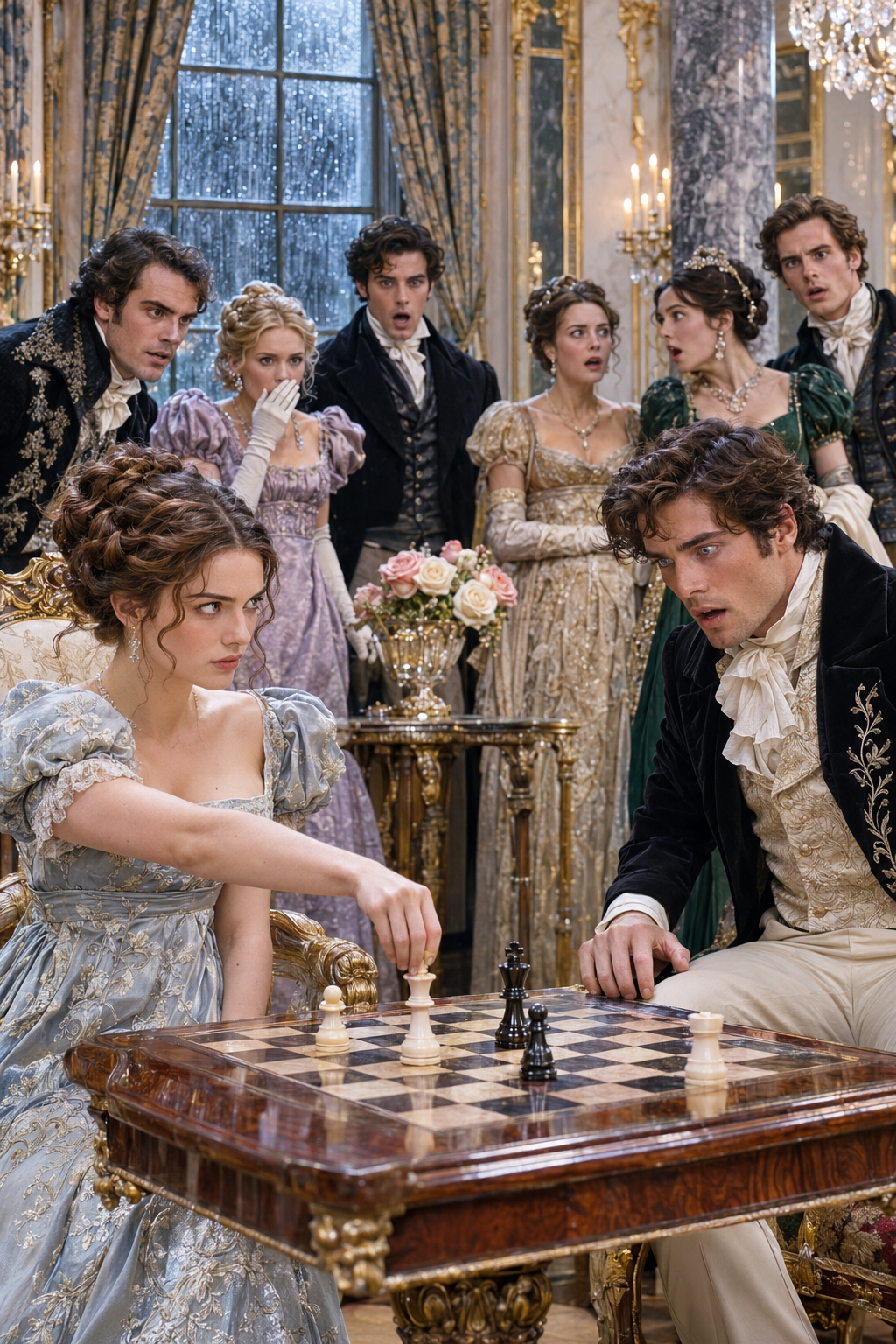
“If you lose this chess match, Abigail, you’ll leave my house without a penny.”
Abigail looked at the queen beneath her trembling fingers.
For three years, she had endured Lady Beatrice’s insults, her unreasonable demands, and her endless reminders that a woman without money had no right to pride.
She had eaten cold dinners, slept in an unheated attic, and apologized for mistakes she hadn’t made.
And now she was being asked to surrender the one thing that truly belonged to her.
Her intelligence.
Abigail took a deep breath.
Then she moved her queen.
“Check, Your Grace.”
Lady Beatrice’s face turned scarlet.
The Duke examined the board. He moved his king, but Abigail was already prepared. Her knight closed another escape, forcing him into the position she had anticipated.
When he made his final defensive move, Abigail calmly advanced her bishop.
“Checkmate.”
Nobody spoke.
A gentleman near the fireplace slowly lowered his wineglass. Another stepped closer to the table, apparently convinced that his eyes had deceived him.
The Duke of Ashbourne had lost.
And he had lost to a woman who owned only two dresses.
For several seconds, the Duke remained perfectly still. Then something extraordinary happened.
He smiled.
“Magnificent.”
He stood and extended his hand across the table.
Abigail hesitated before accepting it.
“Miss West, that was the finest game I have played in eleven years.”
A few guests began applauding. Within moments, the ballroom erupted with astonished conversation.
Lady Beatrice, however, looked as though she had swallowed poison.
“She cheated!”
The applause stopped.
Abigail’s stomach tightened.
“Excuse me?” the Duke asked.
“She must have cheated. A girl of her background couldn’t possibly possess such intelligence.”
“Then perhaps you would care to explain how she cheated at a game played before forty witnesses.”
Lady Beatrice opened her mouth, but no explanation came.
Instead, she turned toward Abigail.
“Collect your belongings tonight. You are dismissed.”
Abigail had expected those words. Nevertheless, hearing them felt like being pushed into freezing water.
“My wages, my lady?”
“You shall receive nothing.”
“But you owe me six months’ wages.”
“Consider them compensation for my humiliation.”
The Duke’s smile disappeared.
“Lady Beatrice, you appear to have forgotten that you made a public wager.”
“I wagered with the gentlemen, not with her.”
“Indeed. And you owe them fifty pounds each. I imagine they will be interested to learn how you honor your financial obligations.”
Several gentlemen exchanged uncomfortable glances.
Lady Beatrice snatched her fan from the table.
“I refuse to discuss my private affairs with a servant.”
She marched away, leaving Abigail standing beside the chessboard.
The Duke reached into his coat and withdrew a leather purse.
“Miss West, please accept this.”
Abigail looked at the money but didn’t touch it.
“Why?”
“For winning.”
“We agreed upon no prize, Your Grace.”
“Then consider it assistance.”
Her expression hardened slightly.
“I would rather earn my next meal than become another wealthy person’s charity.”
The Duke regarded her with renewed interest.
“Very well. How would you feel about employment?”
Abigail blinked.
“Employment?”
“I require someone to catalogue my late father’s library. The collection contains several hundred books on mathematics, philosophy, and chess. I believe you would find the work agreeable.”
“And what would you expect in return?”
“Competence. Nothing more.”
For the first time that evening, Abigail didn’t know what to say.
“Twenty pounds a month,” he continued. “Accommodation included. My aunt supervises the household, so your reputation need not suffer.”
Twenty pounds a month was more than Lady Beatrice had paid her in an entire year.
“Why would you offer such a position to a stranger?”
“Because, Miss West, I have spent years surrounded by people who tell me what I wish to hear. Tonight, I finally met someone courageous enough to defeat me.”
Abigail accepted.
But neither of them noticed Lady Beatrice standing behind a marble column, listening to every word.
Her humiliation had already transformed into something far more dangerous.
Revenge.
The following morning, Abigail arrived at Ashbourne House carrying a small wooden trunk.
The magnificent residence stood behind iron gates, with towering windows and gardens stretching beyond anything she had ever seen.
An elderly woman greeted her at the entrance.
“You must be the young lady who has turned my nephew into the laughingstock of London.”
Abigail immediately lowered her eyes.
“I apologize, madam.”
“Good heavens, don’t apologize. I’ve been waiting years for someone to defeat that arrogant creature.”
The woman introduced herself as Lady Margaret, the Duke’s aunt.
Within an hour, Abigail had been given a comfortable bedroom, clean clothing, and a breakfast that was still warm when she received it.
She nearly cried over the simple luxury of buttered toast.
The library was even more extraordinary. Thousands of books lined the walls, and sunlight poured across enormous mahogany desks.
The Duke appeared shortly after noon.
“I trust everything is satisfactory?”
“More than satisfactory, Your Grace.”
“Excellent. There is one additional condition of your employment.”
Abigail stiffened.
“What condition?”
“You must grant me a rematch.”
She stared at him before realizing he was teasing her.
“Only if you promise not to dismiss me when you lose.”
He laughed.
It was a warm, unexpected sound.
Over the following weeks, Abigail discovered that Alexander Blackwood, the Duke of Ashbourne, was nothing like the cold aristocrat London described.
He was demanding, certainly. He disliked dishonesty and had little patience for foolish conversation. But he listened when she spoke, respected her opinions, and never interrupted her simply because she was a woman.
They played chess every Thursday evening.
Sometimes Alexander won. Sometimes Abigail did.
Their conversations gradually wandered beyond the board.
One evening, he asked about her family.
“My mother died when I was nine,” Abigail explained. “My father repaired clocks. After he became ill, I worked wherever I could.”
“And the taverns?”
“I washed dishes in one near Covent Garden. The owner allowed me to watch the gentlemen play after closing.”
“Did your father teach you chess?”
“The beginning of it. He used to say that a person’s circumstances might determine where they stood, but never how far they could think.”
Alexander studied her face.
“He sounds like a remarkable man.”
“He was.”
Abigail smiled sadly.
“He died owing money. His creditors took nearly everything.”
“Nearly?”
She reached beneath her collar and revealed a small silver pendant shaped like a chess knight.
“This belonged to him.”
Alexander examined it.
Something about the design seemed familiar, but before he could ask another question, Lady Margaret entered the library.
She carried a newspaper.
“Alexander, we have a problem.”
Across the society column was an article describing Abigail as a calculating adventuress who had manipulated her way into the Duke’s household.
It claimed that she had deliberately seduced wealthy men in gambling establishments and that her victory had been arranged to attract his attention.
Abigail read the article twice.
Her hands became cold.
“None of this is true.”
“I know,” Alexander answered.
“But everyone will believe it.”
“Not everyone.”
She placed the newspaper on the desk.
“I should leave.”
“Absolutely not.”
“Your Grace, my presence will damage your reputation.”
Alexander’s expression darkened.
“Then my reputation is considerably less valuable than I imagined.”
Lady Margaret folded her arms.
“I have a rather good idea who supplied this ridiculous story.”
So did Abigail.
Lady Beatrice had kept her promise.
By the end of the week, invitations stopped arriving. Several aristocratic families refused to visit Ashbourne House while Abigail remained there.
Alexander ignored them.
Then came a letter that changed everything.
It was delivered by Lord Edmund Harcourt, Lady Beatrice’s younger brother and one of London’s most influential gentlemen.
He arrived without warning and demanded a private audience with the Duke.
Abigail was working in the adjoining room when she heard her name.
“The girl is a thief,” Lord Edmund declared.
Alexander’s voice remained controlled.
“Choose your next words carefully.”
“My sister discovered that a diamond brooch disappeared on the evening of the ball. Her former companion was the only servant with access to her dressing room.”
“An accusation is not evidence.”
“Then perhaps you should search the girl’s belongings.”
Abigail stepped into the room.
“You may search them.”
Alexander turned sharply.
“Abigail.”
“I have nothing to hide.”
Lord Edmund smiled.
“How reassuring.”
Two servants brought Abigail’s trunk downstairs. Lady Margaret insisted on witnessing the search herself.
One by one, Abigail’s possessions were placed upon the table.
Two dresses. A worn pair of shoes. Her father’s notebook. A collection of letters.
Then Lord Edmund lifted the folded lining at the bottom of the trunk.
A diamond brooch fell onto the floor.
Abigail stopped breathing.
Lord Edmund picked it up triumphantly.
“Well, Your Grace?”
“That isn’t mine,” Abigail whispered.
“Obviously.”
“I have never seen it before.”
“An unfortunate defense.”
Alexander looked at the brooch, then at Abigail.
For one terrible moment, she wondered whether he believed them.
“Who packed your trunk?” he asked.
“I did.”
“Was it ever unattended?”
“Lady Beatrice’s servants carried it downstairs before I left.”
Lord Edmund scoffed.
“A convenient story.”
Alexander turned toward him.
“You will leave my house.”
“You cannot protect a criminal.”
“And you cannot declare someone guilty merely because it pleases you.”
Lord Edmund’s smile vanished.
“My sister intends to involve the magistrate. Unless, of course, Miss West disappears from respectable society.”
Abigail understood immediately.
They didn’t want justice.
They wanted her gone.
That night, she packed her belongings.
Alexander found her standing beside the carriage entrance shortly before dawn.
“Where are you going?”
“Somewhere my existence cannot cause you trouble.”
“Do you truly believe running away will prove your innocence?”
“No. But staying will destroy everything you have.”
He stepped closer.
“You are not responsible for the cruelty of other people.”
“Perhaps not. But I am the one who suffers for it.”
Her voice broke.
“I cannot fight people like Lady Beatrice. They have money, connections, and influence. What do I have?”
Alexander answered quietly.
“The truth.”
Abigail laughed bitterly.
“The truth doesn’t always win.”
“No,” he admitted. “But surrendering guarantees that it never will.”
She looked at him.
For the first time, she saw something beneath his confidence that resembled fear.
“Please stay,” he said.
Not as a duke giving an order.
As a man asking someone not to leave.
Abigail slowly lowered her trunk.
The next morning, they began investigating.
Lady Margaret questioned the servants who had transported Abigail’s belongings. Alexander consulted his solicitor. Abigail examined every detail she could remember about her final evening in Lady Beatrice’s household.
Three days passed without progress.
Then a frightened young maid named Clara appeared at the servants’ entrance.
Abigail recognized her immediately.
“Clara? What are you doing here?”
The girl glanced behind her.
“I shouldn’t have come, miss.”
Abigail brought her inside.
Clara’s hands shook as she explained that she had witnessed Lady Beatrice placing something inside Abigail’s trunk.
“She threatened to dismiss me if I spoke.”
“Would you testify?” Alexander asked.
Clara began crying.
“My mother depends upon my wages, Your Grace.”
Abigail took her hand.
“I won’t ask you to risk your mother’s survival.”
“But there’s something else,” Clara whispered. “Her ladyship’s brother has been visiting every evening. They’re frightened about some papers.”
“What papers?”
“I heard your father’s name, Miss West.”
Abigail stared at her.
“My father?”
Clara nodded.
“Lord Edmund said the old clockmaker’s daughter must never discover what happened seventeen years ago.”
A strange silence filled the room.
Alexander looked toward Abigail’s silver pendant.
“May I see your father’s notebook?”
She brought it from her bedroom.
Most of its pages contained clock designs, household accounts, and chess positions. But near the back, Alexander discovered a series of payments recorded under Lord Edmund’s name.
Beside them were the words: Ashbourne estate accounts.
Alexander’s face changed.
“My father employed Edmund to oversee several financial investments.”
He hurried toward a locked cabinet and removed a collection of old documents.
Hours later, the pieces began falling into place.
Abigail’s father had once repaired clocks at Ashbourne House. He had discovered that Lord Edmund was stealing money from the estate and had secretly recorded evidence of the transactions.
Before he could expose the theft, Edmund accused him of stealing valuable silverware.
The clockmaker lost his employment and his reputation.
Unable to find respectable work, he had fallen into poverty.
Abigail pressed a hand against her mouth.
“My father wasn’t dishonest.”
“No,” Alexander said gently. “He was punished for discovering dishonesty.”
She remembered his exhausted face, his desperate attempts to find employment, and the shame he had carried until his death.
All those years of suffering had begun with a lie.
And now the same family was attempting to destroy his daughter.
Alexander discovered something else among his father’s papers.
A letter describing an unfinished investigation into Edmund’s accounts mentioned a silver chess knight given to the clockmaker as a token of gratitude for his assistance.
Abigail touched her pendant.
Her father had preserved it even when they had been starving.
It had been proof that someone once believed him.
Unfortunately, the notebook and letter established suspicion rather than conclusive proof of Edmund’s crimes.
They needed the original financial records.
And Edmund apparently still possessed them.
Abigail stared at the chessboard in the library.
“He believes we’re desperate,” she said.
“We are running out of time,” Alexander admitted.
“Then we must give him something he wants.”
Two evenings later, Alexander sent Lord Edmund an invitation to a private chess tournament.
The prize was five thousand pounds.
Edmund, whose gambling debts were becoming impossible to conceal, accepted immediately.
Lady Beatrice accompanied him.
When they entered Ashbourne House, they discovered nearly sixty guests, including several prominent solicitors, bankers, and a magistrate.
Abigail stood beside the chessboard wearing a simple blue gown.
Lady Beatrice laughed.
“Still pretending to be respectable?”
Abigail smiled politely.
“Good evening, my lady.”
Alexander announced the tournament’s unusual final challenge.
Lord Edmund would play Abigail. If he won, he would receive the prize money. If Abigail won, Edmund would permit an independent examination of the disputed Ashbourne estate accounts still in his possession.
Edmund’s face stiffened.
“What ridiculous nonsense.”
“Surely,” Alexander replied, “an honest gentleman has nothing to fear from an examination.”
The guests murmured their agreement.
Edmund glanced at the five thousand pounds displayed upon the table.
His creditors had given him until the following morning.
He couldn’t refuse.
“Very well.”
A written agreement was prepared and witnessed.
Abigail took her seat.
Edmund was a competent player, though nowhere near Alexander’s ability. Nevertheless, he possessed something Abigail hadn’t anticipated.
He knew exactly how to wound her.
“Your father begged me for money before he died,” he whispered during the opening moves.
Abigail’s fingers tightened.
“Did he ever tell you that?”
She remained silent.
“He was a pathetic creature. Always talking about honesty while his daughter went hungry.”
Her concentration faltered.
Edmund captured her bishop.
Across the room, Lady Beatrice smiled.
Several moves later, Abigail lost her knight.
Alexander watched helplessly.
Edmund leaned forward.
“Perhaps poverty runs in your blood.”
Abigail looked at the silver pendant resting against her gown.
For years, she had remembered her father’s poverty.
Now she remembered something different.
His kindness. His patience. His refusal to steal even when they had nothing.
Edmund had taken his livelihood, but he had never taken his character.
Abigail lifted her head.
And suddenly, the board became clear.
She abandoned her defensive position and offered Edmund a valuable piece.
He accepted eagerly.
Then another.
The spectators began whispering.
Was she deliberately losing?
Edmund smiled as he captured her rook.
“You really aren’t as clever as everyone thinks.”
Abigail moved her queen.
“Perhaps not.”
Edmund reached for his king.
Then stopped.
His smile disappeared.
Every escape had been closed. His earlier victories had drawn his pieces away from the very position he needed to defend.
He examined the board frantically.
Abigail waited.
Finally, he knocked his king onto its side.
The room erupted.
But before Alexander could collect the signed agreement, Edmund seized it and tore it in half.
“I will not be blackmailed by a servant!”
The magistrate rose.
“Destroying the paper does not erase an agreement witnessed by this room.”
Lady Beatrice suddenly screamed at her brother.
“You fool! I told you to burn those accounts years ago!”
Silence fell.
She realized her mistake too late.
Edmund turned toward her with hatred.
“You should have kept your mouth shut!”
“And you should have disposed of the evidence instead of keeping it to threaten me!”
The magistrate stepped forward.
“I believe we have several matters to discuss.”
At that moment, Clara entered with Lady Margaret.
She was carrying a leather ledger.
Lady Beatrice went pale.
While the tournament occupied the siblings, Edmund’s former clerk, contacted by Alexander’s solicitor, had surrendered financial records he had secretly preserved against his employer.
Clara had also agreed to testify after Lady Margaret guaranteed employment for both her and her mother.
The ledger confirmed the missing money, the fraudulent transactions, and payments connected to the false accusation against Abigail’s father.
Edmund attempted to leave.
He was stopped at the door.
Lady Beatrice turned desperately toward Abigail.
“You cannot allow this! I gave you a home!”
Abigail looked at the woman who had controlled her life for three miserable years.
“You gave me a roof, my lady. You never gave me dignity.”
“Have mercy!”
Abigail felt no pleasure in seeing her frightened.
“I will tell the truth. What happens afterward is not mine to decide.”
The investigation lasted several months.
Lord Edmund was convicted of financial crimes, and Lady Beatrice faced legal consequences for her involvement in the fraud and the fabricated theft accusation.
Her social influence collapsed.
Abigail’s father’s name was publicly cleared.
Alexander recovered a substantial portion of the stolen estate funds and arranged compensation for the injustice suffered by the West family.
For the first time in her life, Abigail possessed enough money to live independently.
She no longer needed employment.
And that realization frightened Alexander more than losing any chess match.
One afternoon, he found her preparing to leave the library.
“Have you decided what you will do?”
“I intend to establish a school.”
“A school?”
“For girls who cannot afford an education. Particularly those expected to become servants simply because they were born poor.”
Alexander smiled.
“Your father would be proud.”
“I hope so.”
She gathered her books.
“Abigail, there is something I must ask you.”
He appeared unusually nervous.
She waited.
“I have considered a hundred different ways of saying this. Unfortunately, none seems particularly adequate.”
He took her hand.
“I love you.”
Abigail’s eyes widened.
“I loved you before I understood that I did. Before the accusations, before the discovery of your father’s innocence. Perhaps even before you finished humiliating me at that dreadful ball.”
She laughed softly, although tears had begun filling her eyes.
“But I don’t want gratitude to influence your answer,” he continued. “You are free to refuse me. You are free to leave. And whatever you decide, I will respect it.”
Abigail looked at their joined hands.
All her life, powerful people had demanded obedience in exchange for security.
Alexander was offering her something entirely different.
A choice.
“I have one condition,” she said.
“Anything.”
“You must never expect me to lose a chess match simply because you are my husband.”
Alexander laughed.
“An exceptionally unreasonable demand.”
“Then perhaps you should reconsider.”
“Never.”
He kissed her hand.
And Abigail finally allowed herself to believe that happiness was something she could possess without having to apologize for it.
They married the following spring.
Their wedding attracted many of the same people who had laughed at Abigail’s gray dress. Some offered apologies. Others pretended they had admired her from the beginning.
Abigail accepted their greetings without bitterness, but she never forgot how quickly admiration could follow wealth.
A year later, the West Academy opened its doors.
Its first students were the daughters of laundresses, factory workers, seamstresses, and servants.
They studied literature, mathematics, history, and chess.
Above the entrance hung a portrait of Abigail’s father.
One afternoon, a little girl approached Abigail after losing her first chess match.
“Your Grace, I think I’m too stupid to learn.”
Abigail knelt beside her.
“Who told you that?”
“My brother says girls aren’t clever enough.”
Abigail placed the fallen king upright.
“People sometimes tell us we are incapable because they are frightened of what might happen if we discover otherwise.”
“Will I ever win?”
“Perhaps tomorrow. Perhaps next year. But losing today doesn’t determine what you can become.”
The girl smiled and returned to the board.
Alexander stood in the doorway, watching his wife.
“Another future champion?”
“Possibly.”
“Should I be worried?”
“Extremely.”
He offered his arm, and together they walked through the sunlit courtyard.
Abigail still wore her father’s silver knight.
She had never replaced it with diamonds.
Years earlier, she had believed that winning a chess match might cost her everything. Instead, it had taught her that a life built upon surrendering her dignity was not a life worth protecting.
Her greatest victory had never been defeating the Duke, exposing Lord Edmund, or becoming a duchess.
It was discovering that her worth had existed long before anyone important recognized it.
And now, every time a frightened young girl entered her school believing poverty had already decided her future, Abigail had the opportunity to pass that discovery on.
Because a pawn may begin its journey as the smallest and seemingly weakest piece on the chessboard.
But given the freedom to advance, the courage to endure, and the opportunity to reach the other side, even a pawn can become a queen.
Seven years passed, and the West Academy became one of the most respected schools for girls in London.
Abigail had transformed a modest building with twelve students into an institution that educated nearly two hundred young women.
Some became teachers. Others found employment as bookkeepers, governesses, and skilled artisans.
But success brought enemies Abigail had never anticipated.
One winter morning, she arrived at the academy to discover a crowd gathered outside its gates.
Several angry gentlemen were distributing pamphlets.
“An educated servant is a dangerous servant!” one shouted.
“Women belong in their homes, not in institutions that encourage rebellion!”
Abigail stepped from her carriage.
The crowd immediately recognized her.
“There she is!” someone cried. “The clockmaker’s daughter who thinks she’s better than the rest of us!”
Abigail approached the gates without answering.
Inside, her headmistress, Clara, hurried toward her.
“Your Grace, three families withdrew their daughters this morning. Two of our largest benefactors have threatened to discontinue their support.”
“On what grounds?”
“They claim we are teaching girls to disrespect their natural place in society.”
Abigail looked through the classroom windows.
Young women were reading, calculating figures, and discussing literature.
Nothing about their behavior seemed dangerous.
Unless ignorance was necessary to maintain someone’s power.
“Who organized the protest?” Abigail asked.
Clara handed her a pamphlet.
At the bottom appeared a name Abigail had not encountered in years.
Lady Beatrice Harcourt.
Abigail felt an unexpected chill.
After her brother’s conviction, Beatrice had escaped imprisonment but lost much of her fortune through legal settlements. She had disappeared from London society, living quietly on a distant relative’s estate.
Apparently, she had returned.
And she had not forgotten.
That evening, Alexander read the pamphlet beside the fireplace.
“This woman has learned absolutely nothing.”
“Perhaps she has learned that attacking me personally is no longer effective,” Abigail replied. “So now she’s attacking the school.”
Alexander threw the pamphlet onto the table.
“I can speak to the authorities.”
“And what would that accomplish?”
“It might discourage her.”
“Temporarily. But there will always be another Lady Beatrice.”
Alexander looked at his wife.
“What do you intend to do?”
“Find out what she really wants.”
The answer arrived sooner than expected.
Two days later, Lady Beatrice requested a private meeting.
Abigail received her in the academy’s drawing room.
The woman who had once worn magnificent silk gowns now appeared in a faded burgundy dress. Her face had aged considerably, but her eyes remained sharp.
“Your Grace,” Beatrice said with exaggerated politeness.
“Lady Beatrice.”
“How extraordinary. I remember when you used to polish my shoes.”
“And I remember when you refused to pay me for doing so.”
Beatrice’s smile disappeared.
“You have certainly become confident.”
“I have become independent. There is a difference.”
Beatrice placed a document on the table.
It was a petition signed by several influential members of society demanding an investigation into the academy.
“Your institution could be closed within a month.”
Abigail examined the signatures.
“What do you want?”
“Ten thousand pounds.”
Abigail looked up.
“Is that all?”
“And a public statement declaring that the accusations against my family were exaggerated.”
“You wish me to purchase your silence and dishonor my father’s memory?”
“I wish you to remember that everything you possess can be taken away.”
Abigail folded the document.
“Then you have wasted your journey.”
Beatrice leaned forward.
“You believe your husband can protect you forever?”
“No. I believe I should never have to depend upon another person’s protection to tell the truth.”
Beatrice rose furiously.
“You will regret this.”
After she departed, Abigail remained seated for several minutes.
She had refused the demand without hesitation.
But the academy was no longer merely her own dream.
Hundreds of young women depended upon it.
Their futures were now threatened because of a grudge that had begun over a chessboard.
Within a fortnight, matters grew considerably worse.
A wealthy benefactor withdrew his annual contribution. A newspaper published allegations that the academy was misusing charitable donations.
Then an anonymous letter accused Clara of stealing school funds.
Abigail immediately ordered an independent examination of every financial record.
The investigation uncovered no theft.
Nevertheless, the rumors continued spreading.
Parents became frightened. Teachers worried about their wages.
One afternoon, Abigail discovered a thirteen-year-old student named Emily crying beside the staircase.
“What’s happened?”
Emily quickly wiped her cheeks.
“My father says I must leave, Your Grace.”
“Why?”
“He says nobody will marry a girl who thinks she’s clever.”
Abigail sat beside her.
“And what do you think?”
“I don’t want to marry yet. I want to become a physician.”
The girl’s voice became almost inaudible.
“But perhaps that’s foolish.”
Abigail remembered the ballroom, the laughter, and Lady Beatrice’s hand gripping her shoulder.
“No, Emily. What would be foolish is allowing someone else’s fear to determine the limits of your ambition.”
“Can you promise the school won’t close?”
Abigail opened her mouth.
Then she stopped.
She could not make a promise she might be unable to keep.
“I can promise that I will do everything in my power to keep it open.”
Emily nodded.
That night, Abigail barely slept.
She walked into the library and found Alexander sitting beside their old chessboard.
Without speaking, she took the opposite chair.
He began arranging the pieces.
“Do you remember what you told me after our first game?” she asked.
“That you had thoroughly destroyed my reputation?”
“You said you were tired of people telling you what you wished to hear.”
Alexander smiled.
“I still am.”
“Then tell me the truth. Am I going to lose everything I’ve built?”
He considered her question carefully.
“You might lose the building. You might lose some financial support. But everything you’ve taught those girls cannot be taken from them.”
Abigail looked at the board.
Alexander moved a pawn.
“You taught me something important during our first match,” he continued. “When your opponent threatens something valuable, sometimes the correct response is not to defend it.”
Abigail slowly raised her eyes.
“It’s to create a greater threat.”
For the first time in weeks, she smiled.
The following morning, invitations were delivered throughout London.
The West Academy would host a public exhibition of its students’ accomplishments.
Bankers, journalists, physicians, aristocrats, and members of Parliament were invited.
So was Lady Beatrice.
The event would conclude with a chess competition.
Abigail announced that she would personally contribute five thousand pounds to an educational fund if any student defeated a distinguished gentleman in the competition.
The announcement attracted enormous attention.
Critics arrived expecting entertainment.
Supporters arrived hoping for a miracle.
Lady Beatrice arrived expecting humiliation.
The exhibition began with mathematics.
A fifteen-year-old student calculated a complicated commercial account faster than two experienced merchants.
Another presented an essay concerning sanitation and disease.
Several girls demonstrated their knowledge of literature, geography, and bookkeeping.
The guests gradually stopped whispering.
These were not rebellious young women.
They were talented individuals who had finally been given an opportunity to demonstrate their abilities.
Then came the chess competition.
Emily stepped forward.
Her opponent was Sir Frederick Langley, a wealthy gentleman celebrated for his mathematical intelligence and considerable chess ability.
He looked at the young girl with amusement.
“Have you ever played against a gentleman before?”
“No, sir.”
“Then I shall endeavor not to frighten you.”
Emily sat down.
Abigail watched from the audience.
The opening moves proceeded quickly.
Sir Frederick captured two pawns and smiled confidently.
Emily remained focused.
By the twentieth move, however, she had lost a bishop and a knight.
Several guests began laughing.
Lady Beatrice turned toward Abigail.
“How familiar this all seems.”
Abigail ignored her.
Emily studied the board for a long time.
Then she sacrificed her queen.
The audience gasped.
Sir Frederick stared at her.
“Child, do you understand what you’ve just done?”
“Yes, sir.”
He captured the queen.
Emily moved her rook.
Sir Frederick’s expression changed.
He examined the board, searching for an escape.
There was none.
“Checkmate,” Emily whispered.
For a moment, the young girl appeared more astonished than anyone else.
Then the room erupted in applause.
Sir Frederick stood slowly.
Abigail feared he might react with anger.
Instead, he bowed.
“An excellent game, young lady. I underestimated you.”
Emily smiled.
“So did my father, sir.”
Laughter filled the hall.
Abigail felt tears rising in her eyes.
But the evening’s greatest surprise was still to come.
Sir Frederick turned toward the assembled guests.
“I came here believing this institution was encouraging ambitions beyond the abilities of its students. I find myself considerably embarrassed by that opinion.”
He withdrew his chequebook.
“I shall match the Duchess’s contribution.”
Another gentleman stood.
“As shall I.”
Then another.
Within twenty minutes, the academy had secured enough financial support to operate for several years.
Lady Beatrice rose abruptly and attempted to leave.
But a journalist intercepted her.
“Lady Beatrice, you organized the petition against this institution. Have tonight’s demonstrations altered your opinion?”
She looked around desperately.
“These girls have merely been trained to perform tricks!”
Emily heard her.
“Learning isn’t a trick, my lady.”
Beatrice stared at the child.
“You insolent little creature!”
The room fell silent.
Abigail approached.
“Lady Beatrice, I think you have said enough.”
For once, Beatrice found no sympathetic faces surrounding her.
The people whose approval she had spent her entire life pursuing now regarded her with discomfort.
She hurried from the building.
Abigail watched her leave.
She expected to feel triumphant.
Instead, she felt strangely sad.
Beatrice had spent years trying to destroy another woman’s happiness, never realizing how completely hatred had consumed her own.
Several months later, Abigail received an unexpected letter.
Lady Beatrice was seriously ill.
Her remaining relatives had abandoned her, and she was living in a small rented house outside London.
The letter came from her housekeeper, who explained that Beatrice had refused to seek assistance despite having almost no money.
Alexander read it and looked at Abigail.
“You aren’t considering visiting her, are you?”
“I am.”
“After everything she has done?”
Abigail folded the letter.
“I haven’t forgotten.”
“Then why?”
“Because I don’t want her cruelty to determine the kind of person I become.”
The following afternoon, Abigail traveled to the house.
She found Beatrice lying beside a window, wrapped in a thin blanket.
The once-powerful woman looked painfully frail.
When she recognized Abigail, her expression hardened.
“Have you come to enjoy the spectacle?”
“No.”
“To remind me that you’ve won?”
“No.”
“Then what do you want?”
Abigail placed a basket of food beside the bed.
“Your housekeeper tells me you need a physician.”
“I don’t need your charity.”
Abigail almost smiled at the familiar words.
“Then consider it a loan. You may repay me whenever you are able.”
Beatrice turned her face toward the window.
“Why would you help me?”
Abigail considered her answer.
“Because someone once helped me when I had nothing.”
“I would never have done the same for you.”
“I know.”
The simplicity of that answer seemed to disturb Beatrice more than any accusation could have.
For a long while, neither woman spoke.
Then Beatrice began to cry.
Not dramatically, as she once might have done to manipulate an audience.
She cried quietly, with the exhaustion of someone who had finally run out of excuses.
“My father used to tell me that a woman without wealth was worthless,” she whispered. “I believed him.”
Abigail listened.
“When you defeated the Duke, everyone admired you. You had nothing, yet they admired you. I couldn’t understand it.”
“You could have admired me too.”
Beatrice closed her eyes.
“I know that now.”
Her voice trembled.
“I was wrong about your father. I was wrong about you. And I was wrong about those girls.”
Abigail felt the weight of years settling between them.
An apology could not restore her father’s life.
It could not erase the hunger, humiliation, or fear she had endured.
But it could be a beginning.
“I cannot change what happened,” Abigail said. “Neither can you. But you can still choose what you do with the time remaining to you.”
Beatrice reached for her hand.
“Can you forgive me?”
Abigail remained silent for a moment.
“I can forgive you without pretending that what you did was acceptable.”
Beatrice nodded, tears slipping down her cheeks.
Before Abigail departed, Beatrice asked her housekeeper to retrieve a small jewelry box.
Inside was a pearl necklace.
It was the last valuable possession she owned.
“Sell it,” Beatrice whispered. “Use the money for one of your students.”
Abigail accepted the necklace.
“What shall I tell her about the woman who donated it?”
Beatrice looked toward the winter sunlight.
“Tell her that it is never too late to learn.”
Lady Beatrice died peacefully the following spring.
Her necklace funded the education of three young women.
Abigail never publicly revealed the identity of their benefactor.
Years continued passing.
Emily eventually pursued medical training despite considerable opposition, becoming one of the academy’s most determined graduates.
Clara remained its headmistress, overseeing the education of generations of girls.
And Abigail and Alexander raised two children who learned to play chess almost as soon as they could read.
Their daughter, Charlotte, inherited her mother’s patience.
Their son, Henry, inherited his father’s competitive nature.
Neither enjoyed losing.
One summer evening, many decades after the ballroom encounter, Abigail sat beneath an oak tree in the gardens of Ashbourne House.
Her hair had turned silver, and her hands were no longer as steady as they had once been.
Alexander sat opposite her.
Between them stood the same chessboard upon which they had played countless games.
“You’re distracted,” he observed.
“I’m remembering something.”
“Something pleasant?”
“Very.”
She moved her bishop.
Alexander studied the position.
“Oh, no.”
Abigail smiled.
“Checkmate.”
He leaned back with theatrical disappointment.
“After all these years, you might occasionally allow your elderly husband to win.”
“And deprive you of the opportunity to improve?”
“How extraordinarily considerate of you.”
They laughed together.
From the courtyard came the voices of their grandchildren.
Beyond the estate walls, the academy’s newest building stood proudly against the evening sky.
Alexander reached across the table and took Abigail’s hand.
“Do you ever wonder what would have happened if you had deliberately lost that first game?”
Abigail looked at the silver knight pendant she still wore.
“Sometimes.”
“Would you have remained with Lady Beatrice?”
“Perhaps. I might have spent my entire life believing that survival required silence.”
“And I would have remained an insufferable bachelor.”
“You were certainly insufferable.”
He laughed.
Then Abigail’s expression softened.
“But I think the saddest possibility is that all those girls might never have discovered what they were capable of becoming.”
Alexander kissed her hand.
“You changed their lives.”
“They changed mine, too.”
As the sun disappeared behind the trees, Abigail looked at the chessboard one final time that evening.
She remembered the frightened young woman in the worn gray dress, surrounded by wealthy strangers who believed her humiliation would make an entertaining spectacle.
That young woman had possessed neither money nor influence.
Yet she had possessed something more valuable than either.
The courage to make her own decision.
Abigail understood now that life was not truly about defeating opponents.
It was about refusing to become the person your enemies expected you to be.
It was about remaining honest when dishonesty offered an easier path, remaining compassionate when cruelty seemed deserved, and opening doors for others after finally finding the courage to open your own.
She had entered that ballroom believing she was fighting for her livelihood.
In reality, she had been fighting for the right to decide who she would become.
And that single decision had changed more lives than she could ever have imagined.
Long after Abigail and Alexander passed away, their chessboard was displayed inside the West Academy.
Beneath it stood a small brass plaque bearing Abigail’s favorite words:
“Never make yourself smaller merely to make someone else feel powerful.”
Every year, new students gathered before that chessboard and listened to the story of a penniless companion who had defeated a duke.
But their teachers always reminded them that the most important part of the story was not that Abigail had married a wealthy man.
Nor was it that she had become a duchess.
It was that she had recognized her own value before the world was willing to acknowledge it.
And somewhere among those students, there was always a frightened little girl who needed to hear those words.
A girl who had been told that her dreams were impossible.
A girl who believed her circumstances had already written the ending of her story.
A girl who would eventually discover that the beginning of a person’s life does not have to determine its conclusion.
For the greatest victories are not measured by the number of people we defeat, but by the number of people we inspire to rise.
And sometimes, changing the world begins with nothing more than a trembling hand, a courageous heart, and the willingness to make one move that everyone else is afraid to make.
Thirty years after Abigail’s death, a young girl stood outside the iron gates of the West Academy, clutching a letter that could change her life.
Her name was Eleanor Bennett, and she was sixteen years old.
Her father had died in a factory accident, leaving her mother with four children and debts she could never hope to repay.
Eleanor had spent most of her childhood working in a textile factory. At night, she taught herself mathematics using discarded newspapers and damaged books.
When she discovered that the West Academy offered scholarships to impoverished girls, she applied without telling anyone.
The letter in her hands contained an invitation to attend an entrance examination.
Unfortunately, her uncle had discovered it that morning.
“You’re wasting your time,” he had declared. “Your mother needs money, not another mouth dreaming of becoming a lady.”
Eleanor had left before he could stop her.
Now, standing before the magnificent academy, she wondered whether he had been right.
The other applicants wore beautiful dresses and carried expensive leather cases.
Eleanor wore shoes with holes in their soles.
She nearly turned away.
Then an elderly woman approached her.
“Are you here for the examination?”
“Yes, madam.”
“Then why are you standing outside?”
Eleanor lowered her eyes.
“I don’t think I belong here.”
The woman smiled.
“My mother once stood in a ballroom believing precisely the same thing.”
She introduced herself as Charlotte Blackwood, Abigail’s daughter and the academy’s current director.
“Come inside, child. We shall allow your abilities to determine whether you belong here, not your shoes.”
Eleanor followed her through the entrance.
Inside the main hall, she noticed an old chessboard displayed beneath a glass cabinet.
Beside it hung a portrait of a beautiful woman wearing a silver knight pendant.
“Who is she?” Eleanor asked.
“My mother.”
Charlotte paused beside the portrait.
“She founded this school because she understood what it meant to possess talent without opportunity.”
Eleanor read the inscription beneath the chessboard.
Something about those words gave her the courage to continue.
Three hours later, she completed the entrance examination.
Her mathematics results were the highest the academy had recorded in twelve years.
Charlotte immediately offered her a full scholarship.
But Eleanor’s happiness lasted less than a day.
When she returned home, her uncle was waiting.
He snatched the acceptance letter from her hands and threw it into the fireplace.
“You will return to the factory tomorrow.”
Eleanor watched the paper disappear into flames.
“Uncle, please. I could become a teacher. I could earn enough to support Mother.”
“You will do as you’re told.”
Her mother stood silently beside the kitchen table, frightened of the man upon whom the family depended.
Eleanor went to bed believing her future had been destroyed.
The following afternoon, however, Charlotte arrived at their small house.
Eleanor’s uncle greeted her with obvious irritation.
“The girl will not be attending your school.”
“May I ask why?”
“Her family requires her wages.”
Charlotte examined the miserable surroundings.
“Then the academy will provide a maintenance allowance sufficient to replace those wages.”
The man’s expression changed.
“And who will receive this money?”
“Her mother.”
He immediately refused.
Charlotte understood.
His objection had never been about the family’s survival.
It was about maintaining control.
She turned toward Eleanor’s mother.
“Your daughter possesses extraordinary mathematical ability. Would you truly deny her an opportunity to escape poverty?”
The woman looked at her brother.
Then she looked at Eleanor.
For years, she had obeyed because obedience seemed necessary for survival.
But something in her daughter’s hopeful expression awakened a courage she thought she had lost.
“I want her to attend.”
Her brother stared at her.
“You ungrateful woman!”
“No,” she replied, her voice trembling. “I am her mother.”
Charlotte smiled.
Two weeks later, Eleanor entered the academy.
She worked harder than any student in her class.
She learned mathematics, literature, economics, and the principles of scientific investigation.
She also discovered chess.
At first, she found the game frustrating.
She hated losing and frequently became discouraged.
Then Charlotte told her the complete story of Abigail’s first encounter with the Duke of Ashbourne.
Eleanor listened in astonishment.
“Was she frightened?”
“Terribly.”
“But she played anyway?”
“Yes.”
Charlotte placed a white pawn in Eleanor’s palm.
“Courage does not mean the absence of fear. It means deciding that something else matters more.”
Eleanor kept those words close to her heart.
Over the following years, she became one of the academy’s most accomplished students.
However, just before her graduation, a financial disaster threatened everything Abigail had built.
The academy’s principal investment company collapsed.
A dishonest manager had concealed enormous losses, leaving the institution with insufficient funds to continue operating.
Teachers received notices warning that their salaries might be suspended.
Scholarship students were informed that their education could soon end.
Charlotte, now nearly seventy years old, summoned an emergency meeting.
“We have enough money to remain open for approximately three months.”
The trustees began arguing.
One suggested selling the academy’s original building.
Another recommended dismissing every student who could not afford tuition.
A third proposed transforming the institution into an exclusive school for wealthy young ladies.
Charlotte struck the table with her hand.
“My mother did not establish this academy to educate only those who already possess every advantage.”
“Sentiment will not pay our creditors,” a trustee replied.
“No. But abandoning our purpose would make our survival meaningless.”
Eleanor, who had been assisting with the financial records, raised her hand.
“I believe there may be another solution.”
Several trustees looked at her dismissively.
“You are a student, Miss Bennett.”
“Yes, sir. But I have examined the accounts.”
She placed several documents upon the table.
“The academy owns property that produces almost no income. Meanwhile, we purchase supplies through merchants who charge considerably more than necessary.”
One trustee frowned.
“What are you suggesting?”
“That we restructure our expenses, lease the unused property, and establish a cooperative enterprise managed by graduates of the academy.”
The gentlemen exchanged amused glances.
“A business operated by women?”
“Precisely.”
The laughter reminded Charlotte of a story her mother had told her many years earlier.
She looked at Eleanor.
“Continue.”
Eleanor explained her proposal in remarkable detail.
Graduates trained in bookkeeping could manage the enterprise. Those skilled in sewing and design could produce clothing. Others could offer educational services and commercial accounting.
The profits would support scholarships.
It was an ambitious plan.
Unfortunately, it required an initial investment the academy did not possess.
The trustees rejected it.
Eleanor left the meeting feeling humiliated.
That evening, Charlotte found her sitting beside Abigail’s chessboard.
“Perhaps they were right,” Eleanor whispered. “Perhaps I’m too inexperienced.”
Charlotte sat beside her.
“My mother once defeated the most celebrated chess player in England while wearing a dress that embarrassed everyone around her.”
Eleanor looked at the portrait.
“What would she have done?”
“She would have examined the board again.”
Eleanor remained in the hall long after Charlotte departed.
She studied her financial calculations, searching for something she had overlooked.
Then an idea occurred to her.
The academy had educated hundreds of women over several decades.
Many had established successful careers.
Some had married prosperous merchants. Others operated businesses of their own.
What if the institution’s greatest financial resource had never been its investments?
What if it was the very women whose lives it had transformed?
Eleanor began writing letters.
She wrote to teachers, physicians, shopkeepers, governesses, and former students scattered throughout England.
She explained the academy’s circumstances and proposed a new enterprise that would allow graduates to support future generations.
Within days, replies began arriving.
A former student sent five pounds.
Another contributed twenty.
A successful dressmaker offered equipment.
A retired teacher volunteered her services.
Then came a letter from a physician named Dr. Emily Carter.
Charlotte recognized the name immediately.
Emily had been the frightened young girl who once dreamed of studying medicine despite her father’s objections.
Now elderly and highly respected, she had spent decades treating women and children who could not afford expensive medical care.
Her letter contained a cheque for two thousand pounds.
It also contained a message.
“Your mother gave me the opportunity to become the woman I wished to be. Please allow me to return a small portion of what she gave me.”
Charlotte cried when she read it.
Within six weeks, Eleanor had raised enough money to launch her enterprise.
But one final obstacle remained.
A wealthy businessman named Richard Harcourt had purchased the academy’s outstanding debts.
He intended to acquire its property and demolish the original building.
When Charlotte learned his surname, she felt a familiar uneasiness.
Richard was a descendant of Lord Edmund Harcourt.
Unlike his disgraced grandfather, he had rebuilt the family’s fortune through successful commercial investments.
He arrived at the academy wearing an expensive black coat.
“I understand you have been attempting to raise money,” he said.
“We have,” Charlotte replied.
“Unfortunately, your efforts are insufficient. The full debt must be settled by the end of the month.”
Eleanor stepped forward.
“We require six additional months.”
Richard smiled.
“Business does not concern itself with charitable intentions.”
“Neither should business destroy valuable institutions merely because it can.”
His expression hardened.
“Young lady, you clearly know very little about the world.”
Eleanor looked directly at him.
“Perhaps. But I know your proposed purchase would earn you less than accepting our repayment arrangement.”
Richard laughed.
“An interesting claim.”
“Would you permit me to demonstrate it?”
He glanced toward the financial documents in her hands.
“Tomorrow evening. Bring your figures to my office.”
Eleanor spent the entire night preparing.
The following evening, she presented her proposal.
Richard listened without interruption.
When she finished, he examined the figures.
To his annoyance, they were remarkably persuasive.
Nevertheless, he refused.
“My decision is final.”
Eleanor gathered her documents.
Then she noticed a chessboard beside his desk.
“Do you play, Mr. Harcourt?”
“Frequently.”
“Would you accept a challenge?”
He raised an eyebrow.
“What sort of challenge?”
“If I defeat you, you will grant the academy six months to repay its debt.”
“And if you lose?”
“I shall withdraw my request.”
Richard considered her offer.
He had competed against some of London’s strongest players.
Defeating a schoolgirl would be effortless.
“Very well.”
Eleanor sat opposite him.
Her heart pounded as he arranged the pieces.
She remembered Abigail’s story.
She remembered Charlotte’s advice.
Most importantly, she remembered every student whose future depended upon the academy remaining open.
The game began.
Richard played aggressively, capturing several pieces during the opening.
Eleanor defended carefully.
After half an hour, her position appeared desperate.
“You should have chosen a different opponent,” Richard remarked.
“Perhaps.”
She moved her knight.
He captured her bishop.
Then she advanced a pawn.
Richard frowned.
The insignificant piece was approaching the opposite side of the board.
He attempted to stop it, but Eleanor had anticipated his response.
She sacrificed her rook.
Richard stared at her.
“An expensive mistake.”
He captured it.
Eleanor advanced her pawn again.
Three moves later, it reached the final square.
She exchanged it for a queen.
Richard’s confidence vanished.
He suddenly realized that his pursuit of her more valuable pieces had allowed the smallest piece on the board to become his greatest threat.
Eleanor moved her newly promoted queen.
“Checkmate.”
Richard stared at the board.
For several seconds, he said nothing.
Then he began laughing.
Not with cruelty, but with genuine astonishment.
“Remarkable.”
Eleanor waited nervously.
“Will you honor our agreement?”
Richard looked toward the financial documents she had brought.
“Yes.”
He paused.
“And I believe I shall invest in your enterprise.”
Eleanor could scarcely believe him.
“Why?”
“Because anyone capable of seeing opportunities where others see worthless pawns deserves to be taken seriously.”
Six months later, the academy repaid its debt.
Within three years, Eleanor’s enterprise became profitable enough to support dozens of scholarships annually.
The institution that had nearly disappeared emerged stronger than ever.
Charlotte lived long enough to witness its recovery.
On her final afternoon, she asked Eleanor to accompany her to the main hall.
Together, they stood before Abigail’s portrait.
“I think Mother would have liked you,” Charlotte whispered.
Eleanor smiled through her tears.
“I wish I could have met her.”
“In a way, you have. Every opportunity you received began with a decision she made before you were born.”
Charlotte removed a silver pendant from beneath her collar.
It was shaped like a chess knight.
Eleanor recognized it immediately.
“I cannot accept that.”
“You can.”
Charlotte placed it in her hands.
“My grandfather gave my mother the belief that intelligence was not determined by wealth. My mother gave that belief to me. Now I entrust it to you.”
Eleanor closed her fingers around the pendant.
“I promise I will protect the academy.”
Charlotte smiled.
“Do more than protect it. Make it better.”
She died peacefully that evening.
Eleanor eventually became the academy’s director.
Under her leadership, new schools opened throughout England.
Thousands of children received opportunities their parents had never imagined possible.
She established scholarships for girls whose families depended upon their wages, ensuring that poverty would no longer force them to abandon their education.
And whenever someone questioned whether such children deserved an investment, Eleanor told them about Abigail West.
Many years later, Eleanor received a visitor.
A little girl wearing a patched dress stood nervously outside her office.
“Madam, my teacher says I’m good at mathematics.”
“That’s wonderful.”
“But my father says clever girls only cause trouble.”
Eleanor smiled.
She opened a drawer and removed a small wooden chess set.
“Would you like to learn a game?”
The girl nodded.
Eleanor placed a pawn before her.
“This is the smallest piece on the board. Many players underestimate it.”
“Is it important?”
“Very.”
“Can it become something stronger?”
Eleanor touched the silver knight pendant resting against her chest.
“Given the opportunity, it can become the most powerful piece of all.”
The girl smiled.
Outside, the academy’s bells rang, announcing the beginning of another lesson.
Classrooms filled with children whose dreams would once have been dismissed as impossible.
The world had changed considerably since Abigail’s first chess match.
Yet the courage required to challenge prejudice remained the same.
Abigail had never known Eleanor.
She had never witnessed the schools that would eventually bear her name or met the thousands of women whose lives would be transformed by her decisions.
But that was the extraordinary nature of kindness.
Its influence could travel far beyond the lifetime of the person who first offered it.
One frightened companion had refused to surrender her dignity.
One powerful man had chosen to recognize talent instead of social rank.
Together, they had created opportunities that continued multiplying long after their own lives had ended.
Their greatest legacy was not a fortune, a title, or a magnificent estate.
It was a future in which fewer children would be forced to choose between survival and their dreams.
And although the original chessboard eventually grew faded with age, the lesson it represented never lost its meaning.
Never underestimate someone because of where they began.
Never confuse privilege with intelligence, obedience with respect, or poverty with weakness.
Above all, when life finally gives you the opportunity to rise, remember those who are still waiting for their chance.
Because true success is not reaching the other side of the chessboard alone.
It is making certain that others have the freedom to follow.
And that was how the story of Abigail West, the penniless companion who dared to defeat a duke, became something greater than a remarkable love story.
It became a legacy of courage, education, compassion, and hope.
A legacy that no amount of wealth could purchase and no passage of time could erase.
Her first victory had ended with a single word.
Checkmate.
Her greatest victory would never end.
THE END.