“If you intend to marry Miss Kingsley for her money, Your Grace, the least you could do is stop pretending it is anything else.”
“Would you stay if there were no Miss Kingsley?”
Cecilia stared at Julian, uncertain whether she had understood him correctly. The fire crackled behind them, filling the silence neither seemed willing to break.
“Your Grace, please don’t ask me questions that have no possible answers.”
“Then allow me to make it possible.”
He reached for her hand, but she stepped backward.
“Do you understand what you are saying? Miss Kingsley can give you everything you need. I have nothing. Not a fortune, not an influential family, not even enough money to support myself for more than a few months.”
“I am perfectly aware of your circumstances.”
“Then why are you making this more difficult?”
“Because the thought of you leaving this house frightens me more than the thought of losing it.”
Cecilia’s lips parted, but no words came.
Julian looked toward the fireplace. For a man who had negotiated with ruthless creditors and faced financial ruin without showing weakness, he suddenly seemed incapable of hiding his emotions.
“For seven years, I have awakened every morning thinking about what must be repaired, what must be sold, and whom I must disappoint. Then you arrived and began telling me things nobody else had the courage to say.”
“I thought you disliked me for that.”
“I tried very hard to.”
Despite her tears, Cecilia almost smiled.
Julian took another step toward her.
“I have spent months convincing myself that marrying Miss Kingsley was the responsible thing to do. But tonight, when you told me you intended to leave, I realized something rather inconvenient.”
“What?”
“I cannot imagine spending the rest of my life wishing my wife were someone else.”
Cecilia felt her heart pounding.
Julian took her hand, and this time, she did not withdraw it.
“Marry me, Cecilia.”
She looked at him in disbelief.
There was no grand speech, no expensive ring, and no carefully arranged proposal. There was only a man standing before her, offering the one thing he had spent years protecting.
His heart.
“You cannot be serious.”
“I have never been more serious.”
“And the estate?”
“We shall find another way.”
“And if there is no other way?”
“Then I would rather face that truth beside you than spend my life hiding from it beside someone I do not love.”
A tear slipped down Cecilia’s cheek.
She wanted desperately to accept. Yet she knew that love alone would not pay the wages of servants or repair the cottages of tenant farmers. Hundreds of people depended upon Halworth Park.
“Ask me again tomorrow,” she whispered.
Julian frowned.
“Tomorrow?”
“After you have spoken to Miss Kingsley. After you have examined your accounts. After you have considered what marrying me might cost you. I will not accept a proposal made in a moment of desperation.”
For several seconds, Julian studied her face.
Then he lifted her hand to his lips.
“Even when I propose marriage, you insist upon correcting me.”
“Someone must.”
He smiled.
It was not the polite smile he offered guests or the cold expression he used during negotiations. It was warm, unguarded, and wonderfully unfamiliar.
“Tomorrow, then.”
Neither of them slept much that night.
By breakfast, Julian had requested a private meeting with Miss Kingsley.
She arrived shortly before noon, dressed elegantly in pale blue, expecting another discussion about their future.
Instead, Julian informed her that he could not proceed with their arrangement.
Miss Kingsley remained remarkably composed.
“May I ask whether your financial circumstances have improved?”
“They have not.”
“Then I assume another woman is involved.”
Julian did not insult her intelligence by denying it.
“Yes.”
She placed her teacup upon its saucer.
“Someone of considerable fortune?”
“No.”
“Someone of noble birth?”
“No.”
Understanding slowly appeared on her face.
“Your grandmother’s companion.”
Julian said nothing.
Miss Kingsley laughed softly, although there was little amusement in it.
“How extraordinary. I was prepared to marry a man who did not love me because I believed he possessed excellent judgment. Apparently, I was mistaken.”
“You deserve a husband who chooses you without reservation.”
“And you, Your Grace, deserve whatever consequences follow your decision.”
She rose, gathered her gloves, and walked toward the door.
Before leaving, she turned.
“I hope Miss Ashworth understands that affection is considerably easier to maintain when the bills have been paid.”
Her carriage departed within minutes.
By evening, news of the broken arrangement had reached several neighboring families.
By the following morning, it seemed the entire county knew.
The rumors were merciless.
Some claimed Cecilia had deliberately pursued the duke. Others suggested she had manipulated his grandmother to gain access to him. One particularly cruel story insisted that Julian had been trapped into marriage by a calculating servant.
Cecilia heard two visiting ladies discussing her in the entrance hall.
“She arrived without a penny,” one whispered. “And now she intends to become a duchess. Remarkably convenient, wouldn’t you say?”
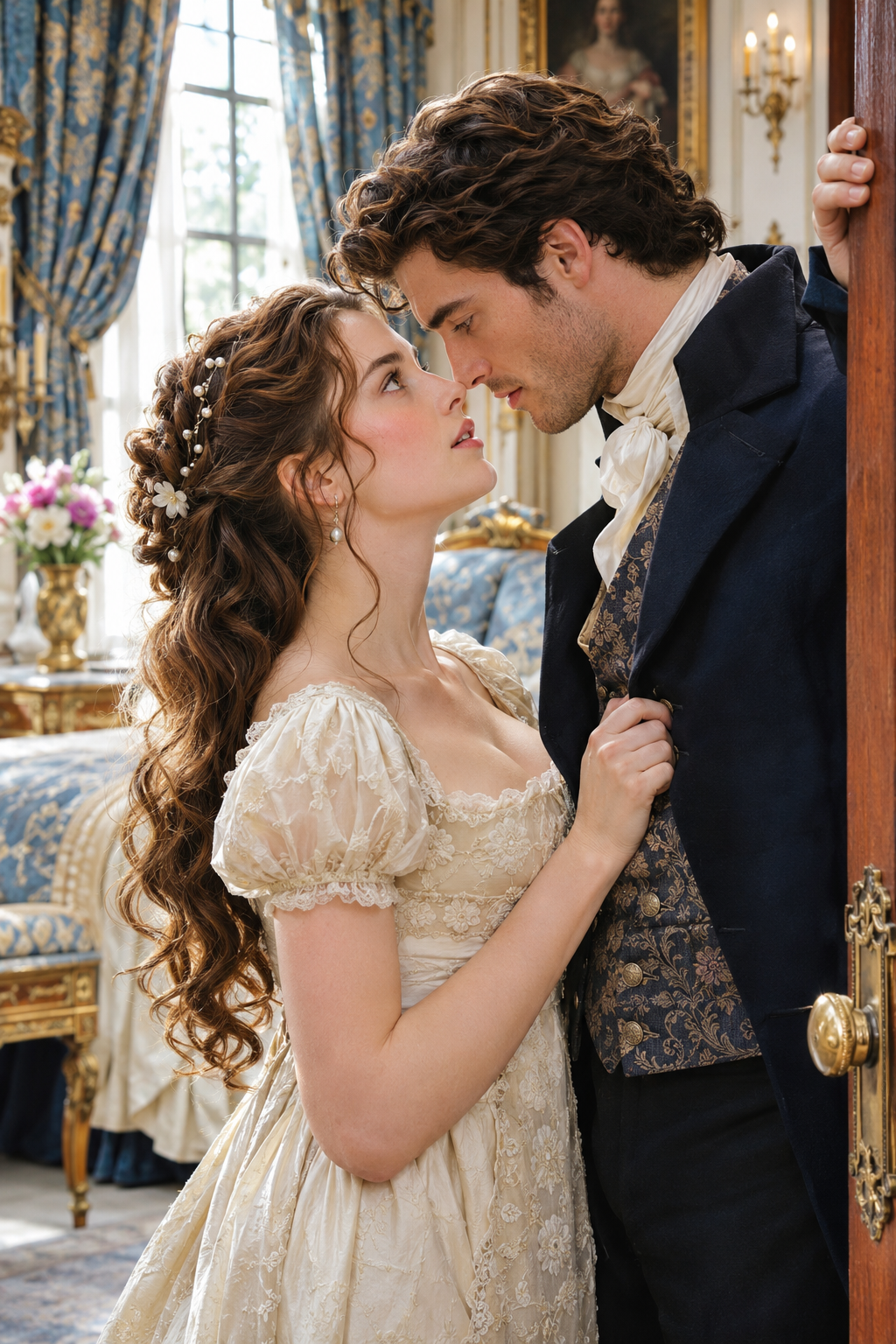
Cecilia continued walking as though she had heard nothing.
But when she reached the dowager’s sitting room, her composure disappeared.
Lady Halworth looked up from her embroidery.
“Good heavens, child. Who has died?”
“No one, my lady.”
“Then why do you look as though you have attended your own funeral?”
Cecilia explained everything, including Julian’s proposal.
The dowager listened without interruption.
When Cecilia finished, the elderly woman set aside her embroidery.
“Well, it certainly took him long enough.”
Cecilia blinked.
“You knew?”
“My dear, my grandson has been inventing reasons to visit the library for months. A man does not suddenly develop an interest in poetry when he has spent seven years reading nothing but financial records.”
Despite herself, Cecilia laughed.
Then her expression grew serious.
“People believe I wanted his title.”
“People believe all sorts of nonsense. Most of them have never experienced an original thought.”
“But what if marrying me destroys everything he has worked for?”
Lady Halworth reached for her walking stick and stood.
“Come with me.”
She led Cecilia into a room filled with family portraits. Generations of dukes and duchesses stared down from enormous golden frames.
The dowager stopped before a portrait of her late husband.
“I married a wealthy man because my parents considered it an excellent arrangement. He was respectable, intelligent, and admired by everyone.”
She paused.
“He was also incapable of admitting when he was wrong. We spent forty years together, and there were days when I felt more alone beside him than I ever have since his death.”
Cecilia looked at her quietly.
“Julian’s father inherited that same pride. He borrowed money to maintain appearances, refused sensible advice, and left his son a mountain of debt. Do you know what this family has lacked for generations?”
Cecilia shook her head.
“Someone willing to tell the truth.”
Lady Halworth squeezed her hand.
“Do not underestimate what you bring into this house simply because it cannot be counted in pounds.”
That afternoon, however, a letter arrived that threatened to change everything.
Julian’s solicitor had received word that one of the estate’s principal creditors intended to demand repayment of a substantial loan when it became due.
The expected marriage to Miss Kingsley had encouraged patience among several creditors. Without her fortune, that patience was disappearing.
Julian summoned his estate manager and spent hours behind closed doors.
When Cecilia entered the study that evening, she found him surrounded by papers.
“How serious is it?” she asked.
He immediately began gathering the documents.
“Nothing you need to concern yourself with.”
Cecilia’s expression hardened.
“Is that how you intend to begin our marriage?”
Julian stopped.
“We are not married yet.”
“Precisely. There is still time for me to discover whether you intend to treat me as a partner or a decorative piece of furniture.”
He stared at her.
Then, slowly, he pushed the papers across the desk.
Cecilia sat down.
For the next hour, Julian explained the estate’s situation. There were overdue repairs, expensive household traditions, unprofitable land, and debts inherited from his father.
The numbers were frightening.
Yet as Cecilia examined the accounts, several expenses caught her attention.
“Why are you maintaining three carriages when you rarely use more than one?”
“Because a duke is expected to maintain a household appropriate to his rank.”
“And these rooms in London?”
“Tradition.”
“The hunting dinners?”
“Social obligations.”
Cecilia looked up.
“Julian, are you trying to save Halworth Park or convince everyone that it has never been in trouble?”
The question struck him harder than she intended.
He walked toward the window.
“My father would have considered such reductions humiliating.”
“Your father is not responsible for paying these debts anymore. You are.”
He remained silent.
Cecilia softened her voice.
“There is no shame in living within your means. There is shame in allowing innocent people to suffer because you are afraid of appearing less wealthy than your neighbors.”
Julian turned toward her.
For a moment, she feared she had gone too far.
Instead, he returned to the desk and picked up his pen.
“Very well. Where shall we begin?”
They worked until nearly dawn.
Some decisions were painful. Others were surprisingly simple. Julian agreed to sell two carriages, surrender the expensive London residence, reduce unnecessary entertaining, and explore better uses for neglected farmland.
The savings would not solve everything immediately, but they would provide a credible foundation for negotiations.
When the solicitor examined their revised plans, he expressed cautious optimism.
With the sale of certain assets and a carefully negotiated repayment schedule, Halworth Park might survive.
It would require years of discipline.
But it was possible.
Julian found Cecilia in the garden that afternoon.
She was helping Lady Halworth choose flowers for the sitting room when he approached.
“Miss Ashworth, I believe you requested that I reconsider my proposal after examining my circumstances.”
The dowager immediately pretended to be fascinated by a rosebush.
Cecilia smiled nervously.
“And have you?”
“Extensively.”
“Have you considered the financial consequences?”
“Every miserable one of them.”
“And your reputation?”
“Already damaged beyond repair, apparently.”
Lady Halworth made a suspicious coughing sound.
Julian reached into his pocket and withdrew a small velvet box.
Inside lay a beautiful ring that had belonged to his mother.
“I cannot promise you an easy life,” he said. “There will be difficult years. There may be people who never accept you. And I suspect you will spend a considerable portion of our marriage informing me that I am being unreasonable.”
“That seems likely.”
“But I can promise that I will never knowingly build our life upon a lie. I love you, Cecilia. Will you marry me?”
This time, she did not ask him to wait.
“Yes.”
Julian slipped the ring onto her finger and kissed her.
Behind them, Lady Halworth declared that if they intended to behave so sentimentally, they could at least have the courtesy to do it somewhere she could sit comfortably.
Their laughter carried across the garden.
The wedding was arranged for several weeks later.
Unfortunately, the announcement only intensified the gossip.
Invitations were declined. Former acquaintances stopped visiting. One distant relative wrote Julian a lengthy letter accusing him of disgracing his ancestors.
Cecilia tried to remain unaffected, but the cruelty eventually wore her down.
One evening, shortly before the wedding, Julian discovered her packing her old suitcase.
His face went pale.
“What are you doing?”
She sat beside the bed.
“I received a letter today.”
She handed it to him.
The anonymous writer had accused her of ruining Julian’s future and suggested that any children they might have would forever be regarded as the descendants of a fortune hunter.
Julian read the letter twice.
Then he placed it in the fireplace.
“Look at me, Cecilia.”
She reluctantly obeyed.
“Do you regret accepting my proposal?”
“No.”
“Do you love me?”
“More than I know how to explain.”
“Then why is your suitcase open?”
“Because I love you enough to wonder whether leaving would be kinder.”
Julian sat beside her.
“Do you remember what you told me about saving the estate?”
She nodded.
“You asked whether I wished to save Halworth Park or merely protect its appearance. I think you must ask yourself a similar question now. Do you wish to build a life with me, or spend your life satisfying people who have already decided to dislike you?”
Cecilia lowered her eyes.
“I am afraid.”
“So am I.”
She looked at him in surprise.
Julian took her hands.
“I am afraid of failing you. I am afraid of losing the estate. I am afraid that after years of carrying everything alone, I will forget how to share my burdens. But none of those fears makes me love you less.”
Cecilia began crying.
He held her until the tears subsided.
That night, they remained together long after the household had fallen silent. They spoke about their childhoods, their hopes, and the family they dreamed of building.
When Julian kissed her, Cecilia understood that she no longer wanted to run from the happiness they had found.
Their tenderness deepened into an intimacy they both freely chose, and for once, neither allowed fear of other people’s opinions to decide what their hearts already knew.
By morning, Cecilia’s suitcase was empty again.
Their wedding took place in the small church near Halworth Park.
It was not the magnificent society event that people had once expected for the Duke of Halworth. There were fewer guests, simpler decorations, and no extravagant celebration.
Yet the church was far from empty.
Servants, tenant farmers, local shopkeepers, and families from neighboring cottages filled many of the seats.
They had come because Julian had worked to protect their livelihoods and because Cecilia had treated them with kindness long before she possessed a title.
When she entered the church, Julian forgot every carefully prepared thought.
She wore a modest ivory gown, with flowers chosen from the estate’s garden.
Lady Halworth watched from the front pew, discreetly wiping her eyes.
As Cecilia reached Julian, he whispered, “You are certain?”
She smiled.
“Unless you have purchased another unnecessary carriage.”
He laughed so unexpectedly that several guests turned their heads.
Minutes later, Cecilia Ashworth became the Duchess of Halworth.
Marriage did not magically erase their difficulties.
During their first winter together, heavy storms damaged several farm buildings. The following spring, disappointing harvests placed further pressure on their finances.
There were evenings when Julian returned home exhausted and mornings when Cecilia worried whether their plans would succeed.
They disagreed frequently.
Once, Julian attempted to conceal a particularly troubling financial report because he did not wish to upset her.
Cecilia discovered it beneath a stack of correspondence.
“Did you marry me because you valued my honesty,” she demanded, “or because you hoped marriage would finally silence me?”
Julian apologized before dinner.
He never made that particular mistake again.
Together, they visited tenant families, listened to experienced farmers, and introduced gradual improvements across the estate.
Cecilia encouraged Julian to consider ideas from people whose practical knowledge had often been ignored because they lacked impressive titles.
They repaired cottages, improved drainage, renegotiated leases, and directed their limited resources toward projects that could produce lasting income.
Progress was slow, but it was real.
Three years into their marriage, Cecilia gave birth to their first child, a daughter.
Julian, who had once been described as the coldest gentleman in the county, spent hours carrying the tiny girl through the corridors.
When Lady Halworth suggested that the nursery maid could manage perfectly well without his assistance, he looked offended.
“She prefers me.”
“She is six weeks old,” the dowager replied. “She prefers anyone who keeps her warm.”
Two sons followed in the years ahead.
Halworth Park became a noisier, warmer place. Children’s laughter replaced the oppressive silence that had once filled its grand rooms.
Julian still worked hard, but he no longer considered exhaustion a measure of his worth.
On their tenth wedding anniversary, his solicitor arrived with documents confirming that the final portion of his father’s inherited debts had been repaid.
Julian read the confirmation in silence.
Then he went looking for Cecilia.
He found her beneath an old oak tree, watching their children play.
“It is finished,” he said.
She looked up.
“The debts?”
He nodded.
For several moments, neither spoke.
Cecilia stood and wrapped her arms around him.
Julian closed his eyes.
Seven years of struggle before meeting her, followed by ten years of building a different future, had finally brought him to this moment.
“You saved Halworth Park,” he whispered.
“No,” Cecilia replied. “We saved it.”
He kissed her forehead.
Years passed, and the people who had once mocked their marriage gradually changed their opinions.
Some praised Cecilia’s intelligence. Others admired Julian’s devotion to his wife. A few even claimed they had always believed the marriage would succeed.
Lady Halworth found that particularly amusing.
Before her death, she called Cecilia to her bedside.
“You have done something rather remarkable, my dear.”
Cecilia held her hand.
“What is that?”
“You have taught a family of stubborn fools that being wrong is not nearly as dangerous as refusing to admit it.”
Cecilia laughed through her tears.
The dowager smiled peacefully.
“Promise me you will never stop telling him the truth.”
“I promise.”
“Good. He would become absolutely unbearable otherwise.”
Many decades later, Julian and Cecilia sat together in the same library where their affection had first grown.
Their children were adults, their grandchildren frequently visited, and Halworth Park was prosperous without the wasteful extravagance that had once threatened its survival.
Julian’s hair had turned silver. Cecilia’s hands were lined with age.
Yet when he looked at her, he still saw the fearless young woman who had dared challenge him beside the fireplace.
“Do you ever wonder what would have happened if I had married Miss Kingsley?” he asked.
Cecilia lowered her book.
“You would probably have owned several unnecessary carriages.”
He chuckled.
“And I would have missed the greatest happiness of my life.”
She reached for his hand.
Julian had once believed that his duty required him to sacrifice his heart. Cecilia had taught him that responsibility did not mean surrendering happiness, and that love was strongest when supported by courage, honesty, and shared effort.
She had entered Halworth Park without money, influence, or social standing.
But she had brought something no fortune could purchase.
The courage to speak the truth, even when silence would have been easier.
And Julian, who had inherited a magnificent estate burdened by debt and pride, eventually left his children something far more valuable than wealth.
A home where mistakes could be admitted, burdens could be shared, and nobody needed to pretend to deserve love.
In the end, the greatest treasure of Halworth Park was never its land, its portraits, or its ancient title.
It was the life two imperfect people had built together by choosing honesty over appearances, partnership over pride, and love over fear.