I was ordered to leave three dying hatchlings beneath a ruined colony tower while my commanding officer watched coldly, but I knew someone had abandoned them for a reason.
The first warning came six hours after we left Black Mesa.
It was not an alarm.
It was a single red light blinking above the civilian ship’s main corridor.
Captain Cole saw it before I did.
She stopped walking.
“What is that?”
I looked at the light.
“Navigation fault?”
“No.”
Her voice was too quiet.
Then the ship shuddered.
Not enough to throw anyone from their feet, but enough to make the ceiling panels tremble.
Somewhere deep inside the vessel, metal groaned.
I immediately thought of the hatchlings.
I ran.
Cole followed.
When I reached their compartment, the door was already open.
The heat lamps were still burning.
The food containers were untouched.
Ski, Nev, and Breck were gone.
For one terrible second, I could not breathe.
I checked beneath the beds, behind the storage units, inside the emergency cabinet.
Nothing.
“Ski!”
My voice echoed through the compartment.
Cole grabbed my shoulder.
“Wraith.”
“Where are they?”
“I don’t know.”
She looked at the open ventilation panel.
The metal grate had been torn away from the inside.
I stared at it.
“They couldn’t fit through there.”
Cole crouched and examined the torn edges.
“No.”
She touched a dark smear on the metal.
“Someone helped them.”
A sound came from the corridor.
Three claws scraped softly against the floor.
I spun around.
Ski stood there.
Behind him were Nev and Breck.
They were alive.
They were not alone.
An old Draeri woman stood behind them, wrapped in a gray traveling cloak.
Her hands were raised.
She was unarmed.
Ski moved toward me.
I dropped to one knee and pulled him into my arms.
“What happened?”
He buried his face against my chest.
“She came.”
I looked at the Draeri woman.
“Who are you?”
She stared at the three hatchlings with an expression I could not understand.
Then she looked at me.
“My name is Veyra.”
Captain Cole stepped forward.
“You boarded this ship without authorization.”
“I did.”
“How?”
Veyra glanced at the hatchlings.
“They opened the door.”
I almost laughed.
“They can’t open a sealed compartment.”
Veyra’s eyes narrowed.
“You still do not understand what they are.”
Cole’s hand moved toward her sidearm.
“Then explain.”
Veyra looked at me.
“Before I do, you must promise me one thing.”
“What?”
“If the ship is attacked, you do not surrender them.”
Cole’s face hardened.
“Why?”
“Because the ones hunting them are not trying to kill three defective hatchlings.”
Veyra paused.
“They are trying to kill the last three witnesses to a crime that could end this war.”
The ship shook again.
This time, alarms erupted throughout the corridor.
A voice announced an incoming vessel.
I carried Ski as we ran toward the bridge.
Cole was already issuing orders.
“Identify the contact.”
The communications officer stared at his console.
“We’re being hailed.”
“By whom?”
He swallowed.
“Draeri military command.”
Cole looked at me.
“Put it through.”
The screen flickered.
The silver-armored officer from Black Mesa appeared.
His face was colder than I remembered.
“Captain Cole.”
“Cerak.”
So that was his name.
Cerak’s gaze moved past her.
It stopped on me.
Then on Ski.
His expression changed.
Not anger.
Fear.
For the first time, I saw fear in a Draeri officer’s eyes.
“Return the hatchlings.”
“No.”
Cerak leaned closer to the camera.
“You have no understanding of what you have taken.”
“Then explain it.”
His silence lasted several seconds.
“They are not ordinary hatchlings.”
Ski lifted his head.
His tiny eyes were fixed on Cerak.
Cerak noticed.
He immediately looked away.
I felt Ski’s claws tighten around my armor.
“Why are you afraid of them?” I asked.
Cerak’s expression hardened again.
“Because they were never supposed to survive.”
The transmission ended.
Everyone on the bridge stared at the dead screen.
Captain Cole slowly turned toward Veyra.
“Talk.”
Veyra nodded.
“The Draeri war began twelve years ago.”
“We know.”
“No. You know the official history.”
She pointed toward the stars.
“You were told that the Draeri attacked human colonies first. We were told that humans destroyed our sacred nesting grounds first. Both sides were given enough truth to make hatred easy.”
Cole crossed her arms.
“And the real story?”
Veyra looked at the hatchlings.
“The war was manufactured.”
No one spoke.
She continued.
“A faction within the Draeri military discovered that our oldest ruling families were losing control. The colonies were starving. The younger generations were questioning the caste laws. They needed an enemy.”
“Humans,” I said.
“Yes.”
Veyra nodded.
“But that was only the beginning.”
She told us about the Black Mesa settlement.
Before the war, it had been a joint research colony.
Human scientists and Draeri geneticists had worked there together.
They had discovered something buried beneath the planet’s surface.
Not a weapon.
Not a mineral.
Records.
Ancient records belonging to the first Draeri civilization.
The records described a time when the Draeri had nearly destroyed themselves through a system of forced selection.
Hatchlings considered weak were abandoned.
Families were separated.
Only the strongest were allowed to reproduce.
The system created powerful soldiers.
It also created generations of fear.
Eventually, a group of scientists had found evidence that the so-called defective hatchlings were not defective at all.
Some carried rare genetic traits that made them unusually resistant to disease, environmental toxins, and neurological manipulation.
The strongest bodies had been mistaken for the strongest minds.
The abandoned children had been carrying the traits that could save the species.
“They erased the research,” Veyra said.
“Why?”
“Because the truth threatened the entire system.”
I looked at Ski.
He was listening.
“Why these three?”
Veyra hesitated.
“Because their parents discovered what had been hidden.”
Captain Cole’s face went pale.
“What happened to their parents?”
“They were killed.”
“And the hatchlings?”
“Marked for rejection.”
I stared at the three little creatures.
“Someone deliberately abandoned them.”
“Yes.”
“So they could be killed quietly.”
Veyra nodded.
“But their parents knew someone might try to save them.”
She reached inside her cloak and removed a small metal object.
It was shaped like a broken piece of black glass.
She placed it on the table.
“Each hatchling carries part of the access sequence to the original research archive.”
Cole frowned.
“Inside their bodies?”
“No.”
Veyra pointed toward their identification bands.
“Their bands.”
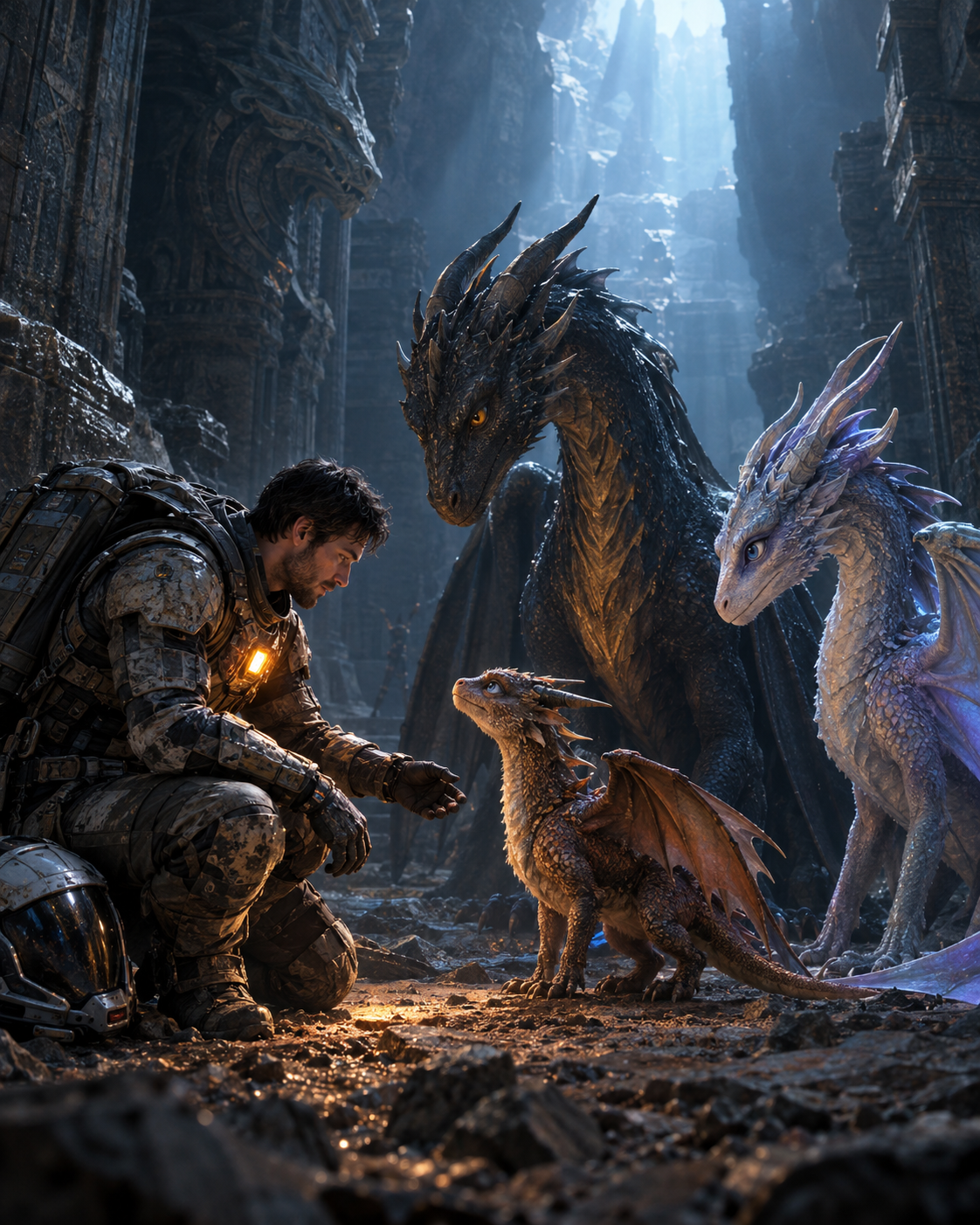
I looked at the three bands.
Rejected.
I suddenly understood.
The marks were not merely rejection symbols.
They were data.
Each band contained a fragment of a coded sequence.
Together, the three fragments opened the archive.
Ski looked at me.
“They’re coming.”
I froze.
“Who?”
He pointed toward the stars.
“The ones who make people forget.”
Veyra closed her eyes.
“That is why they are dangerous.”
Cole turned toward the navigation officer.
“How long?”
“Three minutes until contact.”
“Can we outrun them?”
“No.”
“Can we hide?”
“Not from a military tracker.”
Cole looked at me.
Then at the hatchlings.
Then at Veyra.
“Where is this archive?”
Veyra answered quietly.
“Under Black Mesa.”
I almost laughed.
“We just left.”
“Then we have to go back.”
“No.”
The word came from Ski.
Everyone looked at him.
He climbed down from my arms and stood on the floor.
He looked impossibly small beneath the bridge lights.
“We go back.”
I crouched in front of him.
“Ski, there are soldiers waiting for us.”
He touched the side of his head.
“They don’t know what is inside.”
“What?”
He looked at me with those strange, intelligent eyes.
“The tower.”
I remembered the ruined communications tower.
The place where I had found them.
“What about it?”
“Under it.”
Veyra stared at him.
“No hatchling should know that.”
Ski lowered his head.
“They showed us.”
“Who showed you?”
He looked toward the ceiling.
“The memories.”
The bridge went silent.
Then the enemy vessel appeared on the long-range display.
It was enormous.
Captain Cole made her decision.
“Turn the ship around.”
The navigation officer stared at her.
“Captain?”
“Black Mesa.”
We returned to the planet under fire.
The enemy ship followed.
The ceasefire had ended.
But neither side announced it.
There was no declaration.
No speech.
Only missiles cutting through the darkness.
Our civilian ship had no military defenses capable of surviving a direct attack.
We had one advantage.
The enemy believed we were trying to escape.
They did not know we were returning.
As we descended through the atmosphere, the sky turned orange.
Black Mesa was still burning.
Cole handed me a weapon.
“This is no longer a rescue mission.”
I checked the magazine.
“What is it?”
“Whatever comes next.”
Veyra joined us at the hatch.
The three hatchlings stood behind her.
“I am going with you.”
I looked at her.
“You’re old.”
She smiled.
“I survived longer than the people who started this war.”
Fair enough.
The ship landed less than two kilometers from the tower.
We ran.
Explosions shook the ground behind us.
Draeri soldiers descended from the clouds.
Human ships appeared overhead.
The entire battlefield had awakened.
But no one seemed to understand why.
We reached the tower.
It looked exactly as I remembered it.
Twisted metal.
Broken cables.
Dust.
Death.
Ski walked straight to the center.
He placed one claw against the ground.
“Here.”
Breck and Nev stood beside him.
Their identification bands began to glow.
I had never seen anything like it.
The three symbols connected.
A circle appeared beneath their feet.
Then the ground opened.
A staircase descended into darkness.
Captain Cole stared at me.
“You found them here.”
“Yes.”
“And the archive was here the whole time.”
“Apparently.”
We descended.
The deeper we went, the quieter the battlefield became.
The walls were covered with ancient symbols.
Some were Draeri.
Some were human.
At the bottom stood a massive door.
Three empty slots waited in the center.
Ski stepped forward.
Then Nev.
Then Breck.
Each placed one claw against a slot.
The door opened.
Inside was a chamber filled with thousands of suspended memory crystals.
A voice awakened.
“Genetic archive active.”
Veyra began to cry.
I had never seen a Draeri cry before.
The crystals illuminated one by one.
Images appeared in the air.
Scientists.
Children.
Families.
Then the war.
We watched humans attacking Draeri settlements.
Then Draeri forces attacking human colonies.
But the images showed something we had never been told.
The same officers were appearing on both sides.
The same symbols.
The same orders.
The same organization.
They had created attacks designed to look like retaliation.
They had murdered their own people.
They had murdered ours.
They had prolonged the war because fear made obedience easy.
Captain Cole stared at the recordings.
“My God.”
Veyra whispered, “There is more.”
The final recording appeared.
A Draeri scientist stood before the camera.
He looked exhausted.
Behind him were three small eggs.
“If you are seeing this,” he said, “then our children survived.”
He looked directly into the camera.
“Remember this. The strongest weapon we created was not a ship or a bomb.”
He placed one hand against his chest.
“It was the belief that some lives were worth less than others.”
The recording ended.
For several seconds, nobody moved.
Then the chamber doors exploded inward.
Draeri soldiers poured through.
Cerak stood behind them.
“Step away from the archive.”
Captain Cole raised her rifle.
“You lied to both our worlds.”
Cerak looked at the recordings.
His face was unreadable.
“You don’t understand what happens if this becomes public.”
“People learn the truth.”
“People lose control.”
“No,” Veyra said.
“They gain a choice.”
Cerak raised his weapon.
I moved in front of the hatchlings.
Again.
Just like at the tower.
But this time there were dozens of weapons pointed at us.
Cerak looked at me.
“You will die for them.”
I tightened my grip.
“I already made that choice.”
Then Ski stepped forward.
He was trembling.
But he did not hide.
“Cerak.”
The officer froze.
“You know my name?”
Ski nodded.
“You knew our parents.”
Something changed in Cerak’s face.
“They trusted you.”
“I did what was necessary.”
“You killed them.”
Cerak lowered his weapon slightly.
“They would have destroyed everything.”
“No,” Ski whispered.
“They tried to save everyone.”
The chamber shook.
A warning appeared across the archive.
“External breach detected.”
Captain Cole looked at the ceiling.
“What now?”
Veyra understood first.
“The archive is being destroyed.”
Cerak turned toward the soldiers.
“Stop it.”
One soldier hesitated.
“Commander?”
“STOP IT!”
For the first time, Cerak sounded terrified.
A series of explosions echoed above.
Someone was destroying the research complex.
Not human forces.
Not Draeri forces.
Someone who wanted no evidence to survive.
Cerak looked at us.
“The faction has decided to erase the archive.”
Cole raised her weapon.
“Then help us save it.”
Cerak stared at her.
He knew the choice before him.
He lowered his weapon.
“Move.”
The next ten minutes became chaos.
Humans and Draeri fought side by side through the underground facility.
Not because we trusted each other.
Not because the war had suddenly disappeared.
We fought because there were children behind us.
We fought because there was truth in the chamber.
We fought because, for once, the enemy was not the creature standing in front of us.
It was the lie that had convinced us we had to hate each other.
The archive could not be carried.
But it could be transmitted.
Veyra connected the memory crystals to the communications system.
Cole opened every military frequency she could reach.
Human.
Draeri.
Civilian.
Emergency.
Everything.
“Send it,” I said.
Veyra looked at me.
“Once it goes out, there is no taking it back.”
I looked at Ski.
He was standing beside Nev and Breck.
Three tiny bodies.
Three children who had been sentenced to die because someone had decided they were worthless.
“Send it.”
The transmission began.
Across the planet, screens flickered.
Across the human colonies, military networks received the archive.
Across Draeri worlds, citizens watched their history unfold.
For the first time in twelve years, everyone saw the same truth.
The war had been manipulated.
The rejected hatchlings were not defective.
The leaders who had preached survival had spent generations destroying the very lives capable of saving their people.
Then the archive showed the genetic data.
The three hatchlings were living proof.
Their traits could resist the disease spreading through both species.
A disease that had been hidden from the public because its existence would have forced cooperation.
Silence followed the transmission.
Then came the messages.
Thousands.
Then millions.
People asking questions.
Soldiers refusing orders.
Families demanding answers.
Ships stopping their attacks.
The war did not end in one beautiful moment.
Real life was not that simple.
Some commanders continued fighting.
Some governments denied the evidence.
Some people refused to believe it.
But enough people believed.
Enough soldiers lowered their weapons.
Enough parents asked why children had been taught to hate.
The ceasefire became permanent three days later.
The Draeri government collapsed two weeks after that.
Human military leadership was forced into an international investigation.
Cerak surrendered.
He testified for nineteen days.
He named everyone he knew.
Some escaped.
Some were arrested.
Some disappeared.
History would argue about them for decades.
But history would also remember the three hatchlings.
Ski, Nev, and Breck became symbols of something neither side had expected.
Not strength.
Not victory.
Survival.
Years later, I returned to Black Mesa.
The tower had been rebuilt.
Not as a military installation.
As a memorial.
At the base stood three small statues of Draeri hatchlings.
Children left behind.
Children who lived.
Children who changed the course of two civilizations.
Ski was much larger now.
His wings stretched nearly six meters.
Nev had become a gifted scientist.
Breck had joined the first joint human-Draeri peacekeeping force.
They had kept their promise.
They protected us.
Not because they owed me.
Not because I had saved them.
But because they had learned something none of us had understood when the war began.
Protection was not about deciding who deserved to live.
It was about refusing to let anyone make that decision for you.
Ski stood beside me beneath the rebuilt tower.
“You remember this place?”
I smiled.
“I remember thinking you were three pieces of wreckage.”
He laughed.
“We thought you were going to leave us.”
“I almost did.”
“But you didn’t.”
I looked at the memorial.
“No.”
Ski was quiet for a while.
Then he asked, “Do you ever regret it?”
I knew what he meant.
The order I had disobeyed.
The ceasefire I had risked.
The soldiers I had fought.
The war that had followed.
I looked at the sky.
“No.”
He smiled.
“Good.”
A wind moved through the tower.
For a moment, I could almost hear the tiny claws that had once touched my ankle.
The three abandoned hatchlings were gone.
In their place stood three adults who had survived a world that had decided they should not.
And that was the lesson Black Mesa left behind.
Sometimes the most dangerous order is the one everyone follows without asking why.
Sometimes the smallest life in front of you carries a future you cannot yet imagine.
And sometimes courage is not the absence of fear.
It is simply the decision that fear will not choose for you.
I had once been ordered to leave three dying hatchlings beneath a ruined tower.
Instead, I gave them food.
Then shelter.
Then a chance.
They gave us something much larger in return.
They reminded two species that survival was never supposed to mean choosing who gets to live.
It was supposed to mean making sure no child had to beg for the right to exist.
And beneath the rebuilt tower, where three unwanted hatchlings had once waited alone in the dust, we finally understood what the war had cost us.
Not territory.
Not ships.
Not soldiers.
It had cost us the ability to see the lives standing in front of us.
The three little claws that had once trembled against my ankle had become strong enough to reach across an entire world.
And I knew, without a doubt, that saving them had never been the greatest thing I had done.
The greatest thing was refusing to believe that their lives were worthless just because someone powerful had said they were.
For a long time, none of us spoke.
The memorial stood behind us, silent beneath the evening sky.
I thought that was how our story would end.
Three statues.
One rebuilt tower.
A war finally buried beneath history.
I was wrong.
Because three days after returning to Black Mesa, Captain Cole called me.
Her voice sounded different.
Older.
“Where are you?”
“At the memorial.”
“Leave.”
I frowned.
“Why?”
“Just leave, Wraith.”
Something in her voice made me turn around.
Ski was standing several meters away.
Nev and Breck were beside him.
All three were staring toward the horizon.
The sky was clear.
Then the stars disappeared.
Not gradually.
All at once.
A black shape crossed above the atmosphere.
Then another.
Then dozens.
I felt the old instinct return.
My hand moved toward the weapon I no longer carried.
“What are those?”
Cole answered through the communicator.
“We don’t know.”
A flash appeared on the horizon.
Then the ground shook.
Ski spread his wings.
“Get inside.”
I looked at him.
“Why?”
His eyes were fixed on the sky.
“Because they are not here for the memorial.”
The first ship descended behind the mountains.
It was unlike anything human or Draeri.
No markings.
No visible weapons.
No engines.
It simply appeared.
Then the second ship.
Then the third.
Nev whispered something in Draeri.
Breck looked terrified.
I had never seen him afraid before.
“Who are they?”
Ski answered.
“The ones our parents were running from.”
Captain Cole’s voice came through again.
“Wraith, listen carefully.”
“I’m listening.”
“The archive transmission revealed more than we realized.”
“What?”
“There was another file.”
My stomach tightened.
“What kind?”
“A warning.”
The communicator crackled.
Then Cole said the words I would remember for the rest of my life.
“Your three hatchlings were not the end of the experiment.”
I looked at Ski.
He had heard her.
His expression changed.
“We know.”
I stared at him.
“You knew?”
Ski lowered his head.
“Not everything.”
Nev stepped forward.
“Our parents told us something before they died.”
“What?”
She looked toward the sky.
“They said there were others.”
The ground shook again.
This time, something landed near the memorial.
The object opened.
A figure stepped out.
It was Draeri.
But not like any Draeri I had ever seen.
Its scales were almost white.
Its eyes were silver.
It wore no armor.
No weapons.
Yet every soldier who had arrived with Captain Cole instinctively raised their rifles.
The creature looked at them.
“Lower them.”
Nobody moved.
Then Ski walked forward.
The stranger looked at him.
For several seconds, neither spoke.
Finally, the stranger said,
“You survived.”
Ski nodded.
“Who are you?”
The creature looked at Nev and Breck.
Then at me.
“My name is Oran.”
He pointed toward the sky.
“And those ships belong to the people who created your rejection bands.”
I felt something cold settle in my chest.
“You mean the faction?”
“No.”
Oran shook his head.
“The faction was only their servant.”
Cole’s voice came through the communicator.
“Who are they?”
Oran looked at the stars.
“The Architects.”
The name meant nothing to me.
Apparently it meant something to Ski.
His wings tightened.
“They found us.”
Oran nodded.
“They have been searching for you since Black Mesa.”
“Why?”
“Because your bodies contain the final genetic sequence.”
Nev looked at him.
“Sequence for what?”
Oran’s expression became grim.
“For ending the disease.”
Silence.
I looked between them.
“You said their traits could resist the disease.”
Oran shook his head.
“That was only part of the truth.”
He walked closer.
“The disease was not natural.”
Cole appeared on a portable screen.
“What are you saying?”
“The Architects created it.”
Everyone went still.
“Why?”
Oran answered with a single sentence.
“To make civilizations dependent on them.”
The truth was worse than anything I had imagined.
The war.
The famine.
The disease.
The rejection laws.
The experiments.
All of it had been pieces of the same design.
Keep people afraid.
Keep them divided.
Then sell them survival.
I looked at the three hatchlings.
“They were going to use them.”
“Yes.”
“Then why abandon them?”
Oran looked at Ski.
“Because their parents discovered that the three of them carried a mutation that could destroy the disease permanently.”
Ski stepped forward.
“And our parents?”
“They tried to hide you.”
“They died.”
Oran lowered his head.
“Yes.”
The ships above us began to move.
Cole’s soldiers opened fire.
The shots disappeared against an invisible barrier.
Oran did not react.
“They will not stop.”
“Then we fight.”
Ski looked at me.
“No.”
I stared at him.
“No?”
“We don’t fight them the way they expect.”
I almost smiled.
“You have a plan?”
He nodded.
“We have something better.”
He turned toward the memorial.
“The archive.”
I frowned.
“It’s already been transmitted.”
“Not everything.”
Ski placed one claw against the base of his statue.
A hidden panel opened.
Inside was a small crystal.
My blood went cold.
“That wasn’t there before.”
Nev shook her head.
“It was hidden in the original tower.”
Breck picked it up.
“It contains the final sequence.”
Cole stared at the screen.
“Can we transmit it?”
Ski shook his head.
“Not from here.”
“Where?”
He looked toward the mountains.
“The original Draeri communication station.”
I understood.
The same station that had been destroyed at the beginning of the war.
The place where the first false attack had been broadcast.
“If we reach it, we can send the sequence to every medical network.”
Oran nodded.
“And destroy the Architects’ control system.”
Cole looked at me.
“How long?”
Ski answered.
“Thirty minutes.”
Cole cursed.
“We have ten.”
I looked at the sky.
Ships were descending.
Hundreds of them.
“Then we have ten minutes.”
We ran.
For the first time in years, human soldiers and Draeri warriors fought on the same side without asking who had started the war.
Cole led the ground forces.
Oran coordinated the Draeri.
Nev carried the crystal.
Breck stayed beside her.
Ski flew above us.
I ran at the center.
Not because I was the strongest.
I wasn’t.
Not because I had the best weapon.
I didn’t.
I ran because years earlier, three dying hatchlings had touched my ankle.
And somehow, that small moment had brought us here.
We reached the communication station with only four minutes remaining.
The doors were sealed.
Nev placed the crystal against the control panel.
Nothing happened.
“Why isn’t it working?”
Ski landed beside us.
“Because it needs three genetic signatures.”
He looked at his siblings.
“Together.”
They placed their claws on the panel.
The station awakened.
Lights flooded the room.
A voice spoke.
“Genetic sequence confirmed.”
Then another voice answered from the speakers.
“You should not have survived.”
The Architects.
Ski stepped toward the console.
“We did.”
“You belong to us.”
“No.”
His voice was calm.
“We belong to ourselves.”
The transmission system began charging.
Outside, explosions shook the building.
Cole shouted over the radio.
“We can’t hold them!”
I looked at the three hatchlings.
“How long?”
Nev checked the console.
“Two minutes.”
“Then we hold for two minutes.”
I grabbed a rifle.
Cole stood beside me.
“You know, Wraith, this is the second time you’ve disobeyed orders.”
I smiled.
“Only the second?”
She laughed.
“Fair point.”
The doors began to bend inward.
Draeri soldiers formed a line.
Human soldiers stood beside them.
Enemies from yesterday.
Brothers today.
The door exploded.
The Architects entered.
They were not monsters.
That was what frightened me.
They looked almost ordinary.
Human.
Draeri.
Several other species I had never seen.
Different faces.
Different bodies.
But the same silver symbol burned into their armor.
One of them stepped forward.
“Give us the hatchlings.”
Cole raised her rifle.
“No.”
The Architect tilted his head.
“Then your species will suffer.”
Cole answered,
“We already have.”
The battle began.
Everything became noise.
Light.
Smoke.
Metal.
I saw soldiers fall on both sides.
I saw Oran fighting three Architects at once.
I saw Breck protecting Nev even after taking a wound across his wing.
I saw Ski fly directly into the center of the enemy formation.
Then the transmission completed.
Every screen on the planet turned white.
The sequence spread across every medical network.
Every research station.
Every hospital.
Every military system.
Every civilian device.
The cure began replicating automatically.
The Architects screamed.
Not because they were losing a battle.
Because they had lost control.
Their greatest weapon had become useless.
People no longer needed them.
A final message appeared across the screen.
It was not from a government.
Not from a general.
Not from a scientist.
It was from Ski.
Three simple sentences.
“We were told we were worthless.
We survived.
Now no one gets to decide that another child is worthless again.”
The transmission ended.
The Architects’ ships began falling from the sky.
Some surrendered.
Others fled.
For the first time in generations, there was no reason to chase them.
The war was truly over.
Not because one side had defeated the other.
Because the reason for fighting had finally been exposed.
Months later, the disease disappeared.
Not instantly.
Not magically.
Millions still carried scars.
Millions still mourned.
There were trials.
There were apologies.
There were monuments.
There were arguments about who deserved punishment.
Some wounds never closed.
But something else changed.
The Draeri abolished the rejection laws.
Human military schools began teaching the real history of the war.
Children from both species were educated together.
The old borders slowly disappeared.
And the three hatchlings became something none of us had expected.
They became teachers.
Ski traveled between colonies.
Nev became a genetic scientist.
Breck became a peacekeeper.
They never forgot where they came from.
Every year, they returned to Black Mesa.
Every year, they visited the tower.
And every year, they placed three small flowers beneath the memorial.
One for each parent.
One for every child abandoned because someone had decided that weakness meant worthlessness.
I retired two years later.
Captain Cole retired the year after me.
We bought a small house near the rebuilt colony.
It was quiet.
Too quiet sometimes.
But I liked it.
One evening, I sat outside watching the sunset.
A shadow passed overhead.
Ski landed in the field.
He was enormous now.
His wings folded slowly behind him.
“Still afraid of heights?” I asked.
He smiled.
“Still afraid of orders?”
I laughed.
“Some things never change.”
He sat beside me.
For a while, we watched the sun disappear.
Then he said,
“I remember the first thing you said to us.”
“What?”
“You’re not supposed to be here.”
I smiled.
“You weren’t.”
Ski looked toward the horizon.
“Neither were you.”
I frowned.
“What does that mean?”
“You were supposed to become a soldier who followed orders.”
He looked at me.
“But you became the person who questioned them.”
I looked down at my hands.
The hands that had once held a rifle.
The hands that had fed three starving creatures.
The hands that had refused to move.
“I was scared,” I admitted.
“I know.”
“I thought I was going to die.”
“I know.”
“Then why didn’t I leave?”
Ski smiled.
“Because you saw us.”
That sentence stayed with me.
Not because it was profound.
Because it was simple.
I had not saved the hatchlings because I was a hero.
I had not understood their destiny.
I had not known about the archive.
I had not known there were forces beyond our war.
I had simply seen three living beings who were suffering.
And for one moment, I refused to look away.
Maybe that was where everything had changed.
Not in a battlefield.
Not in a command room.
Not inside the ancient archive.
It had begun beneath a ruined tower, with three frightened children and one exhausted soldier who decided that an order was not more important than a life.
Years later, people would write books about Black Mesa.
They would call it the turning point.
They would study the battles.
They would analyze the political collapse.
They would debate which commander had made the decisive choice.
Historians would argue over dates and strategies.
But I would remember something else.
A tiny claw around my finger.
A whispered promise.
“We will.”
And they did.
They protected us.
They changed us.
They taught us that survival was not about being strong enough to crush the weak.
It was about being strong enough to protect them.
The sun disappeared completely.
Ski stood up.
“I should go.”
“Where?”
“There’s a group of young hatchlings waiting for me.”
I looked at him.
“Teaching them?”
He nodded.
“What are you teaching them?”
He smiled.
“The first rule.”
“And what is that?”
He looked toward the stars.
“Never let anyone convince you that another life matters less than yours.”
Then he spread his wings.
Before he took off, he looked back at me.
“Goodnight, Sergeant.”
I shook my head.
“I haven’t been a sergeant for years.”
Ski grinned.
“I know.”
Then he launched into the sky.
I watched until he became a small silhouette against the stars.
For a moment, I was back beneath the ruined tower.
Dust in the air.
Rifle in my hands.
Three tiny creatures staring at me.
One of them trembling.
One trying to look brave.
One already closing its eyes.
I remembered the decision.
I remembered the fear.
And I remembered the first words I had whispered.
“Hey.”
“You’re not supposed to be here.”
Maybe that had been true.
Maybe none of us were supposed to be there.
Maybe the war was never supposed to happen.
Maybe the children were never supposed to be abandoned.
Maybe I was never supposed to survive long enough to see the world change.
But sometimes life does not follow the orders written for it.
Sometimes the smallest act of kindness becomes the first crack in a system built on cruelty.
Sometimes saving one life changes thousands.
And sometimes the person standing in front of you is not asking you to be a hero.
They are only asking you not to turn away.
I looked toward the rebuilt tower one last time.
Three statues stood beneath it.
Three hatchlings with their heads held high.
Not rejected.
Not defective.
Not forgotten.
Alive.
And beneath them was a single sentence carved into the stone.
“Every life deserves the chance to become more than the world expected of it.”
I touched the words with my hand.
Then I walked home.
The war was over.
The children had survived.
And for the first time in my life, I understood that sometimes the greatest victory is not defeating the enemy.
It is refusing to become the kind of person who would have left those three hatchlings behind.
THE END.