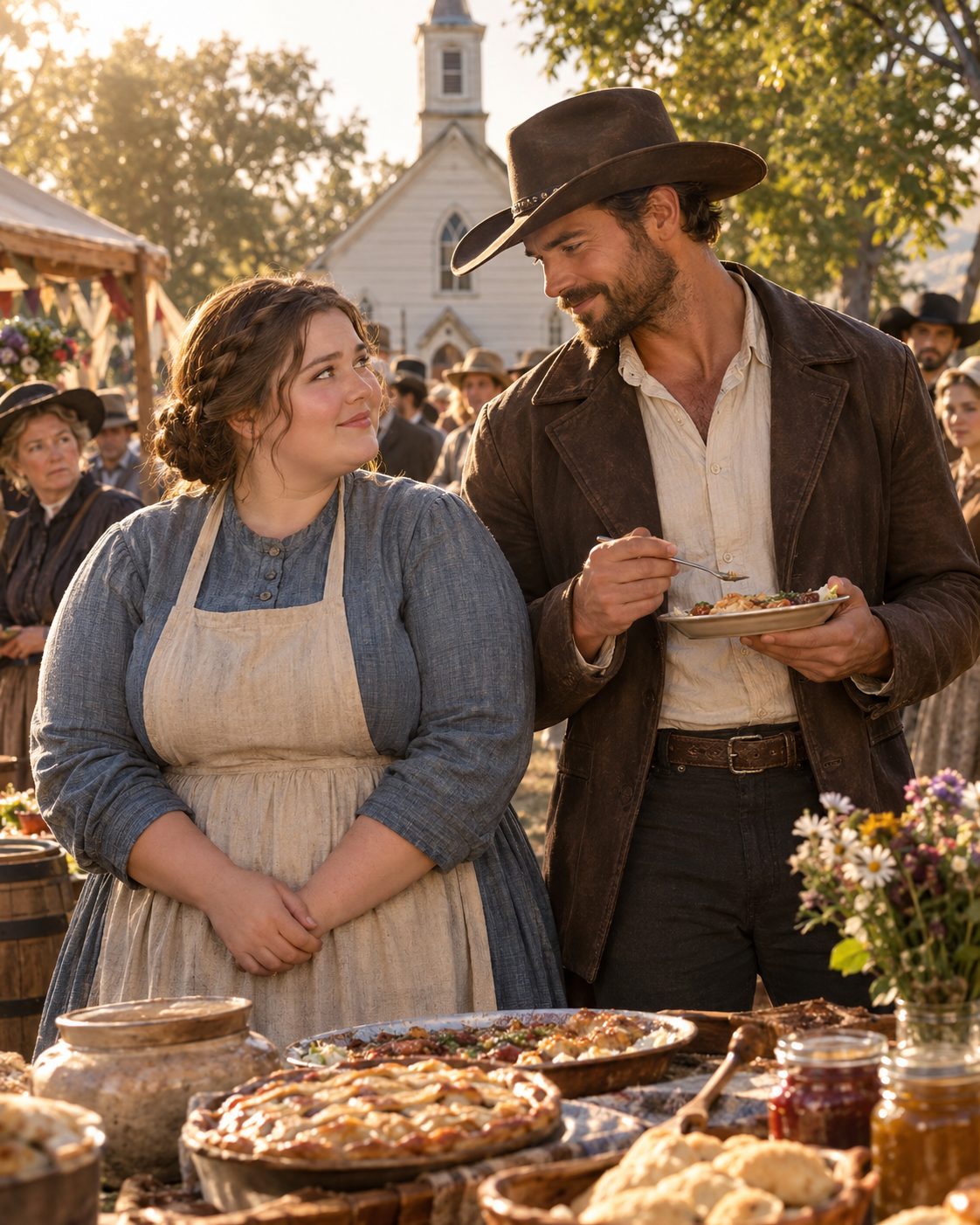
I was mocked beside the church-fair pie table while Caleb Caldwell stared coldly at me, unaware that the debt he meant to expose concealed a much darker theft.
Caleb’s smile disappeared.
For one terrible second, nobody moved.
The cowboy stood beneath the courthouse awning, breathing hard, snow melting from the brim of his hat.
“Mr. Caldwell,” he said, holding out the envelope, “I found it in the old office at Iron Cross. It was hidden behind the loose board where the ranch ledgers are kept.”
Caleb took the envelope without opening it.
His eyes met mine.
“Mabel,” he said quietly, “this has your husband’s handwriting.”
My fingers went cold.
After everything that had happened that day, after the forged documents, the ledger, the silver, Mrs. Aldrich’s name, and Caleb’s proposal, I had almost allowed myself to believe the worst was finally behind me.
But the past had one more door to open.
Caleb broke the seal.
Inside was a single sheet of paper, folded twice.
He read it once.
Then again.
His jaw tightened.
“What does it say?” I whispered.
He handed it to me.
The handwriting belonged to Thomas.
I knew it instantly.
My husband had always written with a slight slant, as if every word were trying to hurry toward the next.
Mabel,
If you are reading this, then something has happened to me, and I was right to be afraid.
I stared at the first sentence until the letters blurred.
Caleb stood close enough that his shoulder touched mine.
I forced myself to continue.
The silver is not the only thing beneath our land.
My breath caught.
There is an old mine tunnel beneath the western field. It was abandoned years ago, but I discovered something inside that could make certain men desperate enough to kill.
I looked at Caleb.
He was already reading over my shoulder.
“What could be more valuable than silver?” he murmured.
I shook my head.
The letter continued.
I found records hidden in the mine. They prove that the land surrounding Bitter Creek was deliberately divided and sold under false names many years ago. Men who owned nothing suddenly became owners. Men who questioned it disappeared. I don’t know how far the corruption reaches.
And I don’t know whom to trust.
Except you.
If I die before I can tell you everything, do not trust anyone who suddenly becomes interested in our land.
Especially someone who has spent years pretending to despise it.
At the bottom was one final line.
There is a key beneath the third floorboard in our kitchen. Take it to the western field. The truth is behind the iron door.
I lowered the paper.
The courthouse behind us suddenly felt very far away.
Caleb’s voice was low.
“Mrs. Aldrich wasn’t acting alone.”
“No,” I whispered.
The cowboy looked toward the street.
“There’s something else.”
He reached into his coat and produced a second scrap of paper.
“This was wrapped around the envelope.”
I unfolded it.
Four words had been written in thick black ink.
DO NOT TRUST CALEB CALDWELL.
My heart seemed to stop.
I looked at Caleb.
He did not flinch.
He did not defend himself.
That frightened me more than anger would have.
The cowboy shifted uneasily.
“Mr. Caldwell?”
Caleb folded the warning and placed it inside his coat.
“Take the men back to the ranch.”
“But—”
“Now.”
The cowboy hesitated before nodding and disappearing into the snow.
I watched him go.
Then I turned to Caleb.
“Is it true?”
He looked at me for a long moment.
“Which part?”
“That I shouldn’t trust you.”
His eyes hardened with something I had never seen there before.
Not anger.
Pain.
“Mabel, if I wanted your land, I could have taken it months ago.”
“You paid my debt.”
“Yes.”
“You gave me work.”
“Yes.”
“You stood beside me in court.”
“Yes.”
“And now my husband’s last letter warns me not to trust you.”
Caleb stepped closer.
“I know.”
“Then tell me why.”
He looked down the snowy street before answering.
“Because your husband was afraid of me.”
My stomach tightened.
“Why?”
“Because he believed I was part of the reason men were disappearing.”
The words struck harder than any slap.
I took a step backward.
Caleb did not stop me.
“I bought Iron Cross eight years ago,” he said. “When I arrived, I found records that didn’t make sense. Land had changed hands repeatedly. Ranchers who had lived here for generations suddenly owed money to companies nobody had heard of.”
“Why didn’t you tell anyone?”
“I tried.”
His voice became bitter.
“People laughed. Then two men who helped me investigate were found dead.”
The wind howled between the buildings.
“I thought the matter ended there,” he continued. “Then Thomas came to me six months before he died.”
My eyes widened.
“You knew my husband was investigating?”
“Yes.”
“And you never told me?”
“I didn’t know whom I could trust.”
I stared at him.
“You could have trusted me.”
His expression broke.
“I know that now.”
For several seconds, neither of us spoke.
Then I remembered the velvet box still in his hand.
He looked down at it.
Slowly, he opened it.
Inside was a simple gold ring.
No diamond.
No elaborate design.
Just a narrow band polished until it caught the pale winter light.
“I was going to ask you before that cowboy arrived,” he said.
My eyes filled with tears.
“I was going to say yes.”
His eyes lifted.
“You still can.”
I reached for his hand.
“But first, we find the truth.”
Caleb closed his fingers around mine.
“Together.”
We returned to my house after dark.
The snow had stopped, but the cold was sharper than before.
My little house looked exactly as it had when Thomas was alive.
The kitchen table.
The cracked blue cup.
The iron stove.
The worn floorboards.
For years I had thought the house contained nothing but memories.
Now I realized it might contain the answer to everything.
I knelt beside the stove and counted the floorboards.
One.
Two.
Three.
The third board lifted more easily than I expected.
Beneath it was a small iron key.
Caleb crouched beside me.
“You knew this was here?”
“No.”
“Thomas never mentioned it?”
“Never.”
I held the key in my palm.
It was black with age.
On its handle was a tiny mark shaped like a cross.
The same mark appeared on old documents I had seen at Iron Cross Ranch.
Caleb noticed it too.
“Come on.”
We rode toward the western field before dawn.
The land was buried beneath snow, but Thomas had left one final clue.
Near the edge of the field stood three dead cottonwood trees.
The middle one leaned slightly toward the mountains.
I remembered something Thomas had once said while we were sitting on the porch.
If the trees ever die, follow the middle one.
At the time, I had thought he was talking about weather.
Now I understood.
We searched beneath the tree until Caleb’s shovel struck metal.
He cleared the snow.
An iron door appeared in the earth.
My hand shook as I inserted the key.
The lock turned.
The door opened with a long groan.
A staircase descended into darkness.
Caleb lit a lantern.
“You stay behind me.”
“I have spent too much of my life staying behind people.”
He looked at me.
Then he nodded.
“Then stay beside me.”
We descended.
The air smelled of damp stone and old earth.
The tunnel stretched beneath the field.
Every few yards, wooden beams supported the ceiling.
Some were rotten.
Others looked surprisingly strong.
After nearly a hundred yards, the tunnel divided.
Thomas had marked the left wall with a small cross.
We followed it.
At the end stood an iron door.
The same symbol was carved into its center.
Caleb inserted the key.
This lock turned more easily.
Inside was a small chamber.
There were shelves along every wall.
And on those shelves were boxes.
Dozens of them.
Land deeds.
Bank records.
Letters.
Maps.
Names.
Caleb lifted one document.
His face changed.
“This is from twenty years ago.”
“What does it say?”
He handed it to me.
The document showed a land transfer.
The buyer’s name was false.
But the witness was not.
Mrs. Aldrich’s father.
I picked up another.
Then another.
The pattern became impossible to deny.
For years, families in Bitter Creek had been pressured into selling their land cheaply.
Those who refused found themselves buried under debts.
Those who resisted were threatened.
Those who continued asking questions disappeared.
And at the center of it all was a company called Western Meridian.
Mrs. Aldrich had inherited part of it.
But there were other names.
Powerful names.
Names belonging to men who had smiled at church gatherings and shaken hands at town meetings.
Caleb stood in silence.
“This is bigger than Mrs. Aldrich.”
“Much bigger.”
Then I saw a small wooden box on the floor.
My name was written across the lid.
MABEL.
My hands trembled as I opened it.
Inside was Thomas’s wedding photograph.
A silver pendant.
And one final letter.
My dear Mabel,
I am sorry.
I wanted to protect you, but I may have done the opposite.
If you found this, then you know I was investigating the land theft.
But there is something else I never told you.
I did not discover the silver deposit by accident.
Someone showed me where it was.
That person was Caleb Caldwell.
I looked at Caleb.
He closed his eyes.
“He showed you?”
“Yes.”
“Why?”
“Because I wanted to prove the land was worth enough to protect you.”
My heart twisted.
Thomas’s letter continued.
Caleb believed the silver would force the town to recognize our claim before Western Meridian could take it.
But I became convinced they already knew.
Someone was watching us.
Someone inside the town was telling them what we were doing.
If anything happens to me, trust Caleb with your life, but do not trust him with the truth.
He has secrets he thinks are protecting people.
Sometimes secrets do more damage than lies.
I lowered the letter.
Caleb looked at the floor.
“Thomas knew me better than I thought.”
“Did you know they were watching him?”
“I suspected.”
“Did you know he was in danger?”
“Yes.”
“Then why didn’t you save him?”
The question came out like a cry.
Caleb absorbed it without defending himself.
“I tried.”
“Was he killed?”
“I don’t know.”
“You don’t know?”
“I found his horse near the eastern road the night before he died. I searched for him. I found him hours later.”
My breath stopped.
“You found him?”
“Yes.”
“Then what happened?”
“He was already dead.”
I covered my mouth.
“Why didn’t you tell me?”
“Because when I found him, there were tracks nearby. More than one rider. I knew whoever did it would come after me if they learned what I knew.”
I stared at him through tears.
“You let me believe my husband died from an accident.”
“I let you believe what would keep you alive.”
“You don’t get to decide what I can survive.”
He looked at me.
“No. I don’t.”
For the first time, I saw how tired he really was.
Not physically.
Something deeper.
A man who had spent years carrying secrets until they became heavier than guilt.
Then we heard a sound.
A scrape.
Above us.
Caleb extinguished the lantern.
We froze.
Footsteps moved across the floor overhead.
One.
Two.
Three.
Then a man’s voice echoed through the tunnel entrance.
“Search every room.”
Caleb took my hand.
“They followed us.”
We moved deeper into the chamber.
There was no other exit.
I could hear my own heartbeat.
The footsteps came closer.
Caleb looked around.
Then his eyes stopped on the shelves.
“The old mine maps.”
“What?”
“Thomas said the tunnel had another entrance.”
We searched the walls.
Nothing.
Then I remembered the phrase in his letter.
Sometimes secrets do more damage than lies.
I looked at the iron door.
Not the lock.
The cross carved above it.
I pressed it.
A section of stone shifted.
A narrow passage opened behind the shelves.
Caleb grabbed the lantern and pulled me through.
We closed the passage just as the iron door opened.
Voices filled the chamber.
“He’s been here.”
“Find the papers.”
“They must have taken them.”
Caleb and I crawled through the narrow passage until it opened into another tunnel.
We ran.
Behind us, men shouted.
The tunnel twisted through the mountain.
At one point, the ceiling collapsed behind us with a thunderous crash.
The men stopped following.
We kept going until we saw daylight.
We emerged on the other side of the ridge.
A mile from the ranch.
Caleb fell to his knees in the snow.
I knelt beside him.
He laughed once, breathlessly.
“I suppose that answers the question of whether you still want to marry me.”
I almost laughed too.
“Ask me again when we’re not being hunted.”
He smiled.
“Fair enough.”
But the danger was not over.
By sunrise, Bitter Creek had changed.
Men loyal to Western Meridian had gathered outside the courthouse.
Mrs. Aldrich was nowhere to be found.
Neither were several of the town’s wealthiest businessmen.
Caleb placed the documents on the judge’s desk.
The judge stared at them.
“This could destroy half the land titles in the county.”
“Then half the county has been built on theft,” I said.
Nobody laughed.
Nobody mocked me.
For once, the room was silent because people were listening.
We presented the records one by one.
Names.
Dates.
Payments.
Threats.
Forged signatures.
And finally, evidence connecting Mrs. Aldrich to Western Meridian.
But there was one missing piece.
Proof that Thomas had been murdered.
Without it, the men behind the scheme could claim the records were meaningless.
Then the courthouse doors opened.
Mrs. Aldrich walked inside.
Her coat was covered in snow.
Her face looked older than it had the day before.
She walked directly toward me.
“You have no idea what you are doing,” she said.
“Tell me.”
Her lips trembled.
“I was trying to protect my family.”
“You stole from widows.”
“I was afraid.”
“You ruined people.”
“I was afraid!”
Her voice broke.
The courtroom went silent.
She looked at Caleb.
“Your father started it.”
Caleb went still.
“My father?”
“Your father founded Western Meridian’s local operation. He bought land through false companies. He threatened anyone who resisted.”
She wiped tears from her face.
“When he died, I inherited the debts and the secrets.”
Caleb stared at her.
“Why did you come after Mabel?”
“Because Thomas found the records.”
“Who killed him?”
She looked at me.
Then toward the door.
“I don’t know.”
A shot shattered the window.
Everyone dropped.
Caleb pulled me to the floor.
Another shot struck the wall.
People screamed.
The judge crawled behind his desk.
Outside, horses thundered away.
Caleb rose.
“Stay here.”
I grabbed his sleeve.
“No.”
He looked at me.
“I’m done waiting for other people to save me.”
We ran outside.
Three riders disappeared into the snowy street.
One dropped something.
A leather notebook.
Caleb picked it up.
Inside were payments made to Western Meridian.
The final entry was dated three days before Thomas died.
Next to the amount was one name.
Elias Vane.
Mrs. Aldrich’s attorney.
The man who had presented the forged land documents.
The man who had been standing beside her at the church fair.
He had been there from the beginning.
We found Vane at the train station.
He was preparing to leave Bitter Creek.
When Caleb confronted him, he pulled a pistol.
But before he could raise it, Mrs. Aldrich stepped between them.
“Enough.”
Vane stared at her.
“You foolish woman.”
She did not move.
“You’ve taken enough.”
He fired.
The bullet struck Mrs. Aldrich in the shoulder.
Caleb tackled Vane before he could fire again.
Within minutes, the sheriff arrived.
Vane was arrested.
Mrs. Aldrich survived.
The records were placed under official seal.
The investigation lasted months.
Some land titles were overturned.
Some families received their property back.
Others had to fight through years of legal disputes.
Western Meridian collapsed.
The silver beneath my land was real, but it did not make me rich overnight.
Mining it required permits, workers, equipment, and time.
Still, for the first time, I owned something nobody could take from me with a forged signature.
More importantly, I owned the truth.
Spring came slowly to Bitter Creek.
The snow melted from the fields.
The cottonwoods grew green again.
The old mine was closed until the authorities could make it safe.
The church fair returned that summer.
I stood behind the same pie table where Mrs. Aldrich had once mocked me.
Only this time, the table was larger.
There were twenty pies.
Cowboys lined up before sunrise.
Children ran between the benches.
People laughed.
And nobody whispered about my size.
Or if they did, I never cared enough to listen.
Caleb approached carrying two cups of coffee.
“You know,” he said, “I think you’ve become the most dangerous woman in Bitter Creek.”
I smiled.
“Because I discovered silver?”
“No.”
He handed me a cup.
“Because you finally learned that you don’t need anyone’s permission to know your own worth.”
I looked at him.
The velvet box was still in his pocket.
He had never asked again.
Not until now.
He set down his coffee.
Then he reached into his coat.
“Mabel Higgins.”
He opened the box.
The gold ring caught the afternoon sunlight.
“Will you let me spend the rest of my life proving that you were never what they called you?”
I laughed through tears.
“You don’t have to prove anything.”
His expression softened.
“Then what do you want?”
I looked around the fair.
At the families eating together.
At the cowboys arguing over pie.
At the house beyond the hill.
At the land Thomas had died trying to protect.
At the life I had almost believed I had lost forever.
“I want a life where nobody has to prove they deserve to be treated like a human being.”
Caleb smiled.
“That sounds like something worth building.”
So I took his hand.
And I said yes.
Years later, people in Bitter Creek would tell the story differently.
Some said Caleb Caldwell had rescued a poor widow.
Some said Mabel Higgins had discovered a fortune beneath worthless land.
Some remembered the courtroom.
Others remembered the mine.
A few still remembered the church fair and the woman who had laughed at my pie.
But that was not the story I remembered.
I remembered the trembling hands beneath the table.
I remembered thinking that my body made me less worthy.
I remembered believing that poverty meant I had failed.
I remembered the first cowboy who tasted my biscuits and made me laugh.
I remembered dragging Caleb through the snow when I was certain I could not take another step.
I remembered opening Thomas’s final letter and realizing that truth could survive even when the person who carried it could not.
And I remembered the moment I stopped asking whether I was worthy of being loved.
Because worth had never been something another person could grant me.
It was something I had possessed all along.
The silver changed my circumstances.
The ranch changed my future.
Caleb changed my heart.
But it was the truth that changed my life.
People will sometimes measure you by the easiest thing they can see.
Your clothes.
Your body.
Your money.
Your failures.
Your past.
Let them.
Their judgment does not become your identity simply because they repeat it loudly.
A person can be mocked at a church fair in the afternoon and still become the woman who saves a ranch before winter.
A widow can lose her husband, her money, and almost her home and still discover that she has more courage than the people who laughed at her.
And sometimes the land everyone calls worthless is the very land hiding the greatest treasure.
But the greatest treasure is not always beneath the ground.
Sometimes it is the strength you discover after everyone else has convinced you that you have none.
Sometimes it is the person who sees you when everyone else is looking only at the surface.
And sometimes it is the simple realization that survival is not the end of the story.
You are allowed to build something beautiful afterward.
The last time I stood beside the old pie table, Caleb came up behind me and slipped his arms around my waist.
“Mrs. Caldwell,” he whispered, “I believe we’re sold out.”
I looked at the empty plates.
“Then we’d better make more.”
He kissed my cheek.
And together we walked toward the kitchen.
Behind us, the people of Bitter Creek continued laughing beneath the summer sun.
Ahead of us was another batch of dough, another fire, another morning, and a life neither of us had expected.
For the first time, I did not wonder whether I belonged there.
I knew I did.
And that, more than silver, more than land, more than money, was the fortune I had spent my whole life searching for.
THE END.