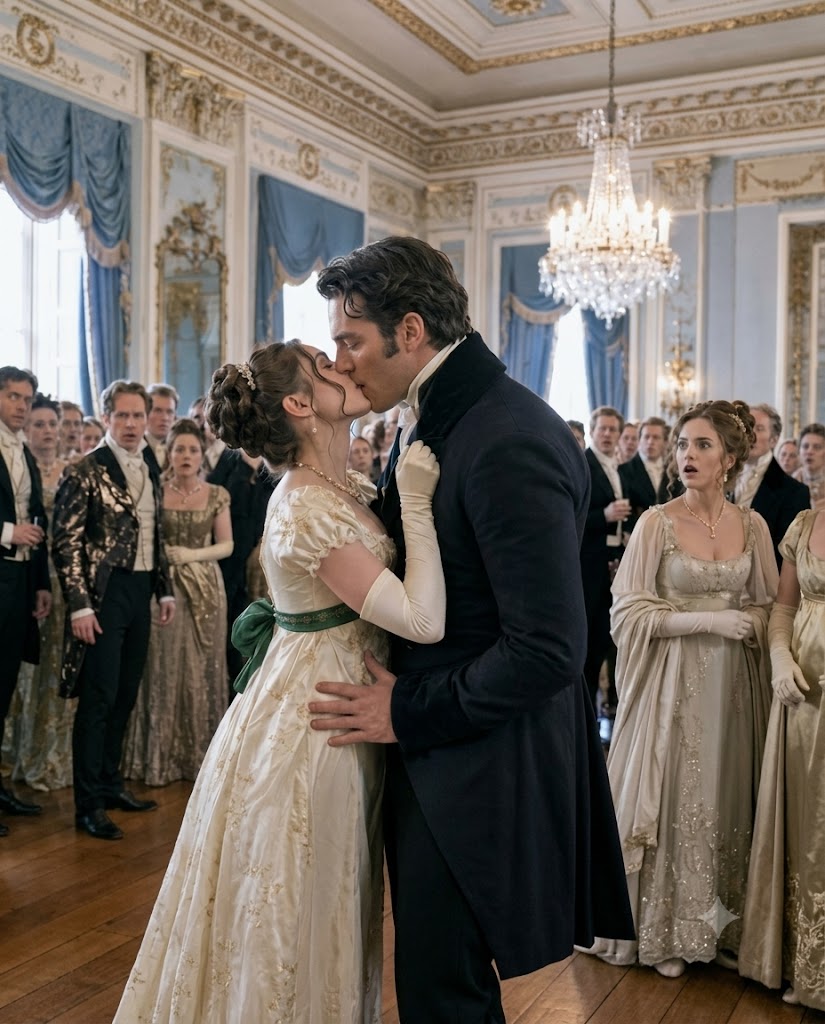
I kissed a stranger beneath the crystal chandelier at the Waldorf ballroom while Manhattan watched in disgust, never knowing his humiliation was part of a deception.
The voice came again from the other side of the door.
“Alexander, open this door.”
My blood ran cold.
I had never heard fear in Alexander’s voice before, but now it was there.
Not anger.
Not surprise.
Fear.
He released my hand and stood.
“Stay here.”
“Who is it?”
He did not answer.
The knock came a third time.
Three slow strikes.
Alexander crossed the room and opened the door.
An old man stood in the hallway.
He was thin, pale, and dressed in a black coat that looked as though it had survived several decades of winters. A scar ran from his left temple to his jaw.
But it was his eyes that frightened me.
They were the eyes of a man who had spent too long carrying something he could never confess.
Alexander stared at him.
“You were supposed to be dead.”
The old man’s mouth twisted into a bitter smile.
“So were you, once.”
I stepped forward despite Alexander’s warning.
“Who is he?”
The old man looked at me.
His expression changed.
“You married her?”
Alexander’s jaw tightened.
“Her name is Eleanor.”
“I know who she is.”
The old man reached inside his coat.
Alexander moved instantly, placing himself between us.
But instead of a weapon, the stranger pulled out a small envelope.
He held it toward Alexander.
“This belongs to you.”
Alexander did not take it.
“What is it?”
“Proof.”
“Of what?”
“That your father did not die the way you were told.”
The room seemed to tilt beneath my feet.
Alexander slowly took the envelope.
His hands were shaking.
That frightened me more than anything else.
He opened it.
Inside was a photograph.
A young man stood beside a black automobile.
Behind him was a warehouse.
On the back, written in faded ink, were six words:
HE WAS TAKEN ALIVE THAT NIGHT.
Alexander stared at the photograph for a long moment.
“My father died in a train accident.”
“No,” the old man whispered. “He was taken from the train before it reached Albany.”
“Who took him?”
The old man looked toward the window.
“The Rutledges.”
Alexander’s face became utterly still.
The same stillness I had seen on the night of the ballroom.
Only now I understood it.
It was not calm.
It was restraint.
A man holding a lifetime of fury inside his chest.
“Why?” I asked.
The old man looked at me again.
“Because your husband’s father discovered where the Rutledges were getting their money.”
Alexander’s eyes lifted.
“Illegal loans.”
The old man nodded.
“Blackmail. Forged accounts. Stolen shares. They ruined families and bought judges. Your father-in-law found evidence.”
“And they killed him.”
“No.”
The old man’s voice dropped.
“They wanted him alive.”
Alexander stepped closer.
“Why?”
“Because he knew where the evidence was hidden.”
A terrible silence filled the room.
Then the old man reached into his coat again.
This time he produced a small brass key.
“He never told them.”
He placed it on the table.
“He told only me.”
Alexander stared at the key.
“Where is the evidence?”
The old man smiled sadly.
“That is what the Rutledges have been searching for all these years.”
I looked at Alexander.
“Then why are you telling us now?”
The old man’s expression hardened.
“Because I am dying.”
He turned toward the door.
“And because they know I came here.”
Alexander grabbed his arm.
“Who knows?”
The old man looked back.
“Everyone who matters.”
Then the lights in the house went out.
A second later, the sound of breaking glass exploded from downstairs.
Alexander pulled me behind him.
“Stay here.”
“No.”
“Eleanor—”
“I am not staying behind while someone attacks my home.”
For one brief second, something almost like pride crossed his face.
Then he took my hand.
We ran.
The house had become chaos.
Servants were shouting.
A window shattered.
Someone screamed.
Alexander pushed open the study’s hidden panel behind the bookcase.
I had never known it existed.
“Where does this go?”
“To the carriage house.”
He pulled me inside.
The old man followed.
We moved through the narrow passage in darkness while footsteps thundered above us.
My heart pounded.
“Alexander.”
“What?”
“Who is attacking us?”
He did not answer immediately.
Then he said quietly,
“People who have been waiting for me to find that key.”
We reached the carriage house.
Alexander opened the rear door of his automobile.
“Get in.”
We drove into the night.
For several minutes, nobody spoke.
The old man sat opposite us, breathing heavily.
Finally I asked,
“Who are you?”
He looked at me.
“My name is Thomas Reed.”
Alexander’s eyes narrowed.
“You were my father’s secretary.”
“Yes.”
“I was told you disappeared after the accident.”
“I was running for my life.”
Thomas looked down at his hands.
“Your father trusted me. I failed him.”
Alexander’s voice became cold.
“What happened that night?”
Thomas closed his eyes.
“He had discovered a ledger.”
“What ledger?”
“The one that connected the Rutledges to half the men who controlled New York’s respectable institutions.”
My stomach tightened.
“Then why hasn’t anyone found it?”
Thomas looked at me.
“Because your father hid it somewhere nobody would think to search.”
Alexander frowned.
“Where?”
Thomas smiled faintly.
“At the Waldorf.”
My breath caught.
“The ballroom?”
“Not the ballroom.”
He looked at Alexander.
“Under it.”
The automobile suddenly swerved.
Alexander seized the wheel.
A black carriage had appeared in front of us.
He turned sharply.
We narrowly avoided it.
Thomas was thrown against the seat.
Alexander cursed under his breath.
“They’re following us.”
He drove faster.
But the carriage remained behind us.
I looked through the rear window.
A man leaned out.
A pistol flashed.
The shot struck the side of our automobile.
I screamed.
Alexander did not slow down.
“Eleanor, get down.”
I obeyed.
Another shot shattered the rear window.
Thomas pulled me toward the floor.
Alexander drove through a narrow alley, then another, until the pursuing carriage disappeared.
When he finally stopped, we were outside an abandoned church on the edge of the city.
“We stay here until morning,” he said.
Thomas shook his head.
“No.”
Alexander looked at him.
“The ledger must be recovered tonight.”
“Why?”
“Because if they know where it is, they will destroy it.”
I looked at Alexander.
“Then we go back to the Waldorf.”
He stared at me.
“No.”
“I am coming.”
“You have already risked enough.”
I stepped closer.
“That is not your decision.”
His expression softened.
“Eleanor…”
“I kissed you once to save you from a lie.”
I touched his hand.
“I will not let you face the truth alone.”
For a moment he said nothing.
Then he raised my hand to his lips.
“All right.”
We returned to the Waldorf through a service entrance shortly before midnight.
The ballroom was empty.
The crystal chandelier still hung above the polished floor.
The same floor where I had ruined my reputation with one reckless kiss.
I looked up at the chandelier.
“I never thought I would come back here.”
Alexander looked at me.
“Neither did I.”
Thomas led us toward the center of the room.
He counted twelve marble tiles from the western wall.
Then eight from the northern side.
He knelt.
“There.”
Alexander removed his coat.
He used a small iron tool to lift the edge of the marble.
Nothing happened.
He tried again.
A hollow sound came from beneath it.
My heart began to race.
Together, we lifted the stone.
Underneath was a narrow iron compartment.
Inside sat a leather ledger wrapped in oilcloth.
Alexander reached for it.
Then the ballroom doors opened.
Mr. Rutledge entered.
He was not alone.
Six men stood behind him.
And among them was a judge I recognized from newspapers, two bankers, and the very man who had taken the photograph on the night I kissed Alexander.
Mr. Rutledge smiled.
“How touching.”
Alexander stood.
“I wondered how long it would take you.”
Rutledge laughed.
“You always were your father’s son.”
Alexander held up the ledger.
“You killed him for this.”
“No.”
Rutledge’s smile disappeared.
“Your father destroyed himself.”
“You expect me to believe that?”
“I expect you to understand that money makes people disappear every day.”
I felt something cold settle inside me.
“You ruined innocent families.”
Rutledge looked at me.
“No, Mrs. Montgomery. We revealed what society already believed about them.”
He smiled.
“People are very easy to destroy when you give them a story they want to believe.”
The words struck me.
Because suddenly I understood.
That was exactly what had happened to me.
They had never needed proof.
Only a story.
Alexander stepped forward.
“You are finished.”
Rutledge laughed.
“You have no idea how many people owe me.”
“Perhaps.”
I stepped beside Alexander.
“But you forgot something.”
Rutledge looked at me.
“What?”
“People can change their minds.”
He laughed again.
“About what?”
“About the story.”
I pointed toward the entrance.
“Look.”
A dozen men were entering the ballroom.
Reporters.
Police officers.
Bank investigators.
And behind them stood my father.
Rutledge’s smile vanished.
Alexander stared at me.
I smiled faintly.
“While you were chasing us, I sent Thomas through the service corridor.”
Thomas nodded.
“He brought copies.”
Rutledge’s face turned white.
“You had no time.”
“Enough.”
I held up a small notebook.
“Every name in the ledger has already been copied.”
One of the bankers stepped backward.
“You said nobody knew.”
Rutledge turned toward him.
“Be quiet.”
The man shook his head.
“No. I am done.”
Another man followed.
“So am I.”
Then another.
One by one, the people who had stood behind Rutledge began to separate themselves from him.
He looked around the ballroom as though the walls themselves had betrayed him.
Alexander walked toward him.
“You spent your life believing fear was power.”
Rutledge stared at him.
“And what do you believe?”
Alexander stopped.
“That fear only works until someone stops being afraid.”
Rutledge reached into his coat.
Everything happened at once.
A gun appeared.
Alexander moved toward me.
A shot rang through the ballroom.
I screamed.
Alexander fell.
For one terrible second, I thought he was dead.
I ran to him.
Blood spread across his shirt.
“No.”
His eyes opened.
“Eleanor…”
“You’ve been shot.”
He tried to smile.
“It appears so.”
I pressed my hands against the wound.
“Don’t you dare joke.”
He coughed.
“I wasn’t.”
Police officers seized Rutledge.
The judge tried to escape and was arrested at the doors.
The ballroom erupted into shouting.
But I heard none of it.
I heard only Alexander’s breathing.
“Stay with me.”
“I am.”
“Promise.”
He looked at me.
“I promise.”
He survived.
The bullet had struck his shoulder rather than his heart.
The doctors said another inch would have changed everything.
For three days, I sat beside his bed.
On the fourth morning, he woke before sunrise.
“You look terrible.”
I nearly laughed.
“That is your first thought?”
“No.”
He reached for my hand.
“My first thought was that I was afraid I would never see you again.”
My eyes filled with tears.
“Alexander…”
“I married you to protect myself.”
“I know.”
“I thought love was a weakness.”
I squeezed his hand.
“And now?”
He smiled.
“Now I think it is the only reason I survived.”
News of the scandal spread across New York for weeks.
But this time, the story was different.
The ledger exposed years of fraud, blackmail, and corruption.
Families who had been ruined were finally heard.
Men who had considered themselves untouchable stood before judges.
The Rutledges lost nearly everything.
But the strangest part was what happened to me.
The woman once called unmarriageable became the woman newspapers could not stop writing about.
Some called me reckless.
Some called me courageous.
Some insisted I had planned everything from the beginning.
They were all wrong.
I had simply refused to stand silently while someone was destroyed by a lie.
Months later, I returned to the Waldorf ballroom.
The chandelier still glittered above me.
But this time there was music.
People laughed.
No one whispered when I entered.
Alexander stood beside me.
“You remember this place?”
“How could I forget?”
He looked up at the chandelier.
“That was where you kissed a stranger.”
I smiled.
“You were not exactly a stranger for long.”
He laughed.
Then he became serious.
“I never thanked you.”
“For what?”
“For choosing me before you knew me.”
I shook my head.
“I didn’t choose you.”
He raised an eyebrow.
“No?”
“I chose to stop a lie.”
He looked at me for a moment.
“And somehow that brought you to me.”
“Yes.”
He took my hand.
“Would you do it again?”
I looked across the ballroom.
At the marble staircase.
At the place where my old life had ended.
Then I looked at the man beside me.
“No.”
He seemed surprised.
“Why?”
“Because next time, I would kiss my husband.”
He laughed.
Then he kissed my forehead.
The music began.
We stepped onto the dance floor.
For years, I believed society had the power to decide my worth.
I believed a poor dress made me less deserving.
I believed an unmarried woman was a failure waiting to happen.
And I believed reputation was something fragile that had to be protected at any cost.
I was wrong.
A reputation can be stolen.
A fortune can disappear.
A family name can become worthless overnight.
But character is different.
Character is what remains when everyone is watching and you still choose what is right.
That night beneath the crystal chandelier, I thought I had ruined my future with one reckless kiss.
In truth, I had only destroyed the future others had planned for me.
And perhaps that was the greatest gift of all.
Because sometimes the moment that humiliates you is the moment that frees you.
Sometimes the door that closes on your old life opens onto something you never imagined.
And sometimes, when the whole world is waiting for you to become the person it has already decided you are, the bravest thing you can do is become someone else entirely.
Years later, people would still tell the story of the woman who kissed a stranger beneath the chandelier.
They would speak of the scandal.
The wealthy family.
The secret ledger.
The gunshot.
The marriage.
They would turn it into a romance, a mystery, a piece of Manhattan history.
But only Alexander and I knew the truth.
It was never the kiss that changed our lives.
It was the choice behind it.
One person chose to believe a lie.
Another chose to tell the truth.
And I learned that night that courage does not always arrive as a grand gesture.
Sometimes it arrives trembling.
Sometimes it looks foolish.
Sometimes it costs you everything you thought you wanted.
But if you follow it anyway, it can lead you somewhere no reputation ever could.
It can lead you home.
And beneath that same crystal chandelier where our story had begun, Alexander whispered the words I had once been too frightened to believe.
“You saved me.”
I looked into his eyes.
“No,” I whispered.
“We saved each other.”
And this time, when he kissed me, nobody in Manhattan gasped.
Nobody whispered.
Nobody judged.
There was only music, warm light, and the quiet certainty that the woman who had once feared being alone had finally discovered something far more valuable than being chosen.
She had learned how to choose herself.
For a long time, I believed our story had ended that night beneath the chandelier.
I was wrong.
Some stories do not end when the danger disappears.
They end when the people who survived it finally understand what it changed inside them.
Three years passed after the trial of the Rutledges.
New York changed.
Not all at once, and not as dramatically as the newspapers claimed, but enough for people like my family to breathe a little easier.
The Montgomery name remained powerful, but Alexander stopped treating power as something that needed to be guarded behind locked doors.
He opened several of his companies’ records to independent auditors.
He dismissed men who had served his father for years simply because they were useful.
And, to the astonishment of everyone who knew him, he began helping families who had lost everything during the Rutledge schemes.
When I asked him why, he gave me an answer I never forgot.
“Because money is only useful when it can repair something.”
Our marriage changed too.
At first, I thought love would make everything easy.
It did not.
Alexander still carried his silences.
I still carried my fears.
There were nights when he woke from nightmares about his father’s disappearance.
There were mornings when I looked at a newspaper headline and remembered the girl I had been before the ballroom.
Sometimes we argued.
Sometimes we misunderstood each other.
And sometimes, despite loving each other deeply, we simply failed to say what we needed to say.
But we learned.
That was the difference.
We learned that love was not the absence of fear.
It was having someone beside you who stayed when the fear arrived.
One rainy afternoon, I found Alexander standing in the library with a letter in his hand.
He looked troubled.
“What’s wrong?”
He handed it to me.
I read the first line.
Then I looked up.
“It’s from Thomas.”
Alexander nodded.
Thomas had disappeared after the trial.
He had refused every reward Alexander offered him.
All he wanted was enough money to leave New York and live quietly near the sea.
We had not heard from him for almost two years.
The letter was short.
He was dying.
And he wanted to see Alexander one last time.
We left the next morning.
The journey took us north through cold rain and endless gray fields.
When we finally reached the small coastal town where Thomas lived, the sea was violent.
Waves crashed against the rocks below his cottage.
Thomas was sitting beside the window.
He looked older than I remembered.
Much older.
But his eyes were still sharp.
“You came,” he said.
Alexander walked to him.
“Of course.”
Thomas smiled.
Then he looked at me.
“And she came too.”
“I wouldn’t have let him come alone.”
Thomas chuckled.
“Good.”
He coughed into a cloth.
When he pulled it away, there was a faint trace of blood.
Alexander’s expression tightened.
“You should be resting.”
“I have rested enough.”
Thomas reached beneath his chair.
He pulled out a wooden box.
He placed it on the table.
“There is something else your father left behind.”
Alexander stared at the box.
“I thought the ledger was everything.”
“It was everything that could bring the Rutledges down.”
Thomas opened the box.
Inside was a small collection of letters.
Alexander picked up the first.
The handwriting was his father’s.
He read silently.
Then his face changed.
“What is it?”
He handed the letter to me.
I read it.
It was addressed to Alexander.
But it had been written twenty years earlier.
My hands trembled.
“My dear son,
If you are reading this, then I have failed to return home.
I want you to know something before you believe the worst of this world.
Do not become like the men who frightened you.
Do not confuse wealth with strength.
Do not confuse silence with dignity.
And never allow fear to choose the people you love.
There will be men who tell you that kindness is weakness.
They are wrong.
Kindness is difficult precisely because it requires courage.
If I cannot be there to teach you that, find someone who can.”
Alexander stopped reading.
His eyes were wet.
I had never seen him cry.
Not even after his father’s name had been cleared.
He sat down.
For several minutes, he said nothing.
Then he whispered,
“He knew.”
“Your father knew what kind of man you would need to become.”
Thomas nodded.
“He was proud of you.”
Alexander looked at him.
“You should have told me.”
“I was afraid.”
Alexander smiled sadly.
“Everyone was afraid.”
Thomas looked toward me.
“Except her.”
I laughed softly.
“Believe me, I was terrified.”
Thomas smiled.
“That is what makes it courage.”
That evening, Thomas died peacefully.
Alexander stayed beside him until the end.
We buried him overlooking the sea.
There were only four people at the funeral.
The minister.
Alexander.
Me.
And an old fisherman who had been Thomas’s neighbor.
No newspapers came.
No society ladies whispered.
No photographers waited outside.
It was quiet.
And somehow, that quiet felt more honorable than every grand ceremony I had ever attended.
As we stood beside the grave, Alexander took my hand.
“I used to think my father was the reason I had to become strong.”
He looked toward the ocean.
“Now I think he was the reason I needed to learn that I didn’t have to become hard.”
I leaned against his shoulder.
“Maybe strength and hardness were never the same thing.”
He looked at me.
“You always do that.”
“Do what?”
“Say something that makes me rethink my entire life.”
I smiled.
“Perhaps that’s why you married me.”
“No.”
He kissed my forehead.
“That’s why I couldn’t stop loving you.”
Years continued to pass.
We eventually had a daughter.
She had Alexander’s dark eyes and my stubbornness.
From the moment she could walk, she seemed determined to challenge every rule in our house.
When she was sixteen, she came home one evening furious.
A girl from one of the wealthiest families in New York had mocked her dress.
“It was old,” my daughter said bitterly.
“They laughed because it wasn’t fashionable.”
I sat beside her.
“What did you do?”
“I told her she was cruel.”
“And?”
“She said I was poor.”
I was quiet for a moment.
Then I smiled.
“Do you know what I learned when I was your age?”
She shook her head.
“People sometimes insult what they secretly fear.”
“What could she possibly fear about me?”
“That you don’t need what she has.”
My daughter looked confused.
I touched her hair.
“Never let someone else decide what should make you ashamed.”
She nodded slowly.
Then she asked,
“Is that what happened to you?”
I smiled.
“Something like that.”
She had heard the story of the ballroom a hundred times.
But she still loved hearing it.
“Tell me again.”
I laughed.
“Again?”
“Please.”
So I told her.
I told her about the chandelier.
The accusation.
The camera.
The Rutledges.
The stranger standing alone beside the marble staircase.
And the kiss that changed everything.
When I finished, she looked at me with wide eyes.
“Did you really kiss Father before you knew him?”
“Yes.”
“Why?”
I thought about it.
“Because someone needed to.”
She laughed.
“You were very brave.”
“No.”
I shook my head.
“I was very afraid.”
She frowned.
“But you did it anyway.”
“Exactly.”
That was the lesson I wanted her to remember.
Not that courage meant having no fear.
But that fear did not have to make her obedient.
On her eighteenth birthday, Alexander gave her a small gold necklace.
There was a tiny crystal hanging from it.
She looked at him.
“What’s this?”
He smiled.
“A reminder.”
“Of what?”
“That your mother once changed an entire room with one decision.”
She looked at me.
“Was it really that dramatic?”
Alexander and I exchanged a glance.
“Much more dramatic than you know,” he said.
She laughed.
That night, after everyone had gone to bed, I found Alexander standing on the balcony.
New York glittered beneath us.
The city looked different now.
Or perhaps I was the one who had changed.
I stepped beside him.
“What are you thinking?”
He looked at me.
“That we were lucky.”
I smiled.
“We were reckless.”
“That too.”
He wrapped an arm around my waist.
“Do you ever wonder what would have happened if you hadn’t kissed me?”
“Sometimes.”
“And?”
“I probably would have married someone else.”
He frowned.
“That answer is unacceptable.”
I laughed.
“What about you?”
“I would have spent the rest of my life believing I could solve everything alone.”
I looked at him.
“And now?”
He held me closer.
“Now I know better.”
For a while, we watched the city in silence.
Then Alexander said,
“There’s something I never told you.”
I turned toward him.
“What?”
He reached into his pocket.
He pulled out a small photograph.
The photograph from the ballroom.
The one that had been intended to destroy him.
But this time, it had been altered.
Someone had written beneath it:
THE BEGINNING.
I stared at it.
“You kept this?”
“For years.”
“Why?”
He smiled.
“Because it reminds me that the worst night of my life became the beginning of the best part of it.”
I touched the photograph.
“I used to hate that picture.”
“So did I.”
“And now?”
“Now I think it tells the truth.”
I looked at him.
“What truth?”
He kissed my hand.
“That sometimes the person who saves you is the person you least expect.”
I leaned against him.
The wind moved gently through the curtains.
Somewhere below, a carriage passed through the street.
Life continued.
Ordinary.
Beautiful.
Unaware of how close it had once come to breaking us.
I closed my eyes.
And for the first time, I understood something I had not understood when I was twenty-four.
The night beneath the chandelier had not been the story of how I found a husband.
It had been the story of how I found myself.
I had spent years believing I needed society’s approval to prove that I was worthy.
But the truth was much simpler.
Worth was never something another person could give me.
And it was never something they could take away.
The Rutledges had believed they could control people because they understood shame.
They knew that frightened people would protect their reputations at almost any cost.
They were wrong about one thing.
There comes a moment when protecting your reputation becomes less important than protecting your soul.
Once you reach that moment, fear loses its power.
That was what happened to me.
That was what happened to Alexander.
And perhaps that was why our marriage survived everything that had been designed to destroy it.
We did not save each other because we were fearless.
We saved each other because, when fear demanded that we run, we stayed.
Years later, when historians wrote about the scandal that had shaken Manhattan, they focused on the money.
The stolen fortunes.
The secret ledger.
The powerful men who fell.
The mysterious death of Alexander’s father.
And, of course, the kiss.
But they never understood the most important part.
The kiss was not the miracle.
The miracle was what happened afterward.
A woman who believed she had no power discovered that one decision could change the course of many lives.
A man who believed wealth could protect him discovered that love could.
A family that had lived in fear discovered that truth did not become weaker simply because powerful people tried to bury it.
And a city that had once judged us learned, however briefly, that appearances were not the same thing as truth.
Sometimes I still return to the Waldorf ballroom.
The chandelier is still there.
The marble staircase still gleams beneath the lights.
Young women still arrive in expensive gowns, hoping to be noticed.
Young men still stand in corners pretending not to care who is watching.
The music still rises toward the ceiling.
And every once in a while, I see someone staring at the place where I once stood.
They have heard the story.
I can tell by the look in their eyes.
When that happens, I smile.
Because they know the scandal.
But I know the truth.
I know that one reckless act can become a doorway.
I know that a person can survive being misunderstood.
I know that losing the approval of a room can sometimes mean gaining the freedom to live honestly.
And I know that love is not always the soft thing people imagine.
Sometimes love is standing between someone and a lie.
Sometimes it is telling the truth when silence would be safer.
Sometimes it is staying when leaving would be easier.
And sometimes, impossibly, it begins with a kiss from a stranger beneath a crystal chandelier.
One winter evening, many years after that first night, Alexander and I attended another ball.
Our daughter was grown by then.
She danced with her husband beneath the same chandelier.
I watched her laugh.
Alexander stood beside me.
“Do you remember?” he asked.
“Every detail.”
He took my hand.
“Would you change anything?”
I looked at our daughter.
At the people dancing.
At the chandelier shining above us.
Then I looked at the man who had once been a stranger.
“No.”
Not the kiss.
Not the scandal.
Not the fear.
Not even the pain.
Because every mistake, every danger, every moment when I thought my life had ended had carried me toward the life I had never known how to imagine.
Alexander smiled.
“Good.”
“Why?”
“Because neither would I.”
The orchestra began another song.
He offered me his hand.
“May I have this dance?”
I placed my hand in his.
“You may.”
We stepped onto the floor.
And as we danced beneath the crystal chandelier, I finally understood the strangest truth of all.
The night I kissed a stranger, I thought I had destroyed my future.
In reality, I had only destroyed the future other people had chosen for me.
The life that came afterward was not perfect.
It was not easy.
But it was ours.
And that was enough.
Because in the end, a meaningful life is not built by avoiding every scandal, every mistake, or every heartbreak.
It is built by choosing who you will become after them.
The world may judge you by one moment.
It may reduce your entire story to a single photograph.
It may whisper your name as though it knows everything about you.
But you are not the story other people tell about you.
You are the choices you make when nobody is certain what you should do.
You are the courage you find when you are afraid.
You are the truth you protect when a lie would be easier.
And sometimes, if you are very fortunate, you discover that the person standing beside you through all of it is not the person you expected to love.
They are the person who sees you clearly.
The person who stays.
The person who reminds you who you are when the world tries to make you forget.
As the music ended, Alexander leaned close.
“One more dance?”
I smiled.
“Always.”
And beneath the crystal chandelier, where our story had once begun with a reckless kiss and a room full of judgment, we danced again.
Not as strangers.
Not as scandal.
Not as the poor girl and the wealthy man.
Not as two people pretending not to need each other.
But simply as two people who had survived the lies, chosen the truth, and found something far more precious than a perfect reputation.
A life together.
And this time, when the music faded and the lights dimmed, there was no scandal waiting beyond the doors.
Only tomorrow.
And for the first time in my life, tomorrow did not frighten me.
I welcomed it.
Because I had finally learned that the future does not belong to the people who predict it.
It belongs to the people brave enough to choose it.
THE END.