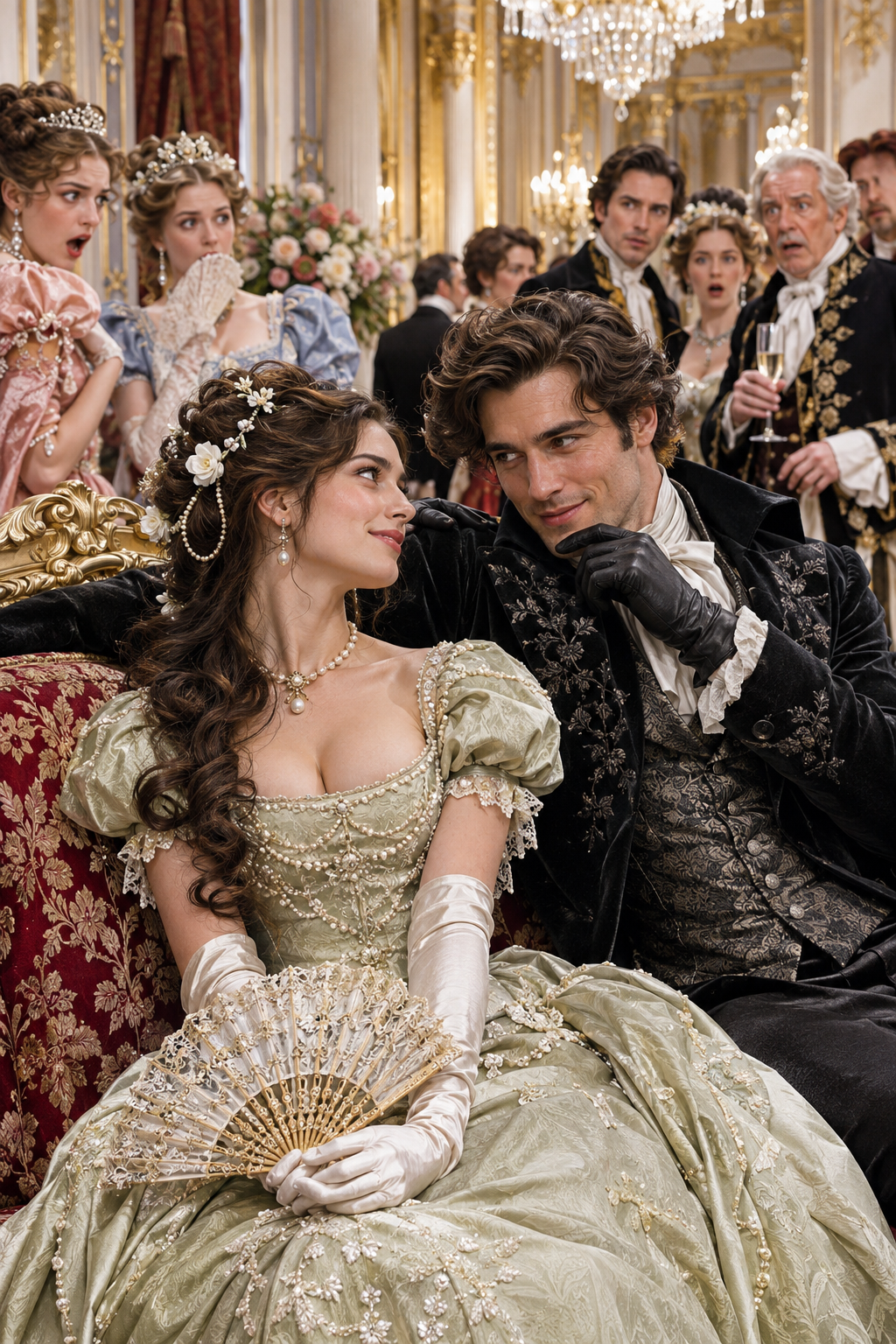
“Go on, Rosalie. Sit beside the mad duke. Unless you’re afraid.”
“There is something you must understand before you decide to stay,” Alistair whispered.
His trembling fingers rested on the drawer beside his bed, but he did not open it.
Rosalie watched him struggle to catch his breath. The man who had once frightened an entire ballroom now looked as though speaking a few words might exhaust him.
“Then tell me,” she said gently.
Alistair gave a bitter smile.
“You believe you have discovered the worst of me. You haven’t.”
He pulled open the drawer and removed a small wooden box. Inside lay a gold engagement ring, a folded letter, and a miniature portrait of a beautiful young woman.
“My former fiancée,” he said. “Lady Eleanor Ashford.”
Rosalie recognized the name immediately.
Eleanor was one of London’s most admired young widows, though she had never married. People still called her Lady Eleanor because of her father’s title, and she had recently become engaged to a wealthy earl.
“She told everyone you were mad,” Rosalie said quietly.
“Yes. But that is not the entire story.”
Alistair lifted the letter, then hesitated.
“Before she left me, she made a promise. And I was foolish enough to believe her.”
His voice broke into another cough.
Rosalie reached for the glass of water beside his bed. He accepted it, but his hands shook so badly that she had to steady the glass.
“You don’t have to tell me tonight,” she said.
“Perhaps I won’t have another night when I feel brave enough.”
The words struck her harder than she expected.
“Don’t speak like that.”
“Rosalie, I am dying.”
She looked away, fighting the sudden burning in her eyes.
“You don’t know that.”
“The physicians have been very clear.”
“Physicians can be wrong.”
“And young ladies can be stubborn.”
“Then we shall both have to endure my stubbornness.”
For a moment, something almost like laughter escaped him.
He returned the letter to its box.
“Eleanor did not merely abandon me because I was ill. She wanted something I refused to give her.”
“What?”
“The right to control Blackwood Hall.”
Rosalie frowned.
“Why would she want that?”
“Because Blackwood is worth considerably more than society believes.”
He closed the box.
“And because there are people who would rather see me buried than see the truth come out.”
Before Rosalie could ask another question, footsteps sounded outside the chamber.
Mr. Finch appeared at the door.
“Your Grace,” he said, his expression tense. “A gentleman has arrived from London.”
Alistair’s face changed.
“Who?”
“Mr. Percival Crowe.”
The duke’s fingers tightened around the wooden box.
“Tell him I am not receiving visitors.”
“He says he carries an urgent message concerning the estate.”
“Then he may leave it with you.”
Finch hesitated.
“He also said that if you refuse to see him, he will take the matter directly to the courts.”
Rosalie saw fear flash across Alistair’s face.
It was gone almost immediately, replaced by cold anger.
“Very well,” he said. “Show him into the morning room.”
Then he turned to Rosalie.
“You must leave Blackwood tomorrow.”
She stared at him.
“What?”
“You heard me.”
“Because of this man?”
“Because I have already allowed you too close to a situation that could destroy your reputation.”
Rosalie rose from her chair.
“You cannot invite me into your life and then send me away whenever something frightens you.”
Alistair looked toward the window.
“I can, if it keeps you safe.”
“And who keeps you safe?”
He had no answer.
That night, Rosalie could not sleep.
The rain beat against the windows, and somewhere downstairs, voices rose behind a closed door.
She had not intended to listen.
But when she heard her own name, she stopped.
“You have already made a mistake allowing Miss Witmore into this house,” a man’s voice said.
It belonged to Crowe.
“She knows nothing,” Alistair replied.
“Perhaps. But her presence complicates matters.”
“She is my guest.”
“A guest who may become a witness.”
A heavy silence followed.
Then Crowe spoke again.
“You have until the end of the month, Your Grace. After that, the trustees will act.”
Rosalie heard a chair scrape across the floor.
“Get out of my house,” Alistair said.
“With pleasure. But remember, a sick man with a damaged reputation has very few friends in court.”
The door opened.
Rosalie barely managed to step behind a curtain before Crowe passed.
His shoes clicked against the marble floor.
Only when the sound faded did she move.
Alistair stood alone in the morning room, one hand gripping the mantelpiece.
“You heard,” he said without turning.
“Enough to know someone is threatening you.”
He closed his eyes.
“Rosalie, please.”
“No. You have spent so long trying to protect everyone from your troubles that you’ve forgotten people can choose to stand beside you.”
He turned toward her.
“And what happens when standing beside me costs you everything?”
She stepped closer.
“Then at least it will have been my choice.”
For several seconds, he simply stared at her.
Then his shoulders dropped.
“Crowe manages several trusts connected to my family’s estate,” he admitted. “He claims I am no longer capable of making decisions.”
“Because you are ill?”
“Because he intends to use my illness and the rumors of madness as proof.”
“And Eleanor?”
“She has been helping him.”
Rosalie felt cold.
“Why?”
“Because if they can have me declared incapable, the trustees can take control of Blackwood’s finances. Crowe will gain access to funds he has wanted for years.”
“Can they truly do that?”
“Not without convincing a court. But I have been too weak to challenge them properly.”
Rosalie looked at him.
“Then we find someone who can.”
He shook his head.
“You make it sound simple.”
“No. I make it sound possible.”
The next morning, Rosalie wrote to her aunt requesting permission to remain at Blackwood a little longer.
The reply arrived two days later.
It contained only three sentences.
Her aunt called her behavior disgraceful, warned that her sisters were already suffering embarrassment, and demanded her immediate return to London.
Rosalie folded the letter and placed it in the fire.
Alistair, sitting across from her in the study, watched the paper burn.
“You shouldn’t have done that.”
“Probably not.”
“Your family will be furious.”
“They have been furious with me for years. At least this time I’ve given them a reason.”
He laughed, then coughed into his handkerchief.
The laughter disappeared from Rosalie’s face.
His illness was growing worse.
Some mornings he could barely leave his bed. On others, he insisted on walking through the gardens, pretending not to notice how often he needed to stop.
Rosalie learned to recognize the difference between his ordinary tiredness and the exhaustion that frightened Mr. Finch.
She also learned that Alistair hated being treated as helpless.
So she stopped asking whether he needed assistance every few minutes.
Instead, she brought books to his study, played chess with him, and argued about everything from poetry to the proper way to grow roses.
Sometimes they sat together without speaking.
Those quiet hours became the happiest moments either had known in years.
One afternoon, while walking through the neglected rose garden, Alistair stopped beside a stone bench.
“My mother planted these,” he said.
Rosalie looked at the tangled bushes.
“They must have been beautiful.”
“They were. She loved yellow roses.”
“Then we should restore them.”
He smiled sadly.
“By next summer, I doubt I shall be here to see them.”
Rosalie knelt beside a bush and carefully lifted a fallen branch.
“Then we shall begin today.”
He watched her for a long time.
“You really don’t understand how impossible you are, do you?”
“I’ve been told often enough.”
“No,” he said softly. “I mean that as a compliment.”
That evening, Mr. Finch approached Rosalie while she was returning a book to the library.
“Miss Witmore, may I speak freely?”
“Of course.”
“His Grace has changed since you arrived.”
She smiled.
“I hope for the better.”
“He eats more. He leaves his chambers. Yesterday, he asked whether the gardens could be repaired.”
Finch’s voice trembled.
“I had begun to think I would never hear him make plans for another season.”
Rosalie felt tears sting her eyes.
“Then we must give him reasons to keep making them.”
But the following week brought terrible news.
A formal notice arrived from London.
A hearing had been scheduled to determine whether Alistair was mentally competent to manage his estate.
Crowe had submitted statements from several witnesses, including Lady Eleanor.
The hearing would take place in twelve days.
Alistair read the notice twice.
Then he placed it on the desk and said nothing.
Rosalie picked it up.
“They are claiming you are dangerous.”
“Yes.”
“That you threatened servants.”
“Yes.”
“That you destroyed family property during fits of madness.”
His expression hardened.
“None of those things happened.”
“Then we prove it.”
“With what?”
“The truth.”
Alistair gave a humorless laugh.
“Truth is a fragile thing when wealthy people are paid to ignore it.”
Rosalie studied the papers.
One witness claimed to have seen Alistair attack a servant three years earlier.
Another described an incident at Blackwood during the winter.
She looked up.
“Were these people actually here?”
“One was. The other left my employment years ago.”
“Then perhaps someone remembers what truly happened.”
That afternoon, Rosalie began speaking with the household staff.
At first, they were reluctant.
Many feared losing their positions if the trustees gained control.
But Mr. Finch encouraged them.
Soon the housekeeper, Mrs. Bell, revealed that one supposed incident of violence had actually been Alistair breaking a locked door to rescue a stable boy trapped during a fire.
The gardener remembered the winter disturbance differently too.
Alistair had smashed a window because smoke was filling a room where two servants were sleeping.
The stories had been twisted until acts of courage sounded like acts of madness.
Rosalie wrote everything down.
For the first time, Alistair allowed himself a little hope.
Then a second letter arrived.
This one was addressed to Rosalie.
It came from Lady Eleanor.
The message was brief.
If Miss Witmore valued her family’s good name, she would return to London immediately and stop interfering in matters she did not understand.
Rosalie read it aloud to Alistair.
His face went pale.
“She will not hesitate to ruin you.”
“Then she should have chosen someone easier to frighten.”
“Rosalie—”
“I am tired of people deciding what I am allowed to care about.”
Alistair reached for her hand.
His fingers were cold.
“You deserve a life filled with happiness,” he whispered.
“And who says I cannot find happiness here?”
He looked at her with such tenderness that she almost forgot to breathe.
For one suspended moment, she thought he might kiss her.
Instead, he released her hand.
“You should not love a dying man.”
Rosalie’s heart stopped.
“I never said I loved you.”
“No,” he replied. “But I am beginning to fear that I love you.”
The confession hung between them.
Alistair looked almost ashamed.
“I had no right to say that.”
Rosalie stepped closer.
“Then allow me to say something equally improper.”
She took his hand again.
“I love you too.”
His eyes filled with tears.
For a moment, the proud Duke of Westall looked like a man who had been starving for kindness and had finally been offered a place at the table.
He raised her hand to his lips.
But before either could speak again, a violent cough seized him.
He staggered.
Blood spilled onto his handkerchief.
Then his knees buckled.
Rosalie caught him as best she could.
“Finch!” she screamed.
The valet came running.
Together they helped Alistair to bed.
The physician arrived before midnight.
After examining him, he asked to speak with Rosalie privately.
“His condition is serious,” he said. “The bleeding concerns me greatly.”
“Can you help him?”
“I can ease his discomfort. Rest and clean air may benefit him, but consumption is a cruel illness.”
“Will he recover?”
The physician hesitated.
“I cannot promise that.”
Rosalie swallowed.
“Will he survive long enough for the hearing?”
The doctor looked toward the closed bedroom door.
“That depends on whether he can avoid another severe episode.”
For the first time since arriving at Blackwood, Rosalie felt truly afraid.
Not of scandal.
Not of Eleanor.
Not even of Crowe.
She was afraid of losing the man she had only just found.
For three days, Alistair remained in bed.
Rosalie sat nearby, reading aloud when he was awake and resting in the adjoining sitting room when he slept.
On the fourth morning, he asked for the legal papers.
“You are not attending that hearing,” she told him.
“I must.”
“You can barely stand.”
“If I do not appear, Crowe will claim my absence proves his case.”
“Then let him claim it. We will find another way.”
Alistair looked at her.
“There may not be another way.”
That afternoon, Mr. Finch entered with an unexpected visitor.
A gray-haired solicitor named Mr. Harcourt had arrived from York.
He had served Alistair’s father for nearly thirty years.
“I came as soon as I heard what Crowe was attempting,” he explained.
Alistair looked astonished.
“I thought you had retired.”
“I did. Retirement becomes considerably less pleasant when one learns an old friend’s son is being robbed.”
Harcourt examined the documents Rosalie had collected.
He listened to the servants’ accounts.
Then he asked a question that changed everything.
“Your Grace, do you still possess the original trust agreement signed by your father?”
Alistair frowned.
“It should be in the estate archives.”
“Not the copy kept by Crowe. The original.”
“I believe so.”
Harcourt leaned forward.
“Then we must find it immediately.”
For the next two days, Rosalie and Finch searched through old cabinets, ledgers, and boxes.
At last, inside a locked chest in the former duke’s private office, they discovered a packet of documents.
Harcourt examined them beneath the lamplight.
His expression slowly changed.
“Good heavens.”
Rosalie leaned closer.
“What is it?”
“The agreement contains a provision Crowe conveniently omitted from his petition.”
“What provision?”
“The trustees may intervene only if two independent physicians certify permanent mental incapacity. Physical illness alone is not sufficient.”
Rosalie’s heart leaped.
“Then he cannot take Blackwood.”
“Not legally, unless he produces those certificates.”
“Can he?”
Harcourt’s face darkened.
“He has already submitted one.”
The physician named in the document was a London doctor who had never examined Alistair.
Harcourt immediately sent inquiries.
Within forty-eight hours, he received a troubling response.
The doctor admitted that Crowe had paid him for a written opinion based entirely on letters supplied by Eleanor.
It was not proof of mental illness.
It was proof of manipulation.
Harcourt prepared a sworn statement.
Rosalie believed they had finally won.
But the night before the hearing, Lady Eleanor arrived at Blackwood.
She entered the drawing room wearing an elegant blue gown, as though attending a dinner party.
Rosalie was waiting for her.
“Miss Witmore,” Eleanor said pleasantly. “How devoted you have become.”
“Lady Eleanor.”
“I had hoped you would be sensible enough to return home.”
“And I had hoped you would be ashamed of what you’ve done.”
Eleanor’s smile vanished.
“You know nothing about me.”
“I know you abandoned a sick man and then destroyed his reputation.”
“He was going to die and leave me with nothing!”
The words burst out before Eleanor could stop them.
Rosalie stared.
Eleanor drew a breath and straightened.
“You have no idea what it means to spend your life depending on the generosity of men.”
“And that gives you the right to destroy someone?”
“He was supposed to marry me. I had made plans.”
“You loved his title and his money.”
Eleanor’s eyes flashed.
“Love does not pay debts.”
Rosalie felt a strange sadness.
Here was a woman who had been offered genuine affection and had treated it as something worthless.
“Alistair would have helped you,” Rosalie said.
Eleanor looked away.
“Perhaps.”
“Then why do this?”
For a moment, her confidence cracked.
“Because Crowe told me the estate was failing. He said the only way to protect my future was to help him gain control.”
“And you believed him?”
“I wanted to.”
A voice sounded from the doorway.
“Then you should have asked me.”
Alistair stood there, supported by Finch.
He was pale, but his eyes were clear.
Eleanor went rigid.
“Alistair.”
“You could have told me you were afraid.”
Her lips trembled.
“I thought you would leave me with nothing.”
“I intended to settle an income upon you, even after you ended our engagement.”
Eleanor stared at him.
“What?”
“I had already instructed Harcourt to prepare it.”
For the first time, she looked genuinely horrified.
All the cruelty, the lies, the damage she had caused had been unnecessary.
She sank into a chair.
“I didn’t know.”
“No,” Alistair said. “You never asked.”
Eleanor began to cry.
Rosalie felt no triumph.
Only exhaustion.
At last, Eleanor lifted her head.
“What do you want from me?”
“The truth,” Alistair replied.
The next morning, Eleanor appeared at the hearing.
Before the magistrate, she withdrew her accusations.
She admitted that she had exaggerated Alistair’s behavior and repeated false stories at Crowe’s urging.
Harcourt presented the original trust agreement, the servants’ statements, and the London physician’s admission.
Crowe attempted to interrupt.
The magistrate silenced him.
By afternoon, the petition to remove Alistair’s control of Blackwood had been dismissed.
The court also ordered further examination of Crowe’s conduct.
But the victory came at a terrible cost.
As Harcourt stepped outside to announce the decision, Alistair collapsed in the corridor.
Rosalie heard Finch shout his name.
She ran toward them.
Alistair lay unconscious, his breathing shallow.
His lips were stained with blood.
For one terrible second, Rosalie thought he was already gone.
They carried him to a nearby house, where the physician worked through the evening.
Rosalie waited beside the bed.
Hours passed.
At last, Alistair opened his eyes.
“Did we win?” he whispered.
Rosalie laughed through her tears.
“Yes. Blackwood is yours.”
He smiled faintly.
“Then perhaps I can finally rest.”
“No,” she said sharply. “You are not allowed to say goodbye like that.”
His smile faded.
“Rosalie.”
“You promised me nothing. I know that. But I am asking you to fight.”
He looked at her for a long moment.
“I am so tired.”
She pressed his hand against her cheek.
“Then rest. But don’t give up because you think the people who love you would be better off without you.”
His eyes filled.
“I never thought I would be loved again.”
“Then you were wrong.”
Alistair closed his eyes.
And Rosalie remained beside him until morning.
The following weeks were the hardest of her life.
Alistair survived the collapse, but recovery was painfully slow.
The physician insisted that he remain in a quiet environment, avoid unnecessary strain, and spend time in fresh air when he was strong enough.
Harcourt arranged for the estate to be managed under Alistair’s instructions while he rested.
Crowe was removed from his position, and an investigation into the missing funds began.
Eleanor returned to London, where her public admission caused a scandal of her own.
Rosalie’s aunt sent another furious letter.
This time, she threatened to cut Rosalie off entirely unless she returned home.
Rosalie read it while sitting beside Alistair’s bed.
“What does she say?” he asked.
“That I have disgraced the family.”
“And have you?”
Rosalie considered the question.
“I have disappointed them. That is not quite the same thing.”
Alistair smiled.
“You are a remarkable woman.”
“No. I am simply learning that being obedient and being good are not always the same.”
A month later, Rosalie received a visitor she had not expected.
Her youngest sister, Margaret, arrived at Blackwood carrying a small suitcase.
Rosalie met her in the entrance hall.
“Margaret? What are you doing here?”
Her sister burst into tears.
“I came to apologize.”
Rosalie stood speechless.
Margaret wiped her face.
“We dared you to sit beside him because we thought it would humiliate you. We never imagined you might actually find happiness.”
“Margaret—”
“And when everyone began talking, I said nothing. I let them laugh at you.”
Rosalie embraced her.
For the first time in years, the sisters held each other without competition or cruelty.
Margaret remained for several days.
She met Alistair, spoke with the servants, and saw the tenderness with which Rosalie cared for him.
Before leaving, she took Rosalie’s hands.
“I understand now,” she whispered.
“Understand what?”
“Why you stayed.”
That spring, Blackwood Hall slowly came back to life.
The curtains were opened.
The neglected gardens were cleared.
Fresh flowers appeared in the rooms.
Alistair began taking short walks again.
Some days he could manage only a few steps.
Other days he reached the rose garden and sat beneath the old trees while Rosalie read beside him.
His illness did not disappear.
There were still fevers, painful coughing fits, and mornings when even speaking exhausted him.
But the hopelessness that had once filled Blackwood was gone.
One warm afternoon, Rosalie found Alistair standing beside the yellow rose bushes.
Tiny green buds had begun to appear.
“You shouldn’t be out here alone,” she said.
“I am not alone.”
She looked around.
“No?”
He turned toward her.
“I have you.”
Then, with obvious effort, he lowered himself onto one knee.
Rosalie gasped.
“Alistair! Get up. You’ll hurt yourself!”
“Please allow me one moment of dignity.”
She laughed, tears already forming.
He reached into his coat and removed a simple gold ring.
It was not Eleanor’s ring.
This one had belonged to his mother.
“I cannot promise you a long life together,” he said. “I cannot promise there won’t be difficult days. And I cannot promise that loving me will be easy.”
Rosalie knelt beside him.
“But I can promise that whatever time I am given, I will spend it loving you honestly.”
His voice trembled.
“Rosalie Witmore, will you marry me?”
She touched his face.
“Yes.”
He stared at her.
“Yes?”
“Yes, you impossible man.”
He laughed, and she kissed him before he could say another word.
They married six weeks later in the small chapel at Blackwood.
There were no grand celebrations, no crowded ballroom, and no fashionable guests pretending to be friends.
Mr. Finch stood beside Alistair.
Margaret attended with tears in her eyes.
Mrs. Bell decorated the chapel with white flowers and the first yellow roses of the season.
Even Rosalie’s aunt came, though she remained stiff and silent through most of the ceremony.
When Alistair placed the ring on Rosalie’s finger, his hand trembled.
Rosalie held it steady.
Their marriage was not a miracle cure.
There were days when Alistair’s health improved and others when the illness returned with frightening force.
They learned to treasure small victories.
A walk through the garden.
A morning without fever.
A shared book.
A quiet dinner by the fire.
Harcourt continued handling the estate’s legal affairs, and the missing funds were eventually traced to accounts controlled by Crowe.
The investigation ended his career and forced him to surrender much of what he had taken.
Blackwood’s finances were secured.
But Alistair cared less about the recovered money than about the people who had remained loyal to him.
He increased the servants’ wages, arranged medical assistance for their families, and established a fund for workers who became too ill to support themselves.
When Rosalie asked why he had chosen that particular cause, he answered simply.
“Because illness should never make a person feel disposable.”
Years passed more gently than anyone had dared hope.
Alistair never regained the strength he had possessed before his illness, and the danger to his health remained real.
But he lived to see the yellow roses bloom again.
And again.
Each summer, Rosalie placed fresh flowers on the windowsill of his study.
Sometimes he teased her for bringing the garden indoors.
Sometimes he simply watched her with a smile that needed no explanation.
One evening, as the sun sank behind the trees, Alistair and Rosalie sat together on the stone bench where they had once spoken of his uncertain future.
The rose bushes were heavy with blossoms.
“Do you remember what you said here?” Rosalie asked.
“That I doubted I would see another summer?”
“Yes.”
He looked across the garden.
“I remember.”
“And yet here you are.”
He took her hand.
“Because you refused to let me believe my life was already over.”
Rosalie shook her head.
“You were the one who kept fighting.”
“Perhaps. But you reminded me there was something worth fighting for.”
They sat quietly as the evening breeze moved through the flowers.
After a while, Alistair spoke again.
“Do you ever regret that night at the ball?”
Rosalie smiled.
“The night my sisters dared me to sit beside the most frightening man in London?”
“The very same.”
She pretended to consider.
“Well, you were terribly rude.”
“I was.”
“And rather gloomy.”
“Undeniably.”
“And you frightened half the ballroom.”
“Only half?”
She laughed.
Then she leaned against his shoulder.
“No, Alistair. I have never regretted it.”
He kissed her forehead.
“Neither have I.”
The world had once called him mad, cruel, and ruined.
Rosalie had seen a lonely man behind those rumors.
And when everyone else had turned away, she had chosen to sit beside him.
That simple act had not erased his suffering or guaranteed a happy future.
But it had changed the direction of two lives.
For Rosalie, it meant discovering that courage was not always loud or dramatic. Sometimes it was refusing to join in when others were cruel.
For Alistair, it meant learning that love was not a burden he had to spare others from. It was a gift he could accept, even when life was uncertain.
And in the quiet gardens of Blackwood Hall, beneath the yellow roses his mother had planted long ago, they found something far more valuable than wealth, reputation, or society’s approval.
They found the freedom to be loved exactly as they were.
Because sometimes the person the world warns you to avoid is the one who most needs someone to stay.
And sometimes, the smallest act of kindness becomes the beginning of a life neither person believed was still possible.
Years later, on a quiet autumn morning, Rosalie found Alistair sitting by the window of his study, holding the little wooden box he had once shown her on the night he confessed his darkest fears.
His hair had turned silver at the temples, and his body remained fragile, but his eyes still carried the same warmth she had fallen in love with.
“What are you looking at?” she asked.
He smiled and opened the box.
Inside was the old engagement ring, the faded portrait, and the letter from Eleanor.
“I kept these because I thought they would remind me never to trust anyone again,” he said.
Rosalie sat beside him.
“And now?”
“Now they remind me how wrong I was.”
He removed the letter and placed it in the fireplace.
Rosalie watched the paper curl into ashes.
“Are you certain?” she asked.
“Quite certain. I have carried that pain long enough.”
He closed the empty box and took her hand.
“Do you know what I remember most clearly about the night we met?”
“My sisters laughing at me?”
“No. I remember that you asked permission to sit beside me.”
Rosalie smiled.
“Was that so unusual?”
“Everyone else treated me as though I were either dangerous or already dead. You treated me like a man who might appreciate some company.”
She squeezed his hand.
“And you looked terribly lonely.”
“I was.”
He glanced toward the garden, where yellow roses still bloomed despite the approaching winter.
“Then you came along and gave me a reason to open the curtains again.”
Rosalie rested her head against his shoulder.
Neither spoke for a while.
They had learned that silence between two people who loved each other was not emptiness. It was peace.
That evening, the household gathered for dinner.
Mr. Finch, now older and slower himself, joined them at Alistair’s insistence. Margaret visited with her children, who filled the dining room with laughter.
Blackwood Hall, once known as a gloomy house belonging to a frightening duke, had become a place where people felt welcome.
After dinner, Rosalie noticed Alistair watching the children play.
“What are you thinking?” she asked.
“That I nearly missed all of this.”
She understood.
There had been a time when he believed withdrawing from the world was an act of kindness. He had thought that if he disappeared quietly, no one would suffer.
But the years had taught him something different.
A person’s worth was not measured by perfect health, wealth, or how useful they could be to others.
Sometimes simply being present mattered more than anything.
Later that night, as Rosalie helped him upstairs, Alistair paused at the landing.
“Rosalie?”
“Yes, my love?”
“Thank you for staying.”
She turned toward him.
“You never have to thank me for loving you.”
He smiled.
“Perhaps not. But I shall anyway.”
She kissed his cheek.
“And I shall keep reminding you that you were worth staying for.”
Outside, the wind moved softly through the trees surrounding Blackwood Hall.
The future remained uncertain, as it always had been.
There would still be difficult days, moments of fear, and losses neither of them could prevent.
But they no longer measured happiness by the number of years they might have left.
They measured it by the love they shared within those years.
And that was the lesson Rosalie carried with her for the rest of her life.
Never judge a person by the stories others tell about them. Sometimes the people who seem hardest to love are simply the ones who have been hurt the deepest.
A little kindness may not solve every problem.
Love cannot promise to stop time or prevent every sorrow.
But being seen, accepted, and cared for can give someone the courage to face another day.
And sometimes, one simple decision to sit beside a lonely stranger can change two lives forever.
THE END.