For ten years, one of the most feared men in America’s criminal underworld had lived with a pain that no doctor could explain.
The ringing beneath the floorboards seemed impossibly loud in the little shoe repair shop.
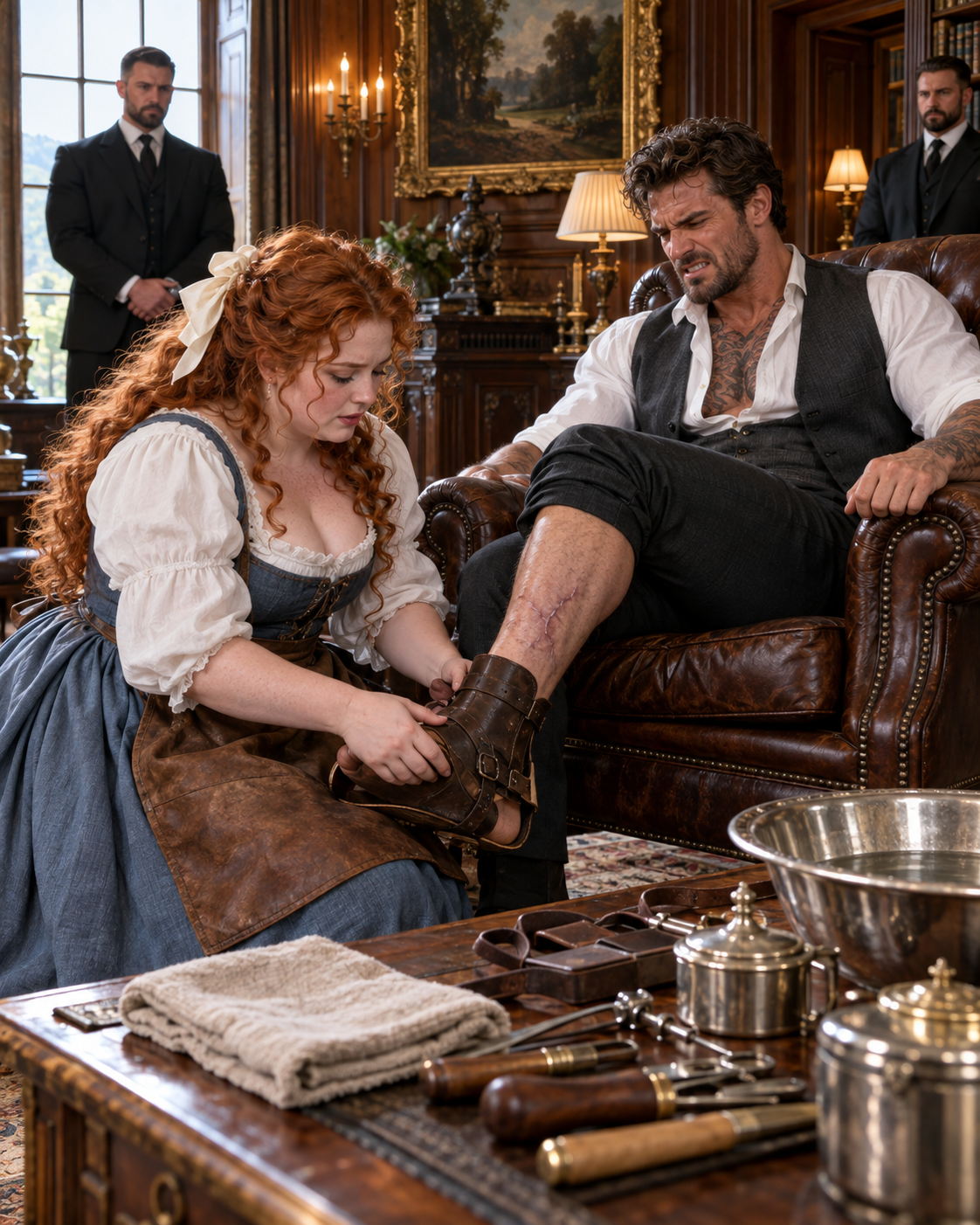
Hazel Pruitt stood frozen, her fingers pressed against the sealed envelope hidden inside her apron, while Cassian Mordred watched Roark Addison with an expression that had suddenly become impossible to read.
Outside, rain swept across the dark streets of the American city, turning the yellow light of passing taxis into trembling reflections on the pavement.
Roark glanced toward the floor.
“Expecting another customer at this hour?”
Hazel forced herself to smile.
“Old wiring,” she answered. “This building makes strange noises whenever it rains.”
Roark smiled back, but his eyes remained fixed on the loose wooden board near her feet.
Cassian shifted in the leather chair.
“Roark, I believe I asked you to remain at headquarters tonight.”
“I was concerned, sir. You left without security.”
“And since when have I needed permission to visit a shoemaker?”
The question landed harder than Cassian intended.
Roark’s expression stiffened for a fraction of a second before returning to its usual composure.
Hazel recognized that tiny change.
She had spent her entire life watching customers conceal discomfort, embarrassment, and desperation while asking her father to repair shoes they could barely afford to replace.
People often lied with their mouths.
Their bodies were far less convincing.
Roark’s right hand had moved closer to the inside of his coat.
Cassian noticed it too.
“You may leave,” he said quietly.
For several seconds, Roark did not move.
Then he looked at Hazel.
“Your father was an interesting man, Miss Pruitt.”
Hazel’s heart tightened.
“Did you know him?”
“Only by reputation.”
“That’s strange,” she replied. “He never mentioned you.”
Something cold passed through Roark’s eyes.
“Perhaps he had his reasons.”
Cassian rose from his chair.
For the first time in ten years, he stood with his weight balanced evenly between both feet.
Roark saw it.
His smile disappeared.
Cassian took one deliberate step forward.
Then another.
The silence between the three of them became almost unbearable.
“Good night, Roark,” Cassian said.
The captain finally turned toward the door.
But before leaving, he glanced at Hazel’s workbench one final time.
“Be careful what you repair, Miss Pruitt. Some broken things are better left alone.”
The brass bell rang softly as he disappeared into the rain.
Hazel waited until the black SUV pulled away before releasing the breath trapped inside her chest.
Cassian immediately locked the door.
“Whatever you found beneath that floor,” he said, “we need to see it now.”
Hazel knelt beside the loose board and reached into the hidden compartment.
The ringing had stopped.
Inside lay an old prepaid cellphone, its cracked screen displaying a single missed call.
There was no contact name.
Only a number registered to an exchange near the abandoned North River Correctional Facility.
Hazel recognized the location from her father’s documents.
The envelope in her apron suddenly felt heavier.
She placed it on the counter.
Across the front, written in her father’s unmistakable handwriting, were six words.
For Hazel, when the truth returns.
Her hands trembled as she broke the seal.
Inside were three photographs, a brass key, and a letter folded so many times that its edges had begun to split.
Cassian stood beside her without speaking.
Hazel unfolded the letter.
“My dearest Hazel,” it began.
“If you are reading this, the past has finally reached our door.”
Her father’s words blurred before her eyes.
She remembered him as a quiet man with rough hands and a patient smile, someone who could spend an entire afternoon repairing a stranger’s worn-out boots without asking for payment.
He had never seemed like a man with dangerous secrets.
But the letter told another story.
Eleven years earlier, Elias Pruitt had worked under a state contract repairing orthopedic footwear for inmates at North River Correctional Facility.
Among the orders had been a set of custom corrective boots for a seriously injured prisoner transferred under an unusual medical exemption.
That prisoner’s name had not appeared on the standard register.
Instead, he had been identified by a number.
The same number Hazel had discovered beneath the plaster cast.
Elias had been instructed to alter the footwear according to measurements supplied by a prison medical contractor.
At first, he believed he was helping a patient recover from severe injuries.
But after studying the casts, he realized the specifications would place continuous pressure on damaged joints and nerves.
The boots would not heal the man.
They would slowly prevent him from recovering.
Elias refused to complete the modifications.
Three days later, his workshop inside the prison was searched, his contract was canceled, and accusations of stealing state property were brought against him.
He had been threatened with prosecution unless he remained silent.
Hazel looked up.
“Why didn’t he go to the police?”
Cassian’s expression darkened.
“Because the people arranging those contracts were paying some of the officers.”
Hazel returned to the letter.
Elias had secretly preserved copies of the original measurements, along with the altered specifications and delivery records.
He also recorded the name of the man who had personally collected the boots.
Roark Addison.
The final paragraph nearly broke Hazel’s heart.
“I stayed silent because they threatened you, sweetheart. I thought keeping you safe meant carrying this burden alone. I was wrong. Fear can protect a person for a night, but truth is what protects them from a lifetime of darkness.”
Below those words was a final instruction.
“Find the black ledger before the man who buried it finds you.”
Hazel lowered the paper.
A tear fell onto the wooden counter.
Cassian turned away, staring through the rain-covered window.
For years, he had believed his suffering began during an attack by a rival organization.
He remembered the injuries, the surgery, the rehabilitation, and Roark’s unwavering presence afterward.
What he had never questioned was why every attempted recovery seemed to collapse just when improvement became possible.
Roark had selected his specialists.
Roark had arranged his footwear.
Roark had supervised his security.
And Roark had convinced him that the pain was permanent.
“Why?” Hazel whispered.
Cassian’s answer was barely audible.
“Because a man who cannot stand without assistance eventually learns to lean on someone else.”
The realization settled between them.
Roark had not simply betrayed Cassian.
He had manufactured dependence.
And while Cassian struggled with pain, Roark had quietly gained control over the organization’s financial accounts, transportation routes, and most trusted personnel.
Cassian reached for his phone.
Hazel caught his wrist.
“Don’t call anyone from your crew.”
He looked at her.
“If Roark has been watching you for ten years,” she continued, “how do you know which of them still answers to you?”
Cassian slowly lowered the phone.
It was the first time Hazel had seen him accept an instruction without arguing.
Then the old cellphone beneath the floorboard began ringing again.
Hazel picked it up.
Cassian shook his head, warning her not to answer.
But she had already recognized something.
The incoming number ended with the same four digits written beside her father’s final entry.
She pressed the green button.
“Hello?”
For several seconds, there was only static.
Then an elderly man’s voice emerged.
“Elias?”
Hazel closed her eyes.
“No. I’m his daughter.”
Silence.
Then a sharp intake of breath.
“Dear God,” the man whispered. “He said you might find the phone someday.”
“Who are you?”
“My name is Walter Bell. I worked in the medical records department at North River.”
Hazel looked toward Cassian.
Walter continued.
“Your father saved evidence that should have brought down half the people running that place. When he died, I thought everything was lost.”
“Where is the black ledger?”
Walter hesitated.
“Not over the phone.”
“Then where?”
“Union Station. Tomorrow morning. Eight o’clock. The old newsstand by the east entrance.”
Before Hazel could respond, Walter added something that made her blood run cold.
“And Miss Pruitt, if Roark Addison is still alive, don’t trust anyone who arrives wearing a silver horse-shaped pin.”
The line went dead.
Hazel stared at the phone.
Cassian was already examining the photographs from the envelope.
The first showed her father standing beside a prison workshop.
The second showed several men gathered outside a government building.
In the third, a younger Roark Addison stood beside a uniformed officer.
On Roark’s lapel was a tiny silver horse.
Cassian swore under his breath.
“That pin,” he said, “is worn by my senior security team.”
Hazel felt the room tilt around her.
Roark’s influence went far deeper than either of them had imagined.
By dawn, they understood that remaining at the shop would be dangerous.
Cassian contacted only one person.
A retired federal investigator named Margaret Voss, who had once pursued financial corruption cases involving North River before the investigation was unexpectedly closed.
Unlike Cassian’s associates, Margaret owed him nothing.
That was precisely why Hazel agreed to meet her.
Margaret arrived shortly after sunrise in an aging blue Chevrolet, wearing a plain raincoat and carrying a paper cup of diner coffee.
She had sharp gray eyes and the tired expression of someone who had spent too many years watching powerful people escape consequences.
After examining Elias’s letter, she looked at Hazel for a long moment.
“I knew your father.”
Hazel almost dropped her coffee.
Margaret explained that Elias had approached her years earlier with evidence of illegal medical contracts and falsified prison records.
Before he could testify, the case disappeared from federal review.
Several witnesses withdrew.
Documents were destroyed.
And Elias died in what authorities classified as an accident.
“I never believed that explanation,” Margaret admitted.
“Then why didn’t you do anything?”
The question came out sharper than Hazel intended.
Margaret accepted it without protest.
“Because I couldn’t prove otherwise. And because I was afraid of what would happen to the remaining witnesses.”
Hazel looked down at her father’s letter.
For the first time, she understood how fear could spread through an entire city without anyone raising their voice.
Cassian interrupted.
“Can you help us get the ledger?”
Margaret nodded.
“But we do this carefully. No private revenge. No armed confrontation. We collect the evidence and put it somewhere Roark cannot make it disappear.”
Cassian studied her.
“You expect me to trust the law?”
“No,” Margaret answered. “I expect you to give it evidence strong enough that ignoring it becomes impossible.”
At seven forty-five, Hazel entered Union Station.
The historic terminal was already crowded with commuters carrying briefcases, students rushing toward the platforms, and travelers stopping beneath the enormous departure board.
The smell of fresh coffee drifted from a bakery near the east entrance.
Outside, yellow taxis lined the curb.
To anyone watching, Hazel appeared to be another young woman heading to work.
She wore her father’s old brown coat and carried a canvas bag filled with ordinary shoe repair supplies.
Cassian remained several blocks away with Margaret, who had arranged for two trusted former colleagues to observe the station.
Hazel approached the old newsstand.
An elderly man wearing a navy baseball cap stood beside a rack of newspapers.
His hands trembled as he folded one of them.
“Mr. Bell?”
He looked up.
For a moment, his face softened.
“You have your father’s eyes.”
Hazel struggled to speak.
Walter handed her a newspaper.
“Don’t open it here.”
She accepted it.
“Is the ledger inside?”
“No. But the place to find it is.”
His expression changed as he looked past her shoulder.
Hazel followed his gaze.
Across the concourse, a man in a dark suit was speaking into a phone.
Something silver glimmered near his collar.
A horse-shaped pin.
Walter gripped her wrist.
“They found me.”
A sudden commotion erupted near the ticket machines when a luggage cart overturned.
Passengers stepped back.
Someone shouted for assistance.
In the confusion, Walter pushed Hazel toward a service corridor.
“Go!”
Hazel ran.
Behind her, footsteps struck the polished floor.
She turned a corner, nearly colliding with a station employee carrying cleaning equipment.
The employee pointed toward an emergency exit.
“This way!”
Hazel hesitated.
Then she saw the woman’s badge.
Margaret had arranged for assistance.
She followed the employee through a maintenance passage and emerged onto a side street beside a parking garage.
A blue Chevrolet pulled alongside the curb.
Margaret leaned across the passenger seat.
“Get in!”
Hazel climbed inside.
The car pulled away just as two men appeared at the station exit.
Only when they had crossed three intersections did Hazel unfold the newspaper.
Inside was a small photograph of a boarded-up warehouse.
On the back, someone had written an address.
Pier 17, Old Harbor District.
Below it were three words.
“Under the heel.”
Hazel stared at the message.
Then she remembered the brass key from her father’s envelope.
It had been shaped like an old-fashioned boot hook, with a tiny number engraved near the handle.
Seventeen.
Margaret drove directly to an abandoned industrial neighborhood near the river.
Cassian met them beneath the rusting steel framework of an old railway bridge.
When Hazel showed him the photograph, his face hardened.
“I know that building.”
“Who owns it?”
Cassian’s answer made the cold morning air seem even colder.
“Roark.”
The warehouse had once belonged to a shipping company that transported medical equipment to state facilities.
Official records showed it had closed nine years earlier.
But Margaret discovered that the property taxes were still being paid through a chain of shell companies.
The final account belonged to a corporation controlled by Roark’s business associates.
They could not simply enter without risking the evidence being challenged or their presence being discovered.
Margaret contacted an attorney working with investigators outside the local chain of command.
By late afternoon, they had enough supporting documentation to request a search warrant.
Meanwhile, Cassian returned to his private residence.
He knew Roark would be waiting.
And he had decided the only way to expose the betrayal completely was to let his captain believe nothing had changed.
Roark greeted him in the marble entrance hall.
“I heard there was trouble at Union Station.”
Cassian removed his gloves.
“Commuter trouble. Nothing more.”
Roark studied the way he walked.
“Your feet seem better.”
“They are.”
“Remarkable.”
Cassian gave a faint smile.
“The cobbler is remarkable.”
For a brief moment, hatred flashed across Roark’s face.
Then he recovered.
“Perhaps she should be rewarded.”
“She will be.”
Cassian walked toward his study.
Roark followed.
“There are matters requiring your signature,” the captain said. “A transfer of assets. Certain accounts would be better managed through our security division.”
Cassian took the folder.
He recognized the pattern immediately.
For years, Roark had used his pain, exhaustion, and medication schedules to persuade him to approve documents without examining every detail.
Now that the pain had eased, the pages seemed painfully clear.
The transfer would place nearly all remaining operating funds under Roark’s direct control.
Cassian closed the folder.
“No.”
Roark blinked.
“Sir?”
“I said no.”
A long silence followed.
Then Roark stepped closer.
“You’ve always trusted my judgment.”
“I trusted your loyalty.”
Roark’s mouth tightened.
“And now?”
Cassian looked him directly in the eyes.
“Now I’m learning to stand on my own feet.”
Roark said nothing.
But Cassian knew the sentence had landed exactly where he intended.
That evening, Hazel returned to the shoe shop with Margaret.
They had received word that the search warrant would be executed the following morning.
Until then, Hazel wanted to examine the final item her father had left behind.
An ordinary pair of work boots.
She had kept them for years beneath her bed, unable to throw away the last pair he had worn.
The leather was cracked.
The heels were uneven.
One lace had been replaced with a piece of brown cord.
Nothing about them appeared remarkable.
Yet Walter’s message echoed in her memory.
Under the heel.
Hazel placed the right boot on her workbench.
Using her father’s favorite awl, she carefully loosened the worn rubber heel.
A narrow compartment had been carved into the wooden support beneath it.
Inside rested a tiny brass cylinder wrapped in waxed cloth.
Hazel removed it with trembling fingers.
The cylinder contained a roll of photographic film and a handwritten index.
There were names.
Dates.
Payment records.
Prison transfer numbers.
And detailed descriptions of medical equipment orders.
The black ledger had never been a conventional book.
It was a collection of concealed records that Elias had divided into separate pieces.
The documents at Pier 17 would complete the evidence.
Margaret examined the index.
Her face became pale.
“This isn’t just about Cassian.”
Hazel looked up.
The list contained the names of prison administrators, private contractors, law enforcement officials, and executives from several medical supply companies.
For more than a decade, an organized network had used legitimate contracts to hide illegal payments and fraudulent operations.
Roark’s scheme against Cassian had been only one part of a much larger arrangement.
And Elias Pruitt had known enough to threaten all of them.
Then Hazel noticed an entry beside her father’s name.
It was dated three days before his death.
“Witness transferred to temporary protection. Location compromised.”
She slowly sat down.
Her father had not simply been hiding.
He had been preparing to testify.
Someone had revealed where he was.
Margaret looked away.
Hazel understood before she spoke.
“You knew.”
Margaret’s eyes filled with regret.
“I knew he had been moved. I didn’t know the location was compromised until afterward.”
“Who betrayed him?”
Margaret swallowed.
“We never proved it.”
Hazel held up the index.
“Maybe now we can.”
At six the following morning, investigators entered the warehouse at Pier 17.
They found filing cabinets concealed behind false walls, boxes of archived contracts, and shelves filled with medical equipment bearing prison inventory markings.
In a locked basement office, they discovered financial records linking Roark Addison to payments made through several shell companies.
But the most important discovery was a second ledger.
It contained a signature authorizing the transfer of Elias Pruitt’s protected address.
The name beside it belonged to a former corrections official who had recently become Roark’s chief financial adviser.
When Margaret called Hazel with the news, her voice shook.
“We found it.”
Hazel closed her eyes.
For years, she had imagined that learning the truth about her father’s death would bring relief.
Instead, she felt grief so sharp it almost stole her breath.
He had died because he refused to let strangers suffer.
And she had spent years believing he had simply been unlucky.
Across town, Roark received a telephone call informing him that the warehouse had been searched.
His carefully constructed empire began collapsing before breakfast.
He ordered his associates to destroy files and empty accounts.
But several had already been detained.
Others had agreed to cooperate.
The phones he had relied on for years suddenly stopped ringing.
Cassian was waiting when Roark entered his study.
The captain looked exhausted.
For once, his polished appearance had begun to unravel.
“You’ve been busy,” Roark said.
Cassian stood beside the fireplace.
“So have you.”
Roark laughed bitterly.
“Do you have any idea how much I’ve done for you?”
“I know exactly what you did.”
Roark’s expression changed.
Cassian stepped forward without hesitation.
Ten years earlier, that movement would have been followed by a grimace of pain.
Now his feet remained steady.
“You made sure I never recovered,” Cassian said.
Roark’s eyes flickered.
“You can’t prove that.”
“The medical records say otherwise.”
Roark looked toward the door.
Cassian continued.
“You arranged the altered footwear. You controlled my treatments. You built an empire while convincing me I needed your help to survive.”
Roark’s jaw tightened.
“You needed someone strong enough to run things.”
“You mistook suffering for weakness.”
The captain gave a harsh laugh.
“Everything you have, I helped build.”
“And everything you stole, you built on lies.”
Roark reached inside his coat.
Cassian did not move.
“Don’t.”
For an instant, the entire room seemed suspended between two possible endings.
Then Roark looked toward the windows.
Vehicles had entered the driveway.
Not Cassian’s vehicles.
Unmarked government sedans.
Roark understood.
“You called them?”
Cassian’s expression remained calm.
“I gave them what they needed.”
“You would hand your own captain over to investigators?”
“You stopped being my captain the day you chose to destroy me.”
Roark slowly withdrew his empty hand.
The study doors opened.
Margaret entered with federal investigators and a warrant.
Roark looked at Cassian one last time.
“You think this makes you innocent?”
Cassian shook his head.
“No. And I intend to answer for my own choices too.”
That answer seemed to surprise Roark more than the arrest itself.
Because Cassian had finally understood something power had never taught him.
A betrayal did not erase his own responsibility.
And justice was not the same thing as revenge.
In the months that followed, the city watched a sprawling investigation unfold.
The evidence recovered from Pier 17 led to charges against corrupt contractors, former prison administrators, and several members of Roark’s organization.
Some defendants cooperated.
Others fought the allegations in court.
The financial network that had protected Roark began to disintegrate under the weight of records no one could easily dismiss.
Cassian also faced scrutiny for his own illegal operations.
He accepted legal counsel, surrendered records, and began separating his legitimate businesses from the organization he had once controlled.
It was neither quick nor comfortable.
But for the first time in many years, he stopped believing that power meant escaping consequences.
Hazel testified about her father’s work and the records he had preserved.
Standing inside the federal courthouse, beneath the carved stone pillars and the American flag hanging near the judge’s bench, she felt her knees tremble.
Then she remembered the old man who had taught her to repair a shoe rather than throw it away.
She remembered his patience.
His quiet courage.
And the letter he had left behind.
When the attorney asked why she had continued investigating despite the danger, Hazel answered simply.
“Because my father believed that knowing something was wrong meant you had a responsibility not to ignore it.”
The courtroom fell silent.
Outside, reporters gathered on the courthouse steps.
But Hazel walked past them without stopping.
She had no desire to become famous.
She wanted to go home and open her shop.
Three months later, the little storefront on Mercer Street looked different.
The peeling paint had been replaced with a warm cream color.
The broken window had been repaired.
A new sign hung above the entrance.
PRUITT & DAUGHTER — FINE SHOE REPAIR AND ORTHOPEDIC CRAFTSMANSHIP
Beneath the lettering was a smaller inscription.
Established with honest hands.
Hazel had refused Cassian’s initial offer to purchase the entire building in her name.
She did not want her father’s legacy to become another possession controlled by a powerful man.
Instead, they reached a different arrangement.
Through one of his legitimate companies, Cassian provided a documented business loan with fair terms, while Hazel retained full ownership and control of her shop.
She used the money to restore the workshop and purchase specialized equipment for customers with difficult foot conditions.
She also began offering low-cost repairs to people who could not afford expensive orthopedic footwear.
Warehouse workers.
Retired veterans.
Nurses who spent twelve-hour shifts standing.
Older customers whose aching feet had quietly shaped every part of their lives.
Hazel never forgot what a poorly fitted shoe had done to Cassian.
But she remembered something else.
The right pair of shoes could change how a person moved through the world.
One autumn afternoon, Cassian visited the shop without security.
He wore an ordinary dark coat and carried a paper bag from the bakery across the street.
Hazel looked up from her workbench.
“You’re late.”
Cassian smiled.
“I had an appointment.”
“With whom?”
“My physical therapist.”
Hazel raised an eyebrow.
“And?”
“He says I’ve made excellent progress.”
She pointed toward the examination chair.
“Then take off your shoes. Let’s see whether he’s right.”
Cassian obeyed.
As Hazel examined the soles, she noticed the even wear along both heels.
His posture had improved.
His balance was stronger.
The lingering pain had not vanished entirely, but it no longer ruled his life.
Cassian looked around the shop.
“You know, I once thought money could fix anything.”
Hazel continued working.
“And now?”
“Now I know money can buy an expensive pair of shoes without buying a single person who understands how to make them fit.”
Hazel laughed softly.
“My father would have liked that.”
Cassian’s smile faded.
“I wish I’d met him under different circumstances.”
“So do I.”
They sat quietly for a moment.
Then Cassian reached inside his coat and placed a small wooden box on the counter.
Hazel stiffened.
“What’s that?”
“Something recovered from the evidence warehouse. The investigators cleared it for release.”
Inside was her father’s old leatherworking stamp.
The wooden handle was worn smooth.
The metal letters still read E. PRUITT.
Hazel picked it up.
For several seconds, she could not speak.
Then tears slipped down her cheeks.
“I thought this was gone.”
Cassian watched her.
“Some things deserve to find their way home.”
Hazel pressed the stamp against her palm.
In that moment, the years of uncertainty seemed to soften around her.
Her father was still gone.
Nothing could change that.
But his work had survived.
His truth had survived.
And the hands he had trained were still building something good.
As the city moved toward winter, Hazel’s shop became a familiar refuge on Mercer Street.
People came for repairs, advice, and sometimes simply a conversation.
She hired two apprentices from a local vocational school and taught them the techniques her father had passed down.
She insisted they learn to examine a customer’s feet before recommending expensive changes.
“Never forget,” she told them, “a person is the reason the shoe matters.”
Cassian continued visiting.
Not as a syndicate king demanding obedience.
Not as a man looking for someone to carry his burdens.
But as a customer learning to live differently.
He had begun funding an independent rehabilitation program for people injured while working in dangerous industries, with outside administrators controlling the money and oversight.
It could not undo his past.
He knew that.
But Hazel believed meaningful change was measured by what a person consistently chose to do next.
One December evening, snow began falling over the city.
Hazel was preparing to close when a delivery driver entered carrying a narrow parcel wrapped in plain brown paper.
“No return address,” he said.
“Who sent it?”
“Don’t know, ma’am. Just says to deliver it personally.”
Hazel signed the receipt.
The parcel was unusually light.
She placed it on the counter and examined the wrapping.
A small symbol had been pressed into the paper.
A silver horse.
Her heartbeat quickened.
Roark was awaiting trial, and his known associates were under investigation.
Yet the symbol was unmistakable.
Hazel reached for her phone, then stopped.
She remembered the fear that had ruled her father’s life.
She also remembered how fear had nearly kept her from discovering the truth.
She did not open the parcel alone.
Instead, she called Margaret and arranged for it to be examined safely.
Inside was a single piece of dark leather, cut into the shape of a shoe sole.
Stamped into its surface was a line of numbers.
Margaret compared them against the recovered records.
They matched an account absent from the original investigation.
An account connected to financial transfers made years before Roark gained control.
Beneath the numbers was a handwritten sentence.
The captain was never the only one.
For a long moment, Hazel stared at the photograph Margaret sent her.
The words suggested that parts of the network might still exist beyond the people already charged.
But this time, Hazel was not alone.
The records were no longer hidden beneath floorboards.
The authorities knew what to look for.
And those who had once relied on silence could no longer assume that their secrets would remain buried.
Hazel looked across her little shop.
Her father’s tools hung neatly above the workbench.
The newly repaired shoes of ordinary customers waited on wooden shelves.
Through the front window, snowflakes drifted beneath the warm glow of American streetlights.
For a moment, she imagined her father standing beside her.
She could almost hear his voice.
“Every good repair begins with finding where the damage really is.”
Hazel smiled through her tears.
Then she placed the leatherworking stamp back in its wooden box.
Tomorrow, she would share the new information with the investigators.
Tonight, she had one final pair of shoes to finish.
They belonged to a little boy whose mother had explained that he could not walk comfortably to school.
Hazel had promised to adjust them before morning.
She sat at her workbench, switched on the lamp, and began stitching.
Beyond the windows, the city still carried secrets, ambitions, and people willing to hurt others for power.
Perhaps it always would.
But there would also be people like Elias Pruitt, who refused to make something harmful merely because someone powerful had ordered it.
There would be people like Margaret, willing to return to an unfinished fight.
There would be people like Cassian, discovering that strength meant taking responsibility rather than controlling everyone around him.
And there would be people like Hazel, whose greatest weapon had never been money, influence, or fear.
It was her ability to see what others overlooked, combined with the courage to act on what she found.
She finally understood that her father had left her something far more valuable than a shoe repair shop.
He had left her a way of living.
A belief that honest work mattered.
That small acts of care could change the course of another person’s life.
And that even the deepest damage could become the beginning of healing when someone was brave enough to face its true cause.
Hazel finished the little boy’s shoes shortly before midnight.
She placed them carefully inside a cardboard box and wrote his name across the lid.
Then she turned off the workbench lamp.
Above the counter, her father’s old sign caught the final glow of the streetlights.
GOOD WORK LEAVES GOOD FOOTPRINTS.
For the first time since his death, Hazel read those words without feeling only sorrow.
She felt purpose.
And when she stepped outside into the falling snow, locking the shop behind her, she knew the future would not always be safe, predictable, or kind.
But it would be hers to choose.
Because the greatest victory was never simply exposing the people who had caused the pain.
It was refusing to let that pain decide what kind of person she would become.
And somewhere in the quiet American city, as the first snow covered the footprints of the day, a young cobbler walked toward home with steady steps, carrying forward the legacy of a father whose courage had finally found its voice.
THE END.