For ten years, Clara had learned how to disappear while standing in the middle of a house that was supposed to be her home.
The first thing Edmund did was stand completely still.
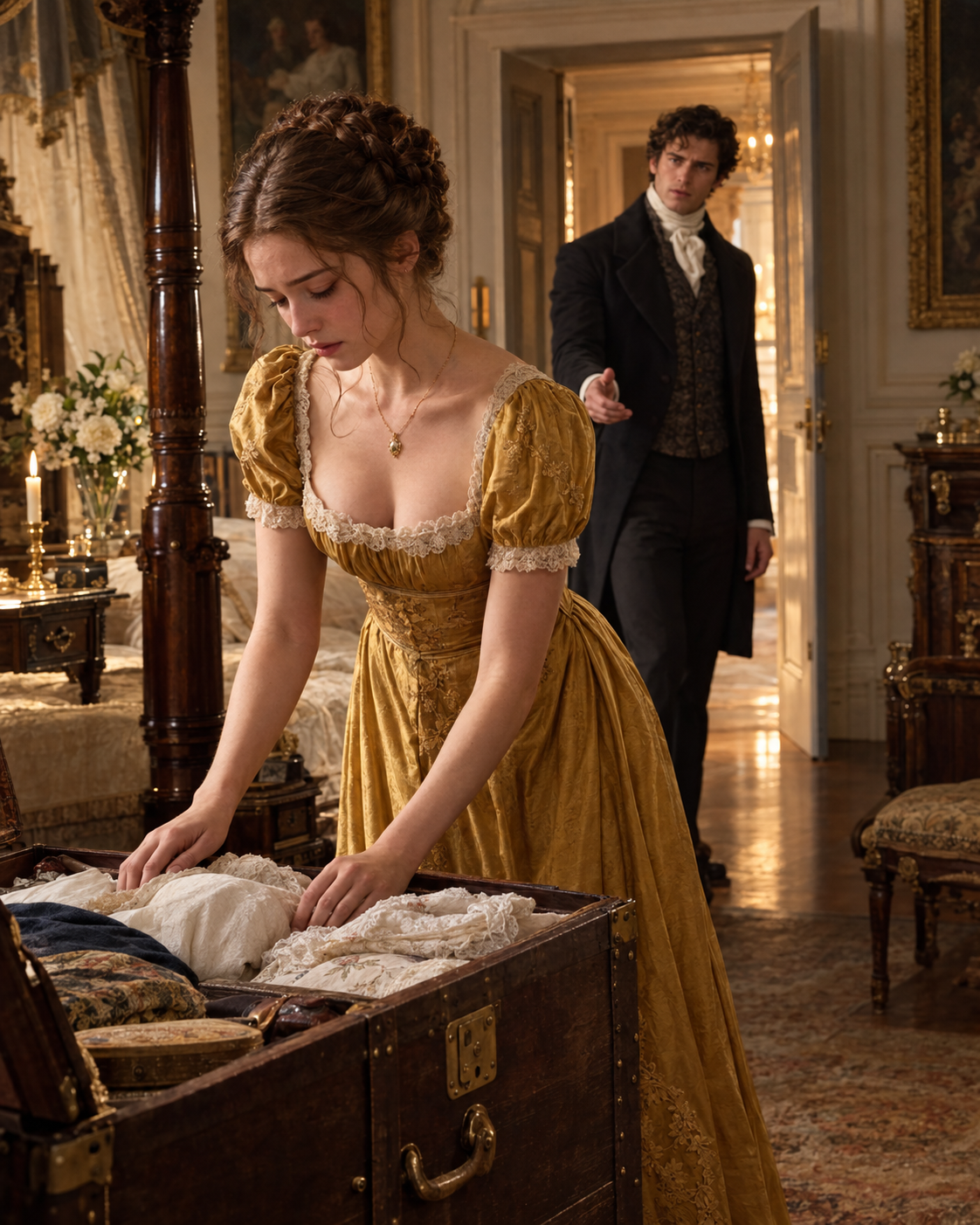
The bedroom at Ashcom Hall looked almost exactly as it had the night before. The curtains were half drawn. A fire had burned down to a bed of gray embers. Clara’s blue shawl still rested over the back of a chair, as though she might return for it before breakfast.
But she was gone.
On the small writing table beside the window lay the three objects he could not stop looking at.
The wedding ring.
The nursery key.
And the blank sheet of paper.
Edmund picked up the ring first.
It was warm from the room, yet somehow it felt colder than anything he had ever held.
He remembered the day Clara had received it. He remembered the photographs, the flowers, the endless congratulations, and his mother’s carefully measured smile.
What he could not remember was what Clara had said to him that evening.
That realization unsettled him.
He searched the room again, opening drawers and cupboards as though she might have left behind some explanation hidden among ordinary things.
There was nothing.
Then he noticed the desk.
A drawer stood slightly open.
Inside was a bundle of envelopes tied with faded blue ribbon.
There were twelve.
His name was written on every one.
Edmund sat down before opening the first.
The letter was dated three years earlier.
She began simply.
I am writing this because I do not know how to tell you when you are looking at me.
Edmund stopped reading.
He looked toward the empty chair.
Then he continued.
The first letter did not accuse him of cruelty. It did not describe Lady Margaret’s sharp remarks or the occasions when Clara’s decisions had been quietly reversed.
Instead, Clara wrote about loneliness.
She wrote about mornings when Edmund left before she woke.
About dinners where he sat beside her but spent most of the evening discussing estate matters.
About moments when she had tried to tell him something important and watched his attention drift toward whatever problem seemed more urgent.
The second letter was harder.
The third made him put the pages down.
By the sixth, Edmund had stopped trying to defend himself.
By the ninth, he understood that Clara had not been asking him to rescue her.
She had been asking him to notice her.
The twelfth letter was the shortest.
If you ever find these, I hope it means you finally noticed the silence.
Edmund lowered the pages.
For the first time in ten years, he understood that Clara’s departure had not happened that morning.
It had happened gradually.
Every unanswered question had been a small departure.
Every conversation interrupted had been another.
Every time he had told himself that Clara was simply quiet, another door had closed between them.
He had mistaken endurance for contentment.
And now the house was silent enough for him to hear his mistake.
Lady Margaret arrived before nine.
She entered without knocking.
“What exactly has happened?”
Edmund looked at her.
“Clara has left.”
His mother barely reacted.
“Then she will return.”
“No.”
The word surprised them both.
Margaret’s expression tightened.
“You cannot mean that.”
“I mean that I don’t know whether she will return.”
“Edmund, think carefully. If she has made some emotional gesture, the sensible thing is to give her time and avoid feeding the drama.”
He held up the letters.
“What do you call this?”
Margaret glanced at the pages.
“I call it evidence of her unhappiness.”
“You knew?”
“I suspected she was unhappy.”
“For how long?”
Margaret said nothing.
Edmund’s voice became quieter.
“How long did you know?”
His mother looked toward the window.
“Women sometimes become dissatisfied when life does not conform to their expectations.”
It was the kind of sentence that had ended arguments in their family for generations.
But this time, Edmund did not let it end anything.
“That isn’t an answer.”
Margaret turned sharply.
“You are allowing one woman’s emotions to destabilize an entire family.”
“No,” Edmund said. “I am finally allowing my wife to have emotions.”
The silence that followed was different from Clara’s silence.
This one was uncomfortable.
Margaret left without another word.
By noon, the first calls had begun.
Friends wanted explanations.
Staff wanted instructions.
Lawyers wanted to know whether the family should issue a statement.
Edmund refused all of them.
There would be no public accusation.
No suggestion that Clara had behaved irrationally.
No attempt to turn her departure into a social contest.
When one adviser suggested that a carefully worded statement could protect the family’s reputation, Edmund answered, “Her reputation is not a family asset.”
That sentence traveled farther than he intended.
Within days, rumors began circulating through the American social circles the family had cultivated during years of charitable events, university dinners, and foundation meetings.
Some said Clara had suffered a breakdown.
Others suggested she had abandoned her responsibilities.
A few claimed she had become obsessed with an education project.
Edmund corrected none of the gossip individually.
Instead, he did something far more difficult.
He told the truth.
“My wife has asked for space,” he said at a small gathering in Boston. “I will respect that.”
No excuses.
No blame.
No attempt to make himself the victim.
It was the first public defense of Clara that did not require him to speak over her.
Meanwhile, Clara had arrived in Vermont.
She rented a modest house near a town where she had once attended a summer educational conference. It was nothing like Ashcom Hall.
There were no formal corridors.
No portraits.
No servants waiting outside doors.
The kitchen window looked over a narrow road lined with maple trees.
On her first morning there, Clara made coffee herself.
She stood by the window holding the mug with both hands.
For several minutes, she felt frightened.
Then she felt something else.
Relief.
Not because she hated Edmund.
Not because she had stopped caring.
But because for the first time in years, every decision in front of her belonged to her.
Her solicitor had already explained the practical matters.
Her finances were secure.
Her legal position was stronger than she had been led to believe.
She did not need permission to establish a foundation.
She did not need the family name to make the work legitimate.
She only needed to begin.
And so she did.
The West Riding Educational Access Network started with a borrowed office, two folding tables, three volunteers, and a handwritten list of schools and community organizations.
Its purpose was simple: help children from tenant and working families gain access to educational resources, tutoring, scholarships, transportation, and opportunities that wealthier families often took for granted.
Clara refused to make the project a monument to herself.
Her name appeared nowhere on the entrance.
She wanted the children to see the organization as something built for them, not something owned by a duchess.
The first meeting was held in a community center outside Burlington.
There were eleven parents.
Then twenty-three.
Then nearly forty.
One father spoke about his daughter, who was brilliant at mathematics but had no reliable transportation to an advanced program.
A mother described how her son had stopped asking for books because he had learned not to expect them.
Clara listened.
Really listened.
It was something she had spent years wishing someone would do for her.
She discovered that listening was not passive.
It could be the beginning of change.
Back at Ashcom Hall, Edmund began changing too.
Not dramatically.
Not in ways that would make good newspaper stories.
He simply began doing the things Clara had once asked him to do.
He read the letters again.
He met with the estate managers.
He reviewed the educational provisions available to tenant families.
He asked questions he should have asked years earlier.
And when his mother objected, he did not argue loudly.
He simply stopped allowing her preferences to become decisions.
Lady Margaret tried different approaches.
First came concern.
Then disappointment.
Then warnings about appearances.
Finally came anger.
“You are dismantling traditions you do not understand.”
Edmund answered, “Some traditions deserve to survive. Others only survive because nobody questions them.”
Margaret stared at him.
“Is this all because of Clara?”
“No,” he said. “Clara showed me what I refused to see.”
That distinction mattered.
He was no longer trying to win Clara back with promises.
He was trying to become a man whose promises meant something.
Months passed.
Clara expanded the education network into several communities.
She worked with teachers, librarians, transportation groups, and scholarship advisers.
When someone suggested using the Ashcom name to attract wealthy donors, she declined.
“Let the work stand on its own.”
Then one winter afternoon, a letter arrived.
It was from Edmund.
Only two pages.
He did not ask her to come home.
He did not say he was suffering.
He did not mention loneliness.
Instead, he wrote about a small education fund he had established for tenant children without attaching the family name to it.
He described the changes being made at Ashcom Hall.
He acknowledged that some of those changes should have happened years earlier.
And at the end, he wrote:
I do not expect forgiveness because I have finally learned what I should have known before. I only want you to know that I am listening now, whether or not you ever come back.
Clara read the letter twice.
Then she folded it carefully.
She did not answer.
Not yet.
Spring came.
Then summer.
Her work grew.
The network received support from educators in several states.
A small scholarship program helped students attend specialized programs.
A traveling library began visiting rural communities.
Clara attended meetings without titles.
Sometimes people recognized her.
Sometimes they did not.
She preferred the latter.
One evening, after a long meeting, Clara returned home to find Edmund standing outside.
He was alone.
No driver.
No staff.
No entourage.
He looked tired.
Older.
But different.
“You shouldn’t have come without telling me,” she said.
“I know.”
“Why are you here?”
“To return something.”
He held out a small velvet box.
Clara did not take it.
“I left that behind.”
“I know.”
“You could have kept it.”
“I could have.”
She looked at him for a long moment.
“Why didn’t you?”
“Because it belongs to you.”
The box contained her wedding ring.
Clara closed her eyes briefly.
“I don’t know what you want from me.”
“Nothing tonight.”
He placed the box on the porch railing.
“I came because I wanted to say something where you could see my face.”
She waited.
“I loved you,” he said. “But I treated love as though feeling it was enough. It wasn’t.”
Clara said nothing.
“I thought providing a comfortable life meant I was being a good husband. I thought avoiding conflict meant I was protecting you. I thought my mother’s certainty was wisdom because it was easier than questioning her.”
He swallowed.
“I was wrong.”
The words were simple.
There was no grand speech.
No dramatic promise.
That was precisely why Clara believed him.
She still did not take the ring.
“Change isn’t a sentence you say once.”
“I know.”
“Then don’t tell me you’ve changed.”
“I won’t.”
“Show me.”
Edmund nodded.
“I will.”
He left the ring and walked back toward the road.
Clara watched until he disappeared.
That night, she opened the velvet box.
She touched the ring but did not put it on.
Not yet.
Over the following months, she watched.
Edmund continued the education program.
He refused to let the estate use Clara’s name without her consent.
When journalists asked about their marriage, he redirected attention toward the educational work.
When Lady Margaret attempted to characterize Clara’s departure as selfishness, Edmund publicly disagreed without humiliating his mother.
And most importantly, he stopped asking when Clara was coming home.
That was the change she noticed most.
He had finally understood that returning was her decision.
Not his entitlement.
Nearly a year after Clara left Ashcom Hall, she received an invitation.
Not from Edmund.
From the children.
They had created a small exhibition about their educational projects.
One of the students had written a note:
Thank you for making room for us.
Clara cried when she read it.
She decided to return to Ashcom Hall for one weekend.
Not as a wife reporting home.
Not as a duchess fulfilling an obligation.
As Clara.
When she arrived, Edmund was waiting in the entrance hall.
He did not reach for her.
He simply smiled.
“Welcome.”
Clara looked around.
The house was still the same house.
The stone walls.
The portraits.
The long staircase.
But something felt different.
Not because the building had changed.
Because she had.
They walked into the library.
On the table was a folder.
“What is that?”
“An agreement.”
She opened it.
It outlined her independent financial arrangements, the governance of the education initiative, and clear boundaries regarding family involvement.
She looked at Edmund.
“You prepared this?”
“With your solicitor.”
“You agreed to everything?”
“I agreed to what you asked for.”
She studied him.
“And if I don’t come back permanently?”
“I’ll respect that.”
“And if I do?”
“Then we begin again.”
“From the beginning?”
“From the truth.”
Clara looked toward the window.
For ten years, she had imagined a moment when someone would finally rescue her from the life she had been living.
She realized now that rescue had never been what she needed.
She needed room.
Room to speak.
Room to work.
Room to disagree.
Room to be loved without being absorbed into someone else’s expectations.
She turned back to Edmund.
“I will come back.”
His face changed, but he remained still.
“On my terms.”
“Yes.”
“And I won’t be the woman I was before.”
“I don’t want you to be.”
She finally smiled.
“Good.”
That evening, they ate dinner at a small table rather than the grand dining room.
No guests.
No speeches.
No family politics.
They talked for hours.
Not about titles.
Not about appearances.
About books.
About children.
About mistakes.
About the future.
For the first time, Edmund did not try to solve everything Clara said.
Sometimes he simply listened.
And sometimes Clara simply spoke.
Their marriage was not magically repaired that night.
There were still old wounds.
There would be difficult conversations.
There would be moments when old habits tried to return.
But this time, they had something they had never truly possessed before.
Honesty.
Clara did not return because she had forgotten the ten years of neglect.
She returned because she could finally imagine a future in which those ten years would not define the rest of her life.
Edmund did not regain his wife by persuading her.
He earned the possibility of rebuilding a partnership by respecting the woman who had once been standing beside him, asking quietly to be seen.
Lady Margaret never fully understood the change.
Perhaps she never would.
But her influence was no longer the invisible force governing every decision at Ashcom Hall.
The estate continued.
The family continued.
Life continued.
But the old order had cracked.
And through that crack came something better than obedience.
Choice.
Years later, when students from the West Riding Educational Access Network returned to visit the estate, Clara stood outside the library and watched them laughing across the lawn.
One of them asked her why she had started the program.
She thought for a moment.
“Because I learned what happens when people are not given a chance to be heard.”
The student nodded, then ran back to the others.
Edmund stood beside her.
He did not interrupt.
He never interrupted anymore.
Clara glanced at him and smiled.
The blank page she had left behind on the morning she departed had once seemed like an ending.
It was not.
It had been an invitation to begin writing a different life.
And perhaps that was the quiet lesson hidden inside everything that happened at Ashcom Hall:
Sometimes leaving is not about abandoning the people you love.
Sometimes it is about refusing to abandon yourself.
And sometimes the most meaningful second chance does not begin when someone comes back.
It begins when both people finally understand that love cannot survive on silence, duty, or appearances alone.
It needs honesty.
It needs freedom.
And above all, it needs two people willing to truly see each other.
For the first few weeks after Clara returned, nothing felt certain.
She slept in her old room, but she kept the key to the guest wing on the table beside her bed.
It was a small thing, almost meaningless to anyone else.
To Clara, it mattered.
It reminded her that returning had not meant surrendering the independence she had fought so hard to reclaim.
Edmund understood.
He never asked why she kept the key there.
He never asked when she would consider the house completely hers again.
Instead, he learned to live with uncertainty.
For a man who had once believed every problem could be solved by deciding what should happen next, that uncertainty was its own education.
Their mornings changed first.
Before, breakfast at Ashcom Hall had been a formal affair governed by schedules and expectations.
Now, Clara often entered the kitchen herself.
Sometimes Edmund was already there, reading reports.
Sometimes he was making coffee badly.
The first time Clara saw him burn toast, she laughed.
It was the first genuine laugh he had heard from her in months.
“You’ve managed to burn both sides,” she said.
Edmund looked at the toast.
“I thought consistency was important.”
Clara laughed again.
For a moment, the years between them seemed lighter.
But neither pretended that laughter erased the past.
There were still difficult conversations.
One evening, Clara told him about a particular dinner from their third year of marriage.
She remembered trying to explain that she felt invisible in his family.
She remembered Edmund answering that his mother “meant well.”
“I remember that conversation,” he said.
“I don’t.”
“You don’t?”
“I remember the feeling. Not the exact words.”
Clara looked at him.
“That is the difference.”
He nodded slowly.
“You remember what happened to you. I remember what I thought I was solving.”
The honesty hurt.
But it also helped.
For the first time, they were not fighting about who had been right.
They were trying to understand what had actually happened.
Meanwhile, Clara’s education network continued to expand.
What had started with a handful of volunteers now connected schools, libraries, local organizations, and scholarship programs across communities on both sides of the Atlantic.
The work remained close to her heart.
She traveled frequently to the United States.
She attended meetings in Boston, Vermont, Pennsylvania, and New York.
She spoke with teachers.
She sat with parents.
She listened to students describe what they wanted to become.
Edmund never complained about the travel.
When her schedule became difficult, he simply asked, “What do you need?”
Sometimes she needed money.
Sometimes she needed transportation.
Sometimes she needed him to stay out of the way.
He learned that supporting someone did not always mean standing beside them.
Sometimes it meant making room.
One autumn, Clara received an unexpected invitation to speak at an education conference in New York.
The organizers wanted to introduce her by her title.
She declined.
“Please introduce me as Clara.”
When Edmund heard, he smiled.
“Good.”
“You aren’t offended?”
“Why would I be?”
“Because you’re a duke.”
He shrugged.
“I know who I am without needing everyone else to say it.”
Clara looked at him for a long moment.
“That may be the most sensible thing you’ve ever said.”
He smiled.
“I’ve been practicing.”
The conference changed everything.
Clara spoke for twenty minutes about access, opportunity, and the quiet barriers that kept talented children from reaching the classrooms they deserved.
She did not speak about Ashcom Hall.
She did not speak about her marriage.
She did not tell the audience about the twelve letters.
But at the end, a student approached her.
She was seventeen and had received one of the network’s first scholarships.
“I almost didn’t apply,” the girl said.
“Why?”
“Because I thought programs like that were for people who already belonged.”
Clara felt something tighten in her chest.
“What made you apply?”
The girl smiled.
“You did.”
That evening, Clara sat alone in her hotel room and cried.
Not because she was sad.
Because she finally understood that the life she had built after leaving was not merely an escape.
It had become something useful.
Something larger than her pain.
When she returned to England, Edmund was waiting at the station.
He did not bring flowers.
He knew Clara disliked public gestures.
Instead, he carried her suitcase.
“You look exhausted,” he said.
“I am.”
“Did it go well?”
“Very.”
She smiled.
“Something happened.”
He waited.
“A student told me she applied because of me.”
Edmund looked at her.
“How did that feel?”
Clara thought about it.
“Like maybe the worst years of my life don’t get to decide what those years mean.”
He nodded.
“They don’t.”
Winter came early that year.
Snow covered the fields surrounding Ashcom Hall.
One morning, Clara found Lady Margaret standing alone in the conservatory.
The older woman had changed.
Age had softened some of the sharpness in her face, but not her pride.
For several seconds neither spoke.
Then Margaret said, “I owe you an apology.”
Clara was not prepared for that.
She remained silent.
“I don’t expect you to accept it.”
“I don’t know what to say.”
“You don’t have to say anything.”
Margaret looked through the glass at the snow.
“I thought control was responsibility.”
Clara listened.
“I thought Edmund needed someone to protect him from making mistakes. I thought you were trying to change things you didn’t understand.”
She paused.
“Perhaps I was protecting myself.”
Clara looked at her.
“From what?”
“From becoming unnecessary.”
The admission was so quiet that Clara almost missed it.
For the first time, she saw not the imposing woman who had dominated Ashcom Hall, but someone who had built her identity around being needed and had never learned how to step aside.
“I was wrong,” Margaret said.
Clara breathed slowly.
“I won’t pretend nothing happened.”
“I know.”
“And I won’t go back to how things were.”
“I know that too.”
Margaret nodded.
“Then perhaps we understand each other.”
It was not reconciliation.
Not yet.
But it was a beginning.
That spring, Margaret made one final decision.
She transferred control of several charitable trusts to an independent board.
The education fund became one of them.
Clara was invited to serve, but she insisted that no family member should have unilateral control.
Margaret agreed.
It was perhaps the first time the two women had made a decision together without one trying to dominate the other.
Years earlier, such a moment would have been unimaginable.
Now it felt almost ordinary.
And that was its own kind of victory.
By the fifth year after Clara’s departure, Ashcom Hall looked different.
Not physically.
The portraits remained.
The stone remained.
The long corridors remained.
But the atmosphere had changed.
The estate hosted teachers instead of only formal dinners.
Children visited the library.
Scholarship recipients attended summer programs there.
The old nursery, once a painful symbol of Clara’s loneliness, had become a reading room.
On the wall above the shelves was a simple inscription:
Every child deserves a door that opens.
Clara had chosen the words.
Edmund had built the shelves.
Neither put their names beneath it.
One afternoon, a group of students gathered in the reading room.
Among them was the young woman who had once told Clara she had nearly been too afraid to apply for a scholarship.
She was now studying at a university in the United States.
“I came back to say thank you,” she told Clara.
Clara smiled.
“You don’t owe me anything.”
“I know.”
The girl paused.
“That’s why I wanted to say it.”
Clara laughed softly.
“Then thank you for telling me.”
The student left.
Edmund watched her go.
“Do you ever think about that morning?”
Clara knew exactly which morning he meant.
“The blank page?”
“Yes.”
“Sometimes.”
“What would you write on it now?”
Clara considered the question.
She looked around the reading room.
At the shelves.
At the children.
At the sunlight coming through the windows.
Then she answered.
“I think I would write, ‘Begin.'”
Edmund smiled.
“Just one word?”
“One word is enough when you finally know what it means.”
He took her hand.
She let him.
Not because she had forgotten the years when he had failed her.
But because she no longer needed to punish either of them for having been imperfect.
They had built something different.
Not a perfect marriage.
A conscious one.
A marriage where disagreement was allowed.
Where silence was not mistaken for agreement.
Where love was not used as an excuse for control.
Where either person could say, “I need space,” without fearing abandonment.
And where returning did not mean going backward.
One summer evening, they walked across the lawn after dinner.
The sky above Ashcom Hall was turning gold.
Clara stopped near the old oak tree.
“Do you know what I used to think?”
“What?”
“That if I ever left this place, I would never come back.”
Edmund looked at her.
“Why did you?”
“Because I wanted to know whether this could become a home.”
He waited.
“And?”
Clara looked at the house.
“It can.”
He smiled.
“But not because it was waiting for me.”
“No.”
“Because we changed it.”
She nodded.
“Because we changed ourselves.”
The wind moved through the branches.
For a moment, neither spoke.
Then Clara said, “There is something I want to do.”
“What?”
“I want to remove the old bell from the nursery corridor.”
Edmund frowned.
“Why?”
“It always frightened me.”
“The bell?”
“It meant someone was calling for me. I never knew whether I was supposed to answer as a wife, a duchess, or someone else’s idea of what I should be.”
Edmund smiled.
“What would you replace it with?”
“A doorbell.”
He laughed.
“That seems reasonable.”
“It is.”
They replaced the bell the following week.
It was a small change.
Almost absurdly small.
But Clara loved it.
No longer did a bell summon her.
Someone had to knock.
And she could decide whether to open the door.
That became a private joke between them.
Whenever Edmund approached her study, he knocked.
Even when the door was open.
Especially when it was open.
Clara would look up and say, “Come in.”
And somehow those two ordinary words carried everything they had learned.
Permission.
Respect.
Choice.
The years continued.
Their lives became quieter.
The scandal that had once seemed inevitable faded into history.
People stopped asking where Clara had gone.
They stopped asking why she had left.
Eventually, most people stopped caring.
And Clara was grateful.
Because the story had never really been about scandal.
It had been about a woman discovering that being loved was not enough if she was never allowed to exist fully inside that love.
It had been about a man discovering that providing was not the same as understanding.
And it had been about a family learning that tradition could not justify every silence.
On the tenth anniversary of the morning Clara left, she woke before dawn.
She walked through the quiet corridors of Ashcom Hall.
The house was dark.
For a moment, she stood outside the bedroom where she had once left the ring.
Then she continued downstairs.
In the library, she opened a drawer.
Inside was the original blank page.
Edmund had preserved it.
He had never framed it.
Never displayed it.
He had simply kept it.
Clara touched the paper.
It was still blank.
Edmund appeared in the doorway.
“I wondered if you’d come here.”
“You kept it.”
“I couldn’t throw it away.”
“Why?”
“Because it reminds me that sometimes a blank page is the most honest thing a person can leave behind.”
Clara smiled.
She took a pen.
“What are you doing?”
“Finishing it.”
She turned the page over.
On the back, she wrote a single sentence.
Then she handed it to him.
He read it.
His eyes softened.
“What does it say?”
“You know.”
“I want to hear you say it.”
Clara looked directly at him.
“I chose to come back.”
Edmund nodded.
Not “you came back.”
Not “I brought you back.”
Not “you forgave me.”
I chose.
That distinction contained the entire journey.
Outside, the first light of morning appeared beyond the hills.
Clara opened the curtains.
The same dawn that had once marked her departure now illuminated the room where she stood.
The symbolism was not lost on either of them.
But neither made a speech about it.
They simply watched the sun rise.
Later that morning, Clara left for a meeting with the education network.
Edmund returned to the estate office.
Their lives moved forward.
Not dramatically.
Not perfectly.
Just honestly.
And perhaps that was the most meaningful ending their story could have.
Because Clara had once believed she needed to escape Ashcom Hall to find herself.
In the end, she discovered something more complicated.
She had needed to leave the version of herself that had been created by other people’s expectations.
Only then could she decide what home meant.
Only then could Edmund learn that loving someone meant allowing them to remain fully themselves.
And only then could Ashcom Hall become something other than a place where Clara had endured.
It became a place where she chose to stay.
The blank page was never really empty.
It carried every word Clara had been unable to say.
It carried every question Edmund had failed to ask.
It carried the courage of a woman who finally understood that silence could be a boundary, but it did not have to be a permanent prison.
And years later, whenever a new group of students entered the old reading room, Clara would watch them walk through the doorway and remember the life she might have lived if she had never left.
She never regretted the departure.
She never romanticized the pain.
But she understood its lesson.
A second chance is not a return to the past.
It is the freedom to build something different from it.
And that was what Clara and Edmund finally did.
Not a perfect love story.
A truthful one.
Not a life without mistakes.
A life in which mistakes could finally be acknowledged.
Not a home ruled by silence.
A home where someone could knock, and someone else could freely choose to open the door.
As the years passed, the children who had once entered Ashcom Hall as scholarship recipients became teachers, engineers, doctors, writers, researchers, and community leaders.
Some returned to the estate.
Some never did.
That did not matter.
The door had been opened.
They had chosen where to go.
And every time Clara saw another student step through it, she remembered the morning she had walked away with nothing but a ring, a key, and a blank page.
She had thought she was leaving everything behind.
She had actually taken the first page of a new life with her.
And this time, she was the one holding the pen.
THE END.