For nine years, Eleanor Ashford had learned how to live inside a marriage that looked respectable from the outside and felt strangely empty from within.
The next morning, Eleanor woke before dawn.
For several minutes, she remained perfectly still beneath the covers, listening to the old house settle around her. Somewhere beyond the bedroom walls, a clock marked the passing of another hour. The sound was ordinary, almost comforting.
Her marriage no longer was.
She turned toward the window.
The first gray light of morning had begun to spread across the grounds, revealing the familiar trees, the long drive, and the stone walls that had surrounded her life for nearly a decade.
Everything looked exactly as it had the day before.
But Eleanor no longer saw it in the same way.
She had spent years believing that Edmund’s silences were simply part of his character. He was reserved. Practical. Not a man who explained himself unnecessarily.
Now she understood that what she had mistaken for reserve had sometimes been concealment.
She rose quietly and dressed before the household servants were fully awake.
There was no trembling in her hands.
That surprised her.
She had expected anger to overwhelm her, perhaps grief, perhaps tears.
Instead, she felt something colder and far more useful.
Clarity.
On the writing desk, she placed the letters she had gathered the previous evening. She arranged them carefully, one beside another.
The estate steward’s letter.
The correspondence bearing the Mayfair address.
The documents connected to the private account.
She studied them as though they belonged to someone else.
Three years.
That was the number that refused to leave her mind.
Three years of meetings, payments, letters, explanations, absences, and decisions made without her knowledge.
Three years in which Edmund had apparently lived one life with her and another beyond her reach.
Eleanor did not yet know everything.
But she knew enough to understand one thing.
If she confronted him now, he would have time to destroy whatever remained.
So she waited.
At breakfast, Edmund entered the room as he always did.
He wore an immaculate coat and carried the expression of a man whose morning had begun without complication.
“Good morning,” he said.
“Good morning.”
He looked at her for a moment.
“Did you sleep well?”
“Quite well.”
It was the easiest lie Eleanor had ever told.
Edmund unfolded his newspaper.
For several minutes, they occupied the same room without truly occupying the same world.
Then he mentioned his plans for the day.
A meeting.
Several estate matters.
A possible journey to London later in the week.
Eleanor listened.
London.
The word settled quietly between them.
She lifted her teacup.
“When will you leave?”
“Perhaps Thursday.”
“And how long will you stay?”
“A few days.”
She nodded.
Nothing more.
Edmund returned to his newspaper.
He did not see the slight change in Eleanor’s expression.
He did not know that Thursday had just become the most important day on her calendar.
By midday, Eleanor had sent a discreet message to the solicitor she trusted.
His name was Mr. Whitmore, a careful man who had represented members of the family on property matters for years. He was not a man given to gossip, and Eleanor knew that if she placed a sensitive matter before him, he would understand the importance of silence.
They met privately that afternoon.
Eleanor told him only what she could prove.
She did not describe Edmund’s behavior.
She did not ask him to judge the marriage.
She simply placed the documents on his desk.
Mr. Whitmore examined each one.
When he reached the bank papers, his expression changed slightly.
“Are you certain you want me to look into this?”
“Yes.”
“Mrs. Ashford, there are ways of doing this discreetly. But once we begin, you may learn things you would rather not know.”
Eleanor looked directly at him.
“I already know enough to understand that not knowing is worse.”
The solicitor was silent for a moment.
Then he nodded.
“I will proceed carefully.”
Eleanor leaned back.
“There is something else.”
“Yes?”
“I want to know whether there are assets connected to that Mayfair address.”
Mr. Whitmore looked at the papers again.
“If the property is held indirectly, it may take some time.”
“Take the time.”
“And if the account contains transfers to another person?”
“Then I want to know the name.”
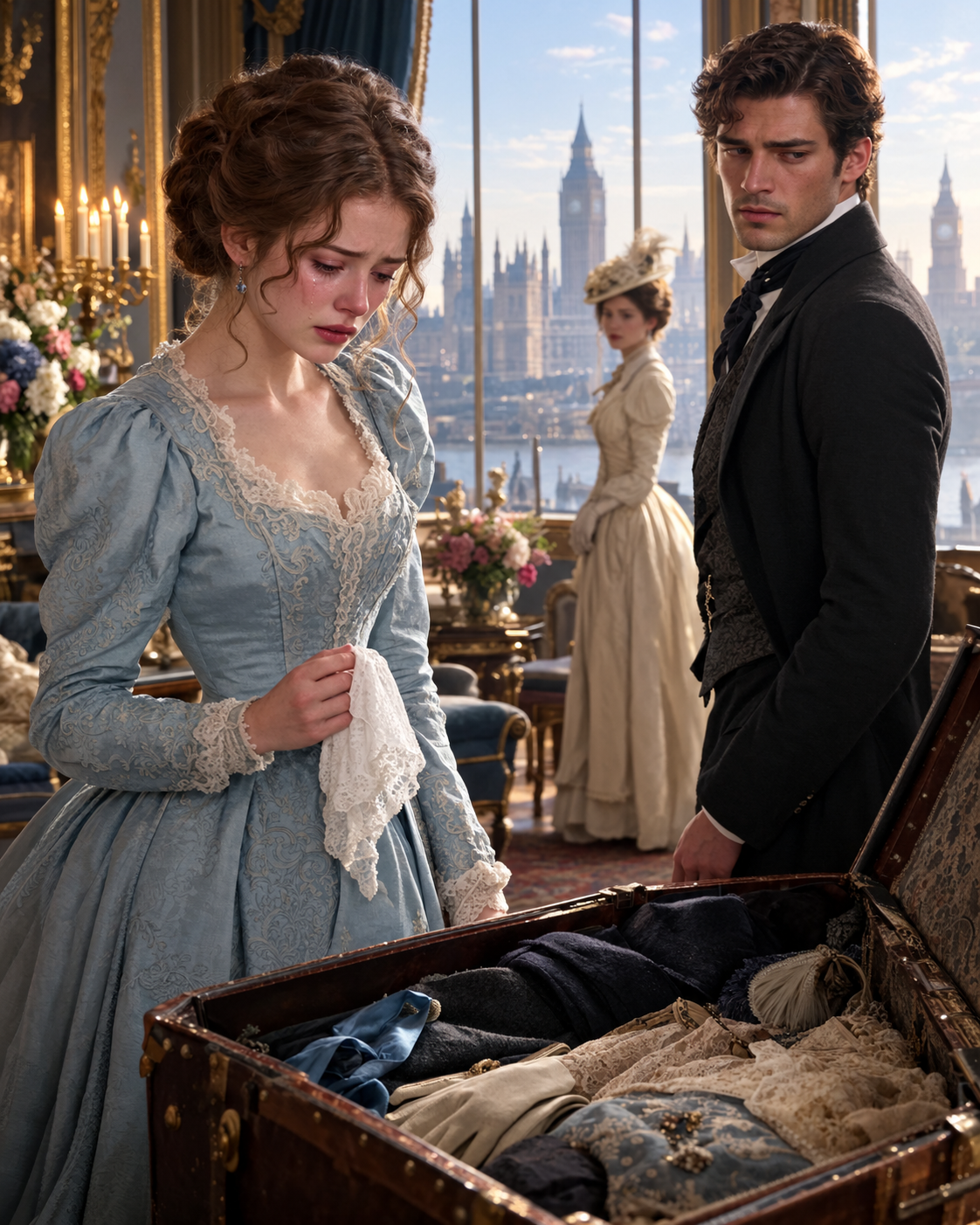
The solicitor studied her face.
There was no hysteria there.
No demand for revenge.
Only determination.
“I understand.”
When Eleanor left the office, the afternoon had turned cold.
She walked through the streets with her thoughts unusually calm.
She had spent years believing that a woman in her position could do little when confronted with a husband’s secret life.
Now she was beginning to understand that ignorance had been her greatest disadvantage.
Knowledge could change the balance.
That evening, Edmund returned later than expected.
Eleanor was seated beside the fire, reading.
He paused when he entered.
“You are still awake.”
“I wanted to finish my book.”
He smiled faintly.
For the first time, Eleanor noticed how practiced the expression seemed.
“Anything interesting?”
“Very.”
She turned a page.
Edmund removed his gloves.
“Are you all right?”
Eleanor looked up.
“Why would I not be?”
He hesitated.
“No reason.”
That hesitation mattered.
Perhaps he sensed something.
Perhaps he had simply noticed that Eleanor seemed quieter than usual.
Either way, she gave him nothing.
The next two days passed without incident.
But beneath the ordinary rhythm of the household, Eleanor’s investigation continued.
Mr. Whitmore sent brief messages.
Nothing conclusive.
Then, late on the second evening, a note arrived.
The solicitor had found something.
Eleanor read it twice.
There was indeed a connection between Edmund and the Mayfair property.
The arrangement was more complicated than she had expected, but the essential fact was unmistakable.
The townhouse had been maintained through funds connected to Edmund.
And there were regular payments.
Some were household expenses.
Others were less easily explained.
One name appeared more than once.
Victoria Harrow.
Eleanor closed her eyes.
For a moment, the room seemed strangely quiet.
She had known the name.
Knowing it was different from seeing it written beside the financial evidence.
A name could be dismissed as coincidence.
A name appearing repeatedly in private records was harder to dismiss.
Yet Eleanor did not allow herself to stop there.
She asked Mr. Whitmore to continue.
There was one question she needed answered.
Who was Lady Victoria Harrow to Edmund?
The answer arrived the following morning.
She was a widow.
She lived in London.
And the connection between her and Edmund extended back several years.
That was all.
No scandalous details.
No dramatic confession.
Only facts.
But facts were enough.
Eleanor spent the rest of the morning walking through the house.
She passed the rooms in which she had spent years arranging flowers, receiving guests, writing letters, and waiting for Edmund to return from journeys that she had once believed were exactly what he claimed them to be.
She remembered birthdays.
Anniversaries.
Quiet dinners.
Conversations that had seemed insignificant at the time.
Suddenly, memories became evidence.
Not proof.
But questions.
How many evenings had Edmund claimed to be exhausted?
How many journeys had changed at the last minute?
How many times had Eleanor accepted an explanation because challenging it seemed unpleasant?
She stopped in the hallway.
Then she understood something painful.
The betrayal had not only been what Edmund had done.
It was what the deception had made her doubt about herself.
She had trusted her instincts, then taught herself to ignore them.
She had noticed inconsistencies, then convinced herself they were unimportant.
She had sensed distance, then blamed herself for expecting too much.
That realization hurt more than she expected.
But it also freed her.
The problem had never been that she was too observant.
It was that she had been trained, by circumstance and habit, to distrust what she observed.
On Thursday morning, Edmund announced that he would leave for London.
Eleanor stood beside the breakfast table.
“How long?”
“Several days.”
“I see.”
He reached for his coat.
Then he looked at her.
“You seem different lately.”
Eleanor smiled.
“Perhaps I am simply tired.”
He studied her for another second.
Then he left.
The carriage disappeared down the drive.
Eleanor waited until it was gone.
Then she went upstairs and changed her clothes.
She had decided to go to London as well.
Not to confront Edmund.
Not yet.
She wanted to see the townhouse.
She wanted to understand the world he had hidden from her.
Most importantly, she wanted to see whether there was anything else he had failed to conceal.
By afternoon, Eleanor was in London.
The city was loud, crowded, and indifferent.
Carriages moved through the streets, people hurried along the pavements, and shop windows reflected a world that continued without caring about private disasters.
Eleanor arrived near the Mayfair address shortly before dusk.
She did not approach the house immediately.
Instead, she watched.
The townhouse was elegant but discreet.
Nothing about it announced secrecy.
That almost amused her.
A place could hide a great deal simply by appearing respectable.
A light appeared in an upstairs window.
A servant entered through the side entrance.
Then, after several minutes, Eleanor saw Edmund.
He stepped from a carriage.
He looked different here.
Not transformed.
But more relaxed.
More familiar.
As though the street itself belonged to a version of him she had never met.
Eleanor’s chest tightened.
Then the door opened.
A woman appeared.
Lady Victoria Harrow.
Eleanor had never seen her before.
Victoria stood in the doorway wearing a dark dress.
She smiled when she saw Edmund.
He smiled back.
There was no ambiguity in the exchange.
No need for explanation.
Eleanor felt the last fragile piece of uncertainty disappear.
She could have walked toward them.
She could have spoken his name.
She could have demanded answers in the middle of the street.
She did none of those things.
Instead, she turned away.
Her decision surprised even her.
She had come to London expecting confrontation.
She left the street carrying something more valuable.
Certainty.
That evening, she returned to her hotel and wrote a single sentence in her notebook:
I will not ask him questions to which I already know the answers.
The following morning, Mr. Whitmore arrived.
He brought more documents.
The private account had been used regularly.
The Mayfair property was connected to Edmund through a financial arrangement.
There were payments extending over several years.
There was also evidence that Edmund had transferred funds without Eleanor’s knowledge.
Mr. Whitmore placed the papers on the table.
“I believe you have enough evidence to understand the situation.”
Eleanor looked down.
“Yes.”
“What do you intend to do?”
For the first time, she hesitated.
Not because she did not know.
Because she was deciding what kind of person she wanted to be after everything that had happened.
“I want my independence.”
Mr. Whitmore nodded.
“Financially?”
“In every meaningful sense.”
“Then we should begin with your legal position.”
They spent several hours discussing the estate, accounts, property, and rights Eleanor might have.
She listened carefully.
There was no dramatic declaration.
No promise of immediate justice.
Only practical steps.
Documents.
Records.
Protection.
Options.
By the end of the meeting, Eleanor understood that her future did not have to depend entirely upon Edmund’s decisions.
That knowledge changed her.
When she returned home, she did not behave differently toward him.
That was precisely what made the change so powerful.
Edmund returned from London two days later.
He entered the drawing room expecting the familiar quiet.
Eleanor was there.
She looked up.
“How was London?”
“Busy.”
“I imagine so.”
He poured himself a drink.
“Everything is settled.”
Eleanor watched him.
“Is it?”
He turned.
“What do you mean?”
“Nothing.”
He smiled uncertainly.
“You have been strange lately.”
“I have been thinking.”
“About what?”
“My future.”
The glass in his hand stopped halfway to his lips.
“Your future?”
“Yes.”
For a moment, neither spoke.
Then Edmund laughed softly.
“You sound serious.”
“I am.”
He looked at her more carefully.
“Eleanor, if something is troubling you, you should simply tell me.”
She almost smiled.
There it was.
The invitation.
The opening he believed he controlled.
She could have placed the letters before him.
She could have named Victoria.
She could have described the Mayfair townhouse.
Instead, she said quietly:
“I will tell you when I am ready.”
Something changed in his face.
It was brief.
But Eleanor saw it.
Fear.
Not guilt.
Fear.
And that told her more than any confession could have.
The next week became a quiet battle.
Edmund began asking questions.
Where had Eleanor been?
Whom had she spoken to?
Why had she contacted Mr. Whitmore?
Why was she suddenly interested in household finances?
She answered only what was necessary.
She did not lie.
She simply stopped volunteering information.
For the first time in their marriage, Edmund discovered what it felt like to stand outside a door that would not open.
Then came the confrontation.
It happened late one evening.
The house was silent.
Edmund entered Eleanor’s sitting room holding a small bundle of letters.
He placed them on the table.
“Why have you been investigating me?”
Eleanor looked at the letters.
Then at him.
“So you know.”
“I know you have been asking questions.”
“I have.”
“Why?”
“Because I had questions.”
“You could have asked me.”
Eleanor’s expression remained calm.
“I did ask you.”
“When?”
“Many times.”
He frowned.
“About what?”
“Your journeys. Your absences. Your accounts.”
Edmund stared at her.
For several seconds, he said nothing.
Then his voice hardened.
“You have misunderstood something.”
“Perhaps.”
“There is nothing you need to worry about.”
“That is not true.”
He stepped closer.
“Eleanor, whatever you think you have found—”
“I know about the townhouse.”
Silence.
Edmund stopped.
“I know about the account.”
His face lost its color.
“And I know Lady Victoria Harrow’s name.”
The room seemed to become smaller.
Edmund looked at her as though he were seeing her for the first time.
“How?”
“I investigated.”
“You had no right.”
That sentence almost made her laugh.
No right.
After three years of deception, that was his objection.
“You are concerned about my methods,” she said softly, “but not about what forced me to use them.”
“It isn’t what you think.”
“Then tell me what it is.”
He opened his mouth.
Nothing came.
Eleanor waited.
She did not rescue him.
She did not supply excuses for him.
Finally, Edmund sat down.
“It began differently.”
Eleanor remained standing.
“How?”
“I never intended for it to become this.”
“Three years is a long time for something unintended.”
He lowered his eyes.
There were explanations then.
Excuses.
Claims that he had been lonely.
Claims that the marriage had become distant.
Claims that Victoria understood him in ways Eleanor no longer did.
Eleanor listened.
Not because she believed him.
Because she wanted to hear what a man said when the story he had built for himself was finally challenged.
When he finished, she said only:
“You had choices.”
Edmund looked up.
“I know.”
“No. I don’t think you do.”
Her voice remained quiet.
“You had the choice to speak. You had the choice to leave. You had the choice to change your marriage. You had the choice to tell me the truth. Instead, you chose to create another life and hide it.”
He looked away.
For the first time, he had no explanation left that could change the facts.
Eleanor walked toward the desk.
She picked up a folder.
“I have taken steps to protect myself.”
Edmund looked at it.
“What does that mean?”
“It means I am no longer depending upon your honesty to determine what happens to me.”
His expression tightened.
“Are you leaving?”
Eleanor paused.
“I haven’t decided.”
The answer frightened him more than a simple yes.
Because for the first time, the decision belonged entirely to her.
In the weeks that followed, Eleanor made changes quietly.
She separated her personal finances.
She secured copies of important records.
She established her own legal arrangements.
She began considering what life would look like if the marriage ended.
She also began asking herself a harder question.
What if it did not?
What would remaining mean?
Could trust ever return?
Could a marriage survive a secret life?
She did not know.
And she refused to make the decision simply because society expected one.
Edmund, meanwhile, seemed to realize that apologies alone would not repair what he had broken.
He stopped defending himself.
He became quieter.
He attempted, awkwardly at first, to answer questions honestly.
But Eleanor understood something important.
Forgiveness was not the same as trust.
An apology was not the same as repair.
And regret was not the same as change.
Months passed.
The house remained standing.
The estate continued.
People still visited.
Letters still arrived.
From the outside, almost nothing had changed.
Inside Eleanor, everything had.
One afternoon, she received a final letter from Mr. Whitmore.
Her arrangements were complete.
She had choices now.
Real choices.
She folded the letter carefully and placed it beside the window.
Then she looked out across the grounds.
For nine years, she had thought of the estate as the center of her life.
Now she understood that it was only a place.
A life could be rebuilt elsewhere.
A woman could begin again.
A future did not become impossible simply because the past had been painful.
That evening, Edmund found her in the garden.
“May I walk with you?”
Eleanor considered him.
“Yes.”
They walked side by side.
For several minutes, neither spoke.
Finally, Edmund said:
“I don’t expect you to forget.”
“I won’t.”
“I don’t expect you to trust me immediately.”
“You shouldn’t.”
He nodded.
“What do you want?”
Eleanor stopped.
She looked at him.
“I want the truth. Even when the truth is uncomfortable. I want choices that are mine. And I want to know that if I stay, I am staying because I choose to—not because I have nowhere else to go.”
Edmund swallowed.
“I understand.”
“Do you?”
“I am beginning to.”
That answer was imperfect.
But it was honest.
And for Eleanor, honesty was no longer a small virtue.
It was the foundation upon which everything else would have to stand.
She did not promise to forgive him.
She did not promise to remain.
She did not promise that their marriage would survive.
Instead, she gave herself something more important.
Time.
Time to decide without fear.
Time to rebuild her confidence.
Time to understand that losing the illusion of a perfect marriage was not the same as losing herself.
The secret Edmund had protected for three years had finally come into the light.
But the greater revelation belonged to Eleanor.
She had spent years believing that strength meant enduring quietly.
She now understood that strength could also mean asking questions, demanding truth, protecting oneself, and refusing to surrender one’s future to someone else’s deception.
Whether she ultimately remained with Edmund or walked away would be her decision.
For the first time in nine years, it truly was.
And that was the lesson she carried with her from that difficult chapter of her life:
Sometimes the most important thing a person can recover after betrayal is not the relationship they lost, but the trust they once had in their own judgment.
Eleanor had spent years listening to everyone except herself.
Now, finally, she had learned to listen.
And whatever came next, no one else would decide the shape of her life for her.
The winter that followed was unlike any Eleanor had known.
Snow came early to the Ashford estate, covering the lawns and stone paths in a quiet white layer. The servants moved more slowly through the cold mornings, fires burned constantly in the great rooms, and the long evenings seemed to stretch without end.
Yet Eleanor no longer feared silence.
She had once associated silence with Edmund’s secrets.
Now she understood that silence could also belong to her.
It could be the space in which she thought.
The space in which she decided.
The space in which she finally heard her own thoughts without immediately pushing them aside for someone else’s comfort.
Edmund changed as well, though Eleanor refused to confuse effort with redemption.
He began keeping his promises.
When he traveled, he told her where he was going.
When financial matters arose, he showed her the records.
He no longer became irritated when she asked questions.
Most importantly, he stopped asking her to trust him simply because he wanted to be trusted.
Instead, he seemed to understand that trust was something he would have to rebuild one ordinary day at a time.
But there was still one matter Eleanor had not resolved.
Lady Victoria Harrow.
For months, Eleanor had heard nothing about her.
Then, one afternoon, a letter arrived in London bearing Victoria’s name.
Eleanor recognized the handwriting immediately.
She stared at the envelope for several seconds before opening it.
Inside was a single sheet.
Lady Harrow did not offer excuses.
She did not ask Eleanor to forgive her.
She wrote only that she had learned the truth about the extent of Edmund’s marriage much later than she should have, and that she regretted allowing a relationship built upon secrecy to continue.
Eleanor read the letter twice.
Then she placed it in the fire.
Not because she hated Victoria.
Not because she wished to erase what had happened.
She simply had no need to carry another person’s explanation into the future.
That was the first thing Eleanor understood that evening.
Closure did not always arrive in the form of an apology.
Sometimes closure was the moment you realized you no longer needed one.
By spring, Eleanor had begun to spend more time away from the estate.
She traveled to London on her own.
She visited friends she had neglected.
She attended lectures, exhibitions, and charitable meetings.
She began managing several charitable projects connected to the estate.
For years, Edmund had assumed she preferred a quiet life.
Only now did he realize that perhaps she had simply never been given enough room to discover what kind of life she wanted.
One afternoon, while Eleanor was reviewing accounts in the library, Edmund entered.
“I received a letter today,” he said.
She looked up.
“From whom?”
He hesitated.
“Victoria.”
Eleanor’s expression did not change.
“And?”
“She is leaving London.”
Eleanor closed the ledger.
“Where is she going?”
“She did not say.”
There was a pause.
Then Edmund added, “I thought you should know.”
Eleanor considered him.
“Thank you for telling me.”
That was all.
Edmund seemed surprised.
“You’re not angry?”
“I don’t know that anger would serve me now.”
He nodded slowly.
“I suppose I understand.”
Eleanor smiled faintly.
“That is something.”
He left her to her work.
She watched the door close behind him.
Once, news like this would have consumed her entire day.
Now it was simply information.
That difference mattered.
The marriage did not magically become happy.
There were difficult days.
There were arguments.
There were evenings when an unanswered question brought back memories Eleanor wished she could forget.
Trust, once broken, did not return because two people wanted it to.
It returned, if it returned at all, through consistency.
Through patience.
Through countless small decisions.
And sometimes it did not return completely.
Eleanor accepted that possibility.
She no longer believed every story needed a perfect ending.
Some endings were simply honest.
A year after the discovery, Eleanor made her decision.
She remained at Ashford.
But she did not return to the woman she had been.
She and Edmund established separate rooms.
They maintained separate financial arrangements.
They agreed that neither would pretend their marriage was something it was not.
They would rebuild what could be rebuilt.
And if one day they discovered that nothing remained worth rebuilding, Eleanor would leave without fear.
For Edmund, this arrangement was humbling.
For Eleanor, it was liberating.
One evening, almost two years after the first letter from the estate steward, Eleanor sat beside the same window where she had once read it.
The grounds outside were green again.
The trees moved gently in the evening wind.
On the desk lay a small stack of papers.
But this time they were not evidence of betrayal.
They were plans for a new charitable foundation Eleanor intended to establish for women who had been left financially vulnerable after the collapse of their marriages.
She had learned too much about how easily a woman could be left without information, money, or choices.
She wanted other women to have the things she had once lacked.
Knowledge.
Protection.
Independence.
Edmund entered quietly.
“What are you working on?”
“A foundation.”
“For the estate?”
“For women.”
He came closer and looked at the papers.
“This is important.”
“Yes.”
“Do you need my help?”
Eleanor looked at him.
“Perhaps. But if I do, I will ask.”
He nodded.
There was no offense in his expression.
He had learned that Eleanor’s independence was not an insult to him.
It was simply hers.
He left the room.
Eleanor returned to her writing.
For the first time, she realized that the story of her marriage was no longer the central story of her life.
It was one chapter.
A painful one.
An important one.
But only one.
There were other chapters waiting.
She thought of the woman she had been nine years earlier.
Young.
Hopeful.
Determined to be the perfect wife.
She wanted to tell that woman something.
You were not foolish for trusting.
You were not weak for loving.
You were not wrong for wanting your marriage to work.
But you must never confuse patience with surrender.
You must never silence your instincts simply because someone else finds them inconvenient.
And you must never believe that your future belongs entirely to another person.
Eleanor placed her pen down.
Outside, the last light of the day disappeared behind the trees.
The house was quiet.
But this time, the quiet did not frighten her.
It felt like freedom.
Years later, people would remember the Ashford marriage in different ways.
Some would say they survived.
Others would say they merely remained together.
A few would whisper about the London townhouse and the woman whose name had once threatened to destroy everything.
Eleanor stopped caring what version of the story people preferred.
They had not lived it.
She had.
And she knew the truth.
The greatest betrayal had not been that Edmund had loved someone else.
It had been that he had built a world in which Eleanor was denied the truth about her own life.
The greatest victory, therefore, was not making him suffer.
It was refusing to remain powerless.
She had not destroyed him.
She had not sought revenge.
She had simply reclaimed the right to decide what happened next.
That was enough.
One summer morning, Eleanor stood at the entrance of the new foundation’s office in London.
A young woman waited inside with a nervous expression.
She had come seeking legal guidance after discovering that her husband had concealed substantial financial matters from her.
Eleanor listened.
She did not tell the woman what decision to make.
She did not tell her to stay.
She did not tell her to leave.
Instead, she gave her something Eleanor herself had once desperately needed.
Information.
“You have more choices than you think,” Eleanor said.
The woman looked at her.
“How do I know what to do?”
Eleanor paused.
Then she answered gently.
“Start by learning the truth. After that, make the decision that allows you to live with yourself.”
The woman nodded.
Eleanor watched her leave.
For a moment, memories of the old estate, the hidden account, the Mayfair townhouse, and that first terrible letter returned.
But they no longer carried the same power.
They were memories now.
Not chains.
That evening, Eleanor returned home.
Edmund was waiting in the garden.
He looked older.
So did she.
But there was something peaceful between them that had not existed before.
Not the careless peace of ignorance.
Something different.
The peace of two people who knew exactly what had been broken and had chosen, cautiously, to live honestly with what remained.
“How was London?” Edmund asked.
“Busy.”
“Did everything go well?”
“Yes.”
He smiled.
“I am glad.”
They stood beneath the old trees.
The sun was setting.
Eleanor looked across the grounds that had once seemed like the boundary of her entire world.
They no longer felt like a prison.
They were simply part of her life.
A life that belonged to her.
And perhaps that was the quietest ending of all.
Not revenge.
Not a dramatic departure.
Not a perfect reconciliation.
But a woman standing once again inside her own life, no longer asking permission to choose its direction.
Eleanor had entered her marriage believing that love meant trusting another person completely.
She left that chapter understanding something more complicated and more valuable.
Love could be shared.
Trust could be earned.
Forgiveness could be offered.
But self-respect had to be protected.
And sometimes, when everything you believed about your life collapses, the first thing you discover among the ruins is not the end of your story.
It is the beginning of your own.
THE END.