Every week, two young wolf princes disappeared from Ashkam Castle for exactly the same reason.
The rider barely managed to climb down from his horse before collapsing against the gate.
“The fever has reached Ashkam.”
For a moment, nobody moved.
Rain struck the road between them like thousands of tiny stones.
Andromeda stared at the rider.
“Where?”
“The lower quarter. Three houses near the eastern wall. Maybe more.” He swallowed hard. “The healers are already there.”
“Maybe?”
The rider looked down.
“We don’t know how many.”
That was enough.
Andromeda swung herself back onto her horse.
“Seal the eastern gate.”
Octan caught the reins before she could move.
“Wait.”
She turned sharply.
“What?”
“If the fever is already inside the city, sealing the gate won’t stop it.”
“It will stop more people from entering.”
“And what about the people already inside?”
Andromeda’s jaw tightened.
“I’ll handle it.”
“You don’t have to handle it alone.”
Her eyes flashed.
“That’s exactly what people say before they get in my way.”
Octan stepped closer.
“And that’s exactly what you said the last time.”
Something broke across her face.
Not anger.
Pain.
Then it vanished.
She pulled her reins free.
“Don’t talk about what you don’t understand.”
She rode toward the castle.
Octan followed.
By the time they reached Ashkam, the city had changed.
The bells were ringing.
Not the great bronze bells used for celebrations or royal ceremonies, but the smaller bells mounted along the watchtowers. Their sharp cries moved through the rain like frightened birds.
People stood beneath awnings, whispering.
Guards were rushing through the streets.
Healers carried wooden boxes from the infirmary.
A mother held a blanket around her daughter while a soldier tried to guide them away from the crowded square.
Andromeda dismounted before the horse had completely stopped.
“Open the old barracks.”
A guard hesitated.
“Captain, those haven’t been used in years.”
“Then today they become useful.”
“Yes, Captain.”
“Bring every healer in the eastern district. Send riders to the farms. Nobody enters the castle without examination.”
The guard nodded and ran.
Andromeda turned toward another soldier.
“Where are the princes?”
“In the great hall.”
“Keep them there.”
She started walking.
Octan caught up.
“You’re going to see them?”
“They’re children.”
“They’re your princes.”
“They’re children first.”
That answer silenced him.
Inside the great hall, the two young princes were sitting on the bottom step of the throne platform.
They had clearly been told not to move.
The older boy stood immediately.
“Father!”
Octan crossed the room.
“Are you both well?”
“Yes.”
“No fever?”
“No.”
The younger prince looked toward Andromeda.
“Is it true?”
Andromeda stopped.
“Is what true?”
“That people are sick.”
She could have lied.
She almost did.
Instead, she knelt in front of him.
“Yes.”
His ears lowered.
“Are they going to die?”
Andromeda looked at Octan.
Then back at the boy.
“Some may.”
The prince’s eyes widened.
“But we’re going to help them, aren’t we?”
Andromeda’s throat tightened.
The question struck deeper than any accusation could have.
“We are.”
Octan stepped forward.
“No. You are staying here.”
Both princes protested at once.
“But—”
“No.”
The king’s voice was firm.
“You don’t enter the infected district. You don’t leave the castle. And you don’t argue.”
The older prince crossed his arms.
“But Captain Andromeda is going.”
“She is an adult.”
The younger prince looked at Andromeda.
“Are you afraid?”
Silence filled the hall.
Andromeda looked down at her hands.
For years, she had believed fear was something a commander buried.
Something locked behind armor.
Something nobody was allowed to see.
But the boy was looking at her with complete trust.
So she answered honestly.
“Yes.”
The princes stared.
“But I’m going anyway.”
The younger boy nodded slowly.
“Then I won’t be afraid either.”
Andromeda smiled.
“You can be afraid.”
She touched his shoulder.
“Courage isn’t the absence of fear.”
“What is it?”
“Doing what must be done while your fear is still there.”
Then she stood.
“And that’s why you’re staying here.”
The boy frowned.
“Why?”
“Because sometimes courage means knowing when to wait.”
She left before either prince could argue again.
The old barracks filled within hours.
Beds were dragged into rows.
Boiling water steamed in iron pots.
Healers shouted for clean cloth.
Soldiers carried buckets from the well.
The smell of vinegar, wet wool, herbs, and sickness settled over the building.
Andromeda moved through it all like a storm.
She knew how to command an army.
She knew how to defend walls.
She knew how to read the movement of enemy soldiers across a battlefield.
But this enemy had no sword.
No banner.
No footsteps.
It moved invisibly from breath to breath.
Every time someone coughed, she turned.
Every time a healer called for help, she ran.
And every time someone whispered the word fever, her chest became tighter.
Near midnight, Octan found her standing outside the barracks.
She was staring at the eastern wall.
“You haven’t eaten.”
“I’ll eat later.”
“You said that six hours ago.”
“I’ll eat later.”
He held out a bowl.
She didn’t take it.
“It’s soup.”
“I know what soup is.”
“Then this should be easier.”
She looked at him.
“Do you ever stop?”
“Occasionally.”
“When?”
“When I’m asleep.”
Despite herself, she almost smiled.
Almost.
Then a scream came from inside.
Andromeda turned immediately.
A healer rushed through the door.
“Captain!”
She ran.
A young soldier was lying on the floor.
His body shook violently.
His eyes were unfocused.
“Get everyone back!”
Andromeda dropped beside him.
“Hold his shoulders.”
Two guards obeyed.
The healer pressed a cloth to his forehead.
“His fever is rising.”
“How high?”
“Too high.”
Andromeda stared at the soldier.
He couldn’t have been more than nineteen.
She knew his name.
Tarin.
He had joined the castle guard only three months earlier.
He had once asked her if becoming a great soldier meant never being scared.
She had told him, “No. It means learning what deserves your fear.”
Now his fingers grabbed hers.
“Captain.”
She leaned closer.
“I don’t want to die.”
Her heart stopped.
For one terrible second, the barracks disappeared.
The rain disappeared.
The guards disappeared.
She was somewhere else.
Years earlier.
Another room.
Another fever.
Another hand growing colder inside hers.
Her husband’s voice whispering her name.
Her little daughter’s breathing becoming weaker.
Two people.
One disease.
One night she had never escaped.
“Captain!”
Octan’s voice pulled her back.
She blinked.
Tarin was still there.
Alive.
Terrified.
Andromeda closed her hand around his.
“Then don’t.”
The healer looked at her.
“What?”
Andromeda stood.
“Don’t let him die.”
“We’re doing everything we can.”
“Then do more.”
“Captain—”
“Find another treatment. Ask the southern healers. Search the old medical records. Send riders tonight.”
Octan stepped beside her.
“I’ll send them.”
Andromeda looked at him.
“No.”
“I said I’ll send them.”
“You’re the king.”
“Exactly.”
He turned toward the nearest guard.
“Wake every royal courier. I want messages sent to every neighboring territory before sunrise.”
The guard bowed.
“Yes, Your Majesty.”
Andromeda stared at Octan.
“You’re risking the kingdom’s resources on a village fever.”
“No.”
He looked at the rows of frightened patients.
“I’m protecting my kingdom.”
Something in her expression changed.
For the first time that night, she let herself lean against the wall.
Just for a moment.
Octan stayed beside her.
Neither spoke.
Outside, the bells continued ringing.
By morning, the number of sick had doubled.
By afternoon, it had tripled.
Ashkam was placed under quarantine.
No one entered.
No one left.
Food was distributed at the gates.
The castle became a maze of locked doors and guarded passages.
The princes were furious.
They had been confined to the western wing, where healers checked them twice a day.
On the third morning, the older prince disappeared.
Andromeda found him sitting in the kitchen.
Alone.
His face was wet with tears.
“You’re supposed to be in the western wing.”
“I know.”
“How did you get here?”
“I know the servants’ passage.”
She sighed.
“You really have been paying attention.”
He looked at the empty table.
“You haven’t made pie.”
Andromeda froze.
The boy wiped his face.
“You always make pie on the day we visit.”
“I haven’t had time.”
“I know.”
He stared at the floor.
“Is that because people are dying?”
Andromeda sat beside him.
“Yes.”
He nodded.
Then he whispered,
“My mother used to make honey cakes.”
Andromeda looked at him.
“I didn’t know that.”
“She died when I was little.”
The captain said nothing.
“I don’t remember her voice anymore.”
That sentence hurt more than she expected.
The boy looked at her.
“Do you remember yours?”
Andromeda’s eyes moved toward the wooden frame on the shelf.
The one she had kept facedown for years.
“Yes.”
“Your family?”
“Yes.”
“Do you remember everything?”
“No.”
She reached for the frame.
Her fingers trembled as she turned it over.
Two figures stood inside the old photograph.
A broad-shouldered wolf with a crooked smile.
A little girl sitting on his shoulders.
Andromeda beside them, younger and laughing.
The prince stared.
“That’s you.”
“Yes.”
“You look different.”
“I was.”
He pointed at the little girl.
“Your daughter?”
Andromeda nodded.
“What was her name?”
“Liora.”
“Was she brave?”
Andromeda looked at the photograph for a long time.
“She was stubborn.”
The prince smiled.
“So she was brave.”
Andromeda laughed softly.
“Yes.”
For the first time in years, she let the frame remain faced upward.
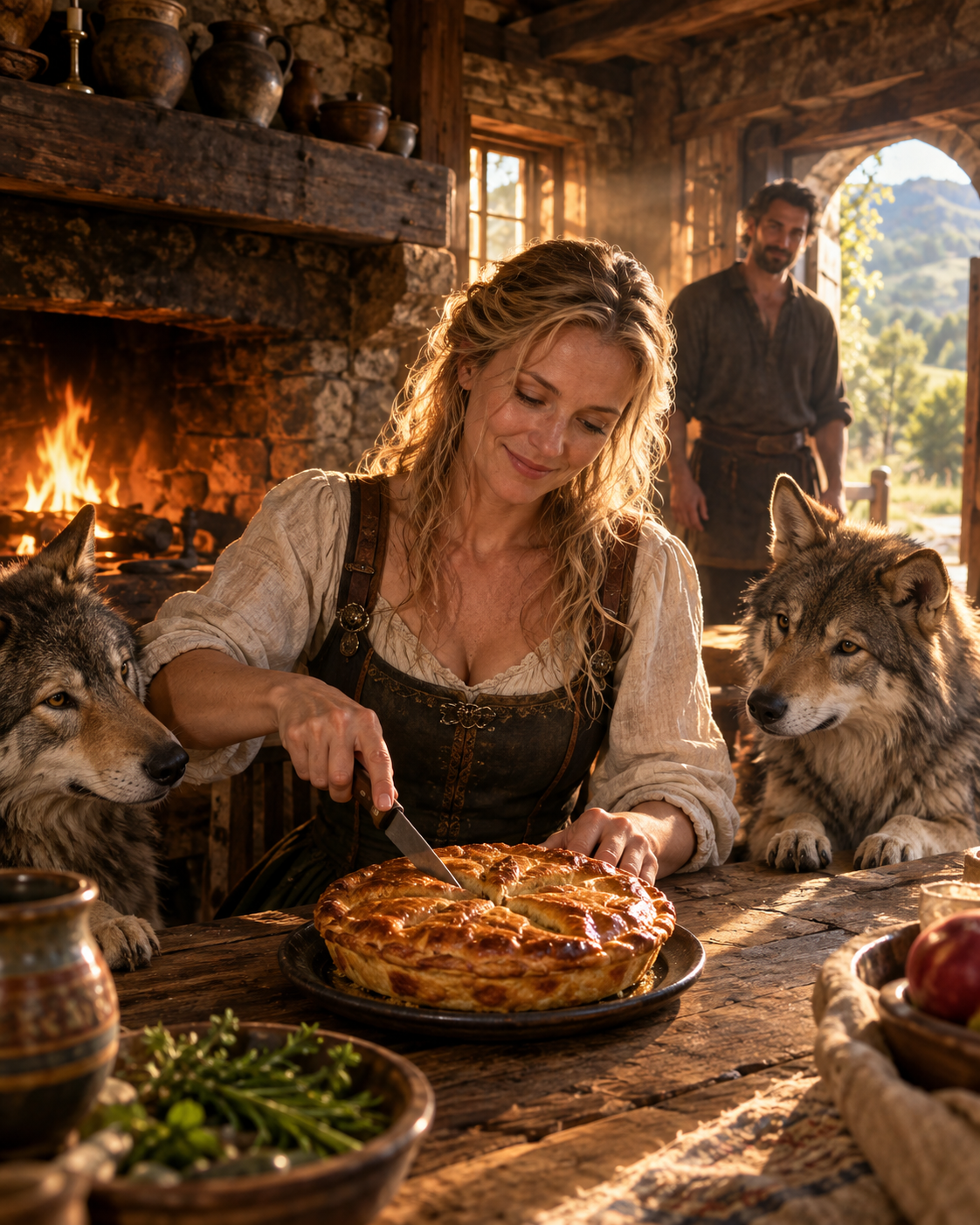
That evening, she made apple pie.
Not because she had time.
She didn’t.
Not because anyone had asked.
Nobody had.
She made it because there were still children in the castle who needed to remember that the world was more than sickness and fear.
She cut three slices.
Then stopped.
There were only two princes now.
Octan entered the kitchen.
He saw the third plate.
“You still do that.”
Andromeda looked at it.
“I know.”
“Who is it for?”
She didn’t answer.
Octan walked closer.
“Liora?”
Her knife stopped.
“Yes.”
He sat down.
Andromeda placed the third slice of pie on the empty plate.
“She always wanted the biggest piece.”
“I can believe that.”
“She used to steal apples while I was baking.”
“Like our princes.”
Andromeda smiled faintly.
“Yes.”
They sat together in silence.
Then a bell rang.
Once.
Twice.
Three times.
The emergency bell.
Andromeda stood so quickly the chair fell backward.
“What happened?”
A guard appeared in the doorway.
“Captain! The southern barracks are burning!”
Andromeda ran.
Smoke was already climbing above the rooftops.
The old barracks roof had caught fire.
Patients were trapped inside.
Guards rushed toward the flames, but the doors had been barred from the outside to prevent escape.
Andromeda grabbed an axe.
“Break the eastern wall!”
“Captain, it’s too dangerous!”
“Do it!”
She swung the axe herself.
Once.
Twice.
The wood cracked.
Smoke filled her lungs.
Someone screamed inside.
Then another voice.
“Help!”
Andromeda hit the wall again.
A beam fell.
She crawled through.
Inside, the air was black.
Beds had overturned.
Cloth was burning.
Patients were crying.
A healer was trapped beneath a wooden frame.
Andromeda lifted it with both hands.
“Get up!”
“I can’t.”
“You can.”
She pulled until the healer was free.
Together they carried a coughing child toward the opening.
Then Andromeda heard another sound.
A familiar one.
A child crying.
She turned.
At the far end of the room, a little boy was trapped beneath a fallen table.
Fire climbed the wall behind him.
Andromeda ran.
“Captain!”
Octan’s voice came from the broken wall.
“Get out!”
“Not without him!”
She reached the boy.
He was burning with fever.
She lifted him.
The ceiling groaned.
Andromeda looked up.
A massive beam was falling.
She threw herself over the child.
The beam crashed down.
For a second, there was silence.
Then Octan’s voice.
“Andromeda!”
He tore through the smoke.
The beam had landed beside her, pinning her cloak but missing her body.
He pulled her free.
“Can you stand?”
“Yes.”
“You’re bleeding.”
“Later.”
She handed him the child.
“Take him.”
Octan did.
Andromeda turned back toward the flames.
“There are still people inside.”
“No.”
She looked at him.
“There are.”
“I’ll go.”
“You can’t.”
“Why?”
“Because you’re the king.”
“And you’re my captain.”
Their eyes met.
Then Octan pushed the child into a guard’s arms and went back inside with her.
Together they pulled six more people from the burning barracks.
By dawn, the fire was out.
The eastern sky turned pale.
Andromeda sat on the steps outside, soaked in rain and covered in ash.
Octan sat beside her.
For a while, neither spoke.
Then Andromeda whispered,
“I thought I could stop it.”
Octan looked at her.
“The fever?”
“The past.”
Her voice broke.
“I thought if I kept everyone safe enough, if I commanded hard enough, if I never became weak again, maybe I could make sure nobody I loved ever died the same way.”
Octan said nothing.
“I was wrong.”
She looked at her bloodstained hands.
“I couldn’t save Liora.”
“You were a mother.”
“I was a soldier.”
“You were both.”
“I wasn’t enough.”
Octan turned toward her.
“You were never supposed to be enough to control death.”
She closed her eyes.
“The last time I lost someone, I spent years believing it was because I failed.”
“And now?”
She opened her eyes.
“Now I think maybe I failed because I thought saving people meant controlling everything.”
Octan nodded.
“You can’t control everything.”
“No.”
She looked toward the burning remains of the barracks.
“But I can still choose what I do next.”
“That,” Octan said quietly, “you can control.”
The fever eventually began to weaken.
Not because of one miracle cure.
Not because of one heroic act.
It weakened because hundreds of people worked together.
Healers found a treatment that reduced the worst symptoms.
Farmers brought food to the gates.
Soldiers delivered medicine.
Villagers cleaned contaminated houses.
Children carried messages between households.
And the royal family opened its private stores to everyone under quarantine.
Weeks passed.
Then one morning, the bells stopped.
The city was silent.
A healer stepped into the courtyard.
“No new cases.”
Andromeda didn’t celebrate.
She simply closed her eyes.
For the first time in weeks, she breathed without fear.
The gates opened three days later.
People emerged slowly.
Some had lost family.
Some had lost homes.
Some had survived with scars that would never completely disappear.
But Ashkam was alive.
The princes were allowed outside again.
Their first request was simple.
“Pie.”
Andromeda laughed.
“You two nearly caused a rebellion.”
“We were imprisoned.”
“You were protected.”
“It felt like imprisonment.”
“You’re lucky I like you.”
They followed her into the kitchen.
Octan was already there.
He had somehow brought tea.
Andromeda placed the pie on the table.
Three plates.
She stared at them.
The older prince noticed.
“You still need three?”
Andromeda looked at the empty chair.
“Yes.”
The boy nodded.
“Then we should always keep three.”
Andromeda smiled.
“Why?”
“So nobody gets forgotten.”
Her eyes filled with tears.
She looked at the frame on the shelf.
This time, she didn’t turn it facedown.
“No,” she whispered.
“We won’t.”
They ate together.
The younger prince reached for the largest slice.
The older prince slapped his hand away.
“That one’s mine.”
“You already had one.”
“So did you.”
Octan laughed.
Andromeda shook her head.
For a few minutes, the castle felt normal again.
But something had changed.
The third plate was no longer a symbol of the people Andromeda had lost.
It became a reminder of the people she had saved.
Months later, a small stone memorial was built outside the eastern wall.
Names were carved into it.
Villagers.
Soldiers.
Healers.
Children.
People whose lives had been taken by the fever.
At the bottom, Andromeda asked the sculptor to carve a single sentence.
Not a warning.
Not a prayer.
Not a promise that such pain would never return.
Because she knew better now.
The world could not be controlled.
Illness would come again.
Storms would return.
People would leave.
Hearts would break.
But there was one thing humans could always choose.
The words on the stone were simple.
“We remember, so we may care better.”
On the day the memorial was finished, Andromeda stood before it with Octan and the two princes.
The younger prince placed an apple at its base.
The older one placed a small piece of paper.
“What did you write?” Andromeda asked.
He smiled.
“A secret.”
“You’re becoming troublesome.”
“I learned from you.”
Octan laughed.
Andromeda looked at the names carved into the stone.
She thought of Liora.
For years, remembering her had felt like opening a wound.
Now it felt different.
The pain was still there.
But so was the love.
And she finally understood that grief was not a prison built by the dead.
It was a bridge between what had been lost and what still remained.
She turned toward the princes.
“Come.”
“Where?”
“Home.”
They walked back toward the castle.
That evening, Andromeda baked another apple pie.
She put three plates on the table.
Then, after a moment, she added a fourth.
Octan raised an eyebrow.
“Who is that for?”
Andromeda looked toward the kitchen door.
A group of young guards stood there, pretending they had not been waiting.
She smiled.
“Anyone who’s hungry.”
The princes cheered.
The guards laughed.
Octan shook his head.
Andromeda cut the pie.
For once, she did not save the best piece for someone who was gone.
She gave it to the youngest guard in the room.
And when everyone had eaten, she looked at the empty plate that had once belonged to a memory.
It was no longer empty.
It held a small apple slice.
Not as an offering to the past.
As a promise to the future.
Because Andromeda had finally learned that love was not measured by how long we hold on to what we have lost.
Sometimes love means carrying the memory forward.
Sometimes it means opening the door again.
Sometimes it means making another pie, setting another plate, and allowing the people still beside us to sit down.
The rain had returned outside Ashkam that night.
But inside the little kitchen, there was laughter.
And for the first time in many years, Andromeda did not listen to the storm and remember the night she had lost everything.
She listened to it and heard something else.
Life.
Still moving.
Still imperfect.
Still fragile.
Still worth protecting.
And as the princes argued over the last slice of apple pie, she laughed with them.
The past remained part of her.
But it no longer commanded her.
And that, she finally understood, was the greatest victory she would ever win.
The storm passed before dawn.
But the morning that followed was not peaceful.
A messenger arrived at the castle gates carrying a black seal.
He was barely able to remain on his feet.
“Captain Battle.”
Andromeda stepped out of the kitchen.
She had flour on her hands.
“What happened?”
The messenger looked at King Octan.
Then at the two princes.
Then back at Andromeda.
“The fever has appeared again.”
The kitchen went silent.
Andromeda’s fingers slowly curled into fists.
“Where?”
“North of Ashkam.”
“How many?”
“We don’t know.”
“Then find out.”
The messenger bowed.
“Yes, Captain.”
Andromeda was already reaching for her cloak when Octan spoke.
“You’re not going alone.”
She looked at him.
“I wasn’t planning to.”
The older prince stepped forward.
“Are you leaving again?”
Andromeda knelt.
“For a little while.”
“Because of the fever?”
“Yes.”
He swallowed.
“Will you come back?”
Andromeda froze.
The question was simple.
But after everything that had happened, it carried the weight of an entire lifetime.
She put both hands on his shoulders.
“Yes.”
The boy searched her face.
“You promise?”
“I promise I’ll do everything I can to come back.”
The younger prince frowned.
“That isn’t the same as promising.”
Andromeda smiled sadly.
“No.”
She pulled them both into her arms.
“It isn’t.”
Octan watched them.
He knew what she was trying not to say.
No one could promise tomorrow.
Not a king.
Not a captain.
Not a healer.
Not a child.
The convoy left before sunrise.
Andromeda rode at the front.
Octan rode beside her.
Behind them came healers, soldiers, wagons of food, medicine, blankets, clean water, and enough supplies to establish a temporary clinic.
They reached the northern settlement by noon.
The village was quiet.
Too quiet.
Doors were closed.
Animals stood unattended in muddy yards.
A woman watched them from behind a window.
Andromeda dismounted.
“Where is the healer?”
An old man stepped out of a house.
“Dead.”
Octan’s expression changed.
“How long?”
“Three days.”
“And the others?”
The old man pointed toward the chapel.
“Inside.”
They entered.
There were seventeen people lying on blankets.
Children.
Adults.
Old men.
Young women.
One of the children was no more than five.
Andromeda immediately began giving orders.
“Separate the severe cases.”
“Bring water.”
“Open the windows.”
“Boil every cloth.”
“Mark every house where someone is sick.”
The soldiers moved.
The healers followed.
For the next three days, Andromeda barely slept.
She had thought the first outbreak had taught her everything.
It had not.
This time, the disease moved differently.
Some patients recovered quickly.
Others deteriorated within hours.
One treatment worked for one person and failed for another.
The healers argued.
The soldiers grew exhausted.
Fear spread faster than the illness.
On the fourth night, someone shouted outside.
“They’re coming!”
Andromeda stepped outside.
A crowd had gathered.
Villagers were holding torches.
At their front stood a tall farmer with red eyes.
“You brought this here.”
Andromeda stared at him.
“What?”
“You and your soldiers.”
“We arrived after the first cases.”
“You don’t know that.”
The crowd murmured.
Another man shouted,
“Send them away!”
Someone threw a stone.
It struck the ground beside Andromeda.
Octan stepped forward.
“Enough.”
The farmer shouted back.
“You’re the king. You should protect us!”
“I am.”
“Then leave!”
The crowd grew louder.
Andromeda looked at them.
She understood.
Fear needed someone to blame.
It always did.
She stepped forward.
“No one is leaving.”
The crowd quieted.
“You can blame me tomorrow,” she said. “You can hate me tomorrow. But tonight, there are seventeen people inside that building who need us.”
Nobody answered.
“And if you want to throw me out after we save them, I’ll walk out myself.”
The farmer lowered his torch.
“What if they die anyway?”
Andromeda looked at the chapel.
“Then we will grieve them.”
Her voice softened.
“But we will not abandon them just because we are afraid of losing them.”
The crowd slowly lowered their torches.
One by one.
The farmer looked down.
“My wife is inside.”
Andromeda nodded.
“I know.”
“She can’t breathe.”
“Then come with me.”
He stared at her.
“I don’t know what to do.”
“You don’t have to.”
She handed him a bucket.
“Hold this.”
He took it.
“Now help me.”
That night, the villagers joined the healers.
By morning, the clinic was full of people who had once stood outside demanding that the outsiders leave.
The farmer carried water.
The old man cleaned floors.
Children gathered firewood.
Andromeda worked until her hands shook.
Then, at sunrise, she heard a tiny voice.
“Captain?”
She turned.
The five-year-old girl was sitting up.
Her fever had broken.
The healer beside her began crying.
Andromeda closed her eyes.
One more.
One more life.
She looked toward the window.
Outside, the first sunlight was touching the roofs.
For a moment, she thought of Liora.
She wondered what her daughter would have looked like at five.
At ten.
At twenty.
The thought hurt.
But it no longer destroyed her.
She walked outside.
Octan was waiting.
“You need sleep.”
“So do you.”
“I asked first.”
She smiled.
“Still giving orders?”
“Always.”
She leaned against the wall.
“Octan.”
“Yes?”
“If I had known what would happen years ago, I would have done everything differently.”
He looked at her.
“Perhaps.”
“I would have stayed home more.”
“Perhaps.”
“I would have stopped pretending I was invincible.”
“Definitely.”
She laughed quietly.
Then her expression became serious.
“But I can’t change it.”
“No.”
“I spent so many years punishing myself for that.”
Octan said nothing.
“I thought grief meant I had to suffer forever to prove that I loved them.”
He looked toward the clinic.
“Maybe grief means remembering without refusing to live.”
Andromeda stared at him.
“That sounds almost wise.”
“I have moments.”
“Rare ones.”
He smiled.
Then the chapel door opened.
The healer stepped out.
“Captain.”
Andromeda straightened.
“What?”
“The fever is falling.”
“How many?”
“Everyone.”
For the first time, Andromeda allowed herself to smile.
Not because the danger was gone.
Not completely.
But because hope had returned.
The outbreak ended after eleven days.
Twenty-nine people became sick.
Five died.
Twenty-four survived.
The village mourned those five.
There was no pretending that survival erased loss.
There was no grand speech that could make death acceptable.
Andromeda attended every funeral.
She stood beneath the gray sky while the names were read aloud.
She listened.
She remembered.
And when the last grave was covered, the farmer approached her.
“You saved my wife.”
Andromeda shook her head.
“We all did.”
He looked at the villagers.
“No.”
He smiled sadly.
“You taught us to.”
Then he handed her something.
A small apple.
Andromeda stared at it.
“Why?”
“My wife said you always bake apple pie.”
Andromeda laughed.
“She exaggerates.”
“She said she wants to learn.”
Andromeda held the apple in her hand.
“Then tell her I’ll teach her.”
The farmer smiled.
“I will.”
When Andromeda returned to Ashkam, winter had arrived.
Snow covered the castle roofs.
The princes ran down the steps before she had even dismounted.
“You came back!”
The younger prince nearly knocked her over.
“I told you I would.”
“You said you would do everything you could.”
“And I did.”
The older prince looked at her carefully.
“Did anyone die?”
Andromeda didn’t lie.
“Yes.”
His ears lowered.
“Were you sad?”
“Yes.”
“Are you still?”
“Yes.”
The boy thought for a moment.
“Then why are you smiling?”
Andromeda looked toward the castle.
Because once, she might have answered that she wasn’t smiling.
She might have hidden it.
She might have believed that happiness after loss was a betrayal.
Now she knew better.
“Because being sad doesn’t mean I can’t be happy too.”
The boy nodded as if storing the answer somewhere important.
That evening, the kitchen was crowded.
The princes sat at the table.
Octan poured tea.
The healers who had traveled with Andromeda were invited.
The guards came in after their shift.
Even the old farmer from the northern village arrived two days later with his wife.
Andromeda baked the largest apple pie Ashkam had ever seen.
When she brought it to the table, everyone cheered.
The younger prince immediately reached for the knife.
“Wait.”
He stopped.
Andromeda looked around the table.
There were too many people for the old tradition.
That made her happy.
She placed the knife in the center.
“Everyone gets a piece.”
The older prince raised his hand.
“What about the third plate?”
Andromeda looked at the shelf.
The wooden frame was still there.
Liora was still smiling from inside it.
The empty plate was beside the frame.
For years, Andromeda had believed she needed to keep that plate empty.
She thought it was the only way to honor what she had lost.
But now she understood.
Memory did not require emptiness.
She picked up the plate.
And placed a slice of pie on it.
Then she carried it to the table.
The prince stared.
“But that’s Liora’s.”
Andromeda smiled.
“Yes.”
She looked around at everyone.
“And tonight, we’re sharing it.”
The room became quiet.
Then the youngest prince asked,
“Does that mean she’s here?”
Andromeda considered the question.
“Not the way you mean.”
“Then how?”
She touched the edge of the plate.
“She is here because she taught me how to love.”
No one spoke.
“And because of her, I know that every person sitting at this table is precious.”
She looked at the princes.
“You.”
At Octan.
“You.”
At the healers.
“You.”
At the guards.
“All of you.”
Her voice trembled.
“That is what we carry when someone leaves us.”
The older prince reached for the pie.
“Then I think Liora would want the biggest piece.”
Andromeda laughed.
“She absolutely would.”
Everyone laughed with her.
Outside, snow began falling.
Inside, the fire burned warmly.
And for the first time, Andromeda understood that the kitchen had never really been about apple pie.
It had been about people.
About making room.
About giving someone a place at the table.
About saying, without words, “You are safe here.”
Years passed.
The princes grew taller.
The kingdom changed.
New generations of guards trained beneath Andromeda’s command.
The eastern wall was rebuilt.
The old barracks became a permanent healing center.
And the memorial outside the castle grew.
Every year, another name was added when necessary.
But there were also new names carved beside them.
Names of people who had been born after the fever.
Names of children who had survived.
Names of healers who had dedicated their lives to medicine.
The monument no longer looked like a place of death.
It looked like a record of survival.
One spring morning, the two princes came running into the kitchen.
“Captain!”
Andromeda looked up from the dough.
“What now?”
“We have news.”
“That expression usually means trouble.”
“We’re leaving Ashkam.”
She raised an eyebrow.
“Where?”
The older prince grinned.
“We’re going to the northern village.”
“To do what?”
“Help rebuild the clinic.”
Andromeda stopped kneading.
“You’re royal princes.”
“We know.”
“You’re supposed to be studying.”
“We are.”
“History?”
“Yes.”
“Politics?”
“Yes.”
“Military strategy?”
“Yes.”
She narrowed her eyes.
“And?”
The younger prince smiled.
“Medicine.”
Andromeda stared at them.
Then she laughed.
“Who taught you that?”
Both boys pointed at her.
She shook her head.
“I only taught you how to bake.”
The older prince answered,
“No. You taught us something else.”
“What?”
He looked toward the wooden frame.
“You taught us that when something hurts, you don’t turn away.”
Andromeda became very still.
For years, she had feared that the story of her family would end with loss.
She had believed the final chapter was the night Liora died.
But perhaps that was never the ending.
Perhaps the ending was every life she helped afterward.
Every child she protected.
Every frightened person she reassured.
Every meal she shared.
Every person who learned that courage did not mean being fearless.
Perhaps a person’s life did not end when they were gone.
Perhaps pieces of them continued in the choices made by those who remembered them.
That afternoon, Andromeda walked alone to the memorial.
The names were covered in sunlight.
She placed an apple beneath Liora’s name.
Then she sat.
“I used to think I was supposed to forget how much it hurt,” she whispered.
The wind moved through the trees.
“I don’t anymore.”
She smiled.
“I remember.”
A small bird landed on the stone.
Andromeda watched it for a moment.
“I remember everything I can.”
She touched Liora’s name.
“And I am still here.”
She stood.
“And I am going to keep living.”
When she returned to the castle, she found Octan waiting outside the kitchen.
He held two cups of tea.
“You disappeared.”
“I went to the memorial.”
“I know.”
“How?”
“You always walk faster when you’re pretending you aren’t sad.”
She rolled her eyes.
“Still watching me?”
“Someone has to.”
She took the tea.
They stood together beneath the evening sky.
“Do you ever regret following those princes into my kitchen?” she asked.
Octan smiled.
“Every day.”
She laughed.
“You’re terrible.”
“And yet you kept making pie.”
“I had to feed the children.”
“Of course.”
He looked through the kitchen window.
The princes were inside, arguing over something.
The same kind of laughter filled the room.
The same kind of warmth.
But it was not the same kitchen anymore.
Andromeda wasn’t the same woman.
Neither was Octan.
Neither were the boys.
Life had moved forward.
Not perfectly.
Not without loss.
But forward.
Octan raised his cup.
“To the people we couldn’t save.”
Andromeda raised hers.
“To the people we can still love.”
Their cups touched.
Inside, the younger prince shouted,
“Captain! He’s stealing my pie!”
Andromeda closed her eyes.
“I’m coming.”
She opened the door.
The boys were fighting over the last slice.
She stared at them.
“Seriously?”
“He took it!”
“I did not!”
“You did!”
Andromeda took the plate.
Both boys fell silent.
She cut the slice in half.
“There.”
They looked disappointed.
“Now,” she said, “sit down.”
They obeyed.
She sat between them.
Octan entered a moment later.
Andromeda looked around the table.
The fire was warm.
The pie smelled of cinnamon and apples.
The window was open.
Outside, the evening wind carried the scent of spring through Ashkam.
For a brief moment, she imagined another chair beside her.
A little girl with bright eyes.
Small hands reaching for an apple.
A mischievous smile.
The image faded.
Andromeda didn’t chase it.
She didn’t need to.
She knew where it belonged.
Not in an empty chair.
Not in a locked room.
Not in the past.
It belonged in her heart.
She cut another apple.
The princes argued again.
Octan laughed.
Andromeda smiled.
Then she looked at the third plate.
For the last time, she picked it up.
But she did not put it away.
She placed it in the center of the table.
And on it, she placed the final slice of pie.
Not for the dead.
Not for the past.
For anyone who might walk through the door tomorrow needing a place to sit.
That was the lesson Andromeda had spent half her life learning.
You cannot stop every storm.
You cannot save everyone.
You cannot command death to leave the people you love alone.
And you cannot change yesterday, no matter how many times you return to it in your mind.
But you can choose what you do with today.
You can open the door.
You can light the fire.
You can feed the hungry.
You can hold the frightened.
You can remember the people you lost without refusing to love the people who remain.
And sometimes, the smallest acts become the ones that survive us.
A warm kitchen.
A shared meal.
A hand held during a fever.
A frightened child told that courage is not the absence of fear.
A plate placed on a table because someone, somewhere, should always have a place.
Years later, when people asked King Octan what had saved Ashkam during the great fever, he never named a single person.
He named the villagers.
The healers.
The soldiers.
The children.
The farmers.
The strangers who opened their homes.
And when people asked Captain Andromeda Battle what had made her continue after losing so much, she gave the same answer every time.
“I had people waiting for me at the table.”
Then she would smile.
And if there happened to be apple pie cooling nearby, she always cut one extra slice.
Because some memories should not be buried.
Some wounds do not need to disappear.
And some love is not meant to end.
It is meant to become something else.
A kindness.
A lesson.
A tradition.
A hand reaching for another hand.
A light left burning in a window.
And sometimes, it becomes a simple plate on a wooden table, waiting for whoever needs to come home.
That was how Andromeda finally made peace with the past.
Not by forgetting it.
Not by defeating it.
But by carrying it forward until the pain became compassion, until grief became wisdom, and until the love she once believed she had lost became the very thing that helped her save others.
The final piece of apple pie remained on the plate that night.
Nobody took it.
Not because it was forbidden.
Not because it belonged to a ghost.
But because everyone at the table understood what it meant.
There would always be someone missing.
There would always be another storm.
There would always be another frightened child, another lonely traveler, another person standing outside the door wondering whether anyone would make room for them.
And when that person came,
the plate would be waiting.
The fire would be warm.
The door would be open.
And there would always be enough pie.
THE END.