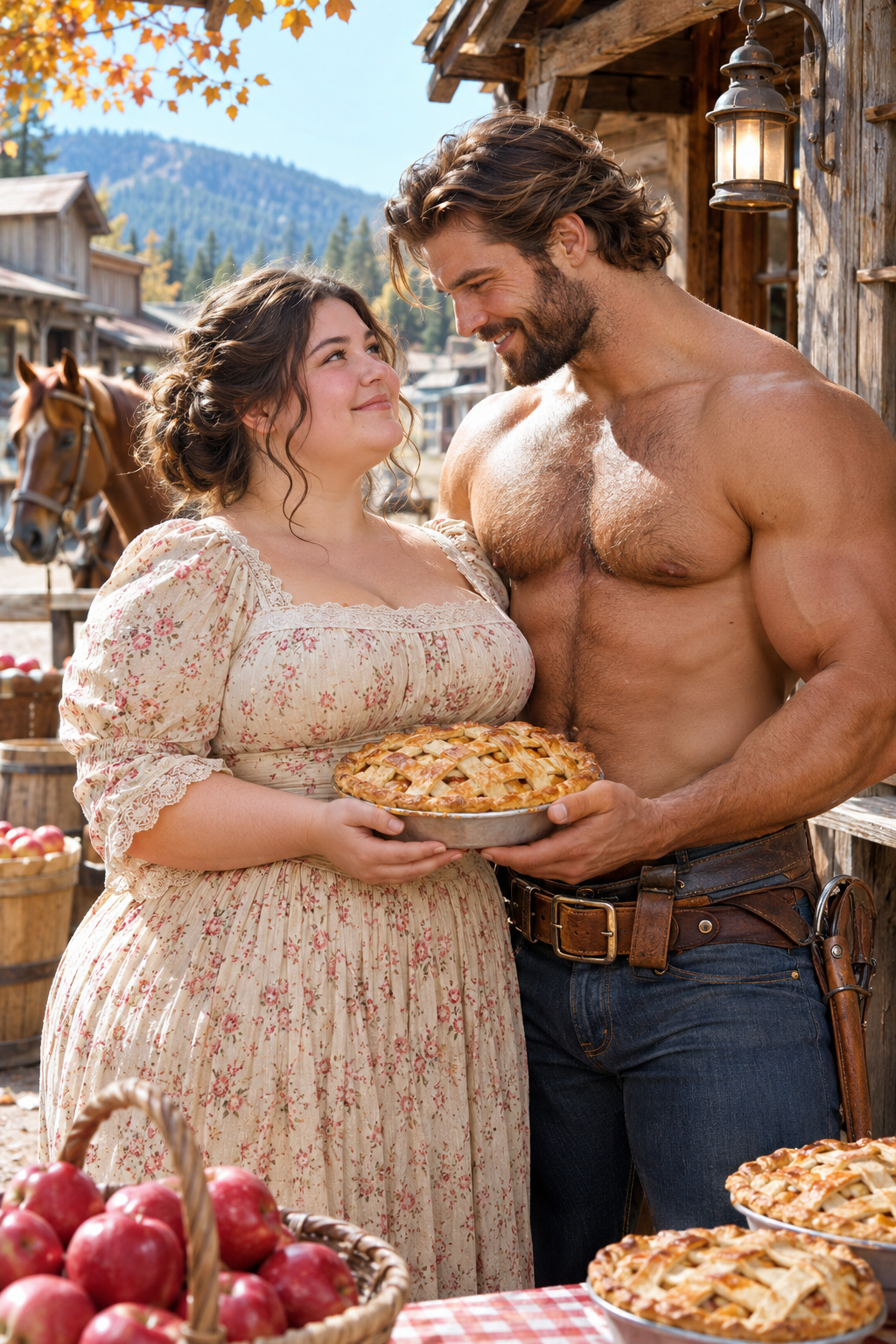
Every Sunday, the wealthiest rancher in Silver Creek rode fourteen miles just to buy a pie from a widow nobody thought he would look twice at.
Garrett took a slow breath, his eyes fixed on Molly’s.
“Would you allow me to take you to supper next Saturday evening?”
For a moment, the entire market seemed to fall silent.
Molly stared at him, certain she had misunderstood.
“Supper?”
“Yes, ma’am. Supper. Not a business arrangement, not a discussion about bread, and certainly not a request for another pie.”
A few people nearby exchanged surprised glances.
Lillian let out a sharp laugh.
“Garrett, surely you’re not serious.”
He turned his head.
“I’ve never been more serious about anything in my life.”
Molly felt the heat rising in her cheeks.
“Mr. Lawson, I don’t think you understand what people will say.”
“I understand perfectly well what people say. I’ve heard enough of it to know that most folks spend their lives talking about things they don’t understand.”
He looked back at her.
“But I would rather spend one evening getting to know you than spend another year wondering what might have happened if I’d simply asked.”
Molly’s fingers trembled against the counter.
“Why me?” she whispered.
Garrett’s expression softened.
“Because you are the only person in Silver Creek who can make a man feel welcome without asking how much land he owns. Because you give away food when you know you cannot afford to. Because you smile at children who have nothing to offer you. And because, every Sunday, I find myself looking forward to seeing you more than I look forward to anything else.”
His words settled over her like a warm blanket.
But before Molly could answer, Lillian stepped forward.
“That’s touching, truly. But perhaps you should consider whether this is wise. A man with your reputation and position deserves someone who can stand beside him without embarrassing him.”
Garrett’s jaw tightened.
“Lillian, I believe I’ve made my own decisions about whom I wish to stand beside.”
“I’m only trying to protect you.”
“Then allow me to protect myself.”
He placed his hat back on his head.
“I’ll come by Saturday, Mrs. Hayes. If you decide you’d rather not go, I’ll understand.”
He left a silver dollar on the counter for a loaf of bread he hadn’t even ordered.
Then he mounted his horse and rode away.
Molly watched him disappear down the dusty street.
For the rest of the afternoon, she could barely concentrate on her customers.
Her heart wanted to say yes.
Her mind reminded her of every cruel remark she had endured since moving to Silver Creek.
She remembered the women who had laughed at her dresses, the men who had called her husband foolish for marrying her, and the countless times she had caught people looking at her as though her body were the only thing worth noticing.
Garrett Lawson was a wealthy man. He owned thousands of acres, employed dozens of ranch hands, and had a house that could have accommodated the entire congregation of Silver Creek.
What could he possibly want with a woman who still counted every penny before buying flour?
That evening, Molly sat alone in her little kitchen, staring at the empty chair across from her.
Her late husband, Thomas, had once promised that they would build a comfortable life together. But his gambling debts had swallowed their savings, and his sudden death had left her with little more than a small house, an aging oven, and bills she could barely pay.
She had spent two years convincing herself that she needed nothing beyond survival.
Yet now, for the first time in a long while, she wanted something more.
She wanted to be seen.
Not as a baker.
Not as a widow.
Not as the woman everyone thought they could laugh at.
Just as Molly.
The next morning, a knock sounded at her door.
She opened it to find Garrett standing on the porch, holding a small wooden box.
“Good morning, Mrs. Hayes.”
“Mr. Lawson. Is something wrong?”
“No, ma’am. At least, I hope not.”
He held out the box.
“I found this among some things my mother left behind. I thought you might like it.”
Inside was a beautiful silver brooch shaped like a small wildflower.
Molly immediately shook her head.
“Oh, I couldn’t possibly accept something so expensive.”
“It isn’t expensive. Not to me.”
“That doesn’t make it right.”
Garrett smiled faintly.
“Then consider it something borrowed. My mother wore it whenever she wanted to feel brave.”
Molly looked down at the delicate flower.
“Was she brave?”
“She was the bravest person I ever knew.”
His voice changed slightly, and Molly noticed a sadness beneath his usual confidence.
“She raised me after my father died. We had almost nothing at first. She took in washing, mended clothes, and cooked for neighboring families. Some people looked down on her because she worked with her hands. But she never allowed their opinions to decide what she was worth.”
Molly looked up.
“Your mother sounds like a wonderful woman.”
“She was. And I believe she would have liked you.”
For several seconds, neither spoke.
Then Garrett glanced toward the road.
“I won’t keep you. Saturday, if your answer is yes.”
He tipped his hat and left.
Molly held the brooch against her chest long after his horse had disappeared.
By Thursday, the whole town knew about Garrett’s invitation.
Lillian made certain of that.
At the general store, she spoke loudly enough for everyone to hear.
“I suppose money makes a man forget what is suitable. Though I cannot imagine what they will look like together at supper.”
A woman named Mrs. Whitcomb giggled.
“Perhaps he’ll order two chairs and have one reinforced.”
The women laughed.
Molly happened to be standing near the flour barrels.
She heard every word.
For a moment, she considered leaving without buying anything. Then she remembered the brooch in her pocket and Garrett’s words about his mother.
She straightened her shoulders.
“Is there something you’d like to say to me directly, Mrs. Price?”
Lillian turned, surprised.
“Why, Molly. We were merely having a conversation.”
“Then perhaps you should have it without using my name.”
The store became quiet.
Molly paid for her flour and walked out.
Her hands were shaking, but she had not lowered her eyes.
It was a small victory.
Yet it felt larger than anything she had accomplished in months.
On Friday afternoon, something unexpected happened.
A young boy named Samuel came running into Molly’s bakery, his face pale with fear.
“Mrs. Hayes! You have to come!”
Molly rushed around the counter.
“What is it, Samuel?”
“My mother. She’s sick, and the doctor says she needs medicine. Papa’s away working at the northern mine, and we haven’t got any money.”
The boy’s eyes filled with tears.
Molly knew his family. His mother, Eleanor, had recently given birth to a little girl. She had been struggling to feed her children since her husband left for seasonal work.
“Where is she?”
“At home.”
Molly grabbed her shawl and hurried after him.
When she reached the little house, she found Eleanor lying in bed, burning with fever. Her newborn daughter cried in a basket beside her.
Molly sent Samuel to fetch the doctor.
Then she heated water, prepared clean cloths, and stayed beside the young mother until help arrived.
The doctor eventually determined that Eleanor needed medicine and several days of rest.
Molly opened her purse.
She had just enough money to pay for the medicine, but doing so meant she would not have enough to purchase flour for the following week.
She looked at Eleanor’s frightened face.
“Please,” the young woman whispered. “I cannot let you spend your money on us.”
“You aren’t spending anything,” Molly replied. “You’re simply allowing me to help.”
By the time Molly returned home, darkness had settled over Silver Creek.
She had barely removed her shawl when another knock sounded.
Garrett stood outside.
He looked at the flour dust on her sleeves and the exhaustion in her face.
“Long day?”
“Something like that.”
He glanced toward the empty kitchen.
“Have you eaten?”
Molly shook her head.
He hesitated.
“Would you mind if I came inside?”
She stepped aside.
Garrett sat at the small table while Molly made coffee.
He noticed the unpaid bills tucked beneath a ceramic bowl and the nearly empty flour sack beside the oven.
“You’ve been having a difficult time.”
Molly stiffened.
“I manage.”
“I didn’t say you didn’t.”
“People seem to think I cannot manage anything without someone feeling sorry for me.”
Garrett looked at her carefully.
“I don’t feel sorry for you, Molly.”
It was the first time he had used her first name.
“I admire you.”
She lowered her eyes.
“There’s a difference between being admired and being wanted.”
Garrett leaned forward.
“Then let me make something clear. I want you. Not because I believe you need rescuing. Not because I think you will make a pretty addition to my house. I want to know what makes you laugh, what makes you angry, what you dream about when you cannot sleep. I want to hear your opinions even when they disagree with mine.”
Molly swallowed.
“Why haven’t you said any of this before?”
“Because I wasn’t sure you would believe me.”
He paused.
“And because I have been a coward.”
Molly looked up in surprise.
Garrett continued.
“After my mother died, I spent years keeping people at a distance. I convinced myself that being alone was easier than risking another loss. Then I started visiting your bakery. Somehow, those little conversations became the best part of my week.”
His eyes met hers.
“I didn’t know how to ask for more.”
Molly felt tears gathering.
“Saturday,” she whispered. “I’ll go to supper with you.”
Garrett’s face brightened.
“Then I’ll consider myself a very fortunate man.”
The following evening, Garrett arrived in a polished carriage instead of on horseback.
Molly wore her best blue dress, the one she had carefully mended twice. She had pinned his mother’s silver brooch near her collar.
When Garrett saw her, he stopped.
“You look beautiful.”
Molly gave a nervous laugh.
“You needn’t say that just to be polite.”
“I’m not in the habit of wasting compliments.”
He offered his arm.
She took it.
For the first time in years, Molly allowed herself to imagine that something good might happen.
They drove beyond the town, following a narrow road that wound toward a hill overlooking Silver Creek.
Garrett had arranged supper beneath a large cottonwood tree. A small table stood beside a lantern, covered with a white cloth. There were roasted potatoes, fresh vegetables, and a chicken pie.
Molly stared at the arrangement.
“You did all this?”
“With some help from my cook.”
She smiled.
“I suppose you wouldn’t want me to believe you can cook.”
“I can manage coffee and eggs. Anything beyond that is a dangerous experiment.”
They laughed.
For hours, they talked.
Garrett told her about growing up on the ranch, about his mother’s stubbornness, and about the first horse he had ever owned. Molly told him about her childhood, her love of baking, and how she had learned to make pies from her grandmother.
When the meal was finished, Garrett walked with her to the edge of the hill.
The town lights shimmered below them.
“Molly, may I ask you something?”
“Of course.”
“Do you believe people can begin again?”
She considered the question.
“I think they can. But it takes courage to leave behind what hurt them.”
Garrett nodded.
“Then I hope you’ll consider beginning something with me.”
She looked at him.
“I would like that.”
He reached for her hand.
She did not pull away.
But happiness in Silver Creek rarely went unnoticed.
And not everyone was pleased.
The following Monday, Garrett received a letter from a business associate in Denver.
The man had been considering purchasing a large section of the Lawson ranch. The proposed deal would have secured Garrett’s financial future for decades.
But the letter contained something else.
It mentioned rumors about his relationship with Molly Hayes and suggested that certain investors were concerned about the judgment of a man who might allow personal feelings to interfere with business.
Garrett crumpled the letter.
He knew exactly where the rumors had come from.
Lillian Price’s brother, Edward, was one of the investors.
Edward had long hoped that Garrett would marry his sister. He believed such a marriage would strengthen his family’s influence and give them access to Garrett’s wealth.
Now he saw Molly as an obstacle.
That afternoon, Edward appeared at the ranch.
“Garrett, my friend, I think we need to talk.”
Garrett invited him into the office.
Edward poured himself a drink without asking.
“I hear you’ve become quite attached to that widow in town.”
Garrett’s expression remained cold.
“Her name is Molly.”
“Of course. Molly Hayes. The baker.”
“What do you want, Edward?”
“To offer some friendly advice. A man in your position needs a wife who understands society. Someone who can entertain important guests and represent the family properly.”
Garrett leaned back.
“And you believe Lillian would be suitable?”
“She would be perfect.”
“Then perhaps you should marry her.”
Edward’s smile disappeared.
“Don’t be foolish. I’m trying to protect your interests.”
“No. You’re trying to control my choices.”
Edward placed his glass down.
“Think carefully. Your ranch needs investment. Without our support, the expansion could become difficult.”
Garrett stood.
“If your investment depends on whom I choose to love, then it was never a good investment.”
Edward’s face darkened.
“You’ll regret this.”
“Show yourself out.”
But Edward had no intention of leaving the matter there.
Two days later, a notice appeared on the door of Molly’s bakery.
The property was being claimed by a creditor over an outstanding debt.
Molly read the paper three times before understanding what it meant.
Her husband’s old debts.
She had believed she was close to paying them off. But a collection agency had recently purchased the remaining balance and was demanding immediate payment, including additional charges that she could not afford.
If she failed to pay within ten days, the bakery and the small house attached to it would be seized.
Molly felt the ground disappear beneath her feet.
She had no savings.
No family nearby.
And no way to raise the money in time.
When Garrett arrived that afternoon, he found her sitting behind the counter with the notice in her hands.
“What happened?”
She handed him the paper.
He read it slowly.
“Who is this creditor?”
“Blackwood Mercantile.”
Garrett frowned.
“I know that name.”
“Apparently they purchased the debt from the original lender.”
“Did they provide an itemized account?”
Molly shook her head.
“They said the amount was legally owed.”
Garrett studied the notice again.
“I’ll have my attorney look into this.”
Molly immediately stood.
“No.”
“Molly—”
“I won’t have you paying my husband’s debts.”
“I’m not asking to pay them.”
“Then don’t interfere.”
Garrett’s expression softened.
“I am trying to help.”
“And I am trying to keep one thing in my life that belongs to me.”
Her voice broke.
“Everyone already thinks I am with you because of your money. If you pay this debt, they’ll say they were right.”
Garrett stood silently.
Then he nodded.
“All right. I won’t pay it.”
Molly looked surprised.
“But I will help you understand what they’re claiming. There’s a difference.”
She slowly sat down.
“Thank you.”
Garrett left shortly afterward, but his mind was already working.
He knew Blackwood Mercantile had recently been involved in several questionable transactions. He also knew Edward Price had been associated with the company.
That evening, Garrett sent a telegram to his attorney.
He asked him to investigate the original loan, the sale of the debt, and every person involved.
Three days later, the answer arrived.
The debt had been inflated.
Several payments Molly had made over the previous two years were missing from the account.
Worse still, the company had purchased the debt for a fraction of its original value and then added charges that had never appeared in the original agreement.
Garrett took the documents directly to the county clerk.
What he discovered there was even more disturbing.
The transfer papers bore a signature supposedly belonging to Molly’s late husband.
But the date on the document was six months after his death.
Someone had forged it.
And the company attempting to seize Molly’s property was connected to Edward Price.
Garrett rode straight into town.
He found Molly outside her bakery, arranging fresh bread in the window.
“I need you to come with me.”
Her expression tightened.
“What has happened?”
“I think someone is trying to steal your property.”
He showed her the documents.
Molly read them, her face growing pale.
“Who would do such a thing?”
“Someone who believes you won’t fight back.”
She looked up.
“Edward Price?”
Garrett nodded.
For a long moment, Molly said nothing.
Then she folded the papers carefully.
“Then I want to fight.”
Garrett smiled.
“Good.”
But neither of them knew that Edward had already learned about the investigation.
That evening, he visited Lillian.
She was sitting in her parlor, embroidering a handkerchief.
“You told me Garrett would come around eventually,” she said. “Instead, he has become more determined than ever to marry that woman.”
Edward poured himself a drink.
“Garrett is making a mistake. But we can still correct it.”
“What are you planning?”
He looked at his sister.
“I need you to visit Molly tomorrow.”
Lillian frowned.
“Why?”
“Because she trusts no one, but she might listen to another woman. Make her believe Garrett is only interested in her because he feels responsible for her troubles.”
Lillian’s lips curved into a small smile.
“And if she refuses to believe me?”
“Then remind her what happens to women who embarrass themselves by reaching above their station.”
The next morning, Lillian entered Molly’s bakery carrying a basket of flowers.
“Molly, dear. I thought we might talk.”
Molly continued arranging loaves.
“I doubt we have much to discuss.”
Lillian placed the basket on the counter.
“I’ve been thinking about you. It must be difficult, knowing Garrett is only helping you because he feels sorry for your situation.”
Molly did not respond.
“Men like Garrett enjoy feeling like heroes. They find a struggling woman and convince themselves that rescuing her makes them noble.”
Molly looked at her.
“Is that what your brother told you?”
Lillian’s smile faltered.
“What?”
“Edward. Is he the one who told you about my debt?”
Lillian’s cheeks reddened.
“I don’t know what you’re talking about.”
“Then perhaps you should ask him why he forged documents in my husband’s name.”
For the first time, Lillian appeared genuinely frightened.
Molly stepped closer.
“I may not have money or influence, Mrs. Price, but I know the difference between kindness and manipulation.”
Lillian snatched up her gloves.
“You’ll regret speaking to me that way.”
“I’ve regretted being silent for too long.”
Lillian stormed out.
That afternoon, Garrett and Molly met with the county judge.
They presented the original loan agreement, receipts for Molly’s payments, and the forged transfer document.
The judge ordered an immediate suspension of the property seizure and summoned the representatives of Blackwood Mercantile for questioning.
But Edward Price was not finished.
He knew the investigation could destroy his reputation and perhaps send him to prison.
So he decided to make one final move.
On the ninth day, a fire broke out behind Molly’s bakery.
It began in the small storage shed where she kept flour, firewood, and spare kitchen supplies.
A neighbor saw the smoke and raised the alarm.
Within minutes, half the town was running toward the building.
Molly was inside.
She had been preparing a large order of bread for the church’s charity supper when the flames spread through the back entrance.
Garrett arrived just as the first section of the roof began to burn.
“Where’s Molly?”
“She went back for the flour ledger!” someone shouted.
Garrett did not hesitate.
He covered his mouth with a wet cloth and rushed through the doorway.
Smoke filled the kitchen.
“Molly!”
He heard coughing from the storeroom.
He found her near the back wall, trying to lift a fallen wooden beam.
“Garrett!”
He grabbed her arm.
“Leave it!”
“My ledger! It has all the records of the payments!”
“I don’t care about the ledger. I care about you!”
He pulled her away just as a section of the ceiling collapsed.
They stumbled through the kitchen and reached the front door.
Garrett shielded her as burning pieces of wood fell around them.
The moment they reached the street, Molly collapsed against him, coughing violently.
Garrett held her tightly.
For several seconds, he could not speak.
Then he pressed his forehead against hers.
“I thought I’d lost you.”
Molly clutched his coat.
“I thought I had lost everything.”
He looked at the burning building.
“Not everything.”
But the bakery was badly damaged.
Most of the kitchen equipment was ruined, and the remaining bread had been destroyed.
The town watched in silence as the firemen worked through the night.
Then something unexpected happened.
The first person to approach Molly was Mrs. Whitcomb, the same woman who had once laughed at her in the general store.
She carried a basket of food.
“I know this won’t replace what you’ve lost,” she said awkwardly. “But perhaps it will help.”
Another woman came forward with blankets.
Then a farmer offered timber.
A blacksmith promised to repair the oven.
Even the children arrived carrying small jars of coins they had collected.
Molly looked around in disbelief.
She had spent two years believing that Silver Creek would never accept her.
Yet now, people she barely knew were standing beside her.
Not because she was wealthy.
Not because she was important.
But because she had spent so much time helping others that, when she finally needed help herself, they remembered.
Garrett stood beside her, holding her hand.
“You see?” he whispered.
Molly wiped her tears.
“I never thought anyone would do this for me.”
“Sometimes people need to be reminded what kindness looks like.”
The following morning, the sheriff arrived at the ranch with a warrant.
Edward Price had been arrested.
An investigation into Blackwood Mercantile had uncovered the forged documents, fraudulent debt claims, and evidence connecting Edward to the fire.
One of the stable boys had witnessed him paying a man to set the shed alight.
The man had confessed in exchange for leniency.
Edward was charged with fraud, forgery, conspiracy, and arson.
Lillian, who had known about the fraudulent debt scheme, was questioned as well. She admitted that her brother had asked her to intimidate Molly, though she denied knowing about the fire.
Her family’s reputation collapsed almost overnight.
But Molly felt no satisfaction in their downfall.
She had learned that bitterness could become another kind of prison, and she had no intention of living inside one.
Instead, she focused on rebuilding.
For six weeks, the townspeople worked together.
Garrett supplied the timber and paid for the structural repairs, but Molly insisted on purchasing her own new oven.
She used the money she had saved for the final debt payments, now returned to her after the court invalidated the fraudulent claims.
When Garrett offered to pay for the equipment, she shook her head.
“You’ve already done enough.”
He smiled.
“I know. But I was hoping you might let me contribute something.”
“What?”
“A new sign.”
Molly laughed.
“I can make a sign.”
“I know you can. But I happen to know a carpenter who owes me a favor.”
She narrowed her eyes.
“Garrett Lawson, are you trying to get your way again?”
“Only when the matter is important.”
The new sign arrived on the morning of the bakery’s reopening.
It was made of dark oak, with elegant lettering painted in gold.
HAYES BAKERY
FRESH BREAD, HOMEMADE PIES, AND A WELCOME FOR EVERYONE.
Molly stood beneath it, unable to speak.
Garrett watched her expression.
“Too much?”
She shook her head.
“No. It’s perfect.”
The reopening was the busiest day Molly had ever experienced.
People came from neighboring towns to purchase her pies.
Some came because they had heard about the fire. Others came because they wanted to support the woman who had stood up to the Prices.
By noon, every loaf of bread had been sold.
And beneath the counter, Molly had placed one special pie.
A huckleberry apple pie.
Wrapped in a clean white cloth.
At exactly two o’clock, Garrett arrived.
He removed his hat.
“One huckleberry apple pie, Mrs. Hayes.”
Molly smiled.
“Same as last Sunday?”
“Wouldn’t dream of changing it.”
She reached beneath the counter and brought out the pie.
But this time, Garrett did not immediately reach for his wallet.
Instead, he placed a small velvet box on the counter.
Molly stared at it.
“What’s that?”
“Something I’ve been carrying around for far too long.”
She opened the box.
Inside was a simple gold ring.
Her breath caught.
Garrett took a step closer.
“I had planned to ask you something before all this trouble began. Then I thought perhaps the timing wasn’t right. But I’ve come to understand that waiting for the perfect moment is sometimes just another way of being afraid.”
He took her hands.
“Molly Hayes, I cannot promise you a life without difficulties. I cannot promise that people will always be kind or that the world will never hurt you. But I can promise that you will never have to face those things alone if you don’t want to.”
His voice grew softer.
“I want to build a life with you. I want to wake up knowing you’re there, argue with you over foolish things, listen to you talk about recipes I cannot understand, and grow old beside you. Will you marry me?”
Molly looked at the ring.
Then she looked at the man standing before her.
A man who had traveled fourteen miles every Sunday for a pie.
A man who had never once made her feel that she needed to become someone else to deserve his attention.
Tears rolled down her cheeks.
“Yes,” she whispered.
Garrett smiled.
“Was that a yes?”
She laughed through her tears.
“Yes, you stubborn man. Yes.”
He slipped the ring onto her finger.
Then he kissed her gently, while the bakery erupted in applause.
Mrs. Whitcomb was crying.
The blacksmith whistled.
Even the children clapped so loudly that Molly could barely hear Garrett whispering in her ear.
“I believe I still owe you for that pie.”
She smiled.
“You can pay me next Sunday.”
He laughed.
“I suppose I’ll have to keep coming, then.”
They were married three months later in the little church where Lillian had once humiliated Molly.
The ceremony was simple.
Molly wore a beautiful ivory dress made by the women who had helped rebuild her bakery. The silver flower brooch from Garrett’s mother rested near her heart.
Garrett wore his finest suit, though he looked more nervous than he had during the court proceedings.
When the minister asked whether anyone had a reason to object, the church fell silent.
Molly glanced toward the back.
Lillian was there.
She had lost much of her former confidence. Her brother had been sentenced to prison, and the Price family had sold their house to cover legal expenses.
For a moment, Molly wondered whether Lillian would say something.
But she remained seated.
After the ceremony, as guests gathered outside, Lillian approached Molly.
“I suppose I owe you an apology.”
Molly looked at her quietly.
“Yes, I believe you do.”
Lillian lowered her eyes.
“I was cruel. I thought I was protecting my family, but I was really protecting my pride.”
Molly waited.
“I don’t expect you to forgive me.”
Molly glanced at Garrett, who stood a short distance away, speaking with the minister.
“Forgiveness doesn’t mean pretending nothing happened,” she said. “But I hope one day you learn that another woman’s happiness does not diminish your own.”
Lillian nodded, unable to answer.
Molly did not embrace her.
She did not need to.
She simply wished her well and walked away.
The newlyweds settled at the Lawson ranch, but Molly refused to abandon her bakery.
Garrett built a small cottage beside it, and they divided their time between the ranch and the town.
Their home became known for its open doors.
Travelers could stop for a meal, children could sit on the porch after school, and anyone struggling to afford bread could take what they needed without embarrassment.
Molly kept a small wooden box beside the counter.
Inside were coins donated by customers who wanted to help others.
She called it the Sunday Basket.
Every week, she used the money to provide food for families who had fallen on hard times.
Garrett never questioned the expense.
In fact, he often added money when he thought she wasn’t looking.
Years passed.
The bakery grew, and Molly eventually hired three women who needed steady work.
Samuel, the little boy who had once come running for help, grew into a fine young man and became an apprentice at the ranch.
Eleanor recovered and later brought her daughter to the bakery every Sunday.
Silver Creek changed, too.
People still gossiped, as people always would.
But the laughter directed at Molly slowly disappeared, replaced by respect for the woman who had turned a small bakery into a place of refuge.
And every Sunday, without exception, Garrett rode those fourteen miles.
Even after they were married.
Even after they lived together.
Even after Molly told him that he could simply ask her to bake a pie at home.
He insisted on coming through the front door, removing his hat, and standing before the counter like any other customer.
“One huckleberry apple pie, Mrs. Lawson.”
Molly would pretend to consider the request.
“I’m afraid those are rather expensive.”
“How expensive?”
“An entire silver dollar.”
Garrett would place the coin on the counter.
“Then I’ll take two.”
She would laugh and wrap the pies in clean cloth.
One Sunday, many years later, a little girl stood near the entrance watching the exchange.
She was the granddaughter of Eleanor, with bright eyes and a curious expression.
“Mrs. Lawson,” she asked, “why does Mr. Lawson buy a pie every Sunday when he could have one at home?”
Molly glanced at Garrett.
He smiled and waited for her answer.
She crouched beside the girl.
“Because sometimes, sweetheart, the important thing isn’t what someone buys. It’s the reason they keep coming back.”
The little girl considered this.
“Is it because he loves you?”
Molly smiled.
“Yes. But not only because of that.”
She looked around the bakery.
“It’s because love is something you show. You show it by remembering someone, by respecting them, by keeping your promises, and by making them feel that they matter.”
The girl nodded as though she understood.
Then she looked at Garrett.
“Do you love her that much?”
Garrett bent down beside them.
“More than I knew was possible.”
The little girl grinned and ran outside.
Molly watched her go before turning back to her husband.
“You know,” she said, “I never did understand why you traveled fourteen miles just to buy a pie.”
Garrett took her hand.
“Would you like the truth?”
“I thought I already knew it.”
“The first time I came here, I had heard about your baking from one of my ranch hands. He said you made the best pie in the county. I was curious, so I rode into town.”
“And after that?”
He smiled.
“After that, I realized the pie wasn’t the best part.”
Molly raised an eyebrow.
“Then what was?”
“You.”
She shook her head, laughing.
Garrett continued.
“I had spent so many years believing that a man’s worth came from what he owned. The land, the cattle, the money in the bank. Then I met a woman who had almost nothing and somehow gave more than anyone I knew.”
Molly rested her head against his shoulder.
“And I spent so many years believing that nobody could love me unless I first became someone they approved of.”
Garrett kissed her forehead.
“You never needed to change for me.”
Outside, the afternoon sun settled over Silver Creek, casting long golden shadows across the dusty street.
Inside the bakery, the smell of fresh bread filled the air.
On the wall hung an old photograph of Molly standing beside the first wooden counter she had ever owned. Her dress was worn, her face tired, and her expression uncertain.
Beside it hung a newer photograph.
Molly and Garrett stood together beneath the bakery sign, smiling as though the world had finally given them permission to be happy.
Beneath the photographs, Molly had placed a small handwritten message:
Never measure a person’s worth by what you see on the outside. Some of the kindest hearts are hidden behind the faces the world is quickest to judge.
She had written it after the fire, but it had become the quiet lesson of her life.
For Molly had learned that beauty was not a measurement, love was not a transaction, and dignity was not something another person could grant or take away.
Garrett had learned that wealth meant very little if a man used it only to make his own life comfortable.
And Silver Creek had learned, perhaps a little too late, that the people who deserve the most kindness are often the ones who receive the least.
As evening approached, Garrett picked up his hat.
“Shall we go home?”
Molly looked around her bakery, at the customers finishing their coffee, the children sharing a loaf of warm bread, and the little Sunday Basket sitting beside the counter.
Then she reached for his hand.
“Yes. But first, there’s something I need to do.”
She walked to the back, selected a freshly baked pie, and placed it in a basket.
“Who’s that for?” Garrett asked.
“Someone who needs a little kindness.”
He smiled.
“Then I suppose we’d better deliver it.”
Together, they stepped into the evening.
And as they walked down the familiar street, Molly realized something she wished she had understood years earlier.
She had once believed that her life would begin when people stopped judging her.
But life had not waited for their approval.
It had begun the moment she decided that their opinions would no longer determine her worth.
The world would always have its Lillians, people who mistook cruelty for honesty and appearances for character.
But it would also have its Garretts, people who looked beyond the surface and understood that a person’s true value could never be measured by a dress size, a bank account, or a place in society.
And sometimes, the greatest love story does not begin with a grand gesture or a beautiful face.
Sometimes, it begins with a simple pie, a fourteen-mile journey, and one person who keeps showing up until another person finally believes they are worthy of being loved.
Because the right person will never ask you to become smaller to make room for their love. They will remind you that you were worthy of it all along.