Emily Douglas was the only woman in the ballroom who refused to curtsy before the Duke of Westfall.
Emily stared at the folded letter in the Duke’s hand.
“What is it?”
“Read it.”
She accepted the letter cautiously. The paper was worn around the edges, as though someone had unfolded it many times. When she recognized the handwriting, her breath caught.
It belonged to her father.
But her father had been dead for seven years.
“Where did you get this?”
“It was written to my father shortly before his death.”
Emily moved closer to the lantern and began reading.
The letter described a painting her father had completed for the previous Duke of Westfall. It mentioned an unpaid commission, a broken agreement, and a considerable sum of money that had never reached the Douglas family.
Then came a sentence that made her hands tremble.
I ask nothing for myself, Your Grace. But my daughter possesses a remarkable gift, and I cannot bear the thought that poverty might deprive her of the future she deserves.
Emily stopped reading.
For years, she had believed her father’s financial troubles were the result of unfortunate business decisions. She remembered the creditors, the furniture being sold, and the terrible winter when her father became too ill to work.
“Your father owed mine money?”
The Duke nodded.
“A substantial amount.”
“And he never paid him?”
“No.”
Emily looked toward the dark waters of the canal. Suddenly, the beautiful palazzo seemed less welcoming.
“Is that why you brought me here? To settle an old debt?”
“Partly.”
She turned sharply.
“Partly?”
“I discovered the letter after meeting you at the ball. Your surname seemed familiar, so I searched through my father’s correspondence.”
“And instead of telling me the truth, you arranged an elaborate deception.”
“I wanted to offer you an opportunity without making you feel obligated.”
“You wanted to make a decision about my life without consulting me.”
The Duke’s expression changed.
For the first time since she had met him, he appeared genuinely uncertain.
“That was not my intention.”
“Perhaps not. But it was your choice.”
Emily placed the letter on the table between them.
“My father died believing he had failed me. Your family could have prevented much of his suffering.”
“I know.”
“And you expected me to spend my days painting the people who benefited from his misfortune?”
“No, Emily.”
It was the first time he had used her Christian name.
She wished it had happened under different circumstances.
“I expect nothing from you. The debt will be repaid whether you finish the portrait or leave tomorrow.”
Emily studied him, searching for some sign of dishonesty.
“Why didn’t you tell me when I arrived?”
The Duke looked away.
“Because by then, I had another reason for wanting you here.”
Her heart betrayed her with a sudden, painful flutter.
But she refused to ask what that reason was.
“Good night, Your Grace.”
She returned to her room and closed the door before the tears came.
By morning, Emily had decided to leave Venice.
She packed her dresses, wrapped her brushes, and placed her unfinished sketches inside her portfolio. Whatever affection she had begun to feel for the Duke could not erase what she had learned.
A knock interrupted her preparations.
It was Lady Catherine, the Duke’s sister.
“Are you truly leaving?”
“Yes.”
“Did something happen between you and my brother?”
Emily hesitated before handing her the letter.
Catherine read it twice. Her face grew pale.
“I never knew.”
“I believe you.”
“Our father was not an easy man,” Catherine admitted. “But I never imagined he would do something so cruel.”
Emily sat beside the window.
“Your brother should have told me.”
“Yes, he should have.”
Catherine folded the letter carefully.
“But there is something you ought to understand about him. Alexander has spent most of his life correcting the damage our father left behind.”
Alexander.
Until that moment, Emily had rarely thought of the Duke as a man with an ordinary name.
“He inherited more than a title,” Catherine continued. “There were debts, ruined friendships, and people our father had treated terribly. My brother learned very young that kindness was considered weakness in this family.”
“That doesn’t excuse dishonesty.”
“No. It doesn’t.”
Catherine took Emily’s hand.
“But please don’t mistake his mistakes for his father’s cruelty.”
Emily looked at their joined hands.
She had grown fond of Catherine. The young woman possessed a warmth that seemed strangely out of place within the formal household.
“I need time to think.”
“Then take it. But don’t leave because you believe you’re unwelcome.”
Catherine smiled sadly.
“You’re the first person in years who has made this house feel alive.”
After Catherine departed, Emily remained beside the window for nearly an hour.
Finally, she unpacked her brushes.
She would finish the portrait. Not for the Duke, and certainly not because of his money. She would finish it because she had accepted a commission, and her father’s disappointment would not determine the rest of her life.
When Alexander entered the drawing room that afternoon, he found her arranging her paints.
“You stayed.”
“Until the portrait is finished.”
Relief crossed his face.
“Thank you.”
“Don’t thank me yet. I intend to make you sit perfectly still for several hours.”
A faint smile appeared.
“I shall consider it a deserved punishment.”
For the next week, their relationship remained painfully polite.
Emily addressed him formally. Alexander respected her distance. Their lively conversations disappeared, replaced by instructions about posture, lighting, and clothing.
Yet she noticed things she had previously overlooked.
Alexander always thanked the servants who brought his meals. He listened patiently when Catherine spoke about her interests. When an elderly gardener injured his hand, the Duke personally arranged for a physician and continued paying the man’s wages.
These were not grand gestures performed for an audience.
Most of the time, Alexander did not realize Emily was watching.
One afternoon, she found him sitting alone in the library with a stack of documents.
“What are those?”
“Accounts from our English estates.”
She glanced at the papers.
“More debts?”
“Some. Others concern repairs to the tenants’ cottages.”
“Your father neglected those, too?”
“I’m afraid so.”
Emily noticed the exhaustion beneath his eyes.
“Do you ever rest?”
“Occasionally.”
“When?”
“When a particularly demanding artist orders me not to move.”
Despite herself, she laughed.
Alexander looked up, and for a moment, the old warmth returned between them.
Then the library doors opened.
A tall, elegantly dressed woman entered without knocking.
“Alexander, darling. You might have warned me that you were entertaining guests.”
Emily immediately recognized Lady Beatrice Ashford, the daughter of a wealthy marquess. She had seen her at several London gatherings, always surrounded by admirers.
Alexander stood.
“Beatrice. I wasn’t expecting you.”
“Clearly.”
Her gaze traveled over Emily’s paint-stained dress.
“And who is this?”
“Miss Emily Douglas. She’s painting our family portrait.”
“How charming.”
Beatrice smiled, but her eyes remained cold.
“I hope you won’t be working during the engagement celebrations.”
Emily felt her stomach tighten.
Alexander’s expression hardened.
“There are no engagement celebrations.”
“Not yet,” Beatrice replied lightly. “But our families have been discussing the matter for years.”
“Our families are not getting married.”
Beatrice laughed as though he had made a delightful joke.
Emily gathered her sketches.
“I should return to my work.”
Alexander started toward her.
“Miss Douglas—”
“Please excuse me.”
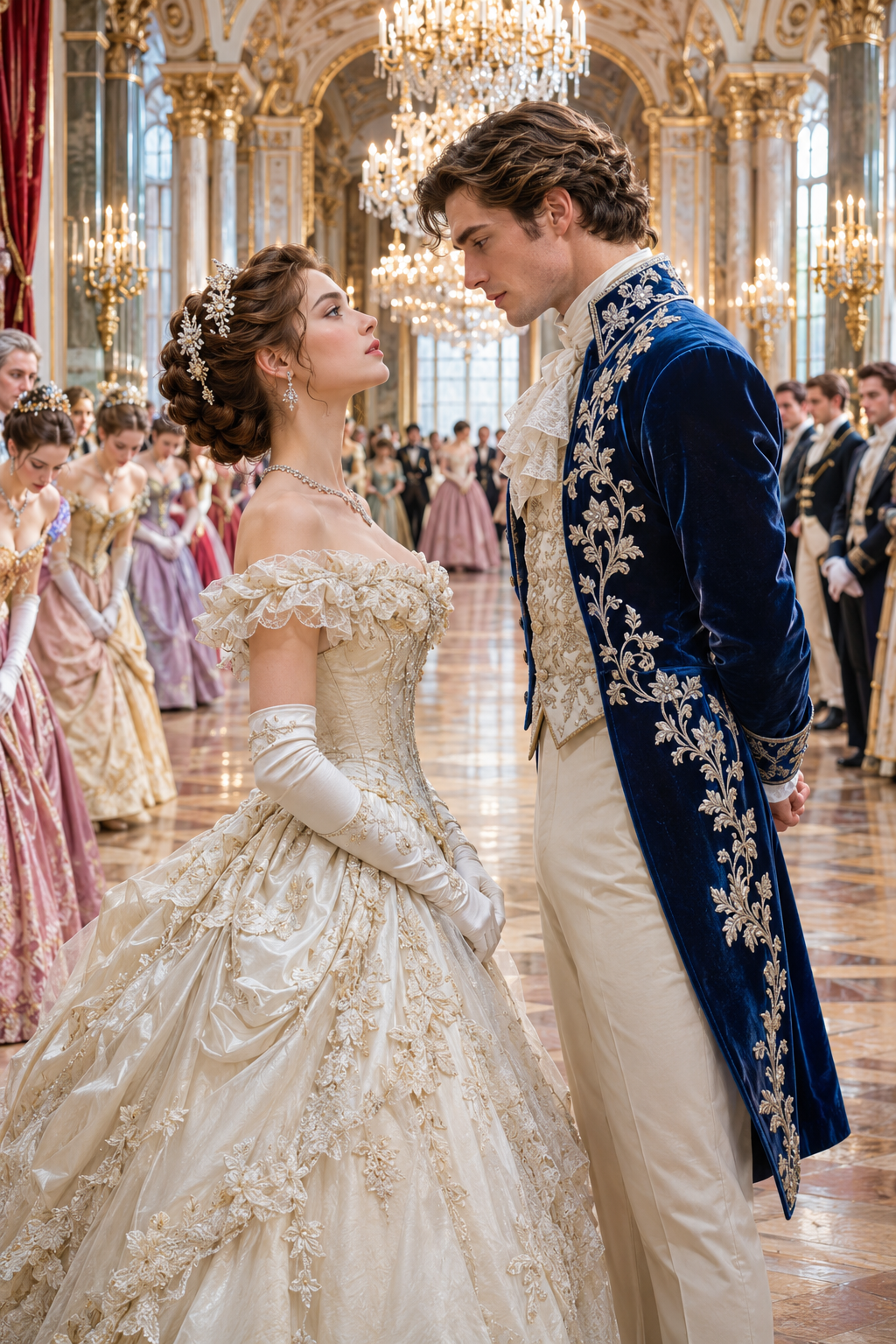
She left before he could finish.
That evening, the household gathered for dinner. Beatrice occupied the seat beside Alexander and spoke endlessly about London society, future parties, and mutual acquaintances.
Emily listened quietly.
It became painfully obvious that Beatrice considered herself the future Duchess of Westfall.
When dinner ended, Emily escaped to the garden.
She had barely reached the fountain when she heard footsteps behind her.
“Miss Douglas.”
It was Beatrice.
“I thought we should become better acquainted.”
Emily turned.
“How kind.”
Beatrice examined the roses beside the fountain.
“Alexander has always possessed an unfortunate habit of becoming interested in unusual things.”
“I’m afraid I don’t understand.”
“Artists, musicians, charitable causes. He finds them entertaining for a while.”
Emily’s expression remained calm.
“And?”
“Eventually, he remembers who he is.”
Beatrice stepped closer.
“A man of his position cannot marry merely because a woman amuses him.”
Emily felt the insult clearly.
“Then I suggest you discuss marriage with him rather than with his portrait painter.”
“You’re clever. I’ll give you that.”
Beatrice’s smile vanished.
“But cleverness will not change your circumstances.”
Emily looked directly at her.
“Nor will wealth improve your manners.”
She walked away, leaving Beatrice speechless.
The following morning, disaster struck.
Emily entered the drawing room and stopped in horror.
Her nearly completed portrait had been ruined.
A long tear stretched across the canvas. Dark paint covered Catherine’s face, and several carefully prepared sketches had disappeared.
For a moment, Emily could not move.
Weeks of work lay destroyed before her.
Catherine rushed into the room.
“Oh, Emily!”
Alexander arrived moments later.
His face darkened when he saw the painting.
“Who did this?”
Nobody answered.
Mrs. Whitmore summoned the servants, but each insisted they had seen nothing unusual.
Then Beatrice appeared.
“How dreadful,” she exclaimed. “Although perhaps it was an accident.”
Emily turned toward her.
“An accident involving a knife?”
Beatrice raised her eyebrows.
“Surely you’re not accusing anyone without evidence.”
Alexander examined the damaged canvas.
“Everyone who entered this room yesterday will be questioned.”
Beatrice folded her arms.
“Really, Alexander. It’s only a painting.”
He turned toward her.
“No. It is someone’s livelihood.”
The room fell silent.
“And whoever destroyed it will answer for their actions.”
Emily appreciated his defense, but it did little to ease her grief.
She spent the afternoon attempting to salvage the painting. By sunset, she understood that she would have to begin again.
Then a young servant named Lucia appeared at her door.
“Miss Douglas, may I speak with you?”
The girl looked terrified.
“Of course.”
Lucia reached into her apron and produced a folded sketch.
It was one of Emily’s missing drawings.
“I found this in Lady Beatrice’s room.”
Emily stared at it.
“Are you certain?”
“Yes, miss. I also saw her leaving the drawing room last night. She told me that if I spoke of it, she would have me dismissed.”
Emily gently took the girl’s hand.
“You’ve done nothing wrong.”
“But my mother depends on my wages.”
“I understand.”
Emily brought Lucia directly to Alexander.
He listened without interrupting.
When the girl finished, he assured her that her employment was secure.
Then he summoned Beatrice.
She arrived smiling, but her expression changed when she saw the sketch on his desk.
“Would you care to explain this?”
Beatrice glanced at Lucia.
“That girl is lying.”
Alexander’s voice remained controlled.
“Be very careful.”
“Surely you cannot believe a servant over me!”
“I believe the evidence.”
Beatrice’s face flushed.
“Fine! I wanted her gone. Is that so terrible?”
Catherine, standing near the fireplace, gasped.
“You destroyed her painting?”
“She has no business here! Alexander, everyone can see how she looks at you.”
Emily felt her cheeks burn.
Beatrice continued desperately.
“You were supposed to marry me. Our families agreed.”
“My father discussed an arrangement with yours. I never consented.”
“You would throw away everything for a woman who paints for money?”
Alexander stood.
“Miss Douglas earns her living through talent and hard work. You would benefit from learning the difference between privilege and worth.”
Beatrice stared at him in disbelief.
“You’ll regret this.”
“Perhaps. But you will leave my home tomorrow.”
Her eyes filled with angry tears.
“You’re making a terrible mistake.”
“No,” Alexander replied. “My mistake was allowing you to believe you could behave this way without consequences.”
Beatrice departed the following morning.
But the trouble did not end with her departure.
Within weeks, letters arrived from England. Rumors had spread through London that the Duke had abandoned an honorable marriage arrangement because of an ambitious young artist.
One newspaper even suggested Emily had deliberately manipulated him for financial gain.
Her aunt wrote begging her to return home before her reputation was destroyed.
Emily read the letter in silence.
Alexander found her in the garden.
“I can stop this,” he said.
“How?”
“I have friends who can speak to the newspaper’s editor.”
“And tomorrow another newspaper will print something worse.”
“Then I’ll publicly explain everything.”
Emily shook her head.
“You cannot spend your life fighting everyone who disapproves of me.”
“I would.”
The simplicity of his answer frightened her.
“Alexander.”
He looked at her, surprised to hear his name.
“I have worked too hard to become an independent woman. I cannot let society turn me into someone whose only achievement is attracting a duke.”
“Then don’t.”
He stepped closer.
“Finish your painting. Return to London. Open your studio. Do everything you intended before you met me.”
“And what about you?”
Alexander was silent for a moment.
Then he reached for her hand.
“I love you, Emily.”
She stopped breathing.
“I think I began falling in love with you the moment you refused to curtsy. But what I felt then was nothing compared to what I feel now.”
Emily’s eyes filled with tears.
“I don’t know whether I can belong in your world.”
“I don’t want you to belong to my world. I want to share yours.”
She looked down at their hands.
“Would you expect me to stop painting?”
“Never.”
“Would you expect me to obey you simply because you are my husband?”
“I suspect attempting that would shorten my life considerably.”
She laughed through her tears.
Alexander smiled.
Then he became serious.
“Marry me, Emily. Not because of my title, my fortune, or the debt my family owes yours. Marry me only if you believe we could build a good life together.”
For one beautiful moment, she wanted to say yes.
But something held her back.
“I need to return to England.”
His smile faded.
“Of course.”
“I need to discover whether I can stand on my own before I promise to stand beside you.”
Alexander released her hand.
It was clearly the last thing he wanted to do.
Yet he nodded.
“Then I shall wait.”
Emily completed the second portrait three weeks later.
It was even more beautiful than the first.
Instead of presenting the Westfall family as distant, powerful figures, she painted them gathered beside an open window. Catherine was laughing, Alexander was smiling gently, and sunlight filled the room.
When Alexander saw it, he remained silent for a long time.
“You’ve made us look happy.”
“You were happy.”
He turned toward her.
“Because you were here.”
The next morning, Emily left Venice.
Alexander accompanied her to the boat. He handed her a small envelope containing the payment for her commission and documents confirming that her father’s outstanding debt would be repaid to his estate.
There were no conditions attached.
“Write to me?” he asked.
“I will.”
He kissed her hand.
And then he let her go.
Back in London, Emily discovered that independence was more difficult than she had imagined.
Several wealthy clients canceled their commissions. Invitations disappeared. At social gatherings, people whispered when she passed.
But Emily refused to hide.
She rented a modest studio and continued painting.
Her first new customer was an elderly widow who wanted a portrait of her grandson. Then came a merchant, followed by a physician and his wife.
Gradually, her reputation began to recover.
Months later, one of her paintings was accepted into a respected London exhibition.
On opening night, Emily stood among the visitors, watching strangers admire her work.
For the first time in years, she felt completely certain that her father would have been proud.
Then she heard a familiar voice behind her.
“An interesting painting.”
She turned.
Alexander stood there, wearing a dark evening coat and the same expression he had worn at the ball where they first met.
Her heart leaped.
“Your Grace.”
“Miss Douglas.”
“You’ve come to criticize my work?”
“Quite the opposite.”
He examined the painting.
“I’ve come to congratulate the finest artist I know.”
Emily smiled.
They had exchanged letters throughout their separation. He had never pressured her to return or repeated his proposal.
Instead, he had asked about her paintings, told her about Catherine, and shared amusing stories from his estates.
She had fallen more deeply in love with him through every letter.
“Would you walk with me?” she asked.
“Gladly.”
They stepped into the quiet courtyard outside the exhibition hall.
Emily looked up at him.
“Do you remember asking me a question in Venice?”
“I remember every conversation we had in Venice.”
“Then perhaps you should ask it again.”
Alexander stared at her.
“Emily?”
She smiled.
“I’ve built my studio. I’ve earned my own reputation. And I’ve discovered something rather inconvenient.”
“What is that?”
“Being independent doesn’t mean I have to be alone.”
For a moment, he appeared unable to speak.
Then he took both her hands.
“Emily Douglas, will you marry me?”
“Yes.”
His face transformed.
She had never seen him smile so openly.
He drew her into his arms, and beneath the London stars, the formidable Duke of Westfall kissed the woman who had once refused to bow before him.
They married the following spring.
Emily continued painting after becoming Duchess of Westfall. She established a school for young women who possessed artistic talent but lacked the money or opportunities to pursue it.
Above the entrance hung a small portrait of her father.
Alexander supported the school without attempting to control it. Whenever anyone suggested that his wife’s occupation was inappropriate for a duchess, he simply invited them to visit her exhibition.
Years later, their young daughter asked Emily how she had met her father.
“Your father expected me to curtsy,” Emily explained.
“And did you?”
“Absolutely not.”
Alexander laughed from across the room.
“Your mother was the most troublesome woman I had ever encountered.”
Their daughter giggled.
“Then why did you marry her?”
Alexander crossed the room and kissed Emily’s forehead.
“Because she taught me that respect cannot be demanded, love cannot be purchased, and a person’s value has very little to do with their title.”
Emily smiled at him.
“And your father taught me something equally important.”
“What?”
“That accepting someone’s love does not mean surrendering your freedom.”
Outside, the afternoon sun illuminated the gardens of Westfall. Inside, the walls were covered with paintings Emily had created throughout their marriage.
Among them hung the family portrait from Venice.
It remained Alexander’s favorite.
Not because it displayed the wealth or importance of his family, but because it reminded him of the woman who had entered his home carrying nothing more than a portfolio, a collection of brushes, and the courage to challenge everything he believed.
Emily had never needed a duke to give her worth.
Alexander had never needed a woman who would blindly obey him.
What they needed was someone who would see them honestly, challenge them when necessary, and choose to remain beside them without being forced.
They had found that in each other.
And the woman who refused to lower herself before a powerful man eventually became the woman before whom that powerful man willingly knelt.
Not because she demanded it.
But because he loved her.
And because the greatest love is not found in possessing another person’s heart, but in giving that person the freedom to offer it willingly.
The story of Emily and Alexander might have ended there, but life had one final surprise waiting for them.
Twelve years after their wedding, a young woman arrived at Emily’s art school carrying a battered wooden box.
Her dress was faded, her shoes were worn, and her hands trembled as she approached the duchess.
“I’m sorry to disturb you, Your Grace. I was told you sometimes help women who wish to become artists.”
Emily smiled.
“What is your name?”
“Margaret Collins.”
“And what have you brought me, Margaret?”
The young woman opened the box. Inside were several drawings made on scraps of inexpensive paper.
Emily examined them carefully.
The girl possessed extraordinary talent.
“Who taught you?”
“My mother. She passed away last winter.”
“I’m very sorry.”
Margaret lowered her eyes.
“My uncle says painting is a foolish occupation. He wants me to marry a man twice my age because he has offered to settle our family’s debts.”
Emily felt a familiar anger rising within her.
“And what do you want?”
Margaret looked surprised.
Nobody had ever asked her that question.
“I want to paint.”
“Then paint you shall.”
Emily offered her a place at the school, along with accommodation and enough money to cover her basic expenses.
However, three days later, Margaret’s uncle arrived at Westfall Manor demanding that his niece return home.
Alexander received him in the drawing room.
“Your wife has interfered in a private family matter,” the man complained.
Alexander calmly set aside his newspaper.
“Has she?”
“That girl belongs under my authority.”
Emily entered just in time to hear those words.
“Margaret is a person, sir. Not a piece of property.”
The man turned toward Alexander.
“Surely you can control your wife!”
Alexander looked at Emily, then back at their visitor.
“I have never considered that my responsibility.”
The man left furious and empty-handed.
Margaret remained at the school.
Over the following years, she became one of Emily’s most accomplished students. Her paintings attracted wealthy collectors, and eventually, she earned enough money to purchase a small house for herself.
On the day of her first major exhibition, Margaret presented Emily with a painting covered by a white cloth.
“I made this for you.”
Emily removed the cloth and immediately burst into tears.
It was a portrait of Emily’s father, recreated from the small painting hanging above the school’s entrance.
Beneath his image, Margaret had painted a simple inscription.
For the man whose dream became a thousand others.
Emily could hardly speak.
“My father would have loved this.”
Margaret smiled.
“And I think he would have loved what you’ve done with your life.”
That evening, Emily returned home carrying the portrait.
She found Alexander sitting beside the fireplace, reading a letter from their daughter, who was traveling through Italy to study architecture.
“Something wonderful happened today,” Emily said.
Alexander listened as she told him everything.
When she finished, he took her hand.
“Your father wanted you to have a future. Look how many futures you’ve created because of him.”
Emily rested her head against his shoulder.
For years, she had mourned everything her father had lost. Now she understood that his greatest gift had never been money, security, or social standing.
It had been the courage to believe in herself.
Decades passed.
Emily’s school grew into a respected institution. Hundreds of women received an education within its walls, and many went on to establish careers of their own.
Alexander grew older, his dark hair turning silver. Yet whenever Emily entered a room, his eyes still brightened as they had in Venice.
On their fiftieth wedding anniversary, their children and grandchildren gathered at Westfall Manor.
Catherine, now an elderly woman herself, insisted on telling everyone the story of the famous ballroom encounter.
“Your grandmother scandalized half of London that evening,” she declared.
Emily laughed.
“Only half? How disappointing.”
Alexander reached for her hand.
“I assure you, the other half heard about it by morning.”
Their grandchildren erupted in laughter.
Later, when the celebrations ended, Alexander led Emily into the drawing room.
The family portrait she had painted in Venice still hung above the fireplace.
“Do you ever wonder what would have happened if you had curtsied that night?” he asked.
Emily considered the question.
“You probably would have forgotten me.”
“Impossible.”
“You seemed rather determined to intimidate me.”
“And you seemed rather determined to make my life difficult.”
“Did I succeed?”
“Magnificently.”
He kissed her hand.
“And I would gladly live every moment again.”
Emily looked at the man beside her. Time had changed his appearance, but not the tenderness she had come to know.
“So would I.”
They remained together until the fire burned low, remembering the extraordinary journey that had begun with one small act of defiance.
Many years later, after Emily and Alexander had both passed away, their daughter discovered a collection of letters hidden inside an old wooden desk.
Among them was the original letter written by Emily’s father.
Beside it lay another letter, written by Alexander shortly before his wedding.
It read:
My dearest Emily,
Before I met you, I believed power meant having the ability to command others. You taught me that true strength lies in having power and choosing not to misuse it.
You never asked me to rescue you. You asked me to respect you. In doing so, you rescued me from becoming a man I would have despised.
Whatever years we are given, I hope you will always remain exactly the woman who stood before me that night.
Never bow merely because the world demands it.
Yours, always,
Alexander.
Their daughter had the letter framed and placed inside Emily’s school, where generations of young artists could read it.
The Westfall fortune eventually passed into other hands. The grand parties became distant memories, and the society that had once judged Emily disappeared with time.
But her school remained.
Her paintings remained.
And the lives she had changed continued to shape the world long after she was gone.
In the end, Emily Douglas was remembered not simply as the woman who married a duke, but as the woman who refused to let anyone decide what she was worth.
Alexander was remembered not for the power he inherited, but for the kindness he chose to practice.
Together, they proved that love does not require one person to become smaller so the other can feel greater.
The right person will never ask you to abandon your dreams to earn a place in their heart.
They will stand beside you while you pursue them.
And sometimes, the most beautiful love story begins not with a woman bowing before a powerful man, but with her finding the courage to remain standing.
THE END.