Bull Riley grabbed the boy’s wrist the moment he saw the silver skull hanging around his neck.
“IF YOU FIND THIS, TRUST ARTHUR. THE DEVIL WEARS OUR COLORS.”
Below the message were two initials.
I.J.
Bull recognized the handwriting immediately. His brother had always written his J’s with a long, crooked tail.
“Jesus Christ,” whispered Mack, one of the oldest members of the chapter.
Bull lifted the lid.
Inside were a bloodstained leather vest, a rusted pocketknife, several photographs, and a sealed envelope. Beneath everything lay a bundle of documents wrapped in an old oilcloth.
There was no money.
There were no human remains.
Bull picked up the vest. On the front was a familiar name patch.
IRON JOHN.
He pressed his thumb against the dried blood, remembering the last time he’d seen his brother alive.
John had been standing outside the clubhouse, smoking a cigarette and complaining about the desert heat. Before leaving, he’d slapped Bull on the shoulder and promised to buy him breakfast when he returned.
That breakfast never happened.
For fifteen years, Bull had waited for answers.
Now he was almost afraid to find them.
He opened the envelope and unfolded a yellowed piece of paper.
“Billy, if Arthur gets this to you, listen to him. Don’t let the boys hurt him. Everything we believed about the money is wrong. Someone inside the chapter has been stealing from us for years. Arthur found out. We were supposed to bring the evidence home tonight, but they knew we were coming.”
Bull stopped reading.
Nobody had called him Billy since his brother disappeared.
He forced himself to continue.
“Arthur wanted to stay with me. I made him leave. He’s got a wife waiting for him, and I’m already losing too much blood. If I don’t make it, remember that loyalty isn’t about the patch on a man’s back. It’s about what he’s willing to sacrifice for somebody else.”
The letter ended with a shaky signature.
Bull sat motionless in the sand.
Mack removed his sunglasses.
“Who the hell did this?”
Bull reached for the documents.
There were bank statements, handwritten receipts, and records of payments made to companies that didn’t appear to exist.
Then he found a photograph of three men standing beside a black pickup truck.
One of them was Arthur.
Another was Iron John.
The third was Victor Kane.
Bull felt something cold move through his chest.
Victor was the chapter’s current president.
He was also the man who had spent fifteen years telling Bull that Arthur Pendleton had murdered his brother.
Victor had organized the searches. He had comforted Bull’s mother. He had stood beside her coffin six years later, promising that one day her oldest son’s killer would pay.
Bull turned the photograph over.
Arthur had written a date and a single sentence.
“Victor knows we found the missing accounts.”
Mack looked over Bull’s shoulder.
“No,” he muttered. “Not Victor.”
Bull gathered the documents and placed them inside his jacket.
Before anyone could speak again, the sound of engines carried across the desert.
Three motorcycles appeared in the distance.
Mack frowned.
“Did you tell anybody else we were coming?”
Bull shook his head.
The motorcycles stopped near their vehicles.
Victor Kane climbed off the first one.
He was fifty-eight, broad-shouldered, with silver hair and a scar running beneath his left eye. He had the relaxed expression of a man who rarely needed to explain himself.
“Quite a morning for digging holes,” Victor said.
Bull stood.
“How’d you find us?”
Victor glanced at the wooden box.
“Word gets around.”
Nobody laughed.
Victor walked closer, his boots sinking into the loose sand.
“What’d you find?”
“Something that belonged to John.”
“Anything else?”
Bull watched his face carefully.
“Should there be?”
For a moment, neither man moved.
Then Victor smiled.
“Fifteen years is a long time, brother. Don’t let some dead accountant send you chasing ghosts.”
Bull hadn’t told him Arthur was dead.
He hadn’t even mentioned the notebook.
Yet Victor already knew.
“Who told you about Arthur?” Bull asked.
Victor’s smile disappeared.
“Come back to the clubhouse. We’ll talk there.”
“I’ve got nothing to discuss right now.”
Victor looked at Mack and the other men.
“You boys remember who you answer to.”
Mack lowered his eyes.
Bull didn’t.
Victor returned to his motorcycle, but before starting the engine, he looked directly at Bull.
“That kid shouldn’t be wandering around alone. Dangerous world for a little boy.”
Bull’s heart nearly stopped.
Leo was waiting at a roadside motel with a waitress named Maggie, who had offered to watch him while Bull searched the desert.
Bull ran toward his truck.
By the time he reached the motel, the door to Leo’s room was open.
A chair lay overturned on the floor.
Maggie was sitting on the bed, holding a towel against a cut above her eyebrow.
“Where is he?” Bull shouted.
“He ran,” she answered. “Two men came asking for him. I told him to get out through the bathroom window.”
Bull rushed outside.
“Leo!”
There was no answer.
He searched behind the motel, around the dumpsters, and beneath the abandoned cars parked near a neighboring garage.
Finally, he heard a small voice.
“Mr. Riley?”
Leo crawled out from beneath a broken trailer.
His shirt was torn, and his knees were bleeding.
Bull dropped to one knee.
The boy threw his arms around him.
“They said my dad stole something. They said they’d hurt me if I didn’t give it back.”
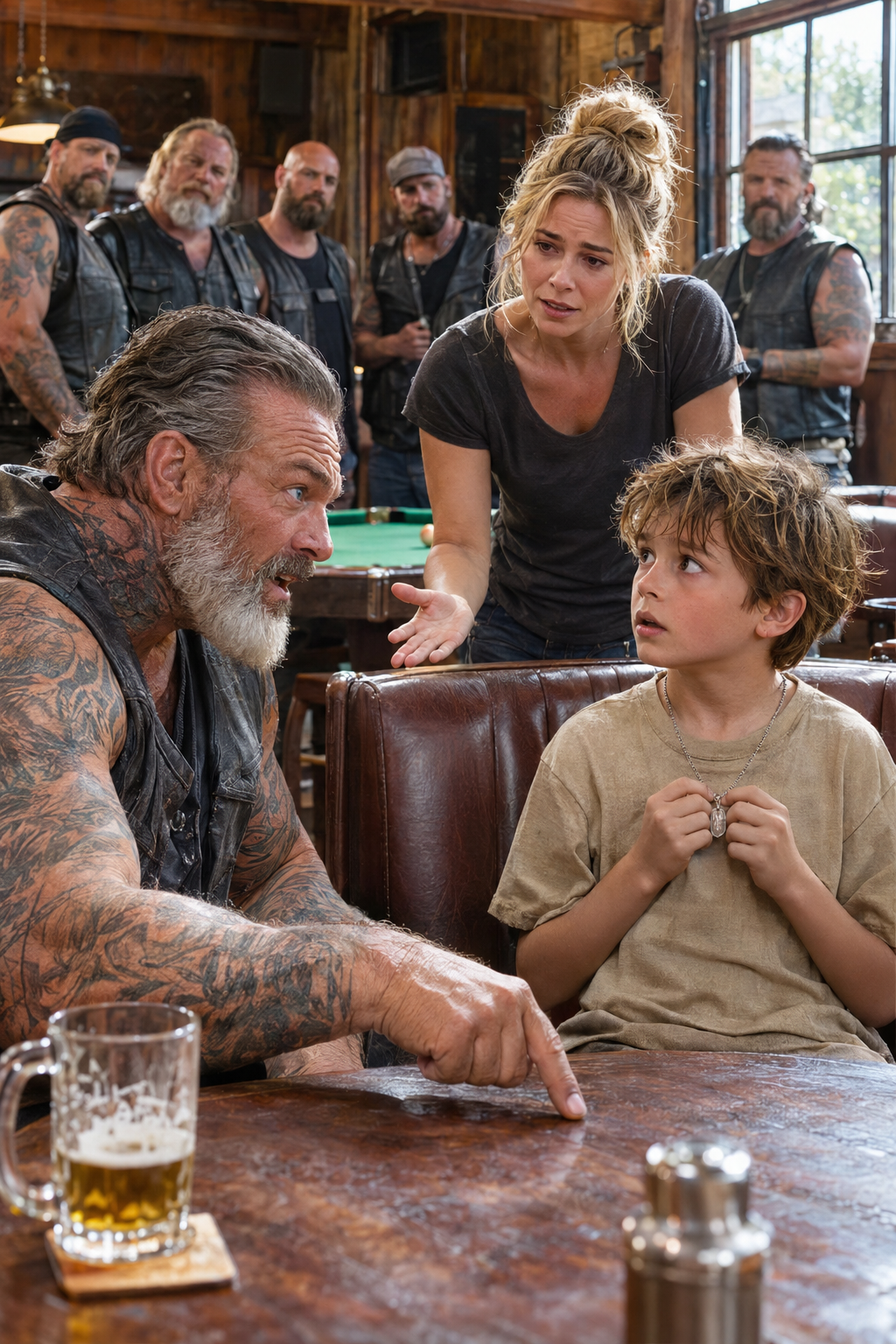
Bull held him tightly.
“They’re not getting near you again.”
“Did you find your brother?”
Bull hesitated.
“I found something he left behind.”
“Was my dad lying?”
“No, son. I don’t think he was.”
Leo began crying.
Bull realized the boy wasn’t crying because of the men who had chased him.
He was crying because someone had finally believed his father.
That evening, Bull took Leo and Maggie to a small ranch outside Barstow owned by a retired mechanic named Eddie Walsh.
Eddie had left the chapter years earlier after suffering a serious injury. He owed Bull nothing, which made him one of the few people Bull felt he could trust.
After Leo fell asleep, Bull spread the documents across Eddie’s kitchen table.
Maggie brought him coffee.
“You’re going after those men, aren’t you?”
Bull didn’t answer.
“Leo already lost his father,” she continued. “Don’t make him watch another man disappear.”
Bull stared at the letter.
For fifteen years, he’d dreamed of finding the person responsible for John’s death.
In those dreams, there had never been a courtroom or a police officer.
There had only been revenge.
But now there was a ten-year-old boy sleeping in the next room.
And revenge suddenly seemed more complicated.
The following morning, Leo came into the kitchen carrying the silver necklace.
“My dad told me something else,” he said.
Bull put down his coffee.
“What was it?”
“He said if the notebook wasn’t enough, I should find the woman who fixed the birds.”
Bull frowned.
“What woman?”
“I don’t know. He showed me a picture once. She had a bird with a broken wing.”
Eddie looked up.
“Could be Ruth Mercer.”
Bull turned toward him.
“Who’s Ruth Mercer?”
“Used to run a little wildlife rescue near an abandoned mining settlement. Took in injured hawks, owls, anything she could save. Closed the place years ago.”
Bull asked Eddie to find her address.
By noon, they were standing outside a weathered house surrounded by wire enclosures and rusted feeding bowls.
An elderly woman opened the door.
When she saw Leo’s necklace, her face changed.
“Where’s Arthur?”
“He passed away,” Bull answered.
The woman closed her eyes.
“Oh, Arthur.”
She invited them inside.
Her living room smelled of old books and medicine. Photographs of rescued animals covered the walls.
Bull placed John’s letter on the table.
“Did you know my brother?”
Ruth looked at the signature.
Then she looked at Bull.
“You have his eyes.”
Bull leaned forward.
“Did he die that night?”
Ruth shook her head.
“No.”
The room seemed to tilt.
Bull gripped the edge of the table.
“What did you say?”
“Arthur brought me to him. He was barely conscious. I was a nurse before I started caring for animals. I did what I could, but he needed a hospital.”
“Where did you take him?”
“To a doctor I knew. Arthur was terrified someone would find them. He kept saying the people responsible had friends everywhere.”
Bull stood so quickly that his chair fell backward.
“Where is John now?”
Ruth’s eyes filled with tears.
“I don’t know.”
She explained that John had survived his initial injuries but had suffered serious damage. For several weeks, he drifted in and out of consciousness.
Arthur stayed nearby, caring for him and trying to arrange a safe return home.
Then Victor’s men began asking questions in the surrounding towns.
One night, John vanished from the doctor’s house.
Arthur returned to find his bed empty.
“He spent years looking for him,” Ruth said. “He never stopped blaming himself.”
Bull walked toward the window.
His brother had survived.
All those years of believing John was buried somewhere beneath the desert sand, and he had survived.
But where had he gone?
Ruth opened a drawer and removed a cassette tape.
“Arthur sent me this eight months ago. He said he was getting sick and couldn’t keep running forever.”
Eddie found an old cassette player in the house.
Arthur’s tired voice filled the room.
“If you’re hearing this, Ruth, then something probably happened to me. I finally found the doctor who treated John. He admitted that Victor paid him to reveal where John was staying. He also told me John was transferred to a private care facility under another name.”
Bull leaned closer.
“The name was James Walker. I couldn’t find the facility. Victor moved him at least twice. I think he’s keeping John alive because John knows where the original financial records are hidden.”
The recording ended with Arthur coughing.
Leo stared at the cassette player.
“That’s my dad.”
Ruth reached across the table and took his hand.
Bull asked for the doctor’s name.
Two hours later, he contacted a retired investigator named Frank Delaney, who had once helped Eddie locate a missing relative.
Frank agreed to examine the documents and search for James Walker.
Meanwhile, Bull returned to the ranch.
He had barely stepped through the door when his phone rang.
Victor.
“You’ve been asking questions.”
“Maybe I should’ve started fifteen years ago.”
Victor sighed.
“You don’t understand what happened back then.”
“Then explain it.”
“John made a mistake. Arthur made a bigger one.”
Bull clenched his jaw.
“Where’s my brother?”
There was a long silence.
Then Victor said something that made Bull’s blood run cold.
“He asks about you sometimes.”
Bull nearly crushed the phone in his hand.
“You son of a bitch.”
“Bring me the notebook and everything you dug up. Tomorrow night. Come alone, and you can see him.”
The call ended.
Bull sat down heavily.
For the first time in fifteen years, he knew his brother might still be alive.
And the man responsible had been standing beside him the entire time.
That night, Bull didn’t sleep.
He kept remembering Victor’s speeches about brotherhood. The funerals they had attended together. The birthdays, the rides, the promises.
He remembered every time Victor had encouraged him to hunt Arthur.
It had all been a lie.
Shortly before dawn, Leo appeared beside him.
“Are you going to find your brother?”
“I’m going to try.”
“Will you come back?”
Bull looked at him.
He wanted to promise.
But he’d heard too many promises from men who never returned.
“I’ll do everything I can.”
Leo removed the necklace and placed it in Bull’s palm.
“Give it back to him.”
Bull closed his fingers around the silver skull.
Later that morning, Frank called.
He had located a patient named James Walker at a privately operated nursing facility outside Kingman, Arizona.
The patient’s expenses had been paid through one of the companies listed in Arthur’s documents.
Bull immediately contacted the authorities through Frank.
He handed over copies of the financial records, John’s letter, and Arthur’s recording.
It was a decision that would cost him his standing with some of the men he’d known for decades.
He made it anyway.
That evening, Bull arrived at an abandoned repair shop where Victor had arranged their meeting.
Victor was waiting inside with two men.
“Where’s the notebook?”
“Where’s John?”
Victor gestured toward a doorway.
A wheelchair slowly emerged.
Bull stopped breathing.
The man sitting in it was thin, with white hair and a badly scarred face. His hands trembled against his knees.
But Bull recognized him.
He would have recognized those eyes anywhere.
“Johnny?”
The old man’s lips moved.
“Billy?”
Bull crossed the room and fell to his knees.
His brother touched his face with a shaking hand.
“You got old,” John whispered.
Bull laughed through his tears.
“So did you, you ugly bastard.”
For a moment, the repair shop disappeared.
They were two brothers again, sitting on the porch of their mother’s house, arguing about motorcycles and borrowing each other’s clothes.
Then Victor spoke.
“Touching reunion. Now give me what I asked for.”
Bull stood.
“You kept him like this for fifteen years?”
Victor’s expression hardened.
“He wouldn’t tell me where the original records were. I couldn’t risk him talking.”
John lifted his head.
“You could’ve let me go.”
“And spend the rest of my life in prison?”
Bull stepped toward Victor.
“You let our mother die believing her son was dead.”
Victor looked away.
“She didn’t need to know.”
Bull struck him.
Victor stumbled backward, knocking over a metal chair.
One of his men reached toward his jacket.
John shouted.
“Billy, don’t!”
Bull froze.
His brother’s voice was weak, but the fear in it was unmistakable.
Victor wiped blood from his mouth.
“You think you’re better than me? After everything you’ve done for this club?”
Bull knew the answer wasn’t simple.
He had hurt people. He had frightened innocent men. He had obeyed orders without asking whether they were right.
Victor had used that loyalty against him.
“No,” Bull said. “But I can stop being like you.”
He placed the notebook on a nearby table.
Victor grabbed it and began tearing through the pages.
“Where are the originals?”
John smiled faintly.
“Arthur had them all along.”
Victor stared at him.
“The notebook was never the evidence,” John continued. “It was the guide to finding it.”
Victor’s face went pale.
Bull had already given the documents to the investigators.
Outside, vehicles approached.
Victor turned toward the entrance.
The two men beside him exchanged frightened looks.
Within moments, law enforcement officers surrounded the building.
Victor looked back at Bull.
“You betrayed your brothers.”
Bull placed a hand on John’s shoulder.
“No. I finally remembered what a brother was.”
Victor and his men were arrested that night.
John was taken to a hospital, where doctors began treating the consequences of years of inadequate care and isolation.
Bull remained beside his bed until morning.
When John woke, Bull gave him the silver skull.
“Arthur’s boy wanted you to have this.”
John held the pendant against his chest.
“Arthur had a son?”
“Ten years old. Good kid.”
John’s eyes filled with tears.
“Arthur saved my life, Billy. He could’ve taken the money and disappeared. Instead, he spent everything he had trying to find me.”
Bull lowered his head.
“He died thinking he’d failed you.”
John covered his face.
For several minutes, neither brother spoke.
Three days later, Leo visited the hospital.
He stood nervously beside John’s bed.
“Did you know my dad?”
John reached for his hand.
“Your father was the bravest man I ever met.”
Leo’s chin trembled.
“People said he was a thief.”
“People were wrong.”
“Was he scared?”
John nodded.
“Terrified. Being brave doesn’t mean you’re never scared. It means you do the right thing even when you are.”
Leo began to cry.
John pulled him into a gentle embrace.
Bull stood beside the window, unable to speak.
Months later, the investigation revealed that Victor had secretly diverted club funds for years. Arthur had discovered the theft, and John had agreed to help expose it.
The missing half million dollars had never been stolen by Arthur.
Much of it had already been transferred into accounts controlled by Victor.
The truth finally became public.
Victor eventually pleaded guilty to several serious criminal charges and received a lengthy prison sentence.
Bull returned to the same bar along Route 66 where he had first met Leo.
Several familiar faces were waiting inside.
He placed Arthur’s photograph on the counter.
“For fifteen years, we called this man a coward and a thief. We were wrong. I was wrong.”
Nobody interrupted.
“He protected my brother when the rest of us believed a liar. His son deserves to grow up knowing what kind of man his father really was.”
Mack raised his glass.
“To Arthur Pendleton.”
One by one, the others followed.
Bull didn’t drink.
He had another place to be.
The following year, after leaving the chapter, Bull opened a motorcycle repair shop with Eddie. John helped with paperwork whenever his health allowed, and Maggie became a regular visitor.
With no surviving parent able to care for Leo, Bull eventually became his legal guardian.
On the anniversary of Arthur’s death, Bull drove John and Leo to a quiet cemetery.
Leo placed flowers beneath his father’s headstone.
John removed the silver necklace and fastened it around the boy’s neck.
“This belongs to you now.”
Leo touched the pendant.
“But it was yours.”
John smiled.
“Your father earned it.”
Bull stood before the grave.
He thought about the angry young man he’d been in 1989 and the fifteen years he’d wasted hating someone who deserved his gratitude.
“I wish I’d known sooner, Arthur,” he whispered. “I’m sorry.”
Leo slipped his small hand into Bull’s.
“You kept your promise.”
Bull looked down at him.
He had spent most of his life believing that strength meant making people afraid, that loyalty meant never questioning orders, and that justice meant making someone suffer.
A ten-year-old boy had taught him otherwise.
Sometimes the strongest thing a man could do was admit he’d been wrong.
Sometimes loyalty meant standing against the very people he’d sworn to protect.
And sometimes honoring the dead meant choosing to protect the living instead of seeking revenge.
As they walked back toward the truck, Leo asked if they could stop somewhere for breakfast.
Bull looked at John.
His brother smiled.
“I’m buying.”
Fifteen years late, Iron John finally kept his promise.
And for the first time in a very long time, Bull Riley felt that the road ahead was worth traveling.
But the road ahead wasn’t going to be as peaceful as Bull imagined.
Three weeks after visiting Arthur’s grave, a package arrived at the repair shop. There was no return address, only Bull’s name written across the front.
Inside was an old photograph and a handwritten letter.
The photograph showed Arthur standing beside a woman holding a newborn baby.
Bull recognized the baby immediately.
It was Leo.
The letter was addressed to Arthur and dated December 1994.
“Whatever happens to us, promise me our son will never grow up believing that hatred is the only way to survive. Give him the childhood neither of us had.”
It was signed Elizabeth Pendleton.
Leo’s mother.
Beneath the letter was a more recent note from a woman named Helen Carter, Elizabeth’s older sister.
She had spent years searching for Arthur and Leo after losing contact with them. When she learned about Victor’s arrest through a newspaper article, she finally discovered where her nephew was living.
Bull read the note several times.
Helen wanted to meet Leo.
For reasons Bull couldn’t explain, the thought frightened him more than any confrontation he’d ever faced.
That evening, he sat beside John outside the repair shop.
“What if she wants to take him away?”
John looked at his younger brother.
“Would she be good for him?”
“I don’t know.”
“Then find out.”
Bull stared at the setting sun.
“I never thought I’d care about somebody this much.”
John smiled.
“That’s the trouble with loving people, Billy. You can’t keep them just because losing them would hurt.”
Two days later, Helen arrived.
She was a schoolteacher from Oregon, with gentle eyes and a nervous smile. When Leo walked into the room, she immediately covered her mouth.
“You look just like your mother.”
Leo stood beside Bull, uncertain what to say.
Helen opened a small suitcase filled with family photographs, birthday cards, and letters Elizabeth had written before her death.
For hours, she told Leo stories about the mother he barely remembered.
She told him how Elizabeth loved dancing in the kitchen, how she rescued stray dogs, and how she had once driven through a snowstorm to bring Arthur home after his car broke down.
Leo listened to every word.
That night, Helen approached Bull.
“I thought I came here to bring him home with me,” she admitted.
Bull remained silent.
“But I’ve been watching him. The way he looks at you. The way you look at him.”
She smiled.
“He already has a home.”
Bull lowered his head, hiding the tears gathering in his eyes.
Helen agreed to remain part of Leo’s life, visiting during holidays and welcoming him to Oregon whenever he wanted.
For the first time, Leo had more family than he could remember having.
The years passed.
The little repair shop became a successful business. Bull hired men who had recently been released from prison, giving them opportunities when nobody else would.
Some customers questioned his decision.
Bull always gave them the same answer.
“A man’s worst mistake shouldn’t have to be the last chapter of his life.”
John’s health gradually improved, although he never regained the full use of his legs.
He spent his afternoons teaching Leo how to repair engines, balance accounts, and recognize when someone was trying to sell him a bad motorcycle.
Leo grew into a quiet, thoughtful young man.
On his eighteenth birthday, Bull handed him the keys to a restored motorcycle.
Leo stared at it in disbelief.
“You built this for me?”
“Your uncle John helped.”
John grinned from his wheelchair.
“Don’t blame me if it breaks down.”
Leo laughed and hugged them both.
Then he reached into his pocket and pulled out an envelope.
Inside was an acceptance letter from a university.
He had received a scholarship to study law.
Bull looked at him proudly.
“A lawyer, huh?”
Leo nodded.
“I want to help people who can’t prove they’re telling the truth.”
Bull understood immediately.
Arthur’s story had never left him.
Eight years later, Leo returned to Barstow as a qualified attorney.
His first major case involved a man who had spent eleven years in prison for a crime he maintained he hadn’t committed.
Leo worked tirelessly, examining forgotten records and interviewing witnesses.
Eventually, new evidence overturned the man’s conviction.
When the man walked out of prison and embraced his daughter, Leo thought about his father.
That evening, he called Bull.
“We won.”
Bull smiled.
“Your dad would’ve been proud.”
There was a brief silence.
“So would my other dad,” Leo replied.
Bull couldn’t speak.
He simply held the phone against his ear while tears rolled down his weathered cheeks.
Two winters later, Iron John’s health began to decline.
One evening, he asked Bull to sit beside him on the porch.
The brothers watched the desert sky turn orange.
“You know what I regret most?” John asked.
“What’s that?”
“Not getting to see you become the man you are now.”
Bull shook his head.
“You’re looking at him.”
John smiled.
“Then I guess I didn’t miss everything.”
He passed away peacefully in his sleep the following morning.
At his funeral, Leo stood beside Bull, wearing the silver skull necklace Arthur had entrusted to him so many years earlier.
They buried John near Arthur.
Two men whose friendship had survived betrayal, separation, and death.
Years later, when Bull was too old to work beneath motorcycles, Leo brought his own young daughter to visit him.
The little girl climbed onto Bull’s lap and pointed at the silver skull around her father’s neck.
“Daddy, why do you always wear that?”
Leo smiled.
“Because it reminds me of three very brave men.”
“Were they heroes?”
Leo looked at Bull.
“They were ordinary men who had to make difficult choices. Some of those choices were wrong. But when it mattered most, they chose to do something right.”
Bull reached out and gently touched the necklace.
He remembered the frightened little boy who had walked into a dusty bar in July 2004.
He had thought that boy was bringing him the answers to his brother’s disappearance.
Instead, Leo had brought him something far more valuable.
A second chance.
Bull died peacefully several years later, surrounded by the family he had never expected to have.
At his funeral, Leo placed Arthur’s battered notebook beside Bull’s photograph.
Then he addressed the people gathered before him.
“When I was ten years old, I asked this man to clear my father’s name. He could have ignored me. He could have chosen revenge. Instead, he chose the truth, and that decision changed the lives of everyone standing here today.”
Leo looked toward his daughter.
“He taught me that we cannot change the mistakes we’ve already made, but we can decide what kind of person we become afterward.”
Outside the cemetery, motorcycles lined the quiet road.
Former prisoners, mechanics, neighbors, and families Bull had helped over the years stood together to honor him.
They hadn’t come because they feared Bull Riley.
They had come because they loved him.
And somewhere along that lonely stretch of Route 66, the little repair shop remained open, managed by the men Bull had once given a second chance.
Above its entrance hung a wooden sign bearing words Leo had chosen himself.
“YOUR PAST DOES NOT HAVE TO DECIDE YOUR FUTURE.”
The silver skull remained with Leo, not as a symbol of violence or fear, but as a reminder that truth could outlive lies, kindness could overcome hatred, and even a man who had spent decades walking the wrong road could still find his way home.
Bull Riley had once believed his greatest victory would be avenging his brother.
In the end, his greatest victory was becoming a father to the son of the man he had spent fifteen years hating.
And that was a legacy no amount of money, power, or revenge could ever buy.
For years after Bull’s death, Leo believed the darkest chapter of his family’s history had finally closed.
Then, one afternoon, a letter arrived at his law office.
The return address belonged to a state correctional facility.
Leo opened the envelope and immediately recognized the name at the bottom.
Victor Kane.
The man responsible for stealing fifteen years from Iron John was now elderly, seriously ill, and approaching the end of his life.
His letter contained only a few sentences.
“Your father deserved better. So did John. There is something I never told Bull, something I should have confessed a long time ago. If you are willing to hear it, come see me.”
Leo placed the letter on his desk.
For the rest of the afternoon, he struggled to concentrate.
Part of him wanted to throw it away. Victor had caused more suffering than any other person in his life.
But another part remembered Bull’s willingness to listen to a frightened boy when everyone else wanted to silence him.
Three days later, Leo entered the prison visiting room.
Victor was brought in by a correctional officer.
The once-powerful chapter president was barely recognizable. His shoulders had collapsed, his hands shook, and his face carried the exhaustion of a man who had spent years alone with his memories.
When he saw the silver skull around Leo’s neck, he lowered his head.
“You still have it.”
Leo sat across from him.
“What did you want to tell me?”
Victor took a long breath.
“Your father had a chance to escape with enough money to start a new life. I offered it to him myself. All he had to do was forget about John.”
Leo remained silent.
“He refused. He told me that one day his son would ask him what kind of man he had been, and he wanted to have an answer he could live with.”
Victor’s eyes became wet.
“I hated him for saying that.”
“Why?”
“Because I knew I couldn’t say the same thing about myself.”
Victor reached into the pocket of his prison uniform and removed a folded piece of paper that had been approved for him to bring into the visiting room.
It contained the names of several people who had suffered because of his decisions.
Some had lost their businesses. Others had lost their freedom after being falsely accused of crimes connected to his financial schemes.
“I gave a statement to the investigators last week,” Victor explained. “I told them everything I remembered. I don’t know if it’ll make a difference.”
Leo examined the names.
One belonged to a man whose daughter had contacted his office nearly two years earlier.
“You could have told the truth a long time ago.”
“I know.”
“Bull died without knowing the full extent of what you did.”
Victor nodded.
“That’s something I’ll have to carry.”
For several minutes, neither man spoke.
Finally, Victor looked directly at Leo.
“Do you think your father would have forgiven me?”
Leo considered the question carefully.
“I can’t speak for him.”
Victor’s expression fell.
“But I think he would’ve wanted you to spend whatever time you have left telling the truth instead of hiding from it.”
Victor began to cry.
Leo didn’t embrace him or pretend that the past no longer mattered.
Some wounds were too deep for a single conversation to heal.
But before leaving, he extended his hand.
Victor stared at it before slowly reaching forward.
It was the first time in decades that he had shaken the hand of someone from Arthur Pendleton’s family.
Victor died four months later.
His final statements helped investigators reopen several old cases. Leo volunteered his time to assist the affected families, and over the following years, some finally received the recognition and justice they had been denied.
One elderly woman traveled hundreds of miles to thank him personally.
“My husband died before anyone believed him,” she said. “But at least our grandchildren will know he wasn’t a criminal.”
Her words reminded Leo of the promise he had demanded from Bull inside that dusty bar.
He realized that his father’s story was not unique.
There were countless people carrying the burden of accusations they could not disprove, mistakes they could not undo, and truths nobody wanted to hear.
With the support of his family, Leo established a nonprofit legal assistance organization named the Pendleton-Riley Foundation.
Its mission was to help people who lacked the resources to defend themselves against wrongful accusations.
Inside its first office hung three photographs.
Arthur Pendleton.
Iron John.
Bull Riley.
Beneath them was a small handwritten message.
“Listen before you judge.”
The foundation grew slowly.
Some years were difficult. Funding disappeared, cases were lost, and Leo occasionally wondered whether his efforts were making enough of a difference.
Whenever he felt discouraged, he visited the old repair shop.
The men who worked there still told stories about Bull.
They remembered how he had hired people nobody trusted, repaired motorcycles for families who couldn’t afford the bill, and quietly paid for groceries when employees were struggling.
Bull had never advertised those acts of kindness.
Most of the people he helped never knew how many others had received the same generosity.
One morning, Leo brought his teenage daughter, Elizabeth, to the shop.
She had been named after the grandmother she never met.
While exploring the storage room, she discovered an old metal toolbox beneath a dusty workbench.
Inside were photographs, receipts, a pair of worn leather gloves, and a sealed envelope.
Across the front, Bull had written Leo’s name.
Leo opened it with trembling hands.
The letter had been written shortly before Bull’s death.
“Son, if you’re reading this, I’m probably somewhere arguing with John about who owes who breakfast. There’s something I want you to remember. You don’t owe me anything for raising you. You don’t have to spend your whole life paying back what you think I gave you. Being your father was the greatest privilege of my life. Go live yours. Laugh when you can. Love your family. Help people when they need it, but don’t forget to be happy yourself.”
Leo stopped reading.
His daughter placed a hand on his shoulder.
He wiped his eyes and continued.
“I spent fifteen years waiting for the past to give me permission to move forward. Don’t make the same mistake. The people we love wouldn’t want their memories to become chains around our necks. They’d want those memories to give us the courage to keep going.”
At the bottom of the page was a final sentence.
“Thank you for walking into that bar, kid.”
Leo folded the letter carefully.
For the first time since Bull’s death, remembering him brought more happiness than pain.
That evening, Leo and Elizabeth drove into the Mojave Desert.
They stopped near the three weathered rocks where Bull had discovered John’s wooden box so many years earlier.
The desert looked almost unchanged.
The wind moved gently across the sand, and the distant mountains glowed beneath the setting sun.
Elizabeth looked around.
“Is this where everything started?”
Leo smiled.
“Not exactly. But it’s where the truth started coming home.”
He told her the entire story, from Arthur’s disappearance to Bull’s final days.
He didn’t hide the terrible things that had happened.
He didn’t turn the men into perfect heroes.
He wanted his daughter to understand that good people could make terrible mistakes, and that people with troubled pasts could still choose to do extraordinary good.
When he finished, Elizabeth looked at the silver skull.
“Are you ever going to stop wearing it?”
Leo removed the necklace.
He studied the scratches that Bull had recognized all those years ago.
Then he placed it in his daughter’s hand.
“I think it’s your turn.”
Elizabeth looked surprised.
“What am I supposed to do with it?”
“Whatever you want. Just remember the story.”
She fastened it around her neck.
Together, they watched the sun disappear behind the mountains.
Years later, the original wooden box, Arthur’s notebook, and Bull’s letter were preserved in a small exhibition at the foundation’s headquarters.
Visitors often stopped to read the story of the frightened ten-year-old boy who had approached a dangerous stranger with nothing but a necklace and a promise from his dying father.
Many arrived believing that justice was something reserved for people with money, influence, or power.
They left understanding that sometimes justice began with one person willing to listen.
Arthur had never lived to see his name cleared.
John had never recovered the fifteen years stolen from him.
Bull could never undo the harm he had caused before meeting Leo.
Yet their sacrifices continued to change lives long after they were gone.
And every time someone entered the foundation seeking help, the promise Bull had made inside that roadside bar lived on.
The greatest lesson of their story was not that every injustice could be corrected or that every broken relationship could be repaired.
It was that doing the right thing was never meaningless, even when its rewards arrived too late for the person who deserved them most.
Arthur had planted the seed.
Bull had protected it.
Leo had helped it grow.
And future generations would find shelter beneath its branches.
Their story had begun with betrayal, disappearance, and a silver skull buried beneath years of painful memories.
It ended with a family, a restored legacy, and countless strangers receiving the second chance they had once believed impossible.
Because in the end, a person’s true legacy is not measured by how many people remember their name.
It is measured by how many lives became better because they were here.
And by that measure, Arthur Pendleton, Iron John, and Bull Riley would never truly be gone.
THE END.