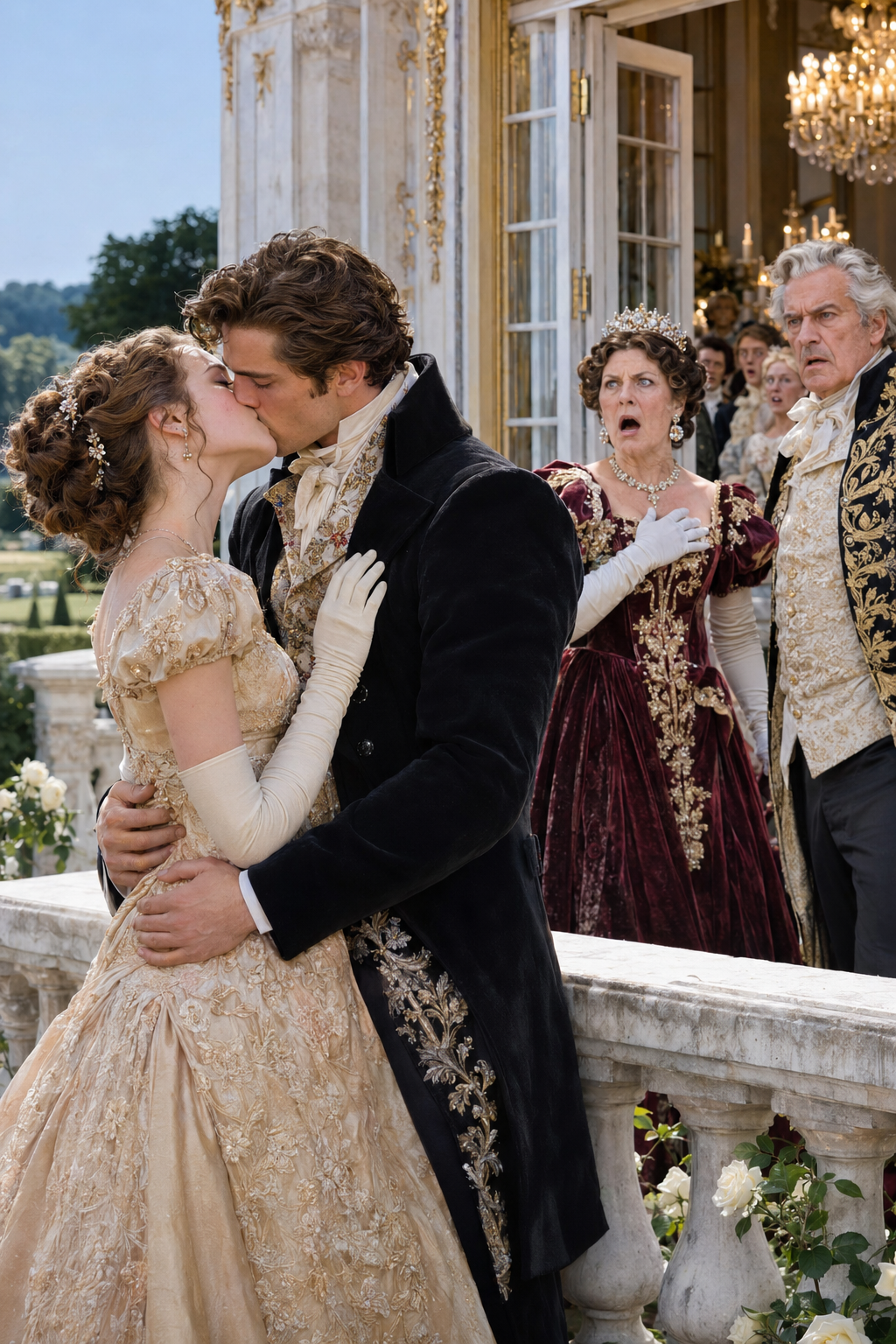
Beatrice kissed a stranger to destroy her engagement. The terrible mistake was discovering that the stranger was the man she was trying to escape.
Beatrice stared at the parchment, her fingers tightening around its brittle edges as the stranger’s final words settled over the balcony. Her father had attempted to sell something that belonged to her, something her grandmother had deliberately concealed from the rest of the family.
“What exactly has he tried to sell?” she asked.
The silver-haired gentleman glanced toward Arthur, who gave a slight nod.
“My name is Sir Edmund Vale, Miss Ashcombe. I served as your grandmother’s legal adviser for nearly twenty years. What I am about to tell you should have been explained on your twenty-first birthday.”
Beatrice was twenty-three.
Two years had passed since that birthday, two years during which her father had insisted the family possessed nothing valuable beyond its rapidly deteriorating estate.
Sir Edmund unfolded another sheet.
“Your grandmother owned a controlling interest in the Westbridge Canal Company. The shares were placed in trust for you, together with the revenues they produced.”
Beatrice looked at him without speaking.
She knew the Westbridge Canal. Its barges carried coal, grain, and manufactured goods between several prosperous towns. Her grandmother had once taken her to watch the boats pass beneath the stone bridges.
She remembered asking why her grandmother knew so many of the workers by name.
“Because a good investment should improve more than its owner’s circumstances,” the old woman had replied.
At the time, Beatrice had been twelve.
Now Sir Edmund was explaining that those ordinary afternoons had concealed a fortune.
“The shares have appreciated considerably,” he continued. “Their present value exceeds one hundred thousand pounds.”
Her mother made a faint sound behind her.
Beatrice barely heard it.
One hundred thousand pounds.
Her father had spent months describing their financial position as hopeless. He had dismissed servants, sold her mother’s jewelry, and insisted that marriage to the Duke of Westford represented their only possible salvation.
Yet her grandmother had left her enough wealth to protect herself.
Perhaps even enough to save the estate.
“Why was I never told?”
Sir Edmund’s expression hardened.
“Your grandmother instructed me to notify you personally. Unfortunately, shortly before your birthday, your father informed my office that you had suffered a serious illness and could not receive visitors.”
Beatrice remembered that summer.
She had been perfectly healthy.
Her father had simply forbidden her to leave the estate, claiming that creditors were becoming aggressive and that public appearances would invite humiliation.
“I wrote repeatedly,” Sir Edmund continued. “My letters were returned. Eventually, I discovered that correspondence addressed to you was being intercepted.”
Arthur remained beside the balustrade, his attention fixed on Lord Ashcombe.
“Your father then approached a commercial syndicate seeking to sell the controlling shares,” he said. “The purchasers required proof of your consent.”
Beatrice looked down at the forged signature.
“And he provided it.”
Lord Ashcombe finally spoke.
“I intended to replace the money.”
His voice was weak, but the familiar authority remained beneath it.
Beatrice turned slowly.
“Replace what money?”
Her father looked toward her mother, then away.
Sir Edmund answered.
“Over the past eighteen months, substantial dividends have been diverted from the trust through accounts your father controlled.”
The words seemed to drain the warmth from the night.
Beatrice remembered the new carriage purchased the previous autumn, the expensive hunting horses, and the endless assurances that her father was negotiating arrangements to restore their fortunes.
She had believed those purchases were necessary to preserve appearances.
Now she understood whose money had paid for them.
“How much?” she asked.
Lord Ashcombe said nothing.
Sir Edmund consulted his papers.
“Approximately twenty-seven thousand pounds.”
Her mother gripped the doorway.
Beatrice did not move.
Twenty-seven thousand pounds.
Enough to pay the household staff for years. Enough to repair the neglected tenants’ cottages. Enough to settle a significant portion of the debts her father had used to justify selling her future.
She looked at him, waiting for an explanation that might make the betrayal less deliberate.
None came.
“You told me Grandmother left nothing but her house.”
“Beatrice, I was trying to protect this family.”
“From what?”
“From disgrace.”
The answer was so familiar that she almost laughed.
Her father had used disgrace to explain every restriction placed upon her life. Disgrace justified silence, obedience, and the sacrifice of anything that might threaten his position.
But the disgrace he feared had not come from his daughter.
It had come from his own decisions.
Arthur stepped forward.
“Lord Ashcombe, the proposed sale will not proceed. I have already notified the company’s directors that the authorization is disputed.”
Beatrice turned toward him.
“You knew about the shares?”
“I knew someone was attempting to sell them under questionable circumstances. I did not know the rightful owner was being kept ignorant.”
“Then why agree to marry me?”
Arthur’s expression changed.
For the first time, he seemed uncertain how to answer.
“Because your father approached me with a proposition involving the estate, and I had reasons to investigate his affairs.”
“Was I part of your investigation?”
The question hung between them.
Arthur did not answer immediately.
That silence hurt more than she expected.
“At first,” he admitted.
Beatrice stepped away from him.
The memory of their kiss returned with humiliating clarity. She had thought herself clever, a desperate young woman seizing control of her circumstances.
Instead, she had kissed a man who had entered her life carrying suspicions about her father.
A man who had known considerably more than she did.
“Then we are finished,” she said.
Arthur’s eyes narrowed slightly.
“Miss Ashcombe—”
“I will not marry a gentleman who considers me useful evidence.”
She handed the parchment back to Sir Edmund.
“Please arrange for me to review every document concerning my inheritance. I wish to understand exactly what belongs to me.”
Sir Edmund bowed.
“Of course.”
Her father moved toward her.
“Beatrice, you cannot simply—”
“Yes,” she interrupted quietly. “I believe I can.”
She walked past him into the ballroom.
The music had stopped.
Several guests turned as she entered, their conversations fading beneath the rustle of silk and the distant crackle of the fireplace.
Beatrice knew what they saw.
A young woman whose engagement was apparently collapsing before it had been formally announced.
Her mother followed, looking pale and distressed.
But Beatrice continued across the room without lowering her head.
For the first time that evening, she had no intention of making herself smaller.
By morning, the scandal had spread through London.
Some claimed Beatrice had deliberately compromised herself with a stranger. Others insisted the duke had discovered her father’s financial dishonesty and withdrawn his proposal.
The truth was less entertaining than either version.
Arthur Pendleton had left the Ashcombe residence shortly after midnight.
He had made no public announcement.
And Beatrice had refused to receive her father when he knocked on her bedroom door.
Three days later, she sat in Sir Edmund’s chambers overlooking Lincoln’s Inn Fields, surrounded by ledgers, legal correspondence, and documents bearing her grandmother’s familiar signature.
The room smelled of old paper and polished wood.
Rain tapped steadily against the windows.
Sir Edmund placed a thick account book before her.
“The trust itself remains intact,” he explained. “The difficulty concerns the diverted income and the attempted sale.”
Beatrice studied the figures.
She had always enjoyed arithmetic, though her father considered financial matters unsuitable for a young lady.
Her grandmother had disagreed.
She had taught Beatrice to calculate interest before she was old enough to attend her first assembly.
Now those lessons were proving more useful than any instruction in dancing.
“These payments,” Beatrice said, pointing to a column, “were transferred to a company called Harrow & Bell.”
Sir Edmund leaned forward.
“Yes.”
“But the company received no canal goods, purchased no equipment, and performed no services.”
“That is what we have been attempting to establish.”
Beatrice turned several pages.
“The amounts are almost identical each quarter.”
Sir Edmund adjusted his spectacles.
“An excellent observation.”
“And the payments began immediately after my father lost his position on the canal board.”
The solicitor looked at her sharply.
“You know about that?”
“Grandmother mentioned it once. She said Father had mistaken the company’s money for his own.”
Sir Edmund became very still.
After a moment, he opened a locked drawer and withdrew a sealed envelope.
“Your grandmother instructed me to give you this if you ever questioned the management of the trust.”
Beatrice recognized the handwriting before he placed it in her hands.
My dearest Beatrice.
She read the first lines silently.
Her grandmother had written the letter during the final months of her life, when illness had confined her to the country house.
The words were affectionate but unusually direct.
She warned that Beatrice’s father had accumulated debts through speculative investments and had repeatedly attempted to obtain control of family assets.
Then came a sentence that made Beatrice’s throat tighten.
Never confuse the preservation of a family name with the preservation of a family. One may require silence; the other requires honesty.
Beatrice lowered the letter.
For several moments, she could not speak.
Sir Edmund waited.
Finally, she asked, “Can the money be recovered?”
“Some of it, certainly. But doing so may require proceedings against your father.”
She looked toward the rain-streaked window.
The thought of publicly accusing him filled her with dread.
He had raised her, provided her education, and stood beside her when her grandmother died.
Yet he had also stolen from her and attempted to sell her inheritance without permission.
Love did not erase either truth.
“Then we must proceed,” she said.
That afternoon, Arthur Pendleton arrived at Sir Edmund’s chambers.
Beatrice had not expected him.
She was reviewing the accounts when the clerk announced his name, and her first instinct was to refuse the visit.
Sir Edmund glanced toward her.
“The duke has brought information concerning Harrow & Bell.”
Beatrice closed the ledger.
“Very well.”
Arthur entered wearing a dark traveling coat, rain glistening on its shoulders.
He looked less imposing than he had beneath the ballroom chandeliers.
Perhaps because she was no longer standing before him as a prospective bride.
He bowed.
“Miss Ashcombe.”
“Your Grace.”
Sir Edmund quietly withdrew.
Arthur placed a packet on the desk.
“Harrow & Bell is not a trading company. It is a financial intermediary controlled by a man named Frederick Harrow.”
Beatrice recognized the name.
“One of my father’s creditors.”
“His principal creditor.”
Arthur opened the packet.
“Harrow has been acquiring distressed estates through loans structured to become impossible to repay. Your father’s debts are only one part of his business.”
Beatrice examined the documents.
Several properties were listed, including the Ashcombe estate.
Beside each appeared a projected acquisition date.
“Why are you investigating him?”
Arthur looked toward the window.
“Because he ruined my younger brother.”
The admission surprised her.
She had heard that the Duke of Westford possessed no surviving siblings.
Arthur’s expression became distant.
“Edward borrowed money to establish a manufacturing venture. Harrow encouraged him to expand, then demanded immediate repayment when the business encountered difficulties.”
“What happened?”
“Edward lost everything. He died the following winter.”
Beatrice lowered her eyes.
“I am sorry.”
Arthur acknowledged the words with a slight inclination of his head.
“For several years, I believed my brother had simply been reckless. Recently, I discovered evidence that Harrow deliberately manipulated the accounts.”
“And my father?”
“May have helped him.”
Beatrice looked up.
Arthur continued carefully.
“The forged signatures, the diverted dividends, the proposed marriage settlement—each arrangement appears designed to transfer control of your inheritance before you could challenge the transactions.”
“Then why did Harrow want me married to you?”
“Because he believed I would assume your father’s liabilities and overlook the irregularities to protect my new wife’s reputation.”
Beatrice considered this.
“But you suspected him.”
“Yes.”
“And agreed to the engagement anyway.”
Arthur met her gaze.
“I believed the arrangement would give me access to documents otherwise concealed.”
She pushed the papers away.
“Without asking whether I wished to participate.”
His expression tightened.
“No. I did not ask.”
For a moment, neither spoke.
Then Arthur said something she had not expected.
“I was wrong.”
Beatrice looked at him.
He continued.
“I believed I was protecting you from a dishonest arrangement. In doing so, I treated your consent as something that could be considered afterward.”
The room fell quiet.
“I have withdrawn my agreement to the marriage,” he said. “You are under no obligation to me.”
Beatrice studied him.
“And the investigation?”
“Will continue, whether or not you ever speak to me again.”
He bowed and turned toward the door.
“Arthur.”
He stopped.
It was the first time she had used his Christian name.
“I would like to see the evidence against Harrow.”
He looked back.
“All of it?”
“Every page.”
For the first time since the balcony, he smiled without reservation.
“Then I suspect we shall require a larger table.”
Over the following weeks, Beatrice entered a world her father had spent years insisting was beyond her understanding.
She met company directors, examined loan agreements, and listened as Sir Edmund explained the complicated relationship between the canal company’s finances and the debts secured against her father’s estate.
Arthur attended several meetings, but he no longer spoke on her behalf.
When questions were directed toward him, he frequently turned to Beatrice.
“Miss Ashcombe is the shareholder. You should ask her.”
At first, the gentlemen appeared uncomfortable.
One director addressed her as though she were a child, explaining elementary matters she had already mastered.
Beatrice listened politely.
Then she asked why his department had approved payments to a company that possessed neither employees nor registered commercial premises.
The gentleman stopped smiling.
By the end of the meeting, he had promised to produce six years of records.
Arthur said nothing until they were outside.
Then he remarked, “I believe Mr. Cartwright underestimated you.”
Beatrice adjusted her gloves.
“Most gentlemen do.”
“An expensive habit.”
She glanced at him.
“Particularly when the lady can count.”
Their laughter surprised them both.
But the investigation soon became dangerous.
One evening, Sir Edmund discovered that several original account books had disappeared from the canal company’s offices.
The clerk responsible for maintaining them had resigned without notice.
Two days later, Beatrice received an anonymous letter.
Withdraw your accusations, or the Ashcombe family will lose more than its reputation.
She read the message twice.
Then she placed it beside the other documents.
Arthur arrived within the hour.
“You should leave London temporarily,” he said.
Beatrice folded her arms.
“To where?”
“Westford. My estate has sufficient staff and security.”
She raised an eyebrow.
“You are suggesting that I take refuge in the home of the gentleman I recently refused to marry?”
Arthur considered the objection.
“When expressed that way, I concede the proposal sounds unfortunate.”
Despite herself, she smiled.
But she refused.
Instead, she moved into her grandmother’s country house, accompanied by a trusted companion and two servants selected by Sir Edmund.
The house stood among rolling fields, its pale stone walls covered with climbing roses.
When Beatrice entered the library, she found her grandmother’s books exactly where they had been left.
Dust lay across the writing desk.
The old brass clock had stopped.
She opened the windows and let the spring air enter.
For the first time in months, she slept without dreaming of debt collectors or wedding arrangements.
Then, one morning, she discovered something unexpected.
Inside the lower drawer of her grandmother’s desk lay a narrow compartment concealed beneath a removable wooden panel.
Beatrice remembered watching her grandmother open it years earlier to retrieve a small silver key.
Now the compartment contained a leather notebook.
Its pages were filled with figures, names, and dates.
At first, Beatrice assumed it was another record of the canal company’s finances.
Then she recognized Frederick Harrow’s name.
Beside it appeared her father’s signature.
And beneath both, a series of payments made to an account belonging to the late Edward Pendleton.
Beatrice stared at the page.
Arthur’s brother.
She turned another sheet.
The entries suggested that Edward had discovered irregular transactions involving Harrow and Lord Ashcombe shortly before his financial collapse.
More troubling still, the final pages contained copies of letters in which Edward threatened to expose the scheme.
Her grandmother had apparently been collecting evidence.
Beatrice closed the notebook with shaking hands.
That evening, Arthur arrived at the country house.
She met him in the library.
Without speaking, she placed the notebook before him.
He opened it.
As he read, the color slowly drained from his face.
For several minutes, the only sound was the ticking of the clock, which Beatrice had wound that morning.
Finally, Arthur looked up.
“My brother knew.”
Beatrice nodded.
“He was trying to stop them.”
Arthur turned another page.
A letter written in Edward’s hand described how Harrow had threatened to ruin him unless he surrendered documents proving the fraudulent transfers.
Edward had refused.
Shortly afterward, his creditors had demanded repayment of every outstanding loan.
Arthur remained motionless.
Beatrice watched his fingers tighten around the edge of the notebook.
For years, he had believed his brother’s downfall resulted from foolish ambition.
Now he was discovering that Edward had been punished for attempting to expose a crime.
“I should have listened to him,” Arthur said.
Beatrice moved closer.
“What do you mean?”
“He came to me before everything collapsed. He said Harrow was manipulating the accounts. I told him to accept responsibility for his mistakes.”
Arthur closed his eyes briefly.
“He never asked me for help again.”
Beatrice wanted to offer comfort, but she understood that easy assurances would only diminish his grief.
Instead, she sat beside him.
After a long silence, she said, “Then perhaps we can finish what he began.”
Arthur looked at her.
Something unspoken passed between them.
Not gratitude alone.
Not affection alone.
A recognition that both had been shaped by the dishonesty of men who expected their silence.
The next morning, they traveled to London.
Sir Edmund examined the notebook and immediately arranged a meeting with the appropriate authorities.
The evidence was substantial, but the case remained incomplete.
They needed the original records showing where the diverted money had gone.
Those records, they discovered, were held in Harrow’s private office.
Beatrice proposed an approach Arthur initially rejected.
She would meet Harrow herself.
“He believes you are frightened and inexperienced,” Arthur argued.
“Then he will be careless.”
“He may be dangerous.”
“He has already threatened me. Hiding will not make him less dangerous.”
Sir Edmund listened to their disagreement before intervening.
“A meeting could be arranged in my chambers. Witnesses would remain nearby, and any documents produced could be examined immediately.”
Arthur looked at Beatrice.
She held his gaze.
Finally, he nodded.
“On those conditions.”
Two days later, Frederick Harrow arrived at Sir Edmund’s office.
He was a neatly dressed gentleman with silver spectacles and an expression of practiced sympathy.
“Miss Ashcombe,” he said, bowing. “I understand you have concerns regarding your father’s obligations.”
Beatrice gestured toward the chair opposite her.
“I have concerns regarding several unauthorized transactions.”
Harrow smiled.
“Financial arrangements can appear confusing without the proper experience.”
“Then perhaps you can explain them.”
She placed a ledger on the table.
For the next twenty minutes, Harrow spoke confidently about commercial risks, unfortunate investments, and the necessity of protecting family property.
Beatrice listened.
Occasionally, she asked a question.
Each answer led him further into the explanation he had prepared.
Then she opened her grandmother’s notebook.
Harrow’s smile disappeared.
“Where did you obtain that?”
“It belonged to my grandmother.”
He reached toward it.
Beatrice closed the cover.
“Please keep your hands on your side of the table.”
His expression hardened.
“You have no understanding of the consequences of these accusations.”
“Then explain why payments were made to Edward Pendleton after his death.”
Harrow went still.
For one revealing instant, his eyes moved toward the door.
Beatrice noticed.
“Those transfers were authorized by your father,” he said.
“Under what agreement?”
“I would need to consult my records.”
“Excellent. Sir Edmund has prepared a formal request for them.”
Harrow rose.
“I will not tolerate this interrogation.”
The door opened.
Arthur entered, accompanied by Sir Edmund and two legal officers.
Harrow stopped.
Arthur placed a signed statement on the table.
“Your former clerk has provided copies of the missing account books.”
Harrow’s face changed.
Beatrice understood then that the meeting had never depended entirely on her questions.
The clerk had been located the previous evening.
He had agreed to cooperate after learning that Harrow intended to blame him for the missing funds.
Sir Edmund explained that the authorities were investigating allegations of forgery, fraud, and conspiracy.
Harrow looked toward Beatrice.
“You foolish girl. Do you imagine your father will escape this?”
She felt the familiar pressure of family loyalty.
For an instant, she saw her father teaching her to ride, lifting her onto a pony when she was seven.
Then she remembered the forged signature.
The intercepted letters.
The marriage arranged without her consent.
“No,” she answered. “I do not.”
The proceedings that followed lasted several months.
Harrow attempted to shift responsibility onto Lord Ashcombe, claiming the fraudulent transactions had been undertaken at his request.
Lord Ashcombe insisted he had been manipulated by a ruthless creditor.
Both statements contained elements of truth.
Neither excused what had happened.
The surviving records established that Harrow had engineered the scheme, while Lord Ashcombe had knowingly authorized the diversion of trust income and arranged the forged documents.
Beatrice attended the hearings.
She sat beside Sir Edmund, answered questions calmly, and refused repeated requests from distant relatives to withdraw her accusations.
Her mother visited her one afternoon.
They met in the garden of the country house, where the roses were beginning to bloom.
Lady Ashcombe appeared older than Beatrice remembered.
“I have come to ask whether you might show your father some mercy,” she said.
Beatrice looked toward the flowerbeds.
“Does he regret what he did?”
“He regrets that the family has suffered.”
“That was not my question.”
Her mother lowered her eyes.
For a long moment, neither spoke.
Then Lady Ashcombe began to cry.
Beatrice took her hand.
She did not promise to abandon the proceedings.
But she invited her mother to remain for tea.
It was the beginning of a different relationship, one in which affection no longer required obedience.
When the court finally delivered its judgment, Harrow was convicted of fraud and forgery and sentenced to imprisonment.
Lord Ashcombe was also convicted for his role in the fraudulent transactions. His sentence was less severe, but the financial consequences were substantial.
Several properties were sold to satisfy legitimate creditors.
The diverted trust funds were partly recovered through the seizure of Harrow’s assets.
The Ashcombe estate, once the center of her father’s ambitions, passed into the hands of purchasers who intended to divide its land.
Beatrice did not attempt to prevent the sale.
She had learned that preserving a building at any cost could become another form of captivity.
Instead, she used part of her recovered income to improve the cottages occupied by families who had worked on the estate for generations.
She arranged fair leases, repaired roofs, and established a small school in a vacant building near the village.
When a local gentleman expressed surprise that she involved herself in such matters, Beatrice answered simply, “The people living there understand their needs better than anyone. I intend to listen.”
Meanwhile, her relationship with Arthur changed gradually.
He visited the country house when business permitted.
Sometimes they discussed the canal company.
Sometimes they walked through the gardens.
Occasionally, they said very little.
Arthur told her stories about Edward, including the brother’s habit of collecting mechanical inventions that rarely worked.
Beatrice spoke of her grandmother, who had taught her that wealth was valuable only when accompanied by judgment.
Their conversations became easier.
The silences became comfortable.
One autumn afternoon, nearly a year after the disastrous engagement celebration, Arthur arrived carrying a small parcel.
Beatrice found him standing beside the library window.
“What have you brought?”
“A gift.”
She regarded him suspiciously.
“That sounds dangerous.”
He smiled and handed her the parcel.
Inside was a beautifully bound volume containing detailed illustrations of canal engineering.
Beatrice opened it with delight.
Arthur watched her turn the pages.
“I thought you might enjoy it.”
“I do.”
She looked up.
“Thank you.”
For a moment, neither moved.
Then Arthur reached into his coat.
Beatrice noticed the gesture immediately.
“If that is another marriage settlement, I shall throw you out.”
He laughed.
“No settlement.”
Instead, he produced a small velvet box.
Her smile faded.
Arthur placed it on the table without opening it.
“I have spent a considerable amount of time considering how to ask you something without repeating my previous mistakes.”
Beatrice looked at the box.
Then at him.
“And have you succeeded?”
“Not entirely.”
He drew a slow breath.
“Beatrice, I love you. Not because of your inheritance, your family connections, or any arrangement made by another person. I love the woman who refused to surrender when everyone expected her to.”
Her eyes softened.
Arthur continued.
“I would like to marry you. But I will not ask for an answer today, and I will not mistake silence for agreement.”
Beatrice approached the table.
She opened the box.
Inside lay a delicate sapphire ring.
It was beautiful.
But she closed the lid again.
Arthur’s expression changed.
She took his hand.
“I love you too.”
He stared at her.
“Then why—”
“Because I have one condition.”
He smiled faintly.
“Only one?”
“For the moment.”
She led him toward the window, where the afternoon sunlight fell across the garden.
“I will continue managing my inheritance. I will remain involved in the canal company. And I will never again allow another person to decide what my life should become.”
Arthur listened without interruption.
When she finished, he took her hand between his.
“I would expect nothing less.”
Beatrice studied him.
“And you must promise never to conceal important information from me because you believe it will protect me.”
His expression grew serious.
“I promise.”
She opened the box once more.
This time, she allowed him to place the ring on her finger.
Their wedding took place the following spring.
It was a modest ceremony attended by close friends, Sir Edmund, Lady Ashcombe, and several people whose lives had been touched by Beatrice’s work.
There were no elaborate negotiations.
No creditors waiting outside.
No anxious father attempting to secure his future through his daughter’s marriage.
When the clergyman asked whether Beatrice freely consented to the union, she answered clearly.
“I do.”
Arthur’s hand tightened gently around hers.
Later, during the wedding breakfast, Sir Edmund approached with a glass of champagne.
“Your grandmother would have been very proud,” he said.
Beatrice looked toward the gardens beyond the windows.
“I hope so.”
“She always believed you would find your own way.”
Beatrice smiled.
“She made certain I had the means.”
Sir Edmund shook his head.
“The money helped, certainly. But it was never the most important thing she left you.”
That evening, Beatrice stepped onto the balcony of Westford House.
The air was cool, and the gardens below shimmered beneath the last light of sunset.
Arthur joined her a few moments later.
For a while, they stood together in silence.
Then he glanced at her with familiar amusement.
“Do you remember the first time we met?”
Beatrice laughed softly.
“I remember making a spectacularly foolish decision.”
“Do you regret it?”
She considered the question.
She remembered the desperate young woman who had stepped onto a dark balcony believing that scandal was her only path to freedom.
She remembered the forged documents, the painful discoveries, and the courage required to confront people she loved.
Most of all, she remembered the moment she had finally understood that her future belonged to her.
“I regret believing I needed to ruin myself to escape a marriage,” she answered.
Arthur turned toward her.
“And the kiss?”
Beatrice smiled.
“That was rather more successful than I intended.”
He laughed and drew her gently closer.
Below them, the garden lamps glowed among the roses.
Beatrice rested her hand against his chest.
She had once believed that love required sacrifice, that loyalty demanded silence, and that duty meant surrendering her own happiness for the comfort of others.
She knew better now.
Love could ask for courage without demanding obedience.
Family could deserve compassion without being entitled to control.
And forgiveness, when it came, did not require pretending that betrayal had never occurred.
Years later, when Beatrice became known for her work improving the canal company’s conditions and supporting education for girls, people often spoke of her marriage as an extraordinary romantic success.
Some preferred the amusing story of the young lady who had kissed a stranger and discovered he was a duke.
Beatrice never corrected them.
But when young women came to her seeking advice about marriage, inheritance, or the expectations placed upon them, she offered something more useful than a romantic anecdote.
She encouraged them to understand their rights, examine every agreement, and never confuse another person’s desperation with their own obligation.
And whenever someone asked whether she believed fate had brought Arthur into her life that night, she smiled.
“Perhaps fate introduced us,” she would say. “But it was our choices afterward that made us worthy of one another.”
For Beatrice had discovered something far more valuable than a wealthy husband or a restored family fortune.
She had discovered that dignity could not be purchased, consent could not be assumed, and love was meaningful only when both people remained free to choose it.
The kiss on the balcony had begun as an act of desperation.
The life that followed was built on something entirely different.
Freedom.
Trust.
And the quiet, extraordinary courage of a woman who finally understood that she had never been anyone’s property to bargain away.
THE END.