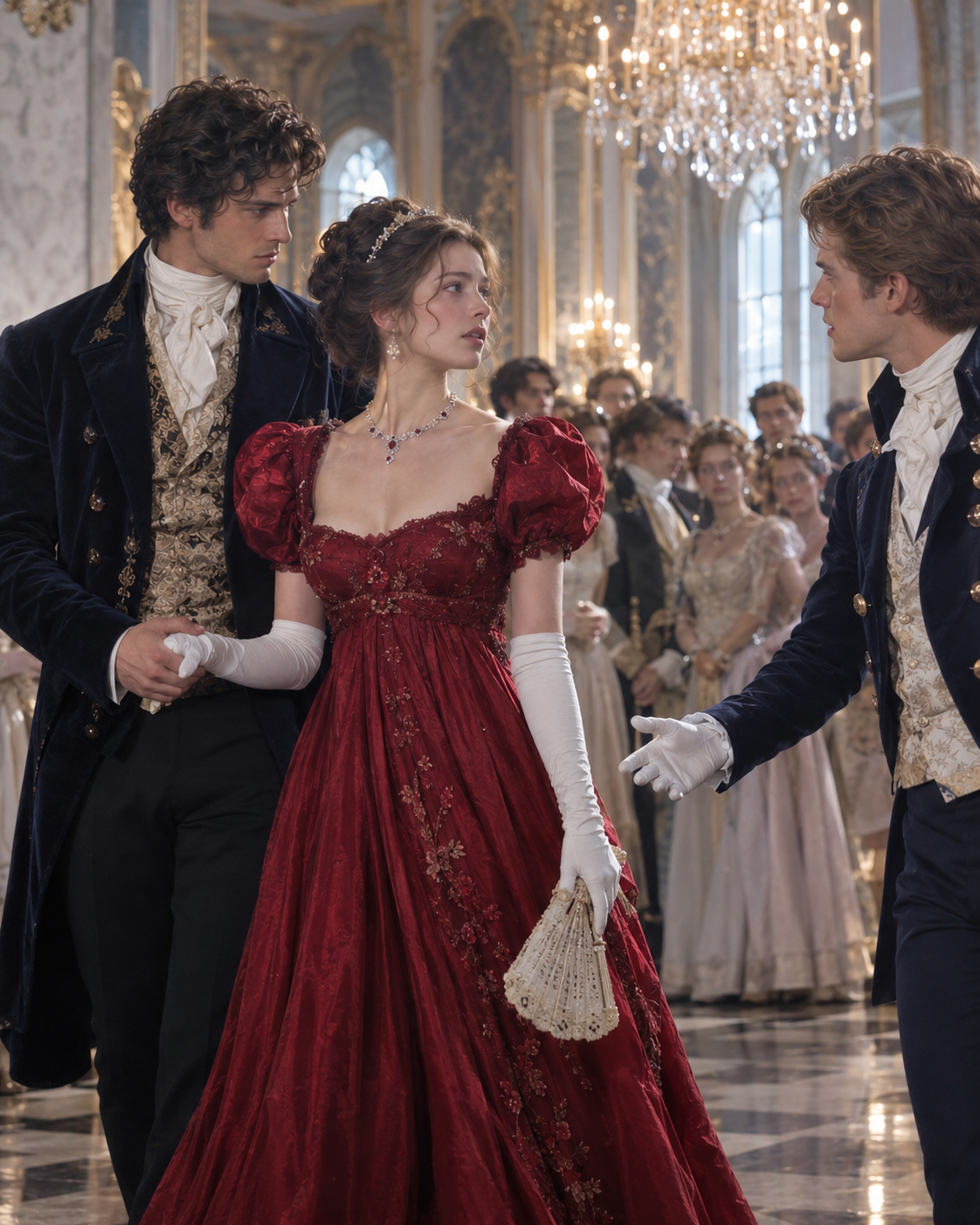
At the most talked-about ballroom in Manhattan, beneath crystal chandeliers and the watchful eyes of New York’s most powerful families, Genevieve Hayes thought she was about to begin the happiest chapter of her life
The morning after the ballroom, Manhattan woke beneath a pale September sky, unaware that one of its most carefully guarded social hierarchies had shifted overnight.
By eight o’clock, photographs of Genevieve Hayes and Darian Croft had already begun circulating through private society circles.
There was one photograph in particular that everyone wanted.
Darian holding out his hand.
Genevieve accepting it.
The instant before they began to dance.
It was not the image of a disgraced woman being rescued.
It was the image of a woman being chosen.
Genevieve discovered this when she entered the breakfast room of the small townhouse she had shared with her aunt.
Three newspapers lay on the table.
Her aunt had folded two of them face down.
The third had been opened directly to the society page.
Genevieve stared at the photograph.
Then she looked at the headline.
ASHBOURNE’S UNEXPECTED CHOICE.
Her aunt, Eleanor, slowly lowered her coffee cup.
“You don’t have to read it.”
“I know.”
Genevieve pulled out a chair.
She sat.
For the first time since the ballroom, her hands trembled.
Not because of Arthur.
Not anymore.
Because she knew what came next.
Darian had promised to send his attorney at nine.
At precisely nine, a black sedan stopped outside the townhouse.
A man in a charcoal suit stepped onto the pavement carrying a leather case.
He introduced himself as Thomas Bell, Darian’s personal solicitor.
“I have documents for Miss Hayes.”
Eleanor immediately stood.
Genevieve stopped her with a quiet gesture.
“Let him in.”
Thomas placed the case on the table.
He removed a thick folder.
Then another.
Then a third.
Genevieve stared at the mountain of paper.
“This is excessive.”
“His Grace prefers certainty.”
“Of course he does.”
Thomas almost smiled.
“He also asked me to make one thing very clear. You are under no obligation to accept.”
Genevieve looked up.
“Did he say that?”
“Yes.”
“And if I refuse?”
“Your transportation home will still be arranged. Your reputation will be defended publicly. Any financial obligations connected to the engagement will be handled without requiring you to repay him.”
She blinked.
“That wasn’t part of our conversation.”
“No.”
“Why would he do that?”
Thomas closed the folder.
“Because His Grace considers a promise a promise.”
That answer stayed with her.
At eleven, Genevieve arrived at Ashbourne House.
The estate stood on the Hudson’s northern bank, hidden behind iron gates and old maple trees. Though the property carried an aristocratic name, everything about it was unmistakably American: private security, a glass-walled library overlooking the river, modern art hanging beside inherited portraits, and a discreet elevator connecting the upper floors.
Darian was waiting in the library.
He wore a dark suit without a tie.
No crown.
No ceremonial jacket.
Nothing theatrical.
Yet the moment Genevieve entered, the room seemed to organize itself around him.
“Miss Hayes.”
“Your Grace.”
“Please don’t call me that when we’re alone.”
“Then what should I call you?”
“Darian.”
She hesitated.
“Darian.”
His expression changed almost imperceptibly.
“Sit.”
She did.
He remained standing.
“I assume you’ve read the agreement.”
“I have.”
“And?”
“You’ve offered me more than I expected.”
“That wasn’t the question.”
Genevieve folded her hands.
“You want a wife who can survive your world.”
“I want a partner who can understand it.”
“And what do you offer in return?”
“Everything I promised last night.”
“Protection?”
“Yes.”
“Financial independence?”
“Yes.”
“Freedom to maintain my own charitable work?”
“Yes.”
“Absolute loyalty?”
“Yes.”
She studied him.
“And what do you want?”
“Discretion. Partnership. Your public support when necessary.”
“And affection?”
“No.”
The answer came too quickly.
Genevieve almost laughed.
“That was remarkably honest.”
“I don’t believe in making promises about emotions.”
“Neither do I.”
For a moment, neither spoke.
Then Darian walked toward the window.
“Arthur is going to attempt to contact you.”
Genevieve stiffened.
“He already has.”
Darian turned.
“What did he say?”
“He wants to explain.”
“Will you listen?”
“No.”
Something close to approval appeared in Darian’s eyes.
“Good.”
She frowned.
“That’s not your decision.”
“I know.”
“Then don’t speak as though it is.”
He paused.
“You’re right.”
The admission surprised her.
Darian Croft did not look like a man accustomed to being corrected.
Genevieve looked back at the contract.
“I’ll agree.”
He didn’t move.
“Are you certain?”
“Yes.”
“Why?”
She looked toward the river.
“Because last night I learned something.”
“What?”
“People can take your position, your engagement, your reputation, even your place at the table.”
She looked at him.
“But they cannot decide what you become afterward.”
Darian watched her for several seconds.
Then he extended his hand.
“Welcome to Ashbourne.”
Genevieve placed her hand in his.
His fingers closed around hers.
For the first time, the arrangement felt less like a contract.
And more like the beginning of something neither of them had named.
The wedding was announced twelve days later.
New York society reacted exactly as Darian expected.
Some called Genevieve a fortune hunter.
Others claimed Darian had lost his judgment.
A few suggested that she had manipulated him at the ballroom.
Genevieve read none of it.
She spent her mornings learning the Ashbourne Foundation’s operations, afternoons meeting staff and reviewing charitable accounts, and evenings preparing for the wedding.
Darian watched her closely.
Not because he distrusted her.
Because she kept surprising him.
She asked questions no one else dared to ask.
She challenged unnecessary expenses.
She noticed when a junior employee was being ignored.
And when she discovered that one of the foundation’s rural education programs in upstate New York was short of funding, she didn’t simply sign a check.
She drove there herself.
Darian found out three days later.
“You went without security?”
“I had one driver.”
“That isn’t enough.”
“I survived.”
“That isn’t the point.”
“What is the point?”
His jaw tightened.
“You are about to become my wife.”
Genevieve raised an eyebrow.
“Your wife, not your prisoner.”
“I know.”
“Do you?”
Silence.
Then Darian exhaled.
“I worry.”
The words seemed to surprise him more than they surprised her.
Genevieve softened.
“You don’t have to.”
“I probably will anyway.”
It was the closest thing to tenderness either had admitted.
Meanwhile, across Manhattan, Arthur Hayes was discovering that his world was beginning to disappear.
At first, the changes were small.
A bank delayed a credit extension.
A business partner requested new collateral.
A supplier demanded payment sooner than usual.
Arthur blamed bad timing.
Then his chief accountant entered his office carrying a folder.
“We have a problem.”
Arthur didn’t look up.
“Fix it.”
“I don’t think we can.”
He finally raised his head.
“What does that mean?”
The accountant placed the folder on his desk.
“Several of our creditors have sold their claims.”
“To whom?”
The man swallowed.
“A holding company.”
Arthur opened the documents.
The name meant nothing.
He called his attorney.
The attorney called back twenty minutes later.
“Arthur, I need you to sit down.”
“I’m already sitting.”
“There have been transfers.”
“What transfers?”
“Your debt obligations.”
“That’s impossible.”
“It isn’t.”
Arthur stared at the papers.
“Who bought them?”
There was a pause.
Then the attorney said a name.
Darian Croft.
Arthur stood so quickly his chair fell backward.
“No.”
“I’ve checked twice.”
“No.”
“Arthur—”
“He can’t.”
“He can.”
Arthur walked to the window.
Manhattan stretched beneath him, enormous and indifferent.
He thought of Genevieve.
Of the ballroom.
Of the moment he had walked away.
He had believed she was finished.
He had believed Darian’s dance was a gesture of pity.
He had never imagined it was the first move.
Over the next week, more notices arrived.
The Croft holding company acquired another block of Arthur’s debt.
Then another.
Then the loan tied to his family’s flagship property.
The process was legal, quiet, and devastating.
Darian did not publicly attack him.
He did not insult him.
He simply purchased the obligations that Arthur had once considered untouchable.
Arthur finally understood.
Darian wasn’t destroying him out of rage.
He was removing every foundation on which Arthur had built his arrogance.
When Arthur demanded a meeting, Darian agreed.
They met at a private club in Midtown.
Arthur arrived furious.
“You planned this.”
Darian took a sip of coffee.
“I planned several things.”
“You bought my debts.”
“Yes.”
“Why?”
Darian looked at him calmly.
“You know why.”
Arthur’s face hardened.
“Because of Genevieve?”
“No.”
The answer unsettled him.
“Then why?”
“Because you believed humiliating someone publicly carried no consequences.”
Arthur laughed bitterly.
“You think this is justice?”
“I didn’t say that.”
“Then what is it?”
“Business.”
Darian stood.
“You borrowed money you couldn’t repay. I purchased the obligations. Nothing more.”
Arthur stared at him.
“You’re doing this because she’s marrying you.”
Darian’s expression finally changed.
“No. I’m doing it because you mistook her dignity for weakness.”
He walked toward the door.
Arthur called after him.
“She’ll leave you.”
Darian stopped.
Arthur smiled.
“She doesn’t love you.”
Darian turned around.
“I know.”
The answer silenced the room.
“That’s the difference between us,” Darian continued. “You needed someone to love you before you respected them.”
Then he left.
The wedding took place six weeks after the ballroom.
It was held at Ashbourne House beside the Hudson River.
There were no royal ceremonies.
No extravagant parade.
Only family, close friends, foundation trustees, and a carefully selected circle of New York society.
Genevieve walked down the aisle in a simple ivory gown.
Darian waited at the other end.
For the first time since she had met him, he looked nervous.
Barely.
But she noticed.
When she reached him, he whispered,
“You look beautiful.”
She smiled.
“That sounded dangerously sincere.”
“It was.”
The ceremony was brief.
Their vows reflected the agreement they had signed.
Protection.
Respect.
Loyalty.
Partnership.
But when it came time for Darian to say his final words, he looked at her instead of the officiant.
“I know what I promised you on paper,” he said quietly.
Genevieve listened.
“But there is one promise I didn’t put in the contract.”
Her breath caught.
“I will never use your dependence against you.”
Her eyes softened.
“And I will never ask you to become smaller so that I can feel larger.”
For the first time that day, Genevieve forgot about the cameras.
She forgot about Arthur.
She forgot about Manhattan.
She simply looked at the man standing before her.
After the ceremony, the guests moved toward the terrace.
Genevieve remained inside for a moment.
Darian found her beside the window.
“Regretting it?”
“No.”
“Good.”
She turned toward him.
“Are you?”
“No.”
“Even though this began as a transaction?”
He considered the question.
“It did.”
“And now?”
Darian stepped closer.
“Now I’m not sure what it is.”
Genevieve smiled.
“That’s probably the first honest answer you’ve given me today.”
He almost smiled.
Then he reached for her hand.
This time, there was no ballroom full of strangers.
No gossip.
No humiliation.
No audience waiting for one of them to lose.
Just two people who had entered an arrangement believing they could control every outcome.
Neither could.
Weeks passed.
Arthur’s empire continued to shrink.
Some of his properties were sold.
Several businesses changed ownership.
Eventually, he left Manhattan.
There were rumors about where he went.
Genevieve never asked.
She had learned that closure did not always require witnessing someone’s downfall.
What mattered was that she no longer defined herself by the night he abandoned her.
One winter evening, nearly four months after the wedding, Genevieve stood in the library reading a report when Darian entered.
“You’re still working.”
“So are you.”
“I own the building.”
“So?”
He smiled.
“You’re becoming difficult.”
“I learned from you.”
He placed a small box on the desk.
Genevieve looked at it.
“What is that?”
“Open it.”
Inside was a delicate silver key.
She frowned.
“To what?”
“The east wing.”
“I thought it was locked.”
“It was.”
“Why?”
“I’ve never used it.”
She looked at him.
“And now?”
“Now it’s yours.”
She laughed softly.
“You’re giving me an entire wing of the house?”
“I told you I’d give you freedom.”
Genevieve closed the box.
“You realize this marriage isn’t what either of us expected.”
“I know.”
“Do you regret it?”
Darian was quiet.
Then he moved closer.
“No.”
She waited.
“Do you?”
Genevieve looked at the man who had first approached her while an entire ballroom watched her humiliation.
Back then, she had thought he was offering her a shield.
Now she understood.
He had not saved her.
He had simply given her the space to save herself.
“I don’t regret it either.”
Darian’s hand found hers.
Outside, snow began falling over the Hudson.
The city lights shimmered in the distance.
Genevieve thought about the woman she had been that night in Manhattan.
Twenty-four years old.
Heartbroken.
Embarrassed.
Certain that everyone had seen her lose everything.
But she had been wrong.
She had not lost everything.
She had lost one man’s approval.
And in the silence that followed, she had found something far more valuable.
Her own voice.
Her own dignity.
Her own future.
Darian had entered that future beside her, not above her.
And perhaps that was the real meaning of their marriage.
Not revenge.
Not wealth.
Not the title Duchess of Ashbourne.
It was the understanding that dignity could survive humiliation, that power meant little without trust, and that sometimes the person who seems to have lost the most in a single terrible moment is actually standing at the beginning of an entirely different life.
Genevieve looked toward the snow-covered river.
Darian stood beside her.
Neither spoke.
They didn’t need to.
The ballroom was far behind them now.
And for the first time, Genevieve understood something she would never forget:
Being abandoned can feel like the end of your story.
Sometimes, it is simply the moment you stop living according to someone else’s choice.
And begin writing your own.
The following spring, Genevieve began to understand that peace could be more frightening than conflict.
For months, her life had been filled with decisions, rumors, negotiations, and unexpected changes. Then, almost without warning, everything became quiet.
The newspapers stopped mentioning Arthur.
The whispers about her marriage faded.
Society found another scandal to discuss.
And Ashbourne House settled into a rhythm that felt almost ordinary.
Almost.
One morning, Genevieve stood in the conservatory overlooking the Hudson River when Thomas Bell appeared at the doorway.
“Your Grace.”
She turned.
“What is it?”
Thomas hesitated.
“There is a letter.”
“From whom?”
He handed it to her.
The envelope was old, slightly creased, and carried a familiar handwriting.
Arthur.
For several seconds, Genevieve simply stared at it.
She had not heard his name spoken in months.
“Did he send it here?”
“Yes.”
“Is there anything else?”
“No.”
She took the letter.
Thomas left without another word.
Genevieve carried it into the library.
She placed it on the desk.
Then she walked away.
She returned ten minutes later.
The envelope was still there.
She opened it.
Genevieve,
I don’t expect forgiveness.
I don’t deserve it.
I have spent months telling myself that what happened to me was caused by Darian. That he took everything from me because he wanted revenge.
But that isn’t the truth.
He only closed doors I had already left unlocked.
I borrowed money because I wanted to appear successful.
I made promises because I wanted people to admire me.
And when I realized I could no longer maintain the image, I chose the easiest person to sacrifice.
You.
I thought if I embarrassed you first, nobody would notice my weakness.
I was wrong.
The letter continued for another page.
Genevieve read it slowly.
Arthur did not ask her to return.
He did not ask for money.
He did not ask her to speak to Darian.
For the first time, he seemed to understand that some consequences could not be negotiated away.
At the bottom, there was one final sentence.
I hope one day you stop remembering me as the man who abandoned you and remember yourself as the woman who refused to be abandoned by her own life.
Genevieve folded the letter.
She did not cry.
She did not feel triumph.
Only a strange sense of completion.
That evening, she told Darian about it.
He was sitting beside the fireplace, reading financial reports.
“Arthur wrote to me.”
Darian looked up.
“Are you all right?”
“Yes.”
“What did he want?”
“Nothing.”
Darian waited.
She handed him the letter.
He read it without expression.
When he finished, he returned it.
“Do you want me to respond?”
“No.”
“Good.”
Genevieve smiled.
“You didn’t even ask what I wanted to say.”
“I know you.”
“You’re becoming confident.”
“I was always confident.”
“No. You were arrogant.”
He looked at her.
She laughed.
“There’s the man I remember.”
Darian put the papers aside.
“Do you hate him?”
Genevieve considered it.
“No.”
“Why not?”
“Because hatred would mean he still has a place in my life.”
Darian’s expression softened.
“That sounds like something you would say.”
“And what would you say?”
“I would say some doors are better left closed.”
She smiled.
“That’s exactly why I married you.”
His eyebrow lifted.
“Because I’m good at closing doors?”
“Because you know when to close them.”
He stood and crossed the room.
“And when should they remain open?”
Genevieve looked at him.
“The important ones.”
For a moment, neither spoke.
Then Darian took her hand.
“There is something I need to tell you.”
The warmth disappeared from his expression.
Genevieve immediately noticed.
“What happened?”
“Your father.”
She froze.
“My father?”
Darian nodded.
“He contacted me.”
Her father had been absent from her life for years, living on the West Coast after a business dispute had divided the family.
“What does he want?”
“He says he wants to come home.”
Genevieve sat down.
“Why now?”
“I don’t know.”
“Did you believe him?”
“No.”
She looked up.
“Then why tell me?”
“Because it is your decision.”
That answer mattered more than Darian realized.
Once, people had made decisions for Genevieve.
Arthur had decided she was expendable.
Society had decided she was disgraced.
Even Darian, in the beginning, had tried to decide what kind of arrangement would protect them both.
Now he was giving the choice back to her.
Genevieve looked toward the window.
“Let him come.”
Darian frowned.
“Are you certain?”
“Yes.”
“You don’t owe him forgiveness.”
“I know.”
“You don’t owe him a relationship.”
“I know.”
“Then why?”
She took a breath.
“Because I want to hear what he has to say.”
Two weeks later, her father arrived at Ashbourne House.
Edward Hayes looked older than Genevieve remembered.
His hair had turned almost completely silver.
His shoulders had lost the confidence she associated with him.
He stood in the entrance hall holding his hat in both hands.
Genevieve walked toward him.
Neither spoke.
Then he said,
“You look like your mother.”
Genevieve felt something inside her tighten.
“I remember you saying that when I was a child.”
“I know.”
He lowered his eyes.
“I should have come sooner.”
“Yes.”
The simple answer seemed to hurt him more than anger would have.
They sat together in the small drawing room.
Edward explained what had happened after he left.
There had been failed investments, pride, arguments, and years of silence.
None of it excused his absence.
Genevieve did not pretend otherwise.
When he finished, she asked,
“Why now?”
He looked at her.
“Because I heard what happened to you.”
She frowned.
“I heard that Arthur abandoned you.”
“He did.”
“And I heard you married Darian.”
“Yes.”
Edward smiled sadly.
“I realized the daughter I had left behind had become a woman without needing me.”
Genevieve looked down.
“That isn’t something you should be proud of.”
“I know.”
Silence filled the room.
Then Edward reached into his coat.
He removed a small photograph.
It was old.
Genevieve recognized herself immediately.
She was seven years old, standing beside her mother in a garden.
“I kept this all these years.”
Genevieve stared at it.
“Why?”
“Because even when I was too proud to come back, I never stopped being your father.”
She looked at him.
“That isn’t enough.”
“No.”
He nodded.
“It isn’t.”
And somehow, that honesty allowed the conversation to continue.
There was no miraculous reconciliation.
No dramatic embrace.
No instant healing.
Only two people sitting across from each other, finally admitting how much had been lost.
When Edward left that evening, Genevieve did not call him Father.
She simply said,
“Goodbye, Edward.”
He nodded.
“I’ll be here if you ever want me.”
She watched him walk away.
Darian appeared beside her.
“You handled that well.”
“I don’t know if I handled it well.”
“You were honest.”
“Is that enough?”
“Sometimes honesty is the only place a relationship can begin.”
She looked at him.
“You’ve changed.”
“No.”
“You have.”
He smiled faintly.
“Perhaps you changed me.”
The summer passed quietly.
Genevieve expanded the Ashbourne Foundation’s education program, eventually establishing scholarships for young women from families who had experienced financial hardship.
She insisted the scholarships be awarded privately.
No grand ceremonies.
No newspaper photographs.
No names engraved on walls.
When Darian asked why, she said,
“Because someone who is struggling shouldn’t have to become a spectacle to receive help.”
He never argued.
Their marriage changed too.
The contract remained in a locked drawer in the library.
Neither had looked at it in months.
One evening, Genevieve found Darian standing beside the desk.
He held the document in his hands.
“What are you doing?”
“Ending it.”
She stared at him.
“What?”
He placed the contract on the desk.
“I think we’ve outgrown it.”
Genevieve slowly approached.
“You want a divorce?”
“No.”
She blinked.
“Then what are you talking about?”
“I want to destroy the agreement.”
He opened the drawer.
The original contract lay inside.
Darian took a match from the fireplace.
Genevieve watched as he held the edge of the paper to the flame.
The corner blackened.
Then the fire consumed the words.
Clause by clause.
Protection.
Financial arrangements.
Public obligations.
The conditions that had once defined their relationship disappeared into ash.
Genevieve watched silently.
When the last piece of paper turned to smoke, Darian looked at her.
“There.”
She smiled.
“Now what?”
He stepped closer.
“Now you can leave whenever you want.”
Her smile faded.
“Do you want me to?”
“No.”
“Then why say it?”
“Because I don’t want you to stay because you signed something.”
Genevieve looked at the ashes.
“And if I stay?”
“Then I want you to stay because you chose me.”
She reached for his hand.
“I think I already did.”
Darian closed his eyes for a moment.
When he opened them, the coldness that had once defined him was gone.
Not completely.
Some parts of him would always be guarded.
But Genevieve had learned that love did not require destroying every wall.
Sometimes it meant being trusted enough to be invited behind them.
One year after the ballroom incident, Ashbourne House hosted another dance.
Genevieve almost refused.
Darian asked her why.
“Because I remember the last one.”
He looked at her.
“Then make a new memory.”
The ballroom was smaller this time.
The guest list was carefully chosen.
There were no journalists.
No strangers.
No hungry observers waiting for scandal.
When the orchestra began, Darian approached her.
He extended his hand.
Genevieve looked at it.
Then at him.
“Again?”
“Again.”
She placed her hand in his.
They stepped onto the floor.
The music began.
For a few moments, Genevieve simply listened.
Then she laughed.
“What?”
“You’re stepping on my foot.”
“I am not.”
“You are.”
“Impossible.”
“You’re the Duke of Ashbourne. Surely you can admit defeat.”
He looked down.
He was, in fact, standing on the edge of her gown.
Genevieve laughed harder.
Darian shook his head.
“I preferred you when you were intimidated by me.”
“You never intimidated me.”
“That is objectively false.”
She looked into his eyes.
“Perhaps at first.”
“And now?”
“Now I know you’re just a man.”
He smiled.
“Just a man?”
“A very difficult man.”
“Better.”
The music carried them across the floor.
This time, Genevieve did not think about Arthur.
She did not think about gossip.
She did not think about what anyone in the room believed.
She danced because she wanted to.
And when Darian pulled her slightly closer, she realized how completely different this moment was from the first.
The first dance had been an act of defiance.
This one was a choice.
After the dance, they stepped onto the terrace.
The Hudson glittered beneath the moon.
Darian leaned against the railing.
“You know what I remember about that night?”
Genevieve smiled.
“What?”
“You didn’t cry.”
She laughed softly.
“That is what you remember?”
“No.”
He looked at her.
“I remember that everyone thought you had lost.”
She became quiet.
“And you didn’t.”
“I thought I had.”
“I know.”
“How did you know?”
“Because I watched your hands.”
She looked down.
“What about them?”
“You were holding them together so tightly they were shaking.”
Genevieve stared at him.
“You noticed?”
“I notice everything about you.”
Her heart skipped.
Darian took a breath.
“That night, I thought I was offering you protection.”
“And now?”
“Now I know you never needed saving.”
Genevieve smiled.
“What did I need?”
He took her hand.
“Someone who would stand beside you while you saved yourself.”
She leaned against him.
The city stretched before them.
Bright.
Restless.
Endless.
And somewhere far below, people were still moving through the streets, chasing money, status, approval, and dreams.
But Genevieve no longer needed the approval of a ballroom.
She had learned that the loudest room could still be wrong about you.
She had learned that humiliation was not an identity.
That being rejected did not make someone worthless.
That power without loyalty was empty.
And that a marriage that began as a bargain could become something neither party had dared to negotiate for.
A home.
A partnership.
A choice.
Years later, people would still tell the story of the night Genevieve Hayes was abandoned at the ballroom.
They would remember the duke who crossed the room.
They would remember the scandal.
They would remember Arthur’s collapse.
They would remember the woman who became Duchess of Ashbourne.
But Genevieve remembered something different.
She remembered the moment after Arthur walked away.
The silence.
The heat beneath her eyes.
The terrible temptation to disappear.
And the decision she made instead.
She stayed.
She lifted her head.
She took one breath.
Then another.
And she kept standing.
Everything that followed began there.
Not with Darian.
Not with the marriage.
Not with wealth.
Not with revenge.
With her decision not to abandon herself.
And perhaps that was the part of the story worth remembering.
Sometimes life does not give you a second chance in the form you expect.
Sometimes it gives you a closed door, a broken promise, an empty ballroom, and a moment when you have no idea what comes next.
You may think that moment is the end.
But it may simply be the first page of a life that finally belongs to you.
Genevieve looked at Darian.
He squeezed her hand.
“Come inside,” he said.
“Why?”
“It’s cold.”
She smiled.
“You always ruin dramatic moments.”
“I prefer keeping you warm.”
She laughed.
Together, they walked back into the light.
The doors closed softly behind them.
And for the first time, there was no contract between them.
No bargain.
No obligation.
Only two people who had once agreed to pretend they belonged together…
and had eventually discovered that they had chosen each other for real.
The ballroom was behind them.
The gossip was behind them.
The past was behind them.
Ahead was the Hudson, the city, the years they had yet to live, and a future neither of them could predict.
This time, Genevieve wasn’t afraid of the unknown.
She had already survived the moment when everything she knew disappeared.
Now she knew something far more important:
A life can be rebuilt.
A heart can heal.
A reputation can recover.
And sometimes, the greatest transformation begins on the night the world believes you have lost everything.
Because Genevieve Hayes had never truly lost herself.
And that was the one thing no one—not Arthur, not society, not even fate—could ever take away from her.
THE END.