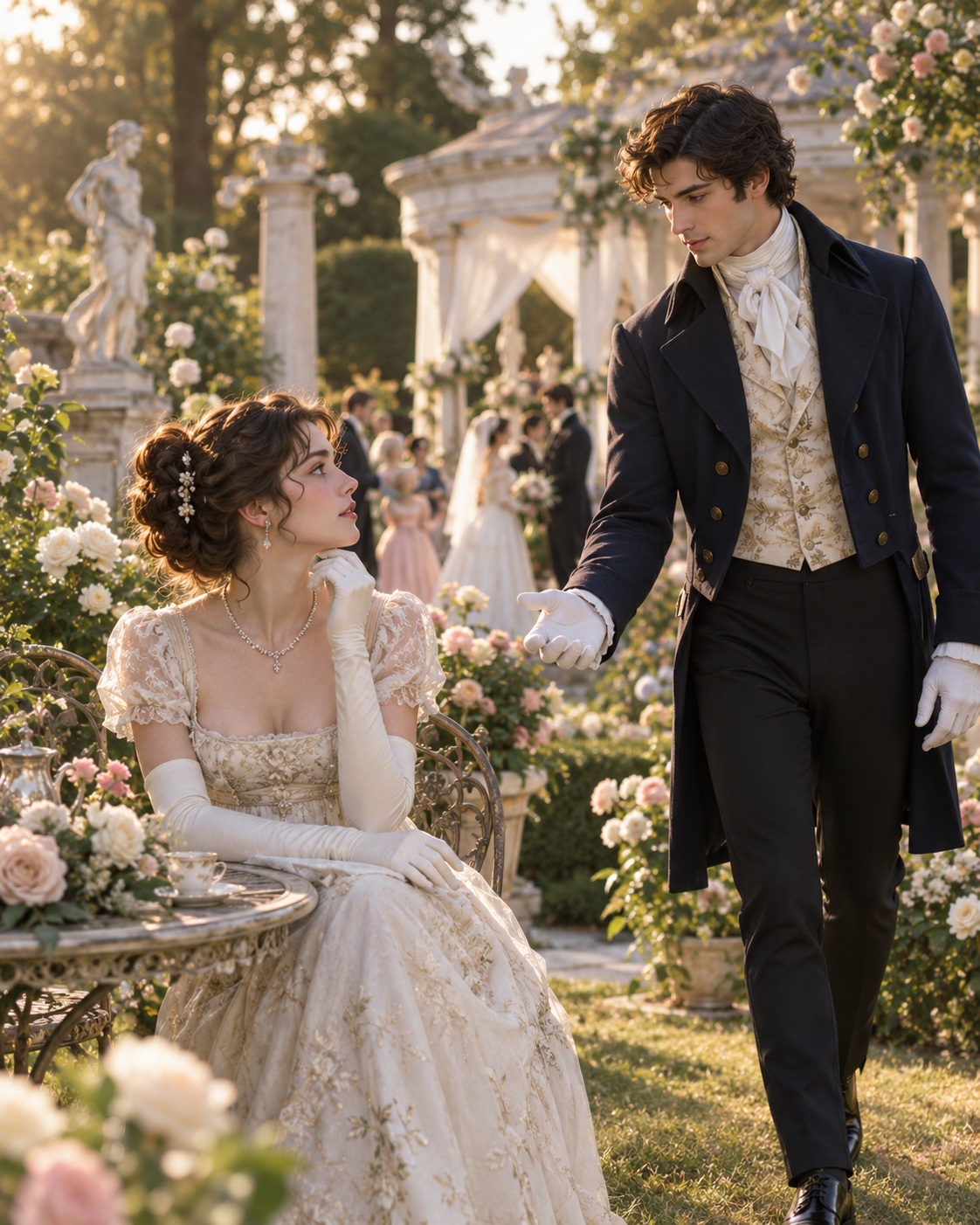
At her younger sister’s summer wedding in the heart of New York’s Hudson Valley, 24-year-old Cassandra Ashwell has already decided that she would rather disappear into the background than become another young woman quietly waiting to be noticed by the right man.
Cassandra did not answer immediately.
She stood beside the small window of the cottage, one hand resting against the wooden frame as she watched the morning sunlight spread across the fields behind the house. Beyond the meadow, the familiar hills rolled toward the distant road that led down to the river and eventually toward New York City.
Everything looked exactly as it had the day before.
The same old barn.
The same apple trees.
The same white fence her father had repaired twice that spring.
Yet somehow, none of it felt quite the same.
Behind her, Gabriel waited.
He did not press her.
That, more than anything, unsettled her.
Men who possessed his title and fortune were not accustomed to waiting for answers from women like Cassandra.
“You understand what you are asking?” she finally said.
“Yes.”
“You understand what I would be giving up?”
Gabriel’s expression tightened.
“I believe I understand some of it.”
“Then you know this is not simply a convenient arrangement.”
“No,” he said quietly. “I know it is not.”
Cassandra turned toward him.
“You want a wife before your thirtieth birthday. You need a respectable marriage to satisfy the conditions attached to your inheritance. You need someone willing to enter your household quickly and accept a life arranged around obligations she did not create.”
Gabriel did not deny a word.
“Yes.”
“And you came to me because I happened to be sitting alone at a wedding.”
“No.”
His answer was so immediate that Cassandra stopped.
Gabriel stepped closer, though he maintained a respectful distance.
“I came to you because you were the only person in that ballroom who seemed completely uninterested in what I could give you.”
Cassandra almost laughed.
“That sounds terribly romantic.”
“It wasn’t intended to be.”
“Then what was it?”
“The truth.”
His eyes remained fixed on hers.
“I watched men spend the entire evening discussing my properties without once asking whether I liked the places they were discussing. I watched women speak to me differently after learning my title. I watched your sister’s guests calculate what a connection to me might mean for their families.”
“And I was sitting in a corner.”
“Yes.”
“Because I wanted to be left alone.”
“I know.”
“Then perhaps you should have left me there.”
A faint smile touched his face.
“I tried.”
That surprised her.
Cassandra looked away before he could see the reluctant smile forming on her own lips.
The silence between them changed.
It no longer felt like the silence between a duke and a prospective bride.
It felt dangerously close to the silence between two people beginning to understand each other.
“I need time,” Cassandra said.
“You have it.”
“How much?”
“As much as you require.”
“You said nine weeks.”
“That is my deadline. It does not have to be yours.”
Cassandra studied him.
“Why would a man in your position allow a woman nine weeks to decide whether she wants to become a duchess?”
“Because I do not want a woman who feels trapped.”
His voice softened.
“I have spent too much of my life watching people obey circumstances they never chose.”
The statement lingered in the room.
Cassandra noticed something then.
For the first time since Gabriel had arrived, he looked tired.
Not physically tired.
Something deeper.
As if the weight of the estate, the villages, his family, and the approaching deadline had been resting on his shoulders for years.
“What exactly happens if you do not marry?” she asked.
Gabriel’s jaw tightened.
“The non-entailed portion of my estate passes to my cousin.”
“And the villages?”
“The land remains tied to the estate, but he gains enough financial control to determine how it is managed.”
“That sounds complicated.”
“It is.”
“And dangerous?”
“For the people living there, yes.”
Cassandra frowned.
“Why?”
“Because my cousin considers tenants numbers on a ledger.”
Gabriel walked toward the table and placed both hands upon its worn surface.
“He has already spoken about raising rents, selling farms, and reducing assistance to families who cannot keep up.”
Cassandra stared at him.
“How many families?”
“Hundreds.”
The cottage suddenly felt smaller.
She had grown up hearing her father complain about wealthy landowners who knew the price of everything but the people who depended upon them. Yet Gabriel was speaking about the same kind of people from the opposite side of the divide.
“You could simply give them money,” she said.
“I could.”
“But?”
“Money can solve a crisis. It cannot always repair a system.”
Cassandra considered that.
“So you are marrying to protect villages.”
“I am marrying because the legal condition requires it. I am trying to use the condition to protect the people affected by it.”
“And if you marry me?”
“I keep control of the property.”
“And if I refuse?”
“My cousin takes it.”
She looked toward the window again.
The sun had climbed higher.
In the distance, a delivery wagon passed along the road, its wheels rattling over the summer-dry earth.
Ordinary life continued.
That was the strangest part.
The world had not stopped simply because Cassandra’s future had suddenly become impossible to recognize.
“I need one condition,” she said.
Gabriel looked up.
“Name it.”
“I will not become a decoration.”
Something changed in his expression.
“I would not ask you to.”
“I mean it. I will not sit in a grand house while everyone else decides what I am allowed to say, where I may go, and whom I may speak to.”
“Agreed.”
“I will keep my own interests.”
“Yes.”
“I will not be expected to pretend that I love you.”
His eyes remained on hers.
“No.”
Cassandra hesitated.
“And you will never use this marriage to control me.”
Gabriel was silent for several seconds.
Then he said, “You have my word.”
She nodded.
“Then I will consider it.”
He exhaled slowly.
“Thank you.”
It was not the response of a triumphant man.
It was the response of someone who had been holding his breath.
Cassandra noticed.
She wished she had not.
Because suddenly the arrangement seemed less simple than it had five minutes earlier.
Gabriel left before noon.
Cassandra watched from the porch as his carriage disappeared down the road.
Only when it was gone did her younger sister, Amelia, emerge from the kitchen.
“You are going to marry a duke.”
Cassandra closed her eyes.
“I am considering marrying a duke.”
Amelia folded her arms.
“That is considerably less dramatic.”
“Good.”
“You danced with him for nearly half an hour.”
“I did not know he was going to propose the next morning.”
“Neither did I.”
Cassandra turned.
Amelia’s expression had changed.
There was no teasing in it now.
“Are you frightened?”
“Yes.”
“Of him?”
“No.”
“Then what?”
Cassandra looked toward the empty road.
“Of becoming someone I don’t recognize.”
Amelia came to stand beside her.
“You have always been afraid of becoming someone else.”
“I have always been afraid of losing myself.”
“Then don’t.”
Cassandra glanced at her.
Amelia smiled.
“You don’t have to become a duchess first and Cassandra second.”
Those words stayed with her.
Three days later, Cassandra accepted.
The announcement traveled through New York society with astonishing speed.
By the end of the week, newspapers in Manhattan were already discussing the unexpected engagement between Gabriel Thorne, Duke of Ravensmore, and Cassandra Ashwell, the daughter of a modest American family.
Some called it surprising.
Some called it romantic.
Others called it a strategic alliance.
Cassandra quickly learned that society rarely cared whether a story was true.
It cared whether the story was interesting.
She arrived at Ravensmore House the following Monday.
The estate stood on a rise overlooking several hundred acres of green countryside. It was impressive without being gaudy, built in a style that combined old European architecture with the confidence of wealthy American estates.
Cassandra expected servants to stare.
They did.
She expected aristocratic guests to judge her.
They did that too.
What she did not expect was to find Gabriel waiting for her at the entrance.
He did not greet her as if she were a possession.
He took her hand.
“Welcome home.”
Cassandra looked at him.
“That is a dangerous thing to say to someone who has not yet decided whether she likes the house.”
A smile appeared.
“Then I will give you time.”
He showed her the rooms that would be hers.
Her bedroom overlooked the gardens.
The library was enormous.
There was a private sitting room.
There was even a small conservatory filled with flowers.
Cassandra should have been impressed.
Instead, she asked, “Where are the accounts?”
Gabriel stopped.
“What?”
“The estate accounts.”
He stared at her for a moment.
Then, unexpectedly, he laughed.
“You really mean to make this marriage difficult.”
“I mean to understand what I am entering.”
He nodded.
“I will have them brought to you.”
That evening, Cassandra read until midnight.
The estate was not in the condition she had imagined.
Gabriel possessed enormous land holdings, but much of the wealth was tied up in property rather than liquid funds. Several farms were barely profitable. Repairs had been postponed. Medical assistance for tenants had increased during the previous winter.
And then Cassandra saw the numbers connected to three villages.
Her expression changed.
There was something wrong.
The figures did not match.
She checked them again.
Then a third time.
The same discrepancy remained.
The following morning, she took the ledger to Gabriel.
“You said your cousin wants control because of the inheritance.”
“Yes.”
“Then why are these accounts showing payments that never reached the villages?”
Gabriel went still.
“What payments?”
She turned the ledger toward him.
“These.”
He read the page.
His face hardened.
“Where did you find this?”
“In the estate accounts.”
“I’ve never seen these entries.”
“Then someone has.”
He called his steward immediately.
Within an hour, the estate had become strangely quiet.
The steward claimed the discrepancies were accounting errors.
Cassandra did not believe him.
Neither did Gabriel.
By evening, the steward had disappeared.
Not physically.
He had simply left the estate under the excuse of visiting family.
Gabriel sent someone after him.
That was when Cassandra understood the marriage was no longer merely a matter of inheritance.
Someone was already interfering with the estate.
Someone who knew Gabriel’s deadline was approaching.
The next two weeks passed in a blur.
Cassandra learned the household.
She met tenant families.
She visited the villages Gabriel had spoken about.
What she found surprised her.
The people did not speak of Gabriel as a distant duke.
They spoke of him as a man who had repaired roofs after storms, paid medical bills when families could not, and delayed rent during poor harvests.
They also spoke of his cousin.
Quietly.
With fear.
One elderly farmer told Cassandra that several families had already received notices threatening them with eviction.
“From Gabriel?”
“No, ma’am.”
“Then from whom?”
The old man looked around before answering.
“From men acting for Lord Thorne’s cousin.”
Cassandra’s heart tightened.
“Gabriel needs to know.”
“He already does.”
“Then why hasn’t he stopped it?”
The farmer lowered his voice.
“Because someone inside the estate keeps making sure he hears about things too late.”
Cassandra returned to Ravensmore that evening with a new understanding.
Gabriel had not simply been trying to protect his inheritance.
He had been fighting a battle in which his own household might contain the enemy.
Three weeks before the wedding, Cassandra found a letter hidden inside an old desk in the library.
It was addressed to Gabriel’s cousin.
The letter contained detailed information about Gabriel’s financial difficulties.
It also mentioned Cassandra.
Her hands trembled as she read.
The writer described her as “an inexperienced American girl who may be easily persuaded.”
Cassandra read the sentence twice.
Then she folded the letter.
She walked directly to Gabriel.
He was standing by the fireplace when she entered.
“You were right,” she said.
His expression sharpened.
“About what?”
“Someone is working with your cousin.”
She handed him the letter.
Gabriel read it.
His face went pale.
“Where did you find this?”
“In your library.”
“Who else knows?”
“No one.”
He looked at her.
“You should not have come here alone.”
“I am beginning to think being underestimated is becoming useful.”
He almost smiled.
Almost.
Then the expression disappeared.
“Cassandra, if someone is trying to manipulate this estate, your involvement makes you a target.”
“Then perhaps they should learn that I am not as easily persuaded as they think.”
Gabriel stepped closer.
“You do not understand.”
“I understand perfectly.”
“No. You don’t.”
His voice cracked with frustration.
“If this marriage goes ahead and something happens to you because of my family—”
“You think I am safer without knowing what is happening?”
“No.”
“Then stop trying to protect me by keeping me ignorant.”
He looked at her for a long moment.
Then he said quietly, “I am afraid of losing you.”
The words silenced the room.
Cassandra had expected anger.
She had expected another explanation.
She had not expected that.
“You barely know me,” she whispered.
“I know enough.”
“Gabriel…”
“I know you sit in corners because you dislike pretending. I know you read estate accounts for pleasure when most people would fall asleep after the second page. I know you ask servants their names. I know you look at every person as if their circumstances matter.”
He swallowed.
“And I know that when you walked into this house, it stopped feeling like a place I had to defend alone.”
Cassandra’s heart beat painfully.
This was not part of the arrangement.
Love had never been mentioned.
Yet something was changing between them.
Something neither of them had planned.
The wedding was set for the following Saturday.
New York society arrived in force.
The ceremony took place at a historic church near the estate, followed by a reception beneath a vast glass pavilion overlooking the gardens.
Cassandra wore a simple ivory gown.
Gabriel watched her walk toward him.
For the first time since their engagement, he looked uncertain.
When she reached him, he whispered, “You can still change your mind.”
She looked up at him.
“So can you.”
“I won’t.”
“Neither will I.”
They exchanged vows.
The marriage was legal.
The inheritance condition had been satisfied.
But before the celebration could truly begin, a messenger arrived.
Gabriel read the note.
His expression changed.
“What is it?” Cassandra asked.
“My cousin has filed a challenge to the inheritance.”
“But you married before your birthday.”
“Yes.”
“Then how can he challenge it?”
“Because he claims the marriage was arranged solely to preserve the estate and therefore violates another clause.”
Cassandra stared at him.
“So he is saying our marriage isn’t real.”
“He is trying to.”
“Then what happens?”
Gabriel folded the note.
“We fight.”
The legal battle lasted weeks.
During that time, Cassandra discovered something unexpected.
She was not simply Gabriel’s wife.
She had become his partner.
She organized the village records.
She uncovered missing payments.
She interviewed employees.
She found evidence that the steward had been diverting money for years.
And eventually, she found the document that changed everything.
It was hidden inside an old collection of correspondence belonging to Gabriel’s late father.
The document clearly stated that any spouse entering the marriage in good faith and taking active responsibility for the estate would satisfy the inheritance condition.
Cassandra stared at the page.
The phrase “in good faith” was underlined.
Her heart raced.
They had proof.
But there was one problem.
The document had never been formally filed.
Gabriel’s cousin could argue it was irrelevant.
Unless they could prove the original intent of the estate arrangement.
That proof came from an unexpected source.
The elderly farmer Cassandra had met weeks earlier arrived at the courthouse carrying a wooden box.
Inside were letters written by Gabriel’s father.
Letters describing his fear that the estate would one day fall into the hands of someone interested only in profit.
The farmer had kept them for twenty years.
He had never believed they would matter.
Now they did.
The court accepted the evidence.
The challenge collapsed.
Gabriel retained control of the estate.
The three villages were protected.
The cousin lost his claim.
But when the ruling was announced, Cassandra felt no triumph.
She thought about the first night she had met Gabriel.
The ballroom.
The music.
The corner where she had tried to disappear.
She remembered thinking that the entire world seemed to revolve around money, titles, and marriage.
Yet the man who had crossed the room toward her had seen something else.
He had seen her.
Months later, Cassandra stood on the terrace of Ravensmore House while the sun disappeared beyond the fields.
Gabriel joined her.
“You were quiet at the wedding,” he said.
“I was deciding whether I regretted everything.”
“And now?”
She smiled.
“I regret the amount of paperwork.”
He laughed.
“That can be arranged.”
She turned toward him.
“You know, when you first came to the cottage, I thought you were asking me to sacrifice my life for yours.”
“And now?”
“Now I think we both saved something.”
Gabriel took her hand.
“Not something.”
“Then what?”
“Each other.”
Cassandra looked across the estate.
The villages beyond the hills were still there.
The families were still working their farms.
Children were playing in the fields.
The future was not perfect.
There would always be difficult seasons, difficult relatives, difficult choices.
But the life she had feared losing had not disappeared.
It had expanded.
Cassandra had entered Gabriel’s world without surrendering her own.
She had learned that independence did not always mean standing alone.
Sometimes it meant having the courage to choose who was allowed to stand beside you.
And Gabriel learned something too.
A marriage built from necessity could begin without love.
But honesty, respect, and trust could transform what began as an arrangement into something neither person had expected.
Years later, when people asked Cassandra how she became a duchess, she rarely mentioned the title.
She told them about a summer wedding in New York.
She told them about a quiet corner of a crowded ballroom.
And she told them about a man who crossed the room because, for once, he had noticed the woman who was not trying to be noticed.
The rest of the story, she would say, was never about becoming a duchess.
It was about discovering that sometimes the life we think we are being asked to give up is the very life we are finally being given the freedom to choose.
By November, the gardens at Ravensmore House had turned silver beneath the morning frost, and the roads connecting the estate to the three villages were often covered in mud and fallen leaves.
Cassandra had begun to understand that protecting an estate was not a single victory.
It was a daily responsibility.
The court ruling had secured Gabriel’s inheritance, but it had not erased every problem left behind by his cousin.
Several tenants still carried debts.
Some buildings required repairs.
A few former employees had disappeared before they could be questioned.
And there were rumors that Gabriel’s cousin had not abandoned his ambitions.
Gabriel wanted Cassandra to stay away from all of it.
She refused.
“You cannot ask me to become your wife and then expect me to behave like a guest,” she told him one evening.
“I am asking you to be careful.”
“I am careful.”
“You walked into a village meeting alone this morning.”
“I walked into a room full of farmers.”
“Exactly.”
Cassandra stared at him.
“You make it sound as though they were waiting to murder me.”
Gabriel sighed.
“That is not what I meant.”
“I know.”
She softened.
“But I also know you are still trying to protect me from everything simply because you love me.”
Gabriel went quiet.
The word hung between them.
Love.
Neither had said it aloud before.
Cassandra realized what she had done.
Gabriel looked at her for several seconds.
“Say that again.”
She felt her cheeks grow warm.
“No.”
“Cassandra.”
“I said no.”
He smiled.
For once, the formidable Duke of Ravensmore looked almost boyish.
“I heard you.”
“Then you heard nothing.”
“I heard everything.”
She tried to walk away.
He caught her hand.
Not forcefully.
Just enough to stop her.
“You know,” he said, “when I proposed to you, I thought I was asking for a solution.”
“And now?”
“Now I know I was asking for a life.”
Cassandra looked at him.
“And is that life what you wanted?”
“Yes.”
The answer came without hesitation.
“So do I.”
That winter, they began changing Ravensmore.
Not dramatically.
Not overnight.
They started with small things.
Cassandra created a fund for widows and children.
Gabriel reduced rents on several farms affected by poor harvests.
They repaired cottages before spending money on improvements to the main house.
They hired a physician to visit the villages twice a week.
And for the first time in years, tenant families were invited to speak directly with the people managing the estate.
The changes were noticed.
People who had once been afraid to enter Ravensmore House began arriving through the front doors without hesitation.
Cassandra found herself happiest during those meetings.
She loved hearing ordinary people talk about ordinary problems.
A broken roof.
A sick child.
A new well.
A shipment delayed by snow.
These things seemed small to people in grand drawing rooms.
To the families living in the villages, they were the difference between security and fear.
One afternoon, a little girl named Elsie brought Cassandra a basket of apples.
“My mother says you helped us,” she said.
Cassandra knelt.
“I only helped a little.”
“She says that little was enough.”
Cassandra smiled.
“Then tell your mother I am glad.”
The child ran away.
Gabriel had been watching from the doorway.
“You are going to spoil them.”
“I hope so.”
He smiled.
“You have changed this place.”
“No.”
Cassandra looked around.
“The people changed it. We simply listened.”
Spring arrived.
Then summer.
Then another autumn.
Three years passed.
Their marriage, once described by gossip columns as an unusual arrangement between an American girl and an English duke, became something nobody could easily explain.
They argued.
They laughed.
They traveled.
They disagreed about money.
They disagreed about renovations.
Cassandra thought Gabriel spent too much on horses.
Gabriel believed Cassandra spent too much on books.
Neither ever won.
But they learned how to disagree without becoming enemies.
And they learned something even more important.
Love was not the absence of difficulty.
It was the decision to face difficulty together.
Then, one October morning, Gabriel received a letter that changed everything again.
His cousin was ill.
Very ill.
The man who had once threatened to take Ravensmore now had almost nothing.
His investments had failed.
His debts had grown.
His friends had disappeared.
And the people he had once treated as business opportunities no longer answered his calls.
Gabriel was silent after reading the letter.
Cassandra watched him.
“You are thinking of helping him.”
“Yes.”
“Why?”
“Because he is still family.”
She studied his face.
“After everything he did?”
Gabriel folded the letter.
“I don’t have to forgive what he did to choose not to become him.”
Cassandra smiled.
“That may be the wisest thing you have ever said.”
Gabriel arranged for his cousin’s medical expenses to be covered.
He did not give him control of anything.
He did not erase his debts.
But he refused to let revenge determine his actions.
Months later, his cousin sent a letter.
It contained only a few lines.
He admitted that he had been wrong about Cassandra.
He admitted that he had underestimated Gabriel.
And, most surprisingly, he admitted that the villages had survived because Gabriel had cared more about people than property.
Gabriel never replied.
He simply placed the letter in a drawer.
Life continued.
One evening, years after the summer wedding where everything had begun, Cassandra returned to the same ballroom.
The family was hosting another wedding.
The room was filled with music, flowers, champagne, and people searching for familiar faces.
Cassandra stood near the doorway.
She looked around and remembered herself at twenty-four.
The young woman hiding in a corner.
The woman convinced that she did not belong.
The woman who had believed being overlooked was a form of safety.
Gabriel approached from across the room.
He had aged.
There were faint lines around his eyes now.
His hair was touched with gray.
But his smile remained the same.
“May I have this dance?”
Cassandra laughed.
“You already know the answer.”
“I would like to hear it.”
She placed her hand in his.
“Yes.”
The music began.
They moved across the floor.
For a moment, Cassandra could almost see the younger versions of themselves.
Two strangers.
One unexpected dance.
A proposal made out of necessity.
A future neither had planned.
Gabriel leaned closer.
“Do you ever think about that morning?”
“Every year.”
“What would you tell the woman you were then?”
Cassandra considered the question.
“I would tell her not to be afraid of an unexpected door.”
“And would you tell her to accept the proposal?”
She smiled.
“No.”
Gabriel raised an eyebrow.
“No?”
“I would tell her to ask more questions.”
He laughed.
“That sounds like you.”
“And I would tell her that she doesn’t have to become someone else to deserve a remarkable life.”
His expression softened.
“That is something I wish I had known too.”
The song ended.
Neither immediately let go.
Around them, people continued dancing.
The orchestra began another piece.
Outside, the lights of the estate glowed against the dark American evening.
Cassandra looked toward the windows.
Beyond them lay the fields.
Beyond the fields lay the villages.
And somewhere beyond those hills was the road that had once carried Gabriel to her family’s little cottage.
She thought about how strange life could be.
A woman could spend years believing she was invisible.
A man could spend years believing duty was the only thing waiting for him.
Then one ordinary evening could place them in the same room.
One conversation could change everything.
One choice could open a door.
But the greatest lesson Cassandra had learned was that the door itself was never the miracle.
The miracle was having the courage to walk through it without surrendering who you were.
Gabriel squeezed her hand.
“Ready?”
“For what?”
“The next dance.”
She smiled.
“Yes.”
And together they stepped back onto the floor.
Not as a duke and the overlooked girl from a modest cottage.
Not as a marriage of convenience.
Not as two people bound together by an inheritance clause.
But simply as Cassandra and Gabriel.
Two people who had entered the same room for entirely different reasons and somehow found the life neither had known how to ask for.
Years later, people would still tell the story of how the Duke of Ravensmore met his wife at a summer wedding.
They would make it sound like fate.
They would speak of titles, estates, wealth, and romance.
They would say the duke had crossed a ballroom and chosen the quiet girl in the corner.
But Cassandra always corrected them.
“He didn’t choose me,” she would say.
“And I didn’t choose him because he was a duke.”
“We chose the truth.”
That was the part the stories often left out.
A convenient marriage had brought them together.
But convenience had not made them stay.
Respect had.
Trust had.
Honesty had.
And eventually, love had.
The estate survived.
The villages prospered.
The children who had once been frightened of losing their homes grew up believing that Ravensmore was not a distant symbol of wealth but a place where their voices mattered.
And Cassandra never again sat alone in a corner hoping nobody would notice her.
She had learned that being seen was not the same as being valued.
Titles could attract attention.
Money could open doors.
Names could command a room.
But none of those things could create the kind of life that was built through ordinary acts of courage, kindness, and loyalty.
Her story began with a proposal she never expected.
It became a marriage she never planned.
And in the end, it taught her that the greatest transformations rarely arrive looking like miracles.
Sometimes they arrive in a carriage on an ordinary morning.
Sometimes they begin with a question.
Sometimes they ask you to step into a future you cannot yet understand.
And sometimes, if you are brave enough to remain yourself while doing it, that uncertain future becomes home.