At her own wedding breakfast, Georgiana discovered that her husband had married her for money
“I owe you an apology,” Henry said.
Georgiana waited, certain that there must be more. The Duke of Iley was not a man who apologized easily, particularly to the woman he had spent months treating as an inconvenient guest.
“For what, precisely?” she asked.
Henry looked toward the window. Beyond the glass, several women were walking home from the workshop, carrying baskets filled with lace.
“For believing that your father’s occupation made you somehow less deserving of respect. For bringing you here and expecting you to disappear. And for speaking to you on our wedding day in a manner no gentleman should speak to his wife.”
Georgiana folded her hands in her lap.
“You have had considerable time to reach that conclusion.”
“I have.”
“And what has changed?”
Henry looked at her.
“I have come to know you.”
She felt an unexpected ache in her chest. Those were words she might once have given anything to hear. Now, however, she understood how dangerous it was to build her happiness upon another person’s approval.
“Is that why you wish me to attend the ball?”
“I would like you to stand beside me.”
“As your wife or as evidence that your marriage has not been a complete disaster?”
Henry’s expression tightened.
“As my wife.”
Georgiana rose and walked toward the fireplace.
“Then perhaps you should tell me about Lady Jaketta.”
The silence that followed was enough to make her regret asking.
Henry took a slow breath.
“Before our marriage, there was an understanding between us. Nothing formal, but I believed she might become my wife.”
“And you loved her?”
“I believed I did.”
Georgiana turned away.
Henry continued before she could dismiss him.
“When my father’s debts became known, her family made it clear that a marriage would be impossible unless I could restore the estate’s finances. Jaketta agreed with them.”
“So you married me instead.”
“Yes.”
The simple admission hurt more than any elaborate excuse could have.
“I was angry with my circumstances,” Henry said. “I was ashamed of needing your father’s assistance. And rather than admit my own failures, I punished you for them.”
Georgiana looked at him for a long moment.
“I was not responsible for your debts, Henry.”
“I know.”
“Nor was I responsible for Lady Jaketta’s disappointment.”
“I know that, too.”
She returned to the table and picked up the invitation.
“I shall consider attending. But I will not pretend that we are happily married simply because it would be convenient for you.”
Henry nodded.
“That is more than fair.”
After he left, Georgiana remained beside the window until his carriage disappeared. She wanted to believe his apology. Yet she remembered the young bride who had arrived at Iley with dreams of companionship and had been sent away with nothing but a title.
She could not afford to become that woman again.
Two mornings later, a letter arrived from a fashionable dressmaker in London. Georgiana opened it eagerly, expecting confirmation of a substantial lace order.
Instead, she found a cancellation.
The dressmaker expressed regret, explaining that unfortunate information had reached her concerning the reputation of the duchess’s workshop.
Georgiana read the letter twice.
By noon, another cancellation had arrived.
The following morning brought a third.
Mrs. Whitmore, a widow who supervised several of the younger lacemakers, stood beside Georgiana’s desk with tears in her eyes.
“My lady, Mrs. Bell says her sister heard something terrible at the market.”
“What did she hear?”
“That the lace we sell is being passed off as finer work than it truly is. They say we purchase cheap materials and deceive our customers.”
Georgiana stared at her.
“That is absurd.”
“I know, Your Grace. But people are talking.”
Georgiana opened her account books. Every purchase, every payment, and every finished order had been carefully recorded. She had built her business upon honesty, knowing that even the smallest mistake would be used against her.
Someone was deliberately trying to destroy it.
That afternoon, Henry arrived to find her surrounded by letters.
She handed him the cancellations without explanation.
His expression darkened as he read them.
“Who has done this?”
“I have my suspicions.”
“Jaketta?”
Georgiana did not answer.
Henry walked toward the door.
“I shall put an end to it.”
“How?”
He stopped.
“I will speak to the families involved.”
“And what will you tell them? That they must purchase my lace because a duke commands it?”
“I cannot allow someone to injure you.”
“Then help me discover the truth. Do not replace my judgment with your authority.”
Henry looked down at the letters again.
In the past, he would have considered her refusal an insult. Now he recognized something he had never understood before. Georgiana was not rejecting his assistance. She was asking him to respect her ability to decide what kind of assistance she needed.
“What would you have me do?” he asked.
For the first time that afternoon, she smiled.
“Find out where these rumors began.”
Henry spent the next several days visiting acquaintances and speaking privately with merchants. Meanwhile, Georgiana refused to dismiss a single woman from her workshop.
She used her savings to cover their wages, even as the finished lace began piling up without buyers.
“You must think of yourself, Your Grace,” Mrs. Whitmore pleaded.
“I am thinking of myself,” Georgiana replied. “I would not sleep peacefully knowing that your children went hungry because someone wished to embarrass me.”
News of her decision eventually reached Henry.
He began to understand why the women spoke of his wife with such affection. Their loyalty had not been purchased with her father’s fortune or demanded through her title. Georgiana had earned it.
Three days before the ball, Henry returned with troubling news.
One of the dressmakers had admitted that the rumors came from a woman associated with Lady Jaketta’s household.
Unfortunately, no one was willing to make a public accusation against a lady of such standing.
Georgiana listened quietly.
“Then we cannot prove it.”
“Not yet.”
She glanced at the invitation resting upon her desk.
“Tell me, Henry. Will the London dressmakers attend the Melton Hunt ball?”
“Several of their wealthiest customers certainly will.”
Georgiana considered this.
“Then I believe I shall accept your invitation.”
On the evening of the ball, Henry waited at the foot of the staircase in the dower house.
When Georgiana appeared, he forgot the greeting he had prepared.
She wore a simple ivory gown decorated with delicate lace. The pattern featured small leaves and flowers, each joined so carefully that the fabric seemed almost weightless.
There were no extravagant jewels around her neck. She wore only a pearl necklace that had belonged to her grandmother.
“You look beautiful,” Henry said.
Georgiana smiled faintly.
“Thank you.”
He offered his arm, and she accepted it.
During the carriage ride, Henry noticed her gripping her small evening bag.
“Are you nervous?”
“Would you believe me if I said no?”
“Not for a moment.”
She laughed, and the sound surprised them both.
When they entered the ballroom, conversations immediately began to fade.
Many of the guests had never seen the Duke and Duchess of Iley appear together. Others had heard so many stories about their marriage that they hardly knew what to believe.
Lady Jaketta stood near the musicians, dressed in pale blue silk.
Her smile vanished when she saw Georgiana on Henry’s arm.
Henry led his wife toward the hostess and introduced her with a warmth that attracted considerable attention.
For nearly an hour, Georgiana received polite greetings and curious glances. Several women complimented her gown, asking where she had obtained the remarkable lace.
“It was made at my workshop,” she explained.
Their surprise was obvious.
Before long, Lady Jaketta approached.
“Georgiana, what a charming dress. How brave of you to wear something made by your village women.”
“Thank you, Lady Jaketta. They are exceptionally skilled.”
“Indeed? I heard there had been some concerns about the quality of their work.”
Several nearby guests turned toward them.
Georgiana recognized the opportunity immediately.
“How fortunate that you mentioned it,” she replied. “Perhaps you would care to explain those concerns.”
Jaketta’s smile became strained.
“Oh, merely something I heard.”
“From whom?”
“I cannot possibly remember.”
“Then perhaps we should be careful about repeating it.”
A few women exchanged amused glances.
Jaketta’s cheeks colored.
“I only thought you ought to know. After all, commerce is a rather unusual occupation for a duchess.”
“My father taught me that honest work is nothing to be ashamed of.”
“Your father is a coal merchant.”
“Yes,” Georgiana answered proudly. “And his coal has warmed considerably more homes than my title ever will.”
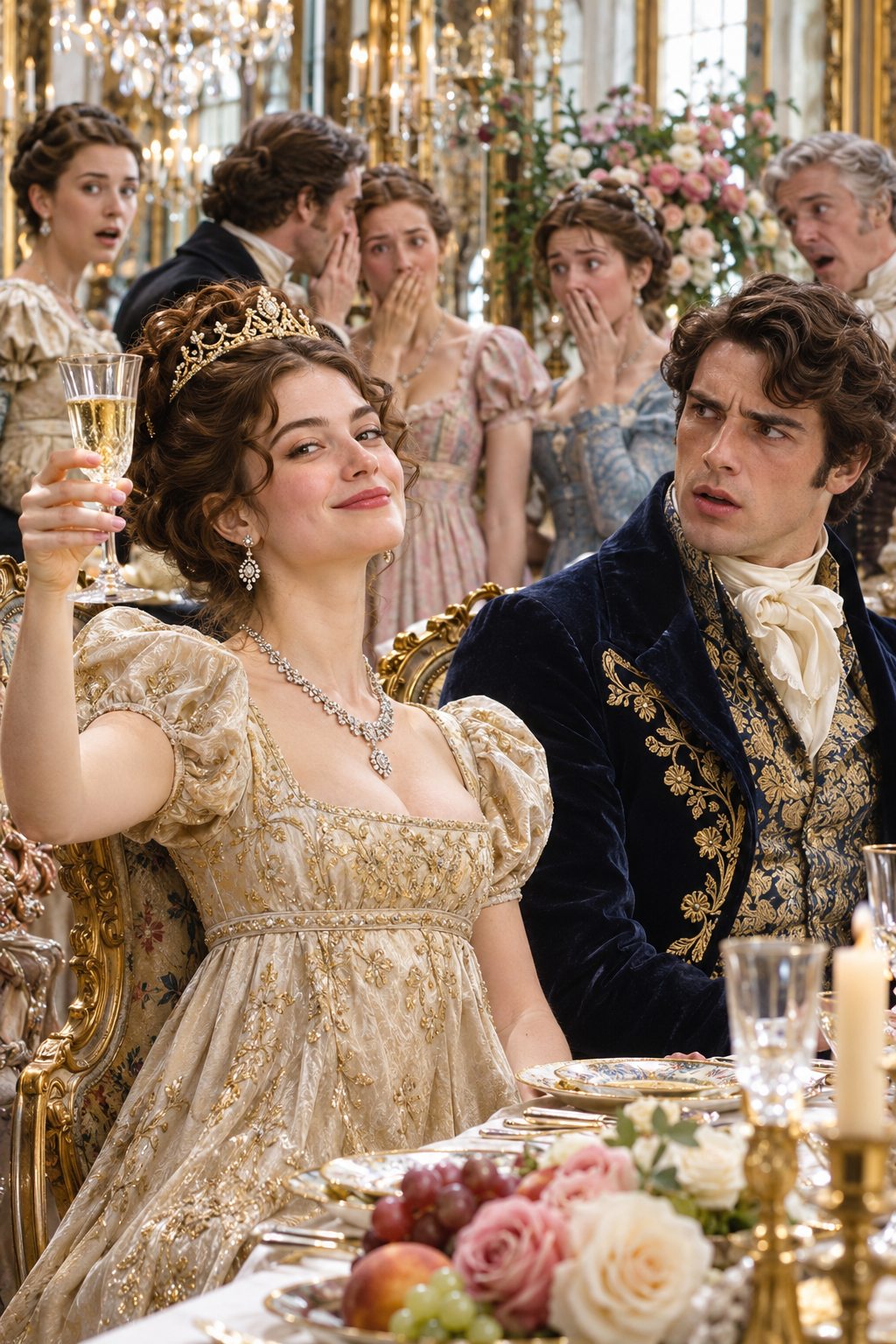
Someone nearby laughed.
Jaketta looked toward Henry, expecting him to intervene.
Instead, he smiled at his wife.
“I believe the duchess has answered you quite sufficiently.”
For the first time in months, Lady Jaketta found herself without an audience willing to admire her cruelty.
She withdrew, but Georgiana knew the evening was far from over.
Later, as Henry and Georgiana prepared to dance, a gentleman approached them carrying a folded piece of paper.
“Your Grace,” he said awkwardly, addressing Henry. “I fear something has been circulating that you ought to see.”
Henry opened the paper.
His face changed.
Georgiana reached for it.
Printed upon the page was a short, vicious account of their marriage. It described her as a wealthy merchant’s daughter who had purchased a noble husband and claimed that her lace business was a desperate attempt to recover the money her family had spent.
Worse still, it suggested that Henry continued to visit another woman while his wife remained hidden in the dower house.
Georgiana felt the blood drain from her face.
Around the ballroom, other guests were quietly examining identical pages.
Jaketta had apparently decided that destroying the workshop was not enough. She intended to humiliate Georgiana before the entire county.
Henry folded the paper.
“We are leaving.”
“No,” Georgiana said.
“Georgiana, you need not endure this.”
“If we leave now, everyone will assume it is true.”
Henry looked at her helplessly.
She straightened her shoulders.
“Some of it is true. My father did save your estate. You did send me away. I cannot change those facts.”
Her voice trembled slightly.
“But I will not be ashamed of surviving them.”
Before Henry could answer, Mrs. Whitmore appeared near the ballroom entrance.
She had been invited to deliver a small lace order to one of the guests and was accompanied by a young woman named Alice.
Alice looked terrified.
“Your Grace,” Mrs. Whitmore whispered, “there is something you must hear.”
Georgiana led them into a quieter adjoining room.
Alice twisted her fingers together.
“My sister works as a maid for Lady Jaketta. She was instructed to deliver letters to several merchants. When she discovered what was inside them, she became frightened.”
Alice produced two folded letters.
“My sister kept these. She thought the lady might deny everything and blame her.”
Georgiana opened them.
The letters contained instructions to spread false reports about the workshop. Both bore Lady Jaketta’s signature.
Henry read them over her shoulder.
His anger was immediate.
“I shall confront her.”
“Wait,” Georgiana said.
She turned to Alice.
“Does your sister understand what might happen if these letters become public?”
Alice nodded tearfully.
“She has already been dismissed, Your Grace. Lady Jaketta discovered that she had kept them.”
Georgiana took the young woman’s hand.
“Tell your sister that she will have employment at my workshop for as long as she wishes.”
Alice began to cry.
Henry watched his wife comfort her. Even after everything Jaketta had done, Georgiana’s first concern was for someone more vulnerable than herself.
Together, Henry and Georgiana returned to the ballroom.
Lady Jaketta was speaking with a group of women when Henry approached.
“I believe these belong to you,” he said, holding out the letters.
Jaketta glanced at them and went pale.
“Where did you obtain those?”
“That is hardly the question you should be asking.”
The surrounding conversations stopped.
Jaketta looked desperately at Georgiana.
“You cannot seriously believe that I intended any harm.”
“You attempted to take away the livelihoods of women who had never offended you,” Georgiana replied.
“I was angry!”
“And what had those women done to deserve your anger?”
Jaketta’s eyes filled with tears.
“You took everything from me!”
Georgiana looked at her with quiet sadness.
“No, Lady Jaketta. I married a man who was free to marry me. Whatever expectations you had were not mine to fulfill.”
Jaketta turned to Henry.
“Tell her! Tell her what we meant to each other!”
Henry stood very still.
“Whatever affection once existed between us ended long before my wedding. I should have made that clear sooner.”
Jaketta stared at him.
Then Henry addressed the watching guests.
“There is something else that must be made clear. My wife’s father rescued my estate from financial ruin. That is true. What is not true is the suggestion that she should feel ashamed of it.”
Georgiana’s eyes widened.
Henry had spent years protecting his pride. Now he was openly admitting the very thing he had once considered unbearable.
“I entered our marriage with selfish intentions,” he continued. “I treated my wife with coldness because I resented circumstances for which she bore no responsibility. The disgrace belongs to me, not to her.”
No one spoke.
“The Duchess of Iley has shown more integrity, generosity, and courage than I have. Her business is honest, her work is exceptional, and I consider myself fortunate to be her husband.”
Georgiana felt tears gathering in her eyes.
Lady Jaketta left the ballroom shortly afterward.
But Georgiana did not watch her go.
She was looking at Henry.
When the musicians began playing again, he extended his hand.
“May I have this dance?”
She placed her hand in his.
“You may.”
They moved slowly across the ballroom. For once, Georgiana did not feel like an unwanted visitor in her husband’s world.
Yet she knew that one public declaration could not repair months of loneliness.
Henry seemed to understand.
“I do not expect you to forgive me tonight,” he whispered.
“Good,” she replied softly.
He laughed.
It was the first time they had danced together since their wedding.
In the weeks that followed, orders returned to the workshop. Several wealthy women commissioned lace for their daughters’ wedding gowns, and Georgiana was able to employ additional workers.
Henry arranged for a larger building to be repaired near the village, but only after Georgiana approved the plans. The workshop remained under her direction, with its earnings protected through a proper legal arrangement.
Lady Jaketta withdrew from county society for a considerable time. Georgiana never spoke publicly against her again.
She had no desire to spend her life punishing someone whose bitterness had already cost her so much.
As winter approached, Henry began visiting the dower house almost daily.
Sometimes he brought books. Sometimes he helped Georgiana examine business correspondence. Occasionally, he arrived simply to share a cup of tea.
He discovered that she disliked hunting, enjoyed thunderstorms, and had a wonderful sense of humor when she felt comfortable enough to reveal it.
Georgiana discovered that beneath his pride was a man who had spent much of his life fearing failure.
One snowy evening, Henry arrived without his carriage. His coat was covered in snow, and he was carrying a small wooden box.
“What on earth have you done?” Georgiana asked, laughing as she opened the door.
“Walked here.”
“In this weather?”
“I wished to see you.”
He placed the box upon her table.
Inside lay several beautifully polished wooden lace bobbins.
“I had them made by a carpenter in the village,” he explained. “I thought your grandmother’s might be growing worn.”
Georgiana lifted one carefully.
It was not an expensive gift. That was precisely why it meant so much.
Henry had finally learned what mattered to her.
“There is something else,” he said.
She looked up.
“I would like you to come home.”
Her smile faded slightly.
Henry hurried to explain.
“Not because society expects it. Not because I require an heir. And certainly not because I wish you to abandon your work.”
He reached for her hand.
“I miss you when you are not there. I look forward to hearing your thoughts. I find myself wanting to tell you everything that happens during my day.”
Georgiana’s heart began to race.
“I believe I have fallen in love with my wife,” he said. “Rather inconveniently, she has every reason not to love me.”
She laughed through sudden tears.
“You have made a dreadful beginning.”
“I am aware.”
“And I shall not surrender my workshop.”
“I would never ask it.”
“Nor shall I allow you to make decisions about my life without consulting me.”
“Understood.”
She studied his face.
“Then perhaps you might begin by courting me properly.”
Henry smiled.
“With pleasure.”
He kept his promise.
For the next several months, the Duke of Iley courted his own wife with the patience he should have shown before their marriage.
By spring, Georgiana chose to return to the main house. The dower house remained open as a place where women could learn lacemaking and find support during difficult times.
Years later, visitors to Iley often admired the beautiful lace curtains hanging in the drawing room. Few understood why the duchess treasured them above her jewels.
They were made from the first pieces her workshop had produced.
One afternoon, Henry found Georgiana showing their young daughter how to wind thread around a wooden bobbin.
“Is it difficult, Mama?” the little girl asked.
“At first,” Georgiana answered. “But beautiful things often require patience.”
Henry sat beside them.
“And what happens when you make a mistake?” he asked.
Georgiana smiled at him.
“You untangle the thread and begin again. But you must be willing to do the work.”
Henry kissed her forehead.
He knew she was speaking of more than lace.
Their marriage had begun with money, pride, and disappointment. It had become something neither of them could have purchased with all the wealth in England.
Georgiana had never needed a duke to make her worthy. She had possessed that worth long before she wore a wedding ring.
And Henry had learned that a title might command obedience, but only kindness, humility, and respect could earn love.
In the end, the greatest fortune the Duke of Iley ever received was not the money that saved his estate.
It was the second chance given to him by the woman he had once been too proud to appreciate.
Ten years after their wedding, Georgiana received a letter that brought the past rushing back.
It arrived on an ordinary spring morning while she was reviewing accounts in the drawing room. Henry was reading beside the fireplace, and their daughter, Charlotte, was practicing her embroidery.
Georgiana recognized the name at the bottom of the letter immediately.
Lady Jaketta Lamourne.
She had heard little about the woman since the night of the Melton Hunt ball. There had been rumors of an unhappy marriage, financial difficulties, and a husband who had died unexpectedly.
But nothing had prepared Georgiana for what she was about to read.
“Dear Duchess,
I understand that I have no right to ask anything of you. However, circumstances have left me with very few choices. I have a daughter of eight years who deserves a better future than I can presently provide.
I have heard of the work you offer women in difficult circumstances. If you could find a place for me, I would be willing to learn.
I shall understand if you refuse.”
Georgiana lowered the letter.
Henry noticed her expression.
“Is something wrong?”
She handed it to him.
He read it silently before looking up in disbelief.
“After everything she did to you?”
Georgiana walked toward the window.
Beyond the garden, the workshop she had established years earlier was now a thriving business. Its lace was sold throughout England, and dozens of women had found financial security through their work.
“She must have been desperate to write this,” Georgiana said.
Henry placed the letter on the table.
“You owe her nothing.”
“No,” Georgiana agreed. “But her daughter owes me nothing, either.”
Three days later, Lady Jaketta arrived at the dower house.
The woman who had once entered ballrooms expecting admiration now wore a faded dress and carried a small traveling bag. Beside her stood a thin little girl holding a wooden doll.
When Georgiana entered the room, Jaketta immediately lowered her eyes.
“I never imagined we would meet again under such circumstances.”
“Neither did I,” Georgiana replied.
Jaketta struggled to maintain her composure.
“I suppose you find this rather satisfying.”
Georgiana shook her head.
“I have never found another woman’s suffering particularly satisfying.”
Those words seemed to break something inside Jaketta.
She began to cry.
“I was horrible to you.”
“Yes,” Georgiana answered gently. “You were.”
“I wanted your position. Your husband. Your entire life. I thought that becoming a duchess would make me happy.”
She glanced at her daughter.
“And now I have almost nothing.”
Georgiana sat beside her.
“You have a child who loves you. You have the ability to learn. And you have an opportunity to begin again.”
Jaketta looked at her in astonishment.
“You would truly employ me?”
“Under the same conditions as every other woman here. You will receive fair wages, and you will be expected to work honestly.”
Jaketta nodded, unable to speak.
Georgiana called Mrs. Whitmore into the room and arranged for the little girl to receive lessons alongside the other workers’ children.
As Jaketta prepared to leave, she turned back.
“Why are you doing this?”
Georgiana considered the question.
“Because someone once decided that my birth made me unworthy of kindness. I have no intention of becoming that sort of person.”
For the first time in their acquaintance, Jaketta looked at Georgiana without jealousy.
“Thank you,” she whispered.
Months passed, and Jaketta proved to be a surprisingly capable student. Her hands, once accustomed only to holding elegant fans and expensive gloves, gradually learned to create beautiful patterns.
She made mistakes, accepted corrections, and eventually earned the respect of the women around her.
One afternoon, she brought Georgiana a finished piece of lace.
It was not perfect, but it was beautiful.
“I never knew how much effort went into something so delicate,” Jaketta admitted.
Georgiana smiled.
“Most people do not.”
Jaketta hesitated.
“I believe that was my greatest mistake. I admired everything that appeared beautiful without ever considering what it took to create it.”
From that day forward, the two women were never quite friends, but they became something perhaps more remarkable: people who had made peace with their past.
Years later, when Henry’s hair had turned silver and Georgiana’s hands had grown slower, the Duke and Duchess of Iley celebrated their thirtieth wedding anniversary.
Their children arranged a gathering at the estate.
The ballroom was decorated with flowers and handmade lace. Former workshop employees arrived with their families, many bringing daughters who had learned the same craft.
Georgiana was overwhelmed by the number of people who wished to thank her.
One woman had purchased a small cottage with her earnings. Another had educated her children. Several had escaped lives of poverty because the workshop had offered them an opportunity when no one else would.
Henry stood beside his wife, listening to their stories.
When the evening came to an end, he asked the musicians to play one final dance.
Georgiana laughed.
“At our age?”
“Especially at our age.”
He took her hand and led her onto the floor.
As they moved slowly beneath the candlelight, Henry looked into the eyes of the woman he had once dismissed as nothing more than the daughter of a coal merchant.
“Do you remember our wedding breakfast?” he asked.
“Unfortunately, I remember it quite well.”
“I was a dreadful fool.”
“You were.”
He smiled.
“Would you marry me again?”
Georgiana pretended to consider the question.
“Only if you promised to behave considerably better than you did the first time.”
Henry laughed, drawing her closer.
“I promise.”
She rested her head against his shoulder.
“Then yes.”
Outside, the lights of the dower house glowed through the darkness.
What had once been a place of rejection had become a place of hope. Generations of women would continue to enter its doors, discovering that their circumstances did not have to determine their futures.
Georgiana’s legacy was not the title she had acquired through marriage, nor the fortune she had inherited from her father.
It was the lives she had changed.
She had transformed humiliation into independence, loneliness into purpose, and betrayal into an opportunity to demonstrate compassion.
Henry had given her a title, but Georgiana had given that title meaning.
And long after the Duke and Duchess of Iley were gone, their story continued to be told.
Not because a wealthy merchant’s daughter had married a duke, but because a woman who had been treated as though she possessed little value had refused to believe it.
She had understood something that many people spend their entire lives trying to learn.
True dignity does not come from wealth, marriage, beauty, or social position. It comes from knowing your own worth, standing firm when others doubt you, and choosing kindness even when life has given you every reason to become bitter.
And that was how Georgiana Huxley, the coal merchant’s daughter whom society had once mocked, became the most beloved Duchess of Iley England had ever known.
THE END.