At Blackwater Pass, I was dragged from beneath a loaded wagon while Silas Boon sneered that a widow had no business touching his axle, never realizing I had just uncovered the sabotage meant to kill him.
The third knock behind us was softer than the first.
But it was closer.
Silas raised his rifle.
“Down.”
I dropped behind the wagon wheel as a bullet tore through the canvas above my head.
The horses screamed.
Silas fired toward the trees, and the sharp crack of his rifle rolled through the pass like thunder.
“Get the horses moving!” he shouted.
I scrambled onto the driver’s bench and seized the reins.
The team was panicking, their breath exploding white into the frozen air.
I pulled hard, forcing them forward while Silas crouched beside the wagon, rifle braced against his shoulder.
Another shot struck the iron rim of the rear wheel.
Someone was not trying to scare us.
They were trying to stop us.
The wagon lurched forward.
Snow sprayed beneath the hooves as we pushed deeper into the pass.
“Left!” Silas shouted.
I turned the reins.
The wagon swung between two enormous pines, its wheels nearly scraping the trunks.
A bullet struck the wagon bed behind us.
Then silence.
Not the peaceful kind.
The kind that meant the shooter had moved.
I looked at Silas.
“Who is following us?”
His expression was grim.
“I don’t know.”
“You’re lying.”
His eyes snapped toward me.
“I’ve been asking myself the same question.”
“Then why did you recognize the signal?”
“I didn’t.”
“You looked like you did.”
He said nothing.
That frightened me more than the gunfire.
I had spent three years learning to listen to machines because machines rarely lied.
Men did.
We drove another mile before Silas suddenly grabbed the reins.
“Stop.”
I pulled the horses down.
“What?”
He pointed.
Across the trail, half-buried beneath snow, lay a length of rope stretched from one tree to another.
At first glance it looked like an ordinary trail marker.
But beneath it, I could see a second rope.
A snare.
If the wagon had struck it at full speed, the front axle would have lifted, throwing the horses and driver sideways.
I climbed down.
“Someone wants the wagon to leave the trail.”
Silas looked up at the cliffs.
“There’s a ravine beyond that bend.”
“Deep?”
“Deep enough.”
I cut the rope with my knife.
Then I noticed something caught in the knot.
A small brass button.
I brushed away the snow.
My fingers froze.
It was engraved with a tiny letter W.
Silas stared at it.
“You know it?”
I closed my hand around the button.
“Yes.”
“Whose?”
“My former employer’s.”
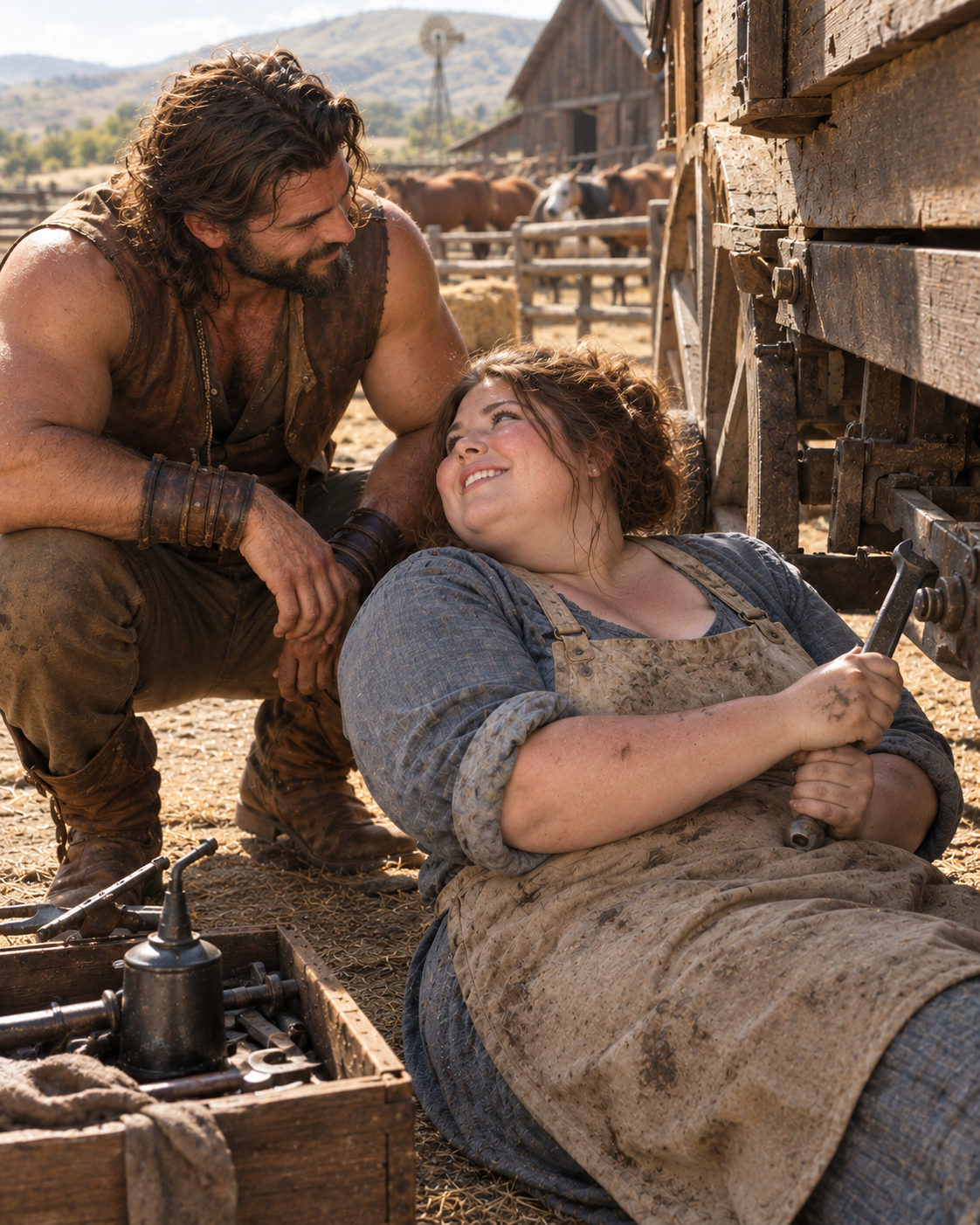
For several seconds, neither of us spoke.
Then a voice came from the ridge.
“Mrs. Whitaker.”
I looked up.
Three men stood among the pines.
The middle one stepped forward.
Even through the falling snow, I recognized him.
Elias Vane.
The man who had dismissed me after my husband’s death.
The man who had called my repairs foolish.
The man whose messenger had appeared at the freight yard the day before.
He smiled.
“You were always more trouble than your husband.”
Silas raised his rifle.
Vane laughed.
“Shoot me and the medicine never reaches Red Creek.”
I stared at him.
“What did you do?”
“I gave you a choice.”
“What choice?”
“Turn around.”
“No.”
His smile disappeared.
“You really are your husband’s widow.”
“I’ll take that as a compliment.”
Vane lifted one hand.
The men behind him disappeared into the trees.
Then he called down.
“You don’t understand what is waiting beyond the pass.”
“I understand sabotage.”
“You understand machinery.”
He pointed toward the wagon.
“But you don’t understand men.”
He turned away.
“Keep driving, Mrs. Whitaker. Let’s see which one kills you first.”
Silas waited until the men vanished.
“Now do you believe me?”
“I believed you when the first bullet came.”
We climbed back onto the wagon.
But something had changed.
Vane had not tried to kill us.
Not yet.
He wanted us to continue.
That meant the wagon itself was still part of his plan.
I looked at the road ahead.
“Stop the wagon.”
Silas frowned.
“We just got moving.”
“That’s exactly why.”
I climbed down and opened the tool chest.
The horses shifted nervously behind me.
I pulled out a wrench.
“What are you doing?”
“Checking every wheel again.”
“We don’t have time.”
“If Vane wants us moving, then something is waiting for us ahead.”
Silas watched me work.
One bolt.
Then another.
I checked the brake linkage, the wheel hubs, the axle pins.
Nothing.
I crawled beneath the wagon.
Nothing.
I was about to emerge when my hand touched something cold and smooth against the underside of the wooden frame.
I stopped breathing.
A metal cylinder had been bolted between two crossbeams.
It was not part of the wagon.
I loosened it carefully.
Silas knelt beside me.
“What is that?”
I wiped the snow from the cylinder.
A thin wire ran from it toward the rear axle.
I understood immediately.
“It isn’t meant to break the wagon.”
“What is it?”
“A trigger.”
“For what?”
I looked at the cargo.
“For whatever they’ve hidden inside.”
We opened the wagon.
Flour sacks filled the front.
Blankets were stacked along the sides.
Medicine crates were secured beneath the canvas.
Coal occupied the rear.
Everything appeared ordinary.
Then I remembered something.
At the freight yard, Silas had told me the cargo had been loaded before he arrived.
I pulled open a medicine crate.
Bottles.
Bandages.
Tin boxes.
Nothing.
The next crate contained blankets.
The third contained coal.
I picked up a piece of coal.
It was strangely heavy.
I struck it against the wagon floor.
It split.
Inside was a small hollow chamber.
And inside that chamber was gunpowder.
Silas went pale.
“How much?”
“Enough.”
“To do what?”
I looked at the wagon.
“To turn this entire pass into a grave.”
We worked quickly.
Every sack.
Every crate.
Every piece of coal.
Hidden among the legitimate supplies were dozens of small charges.
They were designed to ignite when the metal cylinder beneath the wagon was triggered.
I held one of the charges in my palm.
There was a marking scratched into its side.
W.
Silas swore under his breath.
“They’re going to blame the explosion on the wagon.”
“No.”
I shook my head.
“They’re going to blame it on me.”
He stared at me.
“Why?”
“Because everyone knows I repaired it.”
The realization settled between us.
The sabotage at the axle.
The cracked hub.
The brake wire.
The explosives.
Each one had been designed to create a chain of failures.
If the wagon crashed, they could say my repairs were defective.
If the wagon exploded, they could say I had tampered with the cargo.
And if anyone survived, there would be a widow mechanic with grease on her hands standing beside the wreckage.
A perfect scapegoat.
Silas looked toward the ridge.
“Vane planned all of it.”
“Yes.”
“Why?”
I thought about the letter from my former employer.
The messenger.
The clean gloves.
The black grease beneath his fingernails.
Then I remembered something Vane had said.
The medicine never reaches Red Creek.
I looked at the cargo again.
“These supplies aren’t the reason he wants the wagon destroyed.”
“What is?”
I opened the final coal crate.
Beneath the coal was a narrow wooden box.
Inside were documents.
Ledgers.
Shipping records.
Names.
Payments.
Railway contracts.
Bribes.
Dates.
Amounts.
And beside every payment was the same small mark.
W.
Silas read the first page.
“Dear God.”
“What?”
He handed it to me.
The records showed that Vane had been stealing supplies from the government freight lines for years.
Flour.
Coal.
Medicine.
Blankets.
Anything that could disappear without immediate suspicion.
But that was only the beginning.
The final pages contained the names of officials who had been paid to ignore the shortages.
At the bottom was a list of shipments scheduled for destruction.
Silas looked at me.
“Blackwater Pass.”
I nodded.
“They weren’t just going to kill us.”
“They were going to destroy the evidence.”
“And blame the missing supplies on the storm.”
A branch cracked behind us.
Silas spun around.
A rifle fired.
He jerked backward.
“Silas!”
He fell against the wagon.
Blood spread across his coat.
I caught him before he hit the ground.
The shooter disappeared into the trees.
I pressed my hand against his shoulder.
“Where were you hit?”
He gritted his teeth.
“Just a graze.”
“That’s not a graze.”
“It missed the bone.”
“You’re bleeding through your coat.”
“I’ll survive.”
I looked at him.
“You’d better.”
For the first time since we entered the pass, he smiled.
“Was that concern?”
“Don’t flatter yourself.”
I tore a strip from my undershirt and wrapped his shoulder.
Then I heard it.
Three knocks.
Metal against metal.
The signal.
But this time it wasn’t coming from the trees.
It was coming from beneath the wagon.
I froze.
Silas stared at me.
“What?”
“The trigger.”
I crawled underneath.
The cylinder was vibrating.
Someone had activated it remotely.
A thin line of smoke curled from one end.
“We have minutes.”
“How many?”
“I don’t know.”
Silas pushed himself upright.
“Then we move.”
“No.”
He looked at me.
“We can’t drive this thing.”
“Why not?”
“Because if the trigger is connected to the wheel mechanism, movement may ignite it.”
“Then what do we do?”
I looked at the cliffside.
There was an abandoned mining tunnel cut into the rock about fifty yards away.
“If I can get the explosives out, we can save the cargo.”
“And if you can’t?”
I met his eyes.
“Then you drive without me.”
He grabbed my wrist.
“No.”
“Silas—”
“No.”
“You’ll die.”
“So will you.”
His voice was quiet.
“But I’m not leaving you behind.”
Something in his expression made me forget the cold.
For three years, I had lived as though surviving were the same thing as living.
I had repaired broken wagons.
Paid debts.
Kept a roof over my head.
Learned how to sleep without hearing my husband’s final breath.
I had convinced myself that needing nobody was strength.
Now a wounded man was holding my wrist as if letting go would be more dangerous than the explosives beneath us.
I pulled free.
“Then help me.”
We began unloading the charges.
One at a time.
Carefully.
Slowly.
The snow muffled every sound.
But somewhere above us, men were watching.
We carried the charges toward the abandoned tunnel.
Silas limped behind me.
Halfway there, the horses suddenly screamed.
I turned.
A figure stood beside the wagon.
The messenger.
He held a lantern in one hand.
In the other was a burning match.
“Drop it!”
He smiled.
“You should have listened.”
He threw the match.
I lunged.
The flame fell toward the wagon.
Silas fired.
The messenger collapsed into the snow.
The match landed inches from a powder charge.
I kicked it away.
The wind extinguished the flame.
Silas lowered his rifle.
“That was close.”
“Too close.”
Then I saw movement behind the messenger.
Vane stepped from the trees.
He was holding a pistol against the head of one of the horses.
“Put down your rifle, Mr. Boon.”
Silas slowly lowered it.
Vane looked at me.
“You should have walked away at the freight yard.”
“I tried.”
“No.”
He shook his head.
“You chose to become difficult.”
“You killed my husband?”
Vane’s expression changed.
Only slightly.
But I saw it.
A flicker.
Not guilt.
Recognition.
“You remember that winter?”
“I remember every second.”
“Your husband found the ledgers.”
My heart stopped.
“He found these?”
“Yes.”
“He knew?”
“He knew enough.”
“What happened to him?”
Vane sighed.
“Your husband was stubborn.”
Silas took one step forward.
Vane cocked the pistol.
“Don’t.”
I stepped between them.
“You killed him.”
“I didn’t push the wagon.”
The words struck harder than a confession.
“You sabotaged it.”
“I gave him a warning.”
“You filed the axle pin.”
“He refused to stop.”
“And the wheel?”
“An unfortunate consequence.”
My hands began to shake.
Vane smiled.
“But you survived.”
I stared at him.
“No.”
His smile faded.
“You made a mistake.”
“What mistake?”
“You thought surviving meant I was broken.”
For the first time, I saw fear in his eyes.
Only a little.
But it was there.
I raised the wooden box of documents.
“You need these.”
Vane’s eyes locked onto them.
“Yes.”
“You want them destroyed.”
“Yes.”
“Then come get them.”
He stepped forward.
I threw the box into the snow.
He lunged.
I kicked the nearest powder charge beneath the wagon.
The metal cylinder sparked.
Vane stopped.
Silas understood immediately.
“Move!”
We ran.
The explosion came seconds later.
The wagon lifted from the ground.
Fire swallowed the rear wheels.
Snow erupted into the air.
The blast threw Vane backward.
I hit the ground hard.
For several seconds, there was nothing but ringing in my ears.
Then I heard horses.
Then shouting.
Then another explosion.
The cargo wagon collapsed in flames.
But the explosives we had removed were safely inside the mining tunnel.
The documents lay scattered across the snow.
Vane crawled toward them.
I reached them first.
He raised his pistol.
Silas stepped between us.
Vane fired.
Silas fell.
I screamed.
Then something struck Vane from behind.
The messenger, bleeding from his shoulder, had risen.
He tackled his employer into the snow.
The pistol flew away.
The two men fought beside the burning wagon.
I grabbed it.
The gun was cold in my hand.
I pointed it at Vane.
“Stop.”
They froze.
Vane looked at the weapon.
Then at me.
“You won’t shoot.”
“No.”
I lowered the barrel slightly.
“But I don’t need to.”
Behind him, through the smoke, came the sound of bells.
Horses.
Many horses.
A rescue party emerged through the pass.
At its front rode the county marshal and six men from Red Creek.
Silas had managed to fire a signal shot before the first explosion.
They had followed the trail of smoke.
The marshal dismounted.
“What happened here?”
I held up the ledger.
“Ask him.”
Vane stared at me with hatred.
“You think this proves anything?”
I opened the book.
“Every payment has a date.”
I held up another page.
“Every stolen shipment has a destination.”
I held up the final page.
“And every man you paid is named.”
The marshal took the ledger.
His face changed as he read.
The messenger tried to run.
Two deputies caught him before he reached the trees.
Vane was handcuffed in the snow.
He looked at me one last time.
“You’ll regret this.”
I looked at the burning wagon.
At the horses.
At Silas lying in the snow.
At the pass that had nearly become our grave.
“No.”
I shook my head.
“I regret that I didn’t find the truth sooner.”
The marshal helped carry Silas down the mountain.
We reached Red Creek after dark.
The town gathered around the infirmary.
The supplies that had survived the explosion were unloaded.
The medicine was counted.
The blankets were distributed.
The coal was stored.
No one spoke about the cold anymore.
They were simply grateful to have something to burn.
Silas survived.
The bullet had passed through the flesh of his shoulder without damaging the bone.
The doctor told him he would be driving again within a few weeks.
Silas said he intended to be driving tomorrow.
The doctor threatened to tie him to the bed.
For the first time in three years, I laughed.
A real laugh.
It startled me.
Silas looked at me from his bed.
“There it is.”
“What?”
“That sound.”
I smiled.
“I’ve laughed before.”
“Not like that.”
I looked down.
He reached for my hand.
I let him take it.
Outside, snow continued to fall.
But it no longer looked like a graveyard.
It looked clean.
New.
Almost hopeful.
The investigation lasted for months.
Vane’s ledgers exposed a network far larger than anyone in Red Creek had imagined.
Men who had seemed respectable were forced to answer questions.
Freight companies were audited.
Repair records were reviewed.
The story of my husband’s death was reopened.
They discovered that the axle had indeed been filed.
They discovered the same black grease on tools belonging to one of Vane’s men.
And they discovered something else.
My husband had hidden a note inside an old repair manual.
It had been overlooked for three winters.
The marshal gave it to me.
My hands trembled as I unfolded the paper.
There were only a few words.
If anything happens to me, don’t let them convince you that you are only a widow.
You know how to fix what is broken.
I read it twice.
Then a third time.
I cried so quietly that nobody noticed.
Except Silas.
He stood beside me without speaking.
I pressed the note against my chest.
For years, I had thought my husband’s death was the moment my life had ended.
I had mistaken grief for an ending.
It was only a wound.
And wounds, like broken axles, could be repaired.
Not perfectly.
Not so that the damage disappeared.
But enough to carry something forward.
That spring, the freight yard reopened.
I rented the old repair shed at the edge of town.
Above the door, I hung a new sign.
Whitaker Wagon Works.
The first morning I opened it, three men stood outside laughing.
One of them said,
“Women don’t belong under wagons.”
I looked at the broken wheel they had brought.
“Then you can carry it home.”
They stopped laughing.
Silas, leaning against the doorway, grinned.
The next week, I had more customers than I could handle.
Widows came asking if I could teach them.
Young men came because they wanted to learn.
Farmers came because they had finally discovered that a person with grease beneath her fingernails could also be the person who kept their families fed.
I taught anyone willing to listen.
Not because I wanted to prove men wrong.
Not anymore.
I taught because knowledge should not die with the person who first gave it to you.
Months later, Silas and I returned to Blackwater Pass.
The snow had melted.
Wild grass had begun pushing through the ground where the wagon had burned.
He stopped beside the cliff.
“You ever think about that day?”
“Every day.”
“Regret coming?”
I looked at him.
“No.”
“Even after everything?”
I watched sunlight move across the mountains.
“I regret what happened to my husband.”
My voice softened.
“But I don’t regret what his death taught me.”
Silas waited.
I touched the old brass button I had kept from the snare.
“What did it teach you?”
“That broken things aren’t useless.”
He smiled.
“And?”
“That being afraid doesn’t mean you have to turn around.”
He nodded.
“And one more thing.”
“What?”
I looked toward the road winding through the mountains.
“No one should have to earn the right to save their own life.”
We stood there in silence.
The same pass that had once felt like a tomb now stretched beneath the morning sun.
I thought about the three knocks.
The signal my husband had taught me.
For years, I had believed it belonged to the past.
But perhaps that was never what it meant.
Perhaps it was never a call from the dead.
Perhaps it was a reminder from the living.
Listen.
Pay attention.
Answer when someone calls.
And never let another person convince you that your hands are too small to hold the tools that can change your life.
Silas started down the trail.
I followed.
Behind us, the mountain kept its secrets.
Ahead of us, the road opened into sunlight.
And for the first time since my husband died, I did not feel as though I was walking away from him.
I felt as though I was carrying something he had left behind.
Not his sorrow.
Not his unfinished grief.
His courage.
His knowledge.
His belief that a broken thing could still be made useful.
The road home was long.
It always had been.
But I had learned something at Blackwater Pass that no sabotage, no gunman, and no powerful man could ever take from me.
Sometimes the strongest way to honor the people we lose is not to remain trapped in the place where we lost them.
Sometimes we honor them by rebuilding.
By learning.
By standing up.
By taking the tools they placed in our hands and using them to build a future they never got to see.
And sometimes, when the road ahead is covered in snow and every direction looks dangerous, the bravest thing a person can do is simply keep driving.
THE END.