After Three Winters of Rejection, She Finally Stopped Waiting for Him—And That Was the Moment He Realized He Could Lose Her
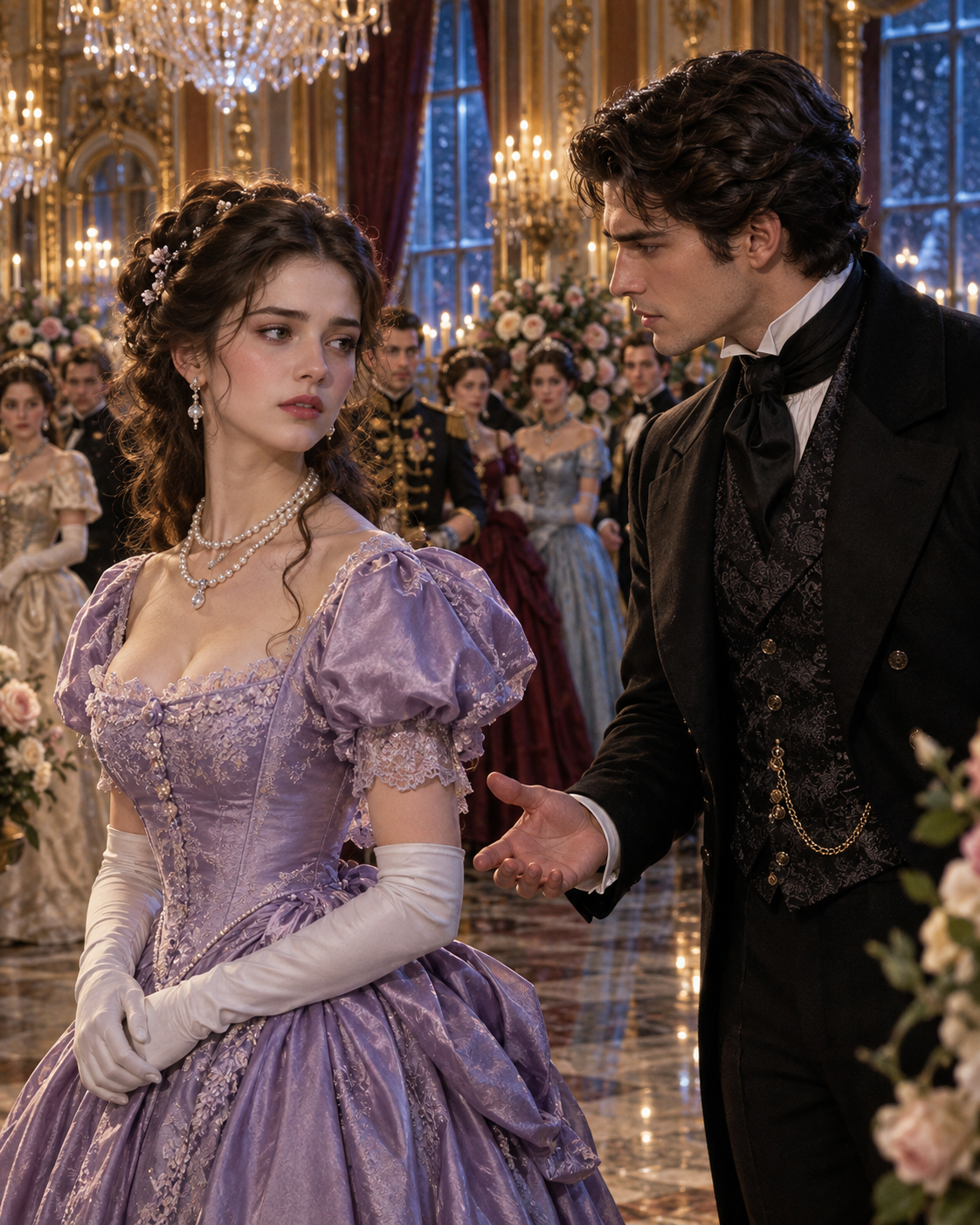
By the time the orchestra finished the first measure of the waltz, Alistair was already standing before Evelyn.
For one suspended moment, the noise of the ballroom seemed to disappear.
The chandeliers of the Manhattan mansion glittered overhead. Beyond the tall windows, snow drifted across Fifth Avenue, settling softly on the black roofs of waiting automobiles. The room smelled of winter roses, beeswax, expensive perfume, and the faint smoke of the fireplaces burning along the walls.
Evelyn looked at him without surprise.
That was what unsettled him most.
Three years ago, she would have lowered her eyes. Two years ago, she might have smiled nervously. Last winter, she would have looked almost painfully hopeful.
Now there was only composure.
“Lady Evelyn,” Alistair said quietly.
“Your Grace.”
His throat tightened at the formality.
He had spent three winters creating that distance between them.
Now he discovered how difficult it was to cross.
“May I have this dance?”
A murmur seemed to pass through the nearby guests.
Evelyn glanced toward the dance floor, then back at him.
“I believe you may be too late.”
Alistair felt the words more sharply than he expected.
“I understand.”
“No,” she said softly. “I don’t think you do.”
The orchestra continued playing.
Across the room, Lord Nathaniel Vale stood beside one of the marble columns. He did not interfere. He simply watched Evelyn with the patient respect he had shown her for months.
Alistair followed her gaze.
Something unpleasant twisted in his chest.
Not anger.
Not jealousy alone.
Fear.
He suddenly realized that Nathaniel was not merely another gentleman asking Evelyn for dances.
He was a man who had been present while Alistair was absent.
A man who had seen the woman Evelyn was becoming.
A man who had not required three years to recognize her worth.
Evelyn extended her hand toward Nathaniel instead.
“Lord Vale has already asked me.”
Nathaniel approached.
“Shall we?”
“Yes.”
As Evelyn walked away, Alistair remained where he was.
The orchestra played on.
For the first time in three winters, he was the one standing alone.
But the humiliation was deserved.
He remembered every moment.
The first winter, when Evelyn had approached him beside a Christmas tree at the Ashcom family’s holiday reception.
The second winter, when she had waited near the ballroom after hearing that he would attend the New Year’s gala.
The third winter, when she had finally stopped approaching him altogether.
He had thought his silence was noble.
He had thought distance was protection.
He had convinced himself that a man carrying the weight of his family’s debts had no right to pull an innocent woman into the wreckage.
But he had never asked Evelyn what she wanted.
That was his first mistake.
His second had been believing she would wait forever.
Alistair left the ballroom before anyone could see the expression on his face.
Outside, the cold Manhattan air struck him immediately.
He stood on the stone steps and watched snow gather along the street.
His valet brought the automobile around.
“Home, Your Grace?”
Alistair stared toward the avenue.
“No.”
The valet waited.
“Take me to the Renford offices.”
It was nearly midnight when Alistair reached the small office his family maintained downtown.
The building was dark except for one room.
He entered and found the ledgers exactly where he had left them.
Years of debts.
Mortgages.
Unpaid obligations.
Property disputes.
Loans his father had taken before his death.
A family fortune that looked impressive from the outside but was dangerously fragile beneath the surface.
Alistair sat behind the desk.
For years, he had believed there were only two choices.
Save his family and lose Evelyn.
Or choose Evelyn and allow his family’s remaining properties to collapse.
But tonight, another possibility occurred to him.
Perhaps he had simply been afraid to look for one.
He spent the next several hours reading every document again.
By dawn, he had reached a decision.
The next morning, Alistair began selling what he could sell.
Not the Ashcom family’s property.
Not anything belonging to Evelyn.
His own unnecessary holdings.
A collection of paintings.
A townhouse he rarely used.
Several parcels of land outside the city.
Anything that could be sacrificed without destroying the future of those who depended on him.
He contacted lawyers in New York and Boston.
He renegotiated loans.
He discovered that one of his father’s largest debts had been transferred between banks so many times that its original terms were questionable.
He fought.
He negotiated.
He worked until his eyes burned.
And through all of it, he kept thinking of Evelyn.
Not as the girl who had once waited for him.
But as the woman who had walked away.
That distinction changed everything.
Meanwhile, Evelyn returned home to the Ashcom residence overlooking the Hudson.
Her mother noticed immediately that something had happened.
“You look thoughtful.”
“I am.”
“Was the gala unpleasant?”
“No.”
Evelyn removed her gloves.
“It was clarifying.”
Her mother smiled faintly.
“That sounds dangerous.”
“It may be.”
Evelyn went upstairs and opened the small desk where she kept the records of her business.
Three years earlier, she had possessed very little confidence in her own ability to build a life independent of marriage.
Now she had clients from Boston to Philadelphia.
She had invested in several properties.
She had helped organize charitable programs for working women in Manhattan.
Her name appeared in society pages not because of whom she might marry, but because of what she had accomplished.
She had not built that life to make Alistair regret losing her.
She had built it because she had finally understood that her life could not remain suspended around someone else’s decision.
That was the lesson she refused to forget.
Later that afternoon, Nathaniel arrived with a bouquet of winter roses.
Evelyn received him in the drawing room.
“I hope I’m not intruding.”
“You aren’t.”
He handed her the flowers.
“For you.”
“Thank you.”
Nathaniel looked toward the fireplace.
“About last night…”
Evelyn waited.
“I don’t want to become another reason for you to feel pressured.”
She studied him.
“You aren’t.”
“I care for you,” he said. “But I would rather know that you choose me freely than discover later that you accepted me because you were tired of waiting for someone else.”
Evelyn’s expression softened.
Nathaniel had once again done what Alistair had failed to do.
He had given her a choice.
“Thank you,” she said.
He nodded.
“I’ll leave you to your thoughts.”
After he left, Evelyn stood alone beside the window.
She admired Nathaniel.
She trusted him.
But admiration and trust were not the same as love.
And she could not pretend otherwise.
Three days later, Alistair arrived at the Ashcom residence.
The butler announced him.
Evelyn’s heart beat faster.
Not because she had been waiting.
Because she hadn’t.
She entered the drawing room and found him standing near the fireplace.
He looked exhausted.
His coat was covered with traces of snow.
“You came.”
“I did.”
“Why?”
Alistair looked at her for a long moment.
“Because I owe you the truth.”
Evelyn folded her hands.
“I’ve heard that before.”
“I know.”
He took a breath.
“For three years, I told myself that keeping away from you was an act of honor.”
She said nothing.
“My father left substantial debts when he died. Much of our family’s wealth was tied to obligations I could not immediately settle. There were people depending on me—employees, tenants, relatives, creditors. If I married you while everything was unstable, I feared I would drag you into a life you never asked for.”
Evelyn’s eyes hardened.
“So you decided for me.”
“Yes.”
The answer came without defense.
“Yes, I did.”
She looked away.
“That was cruel.”
“I know.”
“You could have told me.”
“I was ashamed.”
“And you thought silence would hurt less?”
“No.”
His voice became quieter.
“I thought silence would protect you.”
Evelyn turned back toward him.
“It protected you too.”
Alistair lowered his eyes.
“Yes.”
The admission changed the room.
For the first time, Evelyn saw no carefully constructed excuse.
Only a man confronting his own mistake.
“I was afraid,” he continued. “Afraid that if I told you the truth, you would stay because you felt obligated to help me. Afraid that you would marry me out of pity. Afraid that my family would consume the life you deserved.”
“And what happened?”
“I lost the right to ask you for anything.”
Silence followed.
Outside, the Hudson wind moved through the bare trees.
Evelyn finally said, “Why now?”
Alistair looked at her.
“Because last night I saw you refuse to wait for me.”
Her expression barely changed.
“That should have been obvious three years ago.”
“It was.”
He swallowed.
“I was simply too frightened to understand it.”
Evelyn walked toward the window.
“You saw me dancing with Nathaniel.”
“Yes.”
“And you became jealous.”
“Yes.”
“Is that why you came?”
“No.”
She turned.
“Then why?”
“Because jealousy made me realize something. I had spent years telling myself that I wanted you safe. But somewhere along the way, I stopped considering what would make you happy.”
He stepped closer.
“I don’t want you because another man wants you. I don’t want you because I suddenly discovered that other people admire you. I want you because I have always loved you, and I was too cowardly to tell you.”
Evelyn closed her eyes briefly.
The words she had once dreamed of hearing now arrived when she no longer needed them to validate her worth.
That was the cruelest part.
“Alistair,” she whispered, “I loved you once.”
His face tightened.
“Once?”
“I don’t know what I feel now.”
He nodded slowly.
“I understand.”
“I need time.”
“You shall have it.”
“And if I choose not to return your feelings?”
His answer came immediately.
“Then I will accept it.”
She studied him.
“You mean that?”
“Yes.”
“I don’t want another promise you make because you think it’s the honorable thing.”
A faint sadness crossed his face.
“This isn’t honor.”
“What is it?”
“Respect.”
For several seconds, neither spoke.
Then Alistair placed a small leather folder on the table.
“What is that?”
“Documents.”
Evelyn opened it.
Inside were records of property sales, loan negotiations, and financial agreements.
“You sold these?”
“My properties.”
“Why?”
“To settle what I could without involving you or your family.”
“You didn’t have to.”
“I know.”
He paused.
“I did it because I needed to stop using my family’s burdens as an excuse for refusing to live honestly.”
Evelyn closed the folder.
“This doesn’t change the past.”
“No.”
“It doesn’t erase three winters.”
“No.”
“And it doesn’t mean I owe you anything.”
“I know.”
He took one last look at her.
“I came here to tell you the truth, not to collect a reward for it.”
He walked toward the door.
“Alistair.”
He stopped.
She wanted to say something.
Anything.
But every word seemed too small.
Finally, she said, “Thank you for telling me.”
He nodded.
Then he left.
For the first time, Evelyn watched Alistair disappear without feeling abandoned.
That realization frightened her more than anything else.
Weeks passed.
Winter deepened across New York.
The city became a landscape of snow-covered parks, steaming sidewalks, glowing shop windows, and crowded theaters.
Evelyn continued working.
She attended charity meetings.
She visited properties.
She hosted small dinners.
She saw Nathaniel several times.
She also saw Alistair from a distance.
He did not approach her.
He did not send endless letters.
He did not attempt to manipulate society into bringing them together.
Instead, he respected the boundary he had promised to respect.
That was when Evelyn began to understand that his change was not a performance.
One afternoon, she received a letter.
There was no declaration of love.
No plea.
Only a short note explaining that one of the charitable homes Evelyn supported was facing closure because its lease was ending.
Alistair had quietly purchased the building.
He had transferred it into a charitable trust.
The letter stated that he wanted no recognition.
Evelyn stared at the page.
Her mother read over her shoulder.
“He did this for you?”
“I don’t know.”
“Perhaps.”
Evelyn shook her head.
“No. He did it because he finally learned that helping someone doesn’t mean controlling their choices.”
Her mother smiled.
“You sound as though you’ve forgiven him.”
“I haven’t decided.”
“That wasn’t what I asked.”
Evelyn looked toward the snowy garden.
“I think forgiveness and trust are two different things.”
“And love?”
Evelyn was silent.
That answer came much later.
The fourth winter reached its coldest point in February.
A charity ball was held at a grand Manhattan hotel.
Evelyn almost did not attend.
But she went.
She wore a simple silver gown.
No dramatic jewelry.
No attempt to attract attention.
She entered the ballroom and saw Nathaniel first.
He smiled.
“You came.”
“I did.”
“Would you like to dance?”
She smiled.
“I would.”
They danced once.
When the song ended, Nathaniel looked at her.
“Have you decided?”
Evelyn knew what he meant.
“Not entirely.”
He nodded.
“Then don’t decide for my sake.”
She looked at him with genuine affection.
“You’re very kind.”
“I simply don’t want to become another man asking you to choose before you’re ready.”
They stood quietly for a moment.
Then Evelyn saw Alistair.
He was standing near the far end of the ballroom.
He was not approaching.
He was not watching her possessively.
He simply stood there.
When their eyes met, he inclined his head.
She did the same.
Nothing more.
The orchestra began another waltz.
Nathaniel stepped aside.
“I think someone else has been waiting a long time.”
Evelyn looked at him.
“He isn’t waiting for me.”
“No,” Nathaniel said. “He’s waiting to see whether you come to him.”
She understood.
Nathaniel gave her a gentle smile.
“And that is different.”
Evelyn walked across the ballroom.
Alistair remained still until she stopped before him.
“May I have this dance?” she asked.
His eyes widened.
“If you are certain.”
“I am certain that I want one dance.”
He offered his hand.
She took it.
The orchestra began.
They moved slowly beneath the chandeliers.
For the first few moments, neither spoke.
Then Alistair said, “Thank you.”
“Don’t thank me yet.”
A small smile touched his face.
“I won’t.”
Evelyn looked up at him.
“I don’t know what the future will be.”
“I don’t either.”
“I may still decide that we are better apart.”
“I know.”
“And if we try again, I won’t accept silence when things become difficult.”
“You won’t have to.”
“You will tell me the truth, even when the truth is uncomfortable.”
“Yes.”
“And you will never decide what is best for me without asking me.”
Alistair’s expression softened.
“Never again.”
The music continued.
Evelyn rested her hand lightly against his shoulder.
“I can’t give you the answer you wanted three years ago.”
He looked at her.
“I don’t want the woman from three years ago.”
Her eyes searched his face.
“I want the woman standing here now.”
Something inside Evelyn finally loosened.
Not because his words were perfect.
Not because the past had disappeared.
But because he was no longer asking her to become someone else for him.
The dance ended.
They remained together beneath the fading music.
Outside, snow continued falling over Manhattan.
The city did not stop for them.
The world did not suddenly become simple.
Alistair still had debts to settle.
Evelyn still had a life she had built with her own hands.
Nathaniel would remain a respected friend, and perhaps one of the few people who had taught Evelyn what genuine freedom in affection looked like.
Nothing was magically repaired in one evening.
But something had changed.
This time, the door between Evelyn and Alistair was open.
And neither of them was forcing the other to walk through it.
Months later, Evelyn and Alistair would begin again—not with an engagement, not with a grand announcement, and not because society expected it.
They began with conversations.
Long ones.
Difficult ones.
Honest ones.
He told her about every financial problem he faced.
She told him about every ambition she had.
They disagreed.
They negotiated.
They learned.
And slowly, trust returned.
Not the fragile kind built from promises whispered beneath chandeliers.
The stronger kind built through repeated choices.
By the following winter, the Ashcom residence hosted a small gathering.
There were no reporters.
No dramatic announcement.
Only family, close friends, and a fire burning brightly against the cold.
Evelyn stood beside the window.
Alistair approached.
“Still thinking?”
“Always.”
He smiled.
“May I ask what you’re thinking about?”
She turned toward him.
“How strange it is that I once believed my life would end if you never chose me.”
His expression became serious.
“And now?”
“Now I understand something.”
“What?”
“My life was never waiting for you to choose me.”
She reached for his hand.
“It was waiting for me to choose myself.”
Alistair held her hand gently.
“And what did you choose?”
Evelyn smiled.
“I chose a life where love is welcome, but never required for me to know my worth.”
He nodded.
“That sounds like a good life.”
“It is.”
She paused.
“And perhaps there is room for you in it.”
Alistair’s eyes softened.
“Perhaps?”
She laughed quietly.
“Don’t become greedy.”
“I wouldn’t dare.”
Outside, another winter had arrived over New York.
Snow covered the streets.
Lights glowed from the windows of Manhattan homes.
The city moved forward, just as it always had.
And so did Evelyn.
The difference was that this time, she was not walking toward a future someone else had chosen for her.
She was walking toward one she had chosen herself.
Alistair had finally learned the lesson he should have understood years earlier: love cannot be protected by silence, and devotion cannot be proven by deciding another person’s future for them.
Sometimes the bravest thing two people can do is speak the truth and then leave each other free to choose.
Because real love does not ask, “Will you wait for me?”
It asks, “What do you want—and how can I respect your answer?”
And that was where Evelyn and Alistair’s story truly began.
The following spring arrived quietly in New York.
Snow disappeared from the sidewalks, the Hudson lost its winter-gray appearance, and the first signs of green returned to the parks along the river. For Evelyn, the changing season felt strangely symbolic.
For years, she had measured her life in winters.
The first winter she had hoped.
The second winter she had waited.
The third winter she had finally let go.
The fourth winter had brought Alistair back to her—not as the distant duke who believed silence was noble, but as a man finally willing to tell the truth and accept whatever answer she chose.
Yet Evelyn knew that one honest conversation could not erase three years of hurt.
She had forgiven him.
Trust, however, had to be rebuilt.
And Alistair understood that.
He did not rush her.
Instead, he began showing her through ordinary things that his promises were real.
When Evelyn had a business meeting in lower Manhattan, he never appeared unexpectedly at her side.
When she declined an invitation, he accepted her answer without asking why.
When she spoke about expanding her charitable work, he listened rather than immediately offering money or solutions.
And when she disagreed with him, he no longer mistook disagreement for rejection.
That last lesson proved the hardest.
One afternoon, they were sitting in the library at the Ashcom residence, reviewing plans for a charitable housing project.
“I don’t like this arrangement,” Evelyn said.
Alistair looked up from the papers.
“Why?”
“You’ve assumed I want the project organized through your family’s foundation.”
“I thought it would make the financing easier.”
“It might. But I want control over the project.”
He was silent for a moment.
Then he nodded.
“All right.”
Evelyn raised an eyebrow.
“That easily?”
“You’re right.”
She smiled faintly.
“You’ve changed.”
“I am trying.”
The answer was simple.
And somehow, that meant more to her than another grand declaration would have.
Months passed.
Their relationship became something neither of them had expected.
It was quieter than the romance society had imagined.
There were no dramatic midnight carriage rides through Manhattan or whispered promises designed for gossip columns.
There were breakfasts together.
Long walks.
Letters when they were apart.
Arguments followed by apologies.
Small acts of consideration that no newspaper would ever find interesting.
But Evelyn found them meaningful.
She began to understand that love was not always the moment when the orchestra swelled and the entire room seemed to disappear.
Sometimes love was a man remembering that she preferred the seat beside the window.
Sometimes it was a woman asking about a problem she knew he was reluctant to discuss.
Sometimes it was simply staying when the conversation became difficult.
Then, one morning in late summer, Alistair received unexpected news.
One of the largest creditors connected to his father’s old debts had filed a new claim.
The amount was substantial enough to threaten several of the properties he had spent months protecting.
Alistair read the letter twice.
His old instinct returned immediately.
Hide it.
Handle it alone.
Protect Evelyn from the burden.
He stood from his desk and nearly walked out of the room.
Then he stopped.
For three years, this instinct had governed his life.
He had told himself that secrecy was protection.
He had learned where that road led.
So instead of closing the letter inside his desk, he went directly to Evelyn.
She was in the garden.
“Something happened,” he said.
She looked at him.
“What is it?”
He handed her the letter.
She read it carefully.
“This is serious.”
“Yes.”
“What are you going to do?”
“I don’t know yet.”
She folded the paper.
“Good.”
He looked confused.
“Good?”
“Yes.”
“Why?”
“Because for once, you told me before deciding everything by yourself.”
A reluctant smile appeared on his face.
“I almost didn’t.”
“But you did.”
He nodded.
They sat beneath an old oak tree and discussed the matter for hours.
Evelyn offered ideas.
Alistair explained the risks.
They disagreed over several possibilities.
But when they finally stood, they had a plan.
Not his plan.
Not hers.
Theirs.
It was a small distinction.
But to Evelyn, it represented the entire difference between the man he had been and the man he was becoming.
The legal dispute lasted months.
There were meetings in Boston, negotiations in New York, and long nights reviewing documents.
Eventually, the claim was settled without destroying the Renford estate.
Alistair retained much of what remained of his family’s property, but more importantly, he no longer carried the burden alone.
When the matter finally ended, he returned to New York exhausted.
Evelyn met him at the station.
“You look terrible.”
He laughed.
“That’s a warm welcome.”
“You know what I mean.”
“I do.”
She took his hand.
“Come home.”
He looked at her.
The word struck him.
Home.
For years, he had believed home was a responsibility.
A property.
A family name.
A collection of obligations inherited from people who had come before him.
Now he understood that home could also be a person who knew the truth about you and still chose to stand beside you.
But Evelyn had one more decision to make.
She had spent months wondering whether she could truly trust the future with Alistair.
One evening, they walked along the Hudson as the sun disappeared behind the city.
“I need to tell you something,” she said.
Alistair stopped.
She turned toward him.
“When you first came back, I thought I wanted an apology.”
“You deserved one.”
“I did.”
She smiled.
“But I discovered that an apology wasn’t enough.”
“I know.”
“I needed to see what you would do after the apology.”
He waited.
“And I have.”
His expression changed.
“Evelyn…”
“I love you.”
He stared at her.
She laughed softly.
“You look surprised.”
“I’ve imagined hearing those words so many times that I forgot what they might feel like if they actually came.”
She squeezed his hand.
“But I don’t want the kind of love we imagined before.”
“What kind do you want?”
“The kind where neither of us disappears inside the other person’s life.”
Alistair nodded.
“I want that too.”
She looked toward Manhattan.
“I want to keep my work.”
“You will.”
“I want my own opinions.”
“I would be disappointed if you didn’t.”
“I want you to tell me when you’re afraid.”
He smiled.
“That may be difficult.”
“Then practice.”
He laughed.
“I will.”
She turned back toward him.
“And I want you to remember that I chose this.”
His voice softened.
“I will remember every day.”
Their engagement was announced quietly several weeks later.
Society, of course, was fascinated.
The same people who had once whispered about Evelyn’s three winters of disappointment now whispered about her unexpected reconciliation with the Duke of Renford.
Some called it romantic.
Others wondered whether she had finally surrendered.
Evelyn found the gossip almost amusing.
She knew better.
She had not surrendered.
She had chosen.
There was a difference.
The wedding took place the following autumn at a small church outside Manhattan.
There were no extravagant displays.
The ceremony was attended by family and a handful of close friends.
Nathaniel Vale was there.
Before the ceremony, he approached Evelyn privately.
“You look happy.”
“I am.”
“I hoped you would be.”
She smiled.
“I never wanted you to feel guilty.”
“I don’t.”
He looked toward the church doors.
“You know, three years ago, I thought winning someone’s heart meant being the person who waited long enough.”
Evelyn shook her head.
“And now?”
“Now I think it means wanting their happiness even when the answer isn’t you.”
She touched his arm.
“You’re a good man, Nathaniel.”
“And you’re a very difficult woman.”
She laughed.
“I’ve been told.”
He smiled.
“Go.”
She walked toward the church.
Inside, Alistair stood waiting.
When he saw her, he did not see the young woman from three winters ago.
He saw the woman who had survived disappointment without allowing it to define her.
The woman who had built a life.
The woman who had refused to confuse being chosen with being valuable.
And he knew that whatever happened after that moment, he would never again take her freedom for granted.
When Evelyn reached him, he took her hand.
“You’re certain?”
She smiled.
“I wouldn’t be here otherwise.”
The ceremony was simple.
Their vows were not promises of perfect happiness.
They promised honesty.
Respect.
Patience.
The courage to speak when silence would be easier.
And when they walked outside after the ceremony, autumn leaves moved across the churchyard in the wind.
Alistair leaned toward her.
“Do you remember our first winter?”
“Yes.”
“I wish I could change it.”
Evelyn looked at him.
“I don’t.”
He seemed surprised.
“You don’t?”
“No.”
“Why?”
“Because if you had chosen me then, I might never have learned to choose myself.”
He was quiet.
She continued.
“The pain was real. I won’t pretend it wasn’t. But I became someone stronger because I stopped waiting for someone else to decide my future.”
Alistair kissed her hand.
“Then perhaps I should be grateful you refused to become the woman I once expected you to be.”
“You should.”
They laughed.
Years later, Evelyn would sometimes walk through Manhattan during the first snowfall of winter.
Whenever snow began covering Fifth Avenue, she remembered those three winters.
She remembered the ballroom doors.
The unanswered glances.
The cold rejection.
The loneliness.
And she remembered the fourth winter, when everything changed.
Not because a duke finally decided she was worth pursuing.
But because Evelyn had already decided she was worth pursuing herself.
That became the story she told younger women who asked about her marriage.
They expected a tale about a proud duke who realized too late that he loved the woman he had rejected.
Instead, Evelyn told them something different.
“Never mistake someone’s hesitation for a measurement of your worth.”
She would pause, then smile.
“People can be afraid. People can make mistakes. People can love you badly before they learn how to love you properly. But none of those things determine what you deserve.”
And perhaps that was the real meaning of her story.
Alistair’s greatest mistake had not been falling in love too late.
It had been believing that love gave him the right to decide what another person should endure.
Evelyn’s greatest victory had not been making him regret losing her.
It had been building a life that remained valuable even if he never returned.
Their eventual happiness came only after both understood that distinction.
Because love is not a rescue mission.
It is not a debt.
It is not a reward for patience.
And it is certainly not something one person should have to earn by waiting silently.
Love, at its healthiest, is a choice made freely by two people who already know they can stand on their own.
That was why Evelyn could finally take Alistair’s hand without fear.
She did not need him to complete her story.
She wanted him to share it.
And Alistair, at last, understood that being worthy of her did not mean possessing her future.
It meant respecting it.
So when the first snow of another winter began falling over New York, Evelyn stood beside him at the window of their home.
Alistair watched the flakes descend.
“Another winter.”
She smiled.
“Yes.”
“Do you still hate them?”
She thought for a moment.
“No.”
“Why not?”
“Because now I remember what happened after them.”
He turned toward her.
“What happened?”
She slipped her hand into his.
“I stopped waiting.”
He smiled.
“And then?”
“I started living.”
Outside, Manhattan continued beneath the snow.
The city lights reflected against the white streets.
Somewhere far beyond the window, another ballroom was preparing for another winter celebration.
Music would play.
People would dance.
Someone would wait for someone else to make the first move.
But Evelyn no longer believed that a person’s life should be measured by who walked toward them.
Sometimes the most important step was the one taken in the opposite direction.
The step away from waiting.
Away from fear.
Away from the belief that someone else’s decision determines your value.
And sometimes, after you finally choose yourself, the person who once walked away may return.
If they do, you can listen.
You can forgive.
You can love again.
But the choice remains yours.
Always yours.
That was the lesson Evelyn carried through every winter that followed.
And it was the reason her love story with Alistair finally had a happy ending—not because he came back for her, but because when he did, she was strong enough to decide whether she wanted him back.