A Widow Was Stranded on a Frozen Montana Trail—Then a Silent Rancher Offered Her a Ride, and She Found Something in His Ledger No One Was Supposed to See
The door opened before Ethan reached it.
A gust of Montana cold swept through the room, carrying a scatter of snow over the threshold. One of the ranch hands stood outside with his hat pulled low and his shoulders dusted white.
“Sorry, boss,” he said. “Thought I saw the lamp. Clara left something in the tack room when she came by. She sent me back for it before the weather gets worse.”
Ethan’s hand, which had hovered near the edge of the table, relaxed.
Rose did not.
For one sharp second, she had imagined that whoever had altered the accounts somehow knew what she had found.
That thought frightened her more than she wanted Ethan to see.
“Get what you need,” Ethan said.
The hand nodded and disappeared toward the barn.
Ethan shut the door, slid the wooden bar into place, and turned back toward Rose.
“You were asking about that signature.”
Rose looked down at the receipt beneath her fingers.
“Yes.”
The transaction appeared ordinary at first glance: payment for fencing wire and winter feed, forty dollars more than the supplier’s original invoice. The altered total had been entered in the ranch ledger in the same heavy hand as several other expenses.
But the receipt attached to it had been signed twice.
Once by the merchant.
Once by someone acknowledging payment on Ethan’s behalf.
Rose tapped the second name.
“You told me you never authorized anyone to settle accounts for you.”
“I didn’t.”
“Then why is your name written here?”
Ethan leaned closer.
The signature read E. Blackwood.
For a long moment, he said nothing.
Rose watched his face harden.
“That isn’t mine.”
“I know.”
His eyes moved to her.
“You know?”
“You form the B differently.”
Ethan almost looked amused despite himself. “You’ve studied my handwriting?”
“I’ve spent three days organizing your records. Your handwriting has been attacking me from every direction.”
That earned the faintest movement at the corner of his mouth.
Then Rose placed two more receipts beside the first.
“Here. And here.”
Both carried the same false signature.
The amounts were small enough to disappear inside larger purchases: eleven dollars on a shipment of flour, eighteen on horseshoes, twenty-three on lamp oil and tools. No single entry would ruin a ranch.
Together, they formed a pattern.
Someone had been shaving money from Blackwood Ranch for months.
Perhaps longer.
Ethan pulled out a chair and sat.
He looked less angry than Rose expected.
He looked disappointed.
That troubled her more.
“You know who did it,” she said.
“I know who had access.”
“Who?”
His jaw tightened.
“My freight agent in town. Walter Pike.”
Rose remembered the name. She had seen it on older invoices, freight receipts, and supply orders. Pike arranged shipments whenever Ethan was away hauling freight or moving cattle. His handwriting appeared everywhere.
More importantly, he had often been the man standing between Ethan and the merchants who supplied the ranch.
“Does he owe you money?” Rose asked.
“No.”
“Does he gamble?”
“I don’t know.”
“Drink?”
“Most men in town do.”
“That wasn’t my question.”
Ethan studied her for a moment. “Sometimes.”
Rose gathered the papers.
“Then we don’t accuse him yet.”
Ethan’s brows drew together. “He forged my name.”
“And if you ride into town tomorrow calling him a thief, what happens?”
“He answers for it.”
“Or he denies it, destroys whatever records he has, tells everyone the widow staying at your ranch invented the story, and turns the whole matter into gossip before you can prove a cent.”
Ethan leaned back.
“You’ve thought about this.”
“I’ve been the subject of gossip before.”
The words came out quieter than she intended.
Ethan did not ask for details.
That was one of the things Rose had begun to value about him. He never forced open a door merely because he had noticed it was closed.
Instead he said, “What do you suggest?”
Rose looked at the table covered with receipts.
“We build a case no one can laugh away.”
For the next four days, winter closed around Blackwood Ranch.
Snow buried the lower fences and turned the road to town into a white ribbon barely distinguishable from the fields. Rose used the weather as an ally.
She went through every ledger Ethan owned.
At first, the work seemed hopeless. The ranch accounts had not been kept badly, exactly. They had been kept by a man who remembered everything important and saw no reason paper should do the same.
Receipts were tucked inside seed catalogs.
Invoices had been folded into coat pockets and later flattened beneath books.
Payments were recorded in margins.
But beneath the disorder, Rose found consistency.
Ethan paid his debts.
He did not inflate costs.
He rarely borrowed.
And wherever Walter Pike had handled a transaction alone, the numbers became less trustworthy.
Rose created columns.
Date.
Merchant.
Original charge.
Amount entered.
Difference.
Signature.
Witness.
By the fifth evening, the missing forty dollars had become one hundred and eighty-seven.
Ethan stood beside her at the kitchen table when she added the final figure.
“One hundred eighty-seven dollars,” he said.
“At least.”
“That much money has been taken?”
“That much I can prove.”
He stared at the page.
A ranch hand entering for coffee saw his expression and quietly backed out again.
Rose capped the ink bottle.
“The question is whether the merchants’ copies match ours.”
“We can find out tomorrow. Road’s clearing.”
“You should not go to Pike first.”
“I know.”
Rose lifted her eyes.
He gave her a dry look. “I listen occasionally.”
“Remarkable.”
This time he did smile.
It changed his entire face.
Rose looked down too quickly.
Something warm and dangerous moved through her chest.
She had come to Blackwood Ranch because a wheel broke.
She had stayed because the snow had made leaving difficult.
Neither explanation felt entirely true anymore.
The next morning, Ethan hitched the sleigh before sunrise.
Rose came outside wearing her dark coat and gloves.
He stopped when he saw her.
“No.”
She kept walking.
“You don’t even know what I’m going to say.”
“You’re coming to town.”
“Yes.”
“No.”
Rose reached the sleigh. “Those are my figures.”
“And Pike may realize what we’re doing.”
“Which is exactly why I should be there.”
“Rose.”
“Ethan.”
He stared at her.
She stared back.
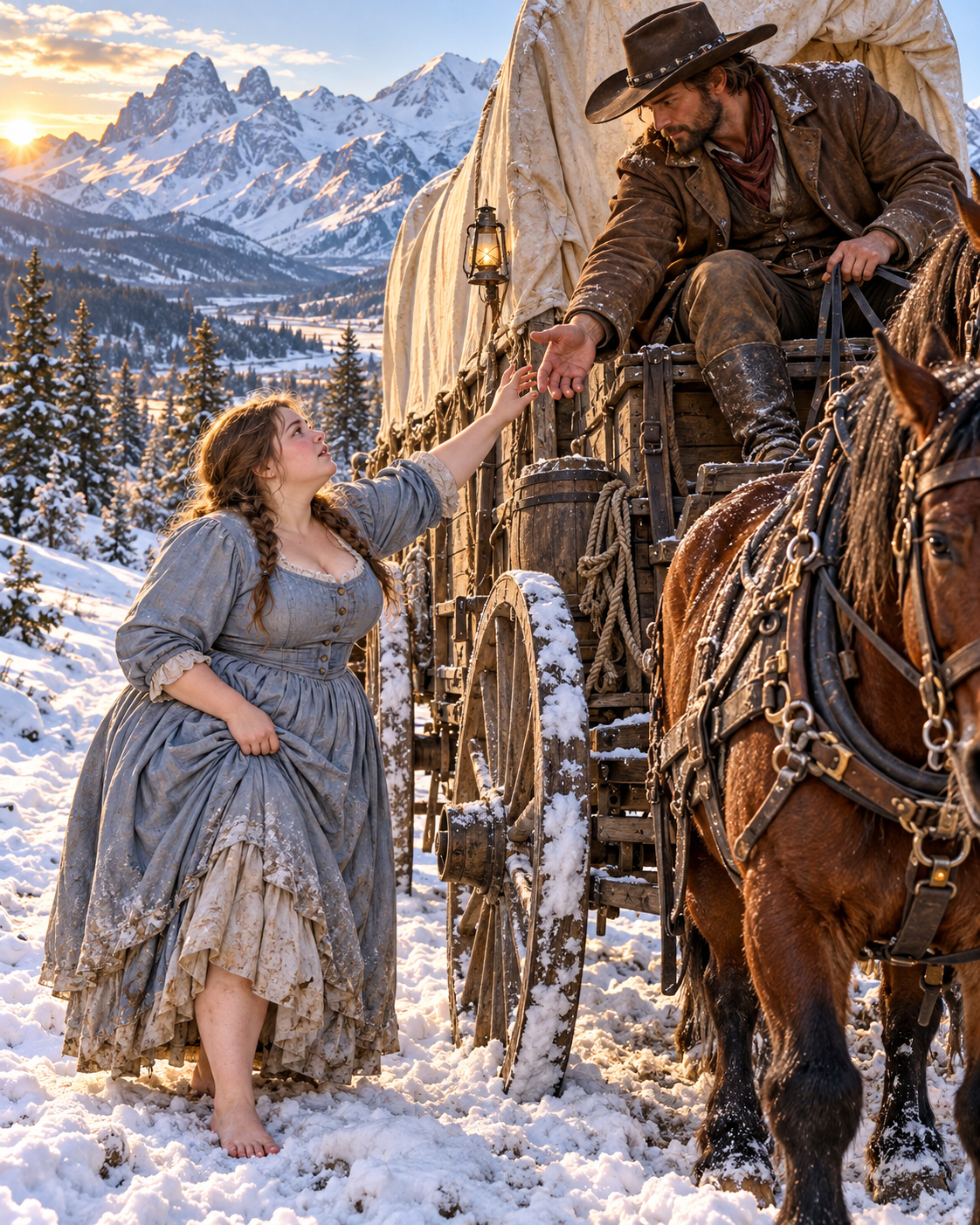
Finally he exhaled through his nose and offered his hand to help her up.
The ride to town took nearly two hours.
Montana stretched around them in white silence, broken by black pine, distant ridges, and the occasional fence line emerging from drifts. Rose sat beneath a wool blanket while Ethan drove.
Halfway there, he said, “You don’t have to prove your usefulness to stay at the ranch.”
Rose turned toward him.
The horses continued forward.
“I’m not.”
“Aren’t you?”
She wanted to deny it.
Instead she watched the road.
After her husband died, kindness had become complicated. Some people offered help because they cared. Others offered it because they wanted gratitude, obedience, or a story to repeat later.
Rose had learned to pay for every kindness with work.
It felt safer.
“I don’t like owing people,” she said.
“You don’t owe me.”
“You took me in.”
“You were freezing beside a broken wagon.”
“You fed me.”
“You’ve fed twenty men since.”
“You gave me a room.”
“You reorganized half the ranch.”
She turned toward him. “Are we keeping accounts now?”
“No.”
“Good.”
Ethan looked ahead.
“That’s what I’m trying to tell you.”
The words stayed with her until town appeared.
They visited three merchants separately.
At the general store, the owner produced a carbon copy showing a charge eleven dollars lower than Pike had entered.
At the blacksmith’s shop, another discrepancy appeared.
At the freight office, Ethan requested copies of shipping receipts under the pretense of preparing yearly accounts.
By noon, Rose’s neat list had become evidence.
Walter Pike had not merely altered Ethan’s ledger.
He had altered invoices, forged acknowledgments, and apparently pocketed the differences whenever he served as intermediary.
Then the general-store owner said something Rose had not expected.
“You’re not the first.”
Ethan went still.
“What?”
The merchant lowered his voice.
“Two ranchers south of here complained last spring. Nothing they could prove. Said shipments cost more than expected whenever Pike arranged them. Everybody figured prices had gone up.”
Rose felt the story widen beneath her feet.
“Do you have their names?” she asked.
The merchant hesitated.
Ethan said, “Please.”
He gave them two.
By late afternoon, they had spoken with both men.
One had thrown away most of his old paperwork.
The other had kept everything.
Rose sat at his dining table while he brought out a tin box filled with receipts.
Within twenty minutes, she found the same pattern.
Different ranch.
Same method.
Same freight agent.
Same convenient increases.
On the ride back toward town, Ethan was silent.
Rose knew him well enough now to recognize the signs of contained anger.
“You were right,” he finally said.
“About what?”
“Not confronting him first.”
“I’m going to remember that sentence.”
“Don’t.”
She smiled despite the tension.
But when they reached the main street, the smile vanished.
Walter Pike stood outside the freight office.
He was a broad man in a fur-lined coat, with a reddish face and the easy posture of someone who believed the street belonged partly to him.
His eyes moved from Ethan to Rose.
Then to the folder in her hands.
He smiled.
“Mrs. Bennett.”
Rose had met him only once.
The fact that he remembered her name did not reassure her.
“Mr. Pike.”
“Blackwood keeping you busy?”
Ethan stepped down from the sleigh.
“We came for records.”
“So I heard.”
The street seemed quieter.
Pike’s smile remained in place, but something behind it had changed.
“Bookkeeping, is it?” he asked Rose.
“Yes.”
“Dangerous habit. Numbers can tell a person anything if she stares at them long enough.”
“Only if someone has taught them to lie.”
The smile disappeared.
Ethan turned slightly toward her, perhaps to warn her.
Too late.
Pike looked at the folder again.
“You ought to be careful about involving yourself in another man’s business.”
Rose felt every old instinct tell her to retreat.
A widow alone learned quickly which tones meant trouble.
But she also knew what happened when men like Pike mistook silence for weakness.
“I am being careful,” she said.
“Very.”
Ethan moved between them.
“We’re done here.”
Pike’s gaze settled on him.
“Are we?”
“For today.”
They drove away without another word.
That night, someone entered the ranch office.
Rose woke to the sound of breaking glass.
She sat upright, heart hammering.
A door slammed below.
By the time she reached the hallway, Ethan was already moving through the house with a lantern in one hand.
“Stay upstairs.”
She ignored him.
The office window had been forced.
Cold air poured inside.
Drawers stood open.
Papers covered the floor.
The cabinet where Ethan kept his account books had been emptied.
Rose stopped in the doorway.
“The ledgers.”
“Gone,” Ethan said.
For one terrible moment, neither moved.
Then Ethan struck the desk with his palm.
Rose had never seen anger break through his stillness before.
“All of it,” he said. “Everything we found.”
“No.”
He turned.
Rose crossed to the kitchen.
From behind the flour bin, she pulled a cloth-wrapped packet.
Ethan stared.
Inside were her summary sheets, copied figures, merchant statements, and the three forged receipts that mattered most.
“You moved them?”
“After Pike saw the folder.”
Ethan looked at her for several seconds.
Then he laughed.
It was a short, startled sound.
Rose blinked.
“Is something funny?”
“No.”
“You’re laughing.”
“I am.”
“At a burglary?”
“At the fact that whoever broke in stole six years of badly organized ranch accounts and left behind the only papers worth taking.”
Rose tried not to laugh.
She failed.
For perhaps half a minute, standing in the cold office surrounded by broken glass and scattered paper, they laughed like two people who had briefly forgotten how much was at stake.
Then Ethan’s expression changed.
He reached toward her, stopped, and let his hand fall.
“You could have been hurt.”
“So could you.”
“This is my trouble.”
Rose’s laughter vanished.
“No. It became mine when someone broke into the house where I sleep.”
“I could send you into town.”
“You could.”
“You’d be safer.”
“Would I?”
He had no answer.
Rose stepped closer.
“Do you want me to leave?”
Ethan’s eyes met hers.
“No.”
It was the quickest answer he had ever given her.
Something inside Rose went quiet.
Not empty.
Quiet.
Like snow settling after wind.
“Then don’t disguise fear as courtesy,” she said.
His voice lowered.
“I’m not good at this.”
“At what?”
“Having someone here I’d notice losing.”
Rose forgot the broken window.
Forgot the papers.
Forgot Walter Pike.
For one breath, all she heard was the fire in the next room and the wind along the roof.
Before she could answer, one of the ranch hands called from outside.
Tracks had been found beneath the office window.
The moment closed.
But it did not disappear.
The tracks led toward the main road and vanished where a horse had been tied.
There was no proof Pike had come himself.
Rose suspected he had not.
A careful thief hired careless men.
The attempted burglary, however, gave Ethan something valuable: urgency.
The following morning, they rode to town with two ranch hands and went directly to the county office.
The deputy listened.
Then he listened again when Rose laid out the figures.
By afternoon, merchants had been questioned.
The second rancher brought his records.
A freight clerk admitted Pike sometimes instructed him to rewrite totals after invoices arrived.
By evening, the investigation no longer depended on Rose’s word.
It had become larger than Blackwood Ranch.
Pike disappeared before anyone could arrest him.
For three days, no one knew where he had gone.
Then a stage driver reported seeing him heading east.
The deputy followed.
Ethan returned home and did something Rose had not expected.
Nothing.
He did not chase Pike.
He did not make speeches in town.
He did not spend the night raging over what had been stolen.
He repaired the office window.
Fed the horses.
Checked the fences.
Paid his men.
Life continued.
Rose found him in the barn near sunset.
“You’re not angry?”
“I’m angry.”
“You don’t look angry.”
“I’ve been angry before. Never improved a fence.”
She leaned against a stall.
“You know people in town are talking.”
“They always were.”
“About me.”
“I know.”
“About us.”
He looked at her.
“Yes.”
Rose had waited for him to deny there was an “us.”
He did not.
That frightened her in an entirely different way.
“My wagon can be repaired now,” she said.
Ethan continued brushing the horse.
“I know.”
“I could leave next week.”
“I know.”
“You say that often.”
“You tell me things I already know.”
Rose frowned.
He set the brush aside.
“What do you want me to say?”
She opened her mouth.
Nothing came.
That was the problem.
She did not want him to ask her to stay out of gratitude.
She did not want protection.
She did not want pity.
And she was terrified of wanting anything more.
“I don’t know,” she admitted.
Ethan nodded.
“All right.”
She almost became angry.
“That’s all?”
“What would you prefer?”
“For once, something unreasonable.”
His expression shifted.
Rose immediately regretted the words.
Then Ethan stepped closer.
“All right.”
She waited.
His voice was quiet.
“Stay.”
Her breath caught.
“Not because of the books. Not because you cook. Not because winter’s bad or your wagon broke or because people in town need something to discuss.”
He paused.
“Stay because the house is better with you in it.”
Rose looked down.
He continued before courage could leave either of them.
“I don’t know what happens after that.”
“That isn’t much of a proposal.”
“It wasn’t meant to be one.”
She looked up sharply.
The smallest trace of humor was in his eyes.
“Ethan Blackwood.”
“Rose Bennett.”
She laughed.
Then her laughter faded.
“My husband died believing we had years ahead of us.”
Ethan’s face softened.
“I’m sorry.”
“So am I.”
She swallowed.
“I learned something after he was gone. You can build your whole life around a person and still wake up one morning with no life you recognize.”
Ethan nodded slowly.
“That’s true.”
“I don’t know if I can do that again.”
“I’m not asking you to.”
“What are you asking?”
“To have supper tomorrow.”
Rose stared at him.
“We have supper every night.”
“Then tomorrow should be easy.”
For the first time in months, perhaps years, she felt hope arrive without demanding an answer from her.
“All right,” she said.
“Tomorrow.”
Walter Pike was captured twelve days later.
The case against him grew quickly once people realized someone else had spoken first. Farmers, ranchers, freight customers, and two merchants came forward with discrepancies of their own.
Rose testified from her records.
She did not enjoy the attention.
But she discovered she could survive it.
The local paper mentioned Ethan’s recovered money, Pike’s forged signatures, and “Mrs. Rose Bennett, whose careful accounting exposed the irregularities.”
For nearly a week, strangers greeted her in town.
Clara came to the ranch two days after the article appeared.
Rose saw her carriage and braced herself.
Instead Clara entered the kitchen, removed her gloves, and placed a pie on the table.
“I owe you an apology,” she said.
Rose blinked.
“For the pie?”
“For behaving as though you had stolen something that belonged to me.”
Rose waited.
Clara smiled without much happiness.
“Ethan never belonged to me. I simply thought if I waited long enough, the town would decide he should.”
“That sounds like a strange way to court someone.”
“You’re not wrong.”
Rose almost smiled.
Clara glanced around the organized kitchen.
“He looks different.”
“Ethan?”
“Less like he’s waiting for the world to leave him alone.”
Rose did not know what to say.
Clara put on her gloves.
“Don’t let the women in town frighten you. Half of them are only angry they didn’t find his account books first.”
Rose laughed.
Clara left before Ethan returned from the north pasture.
Winter softened.
Snow withdrew from the lower fields.
Water ran beneath thinning ice.
Rose’s wagon was repaired.
For three days, it stood beside the barn ready to travel.
No one mentioned it.
On the fourth morning, Rose walked outside and found Ethan tightening a harness.
“I’ve decided what to do with the wagon.”
His hands stopped.
“All right.”
“I’m selling it.”
He looked at her.
“To whom?”
“Anyone who wants it.”
A long silence passed.
Rose tried to keep her voice steady.
“I don’t need it.”
Ethan looked toward the house and then back at her.
“You’re staying?”
“For now.”
The words were cautious.
They were also enough.
Ethan nodded once.
“For now.”
Spring arrived in Montana with mud, wind, newborn calves, and work that began before daylight.
Rose took over the ranch books officially.
Ethan paid her wages.
She insisted.
He complained.
She won.
By summer, Blackwood Ranch had a proper filing cabinet, monthly accounts, supplier comparisons, and a system so orderly that the ranch hands regarded Rose’s desk with the same respectful fear they reserved for thunderstorms.
She also planted herbs beside the kitchen.
She repaired curtains.
She taught one of the younger hands to read invoices.
And slowly, without ceremony, she stopped thinking of the guest room as temporary.
One evening in August, Ethan found her sitting on the porch with the old forty-dollar receipt.
Pike had been convicted weeks earlier.
Some of the stolen money would be recovered.
Much would not.
Ethan sat beside her.
“Why keep that?”
Rose turned the paper over.
“Because it brought me here.”
“Your broken wheel brought you here.”
“That brought me to the ranch.”
She touched the receipt.
“This made me stay long enough to understand why I wanted to.”
Ethan considered that.
“You could have stayed without solving anything.”
“I know that now.”
He looked toward the sunset.
Rose folded the paper.
“I spent a long time believing a person earns the right to belong by being useful.”
Ethan was quiet.
“And?” he asked.
“I think usefulness is good.”
“That sounds like you.”
“But it isn’t the same as belonging.”
He nodded.
“No.”
Rose looked at him.
“Belonging is when you are allowed to stay even on the days you have nothing to prove.”
Ethan’s eyes held hers.
“That sounds right.”
She smiled.
“You could contribute more to this conversation.”
“I’m listening.”
“That also sounds like you.”
He reached into his coat pocket.
Rose’s smile disappeared.
“Ethan.”
He held a small ring between his fingers.
It was simple silver, without ornament.
“I had a speech.”
“What happened to it?”
“It got worse every time I practiced.”
“Then spare us both.”
He looked almost relieved.
Rose laughed softly.
Then he became serious.
“I don’t want you to stay because you need somewhere to go.”
“I know.”
“I want you to have somewhere else you could go and choose this place anyway.”
Her eyes burned.
That, she realized, was the difference.
Not rescue.
Choice.
Not debt.
Love offered without a ledger beside it.
Ethan held out the ring.
“Rose Bennett, would you choose this place with me?”
She did not answer immediately.
Once, silence had terrified her because it seemed like the space left behind by everything she had lost.
Now it felt different.
It felt like room.
Room for memory.
Room for grief.
Room for a future that did not erase the past in order to exist.
Rose placed her hand in his.
“Yes.”
Their wedding that autumn was small.
The ranch hands scrubbed themselves into unfamiliar respectability.
Clara brought another pie and informed Ethan that Rose could still change her mind until the preacher finished.
The general-store owner supplied flowers.
Someone hung a crooked garland across the porch.
No one managed to straighten it.
Rose did not care.
Years later, the story people in town liked to tell was that Rose Bennett had saved Ethan Blackwood from a thief.
Ethan always corrected them.
“She saved my books,” he would say.
Rose would roll her eyes.
But privately, they understood the story differently.
Ethan had found Rose beside a broken wagon on a freezing road.
He had offered her shelter without demanding gratitude.
Rose had found a missing forty dollars in his accounts.
She had followed the discrepancy without asking permission to matter.
Neither event seemed large enough to change two lives.
Yet both did.
Because lives rarely turn on grand moments alone.
Sometimes they turn on a broken wheel.
A warm kitchen.
A chair offered without pity.
A number that does not add up.
A person who notices when everyone else has stopped looking.
And sometimes the greatest kindness is not rescuing someone from loneliness.
It is giving them enough safety to choose connection again.
Rose kept the original forty-dollar receipt in the ranch records for the rest of her life.
Across the top, in her precise handwriting, she eventually added one final note:
Account settled. Nothing owed.
For several years after that, the note remained exactly where Rose had written it.
Account settled. Nothing owed.
It was such a simple sentence that none of the ranch hands understood why Ethan smiled whenever he happened to see it.
Rose understood.
There had been a time when both of them measured nearly everything in debt.
Money owed.
Work owed.
Kindness owed.
Loyalty owed.
Even affection, if they were being truthful.
Rose had believed shelter must be repaid by usefulness.
Ethan had believed care was safest when it was given quietly and never asked for in return.
Marriage did not change those habits overnight.
Nothing real ever changed that easily.
During their first winter as husband and wife, Rose still rose before dawn whenever the weather turned bad, convinced that if she did not make herself useful enough, some invisible balance might tip against her.
She cooked before anyone asked.
She checked the accounts twice.
She mended clothes that did not need mending.
She kept moving until Ethan finally caught her one night standing at the kitchen table after midnight, sorting receipts by lamplight.
He leaned against the doorway.
“Rose.”
She did not look up.
“One minute.”
“You said that twenty minutes ago.”
“These freight invoices are mixed with the feed receipts.”
“They’ll still be wrong in the morning.”
“That isn’t comforting.”
“It wasn’t meant to be.”
She finally looked at him.
His hair was rumpled from sleep, and he wore the expression of a man who had been patient for longer than he intended.
“You should go back to bed,” she said.
“So should you.”
“I’m almost finished.”
“No, you’re not.”
Rose frowned.
“I know exactly how much work is left.”
“I don’t mean the papers.”
She went still.
Ethan walked to the table and rested his hand over the ledger.
“You’ve been trying to earn tomorrow since the day you came here.”
Rose’s throat tightened.
“That isn’t what I’m doing.”
“Yes, it is.”
“You sound very certain.”
“I’ve had time to study you.”
She gave him a narrow look.
“Dangerous habit.”
“Apparently.”
For a moment, neither spoke.
Then Ethan gently closed the ledger.
“You don’t have to earn breakfast.”
Rose’s eyes stung unexpectedly.
“I know.”
“Do you?”
She wanted to say yes.
Instead, she whispered, “I’m learning.”
Ethan nodded.
“So am I.”
That winter taught them more about marriage than the wedding ever had.
They learned that love did not always look like grand declarations.
Sometimes it looked like Ethan leaving coffee beside Rose’s books before sunrise.
Sometimes it looked like Rose knowing he needed silence after a hard day and not filling it because silence frightened her.
Sometimes it looked like disagreement.
Real disagreement.
The kind that proved neither person intended to disappear simply because things had become uncomfortable.
In March, they argued over a new barn roof.
Ethan wanted to delay the expense.
Rose insisted the old beams would not survive another Montana winter.
He said they could patch it.
She said patching bad timber was the financial equivalent of praying over rotten arithmetic.
They barely spoke through supper.
One of the ranch hands ate so quickly he nearly choked.
The next morning, Ethan rode into town.
Rose assumed he was angry.
He returned with lumber.
She stared at the wagon.
“You bought it?”
“Yes.”
“You said we couldn’t afford it.”
“We can.”
“You spent half of yesterday arguing that we couldn’t.”
“I was wrong.”
Rose blinked.
He began unloading boards.
“That’s all?”
“What else?”
“You’re supposed to make it difficult.”
“I did that yesterday.”
She followed him toward the barn.
“And now?”
“Now we fix the roof.”
It was one of the strangest things Rose had ever experienced.
A disagreement that ended without punishment.
No cold revenge.
No threat of abandonment.
No tally quietly added to an emotional account book.
Just two people discovering that being wrong did not make either of them unsafe.
By summer, the ranch had grown.
Ethan purchased a neighboring pasture from an elderly cattleman who wanted to move east.
Rose negotiated the price.
The seller laughed when Ethan told him she handled the accounts.
Then Rose reduced his asking price by nearly ten percent after finding a disputed boundary measurement in the county records.
The old cattleman stopped laughing.
Afterward, Ethan asked, “Did you enjoy that?”
“Immensely.”
“I could tell.”
Word spread.
Soon neighboring ranchers began bringing papers to Rose.
At first, they came reluctantly.
A few still found it strange that Ethan Blackwood’s wife handled business matters.
Then one man arrived with a shipping bill he believed was too high.
Rose found the error in less than five minutes.
Another came with a contract he could barely read.
Rose explained every line before he signed it.
A widow from north of town brought a box of unpaid invoices after her husband died unexpectedly.
Rose spent two afternoons helping her understand what she owed and what she did not.
That woman cried when Rose told her she was not as ruined as she feared.
Rose sat beside her until she stopped.
Later that evening, Ethan found Rose on the porch.
“You all right?”
“Yes.”
He waited.
She looked at him.
“No.”
He sat beside her.
The sunset turned the Montana horizon copper and gold.
“She reminded me of myself,” Rose said.
Ethan said nothing.
“She kept apologizing for not knowing things her husband had always handled. Every question she asked, she apologized first.”
Rose folded her hands.
“I used to do that.”
“I know.”
“I thought grief had made me smaller.”
Ethan looked toward the fields.
“Did it?”
“For a while.”
“And now?”
Rose considered the ranch.
The barns.
The open pasture.
The house where her books sat beside Ethan’s worn gloves.
“No,” she said.
“Now I think grief just took away the version of me that knew exactly what came next.”
Ethan nodded slowly.
“Maybe that’s not the same thing.”
“No.”
Rose smiled faintly.
“It isn’t.”
Years passed.
The ranch survived drought.
Then a brutal winter.
Then a summer when grasshoppers damaged fields throughout the county.
Every season brought something.
A sick horse.
A flooded crossing.
Low cattle prices.
A broken axle.
A hired hand who left without warning.
A year when profits were thin enough that Rose rewrote the budget three times before allowing herself to sleep.
But Blackwood Ranch endured.
Not because Ethan was unbreakable.
Not because Rose always had the answer.
It endured because they stopped pretending either person had to carry everything alone.
When Ethan’s shoulder was injured after being thrown from a horse, Rose ran the ranch while he recovered.
He hated it.
Not because she was incapable.
Because he was.
For weeks, he could not lift more than a coffee cup without pain.
The first time Rose found him trying to saddle a horse one-handed, she nearly exploded.
“What are you doing?”
“Working.”
“You can barely put your coat on.”
“I put it on.”
“It’s buttoned wrong.”
Ethan looked down.
Two buttons were misaligned.
He frowned.
“That’s unrelated.”
“It is entirely related.”
“I’m not sitting in that house another day.”
“You are if I have to lock you in it.”
He looked at her.
“You wouldn’t.”
Rose raised one eyebrow.
Ethan went back inside.
Later, when the anger had faded, he admitted what frightened him.
“I don’t like being useless.”
Rose stared at him.
Then she began laughing.
He looked offended.
“I’m glad my suffering entertains you.”
She sat beside him.
“No. I’m laughing because apparently we are exactly the same kind of fool.”
He understood.
His expression softened.
Rose took his hand.
“You told me once I didn’t have to earn breakfast.”
“I remember.”
“Well.”
She squeezed his fingers.
“You don’t either.”
It took him longer than Rose expected to accept that lesson.
But he learned.
Their home changed gradually.
Books appeared where saddles had once been stacked.
Fresh curtains replaced the faded ones.
A long table was added to the dining room because ranch hands, neighbors, freight drivers, merchants, widows, children, and unexpected travelers always seemed to find their way to the Blackwood house.
Rose never turned away a stranded traveler in winter.
Not once.
Whenever Ethan noticed, he said nothing.
He simply made sure there was wood beside the stove and an extra blanket in the guest room.
One December evening, nearly ten years after Rose’s wagon had broken on the frozen trail, a young woman arrived at the ranch just after dark.
Her horse had gone lame three miles away.
She was terrified, exhausted, and embarrassed to need help.
“I can pay you,” she told Rose immediately.
Rose looked at Ethan.
He looked at her.
Neither smiled.
The memory was too clear.
“You can sleep first,” Rose said.
“We’ll discuss everything else tomorrow.”
The woman began protesting.
Rose touched her arm.
“You don’t owe us for not freezing.”
The words stopped her.
That night, after their guest had gone to bed, Rose stood alone in the kitchen.
Ethan came in carrying two pieces of firewood.
“You heard yourself, didn’t you?” he asked.
Rose nodded.
“What?”
“You sounded like me.”
“That’s alarming.”
“I thought so.”
She threw a towel at him.
He caught it.
Then his smile faded into something gentler.
“You meant it.”
“Yes.”
Rose looked toward the hallway.
“I wish someone had told me that before you did.”
Ethan set down the wood.
“Maybe that’s why you knew what to tell her.”
Rose leaned against him.
Outside, snow began falling over Montana again.
The ranch grew quiet.
For a long time they stood without speaking.
By then, Walter Pike had become little more than an unpleasant name from the past.
He served his sentence and eventually left the territory.
Rose heard once that he had gone farther west.
She never asked for details.
There had been a time when she thought justice meant seeing every consequence.
Age taught her differently.
Sometimes justice was simply refusing to let another person’s wrongdoing remain the most important thing that happened to you.
Pike had stolen money.
He had forged Ethan’s name.
He had frightened Rose.
But he did not get the ranch.
He did not get their marriage.
He did not get the years afterward.
Those belonged to them.
When people asked Rose whether she hated him, she usually said, “I don’t think about him often enough.”
That was true.
Her life became too full.
There were cattle drives and Christmas suppers.
There were springs so beautiful that even Ethan admitted Montana occasionally seemed to be showing off.
There were funerals.
There were births among neighboring families.
There were children who came to the ranch to learn numbers from Rose because their parents knew she would tolerate confusion but not laziness.
There were young ranch hands who fell in love, married, and returned years later with children of their own.
Rose kept books for several widows without charging them.
She taught them how to read contracts.
How to question figures.
How to ask for copies.
How to sign their own names confidently.
“Never let anyone hurry you because they understand the paper and you don’t,” she would say.
“Make them explain it.”
Sometimes the women looked embarrassed.
Rose never allowed that embarrassment to stay long.
“Not knowing something is temporary,” she told them.
“Being afraid to ask can last much longer.”
Eventually people began calling the small desk in the Blackwood front room “Rose’s office.”
There was no sign.
No official business name.
Just a desk, several ledgers, an ink bottle, and a chair where frightened people sat until their problems seemed smaller.
Ethan pretended to complain about the traffic.
“You’ve turned my house into a county office.”
“Our house.”
“Worse.”
“You’re welcome to charge rent.”
He looked horrified.
“To people you refuse to charge for bookkeeping?”
Rose smiled sweetly.
“That sounds like your problem.”
He lost that argument too.
Time moved.
Ethan’s hair silvered first at the temples.
Rose found her first gray strand while standing at the washbasin and announced it as though she had discovered fraud.
Ethan inspected it.
“I don’t see the problem.”
“You’re biased.”
“I married you with brown hair.”
“And?”
“I’m curious what happens next.”
Rose rolled her eyes.
Years later, when nearly all of her hair had turned silver, he still said the same thing.
“I’m curious what happens next.”
It became something between a joke and a promise.
After difficult winters.
After illness.
After losses they did not know how to explain.
What happens next?
Not because the future was always kind.
Because there was still a future.
One autumn, nearly thirty years after Rose first arrived at Blackwood Ranch, Ethan became ill.
At first, they thought it was exhaustion.
Then winter came, and his strength did not return.
The doctor from town visited twice.
On the third visit, he spoke quietly with Rose in the kitchen.
She understood before he finished.
There are moments that return a person to an older version of themselves.
For Rose, hearing the doctor’s words brought back the young widow she had once been.
The woman beside the frozen trail.
The woman who believed loss could erase the shape of the world.
That night, she sat beside Ethan’s bed.
He was awake.
“You know,” he said.
“Yes.”
He watched her.
“You’re angry.”
“Extremely.”
“At me?”
“At time.”
“That seems impractical.”
She almost laughed.
Instead she cried.
Not quietly.
Not gracefully.
Ethan reached for her hand.
“I don’t know how to do this again,” she whispered.
His thumb moved across her fingers.
“You already know.”
“No.”
“Yes.”
She shook her head.
“The first time nearly destroyed me.”
“But it didn’t.”
“That isn’t comforting.”
“It wasn’t meant to be.”
Rose laughed through tears.
The old answer.
After all those years.
She bent her head.
“I don’t want you to leave.”
“I know.”
They sat together in the dim room.
After a while Ethan said, “Do you remember your wagon?”
“Of course.”
“I almost didn’t stop.”
Rose looked at him sharply.
“What?”
“The horses were tired. Snow was coming. I thought about riding past and sending someone back from the ranch.”
“You never told me that.”
“I’m telling you now.”
“That is a terrible confession.”
“I know.”
“Why did you stop?”
Ethan breathed slowly.
“You looked angry.”
Rose stared.
“Angry?”
“Not frightened. Not helpless. Angry at the wheel.”
Despite everything, she smiled.
“That sounds accurate.”
“I thought anyone that angry at a broken wheel probably intended to survive the night.”
“So you stopped because I looked difficult?”
“Yes.”
She squeezed his hand.
“A romantic beginning.”
“I’ve never claimed otherwise.”
His eyes closed briefly.
Then he said, “Rose.”
“Yes?”
“Don’t turn me into another debt.”
Her smile disappeared.
He opened his eyes.
“When I’m gone.”
“Ethan—”
“Listen.”
She did.
“You gave me more years than I expected.”
“You gave me the same.”
“Then we’re even.”
“No.”
“Yes.”
Rose shook her head.
He smiled weakly.
“Account settled.”
She covered her mouth.
He continued.
“Nothing owed.”
The words broke her.
She lowered her forehead to his hand.
For a long time neither spoke.
Ethan lived through most of that winter.
He saw one final snowfall.
One final Christmas.
One final morning when the ranch hands came through the kitchen too loudly and Rose threatened to throw all of them outside.
He died before spring.
Quietly.
With Rose beside him.
Montana seemed impossibly large that day.
The same way it had when she stood beside her broken wagon decades earlier.
For weeks afterward, people came to the ranch.
Neighbors brought food.
Ranch hands took over chores.
Clara, older now and widowed herself, sat with Rose without insisting on conversation.
The young woman Rose had once sheltered during a snowstorm returned with her own family and stayed three days.
Rose accepted help badly.
Then better.
That was another lesson Ethan had left her.
Grief came differently the second time.
It was not smaller.
But Rose was no longer the woman who had once believed the end of one life meant the end of her own.
She knew now that grief and gratitude could occupy the same room.
She missed Ethan fiercely.
She also laughed when she remembered him.
At first the laughter made her feel guilty.
Then she realized Ethan would have considered that guilt ridiculous.
So she stopped apologizing.
Rose continued running the accounts.
She continued helping neighbors.
She continued opening the guest room to stranded travelers.
She kept Ethan’s coat hanging by the back door for nearly two years before finally folding it and placing it in a cedar chest.
Not because she was ready to forget.
Because remembering no longer required leaving everything untouched.
One spring morning, Rose opened the oldest ranch ledger.
The forty-dollar receipt was still there.
Fragile now.
Yellowed at the edges.
Across the top remained her note.
Account settled. Nothing owed.
Beneath it, in a different hand, someone had added a line.
Rose stared at it.
Ethan’s handwriting.
She had never seen the addition.
It must have been written years earlier.
The ink had faded, but the words were clear.
Except for one thing.
Rose covered her mouth.
Then she laughed.
Then she cried.
Beneath her sentence, Ethan had written:
One life together.
Still not enough.
Rose sat at the desk for a very long time.
That afternoon, she placed the receipt inside a small wooden frame.
She did not hang it in the office.
She put it beside the front door.
People asked about it.
Most expected a dramatic story about theft.
Rose sometimes told them.
More often she gave a shorter answer.
“That paper taught me something.”
“What?”
“That numbers are useful,” she would say.
“But not everything worth keeping can be counted.”
Rose lived many years after Ethan.
Long enough to see Montana change.
Rail lines reached places once connected only by wagon roads.
New buildings appeared in town.
Freight moved faster.
Old trails disappeared beneath wider roads.
Blackwood Ranch changed too.
But the porch remained.
The kitchen remained.
And travelers still found warmth there in winter.
Near the end of her life, Rose gave the ranch books to a young woman she had trained for years.
The woman looked terrified.
“I can’t do what you do.”
Rose smiled.
“That’s fortunate.”
“Why?”
“Because you’re supposed to do what you do.”
The young woman frowned.
“What if I make mistakes?”
“You will.”
“That doesn’t reassure me.”
“It shouldn’t.”
Rose closed the final ledger.
“Check your work. Ask questions. Admit when you’re wrong. Never confuse confidence with knowledge.”
She slid the books across the desk.
“And remember that people are not accounts.”
The woman nodded.
Rose tapped the cover.
“You can balance a ledger.”
Then she touched her own chest.
“This part requires different arithmetic.”
Rose died the following winter in the same house where she had once arrived as a stranger.
She was not alone.
People filled the rooms.
Former ranch hands.
Neighbors.
Widows she had helped.
Children she had taught who now arrived with gray hair of their own.
Outside, snow covered Montana again.
After the funeral, the new keeper of the ranch accounts found an envelope inside Rose’s desk.
On it were written three words:
For whoever stays.
Inside was the old forty-dollar receipt.
And one final note.
It read:
If you are holding this, then this house has outlived both Ethan and me.
Good.
Houses should outlive people.
So should kindness.
Years ago, I believed survival meant needing no one.
I was wrong.
Later, I believed belonging meant making yourself useful enough that no one would ask you to leave.
I was wrong about that too.
Ethan taught me that a person can offer shelter without demanding ownership.
Life taught me that love does not erase loss, and loss does not erase love.
Keep the books carefully.
Pay people fairly.
Question numbers that do not make sense.
Feed anyone who arrives hungry.
Give a bed to anyone stranded in winter.
And if someone comes through that door believing they must earn the right to be safe, tell them what took me far too long to learn:
Some kindness is not a loan.
Some love is not a debt.
Some homes do not require payment.
The final line was underlined.
You are allowed to belong before you have proved your worth.
For generations afterward, the story of Blackwood Ranch continued to be told across that part of Montana.
Details changed.
Stories always do.
Some people claimed Rose had uncovered hundreds of dollars on the first night.
Others insisted Ethan had chased Walter Pike halfway across the territory.
One version even claimed Rose confronted the thief with a rifle.
None of that was true.
The truth was quieter.
A widow became stranded.
A man stopped his wagon.
He offered shelter.
She noticed forty dollars that did not belong.
They trusted each other slowly.
Then completely.
And in a place where both of them had expected only to survive, they built a home large enough for other wounded people to discover the same thing.
That being saved is not always the greatest gift.
Sometimes the greater gift is being given a place where you can become strong enough to choose your own life again.
And perhaps that was why the little framed receipt stayed beside the door long after everyone who remembered Rose and Ethan personally was gone.
Visitors rarely understood its importance.
They saw an old piece of paper.
A faded amount.
Two lines of handwriting.
Account settled. Nothing owed.
One life together. Still not enough.
But those who knew the whole story understood.
Forty dollars had once exposed a thief.
In the end, though, it revealed something far more valuable.
Two people who believed they had already lost the safest parts of themselves discovered that trust could be rebuilt.
That grief could live beside hope.
That love could arrive without rescue, possession, or obligation.
And that sometimes the road you never intended to take is the one that finally leads you home.
THE END