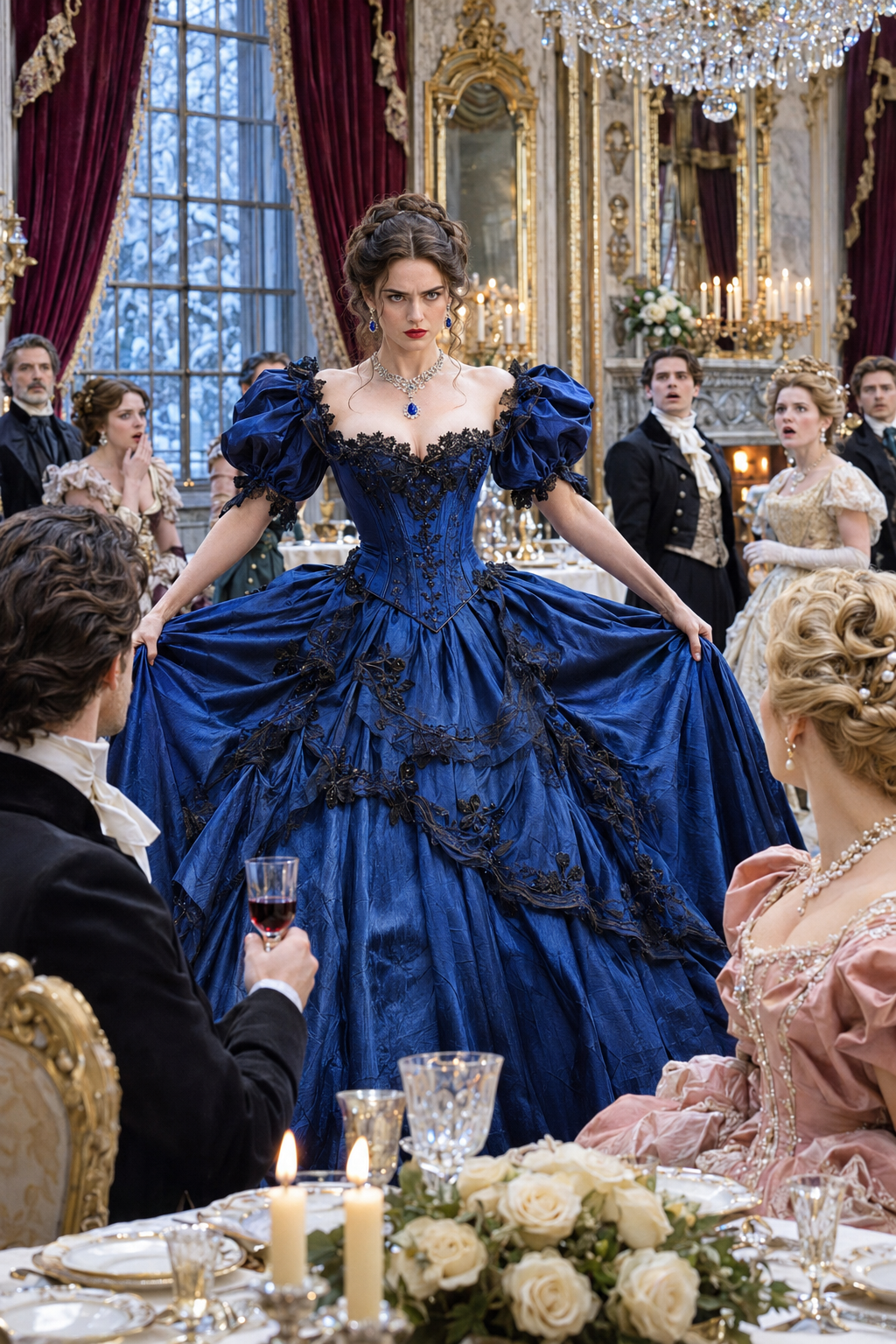
“A plow horse would look more graceful in silk,” my husband announced to a room full of aristocrats.
The seal was unbroken.
I stared at it for several seconds before reaching for the envelope.
“Why have I never seen this before?”
My father sat back in his chair.
“Because I promised your mother I would never let anyone use it to force your hand.”
I looked up sharply.
“My mother?”
He nodded.
“She knew the Rothburys were desperate when they approached us. But she also knew something about the duke’s father that I did not discover until after the wedding negotiations had begun.”
I broke the seal.
Inside were three documents, each bearing signatures and dates.
The first was a copy of the original marriage settlement.
The second was a letter written by the late Duke of Rothbury.
The third was a document that made my fingers go cold.
It was a codicil to the Rothbury estate.
I read the first page twice.
Then a third time.
“Father, what does this mean?”
He leaned forward.
“It means the present duke does not possess the estate in the way he believes he does.”
I looked at the document again.
According to the terms established by the previous duke, the Rothbury estate had been placed under a private trust after the family accumulated enormous debts. Its lands, properties, and principal revenues could not be sold or transferred without the approval of the trustees.
There were three trustees.
One was a solicitor representing the Crown.
Another was the family’s longtime solicitor.
The third was the principal financial guarantor named in the settlement.
My father’s name appeared beneath that final position.
But there was something more.
The settlement stated that if the duke entered a marriage alliance with the guarantor’s family, the duchess would become a beneficiary of the trust.
Not merely a beneficiary of its income.
A beneficiary with the right to demand an independent examination of the estate’s accounts.
And if financial misconduct, deliberate mismanagement, or the diversion of trust funds were established, she could request the removal of the current estate administrator and the appointment of a new management board.
I slowly lowered the papers.
“Why would the previous duke arrange something like this?”
My father opened the second document.
“Because he knew his son.”
I read the letter.
It was written several years before the old duke’s death.
The handwriting was elegant but uneven, as though the writer had been ill.
The letter explained that the Rothbury family had once possessed considerable wealth, but the previous generation had gambled away much of it. The old duke had spent his final years trying to preserve the estate for future generations.
He had feared that his son, Adrian, would destroy what remained.
He had therefore created a settlement that would protect the family lands from reckless spending.
But he had also included a condition.
The future duchess was to be treated as an equal partner in the family’s financial affairs, not as an ornament to be displayed at social gatherings.
The final paragraph was underlined.
If my son should ever mistake a wife’s silence for weakness, let the terms of this settlement remind him that the woman beside him may possess greater judgment than the man wearing the title.
I read it again.
Then I laughed.
It was not a pleasant laugh.
“Adrian knows nothing about this, does he?”
“Apparently not.”
“Then why did he discover something concerning the settlement?”
My father tapped the third document.
“Because he has finally read the contract he signed.”
I turned to the last page.
There it was.
A clause stating that the duchess’s family guarantee was conditional upon the duke honoring the financial and personal obligations specified in the marriage agreement.
Among them was a provision forbidding the use of marital funds to finance personal gifts, private arrangements, or financial obligations undertaken for the benefit of a third party without the duchess’s knowledge.
Lady Beatrice’s bracelet suddenly came to mind.
So did the expensive apartment he had arranged for her in Mayfair.
And the horses he had purchased after telling me that the estate could not afford another carriage.
“How much has he spent?”
My father looked toward the chief clerk.
The clerk placed a thick ledger on the desk.
“Preliminary figures, Your Grace.”
I opened it.
The numbers were worse than I expected.
Over the previous twelve months, nearly forty thousand pounds had disappeared through payments authorized by the duke’s private secretary.
Some were legitimate household expenses.
Others were payments to Lady Beatrice, her family, and several businesses that appeared to exist only on paper.
I closed the ledger.
“Then we have our answer.”
My father studied me.
“What will you do?”
I looked at the letter from the late duke.
“I will do what his son has spent eighteen months preventing me from doing.”
“And that is?”
“Become a duchess.”
For the first time that morning, my father smiled.
Not because I had decided to fight.
But because I had finally decided to stop asking permission.
By noon, my instructions had been sent to London.
The discretionary credit would remain suspended.
An independent audit would begin immediately.
No further payments could be authorized without the approval of the trustees.
And every account connected to the Rothbury estate would be examined.
I also requested something else.
A copy of every letter exchanged between the duke’s office and my father’s bank during the previous eighteen months.
I wanted to know exactly what my husband had told people about me.
I did not have to wait long.
Three days later, the first report arrived.
And with it came a letter that changed everything.
It had been written by Adrian to his solicitor two months before our wedding.
The girl is plain, but her father’s money will be useful. Once the settlement is secured, I expect to retain complete control of the household and its finances. There is no reason to involve her in matters she could never understand.
I read the sentence without moving.
Then I placed the letter on the desk.
For eighteen months, I had convinced myself that Adrian’s cruelty was born of arrogance, immaturity, and the suffocating expectations of his position.
Now I understood something far worse.
He had never intended to regard me as a wife.
He had regarded me as an investment.
My father watched me carefully.
“Emma?”
I folded the letter.
“I want the audit completed.”
“And if it proves what we suspect?”
“Then the trustees will have a decision to make.”
That evening, another telegram arrived.
This one was from London.
Adrian was furious.
He had demanded an emergency meeting with the bank’s directors and threatened to sue for breach of the marriage settlement.
His solicitor had also sent a formal notice claiming that I had abandoned my marital duties without reasonable cause.
I read the message twice.
Then I dictated my response.
Her Grace has not abandoned her duties. She has merely ceased financing the activities of His Grace’s mistress.
I signed it.
The following morning, the London newspapers began whispering.
The Duchess of Rothbury had left her husband.
The Rothbury fortune was in danger.
The duke’s credit had been withdrawn.
And Lady Beatrice had apparently been seen leaving his London townhouse before sunrise.
But the most interesting development came at four o’clock that afternoon.
Adrian arrived at my father’s residence.
He did not send a letter.
He did not request an appointment.
He simply appeared in the entrance hall, wearing an expensive dark coat and the expression of a man accustomed to having doors opened for him.
“I wish to see my wife.”
The butler informed him that I was occupied.
“Then tell her I am waiting.”
The butler remained perfectly still.
“Her Grace has asked that you wait in the drawing room, Your Grace.”
Adrian entered.
I was seated beside the fireplace when he came in.
He looked exhausted.
His usually immaculate hair was untidy, and there were dark circles beneath his eyes.
For a moment, he simply stared at me.
Then his gaze fell to the plain blue dress I was wearing.
“You look different.”
“I feel different.”
“Emma, this has gone far enough.”
I put down my book.
“Has it?”
“You cannot simply walk away from your marriage and expect the world to accept it.”
“I have not walked away from anything. I have withdrawn my family’s financial support from a man who publicly humiliated me.”
His jaw tightened.
“You are making a spectacle of yourself.”
“No, Adrian. I believe you have managed that quite successfully without my assistance.”
He stepped closer.
“I know about the settlement.”
“I should hope so. You signed it.”
“You knew about the trust?”
“I learned about it three days ago.”
His expression changed.
“Then you know what you are doing to my family.”
I looked at him.
“Your family?”
He hesitated.
“The estate. The tenants. The household. Everyone depends on those funds.”
“Then perhaps you should have considered them before spending the estate’s money on Lady Beatrice.”
His face turned red.
“That is a private matter.”
“Not when it involves money held in trust.”
“She is not your concern.”
I almost smiled.
“That is precisely the problem, Adrian. Nothing appears to be my concern until you need my money.”
He walked toward the fireplace.
“Beatrice and I have known each other for years.”
“And yet you married me.”
“My father insisted upon it.”
“Your father is dead.”
The silence that followed was extraordinary.
Adrian turned.
“You have no idea what it is like to carry this title.”
“Then perhaps you should have married someone who wanted to carry it with you.”
For a moment, I saw something unexpected in his expression.
Not anger.
Fear.
He lowered his voice.
“Emma, I need you to restore the credit. Just temporarily. There are bills due, wages to pay, and creditors waiting. If you do not, the estate could face serious consequences.”
I considered him.
“Are the servants being paid?”
“They will be.”
“Are the tenant farmers receiving their agreed payments?”
“Of course.”
“Then you have nothing to fear from an audit.”
He said nothing.
I rose from my chair.
“Sign the authorization allowing the trustees to examine every account. Cooperate with the investigation. Return any money improperly withdrawn from the trust. If you do those things, I will personally ensure that the innocent people employed on your estate are protected.”
“And what do you expect in return?”
“Nothing.”
He looked genuinely confused.
“I want nothing from you, Adrian.”
His face hardened.
“You cannot mean to remain here indefinitely.”
“I have not decided where I shall live.”
“You are my wife.”
“And you are my husband. Neither statement seems to have prevented you from treating me like an inconvenience.”
He stared at me for several seconds.
Then he said the words I would remember for years.
“You will regret humiliating me.”
I met his gaze.
“I suspect I have already regretted marrying you.”
He left without another word.
But I knew he would not stop there.
Men like Adrian rarely surrendered control simply because someone had finally challenged them.
The audit continued for another week.
Its findings were devastating.
The estate had accumulated considerably more debt than the duke had admitted. Several properties had been used as collateral without proper authorization. Payments had been diverted through a company owned by Lady Beatrice’s brother.
Worse still, the estate’s principal steward had been receiving commissions from contractors in exchange for approving inflated invoices.
The amount missing from the trust exceeded sixty thousand pounds.
And there was one final discovery.
A letter from Lady Beatrice to Adrian.
It had been found in a locked cabinet in his London study.
Once the bank is satisfied and the marriage settlement is secure, there is no reason to continue pretending. You promised me that I would become the woman of Rothbury. I have waited long enough.
Beneath it was Adrian’s reply.
Patience, my love. Emma will never understand the details of the estate. She is easily managed. Once the accounts are settled, I shall arrange everything.
I placed both letters beside the audit report.
Then I noticed the date.
The letter had been written only six weeks earlier.
Adrian had known about the financial difficulties.
He had known that the trust was in danger.
And while I had been attending charity dinners, choosing flowers for the estate’s ballroom, and trying to make myself useful in a household that did not want me, he had been planning to replace me.
Not with another wife.
With his mistress.
I felt no jealousy.
Only disgust.
The trustees convened an emergency meeting in London on the following Thursday.
I arrived shortly before ten.
The room was crowded with solicitors, accountants, and representatives of the Crown.
Adrian sat at the far end of the table.
Lady Beatrice was not present.
He stood when I entered.
“Emma.”
“Your Grace.”
His mouth tightened.
The senior trustee, Sir Edmund Carlisle, called the meeting to order.
He was an elderly gentleman with silver hair and a reputation for being almost impossible to intimidate.
He began by outlining the findings of the investigation.
Every fraudulent payment was listed.
Every unauthorized transaction was recorded.
Every signature was verified.
Adrian listened with increasing agitation.
“This is ridiculous,” he finally interrupted. “These were ordinary expenses incurred in managing an estate of this size.”
Sir Edmund adjusted his spectacles.
“An apartment in Mayfair for a lady who is not your wife?”
“That was a personal arrangement.”
“Paid for through a company receiving money from the estate?”
Adrian said nothing.
“And a diamond bracelet purchased using funds designated for estate improvements?”
“It was a gift.”
Sir Edmund looked at him.
“Indeed. A rather expensive gift.”
One of the accountants opened another file.
“There is also the matter of the payment made to your wife’s family bank under the description of agricultural improvement. No such improvement appears to have taken place.”
Adrian turned sharply toward me.
“You arranged this.”
“I requested an audit.”
“You wanted to destroy me.”
I remained calm.
“No, Adrian. You managed that yourself. I simply stopped paying for it.”
The room fell silent.
Sir Edmund continued.
Under the terms of the trust, the duke’s authority over financial management could be suspended pending further investigation.
A new management committee could be appointed.
The committee would oversee the estate’s operations and ensure that its tenants, employees, and creditors were protected.
But there was another issue.
The original settlement required the duchess’s approval before any significant restructuring of the trust.
Sir Edmund turned toward me.
“Your Grace, we require your decision.”
Adrian looked at me.
For the first time, there was no amusement in his eyes.
“Emma, don’t.”
I studied the man I had married.
I remembered our wedding.
His hand resting lightly on mine.
His smile for the photographers.
The promises made in front of two families.
And I remembered the ballroom, where he had called me a plow horse while wearing the diamonds my family had helped preserve.
I had once believed that the greatest humiliation in a marriage was being unloved.
I now understood that it was being treated as though one’s dignity had no value.
“I approve the appointment of an independent management committee,” I said.
Adrian closed his eyes.
“And I request that the committee be given full authority to protect the estate’s assets and investigate all improper transactions.”
Sir Edmund nodded.
“Your decision will be recorded.”
The meeting continued for another hour.
By the end, Adrian’s financial authority had been suspended.
His private secretary was dismissed pending investigation.
The estate steward was removed from his position.
The duke was required to return the improperly diverted funds.
And the management committee would assume responsibility for the estate’s financial operations.
Adrian left the room without looking at me.
I thought that would be the end of it.
I was wrong.
That evening, a messenger delivered a note to my father’s house.
It was from Lady Beatrice.
She requested a private meeting.
My father advised me not to go.
“She may be attempting to provoke you,” he said.
“Perhaps.”
“You owe her nothing.”
“I know.”
Yet something about the request troubled me.
I agreed to meet her the following afternoon at a small hotel near Hyde Park.
She arrived wearing a pale green dress and a hat trimmed with feathers.
Without the glittering jewels and the duke’s attention, she looked considerably less impressive than I remembered.
“Your Grace,” she said.
“Lady Beatrice.”
She sat opposite me.
For a few moments, neither of us spoke.
Then she sighed.
“I suppose you must hate me.”
“I have not spent much time thinking about you.”
Her expression tightened.
“You always were rather cold.”
I looked at her.
“Is that why you wished to meet?”
She opened her handbag and removed a folded document.
“I thought you should know that Adrian has been planning to leave you for some time.”
I glanced at the paper.
It was a draft agreement.
A private separation arrangement.
It proposed that I receive a modest annual allowance in exchange for surrendering my rights under the marriage settlement.
The document was dated three months earlier.
“Where did you get this?”
“From his solicitor.”
“And why are you showing it to me?”
She hesitated.
“Because I have decided that I will no longer wait for him.”
I said nothing.
She looked down at her gloved hands.
“He promised me everything. He said you were merely a business arrangement. That you would eventually return north, leaving him free to marry me.”
“And you believed him?”
“I wanted to.”
There was something almost pitiable in her voice.
But pity was not forgiveness.
“Lady Beatrice, you knew he was married when you accepted his promises.”
“Yes.”
“You knew he was using money from his wife’s family.”
She looked away.
“I did not know the full extent.”
“Yet you accepted the bracelet.”
Her cheeks reddened.
For the first time, she seemed unable to find an answer.
I picked up the draft agreement and returned it to her.
“Keep it.”
She frowned.
“You don’t want it?”
“I have no interest in signing away rights I never intended to surrender.”
She stood.
“Then I suppose there is nothing more to say.”
“Perhaps there is one thing.”
She turned.
“You may have believed Adrian would make you a duchess. But a title is not proof of a man’s character. I hope you remember that before you trust another promise.”
Her expression changed.
Then she left.
Two days later, she disappeared from London’s social circles.
I heard that she had gone to the Continent.
Adrian, meanwhile, faced the consequences of the audit.
His creditors were informed that the estate’s finances would now be managed independently.
Several of his friends stopped inviting him to their gatherings.
The newspapers that had once praised his elegance and generosity began publishing less flattering accounts.
But the greatest blow came from an unexpected source.
His younger sister, Eleanor, wrote to me.
I had met her only twice during my marriage.
She was twenty-three, quiet, and frequently overlooked by her brother.
Her letter was brief.
Dear Emma,
I have heard what has happened. I do not know whether I am entitled to write to you, but I wish to tell you that I am sorry.
I have watched Adrian behave cruelly toward people for years. Our father tried to correct him, but he never succeeded.
The servants adore you. The tenants speak of your kindness. And I know that you were the only person who ever asked whether the estate’s workers were receiving their wages on time.
If you are willing, I would like to meet you.
I read the letter twice.
Then I wrote back.
We met a week later at my father’s residence.
Eleanor arrived without jewelry, accompanied by a single maid.
She looked nervous.
“I hope you don’t think I am here to ask you to help Adrian.”
“I don’t.”
She took a breath.
“I wanted to ask whether you might help me instead.”
I listened.
She explained that she had spent most of her life being told that her only responsibility was to marry well.
Her brother had controlled her allowance and refused to let her pursue an interest in education.
She wanted to establish a school for the daughters of estate workers.
“I know it sounds foolish,” she said. “But there are girls who can barely read. Their fathers work the land, their mothers work in the kitchens, and no one thinks they need anything more than the ability to sew.”
I studied her face.
“Do you have a plan?”
She looked surprised.
“A plan?”
“Yes. A school requires teachers, buildings, books, and money. Have you considered any of those things?”
She slowly shook her head.
“Then we shall begin there.”
For the first time, Eleanor smiled.
And something inside me shifted.
I had spent months believing that my marriage had taken everything from me.
Yet perhaps it had brought me to a place where I could finally do something meaningful.
Over the next two months, I divided my time between my father’s businesses and the Rothbury estate.
The management committee discovered that the estate itself was not beyond repair.
Its land was fertile.
Its tenant farmers were hardworking.
Its workers were loyal.
The problem had never been a lack of resources.
It had been a lack of responsible leadership.
I appointed an experienced agricultural manager and arranged for an independent accountant to oversee the books.
We renegotiated several contracts.
The unnecessary expenses were eliminated.
The tenant farmers were given clearer agreements and fairer terms.
Most importantly, wages were paid on time.
I also helped Eleanor establish her school.
We found an unused building near the village church.
It required repairs, new windows, and a complete renovation of the interior.
Within six weeks, it had become a bright little schoolroom with desks, bookshelves, and a large blackboard.
On opening day, twenty-seven girls arrived.
Some had never held a book.
One little girl, no older than seven, stood near the doorway, clutching her mother’s hand.
“Will I be allowed to come every day?” she asked.
I knelt beside her.
“If you wish to.”
“Even if my father works in the stables?”
“Especially then.”
Her smile was worth more to me than every diamond I had ever worn.
Meanwhile, Adrian’s position continued to deteriorate.
The investigation into the diverted funds was completed.
He was required to repay the money, and the trustees permanently restricted his control over the estate’s finances.
His title remained.
His privileges did not.
He was also informed that the marriage settlement could not be dissolved through a private agreement.
Any formal separation would have to follow the proper legal process.
He sent me three letters.
The first was angry.
The second was pleading.
The third was almost apologetic.
I did not answer the first two.
I read the third carefully.
Emma,
I have been told that you intend to remain away from Rothbury indefinitely.
I cannot pretend that I understand your decision. I have made mistakes, and perhaps I did not appreciate what you contributed to our marriage.
I would like the opportunity to speak privately.
I believe we could still repair what has happened.
I placed the letter in a drawer.
For several days, I considered whether I should meet him.
Not because I wanted him back.
But because I wanted to be certain that I was not making a decision out of anger.
Eventually, I agreed to one final meeting.
We met at Rothbury House on a cold November afternoon.
The grand ballroom was empty.
The chandeliers were unlit, and the windows overlooked the gardens.
Adrian stood beside the fireplace.
He looked older.
His clothes were still expensive, but the effortless confidence had disappeared.
“You came.”
“You asked.”
He gestured toward a chair.
I remained standing.
“I suppose you want to discuss our marriage.”
“Yes.”
“Then speak.”
He looked at me for a long moment.
“I was wrong about the things I said.”
“Which things?”
His brow furrowed.
“All of them.”
“That is not particularly specific.”
He exhaled.
“I should never have humiliated you in front of those people.”
“No.”
“I should never have involved Beatrice in our affairs.”
“No.”
“And I should have allowed you to participate in the management of the estate.”
I regarded him quietly.
“Why?”
He seemed confused.
“Why what?”
“Why should you have allowed me?”
“Because you are my wife.”
I shook my head.
“No, Adrian. You should have respected me because I am a person. Not because I carry your name.”
He looked away.
For a moment, I thought he might argue.
Instead, he sat down.
“I have lost almost everything.”
“You still have your home.”
“I cannot live as I once did.”
“Neither can the people whose wages you delayed.”
His face tightened.
“Must you always bring up the money?”
“It was never only about money.”
“Then what do you want from me?”
I considered the question.
“I wanted a husband who would stand beside me rather than above me. I wanted to be able to speak without being mocked. I wanted to enter a room without wondering whether you would use me as the evening’s entertainment.”
He lowered his eyes.
“And I cannot give you that?”
I looked at him.
“You had eighteen months.”
He stood abruptly.
“People change, Emma.”
“Sometimes.”
“Are you saying I cannot change?”
“No. I am saying your change is not something I am obligated to wait for.”
He stared at me.
Then, in a quieter voice, he asked, “Did you ever love me?”
The question surprised me.
I thought about our wedding.
About the first dinner we had shared.
About the way I had once watched him ride across the estate, believing that perhaps affection might grow between us.
“I wanted to,” I answered.
He closed his eyes.
“But wanting to love someone is not the same as being loved by them.”
He said nothing.
I reached into my handbag and removed a document.
It was a formal proposal for a legal separation, prepared by my solicitor.
The arrangement would protect the financial settlement, preserve the trust, and ensure that the estate’s employees and tenants remained secure.
It would also allow me to live independently.
“I will not seek to destroy your family,” I said. “But I will not continue this marriage as it stands.”
He stared at the papers.
“You are asking for a separation?”
“I am offering one.”
“And if I refuse?”
“Then the solicitors will proceed according to the terms of the settlement and the law.”
He looked at me for a long time.
Finally, he picked up the document.
His hand trembled slightly.
“You really have become quite formidable.”
I almost smiled.
“No, Adrian. I have simply stopped being afraid of disappointing you.”
He signed.
I left Rothbury House before sunset.
The following spring, our separation was formally recognized.
I retained my independent financial rights, and the trust continued under the management committee.
Adrian remained the Duke of Rothbury, but he no longer controlled the estate’s finances.
I did not seek to have him stripped of his title.
That was never my purpose.
I wanted something much more valuable.
My freedom.
Two years passed.
My father’s bank expanded its northern operations, and I became a partner in several of its industrial ventures.
I helped establish a fund to support education for working-class girls.
The little school at Rothbury grew from twenty-seven pupils to nearly a hundred.
Eleanor eventually became its headmistress.
She was no longer the timid young woman who had first written to me.
She had discovered a purpose of her own.
As for me, I purchased a modest country house near York.
It had no ballroom, no marble staircase, and no enormous portraits of ancestors staring down from the walls.
It had a beautiful garden, a library, and windows that let in the morning sunlight.
I kept my mother’s jewelry.
I rarely wore the diamonds.
One afternoon, while visiting the Rothbury school, I saw a small girl standing beside the garden gate.
She was holding a book against her chest.
“Your Grace?” she asked.
I turned.
“Yes?”
“Is it true that you used to live in the big house?”
“I did.”
“Did you like being a duchess?”
I considered the question.
“Sometimes.”
She frowned.
“Then why did you leave?”
I knelt so that we were at the same height.
“Because I learned that having a grand title does not mean you have a happy life.”
She looked down at her book.
“My mother says I should try to marry someone rich.”
I smiled.
“Your mother wants you to be safe. That is understandable.”
“Should I?”
I took her little hand.
“Learn to read. Learn to count. Learn to make your own decisions. Then, if you choose to marry, choose someone who respects you. But never marry because you believe another person’s wealth or name will make you valuable.”
She thought about that for a moment.
“Will I be allowed to become a teacher?”
“If you work hard enough, you may become anything you wish.”
Her face brightened.
She ran toward the schoolhouse, calling to her friends.
I watched her disappear through the door.
Behind me, the old Rothbury estate stood in the afternoon light.
The gardens had been restored.
The workers were being paid fairly.
The school was full of children.
And the great ballroom, once the place where my husband had mocked me before an audience of aristocrats, was now used for village meetings, winter celebrations, and charitable events.
Sometimes I wondered whether Adrian remembered that evening.
Whether he remembered the woman in the blue silk gown, standing silently while everyone laughed.
I never asked.
I had no need to know.
The last time I saw him was at a public agricultural exhibition three years after our separation.
He was standing beside a group of landowners when I entered.
For a moment, our eyes met.
He gave a small, formal nod.
I returned it.
There was no bitterness in the gesture.
No triumph.
No desire to make him feel what he had once made me feel.
I had finally understood that the opposite of humiliation was not revenge.
It was indifference.
As I walked away, I passed a display of working horses.
A magnificent chestnut plow horse stood quietly beside its handler.
Its coat shone in the sunlight, and its powerful legs were planted firmly on the ground.
A young boy was brushing its mane.
“Beautiful animal, isn’t it?” the handler said.
I smiled.
“Very beautiful.”
The horse lowered its head, accepting another gentle stroke.
And I thought of the ridiculous insult that had once changed the course of my life.
My husband had believed that beauty was the only contribution a woman could make to a marriage.
He had believed that money gave him the right to command, that a title made him superior, and that silence meant submission.
He had mistaken my patience for weakness.
My restraint for ignorance.
And my willingness to compromise for an inability to stand alone.
He had been wrong.
But perhaps the greatest lesson was not that a woman could defeat a powerful man.
It was that she did not need to defeat him at all.
For too long, I had measured my worth through the eyes of someone who had never intended to see it.
I had thought that if I were graceful enough, accommodating enough, beautiful enough, or patient enough, I might eventually earn the respect I deserved.
I had been wrong about that, too.
Respect is not a prize awarded to those who suffer quietly.
Love is not something one must purchase with obedience.
And a person’s value does not come from the title they inherit, the wealth they possess, or the approval of the people sitting around their dinner table.
It comes from what they choose to do with the life they have been given.
I returned home that evening and opened the old velvet jewelry case.
The Rothbury diamonds were still inside.
I had kept them, not because they reminded me of my marriage, but because they reminded me of the day I finally understood who I was.
I took out the largest diamond necklace and placed it back in its case.
Then I closed the lid.
Outside, the sun was setting over the garden.
There were letters waiting on my desk, accounts to review, and a school to visit the following morning.
My life was full.
Not because I had become a duchess.
Not because I had won a battle against an arrogant husband.
But because I had stopped allowing someone else to decide what I was worth.
And if there was one thing I hoped every girl who entered that little school would remember, it was this:
Never let someone convince you that you are worthless simply because they cannot see your value.
A title can be inherited.
A fortune can be lost.
Beauty can fade.
But courage, intelligence, dignity, and the ability to stand on your own feet are treasures no one can take from you.
And sometimes, the most powerful thing a woman can do is not to fight for a place at someone else’s table.
It is to build her own.