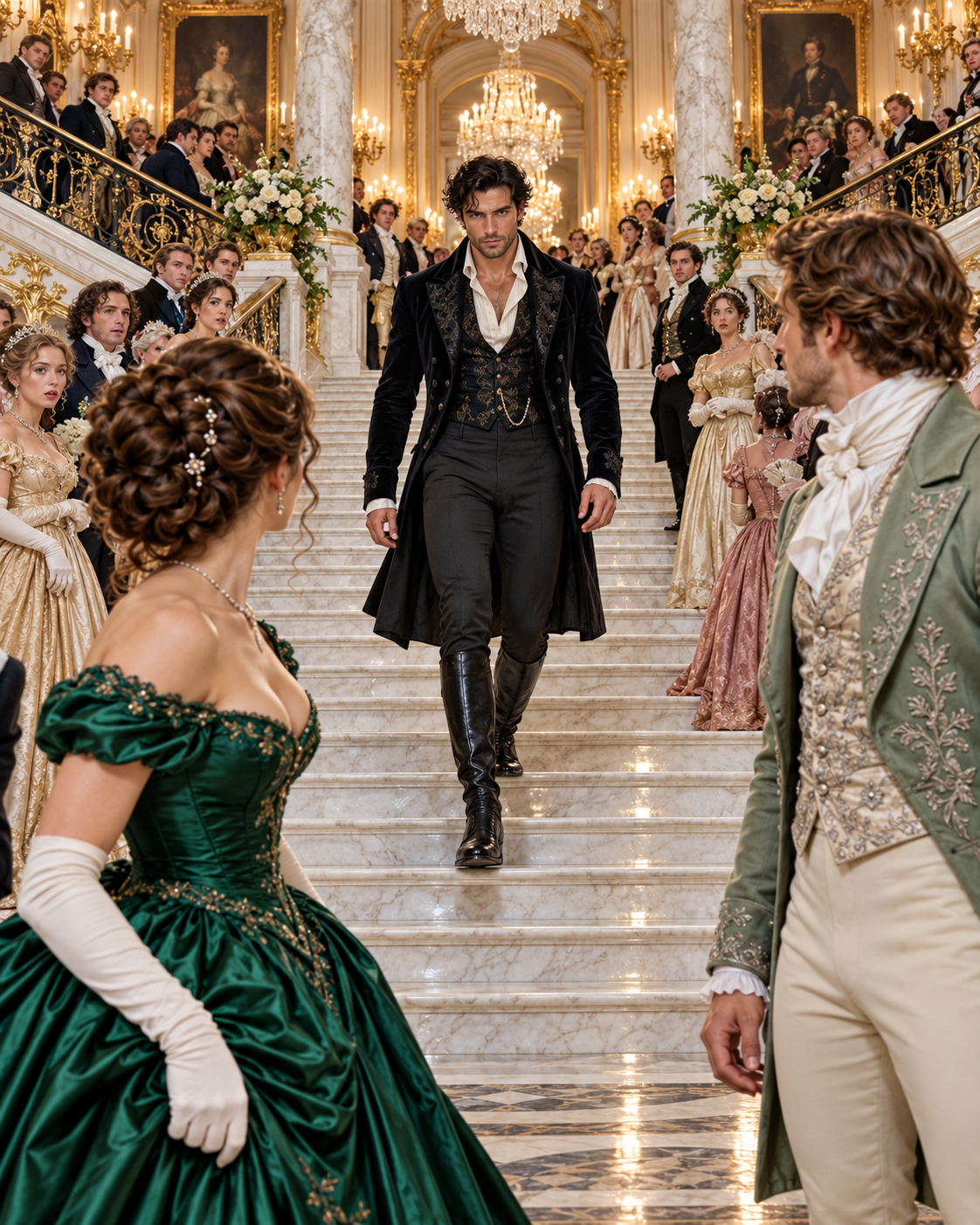
A ballroom full of London’s most powerful families had been expecting music, champagne, and the usual polite spectacle of wealth.
Lydia stared at the papers spread across Gabriel’s workbench, but Gabriel did not immediately explain the page beneath his hand.
He simply looked at her.
There was something different in his expression now. Not fear. Not even anger.
Decision.
She reached for the paper.
Gabriel covered it with his palm.
“Gabriel.”
His jaw tightened.
“You cannot show me that Edward intends to lock you away and then expect me to stand here calmly.”
He shook his head.
“I can give him the estate.”
Another sharp shake.
“He wants the land. If I sign it over, he has no reason to hurt you.”
Gabriel’s hand struck the table so suddenly that several instruments trembled.
Lydia froze.
He had never frightened her before.
He did not frighten her now.
What she saw in his face was not rage directed at her. It was horror at the bargain she was proposing.
Gabriel pulled a sheet of paper toward himself and wrote quickly.
If you surrender because he threatens me, then he has taken it from you all the same.
Lydia read the sentence twice.
“He may have you imprisoned.”
Gabriel wrote again.
Then we stop him before he can.
Only then did he lift his hand from the paper he had been hiding.
It was not a medical document.
It was a ledger.
Lydia frowned.
The pages were filled with dates, sums, initials, and references to properties she recognized as belonging to the Pembroke holdings. Beside several entries Gabriel had written notes in his precise hand.
She turned another page.
Then another.
Large amounts of money had been borrowed against land Edward did not own outright. Payments had been promised using income that had not yet been received. In two places, Lydia saw the name of her inherited estate written in the margins.
Her blood went cold.
“He has already been using it.”
Gabriel nodded.
“But he cannot.”
Another nod.
“He cannot legally pledge my property without my signature.”
Gabriel pointed to one entry.
Beside it was a copy of a letter bearing Lydia’s name.
And beneath her name was a signature.
Her signature.
Except Lydia had never written it.
For several seconds, she could hear nothing but the faint ticking of the workshop clock.
“He forged it.”
Gabriel nodded once.
The humiliation at the ball suddenly made terrible sense.
Edward had not merely wanted control.
He needed it.
Perhaps desperately.
If he had already represented Lydia’s estate as security for his debts, then obtaining the real deed was no longer simply greed. It was protection against exposure.
Lydia turned slowly toward Gabriel.
“How long have you known?”
He raised two fingers.
“Two years?”
He nodded.
The answer hurt more than she expected.
“You knew for two years and said nothing?”
Something passed across his face.
Then he pointed toward his throat.
Regret struck her immediately.
“I did not mean—”
Gabriel stepped away.
“No. I’m sorry.”
He looked back at her, and there was no accusation in his eyes. That somehow made it worse.
Lydia touched the forged letter.
“You could have written to me.”
Gabriel hesitated.
Then he opened a drawer.
Inside were letters.
Dozens of them.
Every one addressed to her.
None sent.
Lydia lifted the top one.
The seal had never been broken because it had never been closed.
She read the first lines.
Lady Lydia,
I fear my brother has begun to involve your inheritance in obligations you have not approved…
She stopped.
The date was more than eighteen months old.
“Why?”
Gabriel pulled another page toward him.
You trusted him then.
“I was his wife.”
You believed marriage required loyalty.
Lydia looked at him.
“And now?”
Gabriel’s pen paused.
Now you know loyalty without truth is only obedience wearing a kinder name.
The words landed with greater force than any speech could have.
Lydia lowered herself into a chair.
Edward had spent years insisting that a good wife obeyed, yielded, smiled, and protected her husband’s reputation. Every demand had been presented as duty. Every refusal had been treated as betrayal.
Yet Gabriel, who could not speak, had somehow named the trap more clearly than anyone else.
“What happens if these documents become public?”
Gabriel wrote:
Creditors come.
His accounts are examined.
The forgery is discovered.
“And the asylum?”
He tapped the medical books.
“He can still do it?”
Gabriel wrote more slowly this time.
He has already begun.
Then he showed her another letter.
It was from a physician.
The language was careful, respectable, and monstrous.
The writer referred to Gabriel’s “increasing instability,” his “fixation upon the Duke’s domestic affairs,” and the possibility that his inability to speak reflected a deeper defect of mind.
Lydia felt sick.
“They are using your silence as evidence that you are insane.”
Gabriel’s expression held bitter amusement.
“They cannot possibly—”
But she stopped.
Of course they could.
Men with titles and physicians with signatures could turn almost anything into respectable cruelty if no one powerful contradicted them.
A door slammed somewhere in the house.
Both of them looked up.
Footsteps sounded in the corridor outside the workshop.
Gabriel swept the ledger shut.
The door opened.
Edward stood there.
He was still dressed for the morning, immaculate except for the fury around his eyes.
“Well,” he said softly. “This is becoming a habit.”
Lydia rose.
Edward’s gaze moved from her to Gabriel and then to the papers on the workbench.
For the first time since she had known him, Lydia saw his composure fail before he could hide it.
Only for an instant.
But Gabriel saw it too.
Edward entered and closed the door behind him.
“I wondered where my wife had disappeared to.”
“I came to speak with Gabriel.”
“Gabriel does not speak.”
Lydia held his gaze.
“He communicates perfectly well.”
Edward smiled.
“That is precisely the sort of romantic foolishness that has created our present embarrassment.”
Gabriel stepped between them.
Edward laughed.
“Oh, do not start performing again. Last night was quite enough.”
Gabriel did not move.
Edward’s smile disappeared.
Then his eyes landed on the ledger.
“What have you shown her?”
Silence.
Edward crossed the room.
Gabriel blocked him.
The brothers stood face-to-face.
Lydia had always thought Edward the larger presence. He occupied rooms as though furniture and people alike existed by his permission.
But Gabriel’s stillness changed the balance.
Edward had authority.
Gabriel had nothing left to pretend.
That made him harder to frighten.
“Move,” Edward said.
Gabriel remained where he was.
Edward shoved him.
Gabriel staggered backward into the workbench, catching himself against its edge.
Lydia stepped forward.
“Do not touch him.”
Edward looked at her almost curiously.
Then he slapped her.
The sound cracked through the workshop.
For a second nobody moved.
Lydia tasted blood where her tooth had cut the inside of her cheek.
Edward seemed almost surprised by what he had done.
Then he recovered.
“You will sign the deed today.”
“No.”
His face hardened.
“You still imagine you have choices.”
“I have more than you think.”
His eyes flicked again toward the ledger.
That was all the confirmation she needed.
He was afraid of it.
Lydia continued, “How much have you borrowed against my estate?”
Edward said nothing.
“How many people have you lied to?”
“You understand nothing about finance.”
“I understand my own signature.”
His face drained of color.
Gabriel moved.
Edward lunged for the ledger.
Gabriel seized it first.
The two men struggled, knocking a wooden tray to the floor.
Tools scattered across the boards.
Edward struck Gabriel in the ribs.
Gabriel bent but did not release the book.
Edward hit him again.
Lydia grabbed Edward’s arm.
He threw her aside.
Her shoulder struck a cabinet.
Gabriel’s expression changed.
He drove forward and forced Edward against the wall.
One hand pressed against his brother’s chest.
The other still held the ledger.
Edward stared at him.
Then, slowly, he smiled.
“There you are.”
Gabriel’s grip tightened.
“The animal underneath.”
Lydia saw what Edward was doing.
“Gabriel, no.”
Edward continued.
“Strike me. Please.”
Gabriel’s breathing became ragged.
“That is what I need. A violent, defective man attacking the Duke of Pembroke in his own home.”
Gabriel’s fist rose.
“Gabriel.”
He looked at Lydia.
She shook her head.
Edward whispered, “Coward.”
Gabriel’s fist trembled.
Then he lowered it.
He stepped away.
Edward straightened his coat.
“You always were weak.”
Gabriel opened the ledger and tore out three pages.
Edward’s expression vanished.
Before he could react, Gabriel crossed to the small iron stove in the corner.
He held one page over the flame.
“No!” Edward shouted.
Gabriel dropped it.
Fire curled through the paper.
Edward rushed forward.
Gabriel held the remaining pages above the flame.
Edward stopped.
Lydia understood.
“These are copies,” she said.
Edward turned.
Gabriel smiled.
It was the smallest smile Lydia had ever seen.
And the cruelest.
“You made copies,” Edward said.
Gabriel nodded.
“How many?”
Gabriel merely looked at him.
Edward’s confidence cracked.
“Where are they?”
No answer.
“Where?”
Gabriel pointed toward the door.
Edward stared at him.
Then Lydia understood the gesture.
Outside.
Beyond the house.
Beyond Edward’s reach.
“You sent them to someone.”
Gabriel nodded.
Edward turned white.
For the next several hours, Pembroke House became a place of locked doors, hurried servants, and whispered orders.
Edward sent men searching Gabriel’s room.
They found nothing.
He searched the workshop himself.
Nothing.
He demanded Lydia remain in her chamber.
She refused.
By afternoon, a carriage arrived.
Edward went to the entrance hall expecting one of his agents.
Instead, an elderly solicitor stepped down.
Mr. Harcourt had served Lydia’s father.
She had not seen him since her marriage.
Edward stopped halfway down the staircase.
Harcourt removed his hat.
“Your Grace.”
“What are you doing here?”
“I was asked to attend.”
“By whom?”
The solicitor glanced toward Gabriel.
“Lord Gabriel.”
Edward laughed once.
“My brother cannot conduct legal affairs.”
“He can write.”
The words settled over the entrance hall.
Harcourt opened his case.
“And he has been writing to me for some time.”
Lydia looked at Gabriel.
He had not merely gathered evidence.
He had prepared an escape route.
Harcourt continued, “I have also examined certain financial representations made concerning Her Grace’s estate.”
Edward descended the final steps.
“You have no authority here.”
“I represent the Duchess in matters related to property inherited from her family.”
“You represented her father.”
“And after his death, his daughter.”
Edward turned to Lydia.
“You contacted him?”
“No.”
That seemed to disturb him more.
Because every strategy Edward had built depended upon the same assumption: that Lydia was isolated and Gabriel was helpless.
Neither was true.
Harcourt removed several documents.
“I believe these require explanation.”
Edward did not take them.
“You enter my house and accuse me?”
“I have accused you of nothing.”
“Yet.”
“Yet,” Harcourt agreed.
The quiet answer was devastating.
Edward looked around.
Servants had gathered at the edges of the hall.
Witnesses.
He lowered his voice.
“Come into my study.”
“No,” Lydia said.
Everyone looked at her.
Edward’s face hardened.
She descended the stairs until she stood beside the solicitor.
“We will speak here.”
“This is a family matter.”
“No. You made it a public matter last night.”
A faint movement passed among the servants.
News of the ball had clearly reached them.
Lydia continued, “You wanted witnesses when you believed I would be ashamed. You may have witnesses now.”
Edward’s eyes burned.
“You are still my wife.”
“Yes.”
The word surprised him.
Lydia took another step.
“And being your wife does not make me your property.”
Harcourt laid the forged document on a table.
Edward looked at it.
Then something unexpected happened.
He laughed.
It was not amusement.
It was the laugh of a man who has reached the edge of a cliff and decided that pretending there is no drop might somehow save him.
“You think this destroys me?”
“No,” Lydia said. “I think you did that yourself.”
Edward’s gaze snapped toward her.
“You enjoyed everything my name gave you.”
“I endured what your name allowed you to do.”
“I gave you position.”
“My father gave me land. You tried to steal it.”
“You know nothing of what it costs to maintain this family.”
“Then you should have told me.”
“I should explain myself to you?”
“Yes.”
The simplicity of her answer silenced him.
“A husband should explain why he intends to risk his wife’s inheritance.”
Edward’s nostrils flared.
“You would have refused.”
“I did refuse.”
“Exactly.”
“And that gave you the right to forge my name?”
His eyes moved toward the servants again.
He could feel the house listening.
For years, his power had depended on other people accepting his version of events.
Now there were too many versions in the room.
Harcourt cleared his throat.
“There is another issue.”
Edward looked at him sharply.
The solicitor produced the physician’s letter.
“An effort has apparently been made to establish Lord Gabriel as mentally incompetent.”
Edward’s expression became unreadable.
Harcourt continued.
“I have spoken this morning with another physician who has known Lord Gabriel’s history since childhood. Loss of speech following physical trauma does not, by itself, constitute insanity.”
“It is not only his speech.”
“No?”
“He is obsessive. Secretive. Violent.”
Gabriel stared at him.
Edward pointed.
“He attacked me today.”
Lydia answered before Harcourt could.
“After you struck him.”
“I defended myself.”
“You struck me first.”
The hall became utterly still.
Edward looked at her.
She turned her face slightly.
The mark from his hand was beginning to darken.
Harcourt saw it.
So did every servant.
Edward realized too late what Lydia had just done.
She had provided no dramatic accusation.
She had simply allowed evidence to exist where people could see it.
“You will regret this,” Edward whispered.
For the first time, Lydia believed him.
Not because she thought he would win.
Because a man losing power could become more dangerous than a man who possessed it.
That night, Edward disappeared.
His horse was found in the stable.
His traveling carriage remained in the coach house.
But Edward himself was gone.
Harcourt advised Lydia to lock her rooms.
Gabriel refused to sleep.
He remained downstairs.
Near midnight Lydia found him sitting in the dark entrance hall with a candle beside him.
“You cannot protect every door.”
Gabriel looked up.
She sat beside him.
For several minutes neither moved.
Then Lydia said, “You should have sent one of those letters.”
He looked away.
“I might not have believed you.”
Gabriel nodded.
“But you should have sent one anyway.”
He looked at her again.
“I spent years thinking silence meant peace,” she said. “Edward was pleased when no one contradicted him. I thought that meant the house was calm.”
Gabriel reached for the small notebook he carried and wrote:
Silence is peaceful only when it is chosen.
Lydia read the words.
“And yours?”
He considered.
Then wrote:
Mine was forced on me once.
He paused.
I will not let him force yours.
Her eyes filled, but she smiled.
“You already stopped him.”
Gabriel shook his head.
Not yet.
A sound came from the corridor.
Both stood.
The candle flame moved.
Gabriel stepped in front of Lydia.
Then Edward emerged from the darkness.
He held a pistol.
Lydia’s breath stopped.
Edward looked exhausted now, his immaculate appearance gone. His collar was open. His hair had fallen across his forehead.
Yet his hand was steady.
“Harcourt has gone to bed,” he said.
Neither answered.
“The servants are frightened.”
Gabriel moved slightly.
Edward raised the pistol.
“Do not.”
Gabriel stopped.
Edward looked at Lydia.
“You could have prevented all of this.”
“How?”
“One signature.”
“You forged one already.”
His mouth twisted.
“And now I need the real one.”
He pulled a folded deed from inside his coat and placed it on the table.
Then a pen.
“Sign.”
“No.”
He pointed the pistol at Gabriel.
Lydia’s body went cold.
“Sign.”
Gabriel shook his head violently.
Edward saw him.
“This is not your decision.”
Gabriel stepped toward the gun.
Edward cocked it.
“Gabriel!”
He stopped.
Edward smiled faintly.
“Finally. We understand each other.”
Lydia looked at the deed.
Then at Gabriel.
He was shaking his head.
If she signed, Edward might spare him.
Or he might not.
That was the truth she had finally learned about submission.
It never purchased safety.
It only taught the person hurting you that threats worked.
Lydia picked up the pen.
Edward exhaled.
Gabriel closed his eyes.
Then Lydia dipped the pen in ink and drew a line across the signature space.
Edward stared.
She drew another.
An X.
“What are you doing?”
“Refusing.”
His face changed.
He swung the pistol toward her.
Gabriel lunged.
The gun fired.
The sound exploded through the hall.
Lydia screamed.
Gabriel struck Edward’s arm upward, but not quickly enough to prevent the shot.
For one terrible instant she thought Gabriel had been hit.
Then Edward staggered.
Blood appeared along his own upper arm where the ball had grazed him after striking the stone arch beside them.
The pistol fell.
Gabriel kicked it away.
Doors opened throughout the house.
Servants rushed into the hall.
Harcourt appeared at the top of the stairs in his nightclothes.
Edward looked around.
Everyone had seen enough.
He sank against the table.
Not defeated by force.
Defeated by witnesses.
By morning, the authorities had been summoned.
The investigation that followed did not end in a single dramatic judgment. Real consequences rarely arrive with the neatness of a ballroom waltz.
They came piece by piece.
Creditors examined Edward’s accounts.
Solicitors compared signatures.
Letters were produced.
Debts emerged.
The physician who had agreed to support Gabriel’s confinement suddenly became far less confident when questioned under scrutiny.
Men who had happily accepted Edward’s hospitality began remembering conversations they had once considered unimportant.
The same society that had been too frightened to challenge him at the ball became fascinated by his fall.
Lydia learned not to mistake that fascination for courage.
Many had known enough to suspect what kind of man Edward was.
Very few had acted before it became safe.
She remembered that.
Months passed.
The forged claims against Lydia’s estate were contested.
Her property remained hers.
Edward lost control of much of what he had used to maintain the appearance of limitless wealth.
More important to Lydia, he lost the ability to determine where she went, whom she spoke to, and what she did with what belonged to her.
Gabriel was never committed.
The official effort to have him declared incompetent collapsed beneath the evidence he had preserved so carefully.
For the first time in years, he stopped keeping his workshop door locked.
One autumn afternoon, Lydia found him there repairing the wooden case of an old music box.
Sunlight entered through the windows.
The room no longer looked like a hiding place.
On the workbench rested the ledger that had begun Edward’s unraveling.
Lydia touched its cover.
“You kept it.”
Gabriel shrugged.
“As a reminder?”
He considered, then nodded.
“Of him?”
Gabriel shook his head.
He took his notebook and wrote:
Of what happens when everyone assumes silence means consent.
Lydia looked at the sentence for a long moment.
Then she walked to the window.
Outside, the trees bordering the estate had begun turning gold.
It was her estate.
Those words still felt strange.
Not because she had ever doubted the law.
Because Edward had spent so long teaching her that possession on paper meant little if she could be made afraid to defend it.
She turned.
“Do you know what I remember most about the ball?”
Gabriel raised an eyebrow.
“Not being alone.”
His expression softened.
“I remember the moment you bowed.”
He looked almost embarrassed.
Lydia smiled.
“Everyone thought you were rescuing me.”
Gabriel tilted his head.
“But you weren’t, were you?”
He waited.
“You were asking.”
His eyes held hers.
“You did not drag me off the floor. You did not decide for me. You asked me to dance.”
Gabriel slowly smiled.
That was the difference.
Edward had spent years calling control protection.
Gabriel had protected her by giving her a choice.
A few weeks later, Lydia hosted another gathering.
Smaller.
No grand spectacle.
No carefully arranged rows of London’s most important families.
Only people she wished to see.
Music began after supper.
For a moment Lydia stood at the edge of the room.
The memory of that earlier ballroom returned: the chandeliers, the watching faces, the terrible empty space around her.
Then Gabriel approached.
He stopped before her.
And bowed.
This time Lydia laughed.
“You know, there are easier ways to ask.”
Gabriel straightened and offered his hand.
She took it.
They stepped onto the floor.
No one was being punished.
No one was being tested.
No one was being forced to prove obedience.
They simply danced.
Gabriel still had no voice.
Perhaps he never would.
But Lydia had come to understand that a voice was not merely sound.
A voice was the ability to express a choice and have that choice matter.
Edward had possessed the loudest voice in every room and had used it to silence everyone around him.
Gabriel had no spoken voice at all, yet when the moment came, he had helped another person reclaim hers.
And Lydia, who had once believed courage meant enduring humiliation without lowering her head, finally understood something more difficult.
Endurance was not always courage.
Sometimes courage was refusing.
Sometimes it was documenting what others wanted hidden.
Sometimes it was standing beside someone the world had dismissed.
Sometimes it was asking for help.
And sometimes it was simply saying no one more time, even when fear insisted that surrender would be easier.
The music continued.
Lydia and Gabriel moved through the waltz together, just as they had on the night everything changed.
But this dance belonged to neither revenge nor scandal.
It belonged to choice.
And that, Lydia realized, was what freedom had always been.
Not the absence of fear.
Not the absence of people who wished to control you.
Freedom was reaching the moment when fear no longer made your decisions for you.
For years, Edward had believed Lydia’s estate was the prize.
He had been wrong.
The land mattered. The inheritance mattered. The law mattered.
But the thing he had wanted most was her surrender.
That was the one possession she never gave him.
And in the end, it was the one thing he could not forge.
And in the end, it was the one thing he could not forge.
But Edward Pembroke’s story did not end with the collapse of his authority inside the family home.
Men like Edward rarely disappeared quietly.
For months after the investigation began, London continued to feed upon the scandal.
His name appeared in drawing-room whispers, gentlemen’s clubs, private letters, and newspaper columns careful enough not to accuse a duke directly but precise enough that everyone knew exactly whom they meant.
A nobleman burdened by mysterious debts.
A disputed signature.
A physician questioned about an attempted confinement.
A pistol fired inside one of London’s most distinguished houses.
Society, which had once protected Edward with silence, now entertained itself by discussing his ruin.
Lydia found that part almost unbearable.
Not because she wished to protect him.
She did not.
But because the same people who had watched her dance alone and done nothing now spoke as if they had always recognized Edward for what he was.
“They knew,” she said one morning.
Gabriel looked up from the newspaper.
Lydia stood beside the breakfast-room window, holding a letter from a woman who had attended the ball.
The letter was filled with sympathy.
It also contained a sentence Lydia could not stop reading.
I confess, dear Duchess, many of us had long worried that His Grace could be severe.
Severe.
The word made her laugh without amusement.
“They knew enough.”
Gabriel folded the newspaper.
“They watched him humiliate me. They knew he frightened people. They heard the way he spoke to servants.”
She dropped the letter onto the table.
“And now they write to tell me they always suspected something.”
Gabriel took his notebook.
Lydia shook her head.
“No. Do not tell me they were afraid.”
He paused.
She looked at him.
“I know they were. I was afraid too.”
Gabriel waited.
“That is what troubles me.”
He wrote:
Fear explains silence.
He added another line.
It does not make silence harmless.
Lydia read it.
Then she nodded.
“No. It does not.”
She folded the letter and placed it away.
That afternoon, Mr. Harcourt arrived with news.
Edward’s financial affairs were worse than any of them had understood.
He had borrowed through several intermediaries, concealed debts under family holdings, and promised revenues from lands already burdened by previous obligations.
The forged claim involving Lydia’s estate was not his only deception.
It was simply the one that had finally exposed the rest.
“There will be proceedings,” Harcourt said.
Lydia sat opposite him in the library.
“What kind?”
“That depends on what can be proven and what his creditors pursue. Some matters concern debt. Others concern fraud.”
“And the pistol?”
Harcourt’s expression tightened.
“There are witnesses.”
Gabriel stood by the fireplace.
“What happens to him?” Lydia asked.
Harcourt hesitated.
“That will not be decided quickly.”
Lydia had expected to feel satisfaction.
Instead she felt tired.
For so long, Edward had occupied every corner of her thoughts.
What mood was he in?
What did he want?
What might anger him?
What would he do if she refused?
Even after his power began to collapse, she still found herself measuring the day against him.
That realization disturbed her more than she expected.
“I do not want the rest of my life to be about what happens to Edward.”
Harcourt studied her.
“That is probably the wisest thing you have said since I arrived.”
Gabriel smiled slightly.
Lydia looked toward him.
“And yet I need to know one thing.”
Harcourt waited.
“Can he take control of my estate again?”
“No.”
The answer came immediately.
Lydia exhaled.
“Can he force Gabriel into an institution?”
“No.”
Gabriel’s gaze lowered.
“Can he enter this house and behave as if nothing happened?”
Harcourt leaned back.
“Not without consequences.”
Lydia nodded.
“Then whatever happens next belongs to the law.”
She stood.
“I have given Edward enough of my life.”
That evening, she went to her room and opened a drawer she had avoided for weeks.
Inside lay several pieces of jewelry Edward had given her during their marriage.
Diamonds.
Pearls.
A sapphire necklace presented after an argument so vicious she had locked herself in her dressing room for an entire night.
At the time, she had accepted each gift as evidence that the storm had passed.
Now she understood them differently.
They had not been apologies.
They had been resets.
A way of purchasing silence without admitting wrongdoing.
Lydia removed each piece and placed it in a wooden box.
The next morning, she asked Harcourt to arrange their sale.
Gabriel looked surprised when she told him.
“They are valuable,” Lydia said.
He raised an eyebrow.
“Yes, I know.”
He wrote:
Then why sell them?
She looked toward the garden.
“Because I want to build something with them.”
A month later, part of the money was used to establish a small legal fund for women whose inherited property was being disputed or controlled by male relatives.
It was modest at first.
Harcourt objected to the amount of work Lydia intended to undertake personally.
“You cannot assist everyone.”
“I know.”
“You cannot repair every unjust marriage.”
“I know.”
“You cannot fight every family.”
“I know, Mr. Harcourt.”
He sighed.
“Then why do I feel you intend to try?”
Lydia smiled.
“Because once you discover how many doors are locked simply because everyone assumes they must remain locked, it becomes difficult not to test the handles.”
Harcourt stared at her.
Then, despite himself, laughed.
Gabriel became involved in his own way.
He had always been skilled with instruments, mechanisms, and delicate repairs, but after the scandal he began spending more time with physicians who treated injuries affecting speech.
Not the doctors Edward had sought.
Different men.
Men who asked questions before drawing conclusions.
Men willing to admit that inability to speak and inability to think were not the same thing.
One physician examined Gabriel for nearly two hours.
Lydia waited outside.
When Gabriel emerged, his expression was unreadable.
“What did he say?”
Gabriel hesitated.
Then wrote:
There may be damage that cannot be repaired.
Lydia’s heart sank.
But Gabriel continued writing.
He also said there are methods I was never taught.
“What methods?”
Breathing. Sound exercises. Muscle training.
He paused.
Maybe nothing happens.
Then:
Maybe something does.
Lydia looked at him.
“Do you want to try?”
Gabriel stared at the page for a long time.
Then nodded.
His first lessons were frustrating.
He returned from them exhausted, angry, and embarrassed.
No miraculous voice appeared.
No dramatic word broke free after years of silence.
His progress was painfully small.
A controlled breath.
A vibration.
A sound that existed for less than a second.
Then nothing.
One evening he threw his notebook across the workshop.
Lydia, who had just entered, watched it slide beneath a chair.
Gabriel turned away.
She retrieved it.
“You do not have to continue.”
He shook his head.
“Then you are allowed to hate it.”
He looked at her sharply.
“You are.”
His shoulders lowered.
“Trying to heal something does not require pretending it does not hurt.”
He sat.
Lydia placed the notebook beside him.
“You spent your entire life being told what your silence meant.”
She leaned against the workbench.
“Weakness. Madness. Defect.”
Gabriel stared at the floor.
“You do not owe anyone a voice to prove them wrong.”
His eyes lifted.
“If you continue, do it because you want to.”
A moment passed.
Then Gabriel wrote:
I want to know if the choice exists.
Lydia smiled.
“Then find out.”
Winter came.
The proceedings against Edward moved slowly.
His creditors stripped away much of the grandeur that had once protected him.
Properties were sold.
Horses disappeared from stables.
Paintings were removed from walls.
Men who had once waited for invitations to Pembroke dinners suddenly found reasons not to be associated with the Duke.
One cold afternoon, Edward requested to see Lydia.
She refused.
He requested again.
She refused again.
The third request came not as a demand but as a letter.
Lydia almost burned it unopened.
Gabriel found her holding it beside the fire.
He did not gesture for her to read it.
He did not gesture for her to destroy it.
He simply waited.
That, more than anything, convinced her to open it.
Edward’s handwriting was as elegant as ever.
Lydia,
You have achieved what you wanted.
You have destroyed my reputation, fractured the family, and exposed private matters to people who had no right to know them.
I hope the victory satisfies you.
I am informed that you have been telling people you were afraid of me.
You were never afraid when you wanted something.
You were never powerless when it suited you to oppose me.
Do not rewrite our marriage simply because society now rewards you for doing so.
If you possess any remaining sense of duty, come and speak with me once.
E.
Lydia finished reading.
Her hands were steady.
Gabriel watched her.
“He still believes I did this to him.”
Gabriel said nothing.
“He still believes exposure is worse than what he did.”
She placed the letter on the desk.
For several moments she felt the old instinct returning.
Explain.
Defend.
Prove.
List every night she had been frightened.
Every threat.
Every humiliation.
Every time she had changed her words because his expression warned her what might follow.
She wanted to write it all.
Then she realized that was precisely what Edward still wanted.
He wanted another trial in which he would appoint himself judge.
Another argument in which she would be forced to prove that her pain met his standards.
Lydia picked up a blank sheet of paper.
She wrote only three lines.
Edward,
I will not debate my own experience with you.
There is nothing further between us that requires a private conversation.
Lydia.
She handed it to Harcourt the next morning.
Edward never wrote to her again.
Spring arrived late.
By then, the legal separation between Lydia’s affairs and Edward’s debts had been secured.
His remaining future would be determined by proceedings, creditors, and the institutions whose protection he had once taken for granted.
Lydia discovered that freedom was strangely ordinary.
That surprised her.
She had imagined it would feel dramatic.
Instead it appeared in small things.
Choosing where to breakfast.
Leaving the house without explaining why.
Inviting people Edward disliked.
Refusing invitations without fear of embarrassing him.
Spending her own money.
Reading until midnight.
Changing a room simply because she preferred the furniture elsewhere.
The absence of control was not thunderous.
It was quiet.
Perhaps that was why she loved it.
One evening, Gabriel entered the library carrying two glasses of wine.
Lydia looked up.
“You are becoming dangerously social.”
He rolled his eyes.
She accepted the glass.
“How was the physician?”
Gabriel sat opposite her.
His lessons had continued for months.
He rarely discussed them now.
“Progress?”
He gave a small shrug.
Lydia smiled.
“Excellent. That tells me absolutely nothing.”
Gabriel opened his mouth.
She waited.
Nothing came.
He tried again.
A faint sound escaped him.
Rough.
Uneven.
Barely louder than breath.
Lydia froze.
Gabriel immediately looked away.
“Gabriel.”
He shook his head, frustrated.
“No.”
She put down the wine.
“No, look at me.”
He did.
“That was a sound.”
His face tightened.
“Yes, a terrible one.”
He gave her a look.
She laughed softly.
“Forgive me. I assume that was the expression.”
Gabriel’s mouth twitched.
“Do it again.”
He frowned.
“Only if you want to.”
That changed everything.
He took a breath.
His throat worked.
A sound emerged.
Then another.
Not a word.
Not yet.
But intentional.
His eyes widened.
Lydia covered her mouth.
Gabriel laughed.
At least, it was meant to be laughter.
The sound was broken and breathy and imperfect.
It was also the most beautiful thing Lydia had ever heard.
She began laughing too.
Neither could stop.
Weeks passed.
Then one morning Lydia was in the garden when Gabriel found her.
He carried no notebook.
That alone made her curious.
“What happened?”
He stopped beside her.
His expression was tense.
“Gabriel?”
He inhaled.
The first attempt failed.
He closed his eyes.
Tried again.
“L…”
Lydia did not move.
His hand curled into a fist.
“Do not force it.”
He opened his eyes.
She smiled.
“I am here.”
Another breath.
“Ly…”
Her heart hammered.
Gabriel swallowed.
“Lyd…ia.”
The name was rough.
The syllables were strained.
But unmistakable.
Lydia’s eyes filled immediately.
Gabriel looked terrified.
Not because he had failed.
Because he had succeeded.
She stepped closer.
“You said my name.”
He nodded.
She laughed through tears.
“You chose the most difficult possible word.”
Gabriel made an offended expression.
She touched his hand.
“Again?”
He smiled and shook his head.
She understood.
Once was enough.
For that day.
His spoken voice never became effortless.
Some words remained impossible.
Others arrived only with preparation.
Long conversations exhausted him.
He continued using writing and gestures because they were often easier.
But that did not matter.
The point was never that speech made him whole.
He had always been whole.
The point was that Edward had once decided Gabriel’s silence meant he could define him.
Now Gabriel defined himself.
Two years after the ball, Lydia returned to London for a charity gathering connected to the legal fund she had established.
The event was held in another grand house.
Another ballroom.
Another orchestra.
For several minutes she stood near the wall and watched couples cross the polished floor.
Memory rose without warning.
The empty space.
Edward’s face.
The laughter that had nearly begun.
The terrible knowledge that everyone was looking.
Gabriel appeared beside her.
He had changed too.
There was greater ease in the way he occupied a room.
People no longer addressed questions about him to Lydia while he stood beside them.
Those who made the mistake quickly learned not to repeat it.
Gabriel glanced toward the dancers.
Lydia smiled.
“Absolutely not.”
He raised an eyebrow.
“We cannot possibly make a habit of this.”
He extended his hand.
She laughed.
“I see speech has not made you less stubborn.”
Gabriel concentrated.
“Dance?”
The word emerged slowly.
Lydia stared at him.
He looked enormously pleased with himself.
“That is unfair.”
Gabriel offered his hand again.
This time she took it.
They stepped onto the floor.
A few people noticed.
Some recognized them from the old scandal.
Lydia could see it in their expressions.
She no longer cared.
The music began.
They moved.
Not perfectly.
Gabriel missed one step.
Lydia nearly stepped on his foot.
He gave her an accusing look.
“That was your fault.”
He shook his head.
“It was.”
Another shake.
“You are impossible.”
He grinned.
And suddenly Lydia understood what made this dance different from the first.
That night, years earlier, they had danced in defiance of Edward.
This time Edward was irrelevant.
They were not resisting him.
They were living beyond him.
There was freedom in that distinction.
Hatred could become another chain if allowed to determine the shape of every future choice.
Lydia did not forgive Edward.
She did not decide that what happened no longer mattered.
Forgiveness was not the price of moving forward.
She simply refused to organize the remainder of her life around him.
When the music ended, Gabriel bowed.
Lydia curtsied with exaggerated seriousness.
Applause rose nearby.
She looked around.
For an instant, the sound transported her back to that first ballroom.
But now no one was laughing.
No one was waiting to see her break.
Gabriel leaned toward her.
His voice was faint.
“Again?”
Lydia smiled.
“Yes.”
Years later, people told many versions of the Pembroke scandal.
Some said Lydia had ruined her husband over money.
Some said Gabriel had masterminded everything out of hatred for his brother.
Others transformed the famous dance into a romantic legend, making it more beautiful and simpler than it had truly been.
Lydia rarely corrected them.
Real stories, she had learned, were seldom as elegant as the versions society preferred.
The truth was messier.
She had been frightened.
Gabriel had waited too long to act.
People who might have helped remained silent.
Edward had been cruel, but his cruelty had survived partly because so many others found it convenient not to see.
There had been no single heroic moment that fixed everything.
There had been a series of choices.
Gabriel stepping onto the dance floor.
Lydia refusing the deed.
The ledger being copied.
A solicitor being contacted.
A forged signature being examined instead of ignored.
A woman saying no again after saying it had already cost her dearly.
That was how power changed.
Not always in a revolution.
Sometimes in a refusal.
Sometimes in a witness.
Sometimes in a record carefully preserved in a locked drawer.
And sometimes in one person approaching another in a crowded room and offering a hand without demanding that it be taken.
In time, Lydia’s legal fund grew into something larger.
Women wrote from across the country.
Widows.
Daughters.
Wives.
Some faced disputes over property.
Others simply needed someone to explain what documents placed before them actually meant.
Lydia could not rescue all of them.
She never pretended she could.
But every letter received an answer.
Every woman was reminded of one principle.
A signature given under fear was not the same thing as willing consent.
A title did not transform cruelty into duty.
A family name did not make injustice honorable.
And silence, whether chosen or imposed, should never automatically be mistaken for agreement.
Gabriel kept the original ledger until the end of his life.
It remained in his workshop, worn at the corners, its pages marked by years of handling.
Beside it he kept the little notebook he had used on the night Edward confronted them.
The page containing one sentence was folded over.
Silence is peaceful only when it is chosen.
Lydia once asked why he kept that particular page.
Gabriel, whose voice had grown stronger but never easy, answered with only three words.
“Because it’s true.”
They were older then.
The estate had changed.
Rooms once associated with Edward held different memories.
The ballroom remained.
Lydia had considered closing it permanently.
Instead, she opened the windows.
She changed the curtains.
She allowed children to run through it during summer visits.
She filled it with musicians, friends, arguments, laughter, imperfect dances, and occasionally terrible singing.
The room where Edward had tried to reduce her became a place where no one was required to perform obedience.
That was perhaps Lydia’s favorite victory.
Not that Edward had lost.
But that what he had damaged did not remain defined by the damage.
One summer evening, long after the scandal ceased to interest London, Lydia stood alone in that ballroom.
Sunset stretched across the floor.
Gabriel entered quietly behind her.
She heard him now.
Not because he always spoke.
Because she had learned every form of his presence.
He stopped beside her.
“Thinking?” he asked.
His voice was rough with age.
“Yes.”
“Dangerous.”
She laughed.
“You have become insufferable since learning sarcasm.”
He smiled.
Lydia looked across the room.
“Do you remember the first dance?”
Gabriel nodded.
“I thought I would die of shame.”
His expression softened.
“Then you bowed.”
He looked at her.
“And suddenly the room changed.”
Gabriel shook his head.
“No?”
He lifted one hand and pointed at her.
Lydia understood.
“I changed?”
He nodded.
She considered that.
Then smiled.
“Perhaps.”
He held out his hand.
Lydia looked at it.
Even after all those years, the gesture still carried the same meaning.
Not command.
Not rescue.
Invitation.
Choice.
She placed her hand in his.
There was no orchestra that evening.
No audience.
No scandal waiting beyond the doors.
They moved anyway.
Slowly.
Imperfectly.
Two people who had once been defined by what others believed they could take from them.
A woman whose inheritance had been treated as something a husband should possess.
A man whose silence had been treated as proof that his mind did not matter.
Neither had escaped unchanged.
But survival had never required returning to who they had been before.
Sometimes survival meant becoming someone new.
Someone harder to deceive.
Someone less willing to confuse obedience with love.
Someone who understood that dignity was not granted by a title, a husband, a physician, a court, or a ballroom full of approving strangers.
It began much closer than that.
With the right to say yes.
With the right to say no.
And with the right to know that either answer would be heard.
As the last sunlight disappeared from the windows, Gabriel and Lydia completed the final turn.
Neither bowed.
Neither needed to.
The first dance had begun as an act of humiliation.
The second had become defiance.
All the dances after that belonged only to them.
And that was how Edward Pembroke finally disappeared from the center of their story.
Not when he lost his fortune.
Not when his crimes became known.
Not when London stopped inviting him into respectable rooms.
He disappeared when Lydia and Gabriel stopped needing him—even as an enemy—to explain who they had become.
In the end, that was the freedom neither money nor law could fully give them.
The freedom to remember without obeying the memory.
The freedom to carry scars without allowing scars to choose the future.
The freedom to live a life no longer shaped around the person who had once tried to control it.
And in a quiet ballroom, with no audience left to impress and no tyrant left to defy, Lydia finally understood the deepest truth of all:
The opposite of control was not revenge.
It was choice.
And the opposite of silence was not always sound.
Sometimes it was simply being heard.
THE END.