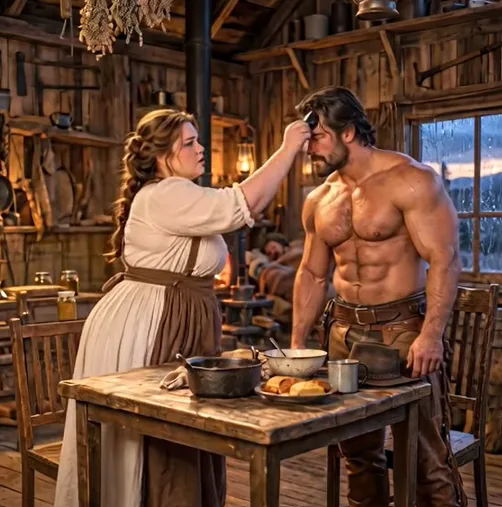
Wyoming cabin while my brutal outlaw husband sneered at my meager stew and mocked my torn apron
I read the signature three times by the dying light of the lantern, and each time the ink refused to change into a name I could forgive.
Marshal Jedediah Crane, Territorial Office, Cheyenne.
The same man whose boots had just splintered my door, whose rifle had been leveled at my husband’s heart, whose voice had rolled across my kitchen like a judge reading a sentence.
The journal trembled in my hands, and the wind pushed at the shutters as though it wanted in.
I turned the first page, and then the second, and the cramped handwriting rose off the paper in cold black lines.
Payments to the governor’s secretary. Payments to the territorial judge. A list of dates, and beside each date a sum of money, and beside each sum a single initial.
J.C.
At the bottom of the fourth page, underlined twice, someone else had written in a different hand, rougher and slanted and full of pressure, as if the pen had been fighting the paper.
If this book is found, I am dead or taken. The governor was killed by the man who signed this ledger. I took the blame to keep the proof alive. Forgive me, Clara.
I put my hand over my mouth.
Colton had written that.
Colton, who sneered at my stew and mocked my torn apron, who had come stumbling through my door in November bleeding from a bullet and demanding I keep my mouth shut.
My name is Clara Whitaker Hale, I am twenty-six years old, and until that night I had believed I was married to a murderer.
The truth, written in his own furious hand, was so much stranger and so much worse.
I sat on the cold floor with the book in my lap and listened to the wagon wheels fade down the frozen trail, taking my husband away into the dark.
I did not cry.
I was past crying.
I had three days of salted beef in the pantry, a half cord of wood by the stove, and a ledger that could hang a federal marshal.
And I had a wagon trail to follow.
I should explain how I came to be on that mountain at all.
Two winters ago my father, a failing rancher in the valley below Laramie Peak, had lost his land to the bank and his health to the cough, and he had died in the spring with a debt he could not pay and a daughter he could not feed. I was twenty-four, with a torn apron and a stubborn chin and nowhere to go.
Colton Hale had ridden into the churchyard on the day we buried my father, a tall, scarred, silent stranger in a black hat, and he had stood at the back of the mourners with his hat in his hands.
Afterward he had walked up to me and said, “I knew your pa. I owe him. I’ve got a cabin and a stove and nobody in it. You can have the cabin, and I’ll stay out of your way.”
I had married him within the month, because the preacher had insisted a woman could not live alone with a man she was not wed to.
He had never touched me.
For two winters he had slept by the door with his revolver under his pillow, and he had growled and glowered and scorned every meal I set before him, and on the cold nights I had sometimes woken to find him sitting up by the stove with his head in his hands.
I had thought him a hard man with a hard past.
I had not known he was a good man doing a hard thing.
I stood up from the floor with the ledger clutched against my chest.
There was a pair of snowshoes hanging beside the door, and my father’s old buffalo coat, and a bag of jerky I had been saving for the thaw. I pulled the coat over my shoulders, and tied the snowshoes to my boots with fingers gone stiff with cold, and shoved the journal inside my dress where it rested against my skin like a second heart.
Then I blew out the lantern, and stepped through the splintered doorway into the storm.
The wind took my breath at once.
It came down the pass in a long white roar, loaded with ice that stung my cheeks like thrown gravel, and the whole world had narrowed to a shuddering gray wall a few feet in front of my face. I could see the wagon ruts running down the trail, already half filled with drift, and I put my head down and followed them.
I walked for two hours.
My legs burned, and my lungs ached, and the cold crept through the buffalo coat like a patient thief. Twice I stumbled and fell to my knees, and twice I told myself that Colton had been bleeding on my floor when they took him, and I got up again.
When I finally saw the light, I thought it was a hallucination.
It was a single yellow window, glowing through the blizzard, set in the wall of a squat log building at the foot of the pass. A line of horses stood tethered beneath a lean-to, steaming in the dark, and beside them the wagon with the federal shield painted on the door.
The marshals had stopped for the night at the old stage station.
I crept up through the drifts with my heart pounding and crouched beneath the nearest window, and wiped a patch of frost from the glass with my sleeve.
Inside, a fire roared in a great stone hearth. Three men sat around a table with tin plates and a bottle between them, their rifles propped beside their chairs. And in the corner, shackled to a ceiling beam with his arms stretched above his head, hung my husband.
He was gray with pain.
His shirt had been torn away, and the wound in his shoulder had bled through a crude bandage and run down his ribs in a dark sticky ribbon. A bruise was blooming along his jaw. But his amber eyes, even from the window, were open and fierce and alive.
Marshal Crane sat at the head of the table with his back to the fire.
He was a big man, broad in the shoulders and heavy in the jaw, with a silver mustache and a heavy gold watch chain across his vest. He looked like a man who had never been refused anything in his life.
“Well, Hale,” Crane said, tilting his chair back. “You’ve led us a merry chase. I’ll give you that.”
“Glad to entertain,” Colton said, and his voice was a dry rasp.
“Where’s the book?”
“What book?”
“Don’t insult me.” Crane’s smile did not change. “The ledger. The one my clerk swore was stolen from my safe the week the governor died. The one that happens to have my initials in it.”
“Lost it.”
“Where?”
“In a river,” Colton said calmly. “Somewhere in the Wind River Range. I’d have to think.”
Crane laughed, soft and pleasant, and nodded to the man on his left, a thick-necked deputy with a scarred lip.
The deputy stood up, rolled his sleeves, and drove his fist into Colton’s stomach.
I flinched so hard that I banged my elbow against the window frame.
Inside, no one noticed over the roar of the fire.
Colton coughed, and hung there with his head bowed, and when he lifted it again there was blood on his teeth and a ghost of a grin on his mouth.
“That the best you’ve got?” he wheezed.
“We have all night,” Crane said gently. “And I have a great deal of patience.”
I pressed my back against the logs and slid down into the snow, my breath coming in short ragged clouds.
There were three of them, and one of me.
They had rifles, and I had a ledger and a bag of jerky.
But I had also lived with Colton Hale for two winters, and I knew one thing about him that Marshal Crane did not.
He had told me, one night in January, when the wind was screaming and the whiskey had loosened him, that the cabin’s cellar had a second door. A tunnel, he’d said, dug by some fool prospector forty years ago, running from beneath our kitchen floor to the old stage station at the foot of the mountain.
I had not believed him.
I had thought it was a drunk man’s story.
I looked up at the squat log building, and then at the sagging lean-to where the horses stood, and I began to wonder where the old stage station kept its cellar.
It took me forty minutes to find the hatch.
It lay under a snowdrift at the back of the building, a square wooden door set into the earth and chained with a rusted padlock that had not been opened in years. I dug the snow away with my bare hands until my fingers were numb, and pried at the lock with a flat stone, and when it finally gave with a crack I nearly cried out.
The cellar below was black and damp and smelled of earth and old potatoes.
I lowered myself down a rickety ladder into the dark, and crouched there listening to the muffled thump of boots on the floorboards above me.
Directly overhead, through the cracks, I could hear voices.
“You’re awfully quiet, Hale,” Crane said. “Cat got your tongue?”
“Just thinking.”
“About what?”
“About your wife,” Colton said, and the voice had gone smooth and conversational. “Annabel. Is that her name? Red hair, a little scar on her chin from a fall off a horse?”
The room went completely silent.
“How do you know about my wife?” Crane said, and the pleasant mask had cracked down the middle.
“I know a lot of things. I spent six months in your clerk’s cellar, Marshal. He kept everything.” Colton coughed, and spat. “He kept letters. He kept receipts. He kept every payment you made to a certain doctor in Denver for the care of a certain lady who isn’t supposed to be alive.”
My eyes widened in the dark.
“Shut your mouth,” Crane said.
“She’s been in that sanitarium for nine years, hasn’t she? Poor thing. Locked away, so you could take over her father’s cattle company without any messy inheritance disputes. And the governor found out. That’s why he had to die.”
“I said shut your mouth!”
There was a crash, the scrape of a chair, the heavy slap of a fist on flesh.
I clamped both hands over my mouth, and I realized with a rising wave of horror that Colton was not stalling.
He was talking so that I would hear him.
He knew I was there.
I did not know how, or when, or what instinct had told him, but I understood it as clearly as if he had spoken in my ear.
He was telling me what the ledger meant, and he was buying me time.
I felt along the cellar wall in the dark with shaking hands until my fingers closed on a rotted wooden shelf, and beneath it a rusty iron ring set into the floor.
I pulled.
A second trapdoor swung upward, and a breath of icy air rolled out of the earth, carrying the smell of stone and snow and distance.
The tunnel.
I had no lantern, and no matches, and I took the first step into the dark with my arms out in front of me and my heart in my mouth.
It ran steeply upward, narrow enough that my shoulders brushed both walls, and I crawled the last twenty feet on my hands and knees. After what felt like an hour I saw a thin gray slit of light above me, and I pushed with my head and shoulders against a wooden board and it gave, and I tumbled out into my own cabin.
I had come back to the beginning.
But I had not come back empty-handed.
Standing in my kitchen in the gray predawn light, with snow melting off my boots and the shattered door banging in the wind, I understood what Colton had meant.
He had never told me the tunnel ran both ways.
It did.
I had walked from the cabin to the station in the open, a long, cold, dangerous mile through a blizzard. I could cross it underground in a quarter of an hour, and so could anyone who knew the way.
Anyone who had a horse in the cabin barn, and a half dozen neighbors in the valley who had hated Marshal Crane for years.
I did not sit down.
I saddled my father’s old gray mare with my hands shaking, and I rode through the dawn to the nearest ranch, a tiny homestead on the edge of the valley where a gruff old woman named Hester Boone kept goats and a loaded shotgun.
She opened the door in a flannel nightgown with the gun already raised.
“Clara Whitaker?” she said. “Girl, you look like death.”
“They have Colton,” I said. “The federal marshals. They’re at the old stage station, and the leader is a murderer, and I have the proof.”
Hester Boone lowered the gun.
She studied me with narrowed, pale blue eyes for a very long moment, and then she turned her head and shouted into the dark of the house.
“Silas! Tobias! Get your boots on! We’re going to church.”
It was the code word, I would learn later, for a gathering.
By noon, there were eleven of them.
Eleven ranchers and homesteaders, in patched coats and mismatched boots, with rifles over their shoulders and cold fury on their weathered faces. Men who had lost cattle to Crane’s land office. Women who had watched their husbands arrested on false charges. An old rancher named Silas Boone who had lost his son to the territorial jail and never gotten a body back.
They sat on hay bales in Hester’s barn and listened to me read from the ledger.
Nobody spoke until I finished.
Then Silas stood, a gaunt, stooped man with eyes like burned coals, and he said, in a quiet voice that carried to the rafters, “Forty years I’ve lived in this valley, and I always knew somebody was robbing us blind. I just never knew whose name was on the receipt.”
“It’s Crane’s,” I said.
“It’s Crane’s,” he agreed. “And now we know.”
They came with me through the tunnel at nightfall.
I led them down the ladder in the cabin cellar with a borrowed lantern, eleven shadows creeping single file through the cold earth, and at the far end I pressed my ear against the trapdoor and listened.
There were voices above us, loud and slurred.
They had been drinking.
“…think he’ll talk by morning?” a deputy was saying.
“He’ll talk,” said Crane. “Everybody does. It’s only a matter of how much it costs.”
Silas Boone put a gnarled hand on my shoulder and nodded.
I pushed.
The trapdoor swung up into the lamplit room, and I climbed out into the stage station with my father’s rifle in my hands and ten men and one old woman pouring up behind me like a tide.
For a moment no one moved.
The marshal’s deputies sat frozen around the table with their tin cups halfway to their mouths. Crane stood by the hearth with a glass in his fist and his silver mustache twitching. And in the corner, still shackled to the beam, Colton lifted his battered head and looked straight at me.
“You took your time,” he said hoarsely.
“I had to get the neighbors.”
“Of course you did.” He smiled, the first real smile I had ever seen on his face, a broken, crooked, astonished thing. “Hello, Clara.”
“Hello, Colton.”
“Federal marshals!” Crane roared, finding his voice and grabbing for the pistol at his hip. “This is a federal arrest! Drop your weapons!”
“No,” said Hester Boone, from behind me, and the double barrels of her shotgun came up level with his belt buckle. “We don’t think we will.”
The deputies reached for their rifles.
Eleven shotguns clicked in unison.
The sound was enormous in the little room, a long metallic ripple like a wave breaking, and the deputies’ hands stopped in midair.
“I’d think about that very carefully, boys,” Silas Boone said softly. “There’s a lot of us, and we’re all old, and we’ve got nothing left to lose.”
Nobody breathed.
Crane’s face had turned a mottled purple, and his glass slipped from his fingers and shattered on the stones.
“You can’t do this,” he said hoarsely. “I’m a federal officer.”
“You’re a thief and a killer,” I said, and I held up the ledger with both hands so that the firelight caught the gold seal on the cover. “And this is your own handwriting, Marshal Crane. Every payment. Every bribe. Every name.”
“That’s a forgery.”
“Is it?” I opened it to the last page. “Because there’s a confession at the bottom signed by the governor’s own secretary, and a notarized statement from a doctor in Denver, and a letter from your wife.”
For the first time, something moved behind his cold eyes.
“Annabel,” he whispered.
“She wrote to the governor three weeks before he died,” I said. “She begged him to help her. She said she was not insane, and she was being held against her will, and that her husband would kill anyone who tried to free her.”
The silence in the room was so deep that I could hear the fire pop.
“She’s alive, Crane,” I said gently. “And she’s been waiting nine years for somebody to come.”
The big man stood perfectly still.
Then his shoulders slumped, and the fight went out of him like air leaving a bellows, and he sank into a chair and put his heavy face in his hands.
Hester Boone and two of the ranchers stepped forward and took the deputies’ guns.
Silas Boone crossed the room in three long strides and unlocked the shackles with a key from the table, and Colton came down off the beam in a heap, and I was beside him on my knees before he hit the floor.
“Easy,” I whispered. “I’ve got you.”
“You’re a damned fool,” he muttered into my shoulder.
“I’m aware.”
“You could’ve been killed.”
“So could you.”
“That’s different.”
“It’s not different at all.”
He laughed, and winced, and laughed again, and I felt his arms come up and wrap around me, careful of his wounded shoulder, holding me against his chest as if I were the only warm thing in the world.
“You read it,” he said, into my hair.
“I read it.”
“I wanted to tell you. Every day. I was a coward.”
“You were a federal agent working under a murderer,” I said. “You were doing the bravest thing a man can do. You were alone.”
He drew back and looked at me, and in his amber eyes I saw all the long cold nights by the stove, and the silence, and the aching care he had never known how to show.
“I’m not a federal agent,” he said quietly. “Not really. I was the governor’s secret investigator. He hired me eighteen months ago, to find out where the territorial funds were going. He was a good man, Clara. He was my friend.”
“And Crane killed him.”
“Crane shot him in his own study. I found the body.” His jaw tightened. “I took the ledger and ran, and the whole Territory put a price on my head. I couldn’t tell you. If Crane had found out you knew anything, he’d have killed you.”
“So you married me instead.”
“I married you because I owed your father, and because I wanted you to be safe,” Colton said. “And because somewhere in the second winter, I stopped being able to tell the difference.”
The room had gone very quiet again.
I realized the ranchers had all, very politely, found something fascinating to look at on the ceiling.
I felt my cheeks go hot, and I took his battered face between my hands and kissed him, right there on the stone floor of the old stage station, in front of eleven neighbors and a disgraced federal marshal.
It was a cold, clumsy, wonderful kiss.
“Well,” Hester Boone said, loudly, to nobody. “I always said that boy was soft on her.”
A ripple of laughter ran around the room, and I felt Colton shake with it against my chest.
Annabel Crane was found in a private sanitarium outside Denver, eight days later, by a pair of honest federal marshals who had come up from Washington on the first train through the thaw.
She was gaunt and gray-haired, and she had not spoken to anyone in four years, but when they told her that her husband was in custody and the door was open, she put down her sewing, folded her hands, and walked straight out.
She came to Wyoming in April.
I met her on the platform of the little depot in Laramie, a thin, silent woman in a borrowed black coat with a single carpetbag at her feet, and I took both her hands in mine and said the only thing I could think of.
“Welcome home.”
She stared at me for a long time.
Then she began to weep, silently, with her face lifted to the spring sunlight, and I put my arms around her and held her while the train whistled and the crowd parted around us.
She lived with us that summer.
She slept in the loft, and learned slowly to eat again, and sat on the porch in the long gold evenings with a shawl around her shoulders and a cup of tea, watching the light move over the mountains. By July she had started to hum, and by August she was telling Colton his biscuits were dreadful and showing him how to make them properly.
“You are a menace in my kitchen, Mr. Hale,” she said, brandishing a wooden spoon.
“Yes, ma’am.”
“I intend to civilize you.”
“I’m sure you’ll try, ma’am.”
I laughed until I cried, standing in the doorway with a basket of laundry on my hip.
Marshal Jedediah Crane was tried in Cheyenne in September.
It took four days.
Hester Boone and Silas Boone and eleven other neighbors testified, and the doctor from Denver, and the governor’s secretary, who had been in hiding for a year and came out of it with a stoop and a stutter and a trunkful of documents. When the ledger was read into the record, a murmur of disgust rolled through the packed courtroom like wind through dry grass.
Crane sat through all of it with his heavy face gone gray and his hands folded.
He did not look at his wife.
When the verdict came, guilty on every count, he did not flinch. When the judge sentenced him to hang, he only bowed his head.
The governor’s widow stood in the gallery in black, with her veil lifted, and she met my eyes across the crowded room and nodded once, slowly.
It was the nod of a woman who had waited a very long time to be told that her husband had not died for nothing.
They hanged him in October, on a cold clear morning, with the aspens burning gold on the hills.
I did not attend.
Annabel did, standing quietly at the back of the crowd with her shawl pulled tight, and when it was over she walked home alone through the dry grass, and sat on our porch for an hour without saying a word.
At the end of it she took my hand.
“I thought I would feel something,” she said. “Triumph, perhaps. Or relief.”
“And?”
“I feel only very tired,” Annabel said. “And very old. And very glad that you were brave.”
I did not know what to say.
We sat together on the porch while the sun went down behind the peaks.
In November, the first snow fell.
It came down soft and slow over the pines, and the cabin glowed in the dusk like a lantern in a drift, with smoke rising from the chimney and light spilling gold across the porch. Inside, the stove ticked, and a stew simmered on the back burner, and the smell of fresh bread filled the little room.
I sat at the oak table with my sewing in my lap, and Colton sat across from me with a new leather-bound book open before him.
It was a ledger, but not a stolen one.
It was the account book of the Hale and Whitaker Cattle Company, which the territorial court had awarded us that summer from the forfeited estate of Jedediah Crane, along with three hundred head of cattle and four thousand acres of the finest grazing land in the valley.
Colton frowned at the columns, chewing his pencil.
“I can’t make it add up,” he said.
“Let me see.”
“It’s fine. I’ll sort it out.”
“Colton.”
“I’m a man who has hunted outlaws across six territories, Clara. I can manage a column of figures.”
“Hand it over.”
He handed it over, with a sigh, and I took the pencil and found the error in thirty seconds, a misplaced decimal in the third row.
“You’re very annoying,” he said, with deep admiration.
“I’m very good at sums.”
“I noticed.”
He reached across the table and laid his hand over mine, scarred and warm and slightly shaking, and I looked up and saw that he was gazing at me with the same expression he had worn on the floor of the stage station.
“Clara,” he said. “I never gave you a proper wedding.”
“We had one.”
“We had a preacher and a dead man’s ring. You deserved a dance.”
“I never wanted a dance.”
“I know.” He smiled. “But I’d like to give you one anyway.”
He stood up, and held out his hand, and I took it, and we stood together in the warm lamplit room while the snow fell outside and the wind sang softly in the chimney.
He did not know how to dance.
He trod on my foot twice and apologized both times, and I laughed so hard I had to hold on to his shoulders, and Annabel, sitting by the stove with her knitting, hummed a slow old waltz under her breath and pretended not to watch.
When the song ended, we stood still for a long moment with our foreheads together.
“I used to think this cabin was a hiding place,” Colton murmured.
“And now?”
“Now I think it’s a home.”
“It was always a home,” I said. “You just had to stop bleeding on the floor.”
He laughed, and kissed me, and the lantern flickered, and outside the winter wind went on howling against the shutters, but it did not matter at all.
There was bread on the table, and a fire in the grate, and a man who had finally stopped running.
And on the wall above the mantel, in a plain wooden frame, hung a single page torn from a stolen ledger, the one with Colton’s handwriting, rough and slanted and full of pressure.
Forgive me, Clara.
I had forgiven him a long time ago.
I only needed the rest of my life to tell him so.