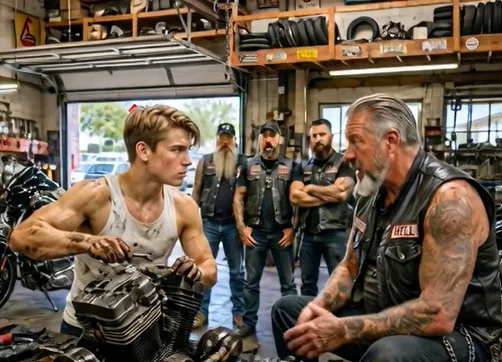
In the greasy workshop of Custom Choppers by a terrifying biker gang leader while grease stained my hands was humiliating
The words dropped into the silence of the garage like a wrench onto concrete, and for a long moment nobody moved.
I stared at the note in my hands, at my father’s slanting, hurried handwriting, and the letters blurred until I had to blink hard to read them.
Jack Brennan, it said. I do not trust him, and yet he is the only one left who can carry this to the right people. If I am dead, find the boy.
“Find the boy,” I whispered. “He wrote that about me.”
“He wrote it about you,” Jack said, and his big shoulders sagged as though someone had cut a rope. “And I did not find you for ten years, Leo. That is the part I cannot forgive myself for.”
The federal agents had cleared the lot outside, and the flashing lights had dwindled to a faint, pulsing glow against the rain-streaked windows.
A tall woman in a gray windbreaker stepped through the side door, with a badge on her belt, a braid of dark hair going silver, and tired, steady brown eyes.
“Mr. Brennan,” she said, “I need to speak with you and the young man, and I would prefer that your people give us the room.”
Jack nodded at the circle of bikers, and they filed out one by one, silent and watchful, until only the three of us stood among the half-built engines and the smell of oil.
“I am Special Agent Rosa Delgado,” the woman said, turning to me. “I have been working the Arthur Wells case for six years, and I have been waiting a very long time to meet you, Leo.”
“Leo Marsh,” I said, trying the name on my tongue. “That is what Jack called me. I have been Leo Wells on paper for three years.”
“Arthur made you a Wells so that nobody would ask who you really were,” Delgado said gently. “Your father was Thomas Marsh, and he was the best engine designer I ever heard of.”
I sat down hard on an overturned crate, because my legs had stopped working.
“Tell me,” I said. “All of it. I am done with half-truths.”
Jack pulled up a stool and sat across from me, and Delgado leaned against the workbench with her arms folded, and the rain whispered against the tin roof.
“Twenty years ago, your father and I started this club with six broken motorcycles and a handful of friends who had nowhere else to go,” Jack began. “Tom could look at an engine and hear what was wrong with it, like a doctor with a stethoscope.”
“He designed a new kind of cylinder, lighter and cleaner than anything on the market, and he never wanted a dime from it. He wanted to give the design away to every mechanic in the country.”
“Arthur Wells was a venture capitalist who came to us wearing a nice suit and smiling like a friend,” Jack said, and his lip curled. “He offered to fund the patent, and your father, who trusted everyone, signed the papers without reading them.”
“Those papers gave Arthur ownership of everything,” said Delgado. “When Tom found out, he went to a lawyer, and Arthur panicked.”
“He framed your father for embezzlement from the club accounts,” Jack went on. “He bribed a bookkeeper and forged a ledger, and the club split in two, half of them believing the lie.”
“I was one of the ones who believed it,” he said, and his voice cracked. “God help me, Leo, I believed it for three weeks.”
My stomach turned cold. “And then?”
“And then I found the real ledger in Arthur’s car,” said Jack. “I drove to your father’s garage at midnight to tell him, and I got there ten minutes too late.”
The shop was quiet, and I could hear my own heartbeat.
“The garage was already burning,” Jack said hoarsely. “Arthur’s men had locked the doors and poured gasoline around the foundation, and I could hear Tom shouting inside.”
“I broke the side window with a tire iron, and I pulled him out, and he was alive, Leo. He was alive, and he was burned across the back and arms, and he grabbed my vest and made me promise.”
“What did he promise you?” I whispered.
“That I would stay away from you,” Jack said, and tears slid down into his silver beard. “He said that Arthur would watch every friend he had, and that if I came near you, Arthur would know you were Tom’s boy and finish the job.”
“He gave me that photograph and the note, and he told me to hide until the day I could prove everything.”
“And my father?” My voice broke. “He did not die in the fire?”
Jack looked at Delgado, and she drew a slow breath.
“Thomas Marsh died eleven days later in a federal hospital under a false name,” she said softly. “Pneumonia from the burns, and his lungs never recovered. I was a young agent then, and I sat beside his bed.”
A sound came out of me that was half laugh and half sob, because for ten years I had believed my father died instantly, in smoke and silence, without anyone beside him.
“Did he say anything?” I asked.
Delgado smiled, and her eyes shone. “He asked me whether you were safe,” she said. “He asked it again and again, and when I said that I would find out, he said, tell him I fixed his bicycle.”
I stopped breathing.
“The bicycle,” I whispered. “The red one. The chain kept slipping, and he told me that I was not allowed to touch it until I was ten, and then the night before the fire, he”
“He fixed it,” Jack said, and his voice shook. “He stayed up late after a double shift and rebuilt the whole drivetrain, because he wanted you to wake up to a bike that worked.”
I pressed my hands over my face, and the dam in my chest broke completely, and I wept in the middle of a greasy workshop with two near-strangers who had known my father better than I had.
Jack was beside me before I could draw a breath, and his arm came around my shoulders, heavy and warm and smelling of leather and engine oil.
 “I am sorry,” he said, over and over. “I am sorry, I am sorry, I am so sorry.”
“It was not your fault,” I said into his vest.
“It was partly my fault,” he said gently. “I carry that, and I will always carry it, but I would like to carry you too, if you will let me.”
I lifted my head and looked at his weathered, tear-streaked face, at the sorrowful blue eyes that I had mistaken for threatening an hour ago.
“I do not know how to be anyone’s family,” I said. “I have been alone for so long.”
“Then we will learn together,” said Jack. “I am not very good at it either.”
Delgado cleared her throat, and I saw that she was wiping her own eyes with the back of her hand.
“There is more, if you are ready,” she said. “But it is good news, and I think that you have earned some.”
She picked up a leather briefcase from the floor and set it on the workbench, and she clicked the latches open with a flourish.
“Arthur Wells has been arrested on eleven federal counts tonight, including murder, arson, fraud, and conspiracy,” she said. “The recording that Jack mentioned is real, and it is damning.”
“Three weeks ago, one of Arthur’s own lawyers came to my office with a flash drive and an attack of conscience. It contained every wire transfer, every forged ledger, and an audio file of Arthur ordering the fire.”
“My father’s patent,” I said slowly. “What happens to it?”
Delgado’s smile widened. “It was never legally Arthur’s,” she said. “The signatures were obtained by fraud, and the court will void the assignment. Everything your father designed belongs to his estate.”
“His estate,” I repeated, and then I understood. “Me.”
“You,” said Delgado. “The patent, the royalties, the licensing rights, all of it, held in trust since the day he died.”
I looked at Jack, who was grinning through his tears like a boy at a birthday party, and I began to laugh, a high, helpless, hiccuping laugh that echoed off the rafters.
“My father is going to give his engine away to the whole world after all,” I said. “He is going to get exactly what he wanted.”
“Not him,” said Jack, squeezing my shoulder. “You. And I would bet my last motorcycle on what you will do with it.”
The trial of Arthur Wells began in January, in a tall federal courthouse of gray stone, under a sky the color of dishwater.
I sat in the second row in a borrowed suit that Jack’s club had bought me, with Jack on one side and Agent Delgado on the other, and I stared at the back of Arthur’s head.
He wore a charcoal suit and kept his chin high, and every so often he leaned toward his lawyer and whispered something that made the man’s mouth tighten.
The prosecutor, a lean, patient man named Mr. Adeyemi, spent three weeks building the case brick by brick.
He played the recording of Arthur’s voice calmly giving instructions about the gasoline, and the whole courtroom sat frozen as the cold, even tones filled the air.
He called the bookkeeper who had forged the ledger, a stooped, trembling man who wept as he described the envelope of cash. He called a retired fire investigator who had never believed the official report, and who had kept a box of evidence in his garage for ten years.
Then he called me.
I stood in the witness box with my hand on the Bible, and I looked across the crowded room into Arthur’s eyes. They were pale and cold, and they held no recognition at all, as though I were a stranger who had wandered into the wrong building.
“Mr. Marsh,” said Mr. Adeyemi gently, “can you tell the jury how you came to live in Arthur Wells’s house?”
“I believed that my parents had died in an accident,” I said. “I believed that Mr. Wells took me in out of kindness. I was seventeen, and I had no one.”
“For three years, I wore the clothes he bought me and went to the school he chose, and I thanked him for it.”
“And when did you learn the truth?”
“When I found a photograph in his safe,” I said. “A photograph of my father, standing beside a motorcycle, laughing. And I realized that the man who had told me my father was a stranger had kept his picture locked up like a trophy.”
The defense attorney tried to shake me in cross-examination, suggesting that I was a runaway with a grudge and a convenient story.
“Sir,” I said, “I am a mechanic. I take things apart for a living, and I put them together again. If you hand me an engine, I can tell you what was done to it, and by whom, and when.”
“I have looked at this case the same way, and I assure you that every part fits.”
A ripple of laughter ran through the gallery, and the judge, an old man with kind eyes and a drooping mustache, hid a smile behind his hand.
The jury deliberated for two days.
When they returned, a deep hush filled the courtroom, and Jack’s hand found mine and gripped it hard.
“On the charge of murder in the first degree of Thomas Marsh, guilty.”
“On the charge of arson, guilty.”
“On the charge of fraud and forgery, guilty.”
“On the charge of conspiracy, guilty.”
Arthur did not move, and for the first time, something cracked in his composed face, and I saw a flicker of raw, naked fear.
The judge sentenced him to life without the possibility of parole, and as the marshals led him past our row, he turned his head.
“Leo,” he said, in a hoarse whisper. “I gave you everything.”
“You gave me clothes and tuition,” I said quietly. “My father gave me a bicycle that worked, and it was worth more than your whole house.”
He stared at me, and the marshals tugged his arm, and he was gone.
Outside, the winter sun broke through the clouds in long gold ribbons, and a crowd of bikers lined the courthouse steps in a double row with their helmets under their arms.
There were fifty of them, grizzled men and women in worn leather vests, and when I came through the doors with Jack beside me, they began to clap.
It was a slow, steady, rolling applause, and it swelled until it filled the whole plaza, and I stopped on the top step with tears running down my face.
“They are clapping for you,” Jack said.
“They are clapping for Tom,” I said. “And for you.”
“Then let us take a bow for him,” said Jack, and he put an arm around my shoulders, and together we nodded to the crowd.
We opened the shop again in the spring, in the same building, with the same hum of overhead lights and the same smell of oil and metal.
But Jack had cleaned the floors until they shone, and painted the walls a warm cream, and hung a new sign above the roll-up door in gold letters.
Marsh Cycle Works, it read, and underneath, in smaller letters, Every Part Has a Purpose.
I put my father’s photograph on the wall behind the register, the one of him laughing beside the motorcycle, and beneath it a brass plate with the words Thomas Marsh, Engine Designer, Friend, Father.
Then I did what my father had always wanted.
I used the first of the patent money to build a free training school in the back half of the shop, with a dozen workbenches, a wall of donated tools, and a chalkboard where Jack drew diagrams of cylinders and camshafts with great flourishes and terrible handwriting.
I invited anyone who wanted to learn, runaways and veterans and kids from the foster homes and people who had been laid off from the factories, and I taught them what my father had taught me, that an engine is a story told in metal, and anyone can learn to read it.
By summer, the school had forty students, and by fall, a waiting list.
One of them was a thin, wary girl of sixteen named Cass, with a shaved head, a split lip, and a duffel bag that she never let out of her sight. She had arrived one rainy evening, asked for work in a voice barely above a whisper, and I recognized in her eyes the exact look that I must have worn the day Jack knelt beside my workbench.
“Do you need a paycheck,” I asked her gently, “or are you ready to rebuild your life?”
She stared at me, and her lip trembled, and she said, “Can it be both?”
“It can be both,” I said, and I put a wrench into her hand. “Come here. I will show you how a carburetor breathes.”
She worked beside me every evening that autumn, and by December she could strip and rebuild an engine blindfolded. On the night of the first snowfall, she looked up from her workbench with grease on her cheek and a small, stunned smile.
“I did not know that I was good at something,” she said.
“You are good at a great many things,” I said. “You just needed somebody to hand you the tools.”
Jack, who had been listening from the doorway with a mug of coffee, ducked his head and cleared his throat very loudly.
“Allergies,” he said.
“To happiness,” Cass and I said together, and he laughed so hard that he spilled his coffee.
On the second anniversary of the arrest, the three of us rode out to the old garage site on the edge of town, where my father’s workshop had once stood.
The charred foundations had been cleared years ago, and wildflowers had grown up in the rubble, yellow and purple and white, swaying in the wind. Someone, Jack would never say who, had planted a small apple tree in the middle, and it was just starting to bloom.
I stood beside it with my hands in my pockets, and the evening light slanted gold across the field.
“Hi, Dad,” I said softly. “I fixed the bike. Well, you did. But I kept it running.”
The wind stirred the branches, and a few white petals drifted down and landed on my shoulders like a blessing.
Jack stood beside me with his hat in his hands, and Cass hung back respectfully, and for a long while nobody spoke.
“I think he would like the school,” Jack said at last.
“I think he would like you,” I said. “I think he would have forgiven you the night he died, if he had had the time.”
Jack’s face crumpled, and he pressed his fist against his mouth, and I put my arm around his broad back and held on.
“Thank you,” he whispered.
“No,” I said. “Thank you, for finding the boy.”
We rode home together at dusk, three motorcycles in a loose line along the winding river road, with the engines singing and the wind carrying the scent of apple blossoms and rain.
The sky blazed orange and rose and violet over the hills, and the first stars blinked awake one by one above the dark line of the pines.
I leaned into the curve with the warm roar of the engine beneath me, and I thought about a boy in a stained tank top bent over a stranger’s engine, believing that he was alone in the world.
I wished that I could reach back through time and tell him that the road would be long and the rain would be cold, but that a man with silver hair and a heart like an open garage door was already looking for him.
The lights of the shop glowed ahead of us in the gathering dark, warm and yellow against the rain, with the gold letters shining over the door.
We pulled into the lot, and the engines died one by one, and the sudden silence was soft and full.
Jack swung off his bike and clapped a heavy hand on my shoulder, and Cass grinned at us both with her helmet under her arm.
“Home,” Jack said, and his voice was thick.
“Home,” I said, and I looked at the glowing windows and the little apple tree on the hill in my mind and the two people beside me, and I understood that my father had never really left the shop at all.
He was in every engine that turned over, in every kid who learned to listen, in every light left burning in a window for someone who was lost.
We walked inside together, out of the rain, and Jack put the kettle on, and the old building hummed around us like a living thing.
“We are home,” I whispered to the warm yellow light, and somewhere in the rafters, I could have sworn that an engine purred in answer.