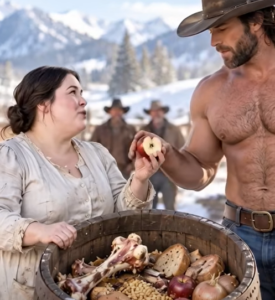
With a half-cut apple in my hand while a massive, shirtless cowboy leaned over a wooden barrel filled with scraps in the freezing snow
The footsteps stopped when I stopped. River light cut a pale bar across the last stones, and a man’s boots stood in it, not Jesse’s, not the sheriff’s. I knew the set of them from a winter when my father still walked the barn aisle and counted this same tunnel as a joke for smugglers who had never come. Marshal Ed Rowe. He had eaten at our table before the syndicate taught the valley a new grace. The phone buzzed again in my fist: Don’t trust the badge at the mouth. I looked at the screen, then at him, and did not drop the ledger.
“Clara,” Rowe said. He did not reach. “Jesse wrote that text from the foothill switch. He wants you to turn around into the sheriff’s gun. The copies you told the sheriff about are real. I sent them at noon. I am not the man in the message.”
“Prove the noon,” I said.
He held up his own phone, federal header, timestamp, the territorial governor’s clerk confirming receipt of the wire log. The cold in my veins loosened one notch and no more. Behind me the tunnel still smelled of powder. Ahead, the river knocked at the ice. I came forward with the book against my coat and let him see the pages without giving them up. Bribes. Land grabs. A line in Jesse’s hand authorizing the night my father did not come back from the timberline. Tender words had been a barrel trick. The mastermind had kissed me over the false bottom and then ridden off to be rescued by his own lie.
“He will be at the county line trying to look like a witness,” Rowe said. “The sheriff is already in cuffs by the trough. If you surface with the book, the performance ends. If you wait for Jesse to come explain the apple, it starts again.”
I surfaced. The settlement was a smear of smoke and shouted orders. Agents moved through the snow with the stiff care of people who had been lied to by local stars and did not intend to be lied to twice. Rowe walked me to a wagon, not a cell. I set the ledger on the seat and kept my hand on it while a deputy photographed every page. Jesse’s authorization. The sheriff’s cut. The committee names. The false-bottom sketch in the margin, drawn by someone who had loved the ranch enough to hide it and hated it enough to sell the hiding place.
They took Jesse off his stallion at the switch, still arranging his face into concern. He saw me and tried the whisper across the distance. I did not give him the distance. I gave the nearest marshal the page with his name and the date of the execution order, and I said, loud enough for the onlookers who had watched the apple, that the kiss had been a search. His mouth changed. The performance does not survive being named in front of the people it recruited. They cuffed him beside the sheriff. The armed riders broke into bargains. None of the bargains returned my father. The river ice kept what the timberline had taken. I had already known. The ledger only stopped me from calling the knowing a doubt.
The hearing sat in a schoolhouse because the courthouse roof had taken the blast at the gate. Families who had lost sections stood along the wall and heard their deeds read back out of the false bottom. Jesse pled to the land fraud and the procurement and tried to call the two years a protection. The judge, a woman who kept ranch hours, wrote the apple into the finding as coercion, not romance. Rowe testified to the noon wire. I testified to the cellar threats, the sunset deadline, the text in the tunnel. I did not spare myself the months I had wanted the tenderness to be true. Wanting was not consent. The record could hold both.
The ranch came back as a reversion, not a crown. I signed the lower pastures over to the families whose names had been in the grab column, and I kept the house and the tunnel and the barrel, which we broke apart in the yard so no false bottom could be romanticized by the next thief. Rowe stayed through the survey and did not stay for a speech. Jesse went east to a sentence that did not include visits. On the first clear morning I cut an apple in the kitchen for no audience and ate both halves. The snow kept its own counsel.
What the onlookers had been meant to see was a love that excused a theft. What the tunnel refused was the savior script. A happy ending here is not a resurrection. It is a ledger in evidence, a sheriff without a key to the cellar, a woman who walks her own gate, and neighbors replanting on ground that has their names again. The lesson is sharper than a kiss. Tenderness that demands the papers by sunset is a warrant in disguise. Believe the page, not the mouth. I keep my father’s last deed framed in the kitchen, not as a relic of the man they murdered, but as proof the valley can be returned. The apple tastes like apple. The performance is over. We are still here.
Spring came late to the settlement, and with it a surveyor who did not work for the committee. He walked the lower pastures with the families whose names had come out of the grab column, and I walked with them because a signature in a schoolhouse is only a promise until the stakes go in. Mrs. Pell, who had lost the creek bend the winter my father vanished, set the first post herself and did not thank me. She asked whether the tunnel still opened. I said it opened onto the river and onto nothing else. She nodded as if a door that no longer led to a sheriff’s gun was thanks enough.
Jesse’s counsel filed a last letter from the east, calling the two years a tragic loyalty and asking me to soften the finding about the apple. I returned it unopened. Rowe, passing through on a boundary check, saw the envelope and did not offer advice. He said the territorial clerk had entered the deeds in the public book, copies anyone could request without a barrel or a kiss. That was the protection the whisper had pretended to be. I kept the public book number on a card above the stove.
A boy from the timberline cabins came in June with a scrap of my father’s handwriting, found in a lining of a coat the syndicate had sold at auction and a widow had bought for the wool. The scrap was a feed receipt, not a confession, oats and a price and the date of the week he died. I stood in the yard and understood the shape of the lie more clearly than the ledger had allowed. They had needed a murder that looked like a disappearance and a daughter that looked like a romance. The receipt was too small for either story. I gave the widow the coat back and the receipt to the file. Small paper is how large thefts are corrected.
On the anniversary of the gate blast we did not hold a ceremony. We mended fence. Hale weather moved across the ridge, ordinary thunder, no marshals in it. Lily was not mine to soothe. The child in this valley was Pell’s grandson, who asked why the barrel staves were still piled by the trough. I told him some furniture had been a hiding place, and hiding places that served thieves got broken in daylight. He accepted that with the seriousness of a person who had watched adults perform tenderness for an audience. Children learn the difference if you let them see the staves.
Rowe came once more before winter and brought nothing but a confirmation that Jesse’s sentence had survived appeal. He drank coffee in the kitchen under the framed deed and did not call himself a savior. I did not call him one. The text in the tunnel had been a last attempt to turn a badge into a threat. It failed because the noon wire existed outside the performance. We talked about drainage and not about kisses. When he left, the house stayed mine.
What the extra months proved, and what the first hearing had only started, was that a returned ranch can still be lost to nostalgia. I could have kept the barrel, retold the apple as fate, waited for a version of Jesse that the cuffs had invented. I broke the barrel, filed the receipt, and let the neighbors set their own posts. The happy ending is not a man at the tunnel mouth. It is a public book number, a creek bend back under Pell’s name, a kitchen where both halves of the apple are eaten without an audience, and a woman who no longer mistakes warning for love. The lesson holds in the staves by the trough. If the tenderness has a sunset deadline, it is a theft. Believe the page. Plant the bend. Leave the performance in the snow where it died. The valley is named correctly again, and I am still here to read it.