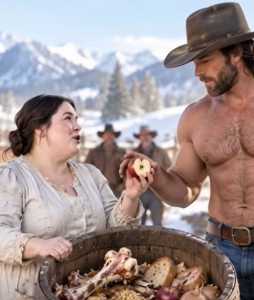
With a half-cut apple in my hand while a massive, shirtless cowboy leaned over a wooden barrel filled with scraps in the freezing snow
The footsteps belonged to a man who knew the tunnel well enough not to hurry. Marshal Ed Rowe stopped where the river light cut the stones and kept his hands where I could see them, empty of a gun, full of a folded wire slip. The phone in my pocket buzzed a second time, same unknown number, same warning. I did not lower the ledger.
“Jesse sent that,” Rowe said. “From the switchback. He wants you to turn around into the sheriff’s barrel. I am the noon wire you told the sheriff about. If I were the trap, I would not be holding the governor’s receipt.”
He held the slip out. The header was federal. The time was noon. The clerk’s name was one my father had trusted with seed orders and nothing else. My blood thawed one degree and no more. Behind me the cabin still thumped with boots. Ahead, the ice clicked. I came forward and let him see the pages without surrendering them. Jesse’s authorization. The sheriff’s cut. The committee. The night my father did not come back from the timberline, written in the same hand that had brushed my hair over a barrel of scraps.
“He ordered it,” I said.
“He ordered it and then kissed you so the yard would remember a love scene instead of a search,” Rowe said. “The sheriff is already down by the trough. Jesse is arranging his face into concern at the county line. If you surface with the book, the scene ends. If you wait for him to explain the apple, it starts again.”
I surfaced. Smoke lay over the settlement in a dirty sheet. Agents moved through the slush with the care of people who had been lied to by local stars. Rowe walked me to a wagon, not a cell. I kept my hand on the ledger while a deputy photographed every page in the gray light. Onlookers who had watched the kiss watched the pages. A performance dies faster when the audience is invited to read.
They took Jesse off the stallion at the switch. He saw me and tried the whisper across the snow. I did not cross the snow. I gave the nearest marshal the execution line and said, loud enough for the armed men who had watched his tenderness, that the apple had been a deadline. His mouth changed. The sheriff, cuffed at the trough, tried to call the tunnel a kidnap. The noon receipt called it a delivery. Riders broke into bargains. None of the bargains brought my father up from the timberline. The ice kept what the order had taken. The ledger only stopped me from calling that knowledge a doubt he could kiss away.
The hearing sat in a schoolhouse because the gate blast had opened the courthouse roof. Families who had lost sections stood along the wall and heard their deeds read out of the false bottom. Jesse pled to the fraud and the procurement and called the two years a protection. The judge, a woman who kept ranch hours, wrote the apple into the finding as coercion. Rowe testified to the noon wire. I testified to the cellar threat, the sunset, the text in the dark. I did not spare the months I had wanted the whisper to be true. Wanting was not consent. The record held both without blushing.
The ranch returned as a reversion, not a crown. I signed the lower pastures back to the names in the grab column and kept the house and the tunnel. We broke the barrel in the yard so no false bottom could be retold as a love token. Rowe stayed through the survey and did not stay for a speech. Jesse went to a sentence that did not include visits. On the first clear morning I cut an apple in the kitchen with no onlookers and ate both halves. The snow had nothing to watch.
What the yard had been built to bless was a theft with a tender face. What the tunnel refused was the savior script, even when the footsteps were honest. A happy ending here is not a resurrection. It is a book in evidence, a sheriff without the cellar key, neighbors replanting on ground that has their names, and a woman who can eat an apple without an audience. The lesson is sharper than the kiss. Tenderness that demands the papers by sunset is a warrant. Believe the page. Not the mouth. Not the text that names the man at the light. I keep my father’s last deed in the kitchen, not as a relic of the murdered, but as proof the valley can be returned. The performance is over. The gate is mine. We are still here, and the wind can sweep the settlement without being asked to hide a barrel.
The schoolhouse stove smoked for the whole of the finding, and the smoke made the sentences slower, which suited them. The judge read the apple not as a symbol but as a time. Sunset. Ledger. Cellar. She read Jesse’s authorization beside the timberline date and did not look at him when the dates met. He sat with his hands visible and tried, once, to catch my eye the way he had caught it over the barrel. I looked at the photographed page. The onlookers along the wall, the same faces that had stood in the snow while he brushed my hair, shifted their weight as if the floor had become a record they did not want to be in. Mrs. Pell, who had lost the creek bend, said her father’s name when it was returned and then sat down hard on a bench. No one clapped. Clapping would have made it a show, and the show was what we were burying.
After the judge signed, Rowe walked the ledger to a clerk who wrapped it in oilcloth and numbered it in a book anyone could ask to see. I watched the number being written. A number is a duller salvation than a kiss and it lasts longer. Jesse was taken out the side door so the yard could not become his last scene. He said my name once, in the voice he had used for darling. A bailiff shut the door on the syllable. I did not follow it. The sheriff tried a speech about order and was walked to the same wagon. His Stetson stayed on the schoolhouse peg until a child took it down and put it in the trash. No one stopped the child.
The reversion took nine days of stakes and arguments about fences. I signed the lower pastures back in the kitchen, not in the yard, because the yard still remembered the apple. Pell took the creek bend and cried without apologizing for it. Two timberline families took the sections the grab column had called vacant. I kept the house, the tunnel, and the obligation to leave both unlocked for the surveyor. Rowe read each deed aloud before I signed, a habit I asked him to keep. When he finished he drank one cup of coffee and left before the cup could become a claim. Help that stays for the second cup starts to look like the first tenderness. He seemed to know the arithmetic.
We broke the barrel on a Saturday with the settlement invited. I wanted witnesses for the unmaking, not for the kiss. The false bottom came up with a crack that sounded like a small bone. Inside, a few grains of the ledger’s leather dust and nothing else. Pell’s grandson asked why we were breaking a good barrel. I told him some furniture had been a hiding place, and hiding places that served a deadline got broken in daylight. He helped stack the staves by the trough. Jesse’s counsel sent a letter that week calling the breaking a desecration of a love. I returned it unopened and pinned the envelope to the stave pile so the weather could open it instead.
The first month was loud with ordinary work. Roof. Latch. A cow that did not care about syndicates. I woke twice to the sound of the tunnel and found only meltwater. On the third waking I went down with a lamp and walked the passage to the river until the fear became a map. Maps are less romantic than footsteps and more useful. I left a copy of the noon receipt in a tin at the exit, not as bait, as a correction for anyone who might be texted that the man at the light was a trap. The receipt had already done its job. Paper can do it twice.
Spring opened the timberline. I went up with Pell and a marshal who was not on anyone’s old payroll, and we found the place the ledger had described, a cut bank, a belt buckle that had been my father’s, no body the thaw was willing to give. I did not make a speech to the trees. I bagged the buckle for the file and let Pell say a prayer if she wanted one. She wanted one. I stood in it without borrowing it. Grief that performs for onlookers is how Jesse had started. I would not give the ridge a performance.
In town the committee’s last clerk tried to refile a grazing note under a new stamp. The public book number stopped him. The clerk who had wrapped the oilcloth sent me the attempt in the mail, a courtesy that felt like a lock. I pinned that, too, beside the stove, under the framed deed. When the girl from the schoolhouse, Pell’s niece, asked why so many papers lived in a kitchen, I said kitchens are where people try to make you eat what they have decided. Papers on the wall are how you refuse the plate.
Jesse wrote once from the territorial prison. The letter smelled like soap and strategy. He wrote that the apple had been real and the order had been the sheriff’s and the kiss had been the only true thing in the yard. I burned it in the stove and sent the prison a notice that further letters would be returned. Burning is not justice. Filing is. The burn was for the part of me that still knew the taste. I do not pretend that part left with the stallion. I pretend nothing. I keep it where the fire is, and I do not feed it.
On the anniversary of the gate blast the settlement mended fence and did not hold a ceremony. Rowe passed on the road, raised a hand, did not stop. The staves by the trough had silvered. The public book still had our names. I cut an apple at dusk, both halves, no whisper, no armed men in the snow, and ate them at the table while the wind did what wind does. The ending is not a man at the tunnel and not a resurrection in the timberline. It is longer than that and plainer. It is the number in the clerk’s book, the bend under Pell’s post, the barrel that cannot hide anything again, the receipt in the tin, the letter burned, the buckle filed, the kitchen where both halves are eaten without an audience. The lesson sits in the duration. A kiss can stage a theft in a minute. Returning the ground takes stakes, refusals, a noon wire, a judge who can read a sunset as a threat, and a woman who stays through the thaw to see what the ice was keeping. Believe the page. Walk the tunnel until it is only a tunnel. Let the onlookers watch the fence go up, not the performance. The valley is named correctly. The apple tastes like apple. I am still here, and the being here is the whole of the mercy I kept.