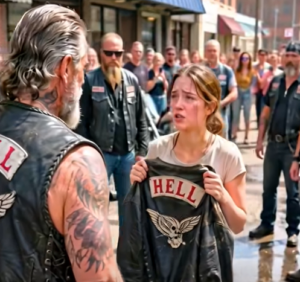
When tearing my father’s heavy leather cut from my trembling hands while sneering that my missing father was a coward who abandoned his club
The SUV slammed into my rear bumper, and the whole truck lurched forward like a wounded animal, the steering wheel bucking so hard in my hands that the jacket slid off the passenger seat and onto the floor mat.
“Come on, come on,” I whispered, and my voice shook so badly the words hardly sounded like mine.
I stomped the gas pedal flat to the floorboard, and the old pickup shuddered up to ninety, rattling like a coffee can full of bolts, the desert flashing past in smears of black and silver.
In the mirror the SUV’s headlights swelled until they filled the cab with white glare, and I squinted against it, tears of fear blurring the road into a long ribbon of nothing.
My name is Nora Reyes, I am twenty-two years old, and until three days ago the most dangerous thing in my life had been a lease agreement on a one-bedroom apartment.
Then my father’s note had appeared on my dresser, written in the cramped, careful handwriting I would have known anywhere, and everything I believed about my family had come apart like wet paper.
Nora, it had said. Take the cut to Agent Whitlock at the Dalton field office. Tell no one in Ridgeback. Trust the stitches, not the men. I’m alive. Forgive me.
I had read the words fifty times, and each time my heart had cracked a little more, because I had spent three years believing my father was either dead or a traitor.
Now I was driving through the dark with a micro-SD card in my fist and a murderer’s headlights in my mirror, and I understood that he had been neither.
The SUV hit me again, harder, and the pickup’s rear end fishtailed across the centerline, and I wrenched the wheel left and right until the tires bit the asphalt again.
“Dad, if you’re out there,” I breathed, “I could really use a miracle.”
The road ahead curved sharply around a wall of red rock, and I saw a narrow gap in the guardrail where a dirt service road dropped away toward a dry riverbed.
I did not think.
I yanked the wheel hard to the right, the truck skidded sideways in a scream of rubber, and then we were bouncing down the gravel track with the SUV’s brake lights flaring red behind us as it overshot the turn.
Dust rolled up around the cab in a choking cloud, and I killed my headlights and let the truck coast down into the wash, my pulse hammering in my ears.
The SUV turned around on the highway above, its engine growling, its spotlight sweeping the desert like the eye of some enormous hunting bird.
I held my breath, flattened against the seat, and watched the white beam slide across the rocks, the sagebrush, the dry creek bed, and stop a few yards from my fender.
Then it moved on.
I counted to sixty, and then to sixty again, and only when the growl of the engine faded away down the highway did I let myself breathe.
My hands were shaking so hard I could barely pick up the jacket from the floor.
It lay across my lap, heavy and warm and smelling of motor oil, old tobacco, and the faint cedar aftershave my father had worn every day of my childhood.
I pressed my face into the leather and felt the grief I had been holding back for three years rise up like water through a cracked dam.
“I miss you,” I whispered into the collar. “I miss you so much, and I’m so angry at you, and I don’t know how to be both.”
A soft tap came against my window.
I screamed, because it was the kind of sound that stops a heart, and I scrambled for the pistol my father had taught me to keep under the seat.
A face peered in through the glass, a young face, freckled and frightened, framed by a ragged mop of red hair and the faded collar of a mechanic’s shirt.
“Hey, hey, don’t shoot, lady, please,” the boy said, holding both hands up. “I’m not with them. I swear to God I’m not with them.”
I did not lower the pistol. “Who are you?”
“Danny Cole,” he said. “I work the garage at the compound. I saw what Ravage did to you back there, and I saw you take off, and I followed you on my brother’s dirt bike.” He swallowed hard. “I know what’s in that jacket.”
My finger tightened on the trigger. “Say that again.”
“The president’s name is Cutter Dane, but everyone calls him Ravage,” Danny said, speaking fast and low. “Three years ago your dad told me something I’ve never forgotten. He said if the day ever came that his daughter walked into that compound holding his cut, I should help her get out alive.”
The wind moved across the wash, cold and dry, and I looked into his wide scared eyes and tried to find the lie.
There wasn’t one.
“My father told you that?” I asked.
“He did me a favor once,” Danny said. “My mom was sick, and the club was going to throw us out of our trailer, and your dad paid the rent for a year out of his own pocket. He never told anyone. He just said, someday, kid, you might pay it back.”
I lowered the pistol slowly, and something unclenched in my chest.
“Get in,” I said.
He climbed into the passenger seat with an armful of scraped knuckles and wild red hair, and he glanced at the jacket on my lap and let out a low whistle.
“You need to know something,” he said. “Ravage has a cop on his payroll. Sheriff Dale Burkett, out of Dalton County. He’s the one who runs the SUVs. If you drive to the Dalton field office, Burkett will be waiting in the parking lot before you reach the front door.”
My stomach turned over. “The note says Agent Whitlock.”
“Whitlock’s a good man,” Danny said. “But Whitlock’s phone is tapped, and Burkett’s deputies watch his building.”
“Then how do I reach him?”
Danny scratched the back of his neck and looked out the windshield at the starlit canyon. “Your dad built a back door,” he said. “A long time ago, when he still ran the club. A railway locker out on the old Calloway spur, forty miles east. Only three people ever knew about it.”
My fingers closed around the small brass key hidden in the jacket pocket. “I know about it now.”
“Then that’s where we start,” Danny said.
We drove east without headlights, creeping along rutted ranch roads under a sky so thick with stars that the whole desert glowed faintly blue, and for the first hour neither of us spoke.
Danny watched the rearview mirror with the haunted attention of someone who had spent his whole life watching for trouble, and I watched the black horizon, and the jacket lay between us like a sleeping animal.
“Can I ask you something?” Danny said at last.
“Sure.”
“Do you think he’s really alive?”
The question landed like a stone in still water, and I felt the ripples spread through me, slow and aching.
“I want to,” I said. “God, I want to so badly it hurts. But I held the memorial candle at his funeral, Danny. I stood in a church and listened to a priest talk about a man who was supposed to be ashes. I don’t know how you un-bury that.”
“Maybe you don’t,” Danny said gently. “Maybe you just keep walking until you find out.”
I wiped my cheek with the back of my wrist and nodded, because there was nothing else to say.
The Calloway spur appeared out of the dark just before midnight, a ghostly stretch of rusted rail running through a field of tumbleweeds, and at the end of it a tin-roofed freight shed leaned against the night like a drunk against a lamppost.
I parked behind a stand of dead cottonwoods, and Danny and I crept toward the shed with a flashlight dimmed to a sliver, our boots crunching softly on frozen gravel.
Inside, the air smelled of rust and mouse droppings, and a long row of battered steel lockers stood against the far wall, each one stamped with a faded number.
“Seventeen,” I said, reading my father’s handwriting off the inside of the note. “It’s locker seventeen.”
I slid the brass key into the lock with fingers that would not stop trembling, and the door swung open with a long, mournful creak.
Inside was a dusty gray duffel bag, a battered tin lunch box, and a thick envelope sealed with red wax and stamped with a single word in my father’s hand.
Nora.
I sat down on the cold concrete floor and opened it with my heart in my throat.
My darling girl, the letter began.
If you are reading this, then I did not get to tell you in person, and I am more sorry for that than I can ever say.
Three years ago I discovered that Cutter Dane had killed our treasurer, Walt Ingram, a good man and my closest friend, and buried the evidence along with the ledger that proved it.
I went to the federal authorities, and they agreed to stage my death so I could gather what I needed from the inside without being murdered for it.
It was the hardest choice of my life, and I made it knowing I would lose three years with you.
Everything in the jacket’s stitching, every transaction, every photograph, every recorded conversation, is the proof that will finally bring Dane and his friends to justice.
Take it to Agent Whitlock.
And Nora, please hear this clearly, you were never alone, not for a single day, because I watched over you from a distance every Sunday morning when you walked to the café on Fourth Street.
I read that last line three times, and then the letter blurred completely, and I pressed it against my mouth to keep from making a sound.
“The café,” I whispered. “There was always a man in a gray cap at the corner table. He read the newspaper upside down.”
Danny made a small choked noise, half laugh, half sob. “That sounds like your dad.”
“It was him,” I said. “Danny, it was him. All those Sundays. He was right there.”
I laughed, and then I cried, and then I did both at once, a ridiculous broken noise that echoed off the tin walls of the old freight shed, and Danny sat down beside me and put a clumsy arm around my shoulders and let me.
It was the happiest I had been in three years.
It was also the moment the headlights came sweeping across the shed windows.
“Down,” Danny hissed, and he killed the flashlight, and we lay flat on the freezing concrete with our hearts crashing in the dark.
Boots crunched across the gravel outside, a lot of them, and a flashlight beam crawled through the dirty glass and swept across the lockers like a searching finger.
“I know you’re in there, little girl,” a man’s voice called, low and amused. “Come on out. Nobody has to get hurt.”
Ravage.
I would have known that rasping, sneering voice anywhere, and the sound of it brought the whole afternoon crashing back, the dust, the cut torn from my hands, the contempt in his dead gray eyes.
“How did he find us?” I breathed.
“Tracker,” Danny whispered. “Has to be. In the truck, or the jacket. Dane’s guys sew them into everything.”
I looked down at the leather cut lying on the floor beside me, and I felt a cold, slow understanding settle over me like frost.
“The jacket,” I said. “He let me take it.”
“What?”
“He didn’t snatch it and throw it down because he was angry. He did it so I’d pick it up and run, and he’d follow me to wherever my father hid the rest.” My throat tightened. “He wanted to be led here.”
“Then we’ve got maybe one minute,” Danny said. “Is there another way out?”
I rolled over and shone a thumbnail of light along the back wall, where a rusted sliding door hung half off its track beside a pile of broken pallets, and I saw a narrow gap between the door and the frame, wide enough for one person to slip through sideways.
“There,” I whispered.
“Go,” Danny said. “I’ll hold the front.”
“Danny, no.”
“Nora, listen to me.” He gripped my wrist, and his freckled face was white but his eyes were fierce. “Your dad paid my mom’s rent for a year. He never asked for a single thing. Let me do something for him.”
“You’ll die.”
“I won’t,” he said, grinning shakily. “I’m a very fast runner. Go. Take the jacket. Take the card. Find Whitlock.”
Before I could argue, he scrambled to his feet, snatched a rusted pipe off the floor, and hurled it through the front window in a spray of shattering glass.
“Over here, you ugly bastards!” he yelled, and he bolted out the side door with a whoop of pure terror.
Gunshots cracked in the dark, and the night filled with the roar of engines and the thunder of running boots, and I did the bravest and most terrible thing I have ever done.
I ran the other way.
I slipped through the gap in the sliding door with the jacket clutched to my chest, tore across the frozen field in a crouch, and threw myself into the cab of my truck, fumbling for the ignition with fingers that felt like wet clay.
The engine caught on the third try.
I did not turn on the headlights, and I did not look back, and I drove through the sagebrush with tears streaming down my face and my father’s letter pressed against my heart.
Please, I prayed to anyone who might be listening. Please let him be a very fast runner.
Dawn found me twenty miles from Dalton, parked in the gravel lot of a roadside diner called the Rusty Spoon, my eyes swollen, my hands numb, the jacket draped across my lap like a sleeping child.
I did not dare drive to the field office, and I did not dare use my phone, and so I did the only thing I could think of.
I walked into the diner, sat at the counter, ordered a black coffee, and asked the waitress for the phone book.
She gave me a strange look, because nobody had used a phone book in twenty years, but she dug one out from under the register, and I thumbed to the federal listings and found the number for the Dalton field office.
“I need to speak to Agent Whitlock,” I told the woman at the end of the line, and I kept my voice low and level. “Tell him it’s Nora, the daughter of Ghost.”
There was a long silence.
“Please hold,” the woman said, and the line clicked.
I held, my coffee growing cold, the sun rising over the parking lot in a wash of pink and gold, and I thought about Danny’s grin and the clatter of the pipe through the window and the gunshots that came after.
“Nora?” a man’s voice said at last, deep and warm and weary. “This is Special Agent Paul Whitlock. Are you safe?”
“No,” I said. “But I have what my father left you.”
“Where are you?”
“The Rusty Spoon, on Route 12. I can’t come to your office. Sheriff Burkett’s people are watching it.”
Whitlock was quiet for a heartbeat, and then he let out a long, tired breath. “Your father said you’d be smart,” he said. “Stay exactly where you are. Do not move. I’ll be there in twelve minutes, and I’m bringing someone you’ve been waiting a very long time to see.”
My heart stopped.
“Who?” I whispered.
“Twelve minutes,” Whitlock said, and he hung up.
I sat at the counter and watched the clock above the pie case, and each second dragged like a stone through mud, and the waitress refilled my coffee without saying a word.
At eleven minutes and forty seconds, two dark sedans pulled into the lot, and a pair of agents in navy windbreakers climbed out and swept the perimeter with quick, practiced eyes.
A tall, silver-haired man in a gray suit stepped out of the lead car, and behind him, slowly, a second man unfolded himself from the back seat.
He was thinner than I remembered, and his hair had gone white at the temples, and he walked with a slight limp that had not been there three years ago.
But he wore a faded gray cap pulled low over his eyes, and when he lifted his head and looked through the diner window, I would have known his face in a thousand lifetimes.
“Dad,” I said.
The coffee cup slipped through my fingers and shattered on the tile.
I do not remember crossing the diner.
I only remember the bell above the door jangling, the cold morning air against my wet face, and then my father’s arms closing around me, rough and strong and impossibly real, the smell of cedar and leather wrapping around me like a childhood I thought I had lost forever.
“Nora,” he said, and his voice broke in the middle of my name. “Nora, my brave girl, my beautiful brave girl.”
“You were at the café,” I sobbed into his coat. “Every Sunday. You read the paper upside down.”
“I couldn’t help it,” he said, laughing and crying together. “I couldn’t stay away. I just needed to see you drink your coffee and know you were all right.”
“I thought you were dead.”
“I know, baby. I know. I’m so sorry.”
“I hated you,” I said, clinging to him with both fists. “For three years I hated you, and I missed you so much I couldn’t breathe.”
“You were allowed to,” he whispered into my hair. “You were allowed to do both.”
We stood in the gravel lot while the sun climbed the sky and the world went on turning around us, and the agents gave us all the time we needed.
When at last I pulled back, wiping my face with my sleeve, I looked up at him and asked the only question that mattered.
“Danny. The boy from the garage. Did he get out?”
Whitlock stepped forward with a small, grim smile. “We found a young man hiding in a drainage culvert six miles from the Calloway spur at four this morning,” he said. “Scraped up, half frozen, and talking a mile a minute. He’s in the second car, drinking hot chocolate and demanding to know if the girl made it.”
I cried out and ran to the sedan and yanked the door open, and Danny Cole tumbled out with a blanket around his shoulders and a grin so wide it nearly split his face.
“I told you I was fast,” he said.
I threw my arms around his neck and hugged him so hard that he squeaked, and I did not care who saw.
“You idiot,” I said, laughing and weeping. “You glorious, reckless idiot.”
“Does this mean I get a medal?” he asked.
“It means you get pancakes,” my father said, appearing at my shoulder, and he held out a hand. “And my gratitude for the rest of my life, son.”
Danny took the hand and shook it with a faintly dazed expression, as though he were shaking hands with a legend, which, in a way, he was.
In the back of Whitlock’s sedan, with the sun streaming through the windows and the diner’s neon sign blinking behind us, I handed over the micro-SD card and the jacket, and my father laid his palm on the faded winged skull one last time.
“Walt Ingram’s widow has been waiting three years for this,” he said softly. “She will finally get to bury him properly.”
“What about Ravage?” I asked.
“We have eleven agents on the road to the compound right now,” Whitlock said. “Warrants for Dane, for Burkett, and for nineteen others. By noon, it will all be over.”
It was over by eleven.
I watched the news broadcast in the corner of the diner with my father’s arm around my shoulders and a plate of pancakes going cold in front of me, as helicopter cameras showed the compound surrounded by armored vehicles and agents leading dozens of handcuffed men out into the sunlight.
Cutter Dane came last, his scarred face stripped of every shred of arrogance, his wrists chained in front of him, and when a reporter shoved a microphone at him and asked if he had any comment, he stared into the lens for a long, empty moment and said nothing at all.
Sheriff Burkett was arrested in his own parking lot, still holding a coffee cup, and the cameras caught the moment his face understood that the world had finally changed.
The trial took eight months, and my father testified for six days, and I sat in the front row for every one of them with Danny at my side, and Walt Ingram’s widow clutching my hand like a rope.
When the verdicts came in, Cutter Dane received life without parole for murder and racketeering, Burkett received thirty years, and the courtroom erupted in a long, shuddering sob of relief that I felt in my bones.
My father’s name was cleared in a ceremony at the federal courthouse on the first day of autumn, and the judge pinned a small bronze medal to the lapel of his suit and thanked him for his service, and he cried openly in front of two hundred people and did not seem to mind.
Afterward, we walked together down the courthouse steps into a cool bright afternoon, the three of us, my father and Danny and me, and the maple trees along the street were blazing red and gold.
“What now?” Danny asked, squinting up at the sky.
“Now,” my father said, putting one arm around each of us, “I think it’s time somebody bought a family a proper dinner.”
“I know a place,” I said. “It has terrible coffee and a waitress who owns a phone book.”
We laughed, and the sound rolled across the courthouse lawn like something that had been waiting years to be let out.
That winter, my father opened a small motorcycle repair shop on the edge of town, and he gave Danny a job at the front counter, and the first thing they hung on the wall was a faded leather cut with a winged skull on the back.
Beneath it, in his careful, cramped handwriting, my father had lettered a single line on a wooden plaque.
Trust the stitches, not the men.
I laughed when I saw it, and then I cried a little, and then I took the pen from his hand and added three more words underneath, in my own looping script.
But trust love.
He read it twice, and he did not say anything, and he did not have to.
On Sunday mornings now we walk together to the little café on Fourth Street, my father and Danny and me, and we sit at the corner table by the window with the morning light pouring across the wood.
My father reads the newspaper right side up, which Danny says is a tremendous improvement, and I drink my coffee, and the whole bright, ordinary world turns slowly around us.
Sometimes I catch him looking at me over the top of the page, his eyes crinkled at the corners, and I know exactly what he is thinking.
You were never alone, not for a single day.
And finally, after three long years of dust and fear and loss, I believe him.