Walking down the sun-scorched, dusty dirt road of the arid Arizona desert while a pair of ruthless local outlaws laughed
For the first time in three days, I believed it was finally over.
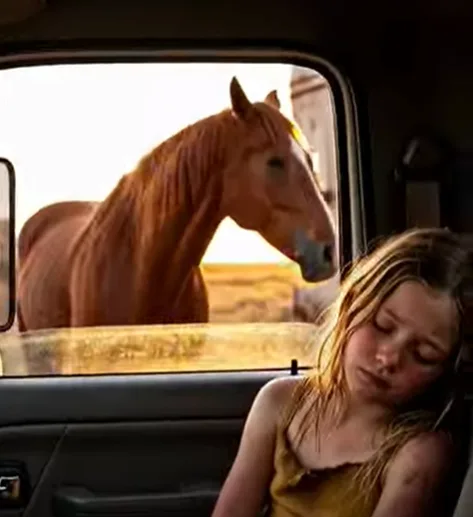
The truck rolled slowly along the desert highway while my daughter slept against the passenger window, one small hand still wrapped around the golden horse’s reins. The animal followed us at a steady trot along the edge of the road, its hooves striking the hard earth with a rhythm that somehow made the silence feel less frightening.
I kept both hands on the steering wheel.
The sun was disappearing behind the mountains.
Behind us were the abandoned water station, the rusted chains, the two captured outlaws, and the nightmare that had nearly taken my daughter from me.
Ahead was home.
At least, that was what I believed.
Three miles from town, the truck’s engine suddenly coughed.
I frowned.
The fuel gauge was nearly full.
Then the headlights flickered.
Once.
Twice.
The engine died.
The truck rolled to a stop in the middle of the empty road.
My daughter woke immediately.
“Daddy?”
“It’s okay.”
I looked into the rearview mirror.
Nothing.
Only desert.
Only dust.
Only the fading orange light of sunset.
Then I noticed something strange.
The golden horse had stopped.
He was staring toward the mountains.
His ears were pointed forward.
His entire body was perfectly still.
“What is it?” I whispered.
The horse suddenly turned and ran toward the rocky ridge.
“Daddy, wait!”
My daughter opened the door.
“Stay inside!”
But she was already moving.
I jumped out and ran after her.
We climbed over a low ridge of red stone until the ground suddenly dropped into a narrow canyon.
The horse was standing beside an old concrete marker.
My daughter pointed at it.
“Daddy, look.”
I knelt.
The marker was almost completely buried beneath sand.
I brushed the dirt away with my hands.
A symbol appeared.
A circle.
A line through the middle.
And beneath it, a date.
1948.My blood ran cold.
That was the year my grandfather had supposedly signed away our family’s original water rights.
The document that had been used for generations to justify the seizure of our land.
I remembered what the outlaws had said.
Forged land deeds.
Illegal transfers.
Decades of intimidation.
But this marker wasn’t on any map.
I dug deeper.
My fingers struck metal.
I pulled away more dirt and uncovered a small steel box.
The lock had already rusted away.
Inside was a bundle of papers wrapped in oilcloth.
My daughter stood beside me.
“What are those?”
I opened the first document.
It was an original water survey.
The second was a property map.
The third was a handwritten agreement signed by my grandfather.
But the signature was not his.
I knew immediately.
I had spent my entire childhood looking at his handwriting.
This wasn’t it.
Someone had forged his name.
My heart began pounding.
“This is why they kidnapped you.”
My daughter looked confused.
“Because of the water?”
“Because of what’s underneath it.”
I unfolded the map.
Red lines stretched beneath our ranch and continued toward the mountains.
At the center was a circle marked:
RESERVOIR 7.
I had never heard of Reservoir 7.
Then I noticed something written in the corner.
“Access restricted by territorial authority.”
The date was 1951.
I looked toward the mountains.
For seventy-five years, everyone had been fighting over water they thought came from a handful of underground wells.
But the map suggested something much larger.
There was an entire underground aquifer beneath the valley.
And someone had known about it since 1948.
The conspiracy wasn’t about stealing a few wells.
They had been trying to control an entire underground water system.
My daughter touched my arm.
“Daddy…”
“What?”
She pointed behind me.
A vehicle was parked at the top of the ridge.
Black.
No license plate.
Engine running.
“We need to go.”
We grabbed the papers and ran.
The truck still wouldn’t start.
I opened the hood.
The battery cables had been deliberately cut.
Someone hadn’t wanted us driving anywhere.
The vehicle above the ridge suddenly began moving.
I grabbed my daughter.
“Run!”
We disappeared into the canyon.
The golden horse followed.
Bullets struck the rocks behind us.
“Down!”
We dropped behind a boulder.
My daughter covered her ears.
I pulled my rifle from the truck before we fled.
The attackers weren’t the local outlaws.
These men moved differently.
They were disciplined.
Organized.
They knew exactly what they were doing.
And that meant someone powerful had sent them.
I waited until the headlights passed the canyon entrance.
Then I looked at my daughter.
“We’re going underground.”
She stared at me.
“What?”
I pointed toward the rock wall.
“There has to be another entrance.”
The map showed a tunnel leading from the original survey station toward Reservoir 7.
We searched the canyon until I found a narrow opening hidden behind a fallen section of rock.
Inside was a passageway.
The air was cool.
Water dripped somewhere in the darkness.
My daughter squeezed my hand.
“Is this safe?”
“No.”
She swallowed.
“But it’s safer than staying outside.”
We entered.
The tunnel descended deeper beneath the desert.
For nearly twenty minutes, we walked in silence.
Then we heard water.
Not a trickle.
A river.
I raised my flashlight.
The passage suddenly opened into an enormous underground cavern.
A lake stretched beneath the rock.
Clear, dark water reflected the beam of my flashlight.
My daughter stared in amazement.
“There’s water down here.”
“Enough to change everything.”
On the far side of the cavern stood an old steel door.
We crossed a narrow concrete bridge.
The door had a faded government emblem.
I tried the handle.
Locked.
Then I noticed something beside it.
A metal plaque.
AUTHORIZED PERSONNEL ONLY.
Below it were three names.
The first was my grandfather’s.
The second belonged to a former governor.
The third was a name I recognized from the documents seized at the water station.
The same family that had spent decades controlling the valley’s largest ranches.
I stared at the plaque.
“They didn’t discover this recently.”
My daughter looked at me.
“They knew all along.”
I nodded.
The door suddenly opened.
We both froze.
A light came on inside.
Someone was already there.
A man stepped into the doorway.
He was old.
Probably in his seventies.
He held no weapon.
He simply stared at me.
Then he whispered:
“You’re Ryan Carter’s son.”
I raised my rifle.
“Who are you?”
“My name is Samuel Bell.”
He looked at the papers in my hand.
“And if you have those, then they failed to stop you.”
“Who?”
Samuel sighed.
“The people who have owned this valley without ever legally owning it.”
He stepped aside.
“Come in.”
I didn’t lower the rifle.
“Give me one reason.”
“Because your grandfather didn’t surrender the water.”
He paused.
“He hid it.”
My heart stopped.
“What?”
Samuel pointed toward the cavern.
“The original agreement was never a sale. It was a protection covenant. Your grandfather and several other families agreed that the underground water would remain public during droughts.”
I stared at him.
“Then how did they take it?”
“Forgery.”
He walked toward an old desk covered with documents.
“They created a second agreement, transferred the rights to a private corporation, and destroyed the original.”
“But why would my family keep fighting for seventy-five years?”
“Because your grandfather never stopped fighting.”
Samuel opened a drawer.
Inside was a photograph.
My grandfather stood beside several ranchers.
And standing behind them was a much younger version of the man who had been responsible for the abduction of my daughter.
The same man whose family had controlled the valley for generations.
“This was taken in 1963,” Samuel said.
“That man was already involved.”
I looked at my daughter.
She was staring at the photograph.
“Why didn’t anyone expose them?”
Samuel’s expression hardened.
“Because people disappeared.”
The room became silent.
“Some lost their farms. Some lost their businesses. Some were arrested. Others simply left town and never came back.”
“And my father?”
“Your father found the original archive.”
I felt my chest tighten.
“He knew?”
“He was getting ready to expose everything.”
“Then why didn’t he?”
Samuel looked at me.
“Because someone betrayed him.”
The pieces suddenly connected.
The forged deeds.
The kidnapping.
The attack on the water station.
The mysterious federal archive.
My father’s disappearance.
None of it had been random.
The conspiracy had survived because every generation had protected the one before it.
And now they had come after my daughter because they believed fear would make me surrender.
I stepped toward Samuel.
“Where is the original archive?”
He pointed at the steel door.
“Behind that.”
I opened it.
Inside was a room filled with boxes.
Hundreds of them.
Maps.
Court records.
Water surveys.
Letters.
Photographs.
Bank statements.
Names.
Everything.
I opened the first box.
At the top was a handwritten note.
I recognized the handwriting instantly.
My father’s.
“If you’re reading this, they finally came for the next generation.”
My eyes filled with tears.
I kept reading.
“Do not fight them with anger. Fight them with evidence.”
I looked at my daughter.
She was standing quietly beside me.
My father had known this day might come.
He had prepared for it.
But there was one final envelope.
I opened it.
Inside was a letter addressed to me.
My hands trembled as I unfolded it.
“My son,
If this reaches you, I failed to protect you from the consequences of a fight I began before you were old enough to understand it.
I want you to know something.
This was never about our family.
It was never about money.
It was never even about the ranch.
It was about whether one group of people could convince an entire community that something essential belonged only to them.
Water is life.
And no signature forged in a dark room can change that truth.
If they ever come for your child, do not teach her to live in fear.
Teach her to remember.
Teach her to ask questions.
Teach her that the truth may take years to surface, but it does not become less true simply because powerful people bury it.”
I couldn’t continue.
I folded the letter against my chest.
My daughter hugged my waist.
“What did Grandpa say?”
I looked down at her.
“He said to remember.”
She nodded.
“Then we’ll remember.”
The next morning, I drove straight to the federal marshal’s office.
This time, I didn’t arrive with a rifle.
I arrived with boxes.
Dozens of them.
Original records.
Signed statements.
Photographs.
Maps.
Proof that could be independently examined.
The investigation lasted months.
The valley changed.
People who had remained silent for decades began coming forward.
Old ranchers brought photographs from their attics.
Families produced letters they had hidden for generations.
Former employees testified about falsified records.
The court eventually invalidated the forged transfers.
The underground water system was placed under public oversight.
The families who had controlled the valley were forced to surrender the rights they had obtained through fraudulent documents.
Nothing happened overnight.
There were hearings.
Appeals.
Arguments.
Threats.
There were people who insisted the old system had been legitimate.
Others argued that the documents proved otherwise.
The truth had to survive the legal process.
And eventually, it did.
A year later, the first community water project opened.
Children from every part of the valley gathered around the new reservoir.
My daughter stood beside me.
The golden horse grazed peacefully behind the fence.
She looked at the water.
“Daddy?”
“Yeah?”
“Is this ours?”
I smiled.
“No.”
She looked surprised.
“Then whose is it?”
“Everyone’s.”
She thought about that for a moment.
Then she smiled.
“That’s better.”
I looked across the valley.
The same desert that had once seemed empty was now alive with possibility.
Pipes carried water toward farms.
Trees had been planted along the dry riverbed.
People who had spent generations fighting one another were finally sitting at the same tables.
The scars hadn’t disappeared.
They never would.
But the valley had learned something that my family had paid dearly to understand.
Power can control property.
It can control documents.
It can control courts for a time.
But it cannot permanently control the truth when ordinary people refuse to forget it.
Years later, my daughter would ask me about the day she was kidnapped.
She would remember the chains.
The heat.
The men with guns.
The golden horse standing beside her.
But I hoped she would remember something else.
She would remember that her father came.
Not because he was fearless.
Not because he was stronger than the men who threatened us.
But because some things are worth walking into the desert for.
Family.
Truth.
And the right of future generations to inherit something better than fear.
I kept my father’s letter framed above my desk.
The final sentence remained the one I thought about most.
“The desert remembers every drop of water that falls upon it.”
For generations, powerful men had tried to convince us that the valley was dry because they owned the water.
They had built walls around wells.
They had forged signatures.
They had threatened families.
They had buried records beneath dust and darkness.
But they had misunderstood the desert.
Water doesn’t belong to the person who finds it first.
And truth doesn’t belong to the person who tries hardest to bury it.
Both have a way of moving beneath the surface.
Quietly.
Patiently.
Waiting for the right moment to rise.
And when they finally do, even the deepest conspiracy can be washed away.
I looked at my daughter as she ran beside the golden horse beneath the evening sun.
For the first time, I wasn’t thinking about what had been stolen from us.
I was thinking about what we had finally recovered.
Not just water.
Not just land.
Not just our family’s name.
We had recovered the future.
And sometimes, that is the greatest victory a person can leave behind.