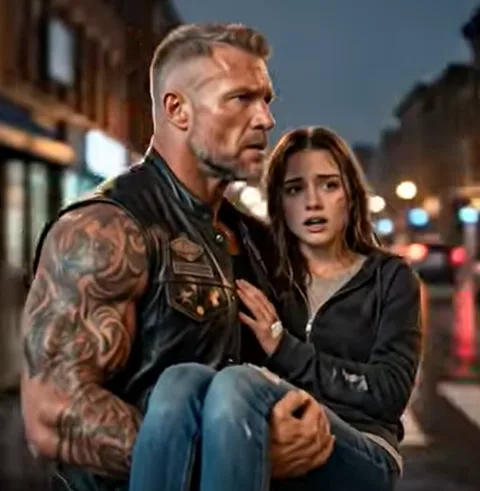
Until a tattooed biker swept me into his arms and whispered that my father’s fatal accident ten years ago
“…disappear, and I took the money, God forgive me, because I was drowning and I thought it would be the last mistake I ever made.”
The words fell into the misty air between us, and I could not feel my hands.
The silver ring lay in my palm beside the flash drive, and the engraved initials glinted under the flashing lights: D.M. and C.M., entwined like two vines.
“Those are my parents’ initials,” I whispered.
“Daniel and Catherine Mercer,” he said, and his voice cracked down the middle.
“I’m not your father, Clara, but I was his brother in everything but blood, and I have worn his ring on a chain around my neck for ten years.”
I stared at him, at the weathered face and the silver in his hair and the wet blue eyes that I had mistaken for something out of an old photograph.
“Who are you?” I asked.
“My name is Jack Brennan,” he said.
“Your father and I served together, and when I came home with nothing, he gave me a job and a couch and a reason to get up in the morning.”
“I was the head of security at Mercer Engineering the night he died.”
A cold wave went through me, and I pressed my back harder against the brick.
“You were there,” I said.
“I was there,” Jack said.
“And I have not slept a full night since.”
Behind him, the agents were securing the alley, and a tall woman in a navy raincoat detached herself from the group and approached us slowly.
She had a badge on her belt, a braid of dark hair going gray, and the careful, unhurried manner of someone who knew that some conversations could not be rushed.
“Miss Mercer, I’m Special Agent Elena Ruiz,” she said.
“I would like to get you somewhere warm, and I would like a paramedic to look at that ankle, but I believe Mr. Brennan has something he needs to say first, and I think you deserve to hear it.”
“Is he under arrest?” I asked.
“He turned himself in to my office three weeks ago,” said Ruiz, and she gave Jack a look that was not quite forgiveness and not quite judgment.
“He has been working with us ever since, and tonight was the culmination of that work.”
I looked at Jack, and he lowered his head like a man standing before a firing squad.
“Tell me,” I said.
He sat down on the wet curb, because his knees seemed to give out, and his gang of bikers dismounted along the avenue and stood silently in the mist with their helmets under their arms.
“Richard’s father, Harold Voss, wanted your father’s patent for a new kind of load-bearing alloy,” Jack began.
“It was worth three hundred million dollars, and your father refused to sell, because he said it would be used to cut corners in bridges and buildings, and people would die.”
“Harold sent Richard to befriend him, and Richard was only twenty-two then, a smooth, smiling kid with a wounded look who said he wanted to learn the business.”
“Your father loved him like a son.”
“I know,” I said bitterly.
“So did I.”
“A week before the crash, Harold came to me in a parking garage with an envelope,” Jack said.
“It held forty thousand dollars, and a photograph of my daughter coming out of her school.”
His voice shattered, and he pressed the heel of his hand against his eyes.
“I did not know that she was not in danger, Clara, I did not know that it was only a picture, and I was so afraid.”
“He told me to leave the garage door unlocked, and to look away for ten minutes.”
“That was all,” he said.
“Ten minutes, and I told myself that it was only a burglary, that they would steal some files, and that nobody would be hurt.”
“I stood at the end of the block and watched the clock, and when the ten minutes were up, I walked back and locked the door.”
“The next morning, Daniel was dead.”
A sob tore out of me, and I pressed the leather jacket against my mouth.
“I tried to confess,” Jack whispered.
“I went to the police station and sat in the lobby for four hours, and then I saw Harold Voss’s lawyer walk in laughing with the captain, and I understood that no one would believe me.”
“So I ran, and I rode for ten years, and I built a club out of men who had nowhere else to go, and I swore that I would find a way to make it right.”
“I watched you from a distance,” he said.
“I knew that Richard was circling you, and I knew what he was, and I could not reach you without getting you killed.”
“I started gathering evidence, one piece at a time, every ledger and recording and witness that I could find.”
“And three weeks ago, a federal agent finally agreed to listen.”
I lifted my eyes to Agent Ruiz, and she nodded.
“Mr. Brennan brought us eleven boxes,” she said.
“Bank records, wire transfers, a recording of Harold Voss’s voice that he made in that parking garage, and a sworn statement that took him nine hours to write.”
“We would not have had a case without him.”
“And without you,” she added, and she held up a clear evidence bag containing a small metal drive identical to mine.
“Richard’s backup drive was encrypted, but yours was the original, with the unaltered timestamps, and that is what will convict him.”
I looked down at the drive in my palm, and I thought of my hands shaking in front of that safe, and of all the nights I had wept for a man who had never existed.
“I do not know how to feel,” I said.
“I want to hate you.”
“You should,” said Jack.
“I hated myself for a decade, and it did not help anyone.”
“But I think that you are the reason I am standing here,” I said slowly.
“You came for me tonight, and you stepped in front of a gun.”
“It is the only thing I ever did right,” said Jack, and his smile was crooked and wet.
I did not forgive him that night, because forgiveness is not a door that opens on a single push.
But I let Agent Ruiz help me to my feet, and I let a paramedic wrap my ankle, and when Jack took off his jacket to put it around my shoulders a second time, I did not stop him.
They took me to a federal safe house, a quiet brick apartment on the north side with a lumpy couch and a kitchen that smelled of toast, and Ruiz made me tea with an awkward, motherly efficiency.
I slept for fourteen hours, and I woke up to gray winter light and the sound of a radio playing softly in the next room.
For a moment I did not know where I was, and then it all returned, and I lay still and let it wash over me.
My father had been murdered, and the man I had loved had done it, and the man who had helped had come back to me with tears in his eyes.
I should have been broken.
Instead, I felt something strange stirring beneath the grief, something quiet and hard and bright, like a seed pushing up through frozen ground.
I got out of bed and limped to the kitchen, where Ruiz sat at a small table with a laptop and a cold cup of coffee.
“You should rest,” she said.
“I have rested enough,” I said.
“Tell me what happens next.”
She closed the laptop and looked at me for a long moment, and a slow smile spread across her face.
“The grand jury convenes in a week,” she said.
“You will be the star witness, and I will not lie to you, Miss Mercer, it is going to be hard.”
“The Voss family has lawyers who could argue a hurricane out of existence.”
“Good,” I said.
“I have an engineering degree and ten years of my father’s notebooks, and I would like to see them try.”
Ruiz laughed out loud, a bright, startled sound.
“Your father would have loved you,” she said.
“I know,” I said, and my eyes burned.
“I wish I had known him better.”
“Then let us start there,” she said, and she opened a folder and slid a stack of photographs across the table.
They were pictures of my father that I had never seen, standing on a half-built bridge with a hard hat, laughing with a group of workers, holding a baby in a blue blanket.
“That is you,” Ruiz said softly.
“Your father carried that picture in his wallet, and Jack kept it after the night he died.”
I touched the glossy paper with one finger, and the baby squinted back at me, round and furious and loved.
The grand jury indicted Richard Voss, Harold Voss, and six of their associates in the second week of December, and the trial was scheduled for April.
I spent the winter in a daze of depositions and document reviews and long, solitary walks along the frozen lakeshore.
Every few days, Jack came to the safe house and sat at the kitchen table with his hands folded, and we talked.
He told me about my father’s laugh, which sounded like a barking seal, and the way he whistled hymns off-key when he was working, and the Sunday mornings he made pancakes in the shape of bridges.
“Why bridges?” I asked.
“Because he said that a bridge was the most honest thing a person could build,” said Jack.
“It does not pretend to be anything but a way across.”
I wrote that down on a napkin, and I kept it in my pocket for the rest of the winter.
Little by little, the weight between us began to shift.
I did not forget what he had done, and he never asked me to.
But I began to see the man beneath the confession, a gentle, haunted soul who had spent a decade building a family of strays and trying to be worthy of a forgiveness he did not expect.
His club, the Open Road Brothers, turned out to be a collection of ex-soldiers, retired mechanics, and one former kindergarten teacher named Dolores, who rode a bright purple Harley and brought homemade cookies to every meeting.
“We take in anyone who needs a place,” she told me, pressing a tin of oatmeal raisin into my hands.
“Jack started it after he lost his own girl to the system, and we have been fixing what we can ever since.”
“He lost his daughter?” I asked, startled.
“Not to death,” Dolores said gently.
“She was taken by her mother’s family after the divorce, and she does not speak to him, and he writes her a letter every month that he never mails.”
I looked across the room at the big man with the silver hair, who was awkwardly trying to fix a broken toaster, and something in my chest softened.
The trial began on the first Monday of April, in the same gray federal courthouse where, a hundred years earlier, men had been tried for far smaller crimes.
I wore a navy suit that Ruiz had bought for me and my mother’s pearl earrings, and I walked up the courthouse steps with my chin high and my hand resting lightly on Jack’s arm.
Cameras flashed, and reporters shouted questions, and I kept walking, because my father had taught me that the only way across a bridge is to keep your eyes on the other side.
Inside, the courtroom was packed from wall to wall.
Richard sat at the defense table in a charcoal suit, pale and hollow-cheeked, and he did not look at me once.
Beside him sat Harold Voss, a heavy, silver-haired man in his seventies with a face like a closed vault, and a team of six lawyers in identical dark suits.
The prosecutor, a lean, intense woman named Ms. Okafor, opened with a statement that made the room fall silent.
“Ladies and gentlemen of the jury,” she said, “this is a story about a bridge.”
“A man named Daniel Mercer believed that what we build should be safe for the people who cross it, and for that belief, he was murdered.”
“You will hear from the daughter he left behind, and you will hear from the man who helped to kill him and who has come forward to tell you the truth.”
She called Agent Ruiz first, and then a forensic accountant, and then a series of bank officers and engineers, each one laying down another plank in the structure of the case.
On the fifth day, she called me.
I walked to the witness stand with my heart hammering and my palms damp, and I put my hand on the Bible and swore to tell the truth.
Then I looked out across the courtroom, and I saw Jack sitting in the third row in a borrowed gray suit, with his hands clasped in his lap and his eyes fixed on mine.
He gave me the smallest nod.
I told them everything, from the night in the safe to the night in the rain, and my voice was steady and clear.
I described how Richard had stood beside my father’s coffin with tears in his eyes, and how he had held my hand through every year that followed, and how it felt to learn that every kindness had been a lie.
When Ms. Okafor asked me why I had kept the flash drive, I paused and thought about it.
“Because my father taught me that the truth is load-bearing,” I said.
“You can paint over it and cover it up, but if you pull it out, everything collapses.”
A murmur rippled through the gallery, and I saw one of the jurors, a middle-aged man in a faded flannel shirt, wipe his eye.
The defense attorney, a smooth, gray-haired man named Mr. Pierce, rose to cross-examine me with a smile like a knife in velvet.
“Miss Mercer,” he said, “isn’t it true that you have been emotionally unstable since your father’s death, and that you have struggled with anxiety and depression?”
“I have grieved,” I said.
“Grief is not instability, Mr. Pierce, it is what happens when you have loved someone.”
“And isn’t it also true,” he pressed, “that the so-called evidence on your flash drive could have been fabricated or altered?”
“It could have been,” I said, “if I were a forger, and if I had access to eleven years of bank timestamps, and if I had the technical skill to replicate the digital signatures of four separate financial institutions.”
“I have an engineering degree, sir, not a criminal mind, and I am afraid that you are mistaking the one for the other.”
Laughter swept the room, and the judge, a stern woman with spectacles, rapped her gavel but could not quite hide her smile.
Mr. Pierce hesitated, and then he said, “No further questions,” and he sat down heavily.
Jack testified the next morning, and I held my breath through every word.
He did not spare himself.
He described the parking garage and the forty thousand dollars and the photograph of his daughter, and he named every man in the room who had been there that night.
When he finished, there was a long silence, and the defense lawyers did not move.
Then Harold Voss himself rose from the table, red-faced and shaking, and shouted that Jack was a liar and a drunk and a murderer.
“Sit down, Mr. Voss,” the judge said coldly.
“I will not be spoken of this way,” Harold roared, and he pointed a trembling finger at Jack.
“You were paid, you took the money, you are as guilty as I am.”
A stunned hush fell over the courtroom.
“Mr. Voss,” the judge said, very quietly, “did you just say, as guilty as I am?”
Harold’s mouth fell open, and the color drained from his face, and for the first time in his life, I think, the old man understood that he had been outmaneuvered by his own temper.
Mr. Pierce was on his feet at once, pulling at his client’s sleeve and begging him to sit, but it was too late.
The courtroom had heard it, and the jury had heard it, and the stenographer’s fingers had already flown across the keys.
The jury deliberated for two days, and I spent them pacing the safe house kitchen with a cup of tea going cold in my hands, while Jack sat silent in the corner like a man waiting for a verdict on his own soul.
When the call came, Ruiz drove us to the courthouse in her old gray sedan, and none of us spoke.
We took our seats in the second row, and I felt Jack’s hand slide hesitantly across the bench and settle beside mine, not quite touching.
I took it.
The foreman, a gray-haired woman with a calm, kind face, rose and read the verdict in a clear voice.
“On the charge of conspiracy to commit murder, we find the defendants guilty.”
“On the charge of murder in the first degree of Daniel Mercer, guilty.”
“On the charge of embezzlement and wire fraud, guilty.”
“On the charge of forgery and corporate fraud, guilty.”
A sound came out of me that was not quite a sob and not quite a laugh, and Jack’s hand closed around mine so tightly that it hurt.
Richard sat motionless, staring at the table, and I watched his face and felt nothing, not triumph, not hatred, only a quiet, enormous release, like a held breath finally let go.
Harold Voss slumped forward, and his lawyers closed ranks around him, and the judge pronounced life sentences for both men.
As the marshals led Richard past our row, he stopped, and for one moment our eyes met.
“Clara,” he said, in a voice I barely recognized.
“I did love you, in my way.”
“No, Richard,” I said quietly.
“You loved what I could give you, and that is not the same thing.”
He lowered his head, and the marshals led him away, and the heavy door closed behind him with a soft, final click.
Outside, the spring sun broke through the clouds, and the courthouse steps were bathed in gold.
Jack and I stood at the top, and the bikers lined the sidewalk below in a long, silent row with their helmets off, and Dolores stood at the front in a purple jacket with tears running down her face.
“It is done,” Jack said.
“It is done,” I said, and then I turned to him.
“Jack, I have something to tell you, and I want you to hear all of it.”
He braced himself, and I saw the old fear flicker across his weathered face.
“I do not forgive you for what you did,” I said.
“I may never be able to forgive that part, because my father is gone and nothing will bring him back.”
“But I forgive the man who came out of the rain, and stepped in front of a bullet, and spent ten years trying to make it right.”
“I forgive the man who writes letters to his daughter and never sends them.”
“And I would like to know him, if he will let me.”
His face crumpled, and he pressed his fist against his mouth, and his shoulders shook.
“I do not deserve that,” he whispered.
“No one deserves anything, Jack,” I said, and I put my arms around his neck.
“We just get to choose what we build with what we have.”
He held me, huge and trembling, and the bikers on the sidewalk bowed their heads, and somewhere a church bell began to ring.
The summer that followed was the strangest and sweetest of my life.
I took back control of Mercer Engineering, and I fired every executive Richard had hired, and I rehired the old engineers whom he had pushed out, a dozen weathered, brilliant men and women who wept when I called them.
We moved into a bright new office overlooking the river, and I hung my father’s photograph in the lobby beneath a brass plate that read, A Bridge Is the Most Honest Thing a Person Can Build.
The first project I signed was a footbridge across the Chicago River, a graceful arc of steel and glass connecting two neighborhoods that had been divided for a century.
I named it the Daniel Mercer Crossing, and I asked Jack to ride the first motorcycle across it on opening day.
He protested that he was not a ceremony man, and I told him that he had no choice.
On a warm morning in September, a crowd of three thousand gathered on both banks of the river, with banners and balloons and a brass band playing old jazz standards.
I stood at the center of the bridge in a white dress, with the wind lifting my hair and the water sparkling below, and I cut the ribbon with a pair of enormous golden scissors.
The crowd roared, and the band struck up a march, and Jack rolled slowly onto the span on his big black chopper, with the whole Open Road Brothers rumbling behind him in a long, gleaming line.
He stopped beside me, cut the engine, and took off his helmet, and his silver hair blazed in the sun.
“How does it feel?” he asked.
“Like a bridge,” I said, and I laughed, and he laughed too.
I climbed up behind him and wrapped my arms around his waist, and we rode the length of the span with the city spread out on either side and the river rushing gold beneath us.
At the far end, a small figure stood waiting beside the railing, a young woman of about twenty-five with dark braids and tired, hopeful eyes.
Jack saw her, and the motorcycle wobbled, and he braked so hard that I nearly fell off.
“Jack?” I said.
He did not answer.
He climbed off the bike and stood with his hands at his sides, and the young woman took one step toward him, and then another.
“Dad,” she said, in a voice so small that I almost missed it.
“I saw the article in the paper, about the bridge, and about you, and I thought that I should come.”
Jack made a sound like a man who had been struck, and he dropped to his knees on the pavement with his hands over his face.
“Rosie,” he whispered.
“My Rosie.”
She knelt in front of him and put her arms around his shoulders, and he held her with a fierce, trembling tenderness, and I turned my face away to give them privacy.
The crowd on the bank had begun to cheer, though they did not know why, and the brass band swelled into a joyous, ragged waltz.
I stood by the railing with tears streaming down my face, and I thought of my father, who had believed that what we build should help people cross.
Later, when the crowd had thinned and the sun was sliding behind the skyline in streaks of rose and amber, the three of us sat on the bridge with our legs dangling over the edge, passing around a paper bag of warm pretzels.
Rosie told us about the long years of silence, and the letters she had found in her grandmother’s attic after she died, thirty-six of them, all unmailed, all addressed in Jack’s blocky hand.
“I read every one,” she said, wiping her eyes.
“And I realized that you had been talking to me the whole time, and I just could not hear you.”
“I am so sorry, Rosie,” Jack said.
“I am sorry for every one of the years.”
“I know,” she said, and she leaned her head against his shoulder.
“But I am here now.”
I watched them, and I felt a warmth spread through my chest that I had not known in a decade, the quiet, steady glow of a family being rebuilt one plank at a time.
That winter, Jack moved into the guest house behind my little brick townhouse, and Rosie took the room above it, and on Sunday mornings the three of us gathered in my kitchen to make pancakes in the shape of bridges.
They were terrible, lumpy, collapsing things, and we ate every one.
Spring came again, and with it the first anniversary of the night in the rain.
I walked alone to the corner where I had knelt on the wet pavement, and I stood there with my hands in my pockets and the sun warm on my face.
A flower shop had opened on the corner, and a girl in an apron was setting out buckets of tulips in the morning light.
I bought a bunch of yellow ones and laid them against the lamppost, and I closed my eyes.
“Thank you, Dad,” I whispered.
“I finished the bridge.”
A soft step sounded behind me, and I knew without turning that it was Jack, with Rosie beside him, and they came up on either side of me and said nothing.
We stood together in the sunshine, three people who had been broken in different ways and mended in the same place, while the traffic hummed and the tulips nodded in the breeze.
“Ready to go home?” Jack asked at last.
I looked at the two of them, at the silver-haired biker with the wet blue eyes and the young woman with her father’s stubborn jaw, and I smiled.
“I am already there,” I said.
We walked back along the avenue in the warm spring light, side by side, and the river sparkled beyond the buildings like a promise kept.
Somewhere above us, the Daniel Mercer Crossing curved gracefully over the water, honest and strong, carrying a thousand strangers across.
And I knew, with a certainty deeper than grief, that the long night was over, and that the road ahead was open, and that I would never again face it alone.