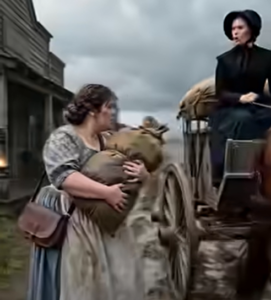
Under the muddy rain outside the crowded town tavern while a wealthy carriage driver callously slammed the door in my face and told me there was no room
The brass lantern threw my face back at me in pieces: rain on the cheek, badge at the throat, the memo clinging to my fingers like a second skin. Director Marcus Hale. The signature was twenty years old and steady. The encrypted text was ten seconds old and worse. Coordinates. A bunker. My father’s name used as a lever. The marshals were already loading the mayor and the burly man, who had called himself a rescuer in the flood and whose cuffs now said otherwise. No one had looked down. The memo could still vanish into mud and become a rumor. I folded it into the sack beside the deeds and stepped out of the lantern’s circle before Hale’s name could be read over my shoulder.
Marshal Vickers caught my elbow at the wagon. “Clerk Rowe. Good work. We’ll take the sack from here.”
“The sack stays with me until the county line,” I said. “Chain of custody. I started it.”
He did not like it. He also did not have a free hand, not with the mayor shouting about jurisdiction into the rain. I swung up beside a deputy I trusted less than the current and kept the burlap between my boots. The phone buzzed once more, a single line under the coordinates: Come alone or the Alden file burns. Alden was the shell company. Alden was also my mother’s maiden name. They had chosen it on purpose. I put the phone face-down and watched the ridge fall behind us.
At the county line Vickers logged the deeds, the transfers, the confession from the council clerk who had broken last week. I logged the memo myself, Hale’s signature included, and made him initial the envelope. His pen hesitated.
“That’s the director.”
“That’s why it gets an initial.”
“He’ll say you lifted it.”
“Then the mayor’s pocket lint can testify.” I sealed the flap. “I’m taking a horse east. Personal. If Hale wires you to stop me, show him the initial and wait.”
Vickers studied the rain. “Your father worked audits, didn’t he. Before the quiet.”
“Before the quiet,” I said, and rode.
The coordinates put the bunker under an old grain elevator fifty miles into the tableland, where the flood had not reached and the road was only a suggestion. I made it by dusk of the next day, mud drying on the skirt I had not had time to change, the phone dark to save what charge the storm had left. A steel door sat in the elevator’s shadow, newer than the wood. It opened before I knocked. The woman inside was gray at the temples and armed with a ledger, not a gun. I knew her from a photograph in my father’s desk: Irene Cade, his last partner, officially retired, unofficially buried.
“You brought the memo,” she said.
“I brought the choice you texted me.”
“The text was mine. The twenty-four hours is real. Hale lands a cleanup team at the rail spur at noon tomorrow. They have a warrant with your name and the word unstable on it. If you are here when they arrive, you are a grieving clerk who forged a director’s signature in a flood. If you are gone, the Alden file in that cabinet stays the only copy he does not own.”
She set the ledger on a crate. My father had written the first pages. Hale had written the margin notes. Twenty years ago a federal relief program had bought homestead patents at panic prices after a staged blight report. Hale authorized the report. The town council, younger then, executed the buys. The shell was Alden. My father found the loop, wrote the memo I had just logged, and was told the signature above his findings was a loyalty test he had failed. Irene had hidden the carbons. He had gone to the river road to meet a marshal and had not come back. The marshal’s name, in the ledger, was the burly man now in Vickers’ wagon. Rescue, in this valley, had always been a job description.
“You let me embed for three years,” I said.
“I let you build a case Hale could not call grief. The council was the limb. He is the trunk. Your sack cuts the limb. This room cuts the trunk. But only if you carry the carbons out before noon and put them where a judge who does not owe him rent can see them.”
“And the side I’m supposed to choose?”
“Not his. Not a bunker. The record.” She closed the ledger. “Your father chose the meeting on the river road. He thought a badge in the rain was the same as a witness. It was not. Do not repeat the method.”
I slept two hours against the crate and dreamed of carriage wheels. At first light Irene walked me through the copies: blight report, buy orders, Hale’s authorization, the council’s kickback schedule, the river-road roster with the burly man’s initial. I photographed what the phone could hold and wrapped the carbons in oilcloth inside the sack. She stayed. Someone had to be the voice if the cleanup team wanted a body. She said that without drama. I hated the calm and used it.
The rail spur was a mistake I did not make. I rode north to a switching shed where a freight clerk owed Irene a favor older than my badge. The carbons went into a locked mail pouch addressed to the territorial judge at the capital, duplicate pouch to a newspaper editor who had once printed my father’s minor audit and kept his job. The phone’s photographs went to Vickers with a line: Initialed memo is the index. Do not let Hale’s warrant pulpit the sack. I dropped the phone in a rain barrel after it sent. Twenty-four hours is a clock. Clocks end.
Hale’s team reached the elevator at noon and found Irene with the empty crate and a statement already sworn before a local justice of the peace she had woken at dawn. They did not shoot her. They did not find me. By evening the editor had the blight report on his desk and the good sense to print the authorization beside it before a injunction could be walked across town. Vickers, to his credit, refused Hale’s warrant on the grounds of the initialed envelope. The mayor, hearing the print run had started, tried to trade the burly man for a lighter count. The burly man tried to trade Hale. Both trades arrived too late to be the only story.
I came into the capital on the third night, mud still in the seams of my boots, and sat in the judge’s anteroom until he had read the pouch. He was a tired man with ink on his cuff and no affection for directors. He issued a hold on Hale’s movements, a preservation order on the Alden accounts, and a witness summons with my name spelled correctly. Hale arrived the next morning with two attorneys and the smile of a man who still believed rank was a kind of weather. The smile did not survive the margin notes. Irene’s statement arrived by courier at midday. The burly man, offered a narrower charge, confirmed the river-road roster and the order to make the meeting look like a washout. He did not ask me for forgiveness. I did not offer it. Forgiveness is not an exhibit.
The hearing took eleven days. Hale’s counsel called the carbons revenge and the phone message a script. The prosecutor laid the buy orders over the homestead map until the blight report looked like what it was: a story told to lower a price. Families who had sold in the panic filled the back benches, my mother’s people among them, Alden no longer a shell but a name they could say without flinching. The judge voided the grabs, froze the accounts, and bound Hale over for conspiracy and for the procurement of the river-road silence. He did not call it murder in the order. The roster made the word unnecessary for anyone who could count backward from a grave.
I resigned the clerk cover on the courthouse steps. Vickers argued, briefly, that the service needed people who would mail the pouch. I said the service had the pouch, and that I had spent three years as a ledger in another man’s handwriting. We parted with the envelope copy between us. He kept the chain. I kept the oilcloth smell on my hands.
In the valley the river had fallen back inside its banks. The bridge still missed a wheel. I stood where the embankment had given way and read the last page of my father’s audit, the one Irene had saved, the one that ended not with an accusation but with a line I had not expected: If they answer the meeting with weather, publish anyway. He had known the badge in the rain might be a door that closed. He had left the carbons so the closing would not be the end of the sentence. I had almost made his mistake in the lantern light, staring at my own calculating face as if recognition were the same as action. Recognition is cheap. The pouch was the cost.
What the flood returned, and what the verdict only certified, was a narrower lesson than vengeance. Corruption recruits the loyal by letting them rescue you in public and invoice you in private. The director’s signature did not become clean because I had wanted a clean service. It became evidence because a partner kept carbons and a daughter chose the mail over the bunker. Justice is not the crack of thunder on a ridge. Justice is the decision, with twenty-four hours on the clock and mud on the deeds, to put the highest name on the table and let the record outrun the warrant. The homesteads are being retitled. The shell has a surname again. I walk the bank when the water is ordinary and do not wait for a carriage to offer room. Room was never theirs to refuse. It was a page, folded wet, that I did not drop.