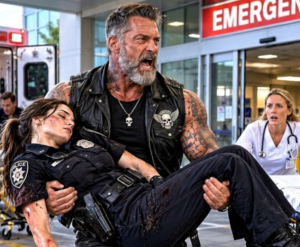
Under the harsh emergency room lights of the county hospital while a ruthless police captain snapped handcuffs onto my wrists and accused me of orches
The cuffs stayed on until the elevator. A federal agent, gray at the temples, badge reading SOLANO, unlocked them herself and did not apologize for the delay. “Captain’s people are still in the building,” she said. “A free man in a corridor is a rumor. A cuffed man is a procedure. Procedures travel farther tonight.”
My wrists burned. Down the hall my partner, Ruiz, lay under a tube light with a nurse who had stopped pretending not to listen. The bullet had taken him under the vest at the edge, not the center. He had shoved me toward the file crate when the captain’s detail opened up in the garage. I had not shoved back hard enough. That arithmetic would sit in me longer than the bruises.
The biker’s photograph was still in the captain’s fist when they bagged it. A fallen officer, younger than the story, rain on the badge, the same precinct steps. I knew the face from a cold case nobody was allowed to warm. Officer Dean Harlow. Three years ago he had signed out a ledger and never signed back in. The official line was a traffic stop. The biker had called it a kitchen. I had spent my career hunting that vest. Tonight the vest had blocked a hallway so a warrant could breathe.
“Who is he?” I asked.
“Call him Rook,” Solano said. “He is not your informant. He is Harlow’s brother-in-law. He has been carrying that photo to rooms where captains still flinch. You are alive because he decided your digging matched his dead. Do not romanticize the club. Use the hour.”
They moved me to a service van, not a cruiser. The narcotics files we had copied, wire transfers dressed as overtime, shipment windows dressed as training, sat in an evidence case between my boots. Months of undercover inside my own department, trusting the badge above me, learning the shipments we were assigned to stop were timed by the man who assigned them. The captain had said federal investigators were not here. They had been in the waiting room since Ruiz hit the gurney.
At the field office I drank bad coffee and said the routes until a stenographer stopped asking me to slow down. Solano listened without comfort. Comfort was not her office. Near dawn she set a phone on the table.
“Rook left a number and a condition,” she said. “He will give the garage where the captain’s detail stages the next truck. He will not wear a wire. He wants you on the lot, not a tac team in the first car. He says you owe Harlow a witness who still has a pulse.”
“I owe Ruiz a partner who does not bleed out for a crate,” I said.
“Then do not miss the truck.”
The garage was under the freeway, sodium lights, oil in the seams of the concrete. I went in a borrowed jacket, no vest showing, Solano’s people in a plumbing van on the frontage road. Rook was already there, arms folded, the photo no longer in his pocket. He looked at my wrists and did not offer a speech.
“Harlow told me the accounts lived in overtime codes,” he said. “You found the codes. The captain found you. This truck is the last clean run before he burns the books. Drivers think they are hauling seized evidence back to the lot. The seals are his. The weight is not.”
“Why trust me?”
“I do not. I trust the crate you did not drop. Stand where he can see you. If he runs, he runs toward the van, not toward a story.”
The truck came in gray, no markings, two of the captain’s guards in the cab. They saw me and saw Rook and reached for the radio. Solano’s team took the doors before the call finished. The seals broke on camera. Bricks, not files. A manifest in the captain’s hand for a training exercise that did not exist. One guard talked before the cuffs warmed. The other did not. Rook watched the load and did not touch it.
“This does not raise him,” he said.
“No,” I said. “It stops the next Ruiz.”
The captain was not in the garage. He was in a courthouse stairwell, badge already boxed, telling a reporter the club had flipped his detective. Solano played him the manifest on a phone. The stairwell went quiet. By evening he had a cell and a lawyer and a version of events in which I had orchestrated the garage to hide my own cut. The version traveled. Versions always do.
Ruiz woke on the second day. He could not sit. He could point at the captain’s name on a photo array and say the garage in a voice like gravel. That pointing mattered more than my plea in the hospital corridor. I stood at the foot of the bed and did not ask him to forgive the shove I had failed to return.
“You kept the copies,” he said.
“Solano kept the copies. I kept the cuffs for an extra minute.”
“Then we are still employed by the truth, if not by the building.”
The hearings were a corridor of wood and microphones. I said the transfers. Rook said Harlow’s last call and refused to name the club’s other sins. Solano said the truck. The captain said I was the rot. The manifests said the rot had a payroll code. He took years. Not all of his guards took the same years. A lieutenant walked on a plea that tasted like ash. The war did not end in the waiting room. It ended in pieces, the way internal files always do, and the pieces were still better than a staged murder on a gurney.
I did not go back to undercover. The face was burned. The work was not. Solano offered a desk in a quieter unit. I took the desk and the habit of copying every account into a second hand before I trusted the first. Rook did not visit the office. He sent the photograph, duplicated, and a note: Hang it where a captain has to see it. I hung it. Harlow’s rain-marked badge watched the door.
On the morning the sentence was entered I stood in the hospital lot where the biker had vanished into the rain. Ruiz was in a chair beside me, alive, angry, employed by the truth. The lesson was not that outlaws are cleaner than badges. It was that a cover-up needs a single hallway, and a file survives when someone blocking that hallway is willing to be hated. I had hunted the vest. The vest had kept the warrant in the room. I intended to be the witness who still had a pulse, and to keep the copies where no captain’s word was the only law. The cuffs were off. The war was smaller. It was not a rumor anymore.
The sentence did not cool the building. It clarified it. Men who had laughed at the captain’s jokes now studied their shoes, and men who had always studied their shoes began to speak in elevators with the doors almost closed. I kept Harlow’s photograph on the inside of my locker, not the outside. A door that has to see a dead officer is a door that learns to stay shut. Solano had warned me about symbols that make cowards tidy.
Ruiz came back on limited duty in a chair he hated and a sling he hated more. He took the desk across from mine in the quieter unit and immediately made it louder. “The lieutenant who walked,” he said, on the first morning he could hold a pen, “still signs the motor-pool logs. If the captain was the mouth, Pell was the hand on the keys. Plea deal or not, the keys still turn.”
Lieutenant Pell had given up two guards and a route and kept his pension conversation. He nodded at me in the corridor as if we had survived the same storm. I nodded back because a nod is not a truce. Solano’s file on him was a corridor of almosts: overtime codes that matched the truck windows, a signature one line above the captain’s, a witness who had recanted after a tire was slashed. Almosts do not cuff a man. They do tell you where to stand.
Rook’s note had not included a second meeting. I called the number anyway. He answered on the fourth ring, wind in the microphone, no greeting.
“Pell,” I said.
“I know the name. Harlow knew it first. He runs the east garage on Thursdays when the manifest says the bay is closed. If you bring a tac team, he will be at a niece’s recital. If you bring a camera and a reason to be there, he might be himself.”
“You will not be on the lot.”
“I will be where I can see the exits. I am done being your hallway.”
He hung up. Ruiz looked at the phone as if it had insulted the sling. “We log it,” he said. “We do not freelance. Solano hears it before the tires move.”
Solano heard it and did not love it. She authorized two cars off the books and a body wire Ruiz insisted on wearing because he could not run and refused to be furniture. I took the borrowed jacket again. The east garage sat under a different freeway, same sodium, same oil. A closed sign hung on the office door. Light lived in the bay anyway.
Pell was there with a clipboard and a driver I recognized from the captain’s detail, the one who had not talked. They were swapping a pallet seal. The new seal was the training-exercise kind. The pallet was not on any training list I had copied. I stepped into the light with my hands visible and the wire hot against my ribs.
“Lieutenant,” I said. “The bay is closed.”
He did not startle. That was its own confession. “Mitchell. You look better without the cuffs. This is a transfer of seized materials. You are not on this assignment.”
“I am on the assignment that reads the seal numbers. That one belongs to a truck we already opened. The captain’s manifest used the same sequence. You kept the stamp.”
The driver moved. Ruiz, in the doorway with the sling and a radio, said Pell’s name into the open channel, calm as a clerk. Solano’s cars took the ramps. Pell looked at the exits and found Rook’s shape in the shadow of the dumpsters, not blocking, only present, the way a fact is present. The fight went out of the driver’s hands before it reached his belt.
“You think a wire makes you clean,” Pell said. “You hunted that club for three years. Now you pose with it. Juries can count.”
“Juries can count seals,” I said. “Open the pallet.”
The bricks were smaller this time, nested in evidence boxes stenciled with a case number from Harlow’s year. Solano bagged the stamp. Pell asked for his lawyer in a voice that had lost the corridor nod. The driver sat on the bumper and began, finally, to talk about Thursdays.
We did not get a parade out of the garage. We got a chain of custody and a lieutenant who had believed a plea was a door. Rook did not come closer. He lifted two fingers and was gone before the first cruiser’s lights painted the bay. Ruiz leaned on the jamb and let the sling win for a minute.
“That was the hand,” he said.
“That was a hand,” I said. “There is still a printer somewhere making seals.”
The printer was a city contractor two bridges south, a woman who had been told the stamps were for training kits and had started keeping the odd invoice when the kits never appeared in any classroom. She did not want a club. She wanted a receipt. I gave her Solano’s card and a promise that her name would be spelled correctly. She brought the invoices in a shoe box, which is how truth often travels when it is afraid of briefcases.
Pell’s second hearing was shorter. The shoe box sat on the table like an accusation that had learned manners. He took the years his first plea had tried to rent. The driver took fewer, and a new name, and a bus ticket Solano did not let me see. Harlow’s case file, cold for three years, acquired a supplemental page. It did not acquire a resurrection. I stood in the records room and wrote the page myself so the handwriting would be mine if anyone tried to call it a biker’s fiction.
At dusk I met Rook on the hospital lot, neutral ground, rain starting in a fine mean mist. He did not offer the photograph. I had the copy.
“Pell is in,” I said.
“Harlow is still dead,” he said. “Do not bring me totals. Bring me the next Thursday if there is one. If there is not, stop calling.”
“There will be another hand. There is always a clerk.”
“Then be the clerk who copies. That is the whole trick they missed. They thought a badge was a single mouth.” He looked at the entrance where he had blocked the hall. “You were the man in cuffs. Stay the man with the extra page. I will not be your myth.”
He left. The mist took the vest. Ruiz texted that the shoe box had been logged twice, his hand and mine. I stood where the war had been a beginning and felt it reduce, not to peace, but to procedure with a pulse. The lesson continuing was narrower than the hallway and harder to betray. A setup needs one official story. A file needs a second hand, a shoe box, a brother-in-law who will not pose, and a partner who points even from a chair. I went back up to the desk, hung nothing new on the door, and started the supplemental in triplicate. The real war was not larger. It was legible. That was the next part, and it was enough to keep.