Three menacing bikers towered over me, I fought back my panic, knowing this aggressive public confrontation was engineered to conceal a terrifying
The note trembled in the pine wind. Lily had fallen asleep against the bunny, her breath warm on my collarbone, and the valley lights below looked like a net. I turned the watch over until the initials caught the moon. C. M. Calder Marsh. My father. The combination scratched beneath them was the old garage lock, the one I had spun as a child while he timed me and laughed. The micro-SD card sat in the casing like a seed. The biker’s hand on the paper was heavy and plain: not a trap in the shape of comfort, or comfort in the shape of a trap. I had been married to a man who used both. I no longer trusted the difference on sight.
Sirens did not climb the canyon. Either the silver-haired man had held the cruisers, or the cruisers had taken him. I could not pay that debt from an overlook. I could follow the trail he had pointed at, the one that left the pavement and became two ruts under the pines, or I could go back down into a county where my ex-husband’s family still signed the duty roster. Lily stirred. I chose the ruts.
The bike was too big and the night was too cold and I rode anyway, her arms locked around my waist, the watch in my shirt. Three miles in, a gate crossed the trail with a padlock that took the garage combination on the second try. Beyond it a cabin sat dark except for one window. I killed the engine and listened. No radio. No second bike. A man’s cough, old, the kind that comes from smoke that never quite left the lungs.
He opened the door before I knocked. Thinner than the photographs, gray at the temples, a scar along the jaw the funeral program had not mentioned because there had been no body to scar. Calder Marsh looked at Lily first, then at me, and did not reach. Reaching would have been a speech.
“Elena,” he said. “You made the gate.”
“You made a funeral,” I said. “Explain it before I decide this is his next trick.”
“Harlan’s,” he said. My ex-husband’s father. The patriarch. “The fire was a vote. I would not sign the canyon leases over to his company. He signed them after the smoke and told the county I was in it. I was in a drainage pipe with a broken leg and Grant Hale sitting on the lid telling me if I surfaced, you would be the next signature.” Hale. The silver-haired biker. Twenty years of an old debt, paid in a set of keys at a gas station.
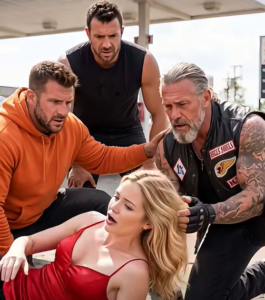
Lily woke and stared. I told her the man was a friend of her grandfather’s and hated the half-truth and used it. Inside, Hale’s note matched a ledger on the table: lease transfers, deputy overtime paid from a company account, a custody filing Harlan had prepared in case I ran. The SD card, played on a battered reader, was Hale at the station two nights ago, Harlan’s voice on a speakerphone telling him to box the woman and the child and call it a welfare check. My father stopped the audio before the threat against Lily could finish. He had already heard it. He looked ashamed of the hearing.
“Hale stayed to be arrested,” Calder said. “That buys hours, not a life. Harlan will trade him for a warrant with your name on it by morning. The card is the warrant’s problem. A judge in the next county owes me nothing and owes Harlan less. We ride at first light.”
“We,” I said.
“I am done being a ghost that keeps you moving. If the card fails, it fails with my face on it.”
Lily slept on the bunk. I did not. I memorized the leases until the names of the families Harlan had cleared off the canyon rim sat in my mouth like grit. At dawn Hale was not at the cabin. A radio in a drawer, left on a channel he had marked, coughed once and gave us his voice from a holding bench: do not come back for me, take the card, tell Marsh the pipe is paid. My father closed his eyes and opened them like a man putting a tool down.
The next county’s judge was a woman who kept ranch hours. We met her in chambers with Lily in the hall drawing rabbits. She listened to the speakerphone. She looked at the leases. She looked at my father as if a resurrection were an affidavit she intended to test. By noon she had signed a preservation order on the canyon transfers and a pickup order for Harlan Marsh that did not route through his son’s deputies. I signed a statement that included the gas station, the threat, the flight, and the fact that I had taken a stranger’s bike. Leaving out the bike would have made the rest look curated.
Harlan met the order with lawyers and a press line about a grieving widow and a biker gang. The card did not care about the line. Hale, released because the holding charge had been a welfare check with no complainant willing to appear, walked into the same courthouse and identified the speakerphone voice without adding heroics. Harlan’s son, my ex-husband, tried the old hiss in the corridor, the one about never seeing Lily again. A bailiff heard it. The hiss became its own exhibit. Custody, which he had treated as a weapon, moved to a supervised schedule he did not control. He called it abduction. The record called it a service station and a child in a bunny’s line of sight.
The leases took longer. Families came back to the rim with copies of their old gates. My father did not take the company chair. He testified, signed the reversions, and asked the judge to note that he had stayed hidden while other names were cleared. The note went in. Hale refused a medal and accepted a repaired bike. I returned the one I had ridden, watch still in my pocket because he said the initials were not his to keep.
We buried the empty funeral on a Tuesday, not with a crowd, with a correction filed at the county clerk: Calder Marsh, living, address the cabin, occupation witness. Lily asked if grandfathers could be late. I said yes. I said late was not the same as gone, and gone was not the same as a fire someone else lit to move a signature. She thought about it and gave him the bunny for the afternoon. He gave it back before dark. Some loans should be short.
What the overlook had threatened to become was another flight. What it became was a gate combination and a card and a man who had waited at the end of the trail because surfacing alone would have made me the next lease. The lesson was not that fathers return. Some do not. The lesson was that a rescue on a highway is only as clean as the paper it points to, and a child is not safe because engines are loud. She is safe when the warrant changes hands, when the duty roster no longer belongs to the man who hisses, when you stop running long enough to play the recording in a room that does not owe him. I keep the watch. I do not keep the ghost. The canyon gates have their old names again, and Lily knows the difference between a siren and a trail that ends at a true door.
The correction at the clerk’s office did not silence Harlan’s press line. It only changed the tense. By the weekend a deputy who still took his overtime from the company account leaked a photograph of the cabin and called it a hideout. I drove Lily to school in the next county under the preservation order and found a cruiser idling across the street, not from our new roster, from the old one. The officer did not get out. He wanted to be seen. Lily saw him. She held the bunny tighter and asked if late grandfathers could still make sirens. I said some men borrowed sirens the way other men borrowed names.
Hale met us at the fence with the repaired bike cold and a copy of the leak in his pocket. He did not offer another flight. He offered a hearing date and a seat for the families whose gates had been restored on paper and contested in practice. My father came down from the cabin without the cough hidden, which cost him, and testified that the drainage pipe had been a choice to keep me off the lease and a failure to keep the rim families off it. The judge who kept ranch hours let the leaked photograph into the record as witness intimidation. The deputy’s overtime deposits matched the company account on the SD card. By Wednesday the old roster had two suspensions and a vacancy where my ex-husband’s hiss had lived.
Harlan tried one last consolidation. His counsel filed a guardianship petition claiming the resurrection was unstable and the child required the patriarch’s continuity. The petition named me unfit for the flight, the bike, the overlook. It did not name the speakerphone. I answered with the audio and with Lily’s drawing of the gas station, which the bailiff had kept, three tall figures between a small one and a sedan. The judge looked at the drawing longer than at the petition. Guardianship denied. Continuity, she wrote, is not a synonym for control.
On the rim the last contested gate came down in the ordinary way, with bolt cutters and a surveyor who did not work for Harlan. Ruiz, whose orchard easement had been a fiction in another county and a fact here, stood with the others and read the reversion aloud so the wind could hear it. My father signed nothing that day. He held the post while someone else set the hinge. Hale stayed at the road and watched for cruisers that did not come. I kept Lily on the safe side of the new wire and told her the difference between a lock that hides a person and a lock that steals a field. She repeated it badly and then better.
We did not move into the cabin. Ghosts make poor roommates, even living ones. We took a rental near the school, visits on Sundays, the watch on the shelf where she could ask about the initials without turning them into a myth. Calder Marsh learned her bus route and did not learn her fears for her. Some knowledge has to be offered. When she offered it, he listened and did not promise that no one would ever stand in a road again. He promised the paper would be where we could reach it. That was the promise the fire had broken. It was the one worth remaking.
Harlan took a plea on the lease fraud and the procurement of the false death record. His son took supervised time and a distance that the order, not my engine, enforced. I stopped checking the mirror for luxury sedans and started checking homework. The change was smaller than a verdict and harder to keep.
What the note in the watch could not finish, the second hearing did. A father at the end of a trail is not a pardon for the years the trail was empty, and a biker in a road is not a substitute for a warrant in the right hands. I had run to save her and nearly taught her that safety was speed. We stayed, and she learned that safety is a gate with the right name, a recording played in a room that does not owe the man who hisses, and a grandfather who arrives late and tells the truth about the lateness. I keep the watch. The combination still opens the old garage, which we use for bicycles now. When she asks if the fire was the end, I say the fire was a signature someone else moved. The end is the hinge set in daylight, the roster that cannot be bought, and the choice to let her see both. That is the door. We walk through it without looking back for permission.