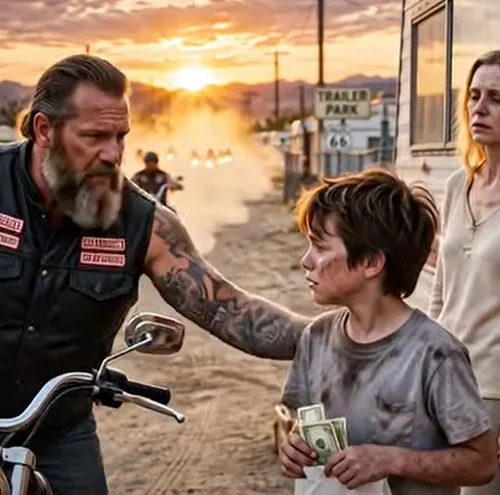
The setting sun cast a bruised orange glow over the weathered aluminum siding of the trailer park
The words hung in the desert air, and for a long moment nobody moved.
Leo’s small fingers tightened around my sweater, and I felt Marcus’s whole body go rigid against mine as though he had just spoken a sentence he had been rehearsing for six years and still could not bear to hear aloud.
“Your father,” I repeated, and my voice came out hollow.
“Walter Reyes, the man who stood at the front of the church at our wedding and wept?”
“He wept because he had already signed the order,” Marcus said, and a shudder ran through him.
“He thought I would take the money and the name and stay quiet, and when I refused, I became a liability he could not afford.”
Jack laid a heavy hand on Marcus’s shoulder, and his silver beard trembled.
“Not here,” he said gently.
“Let the agents finish, and let this boy get out of the dust, and then we will tell her all of it.”
A tall woman in a federal windbreaker approached us across the gravel, her badge catching the red and blue light.
She had cropped gray hair, tired amber eyes, and the careful, quiet walk of someone who did not want to frighten a child.
“Mrs. Reyes, I am Special Agent Dolores Whitfield,” she said.
“I have waited six years to say this to you, and I am sorry that it took so long.”
“Say what?” I whispered.
“That your husband is not a criminal, that your name is cleared, and that the men who destroyed your life are in custody or will be by morning,” she said.
I could not answer, because my throat had closed around a sob.
Leo peered up at the tall stranger with wet eyes and then at the man kneeling in the dirt beside us.
“Mama,” he said in a small, cracked voice, “who is that?”
Marcus’s face crumpled, and he held out one trembling hand and did not touch the boy, as though afraid that a touch might shatter the moment.
“Leo,” I said softly, and I knelt in the gravel and turned my son to face him.
“This is your daddy, sweetheart, and he came home.”
Leo stared at the man for a long, serious moment, with his brows drawn together exactly the way Marcus’s did when he was thinking.
Then he looked down at the silver pocket watch in my hand and back at the man’s tear-streaked face.
“You have the same eyes as the picture on the shelf,” he whispered.
“I do,” Marcus said, and his voice broke.
“I have looked at that picture of you every night for six years, and I never once stopped counting the days.”
Leo hesitated one more heartbeat, and then he flung himself into his father’s arms with a cry that was half laughter and half sob.
Marcus caught him and held him, and his shoulders shook, and he pressed his face into the boy’s dusty hair and rocked him back and forth like something precious that had been lost at sea.
I knelt beside them and wrapped my arms around both, and the desert wind swept over the three of us, carrying the smell of sage and engine oil and rain that had not yet come.
Jack stood a little apart with his hat in his hands, looking away toward the darkening mountains, and I saw him wipe his eyes with the back of his wrist.
“Uncle Jack,” I said, and he turned.
“Come here, you old bear, you are part of this too.”
He lumbered over, and I seized his arm and pulled him down into the circle, and the biggest, toughest man in the county sobbed like a child against my shoulder.
The bikers behind him, a dozen grizzled men and women in worn leather, had silenced their engines and lowered their heads, and not one of them spoke.
The federal agents took Vance and his men away in the transport vans, and the red and blue lights faded down the highway until the night belonged to the stars again.
Agent Whitfield arranged for us to spend the night at a safe motel in the next town, a low, clean place with a flickering vacancy sign and a lobby that smelled of coffee.
Marcus carried Leo into the room in his arms, because the boy had fallen asleep against his shoulder somewhere along the drive and refused to be set down.
I stood in the doorway watching him lay our son on the bed and pull the blanket over him with clumsy, reverent hands.
“He is so big,” Marcus whispered.
“He was a baby when I left, Sarah, he fit in the crook of my elbow.”
“He is ten, and he can read three grades ahead, and he is afraid of thunder,” I said, and my voice shook.
“He wants to be a veterinarian, and he sleeps with a stuffed wolf named Captain.”
Marcus pressed his fist against his mouth and nodded, and the tears ran freely down his weathered face.
“I missed everything,” he said.
“I know,” I said.
“But you are here now.”
He turned to me then, and for the first time since the headlights, we were truly alone.
He looked older, with deep lines carved at the corners of his eyes and gray threading his dark hair, and a pale scar ran along his jaw that I had never seen before.
I wanted to be angry, and I had every right, because six years of grief and fear and hiding do not vanish in an hour.
But when I looked at his face, I saw the man who had held my hand through a thunderstorm on our first date and carried me over the threshold of a rented one-room apartment.
“I do not know whether to hit you or hold you,” I admitted.
“You are allowed to do both,” he said, and a faint, broken smile touched his lips.
I stepped forward and struck his chest with my fist, weakly, and then again, and then I was crying and he was holding me, and I clung to his coat like a drowning woman.
“You let me bury you,” I sobbed.
“You let me stand at that grave and throw dirt on a coffin, and I screamed your name at the sky.”
“I know,” he said, and his own voice was ragged.
“I stood across the cemetery behind a row of cypress trees, and I watched you do it, and I thought my heart would stop.”
“Jack held me back, because I wanted to run to you, and every part of me wanted to run, and I knew that if I did, you would both be dead by morning.”
“My father had men at the funeral,” he said.
“Watching to see whether you knew.”
I drew back and looked at him through my tears.
“Tell me everything,” I said.
“Not tomorrow, and not when it is safe, but now.”
He nodded slowly, and we sat on the edge of the second bed with a single lamp burning low, and Jack came in quietly with a pot of motel coffee and sat in the corner chair.
Marcus told it in a low, steady voice, and I listened without interrupting.
Walter Reyes had built Reyes Holdings out of a single hardware store into a sprawling empire of land, timber, and water rights across three counties, and he had done it with bribes, intimidation, and a network of officials who owed him favors.
Marcus had joined the company at twenty-three, believing that his father was a hard but honest businessman, and it took him four years to learn the truth.
“I found the second set of books by accident,” he said.
“A clerk left a drawer open, and I saw payments to a county judge, a sheriff, and a district attorney named Vance, and the amounts were obscene.”
“I confronted my father in his study, and he did not deny it.”
“He told me that this was how the world worked, and that I would understand when I was older, and that I should take my share and keep my mouth closed.”
“I said no,” Marcus continued.
“I said that I would take the books to the federal prosecutor, and he looked at me with those cold gray eyes and said, you will do no such thing, because you have a wife and a son.”
My blood ran cold.
“He threatened us,” I whispered.
“He threatened you the way a man threatens a bargaining chip,” said Marcus.
“And that was the moment I understood that my father would sacrifice his own blood to protect his money.”
Jack leaned forward, and the lamplight cut deep shadows across his face.
“I was Marcus’s friend long before I was your uncle, Sarah,” he said.
“I rode with a club that did odd jobs for Walter in the early days, and I knew what kind of man he was.”
“When Marcus came to me that night, white as a sheet, I told him the only way out was a federal witness protection arrangement, and I knew a woman who could make it happen.”
“Agent Whitfield,” I said.
“She was a young investigator then,” said Jack.
“She had been working the Reyes case for three years, and she needed an insider, and Marcus agreed to become one.”
“But the plan was supposed to be simple,” Marcus said.
“I would gather evidence for six months, and then we would move you and Leo to a safe place, and I would testify.”
“But my father found out, and he moved faster than we expected.”
“The night of the crash, I was driving home from a meeting with Whitfield, and a black sedan ran me off the road near the canyon.”
“I rolled the car, and I crawled out through the broken window, and I saw the sedan stop at the top of the ridge.”
“My father’s chauffeur got out and looked down at the wreck, and then he got back in, and they drove away.”
“They thought I was dead,” he said.
“And in the morning, when the fire department pulled the body of a federal witness from the passenger seat, they believed they had finished the job.”
“I did not know that the witness had been in the car,” he added, and his voice cracked.
“Whitfield told me later that he had been riding with me to a safe house, and that he did not survive the crash, and I have carried that for six years.”
Silence filled the room, and I reached out and took his hand.
“You did not kill him,” I said.
“Your father did.”
“I know,” said Marcus, and he squeezed my fingers.
“But knowing does not make it lighter.”
We sat that way for a long while, the three of us, with the lamp humming and the desert night pressing against the window.
“Why now?” I asked at last.
“Why did you wait six years?”
“Because we needed more than my testimony,” said Marcus.
“A son accusing his father is a family quarrel, but a ledger with names and dates and bank routing numbers is a prosecution.”
“I spent six years living under a false name in a border town, working as a mechanic and sending encrypted tips to Whitfield, and every month I added another page.”
“And Jack watched over you and Leo, and when the ledger was finished, we came for you.”
“And the pharmacy bag?” I asked, because it still sat on the nightstand, crumpled and absurd.
Jack let out a rueful laugh.
“That was my idea,” he said.
“I needed a way to bring you money without leaving a trail, and Marcus’s old friend at Bartown Pharmacy offered to help.”
“You scared me half to death with it,” I said.
“You were the one who started crying and ran,” he said, with a crooked smile.
“I am sorry, Sarah, I have never been good with gentle.”
“Jack,” I said, “you have been the gentlest man in my life for six years, and I never knew.”
He ducked his head, and his ears turned red, and he coughed into his fist.
“Go to sleep, you two,” he said gruffly.
“There is a long day tomorrow, and I will sit up and guard the door like an old dog.”
We lay down on the narrow bed with Leo between us, our hands joined across his small sleeping body, and I listened to the two breathing patterns, one slow and one steady, until my own breath fell into rhythm with theirs.
In the morning, I woke to the smell of bacon and the sound of my son’s laughter.
Leo sat cross-legged on the floor with a paper plate and a pile of pancakes, while Marcus sat across from him with a plastic fork, demonstrating how to build a syrup dam.
“You make a wall,” Marcus was saying solemnly, “and then you fill the lake, and then you break it.”
“That is so cool,” said Leo, and his whole face glowed.
“Mama never lets me do that.”
“Your mother is a wise woman,” said Marcus, glancing up and catching my eye with a smile that stopped my heart.
I lay very still and watched them, because I did not want to break the spell, and I thought that this was the sound I had been listening for in every empty room for six years.
The trial of Walter Reyes began three months later in the federal courthouse in Albuquerque, and it drew reporters from every corner of the country.
I sat in the second row in a gray dress with Leo beside me in a clip-on tie, and Marcus sat at the prosecution table next to Agent Whitfield with his hands folded in front of him.
Walter Reyes was brought in wearing a charcoal suit and leg irons, a tall, white-haired man with a hawk’s nose and eyes the color of slate.
He did not look at his son once.
The prosecution laid out its case over four weeks, with Marcus’s ledger as the centerpiece, a thick book of pages in his careful hand, each one corroborated by bank records and witness statements.
Vance, the district attorney, had taken a plea deal and testified against his old master, and he sat in the witness box with his expensive coat gone and his shoulders slumped.
“Mr. Reyes paid me four hundred thousand dollars over six years to bury investigations and falsify evidence,” he said in a hollow voice.
“And he ordered the elimination of his own son, and I helped arrange the car.”
A gasp swept the courtroom, and Walter’s jaw tightened, but he did not turn his head.
Then they called Marcus to the stand.
I had been dreading it, and I gripped Leo’s hand so tightly that he whispered, “Mama, ow,” and I loosened my fingers with an apology.
Marcus walked to the witness stand with his shoulders squared, and he laid his palm on the Bible, and in a clear, even voice he swore to tell the truth.
He told them everything, from the open drawer to the black sedan, and his voice never wavered, even when he described the chauffeur looking down at the wreck.
When the prosecutor asked him why he had come forward, he paused for a long moment and looked directly at his father.
“Because I have a son,” he said quietly.
“And I wanted him to grow up in a world where the name Reyes means something I am not ashamed of.”
For the first time, Walter lifted his eyes, and they met his son’s across the courtroom, and I saw something flicker in the old man’s face, a flash of something that looked terribly like grief.
Then it was gone, and the mask came down again, smooth and cold.
The jury deliberated for three days.
When they returned, a hush settled over the room so complete that I could hear Leo swallow.
“On the charge of conspiracy to commit murder, guilty,” read the foreman.
“On the charge of racketeering, guilty.”
“On the charge of bribery of public officials, guilty.”
“On the charge of fraud and embezzlement, guilty.”
Walter sat motionless as the sentence was read, life in federal prison without the possibility of parole, and when the marshals took his arm he rose without a word.
At the door, he paused and turned his head, and for one brief moment his gaze found Leo’s.
My son looked back at him with solemn dark eyes, and the old man’s lips parted as if he meant to speak.
Then the door closed behind him, and the sound echoed through the silent courtroom like the shutting of a very old book.
Marcus came down from the stand and walked straight to us, and I rose and wrapped my arms around his neck.
“It is done,” he whispered into my hair.
“It is done,” I said, and I felt his whole body sag with relief.
Leo tugged at his sleeve.
“Daddy,” he said, and Marcus went very still, because it was the first time the boy had called him that aloud.
“Can we go home now?”
“Where is home, buddy?” Marcus asked, and his voice shook.
Leo thought about it with great seriousness.
“Wherever you and Mama are,” he said.
Marcus knelt in the aisle of the courthouse and pulled our son against his chest, and I knelt beside them, and the three of us stayed there in a knot of tears and laughter while the crowd parted around us.
We found our home in the spring, a small blue farmhouse on twelve acres of green hills outside a town called Mercy Ridge, with a sagging porch, a leaning red barn, and a crooked mailbox shaped like a duck.
The first time we walked through the gate, Leo ran ahead and flung open the barn door and shouted that there were kittens in the hay.
There were five of them, tiny and gray and mewling, and he sat down in the straw and let them climb over him with an expression of such pure, speechless joy that Marcus had to look away.
“He is going to want to keep them all,” I said.
“Then we will keep them all,” said Marcus.
We did, and within a year we had four dogs, a donkey named Biscuit, and a flock of hens that Leo claimed could understand English.
Marcus opened an auto repair shop in town, and the sign above the door read Second Wind Garage, and he painted it himself in bold white letters.
Jack came by every Saturday on his Harley, along with the rest of the old club, and they sat on the porch drinking coffee and fixing engines and telling stories that grew taller with every telling.
“Remember when Walter’s chauffeur tried to follow us in that ridiculous limousine?” Jack would say, and the whole porch would roar with laughter.
Agent Whitfield retired that summer and came to live in the cottage next door, and she took up gardening with a ferocity that left the neighbors terrified.
“I spent thirty years chasing criminals,” she told me, wiping dirt from her hands, “and I would like to spend the rest of my life chasing tomatoes.”
I took a job at the Mercy Ridge library, among the cool shelves and the smell of old paper, and I read aloud to the children on Saturday mornings, and for the first time in my adult life I did not look over my shoulder.
One golden evening in September, when the maples had begun to flare red and the air smelled of woodsmoke, Marcus found me on the porch swing with a mug of tea.
He sat beside me, and the swing creaked, and for a while we watched Leo chase a hen across the yard, shrieking with laughter.
“I have something for you,” he said at last.
He drew the silver pocket watch from his pocket, the one that had belonged to his grandfather, and he opened the lid and held it out.
Inside, where the old photograph had once been, he had placed a new one, a small snapshot of the three of us on the porch of the blue farmhouse, squinting into the sun.
“I had it made last week,” he said.
“The old picture was destroyed in the crash, and I wanted something that was true.”
My eyes filled, and I closed my fingers over the watch.
“It is perfect,” I whispered.
“There is one more thing,” said Marcus, and he took my hand.
“Six years ago, I made you a promise, and I broke it, and I have spent every day since trying to understand how to ask you to trust me again.”
“I cannot give you back the time,” he said.
“But I can give you every day from here forward, and I can promise that I will never leave without telling you, not for any reason, not ever.”
“Marcus,” I said.
“I am not finished,” he said, and he gave a nervous laugh.
“I want to marry you again, Sarah, in front of Leo and Jack and the donkey, with no secrets and no ghosts, just us.”
I looked at his earnest, tender, frightened face, and I felt the last of the old fear loosen like a knot in my chest.
“Yes,” I said.
“Yes, a thousand times, yes.”
He kissed me, and Leo, who had been peeking around the corner of the porch, let out a whoop that scattered the hens in every direction.
We were married in October, in the yard beneath the biggest maple, with the leaves blazing red and gold above us like stained glass.
Jack gave me away in a clean leather vest and a necktie that he had clearly never worn before, and he wept openly all the way down the aisle.
Leo carried the rings on a small velvet pillow, with Biscuit the donkey following behind him wearing a wreath of daisies.
When the preacher asked who would stand with us, the whole yard rose, the bikers and the neighbors and the old agent with dirt under her fingernails, and a great warm murmur of yes rolled across the grass.
Marcus slid the ring onto my finger, and his hands shook so hard that he nearly dropped it, and I laughed through my tears and steadied his fingers with mine.
“I love you,” he said.
“I have never stopped.”
“I know,” I said.
“I never stopped either.”
The years unfolded gently.
Leo grew tall and lanky, and he did become a veterinarian, and he opened a clinic in town with a hand-painted sign that read Captain’s Place, after the stuffed wolf he had never quite given up.
Marcus’s garage became a gathering place for anyone who needed a hand, and he hired young men who had made mistakes and needed a second chance, and he taught them to fix engines and to hold their heads high.
I started a small foundation for families in hiding, women and children running from men who would not let them go, and we kept a row of cottages at the edge of the property where they could rest and heal.
One bright spring morning, many years after the trial, a letter arrived at the farmhouse in a plain white envelope with a federal prison return address.
I held it in my hands for a long time before I carried it out to the barn where Marcus was working under the hood of an old truck.
“It is from your father,” I said softly.
He wiped his hands on a rag and took the envelope, and his face went still.
He opened it and read in silence, his lips moving slightly, and then he lowered the page and stared out the open door at the green hills.
“What does it say?” I asked.
He handed it to me, and I read the cramped, shaking handwriting of an old man who had never learned to say what he meant.
Marcus, it read.
I do not ask your forgiveness, because I do not deserve it.
I have had a great deal of time to think, and I have come to understand that I built a mountain of gold and lost the only thing worth having.
I saw the boy once, in the courtroom, and he has your mother’s eyes, and I wish that I had been a man worthy of looking into them.
Take care of your family, and give them the name that I could not.
Your father.
I folded the letter and laid it on the workbench, and Marcus stood very still with his hands at his sides.
“I do not know what to feel,” he said finally.
“You do not have to know yet,” I said, and I laid my hand against his back.
“But I think that if you wanted to write back, someday, a few words would not hurt.”
He was quiet for a long time, and the barn swallows twittered in the rafters, and the smell of hay and motor oil hung warm in the air.
“Maybe someday,” he said at last.
“Not today, but maybe.”
I leaned my head against his shoulder, and he put his arm around me, and together we looked out at the green fields where our son was playing with a puppy, laughing so hard that his whole body shook.
Behind us, the old truck’s hood stood open, and the radio crackled with a slow, sweet song.
That evening, after supper, we gathered on the porch the way we always did, the whole mismatched family, with Jack in the rocking chair and Whitfield knitting beside him and Leo sprawled on the steps with a dog on his chest.
The sun dropped behind the hills in a blaze of gold and rose, and the fireflies rose from the long grass in drifting, silent constellations.
Marcus took the silver pocket watch from his vest and opened the lid, and the little photograph glowed in the dusk.
“Six years in the dark,” he said quietly.
“And I would live every one of them again, if it led me back to this porch.”
“You will not have to,” I said.
“No more dark, Marcus.”
“No more dark,” he agreed, and he drew me close.
The stars came out one by one, and the night settled warm and sweet around us, and from the yard came the gentle clucking of hens settling to sleep.
Leo yawned and said, in a drowsy voice, “Mama, Daddy, I think this is the best house in the whole world.”
“I think so too,” I said, and my heart swelled until it ached.
I closed my eyes and let the peace wash over me, the creak of the swing, the warmth of my husband’s arm, the low murmur of voices I loved.
I thought of the girl in the dusty trailer park, clutching a paper bag and a frightened child, who had believed that the world had no more mercy to give.
I wished that I could reach across the years and tell her that the road was long, but that it led here, to a porch and a family and a light left burning in the window.
“We are home,” I whispered.
And Marcus, his lips against my hair, whispered back, “We are finally, truly home.”