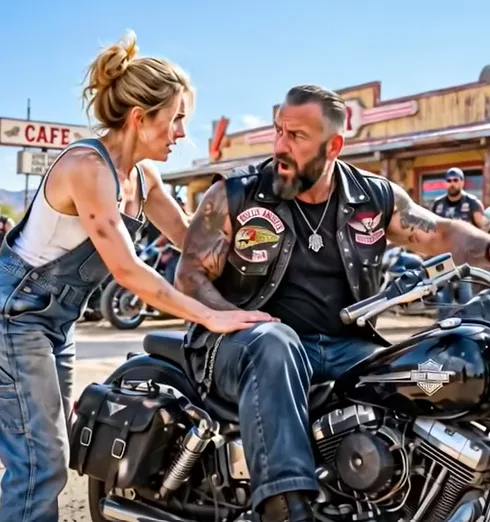
The scorching midday heat radiated off the crushed gravel parking lot
I opened the manila folder with fingers that would not stop trembling, and the first page blurred into a smear of ink and tears.
My father’s signature stared up at me from the bottom of the sheet, the same looping, impatient scrawl I used to see on the margins of my childhood drawings.
“Take your time,” the federal commander said quietly, and she lowered herself onto the cracked curb beside me as though we had all the hours in the world.
She was a tall woman in her fifties with silver-streaked braids and a faded scar across her chin, and her name tag read Special Agent Marcella Reyes.
“I’ve carried that folder for six years,” she said, “and I promised myself that I would only hand it to you.”
I looked down at the pages again, and slowly the words sharpened into meaning.
It was a notarized patent assignment, dated eleven days before the explosion, transferring full ownership of the Calloway Fuel Cell to a trust held in the name of his only daughter.
It was not Jaxson’s name on that line, and it was not the mayor’s name either.
It was mine.
“He knew,” I whispered, and the word scraped my throat like sand.
“He knew they were coming for him, and he made sure they could never really own it.”
“He did,” Reyes said, and her voice softened.
“Your father, Daniel Calloway, came to my office three weeks before he died.”
“He was frightened, but he was not defeated, and he told me that if anything happened to him, I should wait for his daughter to find a way to speak.”
“He said you were the bravest person he had ever met, and that you were only twelve years old.”
A sob broke out of me before I could swallow it, and I pressed the folder against my chest as if it were a living thing.
Across the lot, agents were lining the bikers up on their knees along the burning gravel, and a young officer was reading the Miranda warning to the same men who had laughed at me an hour earlier.
Jaxson knelt at the end of the row with his wrists bound behind him and his head turned toward me.
His icy blue eyes were no longer arrogant, and for the first time in ten years I saw something unguarded in them, something raw and furious and afraid.
“You little thief,” he rasped across the distance.
“You’ll never keep it, you hear me?”
“That patent is worth four hundred million dollars, and the lawyers will bury you before you ever see a cent.”
“Let him talk,” Reyes murmured, and a small, dangerous smile touched her mouth.
“Every word is going straight into the recording.”
I realized then that the agents had set a second microphone on the diner’s sign, and that Jaxson had been confessing for the last five minutes without understanding it.
I stood up slowly, brushing the dust from my worn gray work overalls, and I walked toward him until my shadow fell across his face.
The heat shimmered off the gravel between us, and the whole parking lot seemed to hold its breath.
“Do you remember what you said to me the night of the funeral?” I asked him.
He did not answer, and his jaw worked silently.
“You knelt down in front of me in that smoky workshop, and you said that nobody comes back from the dead,” I told him.
“You said I should learn to be useful, because useless girls don’t survive.”
“I learned,” I said, “and I was very useful.”
“I memorized every shipment, every code, every name, and every whispered threat you thought a child would never understand.”
“I fixed your engines for ten years, and every night I wrote down what I heard in a notebook hidden in the wall of my room.”
His face drained of color, because he finally understood who had been standing beside him all that time.
“It was you,” he whispered hoarsely.
“The leak, the tips, the missing shipments, I thought it was one of my own men.”
“It was never one of your men,” I said gently.
“It was only ever the orphan you didn’t bother to watch.”
The young officer helped him to his feet, and Jaxson stumbled as he was marched toward a waiting SUV, no longer the towering king of the highway but just a tired man in a ruined vest.
At the door of the vehicle, he twisted around and looked at me one last time, and I thought I saw a flicker of something that might have been regret.
Then the door slammed, and the engine rumbled, and he was gone.
Reyes put a steady hand on my shoulder, and for a long moment we simply stood together in the afternoon glare.
“Come on,” she said finally.
“There are people who have been waiting a very long time to meet you.”
The federal convoy took me not to a jail or an office, but to a small white farmhouse on a hill outside the next county, with a green porch swing and a pot of red geraniums by the door.
I climbed out of the SUV with the manila folder still in my arms, and I stared at the house with a strange, trembling ache in my chest.
“Whose place is this?” I asked.
“It’s safe,” Reyes said, “and it’s yours for as long as you need it.”
She opened the screen door, and the smell of warm bread and cinnamon rolled out to meet me, so rich and familiar that my knees almost gave way.
A woman stood in the kitchen with her back to us, kneading dough on a floured counter, her gray hair pinned up with a wooden comb.
She turned at the sound of the door, and the dough fell from her hands.
“Chloe?” she breathed.
I knew that voice, though I had not heard it in ten years.
“Aunt Winnie,” I said, and then I was across the room and in her arms, and the whole world dissolved into flour and cinnamon and the soft, impossible comfort of someone who had never stopped looking for me.
“They told me you were gone,” she wept into my hair.
“They told me you went to the state orphanage, and then they told me the orphanage had burned, and I never believed any of it, not for one single day.”
“I looked for you in every town,” she said, holding my face between her floury palms.
“I wrote to every judge, and I called every shelter, and the mayor’s men turned me away at every door.”
“Then six months ago, a kind federal agent knocked on my window and told me you were alive.”
I turned and saw Reyes standing quietly in the doorway, her eyes bright and her smile tired.
“I told her I couldn’t tell you yet,” Reyes said softly.
“You had to finish what you started, and I didn’t want to give you a reason to stop.”
“You gave me a reason to keep going,” I said, and my voice shook.
“Every time I wanted to quit, I thought about someone out there, still waiting.”
“I didn’t know it was her,” I added, laughing and crying at once, “but I knew somebody was.”
That night, I sat at Winnie’s kitchen table in a borrowed nightgown, with a cup of chamomile tea warming my hands and a plate of cinnamon rolls untouched in front of me.
The windows were open, and a gentle breeze carried the smell of cut hay and distant rain across the sleeping hills.
For ten years, I had not slept without one ear listening for footsteps in the dark.
Now the house was silent, except for the slow tick of an old clock and Winnie humming softly as she washed the dishes.
“Would you like to see something?” she asked, drying her hands.
She led me down a narrow hallway to a door at the end, painted a faded sky blue, and she paused with her fingers on the knob.
“I kept it exactly the way it was,” she said quietly.
“Your father asked me to, the last time I spoke to him.”
She opened the door, and I stepped into a small room that smelled of lavender and old paper.
A narrow bed stood beneath the window with a patchwork quilt of faded yellow stars, and a shelf above it held rows of battered storybooks.
On the desk sat a tiny, half-finished model of a motorcycle engine made from bottle caps and bent wire, and I recognized it at once.
I had built it when I was nine, on the last summer afternoon my father and I spent together in his workshop.
I picked it up gently, and my vision swam, and a memory rushed over me as clear as spring water.
My father crouching beside me with grease on his cheek and laughter in his eyes, saying that engines were just stories told in metal.
“Every part has a purpose, Chlo,” he had told me, “and when they all work together, something beautiful moves.”
I sank onto the edge of the bed and held the little model against my heart, and for the first time in a decade I cried without being afraid of anyone hearing me.
Winnie sat down beside me and wrapped her arms around me, and she rocked me slowly, the way a mother rocks a very small child.
“He loved you so much,” she murmured.
“Everything he did, he did for the little girl with the bottle-cap engines.”
When my tears finally ran dry, I lay back against the pillow, and the quilt smelled of sunshine, and sleep took me like a warm tide.
I dreamed of my father walking through a field of tall gold grass, turning back to smile at me, and for once the dream did not end in fire.
The trial began four months later, in the dead of winter, in a federal courthouse made of gray stone with a flag snapping in the cold wind.
I wore a simple navy dress that Winnie had sewn for me, and she sat in the front row clutching a handkerchief and a thermos of tea.
Reyes sat beside her in a charcoal suit, and behind them, to my surprise, sat a dozen people I had never met.
They were mechanics and engineers and old friends of my father, and a few of them had once worked in his workshop before the explosion.
They had read about the case in the newspapers, and they had driven for hours through the snow to be there.
I took the witness stand on the first morning, and the prosecutor, a calm young man named Mr. Okafor, guided me through my testimony with patient, quiet respect.
I told the jury about the night my father died, and about the years of forced labor, and about the notebook hidden in the wall.
The notebook itself sat on the evidence table in a clear plastic sleeve, its pages filled with ten years of cramped, careful handwriting.
Every date, every name, every license plate, and every threat was written there in a child’s growing script, and by the end, even the bailiffs were wiping their eyes.
The defense attorney tried to shake me, and he suggested that I was a bitter, damaged girl who had invented a story to avenge my loss.
I looked at him calmly, and I said that I would gladly be damaged if it meant the truth survived.
The courtroom went silent, and the judge, a gray-haired woman with spectacles, gave me the faintest nod.
Jaxson sat at the defense table in an orange jumpsuit, and he did not look at me once during my testimony.
But on the third day, when the recording from the diner parking lot was played aloud, I saw his shoulders sag as his own voice filled the room.
Every proud boast and every cruel word rang out across the wooden benches, and the jury listened with grim, motionless faces.
The mayor, who sat beside him in a gray suit, kept turning to his lawyer and whispering furiously, but there was nothing left to whisper about.
The jury deliberated for less than two days.
When they filed back into the box, I felt Winnie’s hand slip into mine, and I held on so tightly that her knuckles went white.
“On the charge of conspiracy to commit murder,” the foreman read, “we find the defendants guilty.”
“On the charge of grand theft of intellectual property, guilty.”
“On the charge of forced labor and unlawful detention of a minor, guilty.”
The words rolled over the room like thunder, one after another, until my ears rang with them.
The mayor slumped forward, and his lawyer put a limp hand on his back.
Jaxson sat perfectly still, and then, slowly, he lifted his head and looked directly at me for the first time in weeks.
There was no rage in his eyes, only a vast, hollow weariness, and I understood that something in him had finally broken for good.
When the judge pronounced the sentences, she gave both men life without parole, and she added a few quiet words that I carried with me long afterward.
“Justice, however late, is still justice,” she said, “and this court is grateful to the young woman who refused to stay silent.”
Outside the courthouse, the snow had begun to fall in thick, soft flakes, and the steps were crowded with reporters and well-wishers.
Cameras flashed, and voices called my name, but I only wanted to find a quiet place to breathe.
Reyes appeared at my side and guided me through the crowd to a small side door, and we stepped out into a narrow, empty alley behind the building.
The snow fell all around us in a hush of white, and the noise of the world faded to a distant murmur.
“I have one more thing for you,” she said, and she reached into her coat and drew out a worn brown envelope.
“Your father left this with me, along with the folder.”
“He asked me to give it to you only after the verdict.”
My hands shook as I tore the flap open and drew out a single folded sheet of paper.
The handwriting was my father’s, hurried and slanting, and the ink had faded to a soft brown.
“My dearest Chlo,” it began.
“If you are reading this, then it means you are grown, and you are strong, and the people who hurt us have finally been brought to account.”
“I am so sorry that I could not be there to see you become the extraordinary woman I always knew you would be.”
“Please do not spend your life in anger, my darling.”
“Anger is a fire that burns the one who carries it, and you deserve to be warm.”
“Take the patent, and use it for good, and build the kind of world where a little girl can fix an engine and no one ever tells her she is only useful for what she can do.”
“And remember that I was never afraid of the dark, because I always knew you were out there, shining.”
“All my love, forever, Dad.”
I read the letter three times, and my tears fell onto the page and blurred the old ink, and I folded it carefully and pressed it to my lips.
Reyes did not say a word, and she stood beside me in the falling snow with her hand resting lightly on my back.
When I finally looked up, I realized that the weight I had carried for ten years had lifted, quietly and completely, like a bird rising from my shoulders.
“What will you do now?” she asked.
I thought of the little bottle-cap engine on my bedroom shelf, and the quilt of yellow stars, and the dozen strangers waiting patiently on the courthouse steps.
“I think I’ll build something,” I said slowly.
“Something he would have been proud of.”
The following spring, I used the first of the patent money to buy the burned-out lot where my father’s workshop had once stood.
The charred beams had been hauled away years before, and the ground had grown over with weeds and wild clover.
I stood in the middle of that empty field on a bright April morning, with Winnie beside me holding a thermos and my father’s old friends gathered around us in work boots.
“It’s smaller than I remembered,” I said, laughing softly.
“Everything gets smaller when you grow up,” said a gruff old mechanic named Teodoro, who had once taught my father to weld.
“But the things that matter don’t, mija.”
We broke ground that afternoon, and the sound of the first shovel striking the earth rang across the field like a church bell.
The workshop rose slowly through the summer, with tall windows and a high, sloping roof, and a wide front door painted the same sky blue as my childhood bedroom.
Above the entrance, we hung a hand-lettered sign that read Calloway Clean Energy Works, and underneath it, in smaller letters, Every Part Has a Purpose.
I hired people who needed a second chance, former mechanics and laid-off engineers and teenagers from the county’s foster homes who had never been taught that their hands were worth anything.
I taught them what my father had taught me, that an engine is a story told in metal, and that anyone can learn to read it with patience.
By autumn, we had built our first working prototype of the fuel cell, a gleaming silver cylinder humming quietly on a steel workbench.
The whole crew gathered around it in a hush, and I laid my palm on its cool surface and felt the faint, steady vibration of clean power coming to life.
“It’s alive,” whispered a young apprentice named Mateo, who had spent most of his teenage years in a group home and had arrived with a shaved head and a suspicious glare.
“It’s not just alive,” I told him with a smile.
“It’s his.”
Within two years, the little workshop had grown into a real company, with a bright new factory on the edge of town and a waiting list of customers across three states.
The fuel cells powered farm tractors and school buses and small-town ambulances, and they ran so cleanly that the air above our valley grew sweeter every year.
I never forgot the line in my father’s letter, and I made sure that a third of every dollar we earned went to a scholarship fund for children who had lost their parents.
We called it the Daniel Calloway Fellowship, and every June, I stood on a small stage in the school gymnasium and handed a handful of bright, nervous teenagers a check and a set of keys to a workshop of their own.
On the tenth anniversary of the day at the diner, I drove out alone to the old gravel lot on the desert highway.
The diner was gone, torn down years earlier, and in its place stood a small stone memorial surrounded by blooming desert marigolds.
A plaque on the stone bore my father’s name, and beneath it, a single line the town had chosen together.
He Built a Light That Could Not Be Put Out.
I knelt in the warm dust and touched the engraved letters, and the afternoon sun settled gently on my shoulders.
Winnie had passed away the winter before, peacefully, in her sleep, with a cinnamon roll still warm on her bedside table, and I carried her memory in every kind thing I did.
I had married that spring, to a quiet engineer named Samuel, who had once been an apprentice in my workshop and who laughed at my terrible jokes.
Beside me in the dust, a small, tousled girl of three crouched with her fists full of marigold petals, studying the stone with solemn dark eyes.
“Mama,” she asked, “who is that man?”
I gathered her into my lap and kissed the top of her head, and I breathed in the sweet, sunny scent of her hair.
“That’s your grandfather, my love,” I said.
“His name was Daniel, and he loved engines and bottle caps and a little girl named Chloe.”
“Did he love me, too?” she asked.
“Before you were even born,” I answered, and my voice caught.
“He made a whole world for you to grow up in, and he never even got to see it.”
She considered this with great seriousness, and then she opened her chubby fist and set a crumpled yellow petal at the foot of the stone.
“For Grandpa,” she announced.
A warm breeze swept down the empty highway and stirred the marigolds, and for a moment, the whole desert seemed to sigh with quiet joy.
I closed my eyes and let the sun warm my face, and in the stillness I could almost hear my father’s laugh, easy and bright and free.
“We brought them home, Dad,” I whispered.
“All of us, finally, we’re home.”
My daughter tugged at my sleeve, and I opened my eyes to find her pointing down the road, where Samuel was walking toward us across the shimmering gravel with a picnic basket swinging from his hand.
Behind him, the horizon stretched wide and golden beneath an endless blue sky, and the future lay before us like an open road.
I stood up with my little girl on my hip, and together we walked out of the shadow of the past and into the light.