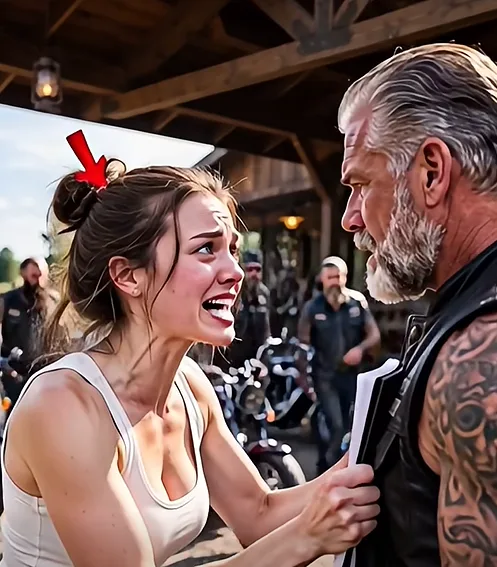
The rustic wooden clubhouse in the freezing rain, where a massive patched biker grabbed the front of my shirt
Arthur’s smile did not reach the flashlight beam. It sat on his mouth like a patch sewn on crooked, and the gun in his other hand was already level with my ribs. Rain ticked on the culvert grate ahead. Somewhere above us the clubhouse was still being taken apart. Down here the only sound was water and the small electric buzz of the phone in my pocket, repeating a message I had not needed a second time.
“Drop the light,” he said.
I dropped it. The beam rolled and stopped against his boot, silver hair gone the color of wet ash. “The text said my father.”
“The text said what I told it to say.” He nodded at the grate. “There are two men out there who still think they work for a task force. They work for me. Your father is not waiting. Your father has been in the river bottom since February. I kept the sentence because fear moves faster than a corpse.”
My brother’s coded diary had named Arthur as the last man he trusted. I had walked into the clubhouse on that trust the way you walk into a lit room. Six months of kitchen errands, six months of letting them call me civilian, and the notebook I had shoved into his chest had been real. The sniper grid had been real. I had mapped it to save the room. He had used the map to time the raid so the wrong agents would be seen doing the shooting while his own buyers cleared the ledger from the back office.
“You sold the Skulls,” I said.
“I rented them.” He stepped over the flashlight. “Rogue badges needed a villain with patches. I provided the villain. They provided the routes. Your brother found the overlap and tried to walk a copy out through this same ditch. I walked behind him. You were the sequel. A grieving girl with a notebook sells a conspiracy cleaner than a wiretap, right up until she sells the wrong direction.”
Boots shifted on the grate. A voice called down, federal cadence, impatient. Arthur did not look up. “The journalist you meant to meet is already in a car on the highway. He thinks he is meeting you. He is meeting a statement that says you lured a task force onto civilian ground. Sign it in your head if you want. The byline will not be yours either way.”
I had one thing he had not taken because he had not believed a kitchen runner would carry it on her skin. The diary’s last page was copied in ballpoint along the inside of my forearm, under the sleeve, grid references for a drop that was not the culvert. My brother had distrusted the exit. He had trusted a mile marker and a woman at a truck stop who owed him a debt older than the club. If I could get Arthur to need me upright for ten more minutes, the sleeve might still matter.
“The ledger isn’t in the clubhouse,” I said. “I moved it last night. Kitchen delivery. Flour tins. Your buyers are pulling empty shelves while the task force films itself.”
The smile cracked. “You’re lying.”
“Then let them call you.” I held out the phone, screen still glowing with his own message. “Ask why the back office safe was full of recipe cards.”
He snatched the phone and thumbed a number with the gun still up. The pause that followed was short and ugly. I heard a man on the other end swear about paper and sugar. Arthur’s jaw worked. Above us the grate voice called again. He angled the barrel a fraction off my ribs, the way a man does when the plan has sprouted a second plan he does not like.
“Where.”
“Mile marker twelve. Truck stop. Locker key is on the diary page you never found because you were busy performing panic on the porch.” I pulled the sleeve up far enough for the ink to catch the fallen light. “Kill me here and your buyers get a key no one can read. Walk me out past your two men and I open it. That is the only order of operations you have left.”
He hated it. Hate was useful. He zip-tied my wrists in front with a cord from his pocket, shoved the flashlight into my hands, and called up that the asset was intact and the package was mobile. The grate screeched. Rain fell through in a hard sheet. Two figures in tactical hoods hauled me onto the shoulder, Arthur climbing behind, gun hidden against my spine so the performance could continue one more mile.
The highway was a black ribbon and a smear of red taillights. One of the hoods said the journalist was secure. Arthur told him to keep the journalist secure and to stay off the radio channel the task force was using. They believed him because belief is the uniform’s other fabric. We took a dark pickup, me in the middle, Arthur on the right, a driver who smelled like cordite and diner coffee. Marker twelve was eight minutes if the driver hurried. I counted silos. I counted the turns my brother had written on my arm. At the seventh silo I leaned as if the zip tie were cutting me and got my mouth close to the driver’s ear.
“He’s burning you after the locker,” I said. “Ask him who signed the buy order on the February load.”
The driver laughed once, unsure. Arthur’s gun nudged. “She’ll say anything.”
“February,” the driver said, almost to himself. “That was the load with the kid’s bike in the report. The one we were told not to log.”
“Drive,” Arthur said.
The driver drove. His knuckles had changed color. At the truck stop the neon was half dead and the woman behind the counter was the one from the diary, gray braid, no questions in her face until she saw my sleeves. Arthur walked me to the lockers with the gun under a folded jacket. The key had been taped inside the napkin dispenser for six months. I had never touched it. My brother had. The woman nodded at the dispenser as if she were nodding at a menu. I palmed the key on the way past, awkward with the ties, and fit it into locker fourteen.
The ledger was there. So was a recorder the size of a thumb, already running, because the woman had started it when she saw the braid of a plan walk through her door. Arthur reached for the book. I let him have the weight of it and stepped on the foot of the driver, who had come in close, and said the February line again, louder, for the thumb and for the counter.
“Buy order. Arthur’s hand. Federal route. My brother’s name on the loss column.”
The driver looked at the top sheet because looking is a reflex. Arthur shot him in the leg to stop the reflex from becoming a decision. The sound was enormous in the tile. The woman dropped behind the counter and did not scream. I swung the locker door into Arthur’s wrist, felt the gun kick wide, and ran for the kitchen hatch my brother had drawn as a square with an X. Zip ties do not stop a shoulder. They stop elegance. I was not after elegance.
Arthur came through the hatch behind me into a lot full of idling trucks. Rain again. The second hood from the culvert was jogging over from the pickup, confused by the shot. I put a truck between us and shouted the only sentence that had ever moved these men faster than money. “He’s logging you as the February loss. The book is in his hand. Read it before you earn a column.”
The hood slowed. Arthur fired and starred a windshield. Somewhere a driver leaned on a horn. The woman from the counter came out the side door with the thumb recorder held up like a badge, already talking into it, names and times, a civilian making a record because no one with a patch was going to do it clean. Sirens started on the highway, the real ones, the channel Arthur had told his men to avoid. Vickers’ people, I hoped. Independent, I hoped. Hope was a thin coat and I wore it anyway.
Arthur caught me at the fence because he was taller and unburdened. He slammed me into chain link and got the barrel under my chin. Up close the smile was gone. What remained was the porch again, fist raised, performance stripped to intent. “You think a diner tape outruns a badge.”
“I think a diner tape outruns a man who needs both hands.” I had worked one loop of the zip tie over the locker key until the plastic bit skin. It gave. My hands were not free. They were free enough to shove the key into the soft place under his badge arm where the jacket gaped. He flinched. The shot went into the fence. The hood, who had read enough of the top sheet to see his own unit number in Arthur’s margin, tackled him from the side with the ugly commitment of a man cancelling his own future.
They went down in the gravel. I crawled clear, got the ledger in both bound hands, and ran for the woman’s voice. She cut the ties with a box cutter and pushed me into the pantry while the lot filled with lights that were not Arthur’s. I talked the whole time into the thumb recorder. Positions. The notebook. The flour tins. The river bottom. My brother’s diary. The text about a father who was not there. When the door opened it was a state investigator I did not know, followed by a journalist who had not been in the car Arthur promised, because the woman had called him herself an hour earlier on a number my brother had left in the napkin dispenser.
Arthur lived. The driver lived. Two of the porch snipers did not, and the task force that had gassed the clubhouse spent the night explaining a raid order with a forged signature block. The ledger’s buy column matched deposits in a shell the state had already been too polite to open. By morning the Iron Skulls who had survived the tunnel were in a sheriff’s bullpen arguing about rats, and the rat was in a hospital bed under a different kind of patch, reading his own margin notes into a camera.
I did not get my brother back. The river bottom gave up a belt buckle and a coded page sealed in plastic, the same grid that had been on my arm, plus a line he had not copied anywhere else: If the president walks you out, the president is the route. I read it in an evidence room that smelled like wet wool and tried to be angry that he had not sent the line to me sooner. Anger was misaimed. He had sent it the only way the club allowed, by hiding it where a sequel might look if she lived long enough to hate the exit.
The case took four months. Arthur pled to the smuggling and the procurement of the February silence and tried to gift the rogue agents the rest. The agents gifted him back. The journalist published the diner tape before an injunction could dress it as classified. Families who had lost freight, and one family who had lost a son on a bike that was never supposed to be in the report, filled the back benches. I testified as what I had been: informant, sister, kitchen civilian, the woman who shoved a notebook into a man’s chest and mistook his flinch for alliance. The flinch had been real. The alliance had been bait. Both facts fit in the record if you refuse to sand either of them down.
I did not take another undercover posting. The service offered one. I declined it in a hallway that still had Arthur’s smile stuck to the air. What I took was the diary, released after the verdict, and the habit of writing the exit before I trusted the man who offered it. The woman at the truck stop kept the napkin dispenser. I eat there when the highway is ordinary. She does not ask about the tunnel. She asks whether the coffee is burned. It always is. That is a smaller honesty than a badge, and it holds.
The lesson was not that brotherhoods are rotten or that rain makes cowards of presidents. Some of the Skulls in the bullpen had been trying to clear a building on the strength of a grid a stranger shoved into their leader’s hands. They were late. They were not empty. The lesson was that a panicked performance is the oldest uniform in a criminal room, and the person who benefits from your warning may be the one who scheduled the warning. My brother mapped the lie and died on the route. I mapped it again and lived because a counter woman pressed record and a driver looked down at a page. Courage is not the scream on the porch. Courage is the second map, the one you hide on your skin, and the decision to make the man who smiles in the dark need you alive long enough for someone outside the patch to hear the buy order read aloud. The clubhouse is a shell. The ledger is a public docket. I keep the diary’s last line where I can see it when a friendly hand offers the exit: if he walks you out, he is the route. Publish anyway.