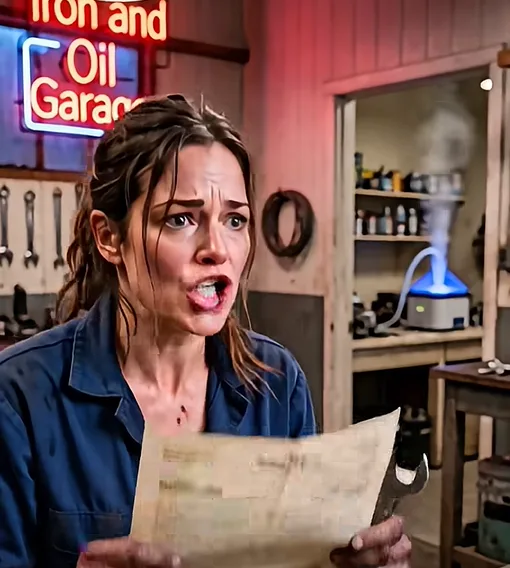
The neon red letters of the Iron and Oil Garage sign flickered weakly against the storm-darkened sky
The face in the moonlight was singed and streaked with soot, and it belonged to the biker, not to the banker.
“Don’t swing that,” Miller rasped, raising both hands, one of them wrapped in a sleeve that was still smoking. “I’m on your side, Maya.”
I did not lower the wrench.
Rain ran into my eyes, and behind him the garage burned like a forge, throwing orange light across the hillside and turning every falling drop into a spark.
“You blew up my father’s shop,” I said, and my voice shook so hard the words came out in pieces.
“The fuel tank blew up your father’s shop,” he said. “I just made sure the men inside it were standing next to it.”
“Vance?”
“Alive. Burned, but alive. He’ll be crawling toward that sedan right now.” Miller winced and pressed a hand to his ribs. “I need you to listen, because we have about four minutes before his partner gets here.”
“Partner?”
“The man in the second suit. He’s the one who matters.”
I stared at him, at the gray in his beard and the hard, tired eyes that I now realized I had seen before, in a photograph pinned above my father’s desk, a younger man in a Marine jacket standing beside my dad with an arm slung around his neck.
“You’re Daniel Miller,” I said slowly. “Dad’s army buddy. The one who went to prison.”
“Eleven years, for a crime I didn’t commit.” His mouth twisted. “Your father wrote to me every month. He signed every letter the same way.”
“Widow,” I whispered. “Because I was married to the garage.”
“He said you were the best mechanic he ever trained, and the worst at asking for help.”
A sound came out of me that was half laugh and half sob, and the wrench slid out of my fingers into the mud.
“My name is Maya Brennan,” I said, to no one, to the rain. “I’m twenty-nine years old, and I thought I was alone.”
“You weren’t,” Miller said. “Not for one day.”
He knelt, gripped my shoulders, and the bone-deep warmth of his hands cut through my soaked jumpsuit.
“Your dad called me three days before he died,” he said. “He said he’d found out where the money was going. Federal pension funds, laundered through foreclosure loans on small family businesses. Vance bought the debt, and a judge in the county seat signed off on every seizure. Dozens of shops, farms, and garages, all ruined to make the paper look clean.”
“And the ledger?”
“On that chip in your fist. Every name, every account, every transfer. Your dad copied it from Vance’s own server, using a mechanic’s tablet and a tow-truck contract as cover.”
I opened my hand.
The little black square sat in my palm, still pulsing red, and it seemed impossibly small to carry so much death.
“They killed him for this,” I said.
“They did.”
“Then we put it where it will count.”
Miller’s weathered face split into a grin, fierce and proud. “He said you’d say that, too.”
Headlights swept the bottom of the hill.
We both flattened into the wet grass, and I watched a long black car roll up beside the burning garage and stop, and a tall man in a gray overcoat step out with an umbrella he did not bother to open.
He stood watching the fire as if it were a television program.
“Judge Harlan Pike,” Miller breathed. “County circuit court. The man who signed every foreclosure.”
“He’s the partner.”
“He’s the head.”
Pike turned slowly, as Vance staggered out of the smoke with his suit in scorched ribbons and one arm hanging limp, and the two of them spoke too low for me to hear.
Then Pike pointed up the hill, directly at us.
“They saw the chip’s signal move,” Miller whispered. “Run.”
We ran.
We tore along the ridge through blackberry thorns and slick roots with the rain hammering our backs and my father’s garage collapsing in a long groan of metal behind us. Gunfire cracked once, twice, and a bullet whined off a stone ahead of me.
“This way!” Miller hauled me left, down a gully filled with rushing brown water. “My bike’s in the culvert.”
“Your bike exploded!”
“My sled exploded. My bike’s the other one.”
He dragged me to a concrete drainage pipe at the bottom of the hill, and there, under a tarp slick with rain, sat a battered black Harley with a sidecar painted in faded army green.
“Get in,” he said.
“I don’t ride in sidecars.”
“You do tonight.”
I folded myself into the cramped seat as the engine caught with a roar, and we burst out of the culvert in a spray of mud and went tearing along a gravel service road with the headlights of Pike’s car swinging behind us like the eyes of a hunting animal.
The storm screamed around us.
Water sheeted off the sidecar’s windshield, and the road ahead was a blur of black and silver, and I clutched the chip in one fist and a handhold in the other and prayed to a God I had not spoken to since the funeral.
“Where are we going?” I shouted.
“Federal courthouse in Cedar Falls! Forty miles!”
“Forty miles in this?”
“There’s a woman there who’s been waiting four years for this chip. A prosecutor named Ruth Okafor.”
“Will she believe us?”
“She’ll believe the ledger.”
Behind us, a second set of headlights appeared, then a third, and I understood that Pike had more men than one.
“They’re gaining!” I yelled.
“I know!”
“Can this thing go faster?”
“She can,” Miller shouted, “if the mechanic back there helps.”
“I’m a mechanic in a sidecar!”
“Then fix something!”
I looked down at the tangle of cables beside my knees, and an old, stubborn instinct woke up in my hands, the same instinct that had once rebuilt a transmission at fourteen with my father laughing over my shoulder.
I found the throttle linkage, loose and sluggish, and pulled a pin out of my hair and twisted it into place with two quick turns.
The engine howled, and the bike lunged forward like a thrown spear.
“Whoa!” Miller whooped, and the sound was so pure and delighted that I laughed out loud in the middle of the storm. “Your daddy was right! Best in three counties!”
We hit the river bridge at ninety, the planks drumming under us, and I looked back and saw two cars skid on the wet boards and the lead one spin sideways into the rail with a scream of metal.
The third kept coming.
It was a black SUV with a roof-mounted spotlight, and it drew alongside us on the bridge’s far end with a window sliding down and a man leaning out with a rifle.
“Maya, get down!” Miller shouted.
I ducked, and a shot punched through the sidecar’s windshield and sprayed glass across my hair.
Miller cut the wheel hard, and we slammed against the SUV with a shriek of steel, and for one terrible second I stared into the gunman’s eyes from three feet away.
Then something beautiful happened.
A pair of headlights burst out of a side road ahead, huge and white, followed by another pair, and another, and the thunder of a dozen engines swelled over the rain like a sudden chorus.
Motorcycles.
Dozens of them, pouring out of the dark in a long gleaming line, riders in dripping leather vests with their lights blazing and their engines roaring, forming a wall of steel across the road behind us.
The SUV braked hard, skidded, and stopped.
“Who are they?” I screamed.
“The Iron Brothers!” Miller yelled back, and his voice was cracking with joy. “Your daddy’s old riding club! He called every one of them the night before he died!”
I twisted in the sidecar and watched the SUV driver throw up his hands as forty riders circled him, silent and enormous, with their headlamps lighting him like a trapped deer.
Miller let out a whoop that shook the whole bike.
“Cedar Falls is ten miles!” he roared. “Hold on!”
We rode into the courthouse square at three in the morning, with an escort of forty motorcycles rumbling at our flanks and the storm finally thinning into a gentle gray mist.
A small woman in a rain-darkened trench coat stood on the courthouse steps under a single lamp.
She had silver hair cut close to her head and a briefcase clutched against her chest, and when she saw us, her whole face lit with something very close to tears.
“Daniel,” she said. “You made it.”
“Ruth.” He climbed stiffly off the bike. “Meet Maya Brennan. She’s got what you’ve been waiting for.”
I climbed out of the sidecar on shaking legs and held out my hand, and the tiny black chip lay in my palm, still blinking its slow red pulse.
Okafor took it in both hands, gently, like a baby bird.
“Your father,” she said, “was the bravest man I never met.”
“He’d have told you he was just a mechanic.”
“I think,” said Okafor softly, “that those are the same thing.”
The arrests came at dawn.
Judge Harlan Pike was taken from his breakfast table in a bathrobe, his hands still holding a cup of tea, while federal agents carried boxes of documents out of his study. Vance, bandaged and sullen, was pulled from a private clinic and walked out in handcuffs past a row of local television cameras.
Within a week, forty-one officials and bankers across three states were in custody.
Within a month, every foreclosure Pike had ever signed was under review, and the courthouse steps in Cedar Falls were lined each morning with families holding sheaves of old paper and looking up with the astonished faces of people who had been told for years that nobody would listen.
I stood among them sometimes, in the thin gold light, and watched.
My father’s name came up in the hearings.
Okafor read it into the record herself, slowly, on a Tuesday morning in the autumn, in a courtroom so packed that people stood along the walls.
“Thomas Brennan,” she said, “mechanic, of Route 9. He gave his life to protect the records that have brought us here today. The people of this state owe him a debt it can never repay.”
A silence followed, deep and warm.
Then someone at the back began to clap, one pair of hands, slow and steady, and another joined, and then the whole room rose together, three hundred strangers on their feet applauding a man who had never wanted to be noticed.
I sat in the front row with my face in my hands and let the sound wash over me.
Miller sat beside me in a clean shirt, wiping his eyes with a handkerchief the size of a flag.
“He’d have hated this,” I said.
“He’d have loved it,” Miller said. “He just wouldn’t have admitted it.”
The Iron Brothers rebuilt the garage in the spring.
They came with trucks and trailers and tool chests, fifty men and women with gray beards and oil-black fingernails, and they raised the walls in nine days. They poured the concrete floor and hung the corrugated roof and bolted a new steel bay door onto the front, and a retired sign painter named Walt carried in a ladder and a can of red paint and refused all help.
The state, in a quiet hearing, canceled the debt on the property and returned every dollar of my father’s seized savings, with interest.
I did not touch it.
I put it into a fund.
When the garage was finished, on a bright Saturday in May, I stood in the gravel lot with my hands in my pockets and my heart in my throat, and I looked up.
Walt had painted the sign himself.
It was the same neon red as the old one, but this one was steady, and bright, and it did not flicker.
IRON & OIL GARAGE. EST. BY TOM. FINISHED BY MAYA.
Beneath it, in smaller letters, a line I had asked Walt to add.
NO ONE GETS TURNED AWAY.
Miller stood beside me with his hat in his hands.
“Your dad would be proud,” he said.
“I know.”
“Did you ever figure out why he called you widow?”
“I thought it was the iron and oil.”
“That was part of it.” Miller smiled gently. “But he told me once it was because you’d lost your mother so young, and you took on the whole shop like a grown woman, and he never forgave himself for letting you. He said you’d earned the title the hard way.”
My eyes filled.
“I’d like to retire the nickname,” I said.
“I’d think so.”
“But I’ll keep the wrench.”
I pulled it from my back pocket, my father’s heavy steel wrench worn smooth by thirty years of his hands, and I held it up to the morning sun.
A line of motorcycles was already rolling into the lot, chrome flashing, engines rumbling, and behind them came a battered sedan and a pickup truck and a beat-up station wagon with a family of five crowded inside, all of them looking for a mechanic who would not turn them away.
I smiled, and I walked toward the open bay door.
The sun was warm on my shoulders, the air smelled of rain and cut grass and new metal, and somewhere in the rafters I could almost hear a laugh like a barrel rolling downhill.
“Shop’s open,” I said.
And for the first time in six months, the words tasted like home.