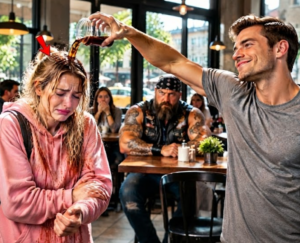
The massive, tattooed biker slammed his fist onto the greasy laminate table of the diner and screamed insults at me
The text sat on the screen like a second raid.
The drive you handed over is a decoy, and your real father is still locked inside the facility beneath your feet.
I did not look at the agent who had just called me Agent Vance. I looked at the basement door behind the counter, the one the cooks said led only to dry storage and a drain that never drained right.
“Phone,” the agent said, hand out, friendly as a receipt.
“In a minute.”
“Now. Chain of custody.”
I smiled the way Clara the waitress smiled when a tip was thin.
“You already have the drive. The rest of my shift is mine.”
His eyes flicked to the door. That was enough. The real federal team did not look at doors they had already cleared. They looked at exits and hands.
The younger man on the floor, still twitching from the taser, laughed once into the tile.
“Told you the apron was the show.”
I stepped toward the counter as if I were fetching a rag. The apron pocket was empty. The real drive had never left the hollow heel of my left shoe, the one I had practiced walking in for six weeks until the limp looked like an old sprain. The decoy in the apron had been built to be found. Someone on the task force had wanted it found.
“Rowan,” I said, using the name on the agent’s vest.
“Who called the basement clear.”
He did not answer. He reached.
I dropped the satellite phone into the coffee urn. Steam and plastic. The room flinched. I was already at the basement latch.
“Vance, stop.”
“If you are federal, you will cover me. If you are not, you will shoot a waitress in front of six zip-tied deputies and a town that finally has eyes. Choose.”
He chose the radio. That was the second tell.
The latch stuck the way it always stuck. I kicked it the way the night cook had taught me, not the way a briefing taught. The stair dropped into cold and the smell of wet concrete and something sweeter, chemical, wrong.
Boots behind me. Not Rowan’s. A second team, the one I had asked to stage at the grain elevator if the diner lights went red and the first team smiled too much.
“Federal. Real ones,” a woman shouted from the top of the stair.
“Agent Vance, we have your secondary signal. Hold.”
I held with my back to the wall and the shoe drive still in the heel. Below, a corridor. Three doors. One open. A cot. A man who had my father’s jaw and twenty years of a story that said he had died in a traffic wreck.
He looked up at the flashlight and did not recognize the apron.
“Clara.”
“It’s me. Can you walk.”
“I can walk if the door is honest.”
“The door is about to be.”
Rowan came down two steps and stopped when the real team’s lights painted his chest.
“This is a controlled site,” he said.
“It was. It isn’t.”
The woman at the top of the stair was Special Agent Ruiz, the one who had never taken the diner coffee. She did not negotiate with his vest. She took the radio, the keys, and the smile.
“Decoy drive logged,” she said to me.
“Where is the live one.”
I sat on the bottom step, unlaced the left shoe, and set the heel drive in her gloved hand.
“Every ledger. Every call. Including the ones that routed through a task-force laptop that was never on the inventory.”
My father stood with one hand on the cot frame. Thin. Clear-eyed. Alive in a way the wreck report had not allowed.
“They kept me because I built the first shell,” he said.
“Not because I ran it. I tried to close it. They put me under a diner and told the town I was a guardrail.”
“I know,” I said.
“I still came for the books.”
Above us the diner had gone from chaos to inventory. Patrons giving names. Deputies in plastic cuffs explaining that they had only been told to stand by the exits. The tattooed enforcer shouting about lawyers he did not have. The younger man quiet now, the smirk gone with the taser’s last tick.
Ruiz walked my father up the stair herself. I walked behind, shoe in one hand, apron in the other, no longer performing either.
Outside, autumn wind cut the red lights into ribbons. Rowan sat in a separate car from the syndicate. That mattered. The town needed to see the split.
My father looked at the Rose Valley sign as if it were a joke that had finally run out of punch.
“You waited tables for two years.”
“I waited tables so they would stop looking at my hands. The hands were the job.”
“I am sorry about the wreck story.”
“Keep the sorry for the hearing. I need you on a record, not in a speech.”
He nodded the way men nod when they have practiced silence too long and are relearning the other option.
They gave us a room at the field office with bad coffee and a window that faced a parking lot instead of a basement. I transferred the heel drive under Ruiz’s camera. The progress bar this time was the real one. Shell companies. Routes. A deputy’s second phone. A task-force login that had opened the diner’s back camera on nights I thought I was alone.
“You were never alone,” Ruiz said.
“You were bait they thought they owned. The secondary team was the part they did not budget.”
“And my brother.”
“In a safe house since noon. The threat in the booth was a script. He has already heard your voice on a line that was not theirs.”
The knot in my ribs finally loosened. Not all the way. Enough to breathe without counting.
Morning came in ordinary. That was the mercy. Indictments do not need neon. The diner owner was taken at his lake house in slippers. The enforcer stopped performing for a room that was no longer afraid of him. The younger man traded names until the names ran out of glamour. Rowan was charged on a different docket, which the town understood better than a speech about institutional trust.
I sat with my father in a courthouse corridor that smelled like wax and wet wool.
“They will ask if I stayed for you or for the case,” I said.
“Tell them both. Both are true. Truth can share a sentence.”
“I hated you for dying badly.”
“I hated the version of me that signed the first shell. We can put both on the table. The table is what they are afraid of.”
The hearing did not make us a family in an afternoon. It made a record. My brother arrived with a jacket that was not a costume and a grip that did not ask me to be Clara. We stood on the steps after and did not pose. The photographer from the local paper wanted the apron. I had already burned the idea of it.
Ruiz offered me a desk that did not require a name tag.
“Analyst. No more booths.”
“I will take the desk after the last transfer is duplicated in three buildings. Then I will take a week where no one calls me sweetheart.”
“Granted.”
My father asked, carefully, if he could see the valley in daylight without a cot.
We drove past the diner. Boards on the windows. A sign that said CLOSED FOR RENOVATION, which was a kind of lie the town could live with until the auction. I did not go in. The basement did not get a pilgrimage.
At the overlook he said, “You could have handed them the real drive in the apron and trusted the vest.”
“I trusted the vest once. It smiled. I will trust a camera and a second team and a brother who is still breathing. That is the new procedure.”
“And me.”
“You are a witness. You can become something else after the sentence, not before. I am not putting a father back together on a deadline.”
He accepted that. Acceptance looked better on him than the wreck report ever had.
Spring took the boards off the diner and put a different name on the glass. I did not apply. My brother opened a garage that fixed brakes and did not launder anything but oil. My father testified, then learned a garden that did not have a lock on the inside. I took the desk. Some nights I still heard mugs rattle. I let them rattle. Memory is not a trap if you can name the door.
The lesson did not need a balaclava to deliver it.
A public humiliation can be a curtain.
A badge can be a costume.
A drive in an apron can be the one they expect, and the one in the shoe can be the one that matters.
Family is not restored by a text and a basement. It is restored, if it is restored at all, by records, by a brother who sees sunrise, by a woman who stops performing the waitress long enough to kick a latch.
I kept the satellite phone they issued me and did not drop it in any more coffee. I kept my own name. When the valley asked what happened at the Rose, I told them the short version.
The shouting was the show.
The books were the point.
And the man under the floor came up the stairs on his own feet, into a morning that had room for him, for me, and for a town that finally looked at the plates only after it had looked at the door.