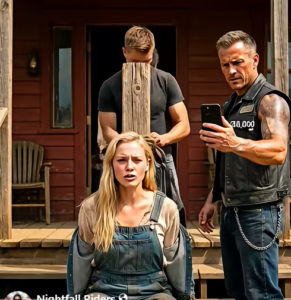
The local motorcycle gang dragged me into the dirt outside our Red Valley farm and shaved my head on a live stream
rivals, and the only man left standing when the dust settles is him.”
The lead investigator’s hand stopped halfway through tucking the blanket around my shoulders.
It was only a pause, the length of one breath, but I had spent three months learning to read pauses, and this one did not belong to a man who had just heard shocking news.
“Mrs. Whitaker,” he said gently, and his warm brown eyes crinkled in a way that was meant to calm me. “You’ve had a terrible shock. Let’s get you away from all this.”
“Where’s Agent Brooks?” I asked.
“Imani is tied up at the warehouse. I’m Special Agent Tom Harlan, I’m running the farm operation.” His hand settled between my shoulder blades and began steering me toward a black sedan parked apart from the other vehicles. “I’ll take you somewhere safe, and we’ll sort out what you saw.”
“Imani told me she’d be here herself,” I said, and I kept my voice small and shaky, the voice of the helpless farm girl the gang had paid to see. “She promised.”
“Plans change in the field.”
“They do,” I agreed, and I let my knees wobble, and I let him take my weight.
Because I had just remembered something, and the memory was so bright and sharp that I nearly gasped.
Three years ago, on the porch of this very farmhouse, a week before our wedding, Luke had told me something foolish and sweet.
Sarah, he had said, turning my hand over in his rough one, there may come a day when I have to look like a stranger to you. A day when I look cold and cruel and nothing like the man you know. If I ever say the word clear, I want you to remember this porch. Clear means I’m still yours, whatever it looks like.
I had laughed at him then and called him dramatic.
It makes us clear, he had whispered in the barnyard, five minutes ago, with a flat dead voice and a face carved from stone.
My heart began to hammer so hard that I was certain Harlan could feel it through his palm.
He had not been telling me we were finished.
He had been telling me to trust him.
And his hand, that cold hand on my wrist as he dragged me upright, had pressed something small and hard into my palm, something I had instinctively closed my fist around and had not dared to look at since.
I could feel it now, biting into my skin beneath the blanket, a little brass key.
“Mrs. Whitaker?” Harlan’s voice sharpened. “Are you with me?”
“I’m sorry,” I whispered, and I swayed against him. “My head is spinning. I think I’m going to be sick.”
“Take a breath.”
I used the breath to look around, the way Luke had taught me to look at a field before the storm broke, noticing everything, trusting nothing.
The agents spread around the barnyard wore windbreakers with FBI printed across the back in yellow letters.
Harlan’s men, the four who stood closest to the sedan, wore plain black jackets.
The sniper on the silo had been a federal sniper, I had assumed, but now I realized I had never seen the shot that disarmed Brock Dunmore come from anywhere I could name.
And the SUV carrying my husband was not parked with the others in the line of vehicles waiting to transport prisoners to the county jail.
It was already moving, rolling slowly down the long gravel drive toward the county road, and as I watched, it turned left.
Left was the quarry road.
Left was the way to nowhere, to forty acres of limestone cliffs and deep green water where the Red Valley sheriff once told me three bodies had been pulled in the nineties, all of them labeled accidents.
“Where are they taking him?” I said.
“The federal building in Cheyenne,” Harlan said smoothly. “It’s a long drive.”
“Cheyenne is the other way.”
His fingers tightened ever so slightly on my back.
“Sarah,” he said, and my first name sounded wrong in his mouth. “Get in the car.”
I did the only thing I could think of, the one thing a man like Harlan would never expect from a trembling woman in a shaved head and a farm girl’s overalls.
I vomited on his shoes.
It was not entirely acting, because fear had been churning my stomach for hours, and I bent double and heaved into the dust, and Harlan leaped backward with a curse, and his hand left my back.
That was all I needed.
I dropped the blanket, and I ran.
I ran not toward the sedan or the agents but toward the circle of bikers face-down in the dirt, where Brock Dunmore’s phone lay in the hay beside the wooden post, screen still glowing, where he had flung it when the gunshot shattered his hand.
It was still recording.
The little red dot blinked in the corner of the cracked glass, and beneath it, in tiny white numbers, the live viewer count flickered upward.
Two hundred and sixty thousand.
The whole country was watching a bald farm girl scramble across a barnyard, and for the first time in my life I was grateful for an audience.
I scooped up the phone and swung it around to face myself.
“My name is Sarah Whitaker,” I said breathlessly, into the lens, and my voice rang out clear and strong across the yard. “I’m in Red Valley, Wyoming. The man in the black sedan is not who he says he is, and if anything happens to me or my husband in the next hour, I need every one of you to remember his face.”
I turned the camera on Harlan, and I watched the color leave him.
“Put that down,” he said, and the warm brown eyes were suddenly flat and dead.
“Say your badge number,” I called. “Say it for the people watching.”
He lunged, but I was faster, because I had spent my life chasing escaped goats across rocky fields, and I dodged under his arm and sprinted for the line of motorcycles gleaming at the edge of the barnyard.
Luke’s red cruiser stood at the front, key still in the ignition, where he had left it with that slow deliberate swing of his leg.
I had ridden it exactly twice.
Both times he had stood behind me in the dirt road with his hands on his hips, grinning, shouting directions I did not need.
I jammed Dunmore’s phone into the bib of my overalls with the camera facing out, threw my leg over the seat, and stomped the starter.
The engine roared, and Harlan’s voice cracked across the yard behind me, shouting for his men to stop me, and a bullet snapped past my ear and buried itself in a fence post.
I twisted the throttle, and the cruiser leaped across the yard, and I did not look back.
The quarry road unrolled ahead of me in a long pale ribbon, bumpy and rutted and white with dust, and I leaned low over the handlebars with the wind scouring my bare scalp and tears streaming sideways across my cheeks.
It was cold.
It was such a strange, naked feeling to have the wind on my head, as though I had lost a layer of skin, and I understood suddenly that the gang had not only been trying to shame me.
They had been trying to unmake me.
And all the while the little glowing screen in my overalls kept counting, three hundred thousand, four hundred thousand, five, and I could hear the faint chime of comments flooding in so fast they sounded like rain on a tin roof.
I did not read them.
I only rode.
I came over the last rise just as the black SUV stopped at the edge of the great gray quarry, with the green water lying far below, and the sun burning low and orange over the limestone cliffs.
Three men climbed out of it, and one of them was dragging my husband by the back of his collar.
Luke’s hands were zip-tied in front of him, and his face was bruised, and there was a thin line of blood at the corner of his mouth, and he was smiling.
He was smiling like a man who had been waiting for this exact moment for a very long time.
I killed the engine and coasted the last fifty yards in silence, and I slid off the cruiser behind a heap of broken stone, and I crept forward on hands and knees until I could hear every word.
“You know how this works, Luke,” said the biggest of the three men, a tall bald figure with a tattoo of a hatchet on his neck. “A fugitive tries to escape federal custody. Agent Harlan’s boys shoot him. Everybody goes home.”
“I know exactly how it works, Rafe,” Luke said, and his voice was calm. “I wrote the playbook.”
“Then you’ll understand why it’s nothing personal.”
“Nothing’s ever personal in this business.” Luke tilted his head toward the quarry. “Do me one favor first. Tell me if my wife got away.”
My heart turned over in my chest like a stone rolling downhill.
“Harlan’s running her down,” Rafe said dismissively. “By the time we finish here, she’ll be in the car beside you.”
“Good,” Luke said, and I almost cried out, because I understood suddenly that the lie was only for them, that he was not afraid for himself at all. “Then it’s the right day.”
“What are you talking about?”
Luke’s smile stretched wider, and for a moment I saw all of him, the whole man, the farmer and the founder and the husband who had once built me a porch swing with his own hands.
“I’m talking about my wife,” he said. “Because she’s smarter than all of you put together.”
I stood up from behind the rocks, with Brock Dunmore’s phone held high in front of me, its screen pulsing red.
“Hi, Rafe,” I said.
All three men spun around.
The bald man’s mouth fell open, and his hand dropped toward his hip, and I lifted the phone higher so the light caught the screen, so he could see the counter climbing past six hundred thousand.
“Smile,” I said. “You’re live.”
Nobody moved.
The wind sighed through the quarry, and somewhere far below a bird called across the green water.
“Six hundred and forty thousand people are watching you point a gun at an unarmed man,” I said. “They can see your face. They can see your tattoo. They can see the car, and the plate, and the quarry, and where we are, because Wyoming Highway Patrol has already texted the coordinates to every news station in four states.”
It was a bluff, mostly.
But as I said it, I heard the far-off thrum of helicopters rising beyond the ridge, and the sound was so beautiful that I nearly wept.
“Sarah,” Luke said softly.
“I’m here,” I said, and I did not take my eyes off Rafe.
“You shouldn’t have come.”
“You said clear,” I told him. “I’m clear.”
Something happened in his face then, a thing I had not seen in three months, in all the cold weeks of scowls and silences and slammed doors.
It was the plain, open, helpless look of a man who has just been shown that he is loved.
“Drop the phone, girl,” Rafe growled, and he raised his pistol and pointed it at my chest.
“Rafe,” said the second man, a nervous thin fellow with a scar on his lip. “The viewers.”
“I don’t care about the viewers.”
“Six hundred thousand, Rafe. That’s more than live in Wyoming.”
Rafe’s finger trembled on the trigger, and in the long silence I could hear him arguing with himself, the old rough animal calculating whether a quick shot and a quicker getaway could erase the world.
The helicopters swept over the ridge.
There were three of them, black and enormous, flying low enough to flatten the grass, and the whine of their rotors tore across the quarry like a cry from heaven.
A voice blasted from a loudspeaker, a woman’s voice, ringing and furious.
“This is Special Agent Imani Brooks, Federal Bureau of Investigation! Drop your weapons and put your hands on your heads! You are surrounded!”
The thin man dropped his gun first, and then the third, and finally, with an ugly strangled snarl, Rafe let his pistol fall from his fingers and raised his hands.
Ten agents in actual FBI jackets rappelled down the cliff face on ropes, and another dozen came pounding across the gravel on foot, and they swarmed over the three men and pressed them to the ground.
A tall woman with close-cropped silver hair strode across the quarry floor in a navy windbreaker with a plain gray badge swinging at her chest.
“Sarah Whitaker,” she called, and she was almost laughing. “Remind me never to underestimate a farm girl with a smartphone.”
“Agent Brooks,” I said, and my voice cracked in half. “Harlan.”
“We have Harlan,” she said grimly. “My deputy pulled him over on the county road not four minutes ago, trying to flee in a black sedan. He had a suitcase with two hundred thousand in cash and a satellite phone he was using to talk to a man I’d very much like to meet.”
She turned to Luke, who was still on his knees, still smiling, and she crouched down, pulled a small folding knife from her belt, and sliced through the zip-ties on his wrists.
“Mr. Whitaker,” she said. “That was cutting it close.”
“I told you he’d try it,” Luke said hoarsely, rubbing his red wrists.
I stared from one of them to the other, and the world made a strange slow tilt.
“You told her,” I whispered.
Luke looked up at me, and his eyes were wet.
“Sarah,” he said. “I owe you the longest apology of my life, and I don’t know where to start.”
“Start with the truth,” I said. “All of it.”
We sat on the tailgate of an FBI truck while the sun slid down the quarry wall, and a medic dabbed iodine on Luke’s cut lip, and I wrapped a gray emergency blanket around my shoulders and listened.
“I started the Red Valley Brotherhood when I was nineteen,” Luke said, and he stared out at the water instead of at me. “I was angry. My father had lost this farm in a bad year and drank himself into the ground, and I swore I’d never be poor and powerless again. I found a few friends who thought the same way. We ran a little weed. A little fencing. Then a little more. And one day I looked up and the thing I had started had grown into something that owned half the county.”
“You’re the founder,” I said.
“I’m the reason there is a Brock Dunmore.” His mouth twisted. “I was twenty-five when I met you. I was at a feed store buying seed, and you were arguing with the clerk about a price tag, and you wouldn’t back down, and I thought, who is this woman who isn’t afraid of anything?”
“I was terrified,” I said.
“You were magnificent,” he said, and he finally turned to look at me. “I tried to quit that week. I went to Dunmore and told him I wanted out, and he laughed and showed me a folder with your name on it, and your mother’s name, and a photograph of your front door.”
A cold hand squeezed my heart.
“For three years I’ve kept that gang at arm’s length and kept them away from you,” Luke said. “I gave them money and looked the other way and stayed in the saddle, because as long as I was boss, you were safe. And every night I lay beside you, and I thought, someday I’m going to find a way to tear this whole thing down without anyone I love getting hurt.”
“And then I started talking to the sheriff,” I said.
“And then you started talking to the sheriff.” A rueful, helpless laugh escaped him. “Do you know how scared I was? I came home the night you told me you’d gone to Ruth Delaney, and I wanted to shake you and kiss you at the same time.”
“You never said a word.”
“I couldn’t. If I’d said anything, you’d have stopped, or they’d have known you were being coached, and Dunmore would have had you buried before sunrise.” He dropped his head. “So I did the only thing I could think of. I called Imani.”
I looked up at Agent Brooks, who stood a few paces away with her arms crossed and her eyes gentle.
“Luke walked into my field office in Casper four months ago,” she said. “With a banker’s box of ledgers, and a hand-drawn map of every stash house in three counties, and a request. He wanted the Bureau to take the Brotherhood down. He wanted to go to prison himself. He asked for only one thing in return.”
“What?” I whispered.
“That you never find out what he was,” Luke said. “That you only see the man who loved you.”
Tears started streaming down my face, hot and sudden, and I did not stop them.
“The fake rumors,” I said slowly. “The plan to make me the sacrificial snitch. That was yours?”
“The idea was yours. I just made it bigger.” He lifted his shoulders in a guilty shrug. “You had come up with the plan to draw their leadership to the farm and leave the warehouse empty. I only added the cameras, and the stream, and the extra men, and the part where I walked over and acted like the worst husband in the state of Wyoming.”
“You let them shave my head.”
“I didn’t know they’d do that,” he said, and for the first time his voice broke. “I swear to you, Sarah. I wasn’t there until the clippers had already started. Dunmore changed the plan, because he’s a sadist, and he wanted a show. I got there as fast as I could. And when I rode up and saw what they were doing to you, I wanted to rip his throat out. But if I had moved one inch, they would have seen it. They would have known.”
His hands were shaking, and I reached out and took them, and they were cold and rough and entirely familiar.
“You laughed at me,” I said.
“It was the hardest thing I’ve ever done.”
“You looked at me like I was nothing.”
“I looked at you the way a man looks at the sun when he’s been told he’s going blind,” Luke said. “I couldn’t let myself see you, or I’d have fallen apart.”
A long silence rolled across the quarry floor, and the light turned gold on the water, and the helicopters hummed in the distance like patient bees.
“And the key?” I asked. “The brass one?”
He smiled slightly, and the old crooked tenderness came back into his face.
“It opens the bottom drawer of my father’s desk,” he said. “In the barn loft, where we keep the seed catalogs. Beneath the false panel is a flash drive with my full confession. Every deal, every name, every payment. Including the ones that went to Tom Harlan.”
Brooks drew in a sharp breath. “You never told me that.”
“I didn’t know for sure he was dirty until the day of the raid,” Luke said. “I suspected. I had a feeling. But I couldn’t prove it, and I couldn’t say it, because I didn’t know how deep he went. So I gave Sarah the key as insurance, in case something went wrong.”
“You trusted me with your life,” I said.
“I trusted you with everything, Sarah,” he said. “I always have.”
I put my arms around him, and he put his arms around me, and I buried my bald head in the curve of his neck and cried until my breath came in broken gulps.
He smelled of hay and sweat and iron, and I held him as though the world might snatch him away if I loosened my grip.
“I’m so angry at you,” I sobbed.
“You should be.”
“I’m going to be angry for a very long time.”
“I know.”
“And I love you more than I’ve ever loved anyone.”
“I know that too,” he said, and he pressed his lips against my scalp, over the stubble, over the nicks the clippers had left, and I felt his tears fall warm against my skin.
Behind us, Agent Brooks cleared her throat and found something fascinating to study on the horizon.
We went back to the farm in the cool of the evening, past the ranks of unmarked cars and the groups of handcuffed bikers waiting in the dust, past Brock Dunmore sitting under guard on a hay bale with his shattered hand wrapped in a field dressing, and his face so slack with disbelief that for a moment I almost felt sorry for him.
He looked up as we passed, and his mouth moved, and I heard the words crawl out like something dragged through gravel.
“You were never the soft one,” he said to Luke.
“No,” Luke said, and he did not slow. “But she was.”
Dunmore spat in the dust, and the agents hauled him away to a waiting van, and I did not feel triumph at all, only a quiet spreading relief, like water filling a dry field.
The next months were harder than I could have imagined.
Luke was arrested formally the next morning, in a quiet ceremony at the courthouse with a federal prosecutor and a gray-haired judge, and the charges against him ran to forty-one counts.
I sat in the front row, still wearing the cap I had taken to hiding my scalp, while the judge read through the indictment, and I held my breath so tightly that it hurt.
Brooks had warned me what to expect.
He had broken the law for eight years, and no confession could undo that, and the judge was a fair woman but not a soft one.
But the evidence Luke had delivered was staggering.
Eleven rival gang leaders, thirty-seven corrupt officials, three county commissioners, a state senator, and one extremely well-dressed FBI agent named Thomas Harlan, whose arrest dominated the news for weeks, and whose confession in the end brought down a network that stretched from Cheyenne to Salt Lake City.
Brock Dunmore received forty years.
Rafe took thirty.
Harlan, after tearful negotiations with his lawyer, took life.
And when the prosecutor rose on the last day to speak for Luke, her voice was clear and carrying and not at all unkind.
“Your Honor,” she said, “in my twenty years of practice, I have never seen a defendant do what Mr. Whitaker did. He did not merely cooperate. He dismantled his own empire from the inside, at the risk of his wife’s life and his own, and he handed the government more evidence than all the investigations of the last decade combined. The people of the state of Wyoming recommend leniency.”
The judge looked down at Luke for a long moment over the rims of her glasses.
“Mr. Whitaker,” she said. “Do you have anything to say?”
Luke stood.
He wore a plain gray suit that I had picked out for him, and his hands were folded in front of him, and he was shaking, very slightly, from head to foot.
“I do, Your Honor,” he said. “I don’t want to say it to you.”
“To whom, then?”
“To my wife.”
The courtroom grew still.
Luke turned, and found me in the front row, and I saw the whole of the last three years pass across his face like clouds across a field.
“Sarah,” he said. “You gave me a home, and I filled it with lies. You trusted me when I gave you every reason not to. I will spend the rest of my life trying to deserve the way you looked at me in that quarry, with the sun on your bare head and a phone in your fist and the whole world watching, and not an ounce of fear in your face. You are the bravest person I have ever known, and I’m sorry I made you be.”
I could not breathe.
“I don’t ask for your forgiveness,” he said. “I ask only that you let me spend whatever time I have left earning it.”
There was not a dry eye in that courtroom.
The judge removed her glasses and rubbed the bridge of her nose.
“Mr. Whitaker,” she said at last, in a voice not altogether steady. “The court sentences you to four years in a minimum-security federal facility, with credit for time served, and eligibility for early release after twenty-six months of good behavior.”
The gavel came down.
I stood up on legs that did not feel like my own, and walked across the courtroom, and the bailiff, a kindly man with a drooping gray mustache, looked the other way as I threw my arms around my husband’s neck.
“Twenty-six months,” I whispered into his collar. “I can wait twenty-six months.”
“You don’t have to,” he said.
“Luke Whitaker,” I said. “I have waited my whole life for you. Twenty-six months is a weekend.”
He laughed, and sobbed, and held me, and the courtroom broke into applause.
I visited him every Saturday.
It was a three-hour drive to the prison, a low tan building ringed with flowerbeds and ugly chain-link, and I made the trip in his old farm truck with a thermos of black coffee and a bag of tomatoes from the garden.
We sat across from each other at a scarred wooden table in the visitors’ room, and he held my hands, and we talked about everything and nothing, the price of feed, the new calf, the way the maple tree outside our bedroom had finally started to turn.
Sometimes we didn’t talk at all.
In the second spring, I brought him a photograph, and he held it up to the light with an expression I will remember all my life.
It was a picture of me standing in the doorway of the farmhouse, my hair grown back to a short silver-brown cap of curls that framed my face like a halo.
“You look like a poet,” he said.
“I look like a boy.”
“You look like the woman I’m going to marry again,” Luke said. “If she’ll have me.”
“Ask me when you’re out,” I said, and I smiled, and he laughed, and the guard at the door looked at the ceiling and pretended not to hear.
The Red Valley community, who had spent years living in the shadow of the Brotherhood, did not forget what we had done.
They came to the farm in small groups at first, a neighbor with a casserole, a deacon with a prayer book, a retired schoolteacher who clasped my hands and said only, thank you, thank you, thank you, with tears running down her lined face.
Sheriff Ruth Delaney came on the third Sunday, in her pressed brown uniform, and sat on our porch swing and drank coffee and admitted, with a rueful smile, that she had underestimated me.
“You walked into my office with a shopping list of crimes,” she said. “And I thought, this poor girl is going to get herself killed.”
“I nearly did,” I said.
“I’m glad you didn’t.” She looked out across the fields. “The county’s different now, Sarah. You can feel it. People are leaving their doors unlocked.”
They called me the Girl Who Went Live, which I found deeply embarrassing, and it was on a mug in the feed store by August.
I did not mind.
When Luke walked out of the prison gates on a bright October morning, twenty-six months to the day after the courthouse, I was standing on the other side in a plain yellow sundress, with a bouquet of wild sunflowers clutched in both hands.
He had gray at his temples now, and a slight stoop, and his hands were calloused from months in the prison woodshop, but when he saw me, the whole tired shape of him lifted like a field after rain.
“Sarah,” he said.
“Luke.”
He crossed the parking lot in six long strides, and I dropped the sunflowers, and he lifted me clean off my feet, and I wrapped my legs around his waist and my arms around his neck and kissed him until the sky spun.
“I’m home,” he said, against my mouth.
“You’re home,” I said.
“I’m not going to let you out of my sight for the rest of my life.”
“I’d like to see you try.”
We drove back to Red Valley with the windows down and the autumn wind pouring through the cab, and every mile the hills seemed to open wider and bluer and more golden, as if the whole valley had been holding its breath.
When we turned onto the long gravel drive, I saw him go still.
Lining both sides of the road, standing in the stubble of the cut cornfields, were nearly two hundred people.
Neighbors, shopkeepers, ranchers in dusty boots, the sheriff and her deputies, Agent Brooks in a surprisingly bright dress, the old schoolteacher with her cane, children on their fathers’ shoulders waving paper flags.
Someone had painted a banner and strung it between two fence posts across the drive, in huge, uneven red letters.
WELCOME HOME, LUKE.
He stopped the truck, and he sat staring at it, and his shoulders began to shake.
“I don’t deserve this,” he said hoarsely.
“No one deserves anything,” I said, and I took his hand. “But they showed up anyway. That’s what a home is.”
He turned and looked at me, and in his dark eyes I saw the cold, distant stranger who had laughed at my shaved head in the barnyard, and the frightened boy who had stolen into the feed store, and the loving, steady man who had walked into a field office with a box of secrets.
They were all him.
They had always been all him.
And I loved every one.
“Come on,” I said, climbing out. “There’s pie.”
We stood on the porch that evening in the last gold light, the crowd gone home and the dishes washed and the lanterns burning low along the fence, and Luke took my hands in both of his.
“There’s something I never got to do properly,” he said.
“What’s that?”
He sank to one knee on the weathered boards, and pulled from his pocket a small, worn velvet box that looked as if it had spent a long time in a drawer.
“Three years ago I promised you a porch and a word,” he said. “I never got to say the word the way I wanted to. So here it is.”
He looked up at me, and the sunset blazed in his eyes.
“Clear,” Luke said softly. “I’m clear, Sarah. I’m entirely, finally clear. Marry me again.”
I laughed, and wept, and knelt down on the boards beside him, and cupped his face in my hands.
“Yes,” I said. “A thousand times yes.”
The wind moved through the maple tree outside the window, shedding its first red leaves like small bright flames, and somewhere down in the valley a train whistled long and low across the dark fields.
I leaned my forehead against his, and breathed in the smell of hay and sunlight and home, and thought about the girl in the barnyard with the clippers buzzing in her ears, who had believed she was losing everything.
She had been losing nothing but a mask.
And what grew back in its place, soft and short and stubborn as spring grass, was something no one could shave away again.