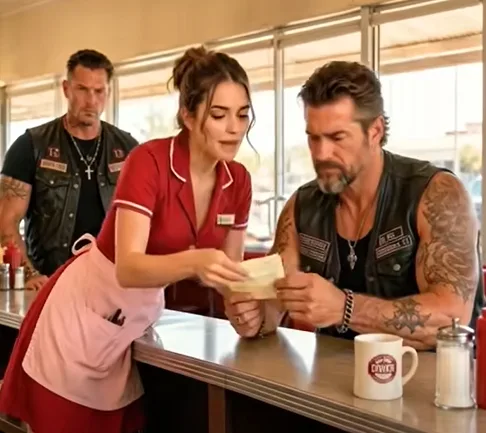
The hum of the old fluorescent lights overhead filled the tense silence as Jaxson’s weather-beaten fingers unfolded the yellow scrap of paper
The ledger felt heavier than paper had any right to be, a thick black book bound in cracked leather, and I stood alone in the humming light of the empty diner with my thumb pressed against its edge, trying to decide whether I was holding a weapon or a coffin.
Marcus had dropped it twenty minutes earlier, when he’d slid into the corner booth and ordered pie he never touched. He had left in a hurry, jittery and sweating, and I had found the book wedged between the cushion and the wall.
I opened it to the first page.
Dates. Routes. Names. Dollar amounts, written in a tight, neat hand that did not look like the hand of a man who could barely sign a receipt.
My name is Clare Donnelly, I am twenty-seven years old, and I had spent three years pouring coffee for men who never looked me in the eye.
I turned to the last entry, dated that same night.
Warehouse 9. Midnight. J.R. does not leave alive. Signal: two flashes from the east roof.
My stomach turned to ice.
Jaxson Rourke was riding straight toward it with a dozen men behind him, believing the traitor was Marcus. And Marcus, who couldn’t plan a grocery list, had been nothing but a messenger.
The real traitor had written this page.
I flipped back through the ledger, faster, and my eyes snagged on a signature at the bottom of a payment record, a looping, elegant initial I had seen a hundred times on the tip slips left beside Jaxson’s coffee cup.
D.
Doc.
The gentle, gray-bearded club medic who had once stitched a cut on my hand in the back booth without charging me, who called me sweetheart, who always asked about my mother.
“No,” I whispered.
The kitchen faucet dripped. The clock ticked. Somewhere out in the desert, fifteen miles away, a trap was closing.
I did not think. I grabbed my keys from the hook, kicked off my work shoes, and ran out to the only vehicle I had, a rust-eaten Ford pickup with a cracked windshield and a gas gauge that lied.
“Come on, Bertha,” I said, turning the key. “Please.”
The engine coughed, caught, and roared.
I drove with the headlights on high and my foot flat to the floor, the ledger on the seat beside me and the dark highway unspooling in long gray ribbons. The needle crept past eighty, then ninety, and Bertha shrieked in protest and kept going.
The abandoned warehouse district rose out of the desert like a row of broken teeth, black against a sky heavy with stars. I killed my lights a quarter mile out and coasted, my heart slamming.
I saw their motorcycles first, parked in a loose cluster behind a fallen fence, chrome faintly glowing.
Then I saw the east roof of Warehouse 9.
A figure stood on it, small and dark against the stars, with something in his hand. A flashlight.
He was raising it.
I did the only thing I could think of. I slammed my palm on the horn and held it down.
The sound tore across the silent lot like a scream, long and ugly and enormous, and a dozen heads snapped toward me. Jaxson, halfway through the warehouse door, spun around with his revolver drawn and his face a thundercloud.
“Clare?” he roared.
“Don’t go in!” I leaped out of the truck, waving the ledger over my head like a flag. “It’s a trap! Doc wrote it! Doc’s on the roof!”
For a heartbeat nobody moved.
Then the figure on the roof flashed his light, twice, frantic.
The warehouse windows exploded with gunfire.
“Down!” Jaxson bellowed, and he hit me like a freight train, hurling me behind the pickup as bullets chewed the gravel where I’d been standing. Glass rained across my hair. Somewhere a man screamed, and a motorcycle fell with a crash.
“Stay low!” Jaxson shouted, pressing me against the rusted door with one enormous arm. “Stay low and don’t move!”
“The roof!” I gasped. “Doc’s on the roof!”
“I know.”
His voice was strangely calm, and when I looked up at him, his face in the muzzle flashes was gray and terrible and full of a grief so raw that I forgot to be afraid.
“I’ve known Doc for twenty years,” he said, hoarsely. “He sewed up my son after the crash. He sat with my wife when she died.”
“I’m sorry.”
“Don’t be.” He checked his revolver. “Be ready.”
The gunfire dwindled, then stopped.
In the ringing silence, a voice drifted down from the east roof, soft and warm and horribly familiar.
“Jaxson? Son, come on out. Nobody needs to get hurt.”
Jaxson closed his eyes.
“Doc,” he said quietly, and stood up from behind the truck with his hands open at his sides.
“Jax, no!” I hissed, grabbing his sleeve.
“It’s all right, Clare.”
“They’ll shoot you!”
“They won’t,” he said. “Not while he’s talking. He’s never been able to shoot a man while he’s talking.”
He walked out into the open gravel, a big stooped figure in a leather vest, and stood in the moonlight with his empty hands lifted.
“Why?” he called.
Doc stepped to the edge of the roof, and I saw him clearly now, a slight old man with a neat gray beard and wire spectacles, holding a flashlight in one hand and a pistol in the other. He looked tired, and kind, and utterly ordinary.
“Because you were going to retire, Jax,” he said. “You told the table in March. You said the club was getting too old, too dangerous. You said you wanted to sell the chapter to the county and go fishing.”
“That’s no reason.”
“It is when forty men depend on you for their living.” Doc’s voice cracked. “I made promises. To the rival syndicate. I promised them a transition, and when you started talking about walking away, they told me I had until summer to deliver.”
“Deliver what?”
“You,” said Doc softly. “Or the whole chapter.”
The wind moved across the lot, cold and dry.
“I never wanted it to be you,” Doc whispered. “I thought if I could arrange an accident, something quick, you’d never suffer. I loved you like a son.”
“You sat at my wife’s deathbed.”
“I know.”
“You held her hand.”
“I know.” Tears glittered on the old man’s cheeks. “That’s why I couldn’t do it myself.”
I clenched my fists against the pickup door and felt something crack inside me, a small private break. I thought of the stitches, and the warm voice, and the way he had said, you’re a good girl, Clare, a good girl.
He had meant it.
He had meant every word, and he had still signed the order.
“Doc,” Jaxson said, very gently. “Put the gun down.”
“I can’t.”
“Of course you can.”
“They’re watching, Jax.” Doc’s eyes flicked toward the darkness beyond the fence. “They’ve got a rifle on you right now. If I put it down, if I fail, they kill everyone. They kill her.” He nodded toward me. “They know she has the book.”
Jaxson did not look at me.
He kept his eyes on Doc’s face, steady and sorrowful, and then he said something I did not expect.
“Then we’d better not fail.”
Doc blinked.
A sharp whistle split the night, three notes, high and clear, and from every shadow around the warehouse district, every fallen wall and rusted dumpster, a ring of lights flared white.
Floodlights.
Dozens of them, blinding, turning the gravel lot as bright as noon, and a voice rolled out through a loudspeaker like thunder from a clear sky.
“Federal agents! Drop your weapons! You are surrounded!”
Doc staggered backward on the roof with his hand raised against the glare.
The shooters in the warehouse windows threw down their guns, one after another, hands high, and I saw agents in black windbreakers pour across the lot from three directions with rifles at their shoulders.
“You called them,” Doc said.
“Three days ago,” said Jaxson. “When Marcus came to me nervous and told me something smelled wrong. I didn’t know it was you. I just knew someone was selling us out, and I wanted the people with the badges standing right here when they showed their hand.”
“The waitress—”
“Clare was the one thing I didn’t plan for,” Jaxson said, and for the first time he turned, and gave me a small, crooked, astonished smile. “I owe her my life.”
I could not speak.
On the roof, Doc lowered the pistol, slowly, as if it had grown unbearably heavy, and let it drop. It clattered across the tar paper and fell into the dark. Two agents were already climbing the fire escape.
He did not run.
He sat down on the edge of the roof with his legs dangling over the side, a small gray old man in the glaring light, and he put his face in his hands.
When they led him down, he stopped in front of Jaxson.
“I’m sorry, son,” he whispered.
Jaxson’s mouth worked. He looked at the old medic for a long time, and I watched forty years of friendship pass across his face like weather.
“I know you are,” he said at last. “That’s the worst part.”
Doc nodded, and the agents took him away.
A tall woman in a navy windbreaker with a gray braid over one shoulder came striding across the gravel, holding a badge in one hand and a flashlight in the other.
“Special Agent Rosa Delgado,” she said. “Mr. Rourke, that was cutting it close.”
“I wanted him to talk.”
“He talked.” She looked at me. “And you must be the waitress.”
“Clare,” I said faintly.
“Ms. Donnelly. You may have just saved the lives of fourteen men, and cracked a case we’ve been working for six years.” She held out her hand. “May I see the ledger?”
I gave it to her.
My fingers would not stop shaking, and Jaxson put one hand on my shoulder, a warm heavy weight, and kept it there.
The arrests continued until dawn.
By the time the first light slid pale and gold across the desert, forty-three men were in federal custody, and the rival syndicate that had bought Doc’s loyalty had been dismantled in a single sweep, its leaders arrested in hotel rooms and ranch houses across three states. Agent Delgado stood on the hood of a truck in the first rosy light, hoarse and grinning, and read out the totals over a bullhorn like a ballgame score.
Jaxson sat on the tailgate of my pickup with a paper cup of coffee in his hand.
I sat beside him.
Neither of us said anything for a long while.
“I’ve been thinking,” he said at last, “about what you said in the diner. That you gave the note to the right person.”
“I didn’t know it was going to turn into this.”
“Neither did I.” He smiled faintly. “But I think maybe you did. Some part of you.”
“Some part of me was terrified.”
“That’s what brave is.”
I laughed, and wiped my eyes, and watched the sun climb over the mesas in long gold bars.
“What will you do?” I asked. “Now the club’s gone?”
“It’s not gone.” He turned the cup in his hands. “The ones who didn’t know, the honest ones, they’re still brothers. Maybe we’ll start over. Do something clean.”
“Like what?”
“Like a repair shop.” He grinned. “Bikes, trucks, anything with wheels. We can all turn a wrench, and the county’s got no decent mechanic for forty miles.”
“That’s a good idea.”
“I’m full of them.” He looked at me, sideways. “I’ll need somebody to run the front counter. Somebody who knows how to talk to people. Somebody who isn’t afraid of a hard job.”
My heart skipped.
“Are you offering me a job?”
“I’m offering you a partner’s share,” Jaxson said. “I’ve got a feeling you might be better at running this thing than I am.”
“I pour coffee.”
“You stopped a massacre with a car horn,” he said. “I’d call that management.”
I stared at him, and then I put my head back and laughed, a real laugh, loud and unguarded, for the first time in three long years.
“Yes,” I said. “Yes, I’ll do it.”
We opened the shop in the spring.
It stood at the edge of the highway where the old diner had been, a long low building with a corrugated roof and three wide bays and a gravel yard full of gleaming bikes. We had torn the diner down ourselves, plank by plank, with twenty of the old club working in the sun, and built the new place from the same salvaged lumber.
The sign was painted by Marcus, who had been cleared of everything but cowardice and had turned out to have a surprisingly steady hand.
ROURKE & DONNELLY. HONEST REPAIRS. COFFEE ALWAYS ON.
Beneath it, in smaller letters, he had added a line I never expected.
Come in. Nobody’s judging.
On opening day, half the county showed up. Truckers pulled in off the interstate, and ranchers drove down from the hills, and a church group from Tucson brought three casseroles and a hand-lettered banner. Agent Delgado came in a leather jacket on a motorcycle she swore she had owned for years and clearly had not, and bought a quart of oil she did not need.
I stood behind the counter in a clean denim apron with a coffee pot in my hand, pouring cup after cup, and watching the room fill with laughter.
Jaxson was under a truck in the middle bay, with only his boots showing, cursing happily at a stubborn bolt.
Around noon, an old Cadillac pulled slowly into the gravel yard.
A gray-bearded man in a prison-issue jacket climbed out of the back seat, escorted by a deputy, thin and stooped, with his wrists in loose cuffs and a battered medical bag clutched in his hands.
The room went quiet.
Doc stood at the shop door for a long moment, looking in.
He had been given a reduced sentence for his testimony, eight years, and a single supervised day pass, which Delgado had arranged without a word to anyone. He looked small and old and frightened.
“I won’t stay,” he said. “I only wanted to see it. To say something.”
Jaxson slid out from under the truck, wiping his hands on a rag, and stood up slowly.
For a long moment nobody breathed.
“Say it,” he said.
“I’m sorry,” said Doc, and his voice cracked. “I can’t put it any better than that. I’m sorry for every day of it. And I’m glad you’re alive.”
Jaxson crossed the floor.
He stopped in front of the old man, tall and scarred and silent, and I thought, for a terrible instant, that he would turn away.
Instead he reached out and took Doc’s cuffed hands in his own, and held them.
“I’m not ready to forgive you,” he said quietly. “I don’t know if I ever will. But I’ll write to you. And when you get out, there will be a stool at this counter and a cup of coffee, and nobody will ask you what you did.”
Doc began to weep.
He wept without sound, with his shoulders shaking, and Jaxson put an arm around him and held him up, and I felt my own eyes fill as I set down the coffee pot and came around the counter.
“Doc,” I said.
He looked at me, with wet, red-rimmed eyes.
“You stitched my hand once,” I told him. “You said I was a good girl.”
“You are,” he whispered.
“So are you,” I said, “or you were. And maybe you can be again.”
He lowered his head, and I touched his arm, and the room let out its breath, and somewhere behind us someone started to clap, slowly, one pair of hands and then another, until the whole shop rang with it.
They took him away at sunset.
He looked back once from the window of the Cadillac, and lifted his hand, and I waved, and then the car disappeared down the long gold road.
That evening, when the last customer had gone and the bays were swept, Jaxson and I sat on the tailgate of my battered pickup, Bertha, who had earned a permanent spot in the yard, drinking cold lemonade and watching the sky turn rose and violet over the desert.
The new neon sign flickered on above the shop, bright and steady.
“Clare,” Jaxson said.
“Mm?”
“I never told you why I read that note aloud. In the diner. I could have taken it to the back and read it quietly.”
“Why did you?”
“Because you were standing there,” he said, “with your name tag and your trembling hands, and I thought, this girl just walked into a room full of men who could end her, to warn someone she barely knew. I wanted her to see that it mattered.”
My throat tightened.
“It did,” I said.
“It saved forty lives.”
“I just honked a horn.”
“Best horn I ever heard,” said Jaxson.
We laughed, and the sound rolled out over the quiet lot, and the first stars came out above us, small and bright and very far away.
I thought of a girl at a diner counter, three years of coffee and silence, believing her life was a small quiet thing that nobody would ever notice.
She had been wrong.
It had been waiting, patient as a lit road, for one yellow scrap of paper and the courage to carry it.
I leaned my head against the cool metal of the truck, and the engine of a distant motorcycle rumbled across the dusk, deep and steady and warm.
“Home,” I whispered.
“Yeah,” said Jaxson, and smiled at the sky. “Home.”