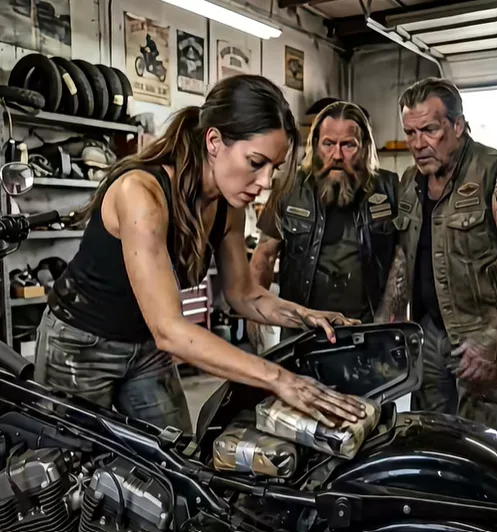
The heavy scent of motor oil and burnt rubber hung thick in the air of the cluttered workshop
The wedding ring lay in my palm, warm from my body, and I turned it toward the light until the inscription caught the sun that slanted through the grimy garage windows.
Forever, Anna. Whatever it costs.
I had read those words a thousand times since I found the ring in the attic, and I had never once understood the last three.
“Ms. Reyes?” said a woman’s voice at my elbow. “You’ve gone pale. Sit down before you fall over.”
She was tall and lean, in a navy windbreaker with a Justice Department badge clipped to her belt, with a gray braid over one shoulder and the calm, tired eyes of someone who had delivered a great deal of difficult news.
“Special Agent Naomi Brandt,” she said. “I’ve been reading your messages since Tuesday.”
“You answered every one.”
“I answered the ones that wouldn’t get you killed.”
I laughed, a thin cracked sound, and she smiled, and for a moment we were just two women standing in the wreckage of a long bad day.
Across the garage, my uncle sat on the concrete with his hands cuffed behind him, staring at nothing.
My name is Chloe Reyes, I am twenty-six years old, and for five years I had believed my father, Daniel Reyes, had hanged himself in a county jail cell with his own belt.
“There is something you should see,” Brandt said. “It came in this morning, from the evidence room at the county courthouse. We think your father hid it before his arrest.”
She led me to a folding table that her team had set up beside the garage, and on it lay a small steel tin, scorched at the edges, with a combination lock.
“We couldn’t open it,” she said. “The lock is a four-digit code. We tried his birthday, yours, your mother’s. Nothing.”
I looked at the ring in my hand.
Forever, Anna. Whatever it costs.
“What was my mother’s wedding date?” I murmured.
“June 14th, 1994.”
“No.” I shook my head slowly. “That’s not the code. Dad had a joke about the engraving. He said the date they met mattered more than the date they married. A rainy Tuesday at a gas station outside Tucson, March 3rd.”
I spun the dials.
0, 3, 0, 3.
The lock clicked open.
Inside lay a single cassette tape, a folded letter, and a Polaroid of a man in a mechanic’s jumpsuit standing beside a laughing little girl on a motorcycle.
I was about six in the picture, grinning, with a gap in my teeth, and my father had one hand on my back and the other raised as if he were about to take off into the sky.
My eyes burned.
I unfolded the letter first.
Chloe, it began, in his cramped, careful handwriting.
If you are reading this, then Ray finally slipped, and I am so proud of you I can hardly stand it.
I am not dead, sweetheart.
The page blurred.
I read the line four times, and Brandt’s hand closed gently around my arm, and I realized I had stopped breathing.
I had to make them believe I died. Ray had men inside the county jail. I found out the night before my arrest that they intended to kill me in my cell, so I made a deal with the only honest federal agent I knew. He moved me out of the cell in the dark, and a man who was already dying of cancer took my place and gave his name to my grave.
His name was Walter Finch. He asked to do it. Light a candle for him every year.
I have lived for five years in a cabin in the Idaho panhandle under a different name, building the case against your uncle, waiting until you were safe to be told.
I wanted to come home every single day.
Do not come looking for me yet. Ray’s partners are still out there. When it is truly over, play the tape.
I love you more than every engine I ever fixed.
Dad.
I do not remember sitting down.
I remember the cold concrete under me, and the gritty smell of oil, and the sound of someone sobbing in great ragged gulps that I slowly understood was me.
“He’s alive,” I said. “Agent Brandt, he’s alive.”
“I know,” she said, and her own voice was thick. “I’ve known for three years. I was the agent who moved him.”
I stared up at her.
“You knew.”
“I wasn’t permitted to tell you. If Ray had learned, he would have come for you first.” She knelt beside me, her braid swinging. “I am so sorry. I watched you at the funeral, and I watched you at the grave every year, and it was the hardest thing I have ever done.”
I wanted to be angry.
I tried, honestly, for about four seconds, but then I thought of a woman holding a secret like a hot coal for three years, and the anger turned to something softer and more tired.
“Where is he?” I whispered.
“Waiting for my call.” Her mouth twitched. “He’s been waiting since Tuesday. He’s driven two hundred miles to a motel in Flagstaff and refuses to eat until he hears that you’re all right.”
“Call him.”
“Chloe, there is still the matter of Ray’s partners. The tape—”
“Call him now.”
She studied my face, and slowly she smiled, and drew a phone from her pocket.
It rang twice.
“Naomi?” The voice on the other end was rough and low, a voice I had not heard in five years but would have known at the bottom of the sea. “Naomi, is she—”
I took the phone out of Brandt’s hand.
“Dad,” I said.
There was a silence so deep that I could hear the sound of a motel television murmuring somewhere behind him.
“Chloe?”
“Hi, Dad.”
“Oh, my girl,” my father said, and his voice cracked in half. “Oh, my girl, my girl.”
“You’re an idiot,” I sobbed.
“I know.”
“You absolute idiot.”
“I know, sweetheart. I know.”
“Get in your truck,” I said. “Get in your truck and come home.”
It took him four hours.
I stood at the end of the gravel drive the whole time, in the thin gold light of late afternoon, with the ring in one hand and the Polaroid in the other, watching the highway for a dust cloud.
The federal agents had finished their work by then. Ray had been taken away in a black van with his two enforcers, shouting curses through the grille, and the yard was quiet except for the ticking of the cooling garage roof and the far-off cry of a hawk.
Brandt sat on the tailgate of a truck, pretending to read a report.
At half past five, a battered green pickup turned off the highway.
It came slowly up the long dirt road, rattling over the ruts, trailing a plume of golden dust, and I felt my heart climb into my throat with every turn of its wheels.
It stopped at the gate.
The engine cut off.
For a long moment nothing moved, and then the driver’s door opened, and a man stepped out.
He was thinner than I remembered, and his hair had gone white at the temples, and he stood a little stooped as if he had been carrying something heavy for a very long time. He wore a faded canvas jacket and a baseball cap pulled low, and his hands, those big scarred mechanic’s hands, hung loose at his sides, shaking.
He took off the cap.
“Chloe,” my father said.
I could not run.
My legs would not do it.
I stood frozen in the middle of the gravel with the Polaroid crushed in my fist, and he took a step toward me, and another, as if approaching a startled horse.
“I look different,” he said. “I’m sorry. I know I’m old.”
“You look like Dad.”
“I’m trying to.”
I made a sound that was half laugh and half sob, and then I crossed the last twenty feet in a stumbling rush and threw myself into his arms.
He caught me.
He held me so tightly that my ribs creaked, and he smelled of cedar and motor oil and the cheap soap he had always used, and I buried my face in his shoulder and felt his whole body shake against mine.
“I’m here,” he kept saying. “I’m here, baby, I’m here, I’m here.”
“You were dead.”
“I know.”
“I buried you.”
“I know. I know you did.”
“I talked to a gravestone for five years.”
“I was in the back, in a ball cap,” he said, laughing and crying together. “Every anniversary. I stood by the cemetery gate and watched you leave flowers.”
“You didn’t,” I gasped.
“I did.”
“You could have said something.”
“I wanted to.” His voice broke. “I wanted to so badly I bit through my lip once. But I couldn’t put you in his path.”
I pulled back and looked at him, at the new lines around his eyes, at the tears running unashamed into the silver stubble on his jaw.
“I hated you for one whole hour,” I said.
“That’s all?”
“It was the worst hour of my life.”
“You were allowed to hate me for a year.”
“I didn’t have the time,” I said, and he laughed, a warm cracked rumble I felt in my bones, and held me again.
Agent Brandt climbed down from the tailgate and found something very interesting to examine on the horizon.
We sat on the porch of the old farmhouse that evening, the three of us, with a pot of coffee and a plate of sandwiches nobody ate.
The sun sank behind the canyon in long ribbons of rose and amber, and the first crickets began to sing in the dry grass, and for the first time in five years the ranch did not feel haunted.
“The tape,” Brandt said at last. “Chloe, are you ready?”
“Yes.”
“Daniel?”
“I’ve been ready for five years,” my father said quietly.
She slid the cassette into a small player and pressed the button.
A hiss. A click. And then my uncle’s voice, low and hoarse and unmistakable, speaking in the dark of some long-ago night.
“Danny knows too much. He’s got the shipping logs, and he’s talking about going to the feds on Monday. We take care of it before then.”
Another voice answered, smooth and cultured and utterly cold.
“The sheriff can arrange a charge. Possession. Something that sticks. And once he’s in the county jail, an accident is simple.”
“You’re sure?”
“I am always sure, Raymond.”
Brandt stopped the tape.
“The second voice,” she said. “You recognize it?”
I stared at the little machine.
“No,” I said. “But Dad does.”
My father’s face had gone gray.
“Judge Harmon Pike,” he said. “The man who set my bail. The man who signed the order to hold me without bond. Chloe, he came to our wedding.”
“He’s still on the bench,” Brandt said. “He has been for twenty-six years. And as of three o’clock this afternoon, he is under arrest.”
My father sagged in his chair as though a string had been cut.
“It’s over,” he whispered.
“It’s over,” Brandt said gently.
We sat in silence while the light drained from the sky.
I thought of a man walking out of a jail cell in the dark and leaving behind a stranger’s name on a grave. I thought of Walter Finch, a dying man who had asked to do one last good thing, and of the candle my father had lit for him every year.
“Dad,” I said. “Where is he buried? Walter Finch.”
“In the county cemetery. Under my name.”
“We should fix that.”
My father looked at me.
“We should put his name on it,” I said. “His real name. He gave you five years. He deserves to have his own stone.”
His eyes filled.
“Your mother would have said exactly that,” he whispered.
We changed the marker in the spring.
It was a bright blue morning, with wildflowers coming up through the cemetery grass and a warm wind pouring down from the hills. A small crowd gathered, Agent Brandt in a black dress, a dozen men from the old shop in their Sunday suits, a gray-haired woman in a wheelchair who turned out to be Walter Finch’s sister, found after four months of searching.
She wept when she saw his name carved in the granite.
WALTER JAMES FINCH. HE GAVE A MAN FIVE YEARS.
“He never told me,” she said, holding my hand with both of hers. “Thirty years we barely spoke. And at the end he did this.”
“He was a very brave man,” I said.
“He was a stubborn one.” She smiled through her tears. “But brave, too.”
My father laid a handful of wildflowers on the stone.
“Thank you, Walter,” he said, so softly that only I could hear. “I’ll spend the rest of my life trying to be worth it.”
Ray was sentenced in June to forty years, and Judge Pike to life, and the long network of officers and clerks and bankers who had fed on our town for two decades fell apart in a single dazzling summer. The courthouse steps filled each morning with families holding old paper, asking to have their cases reopened, and one by one the judges listened.
My father testified for six days.
He sat in the witness box in a borrowed navy suit, with his hands folded, and told the whole story in his quiet steady voice, never once looking at his brother. When the prosecutor asked how he had endured it, he glanced across the room at me.
“I had a picture,” he said. “A little girl on a motorcycle. I looked at it every night. I thought, someday I’ll teach her to ride for real.”
“Did you?”
“Not yet,” my father said, and a ripple of soft laughter ran through the gallery.
He did.
It took the whole of that summer.
We cleared out the back bay of the old garage, my father and I, and wheeled out a battered little 250cc that he had rebuilt in a motel parking lot in Flagstaff and refused to tell me about. We painted it red.
He stood in the gravel yard every evening at sunset with his hands on his hips, shouting gentle instructions as I wobbled in slow circles around the pump.
“Look where you want to go, not where you’re afraid to land!”
“I am looking!”
“Then stop staring at the dirt!”
I fell off four times.
On the fifth evening, with the sun sinking gold behind the canyon and the dust glowing like powdered amber, I twisted the throttle and the little bike leaped forward and I rode, truly rode, the whole length of the yard with the wind pouring through my hair and a whoop of delight tearing out of my throat.
“Dad!” I shrieked. “Dad, look!”
“I see you!”
“I’m doing it!”
“You always could!” he shouted back, and I looked over my shoulder and saw him standing in the yard with both fists raised in the air, weeping and laughing like a boy.
We reopened the garage in September.
My father painted the sign himself, on a ladder, in careful red letters on weathered boards, with his tongue between his teeth and a smear of paint on his nose.
REYES & DAUGHTER. HONEST REPAIRS.
Beneath it, in smaller script, a line he had asked me to approve.
Everybody gets a fair price. Everybody gets a fair chance.
I stood in the yard with my arms crossed and read it three times.
“What do you think?” he asked, climbing down.
“It’s perfect.”
“You’re not just saying that?”
“I’m never just saying anything,” I said. “That’s your fault.”
He grinned, and put an arm around my shoulders, and we stood together in the warm September sun, looking up at the sign.
A line of trucks was already pulling in off the highway, a rattling pickup, a mud-spattered sedan, a battered station wagon with a family of five crowded inside. Behind them came a long gleaming column of motorcycles, riders in leather vests with their helmets in their hands, men and women my father had once ridden with, come to wish him well.
Agent Brandt was among them, in jeans and a leather jacket, perched on a vintage Triumph with a grin a mile wide.
“I’m off duty,” she announced, swinging down. “I came for the pie.”
“There’s no pie,” I said.
“There’s always pie.”
“Who made pie?”
“I did,” said a small cracked voice from the porch, and I turned and saw Walter Finch’s sister in her wheelchair, holding a plate with a clean white cloth. “It’s apple. I hope that’s all right.”
My father crossed the yard in four long strides and knelt in front of her chair.
“Mrs. Finch,” he said, with his hat in his hands. “It’s the finest pie I’ve ever seen.”
“You haven’t tasted it.”
“I don’t need to.”
She laughed, and patted his cheek, and the whole yard laughed with her.
We ate on the porch in the long gold light, thirty people crowded onto the steps and the railings and the old swing, passing paper plates and thermoses of coffee while the crickets started up in the dry grass and the first stars pricked out above the canyon.
I sat beside my father with my head on his shoulder.
Nobody was hunting us.
Nobody was watching.
There was only the warm soft evening, and the smell of apples and motor oil, and the sound of an old country song drifting from somebody’s truck radio.
“Chloe,” he said quietly.
“Yes?”
“Do you remember what your mother used to say? When things were at their worst?”
“The night is darkest just before the shop opens,” I said, and smiled.
“That’s the one.”
“She made that up.”
“She did.” He laughed, and his arm tightened around me. “But I think she was right.”
I looked out at the canyon, where the last light was bleeding out of the sky in long streaks of copper and rose, and I thought of a girl in a cluttered workshop with grease on her hands, accused of a crime she hadn’t committed, certain that the world had closed around her.
I wanted to reach back through time and touch her shoulder.
It’s not the end, I would tell her. Somebody is waiting in a motel in Flagstaff with a ball cap in his hands.
The ring was still in my pocket.
I took it out, and turned it in the starlight, and read the words one last time.
Forever, Anna. Whatever it costs.
I understood them now.
It had cost my father five years, and a stranger’s name, and a daughter’s grief. It had cost a dying man his last quiet months, and a federal agent her peace of mind, and a town its comfortable lies.
And every bit of it had been worth it, because on a September evening in the golden dust, a man who had been dead was sitting on his own porch, laughing, with his arm around his child.
I slipped the ring onto the chain around my neck, where it settled against my heart.
Somewhere down the valley, a train sang its long slow note across the dark.
I closed my eyes, and listened, and for the first time in five years I did not feel the weight of the dark at all.
I only felt the warmth of my father’s shoulder, and the hum of a motorcycle engine in the distance, and the quiet, certain knowledge that I was exactly where I belonged.