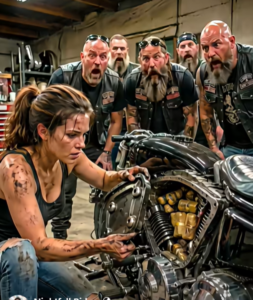
The grizzled motorcycle club president shoved me away from my late father’s custom chopper in a grease-stained garage
The back door slammed against the brick wall so hard that a row of wrenches jumped off their hooks and clattered across the concrete like dropped coins.
Two men filled the doorway, backlit by the headlights of the black SUV, and the engine of my father’s chopper roared on beside me as if it were daring them to come in.
The first man was tall and lean, in a charcoal suit that cost more than every bike in the garage, with silver hair combed straight back and a face as smooth and pleasant as a bank teller’s.
The second was a slab of muscle in a black windbreaker, and he carried a compact submachine gun the way other men carry a lunch box.
“Please shut that off, Miss Doyle,” the silver-haired man said in a mild, cultured voice. “It is very difficult to conduct business over an engine.”
“You know my name,” I said, and my fingers tightened on the handlebars until the grips creaked.
“I know everything about this motorcycle,” he replied, stepping over the threshold with his polished shoes careful of the grease. “I have been paying for it since before you could drive.”
Behind me I heard five men stop breathing, and I felt Marcus’s grip on Jax’s wrist go slack with shock.
“Silas Crowe,” Marcus said slowly, and the name sounded like something he had been afraid to say aloud for a very long time. “Jax, tell me that isn’t who I think it is.”
Jax did not answer.
His face had gone the color of old putty, and sweat ran down the scar along his jaw, and his eyes were fixed on the packages glinting yellow inside the open engine block.
“Hello, Jackson,” Crowe said warmly. “Twelve years. I confess I was beginning to think you had forgotten our arrangement.”
“I told you it’d be ready,” Jax whispered, so softly that I almost lost it under the rumble of the pipes. “I told you I’d call when the heat died down. You weren’t supposed to come here. Not with the others watching.”
“The heat died down a decade ago,” Crowe said gently. “You simply grew comfortable.”
I heard the sound of a revolver clearing leather, and then three more, and the four bikers who had been standing behind Jax swung their pistols from Crowe to their own president and back again, bewildered, betrayed, and furious all at once.
“Jax,” said a big red-bearded man named Dutch, his voice cracking like a boy’s. “Jax, what the hell did you do?”
The enforcer in the windbreaker raised his weapon an inch, and every muscle in the garage went rigid.
“Gentlemen,” Crowe said, spreading his manicured hands. “Nobody here needs to die on a Tuesday. I want the product, and I want the notebook the young lady is holding, and then my associate and I will leave your charming establishment and never trouble you again.”
“And my father?” I said.
Crowe turned his pleasant gaze on me, and for the first time I saw what sat behind it, flat and patient and utterly without warmth, like the eye of a fish on ice.
“Thomas Doyle was a gifted mechanic and a stubborn man,” he said. “He discovered what Jackson and I had built into his frame, and he refused to carry it. Then he made the mistake of saying he would tell the club.”
“So you ran him off the road.”
“I would not put it so crudely.”
“My father died on Route 9 with his hands still on the grips,” I said, and my voice shook with a rage so pure and cold that it felt like standing in a river of ice. “They told me his bike came apart on impact. They told me nobody could ever turn the engine over. Sixty-three mechanics, Mr. Crowe. Do you know why none of them could do it?”
“Enlighten me.”
“Because my father rigged the lock himself,” I said. “He knew somebody would come for it. He built that engine so the only person on earth who could open it was somebody who had grown up beside him, listening to him talk about it every night at dinner.”
Jax made a small broken sound, and I looked at him for the first time without hatred.
“He told me the combination when I was nine,” I said. “He said it was our secret. Left bolt, right bolt, cold key, hot kick. He called it the Doyle lullaby.”
The room was so quiet that the idle of the engine seemed to fill my ribs.
“He never trusted you, Jax,” I said quietly. “He loved you like a brother, and he never stopped, and he still built a lock you couldn’t pick.”
Crowe sighed and glanced at his watch. “This is touching. I regret that we are out of time.”
He nodded once to the enforcer.
I had perhaps half a second.
I did the only thing my father had ever taught me to do when a situation went wrong, which was to open the throttle and let the machine speak.
I twisted the grip all the way back, and the chopper screamed, a rising, shrieking howl of chrome and fire that bounced off the tin roof and punched through every ear in the room.
At the same moment I stamped the clutch, kicked the bike into first, and let it leap, and the huge black machine shot across the concrete with its front wheel off the floor and its headlight blazing straight into the enforcer’s eyes.
He fired blindly, and bullets shredded the rafters and sent sparks cascading down from the lights, and I threw myself sideways off the seat as the bike went on without me, a riderless thunderbolt crashing through a rack of tires and slamming into the doorway.
The enforcer dove away from it with a yell.
In that same moment Marcus hit him like a freight train.
The old veteran took the man at the knees, and the two of them went down in a tangle of limbs and leather and swinging fists, and the submachine gun skidded across the floor and fetched up against my boot.
I scooped it up with greasy fingers I could barely feel.
“Nobody move!” I screamed, and I had no idea where the words came from, because they sounded like my father in a good mood.
Dutch and the others had their guns on Crowe, who stood perfectly calm in the middle of the chaos, one hand lifted slightly away from his body as if he were ordering a coffee.
“Miss Doyle,” he said pleasantly. “You are holding a weapon you do not know how to fire.”
“It’s pointed at you,” I said.
“It is pointed at the ceiling,” he corrected, and he smiled, and he moved.
He was so fast that I did not see the pistol until it was already against my temple, an ankle holster, a spring-loaded sleeve, I never learned which, and one arm like a steel band was suddenly locked around my throat, and the cold muzzle pressed into my skin.
“Drop your weapons,” Crowe said to the room, in the same gentle tone. “Or I will ruin a very pretty young mechanic.”
No one moved.
The only sound was the choked groan of the enforcer beneath Marcus’s elbow and the soft crackle of the broken headlight still sputtering by the door.
“Let her go, Silas,” Jax said.
I felt Crowe’s whole body turn toward the voice.
Jax stood in the center of the garage, and I almost did not recognize him.
His shoulders had straightened, and his hands hung empty at his sides, and the sneer had melted off his face, and what was left looked like a very tired man who had been carrying something enormous for twelve years and had just decided to set it down.
“Jackson,” Crowe said, almost fondly. “You are not going to be foolish.”
“I’ve been foolish since the day I met you,” Jax said, and he took a step forward. “I let you into my club. I let you into my brother’s bike. I let you into my house, and I told myself it was just money, and I kept telling myself that every night for twelve years while his little girl grew up without a father.”
“Jax,” Marcus said hoarsely from the floor, “don’t.”
“I buried Tommy,” Jax said, and his voice finally cracked straight down the middle. “I carried his casket, and I held Maya’s hand at the cemetery, and I said I’d always look after her. And all that time I knew.”
“Jackson, stop talking,” Crowe said, and for the first time the smoothness slid a little in his voice.
“I knew he was a better man than me,” Jax said. “I think I hated him for it. That’s the ugly truth, Maya. I didn’t kill your father for the money. I let him die because I couldn’t stand being the lesser brother in my own club.”
Tears were running down his scarred face now, and he did not wipe them away.
“I’m sorry, kid,” he said. “There’s no word big enough for it. But I can do one clean thing before I’m done.”
He took another step, and Crowe’s pistol swung from my temple toward his chest.
That was all I needed.
I had spent twelve years learning to work in tight spaces with sharp tools and hot metal, and I knew that a person’s elbow is hardest to hold exactly where it bends, and I drove my own elbow backward into Crowe’s ribs with all the force of a girl who had hoisted engine blocks since she was fourteen.
He grunted and loosened for one heartbeat, and I stamped my steel-toed boot down on the arch of his foot and twisted out from under his arm as the pistol went off beside my ear.
The bang was enormous, and the whole world turned to ringing white.
I hit the concrete on my hands and knees, and somewhere above me I heard a heavy, wet thud, and I turned to see Jax stagger backward with one hand clamped over his shoulder and bright blood welling between his fingers.
He had thrown himself into the line of fire.
“Jax!” Dutch roared, and the garage exploded into motion.
The three bikers surged forward in a wall of leather and fury, and Crowe’s pistol cracked again and again, but the bullets chewed into toolboxes and tires and brick, and then Dutch had him by the collar and slammed him against the side of the workbench with a crack that rattled the vise.
The pistol flew away across the floor, and four huge hands pinned Silas Crowe flat against the greasy wood, and for the first time in his life the man in the charcoal suit looked truly, hopelessly afraid.
“Get your hands off me,” he spat. “Do you know who I work for? Do you have any idea how many people—”
“Shut up,” said Marcus, getting stiffly to his feet and wiping blood from his lip. “You’re done talking, mister.”
Outside, over the fading growl of the idling chopper, came a new sound that made every head in the garage turn toward the open door.
Sirens.
Not one, not two, but a swelling chorus of them, rising up the valley road like a tide, and red and blue light began to ripple across the dusty windows in a steady, flashing rhythm.
“What did you do?” Dutch whispered, staring at me.
I sat up on the floor, pressing the heel of one shaking hand against my ringing ear, and I dug the other into my back pocket and pulled out my phone.
The screen was cracked across the middle, but the call was still live, and a calm woman’s voice was speaking out of the tiny speaker over the din.
“Maya? Maya, it’s Agent Okafor. We’re at the gate. Is anyone hurt?”
“One man shot,” I said, and I was astonished by how steady my voice came out. “Shoulder. Two suspects restrained. Weapons on the floor. You can come in.”
“Copy that. Stay where you are. We heard everything.”
I lowered the phone slowly and looked up at the stunned, soot-streaked faces ringed around me.
“I’m sorry,” I told them. “I couldn’t tell you. Three weeks ago I found my father’s logbook in a coffee can in the attic, and the last page named a drop, a date, and a set of initials. I took it to the ATF. I told them what I thought was in the bike. They said if I could prove it, they’d move.”
“So you walked in here alone,” Marcus said, and there was something very close to awe in his gruff voice.
“I walked in with a wrench and a live phone line,” I said. “And a stubborn streak I got from my father.”
“That ain’t a streak, kid,” Dutch said, and he wiped his eyes on his vest. “That’s a family heirloom.”
The federal agents came through the doors a moment later in dark windbreakers, fifteen of them, weapons raised and shouting, and the bikers set their guns on the ground and lifted their hands without a single word of protest.
A slim woman with close-cropped hair and the kind of tired eyes that had seen a great deal and forgiven very little walked straight to me and crouched on the oily floor.
“Maya Doyle,” she said. “Dana Okafor. You’re either the bravest or the craziest civilian I’ve ever met.”
“Can it be both?” I asked.
“It generally is,” she said, and she grinned, and she helped me to my feet.
They cuffed Silas Crowe and his enforcer first, and the man in the charcoal suit did not say a word as they led him out past the wreckage of the tire rack, his silver hair finally out of place, his polished shoes scuffed gray with dust.
They took the yellow packages out of the engine block one by one, photographing each, bagging each, and I counted forty-one before I stopped counting and stood with my arms wrapped around myself, watching my father’s secret come out of him like a long-held breath.
Medics knelt over Jax on the floor, cutting away his vest and pressing gauze against the wound, and I watched his gray face turn toward me as they worked.
“Maya,” he said, thickly.
I walked over and stood above him, and for a long moment I could not think of a single thing to say.
“You took a bullet for me,” I said at last.
“Wasn’t for you,” he rasped. “It was for Tommy.”
“I know.”
“Doesn’t make it right.”
“No,” I said. “It doesn’t.”
We looked at each other across twelve years of silence, and somewhere in the middle of it a small, stubborn thing inside me, a thing I had thought hatred had long since burned to the ground, flickered and refused to die.
“You’ll tell them everything,” I said. “Every name. Every drop. Every dollar.”
“Every word,” Jax said. “I’ll sit in a courtroom and say it until my voice gives out.”
“Then I’ll be in the front row,” I said. “That’s all I can promise.”
His eyes filled again, and he nodded, and the medics lifted him onto a stretcher and carried him out into the red and blue light.
When the garage finally emptied, when the last agent had taken the last evidence bag and the sirens had faded into the dusk, I stood alone in the ruined bay with the chopper lying on its side near the doorway, its front fender crumpled and its headlight shattered.
The engine had finally stalled, and the silence that followed felt enormous.
I walked over and knelt beside the bike and laid my hand against the cooling metal of the tank, and then I noticed something I had missed in all the chaos.
A strip of black electrical tape ran along the underside of the seat, almost invisible against the leather, and one corner had come loose in the crash.
My heart started to beat strangely.
I peeled back the tape with my thumbnail, and a thin slot opened in the seat pan, and inside it, rolled tight as a cigarette and tied with a bit of red fishing line, lay a small curl of paper.
I sat down on the concrete right there in the grease and the broken glass, and I untied the line with fingers that had stopped being steady a long time ago.
The handwriting was cramped and slanting, the way it always got when my father was in a hurry or in love, and I knew it before I read a single word.
Maya girl, it began.
If you are reading this, then you are older than I am, and you figured out the lullaby, and I am prouder than any father has a right to be.
I am sorry for the secrets. I wanted you to have a clean life, and instead I think I left you a mess to clean up.
There are bad men in my club, and one of them is a man I love like blood, and I cannot bring myself to put his name in writing. If something happens to me, then I was wrong about him, and you have my permission to be angrier than I ever could.
But here is the thing I need you to remember when the dust settles. Do not let what they did turn you into what they are.
I have seen what revenge does to people. It is a hungry engine, and it never runs out of fuel.
Fix the bike. Open the shop. Ride it on a Sunday with the sun in your face.
And when you forgive them, and I think someday you will, do it for yourself and not for them.
I love you more than every engine I ever fixed.
Dad.
I read it twice with the tears running unchecked down my filthy face, and then I folded it along its old creases and tucked it inside my coveralls against my heart, and I stayed on the cold concrete a long time with my head against my father’s motorcycle.
“I got it open, Dad,” I whispered. “It only took me twelve years to find the nerve.”
The garage hummed softly with the memory of the engine, and for one impossible moment I could have sworn I smelled cedar and cigar smoke and warm oil, and felt a big rough hand settle against the back of my head the way it used to when I was small.
“I know, kiddo,” the silence seemed to say. “I know.”
The trials began in the fall.
Silas Crowe’s attorneys fought for four months, and they fought dirty, and for a while it seemed that the pleasant silver-haired man might actually slip through the net the way men like him always had.
But Jax kept his word.
He sat in the witness box with his arm in a sling and his face drawn thin, and for eleven days he laid out every deal, every drop, every phone call, every dollar, in a steady, hollow voice, and he never once tried to make himself sound better than he was.
I sat in the front row for every day of it, in a plain gray dress and my father’s old work boots, with Marcus on one side and Agent Okafor on the other.
When Jax described the night he had called Crowe to say that Thomas Doyle was riding home on Route 9 alone, he stopped, and the whole courtroom waited, and he turned in the box and looked straight at me.
“I could have called him,” Jax said. “I could have told him to turn around. I had the phone in my hand, and I chose the other call, and I will carry that until the day I die.”
A woman in the back row began to cry softly, and I realized it was Dutch’s wife, who had known my father when we were all young.
I did not look away from Jax.
I held his eyes until he finished, and then I nodded once, a small, tight nod, not forgiveness and not condemnation, just the acknowledgment of one human being to another that the truth had been told.
The jury deliberated for six hours.
Silas Crowe was convicted on twenty-three counts of trafficking, conspiracy, and murder, and the judge sentenced him to three consecutive life terms in a federal facility in Colorado, and his lawyer’s face was gray as ash.
His enforcer took a plea for thirty years.
The cartel network behind them, the one my father had stumbled onto a dozen years before he could tell anyone, unraveled over the next eighteen months, nineteen arrests across four states, and the evidence from that single hollow engine block became the thread that pulled the whole tapestry apart.
Jax pleaded guilty to conspiracy and accessory to murder in exchange for his testimony, and the judge, who had listened to every word, sentenced him to fifteen years with the possibility of parole at ten.
Before the bailiffs led him away, he asked the court if he might say one thing to me.
The judge allowed it.
He stood in his orange jumpsuit with his hands cuffed in front of him and looked at me across the rail, and his scarred face was steady for the first time in all the years I had known it.
“Your father was the best of us,” he said. “I’ll spend the rest of my life trying to deserve having known him.”
“Then start by being good to the people in there,” I said. “He would have wanted that.”
He lowered his head and nodded, and I watched him go, and I felt something that I had never expected to feel toward Jackson Reyes.
Not love, and not forgiveness exactly, but something lighter and quieter, the gentle loosening of a knot that had been pulled tight for twelve years.
The club met the following week in the garage where it all began.
They gathered under the flickering fluorescent lights among the dust and the old toolboxes, thirty-one riders in scarred leather vests, and I stood at the back by the door with my arms crossed, because I was not a member and had no right to a vote.
Marcus stood at the front on a milk crate, which was the only podium the garage had to offer, and he waited for the murmur to die down.
“Brothers,” he said. “Sisters. Whoever the hell is standing at the back with a wrench in her pocket.”
A ripple of laughter ran through the room, tired and relieved, and I felt my cheeks go warm.
“This club has been a lie for twelve years,” Marcus continued. “I’m not saying that to be cruel. I’m saying it because I was a part of it. I looked the other way. I told myself it was none of my business. And a good man died for that silence.”
Nobody laughed now.
“So here’s what I propose,” Marcus said. “We tear down the old charter. We burn it in a barrel in the yard. We build a new one, and the first line says that no man in this club ever hurts a child, a woman, or a mechanic who’s just trying to fix a bike.”
“Hear, hear,” Dutch rumbled, and the room erupted in cheers and stamping boots.
“And the second line,” Marcus said, raising a calloused hand for quiet, “says that this garage belongs to Thomas Doyle’s daughter, and always did, and any member who forgets it can answer to me.”
All thirty-one heads turned toward me, and the sound that rose through the room was a kind of low, rolling thunder that I felt in the soles of my feet.
I stood very still, because I did not trust myself to move.
“Go on, Maya,” Marcus said gently. “It’s your name on the lease.”
I stepped forward on shaky legs, and I looked at all those weathered, bearded, tattooed faces, and I realized that every one of them was waiting for me to speak.
“My father wrote me a letter,” I said, and my voice came out small. “He asked me not to let what they did turn me into what they were. I don’t know much about being the boss of a motorcycle club. But I know how to fix engines, and I know that a thing that’s broken can be made to run again if you’re patient and you tell the truth about where the damage is.”
“That’s good enough for me,” Dutch said.
“Good enough for all of us,” said a quiet voice from the back, and I turned and saw Dutch’s wife standing in the doorway with a casserole dish and a baby on her hip.
The garage rang with laughter, and the old wooden table in the corner groaned under platters of food that appeared from nowhere, and for the first time in twelve years, I think, the dim brick room felt like what my father had always meant it to be.
A home.
By spring the garage had a new sign over the bay doors, painted by Dutch’s teenage daughter in bold blue letters on a sheet of corrugated tin.
DOYLE’S CUSTOM, it said. EST. BY TOMMY. FINISHED BY MAYA.
I had a staff of six by April, three of them women, which would have made Jax’s old crew choke on their beer, and a waiting list four months long for restorations from as far away as Denver.
I rebuilt my father’s chopper first.
It took me nine weeks of evenings and weekends, straightening the frame, rebuilding the front end, laying down fresh black paint with a ribbon of cherry red along the tank, and when I installed the engine again I did it the way he had taught me, by hand, slowly, listening to every bolt.
On the last night I stood in the empty garage with a rag in my hand and looked at the finished machine, gleaming under the lights, and I felt that big warm hand on my shoulder again.
“Ready, Dad?” I whispered.
I turned the key, and I stomped the kickstart, and the engine caught on the second try with a deep, glorious growl that filled every corner of the room.
The first Sunday in May, the whole club rode out together at dawn, thirty-one bikes in a long shining column, and I rode at the front on my father’s chopper with the wind in my face and the sun coming up gold over the hills.
We rode out Route 9 in silence, past the farm stands and the sleeping fields and the old stone bridge, and we stopped at the bend where the guardrail still bore a long scar from a motorcycle that had come apart twelve years ago.
Someone had already been there.
A small white cross stood in the gravel with a ring of wildflowers around it, and a hand-lettered sign was nailed to the post.
THOMAS DOYLE, it read. MECHANIC. FATHER. BROTHER.
Beneath it, in smaller letters, someone had added, Forgiven, but never forgotten.
I recognized the handwriting, a rough, uneven scrawl I had seen on a thousand shop tickets and one tear-stained letter in a courtroom, and I knew without being told that Jax had asked Marcus to put it there before he reported to prison.
I knelt in the gravel and laid my hand against the cool wood of the cross.
“We did it, Dad,” I said softly. “The shop’s open. The club’s clean. The bike runs like a dream.”
The wind stirred the wildflowers, and a meadowlark broke into song from the fence post, bright and liquid and entirely unafraid.
“I forgave him,” I added, almost too quietly to hear. “I did it for me, like you said. It turns out you were right about that too.”
Behind me the bikers stood in a long, respectful line with their helmets in their hands, and no one said a word, and I felt a thousand things settle into place inside me like tumblers falling into a lock.
When at last I stood and brushed the dust from my knees, Marcus came to stand beside me and offered me a thermos of coffee.
“He’d have liked this,” he said.
“He’d have complained about the coffee,” I said, taking a sip, and we both laughed.
“Where to now, boss?”
I looked down the long curve of the highway, wide and empty and shining in the morning light, and I felt the great calm hum of my father’s engine waiting beneath me.
“Anywhere with a good diner,” I said. “And a very large breakfast.”
A cheer rose from the line of riders, and thirty-one engines roared to life in a thunder that rolled across the valley and sent the meadowlark flying.
I swung my leg over the chopper and settled into the seat, and I looked once more at the little white cross with its ring of wildflowers.
Then I twisted the throttle, and the bike leaped forward into the sun.
Behind me the whole club followed in a long, gleaming river of chrome and leather and light, and I rode with my head high and my heart open, a daughter and a mechanic and a keeper of secrets that had finally been set free.
The road ran on before us, golden and endless, and for the first time in twelve years there were no ghosts waiting at the end of it.
There was only the wind, and the engine, and the quiet, certain feeling of a lullaby that had finally been sung all the way to the end.