The dusty main street of a rugged mining town by a ruthless land baron who ordered his enforcers to tear down my family’s cabin
The folder hit the boardwalk and opened on my father’s name.
Not a clerk’s copy. His hand. Twenty years back. The first seizure, the one the valley still called a misunderstanding about taxes. The same slant he had used on my school lessons and on the letter that said he had died of a fever before I was old enough to argue with a grave.
Gideon Rusk saw it from the cuffs and smiled with a split lip.
“Now the street knows what built you.”
Marshal Crowe bagged the page before the dust could claim it.
“Bennett. Eyes up. We do not do this in the road.”
“I already did it in the road. He just made it public.”
They moved Rusk to the wagon. The enforcer from the porch went quieter than his grin had promised. Townspeople who had watched my family’s cabin come down that morning now watched the baron come down, and nobody cheered. Fear does not turn into applause in an hour. It turns into staring.
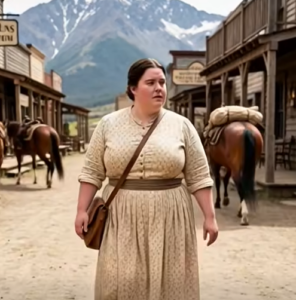
Crowe walked me into the general store, satchel on the counter beside the shopkeeper’s ledgers.
“Your cover held long enough. This signature complicates the hymn. Can you still sign the inventory.”
“I can sign. I will not pretend the name is a stranger.”
The shopkeeper, Ellis, wiped his hands on his apron and did not pretend he had not seen the page.
“Your father bought nails here. He paid. If that paper says he sold the ridge, he did not say it in this store.”
“He may have said it in a room I was not in,” I said.
“That is the part I have to read before I hate him cleanly.”
Crowe sent riders to the ridge where the cabin timbers still lay in a heap. I went with them because the satchel’s maps matched the ground, and because standing still would have let the signature grow teeth.
The cabin was a ribcage. My mother’s chair was kindling. A boy I had paid to watch the trail pointed at the tree line.
“They laughed. Rusk didn’t. He only nodded.”
“I know the nod,” I said.
Under the fallen hearth stone, where my father had kept a tin against flood, I found a second book. Not the federal copies in my satchel. His. Dates. Amounts. A line in the margin beside the first seizure: signed under threat of the ridge burning with the child inside. Not consent. A knife at a timetable.
I sat in the dust with the tin until my legs remembered the job.
“He signed,” I told Crowe.
“He also wrote why. Rusk used me as the price. The conspiracy starts there. It does not end in a daughter’s disgrace unless we let it.”
Crowe read the margin twice.
“Then the hymn changes. He is a victim who made a mark. You are not the mark. Rusk is the man who collected.”
Rusk tried the story anyway, in a cell that smelled of ore and old beer.
“Your father wanted in. The nod was business. You have been playing inspector on land your blood already sold.”
“My blood wrote a margin you hoped the fire would eat. The tin survived. So did the titles in the satchel. You can tell the jury about business. I will tell them about the chair.”
The enforcer broke before supper. Orders. The nod. A list of parcels Rusk wanted empty before the territorial survey. Ellis added the shipping ledgers he had hidden under flour sacks, because shopkeepers in mining towns learn where paper goes to die.
Court came to the town in a canvas tent that leaked when the wind turned. I testified in a dress that was not a costume and not a uniform, only clothes. I said the cabin, the satchel, the porch voice, the shot on the ridge that had been the signal, not the murder. I said my father’s name and the margin in the same breath so the room could not keep only half.
Rusk’s lawyer called it a family romance. The tin called it a record. The jury preferred the tin.
Parcels came back to names that had been living in tents. Not every acre. Enough that the main street sounded different when wagons passed the empty lot where my cabin had stood. Ellis offered me the room above the store. I took it for a month, then took a desk Crowe said was mine if I still wanted the work without the lie.
I walked the ridge once after the notices were posted. The timbers were gone, salvaged by people who needed roofs more than memorials. I did not rebuild on that exact scar. I marked the spring, filed the title in my own name, and let the grass do the first year of healing.
My father stayed complicated. The signature stayed on the page. The margin stayed beside it. I stopped needing him to be only a villain or only a saint. The valley needed the truth more than it needed my comfort.
Rusk did not get the last nod. The enforcer did not get a song. The townspeople who had watched in silence brought nails to Ellis’s counter without being asked, which is as close as some places come to apology.
On the morning I left the room above the store for the territorial circuit, Ellis put a packet of coffee in my satchel.
“For the road. And for the part where you didn’t let the folder finish you.”
“The folder was his mistake.”
“It was also your father’s hand. You carried both. That’s the work.”
I rode out under a sky that had watched the cabin fall and the wagon take Rusk. The satchel was lighter. The title at the spring was real. The conspiracy had a name, a nod, and a sentence.
The lesson did not need a speech on the boardwalk.
A town can watch a home come down and still be taught to look up.
A father’s signature can be both a wound and a record of coercion.
An inspector’s satchel is only as honest as what she does when the blood in the file is hers.
You swallow the bitter tears if the street requires stillness.
You do not swallow the titles.
And when the folder slides out of a baron’s coat, you put it beside the tin, you say both truths, and you leave the ridge standing in the right name.
That was the ending I kept. The spring ran. The desk waited. The dust on the main street settled over a town that had finally seen the nod for what it was.