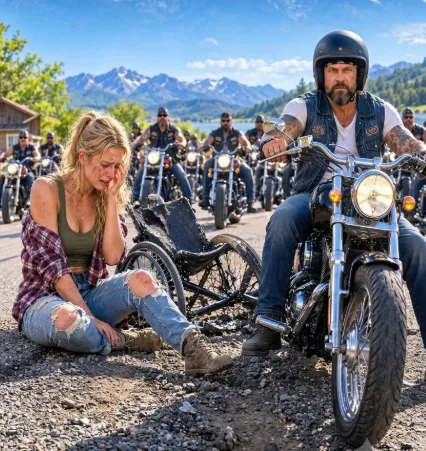
The crowded gang of bikers pulled up beside the gravel shoulder of Route 89 and sneered down at my crying son’s broken wheelchair
I stared at the tarnished dog tag lying on the passenger seat, and the stamped letters blurred together until all I could see was my husband’s name and the faint scratch across the bottom where he had dropped it on our kitchen floor eight years ago.
“That could be a copy,” I said, and my voice came out thin and brittle, like ice over a shallow puddle.
“It could,” the biker president agreed, lowering his weapon and holding the barrel toward the dirt so I could see it was no longer a threat. “Then ask me something only David would know.”
My thumbs dug into the steering wheel until the knuckles went white.
“What did he call me the night he proposed?” I asked.
“He never told me that part,” the man said, and the corner of his weathered mouth twitched. “But he told me about a lighthouse in Maine, and a cheap motel with a broken heater, and how you made him eat cold clam chowder out of a paper cup because the restaurant had closed. He said that was the night he knew he’d have to quit the life if he ever wanted to deserve you.”
My breath left me in one broken rush, because David had never told anyone about that lighthouse.
Not his lawyer, not his mother, not the prison chaplain.
Only me.
“Mom?” Leo’s voice came small and shaky from the passenger seat, where he had curled against the door with the tablet clutched to his chest. “Mom, who is that man?”
“I don’t know yet, baby,” I whispered, and I reached across and gripped his hand so hard I felt his pulse leaping against my fingers. “But I think he might be on our side.”
“My name is Gideon Rourke,” the biker said, stepping up to the window and meeting my eyes without flinching. “Eight years ago your husband and I served in the same unit. Six years ago he pulled me out of a very dark place and told me to build something good with what was left of me. We named it the Iron Scorpions.”
“David founded a motorcycle club,” I said flatly.
“A veterans’ brotherhood,” Gideon said. “A place for men with nowhere to go. We ran charity rides, fixed up bikes, kept guys off the streets. David was the heart of it. Then he walked away to be a husband and a father, and he made me swear never to drag you into any of it.”
“And then?”
“And then Marcus Vance found us.” Gideon’s jaw hardened, and a muscle jumped beneath his gray stubble. “Vance was a federal prosecutor with a gambling problem and a cartel in his pocket. He needed a clean, respectable organization to wash stolen bonds through, and he saw a club full of broken veterans with a good name and no powerful friends.”
Behind him, the two choppers that had blocked our road idled in the red dust, and their riders sat watching with a strange stillness, hands resting nowhere near their weapons.
“They’re mine,” Gideon said, following my gaze. “Wren and Tuck. They’ve been on your tail since the day David’s trial ended.”
“You’ve been following us for six months?” I said, and the anger rose in me like a hot tide. “You watched me sleep in that car outside the courthouse and you didn’t say a word?”
“I couldn’t,” Gideon said, and for the first time his voice cracked. “Every phone in your house was bugged. Every lawyer you hired was reporting to Vance. If I had so much as waved at you, they would have buried you and the boy in the desert and called it a missing persons case.”
I looked at Leo, at his pale freckled face and the braces on his thin legs, and I thought of every night I had spent crouched at the kitchen table with maps and phone records while he slept in the next room.
“Why now?” I asked. “Why reveal yourself now?”
“Because you walked right up to me on that highway and planted a tracker in my vest,” Gideon said, and a ghost of a grin touched his scarred face. “And I realized you were going to find that hangar with or without me. I’d rather you had backup when you did.”
He reached into the pocket of his vest and pulled out the tiny transmitter, dangling it between two fingers like a dead beetle.
“Nice work, by the way,” he added. “David always said you were the smartest person he knew.”
Before I could answer, a flat crack echoed off the canyon wall, and a puff of red dust jumped from the dirt a foot behind Gideon’s boots.
“Down!” Gideon roared, and he threw himself against the side of my sedan as a second shot spanged off the rocks.
“Get in the wash and keep your heads low!” Wren shouted, wheeling her chopper around into a spray of gravel, and Tuck was already firing a heavy revolver toward the ridge where three of Vance’s men had come pouring over the rim.
I shoved the sedan into gear and swung it behind a tumble of boulders, throwing myself across the seat to cover my son with my own body.
“Mom, I’m okay!” Leo gasped from beneath my arm. “I’m okay, listen, the signal! It’s still working!”
I raised my head just far enough to see the tablet, and there on the screen the little red dot I had planted still glowed in Gideon’s hand, a tiny pulse of proof in the middle of the chaos.
“The recording is already uploaded,” Leo said, his words tumbling out fast and fierce. “I sent it to the cloud and to Dad’s old lawyer, but Mom, it’s not enough. They’ll say it was faked. We need to catch them with the bonds.”
I stared at my twelve-year-old son, a boy I had spent half my life trying to protect from a world that kept breaking his body, and I realized he had been three steps ahead of me the entire time.
“Where did you learn all this?” I whispered.
“You never turn off the news when you work,” he said, with a small, trembling smile.
Gunfire cracked again, closer this time, and Gideon crawled up beside the car with blood spotting the sleeve of his shirt.
“You’re hit,” I said.
“Scratch,” he grunted. “Listen to me, Sarah. There’s a federal agent named Priya Nair who was David’s handler before he left the service. She’s the only honest badge left in the whole state, and she’s been waiting forty miles south with a team and a warrant that Vance doesn’t know exists. But she can’t move until she has proof that the bonds are physically inside that hangar and that Vance is in the room.”
“Then we give her proof,” I said.
“It’s a suicide run.”
“I’ve already been running at suicide for six months,” I said, and I surprised myself with the steadiness in my own voice. “What do you need?”
Gideon’s gaze moved from me to Leo and back again, and I saw the weight of a man deciding to trust people with the only family he had left.
“The hangar has a service tunnel that runs under the east wall,” he said. “David and I dug it six years ago, back when this place was ours. Vance doesn’t know it exists. It leads straight to the vault room.”
“And Leo?”
“Leo stays with Doc in the creek bed, and he runs the tablet,” Gideon said. “My medic is the best man I know, and he’s sitting in a gully two hundred yards from here with a satellite uplink. Your boy can stream whatever you record straight to Nair, live, no delays.”
“I want to go with you, Mom,” Leo said at once.
“No.”
“Mom.”
“No, Leo.” I cupped his face in both hands and pressed my forehead against his, and his skin smelled of sunscreen and dust and the little cedar soap he liked. “You are the most important thing in my entire life, and I need you to be the one who keeps all of us alive from the outside. Can you do that?”
He swallowed hard, and his dark eyes glistened, and then he nodded with a seriousness far too old for his age.
“I can do that,” he said. “But you have to come back.”
“I always come back,” I said, and I prayed God would not make a liar of me.
It took us nearly an hour to cross the wash under cover of scrub and rock, Wren and Tuck drawing Vance’s men away with flashes and sudden roars of engines, Doc hauling Leo’s chair through the sand like a patient mule.
By the time the sun slid behind the western ridge and the sky turned the color of dying embers, I was crouching in a narrow stone culvert half a mile from the hangar, my knees scraped raw, with Gideon’s shoulder wrapped in a strip torn from my plaid shirt.
“There,” he whispered, pointing to a rusted iron grate half buried beneath a drift of sand and old mining timber. “The tunnel starts there. It comes up behind the vault.”
We pulled the grate aside together, and a breath of cold stale air rose out of the dark, smelling of copper and wet stone and years of silence.
I switched on a small flashlight and crawled in first, because Gideon’s shoulder would not let him lead, and I felt the walls close around me like a mother’s arms.
“David dug this with a pickaxe and a thermos of black coffee,” Gideon murmured behind me as we inched forward through the dark. “Three weekends in a row. He said a good man always builds himself a way out.”
“He built himself a way in,” I said.
“That’s even better.”
My hand brushed something cold and smooth in the dirt, and when I shone the light on it I found a small tin cup half buried in the clay, the paint on its rim worn away by years of use.
The initials scratched into the bottom were D.M.
I closed my fingers around it, and something warm and fierce unfurled in my chest, something I had thought grief had burned out of me months ago.
Hope.
We reached the end of the tunnel after what felt like forever, and I saw a square of dim yellow light seeping through the slats of a wooden hatch above our heads.
Gideon motioned for silence and pressed his ear to the boards, and I heard muffled voices from the room above, the clink of metal, the slow scrape of heavy crates being dragged across a concrete floor.
“Four men,” he mouthed. “Maybe five.”
I slid my phone from my pocket, opened the camera, and thumbed the live stream Leo had set up, and in the corner of the screen a tiny green light blinked to show that my son was watching.
“I’m here, Mom,” Leo’s voice whispered through my earpiece, small and steady. “Agent Nair says she can see you. She says don’t move until Vance walks into the frame.”
“Understood,” I breathed.
Gideon eased the hatch up a single inch, and a thin blade of light cut across my face.
Through the narrow gap I saw a long concrete room lined with steel shelves and open crates, and in the center of it stood a massive vault door hanging wide open, its inner shelves stacked with neat bundles of paper wrapped in plastic.
Bearer bonds, millions upon millions of dollars of them, the same bonds that had vanished from a federal warehouse and ruined my husband’s life.
And in front of the vault, sleeves rolled to the elbow, sat Marcus Vance at a folding table, a laptop open before him, a glass of whiskey sweating beside his hand.
He looked nothing like the polished prosecutor who had stood in a courtroom and called David a thief and a traitor.
He looked tired, and greedy, and a little afraid.
“Is the fuel in place?” he asked, not looking up from his screen.
“Twelve drums along the north wall,” said a heavyset man in a mechanic’s jumpsuit. “The whole building goes up in four minutes once we light it.”
“Good. We move the last tranche at midnight, burn everything, and walk away clean.” Vance took a slow sip of his whiskey. “The Scorpions will be blamed. Rourke’s traitor ass will be found in the ashes with a bottle in his hand.”
My nails dug crescents into my palms, because I could feel Gideon’s whole body go rigid beside me in the dark.
“And the wife?” the heavyset man asked.
“The wife and the cripple boy will be found in their car at the bottom of a ravine,” Vance said, as casually as someone ordering lunch. “A tragic accident. Grieving woman, desperate, reckless driving. No one will ask questions.”
The word he had used landed against my heart like a hammer, and I felt Gideon’s hand clamp hard on my wrist before I could move.
“Not yet,” he breathed. “He’s about to say more.”
“Is that our proof?” I whispered into my phone.
“Agent Nair says it’s good,” Leo answered, and his voice was shaking now. “She says it’s very good. But she needs the bonds on camera with his hands touching them, Mom. And she needs a judge to hear him say it live. She’s patching one in right now.”
“A judge?” I mouthed.
“Federal magistrate. She says it’s the only way to get an emergency warrant that can’t be thrown out.”
I closed my eyes for exactly one breath and thought of David sitting alone in a gray cell with his hands folded in his lap, waiting for a visit that was always too short.
Then I opened them and pushed the hatch up.
“Sarah, wait!” Gideon hissed, but I was already climbing out into the glaring yellow light of the vault room, my shoulders squared and my phone held out in front of me like a badge.
The mechanic spun around first, his hand flying to the gun at his hip, but Vance simply raised one finger and the man froze.
“Well,” Vance said, and a slow, delighted smile spread across his handsome face. “Mrs. Miller. You’ve saved me a drive.”
“Marcus,” I said evenly, and I let the camera swing slowly across the open vault, the stacked bonds, the drums of fuel, and the open laptop with its glowing list of offshore accounts. “I wanted to see your face one more time.”
“Is that a phone?” he asked, tilting his head with polite curiosity. “How adorable. You’re livestreaming this, aren’t you?”
“I am.”
“To whom?”
“To a federal magistrate,” I said. “And to a special agent named Priya Nair.”
For the first time his smile faltered, a tiny fracture that ran across his composure like a crack across a windowpane.
“Nair,” he repeated softly. “She’s been out of the Bureau for years.”
“She’s been in your files for years,” I said. “David never stopped working, Marcus. Even from a cell.”
Vance stared at me for a long moment, and then he laughed, a low, genuine chuckle that made the hair stand up on my arms.
“You people,” he said, shaking his head. “You think the truth is a weapon. It’s a toy. It’s a story that belongs to whoever has the best lawyers and the biggest budget. Do you know how many men I’ve sent to prison, Mrs. Miller? Four hundred and twelve. Not one of them ever thought I’d be the one to take everything from them.”
“Four hundred and twelve,” I said quietly. “And how many of them were innocent?”
He shrugged, and in that small, careless motion I saw the whole rotten core of him.
“Does it matter?” he asked. “Innocent. Guilty. They’re just names on a docket. I needed a clean, quiet, grateful scapegoat, and your husband had the perfect résumé. Decorated veteran. No family to speak of. A past full of old secrets I could dig up and twist into a motive.”
“He had a family,” I said.
“He had you,” Vance said, almost kindly. “And you were never supposed to be a problem.”
“Mom,” Leo’s voice whispered urgently in my ear, “Agent Nair says the judge heard that. All of it. She says keep him talking, the warrant’s being signed right now.”
My heart was pounding so hard I thought it would crack my ribs, but I kept my voice level and my hand steady.
“You framed him for the warehouse theft,” I said. “You killed the guard who saw your man leave through the loading dock. You had the evidence sealed so no appeal could ever reach it.”
“I was very thorough,” Vance said modestly, and he picked up his whiskey and saluted me with it.
“And you were going to murder a twelve-year-old boy in a wheelchair.”
“Collateral,” Vance said with a shrug. “I don’t enjoy it, if that helps.”
Something moved in the shadows behind him, a flicker of dark leather, and I saw Gideon rise silently out of the hatch like a ghost climbing out of its own grave.
“It doesn’t help,” I said, and I smiled for the first time that day. “But this might.”
Vance frowned, and then the lights of the vault room flared and died as Gideon slammed his fist onto the breaker panel by the wall, plunging us into total darkness.
Chaos erupted.
A gun roared somewhere to my left, and the flash lit the room in a freeze-frame of terror, Vance diving beneath his table, the mechanic firing wildly, two other men sprinting in from the side door with rifles raised.
I dropped to the concrete and rolled behind a steel shelf, my phone still glowing in my fist, the green stream light still blinking, and I heard Gideon’s voice rise over the din like a battle cry.
“Scorpions!”
The roar of a dozen engines tore through the night outside, and the corrugated steel wall of the hangar shuddered as a chopper smashed through the front doors in a shower of sparks.
Wren came through the wreckage standing on her pegs with a shotgun in one hand, and behind her poured Tuck and a dozen leather-clad riders I had never seen, men with gray beards and prosthetic limbs and fury burning in their eyes.
“Who the hell are they?” I gasped.
“The brotherhood,” Gideon shouted back, clubbing the mechanic with the butt of his pistol. “I told you. David built something good.”
Vance’s men scattered in every direction, firing at shadows, and in the confusion I scrambled along the shelves toward the open vault, my lungs burning, my eyes locked on the neat plastic-wrapped bundles gleaming in the dark.
I tore a handful off the shelf, pressed them against my chest, and held up the phone with its camera aimed squarely at the serial numbers printed along the edge.
“Leo, can you read these?” I panted.
“I can read them, Mom,” Leo said, and his voice was thick with tears and fierce pride. “Agent Nair is matching them right now. They’re real. They’re the stolen ones. Mom, they match the federal warehouse manifest.”
“Good,” I breathed. “Tell her to come get them.”
“She’s already in the air,” Leo said. “Two helicopters. Four minutes.”
A flicker of orange light caught my eye, and I turned to see the heavyset mechanic staggering toward the north wall with a flare in his raised hand, a sick, desperate smile twisting his bloody face.
“If I burn, you all burn!” he screamed.
The flare dropped from his fingers, and the first of the fuel drums went up in a roaring sheet of flame that painted the whole vault room in hellish gold.
“Fire!” Wren yelled. “Everybody out!”
The heat hit me like an open furnace door, and I staggered back with the bonds clutched against my chest, my eyes watering, the whole world narrowed to the red glow spreading along the wall and the roar of the flames licking up toward the ceiling.
“Sarah!” Gideon’s arm hooked around my waist, hauling me toward the tunnel hatch. “The bonds! Leave them!”
“Those bonds are my husband’s freedom!” I shouted over the roar.
“Then we take them with us!”
He dragged a canvas tarp from a nearby shelf, swept the stacked bundles into it with one massive arm, and slung the whole bundle over his good shoulder like a sack of flour.
“Go!” he roared. “Go, go, go!”
I dropped through the hatch headfirst, landing hard on the cold clay, and Gideon came down behind me, boots scrabbling, the heat of the flames blasting through the opening above us in a pillar of orange fire.
We crawled through the tunnel on our elbows and knees, coughing and gasping, the roar of the inferno chasing us like a living thing, until at last we burst out into the blessed cold desert air and collapsed in the dirt, choking and laughing and shaking all at once.
Behind us the entire hangar was a tower of flame, its rusted roof peeling back like the lid of a tin can, and I watched the sparks spiral up into the black sky among the stars.
The throb of rotor blades beat in over the ridge, and two helicopters swept in with searchlights blazing white, painting the burning desert in stark silver.
“Federal agents!” a woman’s voice boomed from a loudspeaker. “Everyone on the ground! Hands where we can see them! Federal agents!”
The Scorpions obeyed at once, riders dropping their weapons and kneeling in the sand with their palms open, and I saw Vance’s surviving men scrambling out of the burning hangar in a panic, throwing down their rifles as armored agents poured out of the helicopters.
A dark figure darted from the back of the building toward the canyon edge, a man in a charcoal suit with his tie flying loose and his face streaked with soot.
Vance.
He ran with a briefcase in one hand and a pistol in the other, stumbling over rocks, heading for a battered dirt bike parked near the cliff, and I realized with a surge of cold clarity that he was about to escape.
“Gideon,” I said, already on my feet.
“Sarah, don’t—”
I did not hear the rest.
I ran.
I ran through the thorns and the dust with my lungs screaming and my legs aching, every step carrying me closer to the man who had stolen six years of my husband’s life, and I thought of David’s hands folded in a gray cell, and Leo’s small voice whispering through the dark.
I was twenty feet behind Vance when he reached the bike and spun around with the pistol raised, his face a mask of terror and rage.
“Stay back!” he shrieked. “I’ll shoot, I swear I’ll shoot you!”
“No, you won’t,” I said, and I stopped at the edge of the cliff with my hands open and the whole burning sky behind me. “Because there are two helicopters, forty agents, and a federal judge watching you right now.”
He glanced up, and the thunder of rotors rolled over him, and the white searchlight swung across his face and froze him in its glare like a moth against a lamp.
“Put it down, Marcus,” I said. “It’s over.”
“It’s never over,” he whispered, and his hand trembled on the grip. “I built everything. I had it all. I had it all.”
“You had a lie,” I said. “And it burned.”
For a long, awful moment I thought he would pull the trigger, and I stood perfectly still, waiting, my eyes locked on his.
Then the pistol slipped from his fingers and clattered into the red dust, and Marcus Vance, four hundred and twelve convictions, the most feared prosecutor in northern Arizona, sank to his knees on the canyon edge and began to weep.
Agents swarmed him from both sides, wrenching his arms behind his back and snapping steel cuffs around his wrists, and a tall woman in a navy windbreaker strode across the sand with her silver braid swinging against her shoulder.
“Sarah Miller?” she asked.
“Yes.”
“Priya Nair.” She held out a hand, and I took it, and her grip was warm and dry and utterly sure. “Your husband told me you were the bravest person he knew. I think he undersold you.”
Tears rose in my eyes so suddenly that I could not answer, and she simply pulled me into a hard, brief hug.
“The magistrate signed the warrant at 11:42,” she said into my ear. “Every word Vance said on that stream is admissible. The bonds are in federal custody. We’re filing for David’s release in the morning.”
“In the morning?” I choked.
“In the morning,” she repeated, and she smiled. “I’ve got a judge on standby who owes me a very large favor.”
I do not remember falling to my knees in the dust, only that Gideon’s arm was suddenly around me, and Wren’s hand was on my shoulder, and somewhere in the distance a small voice was shouting my name across the desert.
“Mom! Mom!”
I looked up, and there was Doc, jogging across the sand with Leo’s chair rattling ahead of him, and my son was leaning forward in his seat with his arms outstretched and tears streaming openly down his face.
I ran to him, and he threw himself into my arms so hard that the chair tipped sideways, and we tumbled together into the cool soft sand, laughing and crying and holding on.
“You came back,” he sobbed into my shoulder.
“I told you I always do,” I whispered, and I kissed his dusty hair again and again. “You were so brave. You were so, so brave.”
“I was scared the whole time,” he admitted.
“That’s what brave is,” I said.
Gideon limped up beside us with his arm in a makeshift sling and his gray beard singed at the edges, and he lowered himself heavily onto a rock and looked at the blazing wreck of the hangar with an expression I could not read.
“Six years,” he said quietly. “Six years David and I built that place. Seems a shame to see it go.”
“You can build another,” I said.
“Maybe,” he said, and a tired smile creased his face. “Maybe this time we’ll do it in the open.”
David Miller walked out of the Arizona State Prison Complex at ten in the morning on the ninth day after the fire, wearing the same faded blue shirt he had been arrested in, with a clear plastic bag of personal belongings swinging from one hand.
I stood on the other side of the gate with my heart hammering so fast I thought I might faint, a wedding ring on a chain around my neck and a twelve-year-old boy beside me gripping the arms of a brand-new wheelchair.
He had lost weight, and there was gray in his hair that had not been there before, and the lines around his eyes had deepened into small, tired grooves.
But when he saw us, his whole face broke open like a dam giving way, and the bag fell from his hand and hit the pavement.
“Sarah,” he said, in a voice scraped raw by two hundred and forty days of silence.
“Hi, David,” I whispered, and then I could not say anything else, because I was running.
He caught me in the middle of the parking lot and lifted me clean off the ground, and I buried my face in the rough cotton of his shirt and breathed in the smell of him, soap and sweat and something faintly like cedar, the smell of home.
“I’m sorry,” he kept saying, over and over, into my hair. “I’m so sorry. I should have told you everything. I should have trusted you with it.”
“You should have,” I agreed, laughing through my tears. “And I would have yelled at you for a month. But I would have understood.”
“I know,” he said. “I know you would.”
“Dad?” said a small voice behind us.
David turned slowly, and I felt his arms tighten around me as he saw his son sitting in the shining new chair with his chin lifted and his eyes bright and wet.
“Leo,” he breathed.
“Hi, Dad,” Leo said. “I helped catch the bad guys.”
“I heard,” David said, and his voice shook. “I heard you were a hero.”
“Mom says I was just brave.”
“Brave is better,” David said, and he dropped to his knees on the warm asphalt and pulled our son into his arms, and the three of us stayed there in the middle of the parking lot with the Arizona sun pouring over our shoulders and the whole world blurring gold.
“Dad,” Leo mumbled into his shoulder. “I want to show you something.”
“Anything,” David said.
Leo drew back, wiped his nose on his sleeve, and gripped the arms of the chair with both hands.
Slowly, with his jaw set and his braces creaking, my son pushed himself up out of the seat and stood.
His legs shook, and sweat beaded on his forehead, and I held my breath so hard that my chest ached.
He took one step.
Then another.
Then a third, wobbling, reaching out for his father’s hand, and David caught it and held on as though he were holding the whole world.
“Six steps,” Leo panted, grinning like a boy who had just invented the sun. “I’ve been practicing every night while you were gone. Mom said I wasn’t allowed to tell you until you came home.”
David could not speak.
He simply wrapped his arms around our son, and I wrapped mine around the both of them, and somewhere on the far side of the parking lot a row of motorcycles rumbled softly to life.
I looked up, and there they were along the chain-link fence, Gideon and Wren and Tuck and Doc and a long line of gray-bearded riders in worn leather vests, engines idling, helmets in their hands, saluting a man they had thought they would never see again.
David lifted one hand, and Gideon lifted his, and I saw something pass between them that needed no words at all, eight years of brotherhood and a debt that no one would ever call in.
“They’re going to ride with us to the diner,” Leo announced. “Gideon says he’s buying everybody pancakes.”
“Gideon hasn’t bought anyone pancakes in his entire life,” David said, shaking his head and laughing through his tears.
“Then it’s a historic day,” I said.
Spring came early to our little house in Flagstaff that year, and with it came a long, slow, ordinary peace that I had almost forgotten how to trust.
Marcus Vance was sentenced to life plus ninety years, and when the judge finished reading the verdict he looked at me across the courtroom with a hollow, empty gaze, and I felt nothing at all except a gentle, quiet sense of a door finally closing.
Forty-one men and women were arrested in the ring that had been feeding on the Iron Scorpions, and every one of the four hundred and twelve convictions Vance had won was reopened for review, and families who had waited years for answers finally began to receive them.
David’s name was cleared in a hearing that lasted less than an hour, and when the judge said the words not guilty, the entire gallery rose to its feet, and the Scorpions in the back row wept openly without shame.
Gideon refused every medal Agent Nair tried to pin on him, and instead he asked for a single piece of paper, a federal charter for a nonprofit called the Lighthouse Riders, a veterans’ brotherhood dedicated to helping disabled children and their families.
The first ride was held on a bright Saturday in May, a long line of two hundred motorcycles rolling down Route 89 in the golden afternoon light, engines thundering across the valley like a heartbeat.
At the head of the column rode David on a black chopper he had rebuilt with his own hands, and behind him, in a custom sidecar painted the deep blue of a Maine sky, rode Leo, with a pair of goggles pushed up on his forehead and a grin that stretched from ear to ear.
I rode behind them on a little silver Triumph that Gideon had given me as a gift, my hair streaming in the wind, my heart so full it ached.
At the gravel shoulder where it had all begun, the column slowed and stopped, and the riders stood beside their bikes in a long respectful line while a small plaque was unveiled on a pole by the edge of the road.
It was a simple brass plate, and it read, For every family that was ever left stranded on this road, someone will always stop.
Gideon stood beside it in a clean leather vest with his arm out of its sling at last, and when he looked at me, his gray eyes were bright and soft.
“You stopped us once,” he said quietly. “Back on that day, you stopped a dozen bikers with a broken wheelchair and a good lie.”
“It wasn’t a lie,” I said. “Not completely. We did need help.”
“Yeah.” He smiled. “You did. You just needed more than any of us knew.”
The wind moved through the sagebrush, warm and gentle and smelling of rain far off in the mountains, and I felt David’s hand slip into mine and squeeze.
“Ready to go home?” he asked.
I looked at my husband, tired and scarred and free, at my son laughing in the sidecar with the whole desert gold behind him, at the long line of riders waiting in the light.
“I am home,” I said.
And as the engines roared back to life and the great column rolled on down the open highway toward the sun, I understood at last that the real trap had never been the one I set on a lonely stretch of gravel.
It was the quiet, stubborn, impossible love of the people who had been waiting in the dark to catch us when we fell.