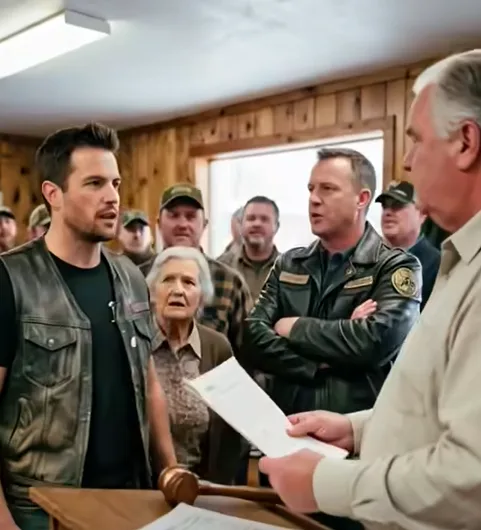
The corrupt mayor mocked my family’s bankruptcy and brought down his wooden gavel to auction off my father’s auto shop for pennies
The brass key sat in my palm, warm from the heat of the truck cab, and I turned it over and over as though the ridges might spell out what my father had never been allowed to say.
“You’ve gone quiet, little brother,” Cole said, without taking his eyes off the road.
“I’m thinking about the file.”
“Don’t think too hard. Dad was never a man who left bad news in a safe.”
“He left you in a prison transport.”
“He left me a chance,” Cole said, and his mouth tightened. “That’s different.”
The hills rolled past the windshield in long gold swells, and the sun hung low and orange behind a ridge of dark pines. I had driven this road ten thousand times in my life, and never once had it felt like it was leading somewhere I was afraid to go.
My name is Eli Miller, I am twenty-four years old, and for three years I had believed I was the last man in my family who still had a name worth carrying.
My father, Arthur Miller, had been arrested on a rainy October night, charged with burning down the county grain warehouse for the insurance money. He had never touched a match. He had spent forty years fixing motorcycles for anyone who walked through the door, and he had a habit of charging the poor half price and the rich double.
He had died in a prison infirmary eight months into a twenty-year sentence, with a cough nobody treated and a letter nobody delivered.
That was what the warden had told us.
“Cole,” I said. “How did you get out? The transport crash. The news said there were no survivors.”
He was quiet for a long moment.
“A federal agent pulled me out of the wreck,” he said at last. “She was riding in the escort vehicle. She had been undercover in the county sheriff’s office for fourteen months, collecting evidence against Hayes and Vance, and when the transport went off the road, she saw her chance.”
“Her chance?”
“To make me dead. On paper.” He glanced at me, and his eyes were steady and tired. “I couldn’t tell you or Mom. If Hayes had known I was alive, he’d have come for you both. So I stayed hidden in a safe house in Spokane for three years, helping her build the case.”
“Three years.”
“Every day I wanted to call.”
“You should have.”
“I know.” His hands tightened on the wheel. “I’m sorry, Eli. I’m sorrier than I can say.”
I looked at the road, because I could not look at him.
Three years of nights at the kitchen table, listening to my mother pray in a small cracked voice. Three years of standing at an empty grave. Three years of carrying a wrench through a shop that smelled of my father’s pipe tobacco and no longer had a father in it.
But I also remembered the way he had walked into that community hall, tall and unafraid, with a satchel of cash and the whole room going silent around him.
“You were magnificent,” I said, because it was true.
“I was terrified.”
“That’s what brave is.”
He laughed, a short rough sound, and reached over and cuffed the back of my head the way he used to when we were boys.
We pulled into the gravel lot of Miller Motorcycle Repair at dusk.
The shop sat at the end of a long dirt lane, a low gray building with a corrugated roof and a hand-painted sign that had been peeling since before I was born. A single bulb burned over the bay door, and moths circled it in a slow gold halo.
Someone had spray-painted a word across the front in red letters.
ARSONIST.
I had scrubbed it off a dozen times. It always came back.
My mother climbed down from the truck and stood looking at it, small and straight-backed in her black Sunday coat, with the worn leather Bible still pressed against her ribs.
“Your father used to say,” she said quietly, “that a man’s name is like a motorcycle. It gets muddy. It gets dented. But it still runs, if somebody cares enough to clean it.”
“Mama,” Cole said gently.
“I’m all right.” She smiled, and her eyes were wet. “I’m better than all right. I have both my boys home.”
She reached up and touched Cole’s face, and he bent his head so she could reach.
We went inside together, through the side door that stuck, into the warm familiar smell of oil and steel and old coffee.
The office was at the back of the shop, a cramped little room with a wooden desk and a calendar from 2019 still hanging on the wall. My father’s reading glasses lay folded on the blotter, beside a half-finished crossword.
Cole knelt in the corner and pulled up a square of rotting linoleum.
Beneath it, set into the concrete, was a small black floor safe with a brass dial.
“The key,” he said.
I handed it over.
He slid it into the lock, and turned it, and the heavy little door swung open with a sigh.
Inside lay a single manila folder.
My name was printed on the front in my father’s blocky capitals, and beneath it, smaller, a line I had to read three times.
Eli. Read this before you decide anything.
My hands shook.
I carried the folder to the desk and sat in my father’s creaking chair, and my mother came to stand behind me with one hand on my shoulder, and Cole leaned against the doorframe with his arms folded.
I opened the folder.
The first page was a letter, in pencil, on prison stationery.
My son, it began.
If you are reading this, then I am gone, and your brother has found a way to bring the truth home. I am proud of both of you. I want you to know that before anything else.
I need to tell you something I should have told you years ago. I wasn’t framed for the warehouse fire because of money. I was framed because of what I knew about your mother’s family.
I stopped reading.
“Mama?” I said.
Her hand tightened on my shoulder.
“Keep going,” she whispered.
I read on.
Your mother’s maiden name is Alvarez. You know that. What you don’t know is that her father, Don Ramón Alvarez, owned the largest cattle ranch in this valley, nine thousand acres of river bottom and grazing land, until the winter of 1987.
That winter, Mayor Hayes’s father, then county assessor, filed a fraudulent tax lien against the ranch and had it seized for pennies. Ramón Alvarez died of a stroke on the courthouse steps. His family was run out of town with nothing.
I found your mother in a bus station in Tucson, nineteen years old, with a suitcase and a baby on the way. I brought her home. I married her. And I spent forty years keeping her away from a town that had destroyed her family.
I looked up.
My mother was weeping silently, with her Bible clutched against her chest.
“Is this true?” I asked.
“Yes,” she said.
“You never told us.”
“I was afraid.” Her voice was very small. “The Hayes family owned this town, Eli. If they had known I was Ramón’s daughter, if they had known I remembered, they’d have found a way to bury us.”
“They found one anyway.”
“Yes.” A tear slid down her cheek. “They did.”
I turned the page.
The second page was a map, hand-drawn, with a ragged line of dots marking the boundary of a large property along the river.
Beneath it was a photocopy of a document so old the paper had gone brown, stamped with the seal of a Spanish colonial governor and a date in the 1840s.
I looked at it, and I looked at it again, and something enormous began to turn over in my chest.
“It’s a land grant,” Cole said softly, reading over my shoulder. “The original. The one Hayes’s family has spent forty years trying to find.”
“Where did Dad get it?”
“Read the last page.”
I turned.
The last page was a single paragraph in my father’s careful hand.
The original grant is hidden in the frame of the 1954 Indian Chief that sits in the back bay of the shop, under the tarp. I told everyone it was a rusted-out wreck. It is not. I rebuilt it myself, and inside the engine case is a sealed steel tube with the original document. Do not sell that bike, Eli. Not for any price.
We all stared at one another.
“The motorcycle,” I said slowly. “The one he never let anyone touch.”
“The one in the back bay,” Cole said.
“Under the tarp.”
We ran.
The back bay was dark, and I fumbled for the light switch, and the old fluorescent tubes flickered and caught with a long electric hum.
In the corner, under a canvas tarp so dusty it had gone the color of dried mud, crouched a shape I had walked past every day of my life.
Cole grabbed the tarp and pulled.
The motorcycle gleamed beneath it like a piece of the sun.
It was a 1954 Indian Chief, deep red, with a black leather saddle and a chrome tank polished to a mirror. Every bolt was bright. Every wire was new. My father had been rebuilding it in secret, night after night, for twenty years, and none of us had known.
I put my hand against the cold cool metal of the tank, and my throat closed.
“It’s beautiful,” my mother whispered.
“It’s him,” I said. “It’s all of him.”
We found the tube inside the engine case after an hour of careful work, wrapped in oilcloth and sealed with wax.
Cole opened it with a pocketknife, and unrolled a sheet of parchment so fragile that it seemed to breathe.
The writing was faded brown, slanting, in an elaborate Spanish hand.
By the grace of His Majesty, the document began, and below it, the boundaries of nine thousand acres along the river, and below that a name.
Don Ignacio Alvarez y Torres.
My mother put her hand over her mouth.
“My great-great-grandfather,” she said. “My father used to tell me about him. He said the family had a paper, a very old paper, that proved the land was ours. I thought it was a story.”
“It’s not a story,” Cole said, and his voice shook. “Mama, it’s real.”
She reached out and touched the parchment with one trembling finger.
“Ramón,” she whispered. “Papa. We found it.”
We sat in the shop until midnight, the three of us, on overturned crates, with the Indian Chief gleaming under the lights and the grant spread across the workbench between us. My mother told us stories about her father that I had never heard, how he sang while he rode the fence lines, how he carried a pocketful of sugar cubes for the horses, how he had once ridden fifty miles through a blizzard to bring a doctor to a sick neighbor.
Cole told us about the safe house in Spokane, and the federal agent who had saved his life, a woman named Imani Rowe, who had pulled him from the wreck with her bare hands.
I told them about the three years, the empty kitchen, the nights I had sat in the shop with my father’s wrench in my lap, wondering why I was still alive.
By the time the clock struck twelve, we were laughing, and crying, and holding hands over the workbench like people at a séance.
“What now?” I asked.
“Now,” said Cole, “we take this to court.”
“Hayes will fight.”
“Hayes is in a federal cell.”
“His lawyers will fight.”
“Then we’ll fight them.” Cole grinned, and for a moment he looked exactly like our father, fierce and stubborn and unbowed. “We have the grant. We have the wire receipts. We have a federal prosecutor who has been waiting four years to put Hayes’s name on a docket.”
“And a mother who’s waited forty,” my mother said softly.
We looked at her.
She had straightened on her crate, with her Bible in her lap and her gray head high, and for the first time in my life I saw the girl she had been, nineteen years old, standing at a bus station with a suitcase and a stubborn chin.
“I would like to see it done,” she said. “Before I die. I would like to stand in that courtroom and hear a judge say my father’s name.”
“You will,” I said.
“Promise me.”
“I promise.”
The hearing began in the first week of December, in the big stone courthouse at the center of town.
It was a cold, bright morning, with frost glittering on the steps and a line of people stretching down the block, families who had lost land to Hayes and his father, widows whose husbands had died in debt, farmers who had signed papers they didn’t understand. They had come from three counties. Some of them carried old documents in plastic bags. Some of them carried nothing at all.
They stood in the cold, and they waited, and when my mother climbed the steps in her black coat with Cole on one side and me on the other, the whole crowd fell silent and parted to let her through.
Nobody said a word.
But as she passed, an old man in a frayed coat took off his hat and held it against his chest.
Then a woman beside him bowed her head.
Then another, and another, until a long path of bowed heads and lifted hats stretched down the courthouse steps and into the cold, bright, silent morning.
My mother paused at the top.
She turned, and looked at them all, and I saw her lips tremble.
“Thank you,” she said, in a voice that carried to the back of the crowd. “I only wish my father were here to see you.”
The courtroom was packed to the rafters.
The judge was a stern white-haired woman named Honoria Pell, who had been appointed from the capital specifically because she had no connection to the county. She listened to the evidence for six days without blinking, the wire transfers, the forged liens, the recorded testimony of a dozen witnesses, and finally, on the seventh day, the grant itself, carried into the courtroom in a glass case by a federal conservator in white gloves.
Judge Pell studied it for a long time.
Then she took off her spectacles, and rubbed the bridge of her nose, and looked directly at my mother.
“Mrs. Miller,” she said. “Would you stand?”
My mother rose, slowly, with her hand on my arm.
“This court finds,” Judge Pell said, in a clear ringing voice, “that the Alvarez land grant of 1846 is valid and has never been legally extinguished. The seizure of 1987 is hereby declared fraudulent and void. Nine thousand acres of river-bottom land are restored to the heirs of Ramón Alvarez, in the person of his daughter, Lucia Alvarez Miller, and her sons.”
She paused.
“Further, this court finds that Arthur Miller was wrongfully convicted. His conviction is vacated. His name is cleared. And the court offers, on behalf of this county and this state, its deepest apology.”
The courtroom erupted.
I do not remember it clearly.
I remember a roar of voices, and a swirl of motion, and my mother’s small hand crushing mine in a grip like iron. I remember Cole lifting her clean off the ground and spinning her around while she shrieked and laughed and beat on his shoulders. I remember the old man in the frayed coat standing on a bench and weeping openly into his hat.
I remember Judge Pell, in the middle of it all, taking off her robe and wiping her eyes with the corner.
Mayor Hayes was sentenced in January to forty years.
Sheriff Vance received twenty-five.
Eleven other officials went down with them, county clerks and tax assessors and a retired judge from the state capital, and the whole sprawling web of forty years of stolen land came apart in a single winter, thread by thread, in the full white light of a federal investigation.
On the day of Hayes’s sentencing, he looked back at my mother from the defendant’s table.
He had gone gray and thin in prison, and his fine suit hung loose on his shoulders.
“Mrs. Miller,” he said hoarsely.
My mother met his eyes.
“I want you to know,” Hayes said, “that my father told me about your family when I was a boy. He said it was business. He said nobody got hurt.”
“My father died on the courthouse steps,” she said quietly.
“I know.” His voice cracked. “I’m sorry.”
“I know you are,” my mother said. “That is not the same as being forgiven.”
He lowered his head, and the bailiffs led him out.
She stood very still for a moment afterward, with her hand on the back of the bench, and I thought she might fall.
“Mama?” I said.
“I thought it would feel different,” she whispered.
“How?”
“I thought I’d feel finished.”
I put my arm around her.
“Maybe you’re not finished,” I said. “Maybe this is just the beginning of the part where you get to live.”
She looked at me for a long time, and slowly, very slowly, she smiled.
We rode out to the ranch in April.
It was a soft bright morning, with the first green coming up along the river and the whole valley smelling of wet earth and wild mint. The three of us rode out from the shop on three motorcycles, Cole on the old Harley he had ridden out of Spokane, I on a rebuilt Triumph, and my mother, in a pair of borrowed goggles and her black Sunday coat, in the sidecar of my father’s Indian Chief.
She had insisted.
“Your father rebuilt this bike for me,” she told us, tying a scarf over her hair. “I’ll ride in it or not at all.”
We followed the old dirt road along the river for nine miles, through stands of cottonwood and fields of new grass, and at the top of a long rise my mother put up her hand.
Cole killed his engine, and I killed mine.
The valley lay below us, wide and gold and green, with the river curving through it like a silver ribbon and a line of blue mountains standing guard on the horizon.
Nobody spoke.
My mother climbed slowly out of the sidecar and walked to the edge of the rise, and stood with her scarf blowing back in the wind and her hands folded in front of her.
“Papa,” she said softly.
The wind moved through the cottonwoods, warm and sweet and smelling of rain, and far below us a hawk wheeled lazily across the sky.
“I’m home.”
She stood there for a very long time.
Cole and I stood behind her, one on either side, and neither of us said a word, because there was nothing in the language to say.
When at last she turned around, her face was wet, and shining, and wonderfully young.
“Well,” she said briskly. “That house is going to need an awful lot of work.”
We laughed until we cried.
We rebuilt the ranch house that summer.
It had stood empty for thirty years, a long low adobe with a sagging porch and a roof like a broken saddle, and every neighbor in the valley came to help. They brought ladders and lumber, casseroles and cold lemonade, and the old man in the frayed coat showed up every morning at dawn with a hammer in his belt and a lunch pail in his hand.
His name was Hollis Greer, and he had lost his farm to Hayes in 1994.
“I’d like to work off a little of my gratitude,” he said, when my mother tried to pay him.
“You owe us nothing.”
“Ma’am,” Hollis said, “I owe you a great deal. Let me do it with a hammer.”
By August the roof was new, and the porch was straight, and the old adobe walls glowed a warm rose gold in the evening light. My mother planted a garden in the yard, tomatoes and chiles and a long border of marigolds, and hung a pair of blue shutters on the windows.
Cole moved into the east wing.
He had a job with the federal marshals now, a quiet desk position that he complained about constantly and secretly loved. Imani Rowe, the agent who had saved his life, came to dinner every Sunday, and by September she had stopped pretending it was for the food.
“She’s a very good cook,” Cole said, with great dignity, one night after she left.
“She brought a store-bought pie,” I said.
“She’s a very good shopper.”
“You’re hopeless.”
“I’m aware,” said Cole, and grinned like a boy of sixteen.
I stayed at the shop.
I had made up my mind that first night, standing over the Indian Chief with my father’s wrench in my hand. I would keep the garage going, and I would keep the sign, and I would fix every motorcycle that came through the door for whatever the owner could afford.
I painted the sign myself, in September, on a warm gold afternoon with the radio playing an old country song.
MILLER MOTORCYCLE REPAIR. EST. 1983.
Beneath it, in smaller letters, I added a line.
A man’s name is like a motorcycle. It still runs, if you care enough to clean it.
When it was dry, I stood back with my hands on my hips and looked at it, and I felt something warm and enormous rise in my chest.
“Dad,” I said aloud, to the empty yard. “I cleaned it.”
A breeze moved through the cottonwoods, warm and gentle, smelling of dust and sun and distant rain.
For a moment I could almost feel a rough, kind hand settle on the back of my neck.
Good work, son.
I closed my eyes, and smiled, and did not wipe away the tears.
On a clear evening in October, my mother asked me to take the Indian Chief out for a ride.
I wheeled it out of the back bay into the golden light, polished and gleaming, with my mother’s old leather satchel strapped to the rack. She came out of the shop in her black coat and settled into the sidecar, tucking the Bible into her lap, and put her goggles on with great ceremony.
“Where to?” I asked.
“Anywhere,” she said. “Slowly. I want to see everything.”
So I rode slowly.
We rode down the long dirt lane, past the sign and the gate and the red letters I had scrubbed away at last. We rode through the town, down Main Street, past the courthouse and the diner and the hardware store, and people looked up from the sidewalks and waved, and a little boy ran along beside us for half a block shouting, “Nice bike, mister!”
We rode out along the river road, with the sun going down in a blaze of copper and rose behind the western hills, and the valley spread out before us like a long green blessing.
My mother said nothing for a long time.
When we reached the rise above the ranch, I pulled over and killed the engine, and we sat in the quiet, watching the light change on the river.
“Eli,” she said.
“Yes, Mama?”
“Do you know what your father said to me the night he proposed?”
“No.”
“He said, ‘Lucia, I can’t give you much. I’ve got a shop, and a wrench, and a motorcycle that barely runs. But I promise you this. Someday I’ll bring you home.'”
She smiled, with her eyes on the shining river.
“I thought it was a lover’s promise,” she said. “Something to say to a girl at a bus station. I never believed he meant it.”
“He meant it.”
“He did.” Her voice shook. “It took him forty years, and a federal prosecutor, and my two stubborn sons. But he brought me home.”
I took her hand, small and warm and wrinkled, and held it against my heart.
Below us the ranch house glowed in the dusk, with lamplight spilling gold from every window and smoke curling up from the chimney in a thin gray thread. Somewhere in the yard Cole’s laughter rang out, followed by a woman’s laugh, bright and clear.
The first stars were coming out above the mountains.
“It’s time to go down,” my mother said.
“Yes, Mama.”
“Your brother has made dinner.”
“God help us.”
“Imani is supervising.”
“Then there’s hope.”
She laughed, and I laughed, and I kicked the starter of my father’s Indian Chief, and the old engine caught on the first try with a deep, glorious rumble that rolled out across the valley like a heartbeat.
We rode down the hill together, toward the light, with the wind in our faces and the whole bright world turning gold.
And as the warm glow of the ranch house rose to meet us out of the dusk, I understood at last what my father had been trying to tell me all along, in every bolt he turned and every motorcycle he mended and every quiet, stubborn year he spent rebuilding a machine in the dark.
Nothing that is truly loved is ever really lost.
It only waits, patient and gleaming, under a dusty tarp, until someone comes home with the key.