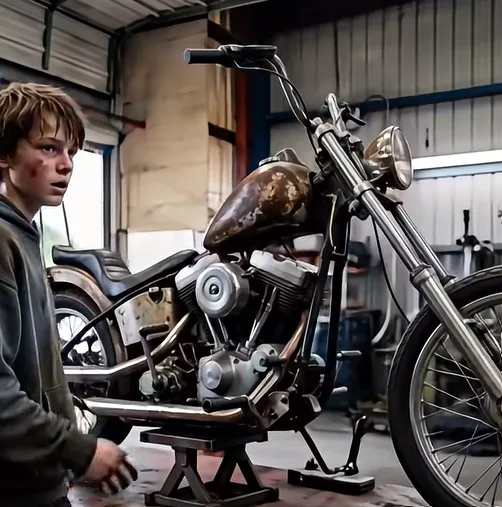
The club president brutally shoved me into a vintage chopper and screamed that my dying mother was worthless
I read the text three times, and each time the words refused to mean anything, like a sentence in a language I had spoken all my life and suddenly could not translate.
Your mother was the one who drove the car that cut your father’s brake lines.
A sentence like that is built to do one thing, and it isn’t to tell the truth.
It is built to make a frightened boy stop running.
“Leo Miller?” a voice called from the road, and I lifted my head above the tall grass to see a woman stepping out of the lead cruiser with her hand raised, palm open, the way you approach a stray dog you don’t want to bolt.
She was tall and weathered, in a gray windbreaker with a federal badge clipped to her belt and a long black braid over one shoulder, and her eyes in the flashing light were sharp and tired and kind.
“Special Agent Rosa Delgado,” she said. “You called us. I’m here. You’re not in trouble.”
“Somebody just texted me,” I said, and held out the phone, and my hand shook so badly the screen blurred. “Somebody who knew I was calling you.”
She read the message once, and her jaw tightened.
“That’s the oldest trick in the book,” she said quietly. “Whoever sent it wants you to believe you can’t trust us, and that you can’t trust your own mother. Do you know how fast Vance would have known you ran?”
“Maybe ten minutes.”
“He didn’t wait ten. He sent that text from inside the compound the second he found the open bay. He’s panicking, Leo. A man who is winning doesn’t send messages like this.”
I swallowed, and some of the ice in my chest cracked.
“My mother,” I whispered. “He said she’s sick. He said she isn’t worth the gas to burn the shop down. I haven’t seen her in four days.”
“Where is she?”
“In the apartment above the office. Vance keeps her there. He says it’s for her health.”
Delgado glanced at the garage, at the dark bulk of the compound crouched behind its fence, and then back at me.
“Then we’re going to get her,” she said. “Tonight. But I need what’s in that backpack first.”
I handed it over.
She unzipped it by the light of her flashlight and looked inside, and for a long moment she did not speak.
“Raw diamonds,” she said finally, and her voice dropped. “Conflict stones. Rough, uncut, no serial marks. Leo, do you understand what you’re holding? We’ve been trying to find this pipeline for six years.”
“There’s more in the engine.”
“Then that engine is evidence, and you’re the most important witness in the state.” She zipped the bag closed and met my eyes. “Get in the car. Now.”
The raid went in at one in the morning.
I watched it from the back of an armored van parked two hundred yards down the road, wrapped in a gray blanket with a paramedic’s cup of sweet tea burning my hands.
Delgado had refused to let me go near the compound, and I had refused to let her leave without me, and we had settled the argument the way adults and eighteen-year-olds often do, by one of us being too stubborn to lose.
“You stay in the van,” she had said. “You stay in the van, you keep your head down, and the second we have your mother, I’ll bring her to you myself.”
“Promise?”
“On my badge.”
So I watched.
The gates went first, ripped from their hinges by a pair of black SUVs, and tactical teams poured through in a rolling wave of dark gear and white flashlight beams. I heard shouts, the flat crack of flashbangs, the muffled thud of boots on concrete. Men in leather came stumbling out into the yard with their hands up, some of them barefoot, some still holding beer bottles, their faces slack with the stunned betrayal of people who had believed they were untouchable.
I knew every one of them.
Rusty, who had taught me to weld. Big Marv, who snuck me chocolate bars when I was twelve. Dutch, who once drove all night to bring my mother cough medicine.
They were not good men.
But some of them had been kind to me in a world where kindness was currency, and I felt something twist inside me as I watched them kneel in the mud.
“They aren’t all guilty of the same thing,” I said, not realizing I’d spoken aloud.
The paramedic beside me, a young man with a shaved head and a gentle voice, looked over.
“No,” he said. “They’re not. That’s what trials are for.”
The minutes dragged.
At twenty past one, the radio on the dashboard crackled, and Delgado’s voice came out of it, clipped and breathless.
“Vance isn’t in the main building. Repeat, no sign of the president. We have the garage secure, we have eleven in custody, and we’re clearing the upstairs apartment now.”
My heart thudded in my throat.
“Mom,” I breathed.
“Stand by,” Delgado said. “Stand by.”
Another minute passed, and then another, long as years.
Then the radio hissed, and Delgado’s voice came back, and I knew from the very first syllable that it was different.
“We have her,” she said. “She’s alive. She’s conscious. She’s asking for her son.”
I do not remember opening the van door.
I remember the cold wet grass under my sneakers, and the flash of red and blue light on the fog, and a paramedic’s hand on my shoulder trying to slow me down. I remember running across the muddy yard with my lungs on fire and my heart trying to climb out of my chest.
And I remember the shape of her in the doorway of the office, thin and stooped and wrapped in a blanket, with a federal agent’s arm around her waist.
“Mama,” I said.
She lifted her head.
She was so small. That was the thing I could not bear. Four days had hollowed her out, and her dark hair had gone to gray at the temples, and her cheeks were sunken and her lips cracked. But her eyes, the warm brown eyes that had watched me fall asleep every night of my childhood, lit up like a lantern in a window.
“Leo,” she whispered. “Leo, my baby.”
I crashed into her, and she caught me, and for a long time neither of us could say anything at all.
She smelled of sickness and old lavender and fear, and under it all, faintly, of the oatmeal soap she had always used. I held her so hard that Delgado stepped forward to loosen my grip, and my mother said, in her small cracked voice, “Let him.”
We stood in the doorway of the garage where we had spent ten years of our lives, and I wept into her shoulder like a child.
“I’m sorry,” she kept saying. “I’m so sorry. I should have gotten us out. I should have found a way.”
“You kept us alive.”
“I didn’t do enough.”
“You did everything,” I said fiercely. “Mama, you did everything.”
She put her hands on either side of my face and looked at me, and I saw the whole of the last decade pass behind her eyes.
“Leo,” she said. “I need to tell you something. Right now. Before anyone else does.”
“You don’t have to.”
“I do.” Her voice shook. “Vance has been telling you things about your father. Hasn’t he? About how he died.”
“He said he drove off a bridge.”
“Your father didn’t drive off any bridge.”
“I know. He said the brakes—” I stopped, and swallowed. “Somebody texted me tonight. They said you cut them.”
My mother’s face went gray.
“Oh, my darling,” she whispered. “Oh, my poor boy. Is that what he’s done?”
“It isn’t true.”
“It isn’t true.” She said it slowly, clearly, each word a stone laid on a wall. “Your father was murdered by Vance because he found the diamonds, and I have known it for ten years, and I have never once been brave enough to say so out loud.”
“Why?”
“Because Vance had you.” Her voice cracked. “From the night your father died, Vance had you. He told me that if I ever spoke, if I ever ran, if I ever went to the police, he would make sure you never saw your fourteenth birthday. And I believed him. God forgive me. I believed him every day.”
Tears ran silently down my cheeks.
“I stayed so you would live,” my mother said. “That’s the only reason. Every day I stayed. Every day I looked at that man’s face and smiled and said yes sir, and the whole time I was planning, and waiting, and praying that somebody would come.”
“I came.”
“You did.” She laughed, a thin wet sound. “You were always going to. You were your father’s son.”
Delgado touched my shoulder.
“Leo,” she said gently. “Ms. Miller needs to go to the hospital. And there’s something else you should hear. We found something in the apartment.”
She held out a small, battered cassette tape in a plastic evidence bag.
“It was taped under the kitchen table,” she said. “Your mother has been hiding it for nine years.”
I looked at my mother.
She lowered her eyes.
“Your father gave it to me,” she said, “the week before he died. He told me if anything happened, I should keep it until somebody came who could use it.”
“What’s on it?”
“Vance’s voice,” my mother said. “Planning the smuggling routes. Naming every buyer. And at the end, he says something I think you should hear.”
I could not move.
Delgado slid the tape into a small recorder, and pressed play.
Hiss. Click. And then a voice I knew, low and rough and cold, speaking in the dark of some long-ago night.
“Miller’s going to the feds Friday. I can’t let that happen. He’s got the ledger. Tell Dutch to handle the bridge.”
Another voice, nervous. “Handle it how?”
“The way we always do. Make it look like an accident. The wife and the kid are leverage. We keep them.”
“And if the wife talks?”
“She won’t,” Vance said. “She loves that boy too much.”
The tape clicked off.
In the silence that followed, I could hear my own breath, and the distant wail of a siren, and the drip of water from the garage eaves.
“That’s him,” I whispered. “That’s his voice. That’s him ordering it.”
“It’s all we need,” Delgado said, and her eyes were bright. “With the diamonds, and the ledger, and this tape, we can put Vance away for the rest of his life.”
“Where is he?”
“We don’t know yet. He slipped out before we hit the gates.” She hesitated. “But we have every road for fifty miles blocked, and a helicopter in the air.”
My mother’s hand tightened on mine.
“He’ll go to the bridge,” she said.
We both turned to her.
“The old Larkspur bridge,” she said. “Where Daniel died. Vance goes there every year on the night of the anniversary and stands at the rail. He thinks no one knows. I’ve watched him from the office window, every year, for ten years.”
“Tonight’s the anniversary,” I said slowly.
“Tonight’s the anniversary.”
Delgado was already on the radio.
It took us twenty minutes to reach the Larkspur bridge, a rusted steel span arching over a black gorge at the edge of the county, with a single rail along each side and the roar of white water rising from far below.
The fog had thickened, and the headlights of the federal convoy turned it to a glowing wall as we crept toward the middle of the span.
I was not supposed to be there.
Delgado had said no three times, and my mother had said no twice, and I had gotten into the second SUV anyway and told them to arrest me if they wanted to stop me.
They had decided, with visible irritation, that they did not want to.
“Stay behind the car,” Delgado said, as we pulled to a halt. “Leo. Behind the car.”
“I will.”
“You won’t.”
“I’ll try.”
She sighed, and drew her weapon, and stepped out into the fog.
A single figure stood at the center of the bridge, tall and heavy in the pale glow, with both hands resting on the rail and his gray head bowed. He wore his leather vest, and his boots were planted wide, and he was staring down into the dark water as though it might give him something back.
“Vance,” Delgado called. “Federal agents. Step away from the rail and put your hands where I can see them.”
He did not turn.
“I’ve been standing here ten years,” Vance said, in a voice that rolled out across the bridge like gravel on a tin roof. “You know that? Every October. I come out here and I look at this water and I think, that’s where Danny went.”
“Step away from the rail.”
“He was my best friend.” Vance’s shoulders heaved. “We were nineteen when we started the club. We were going to ride across the whole country, just us. I loved him like a brother.”
“You killed him,” I said.
The words came out before I could stop them, and the fog swallowed them and carried them across the bridge.
Vance turned.
In the pale headlights I saw his face, and it was not the face I had known. The cruelty had drained out of it, leaving something gaunt and gray and shockingly old, the face of a man who had been awake for a very long time.
“Leo,” he said.
“You killed my father.”
“I did.”
Nobody on that bridge moved.
“I want you to know I never wanted to,” Vance said, and his voice cracked. “He gave me no choice. He was going to the feds, and the whole club would have gone down, and I thought, it’s one man, one life, and the rest of us stay free. That’s the lie I told myself.”
“You cut his brakes.”
“I told Dutch to.” His mouth twisted. “But I’m the one who gave the order. I’m the one who made the call. Don’t put it on anyone else. It was mine.”
“And my mother?” I said. “The text tonight. You told me she did it.”
Vance closed his eyes.
“That was a coward’s trick,” he said quietly. “I wanted you to run to me instead of to them. I’m sorry for that. Of everything I’ve done, I think that may be the thing I’m most ashamed of.”
“Why?”
“Because your mother,” Vance whispered, “is the only person in this whole filthy business who never once lied to me. And I used her name like a knife.”
I stared at him, this ruined, enormous, murderous man, and I felt the great hot rage that had carried me through the last ten years begin, very slowly, to cool.
It did not vanish.
It simply became something else, something heavier and quieter and more tired.
“Put your hands up, Vance,” Delgado said.
He lifted them, empty, to the level of his shoulders.
“I’m not going to run,” he said. “There’s nowhere left to go.”
Two agents advanced from the fog, and one of them snapped cuffs onto his wrists with a sound like a lock closing on a long dark room, and Vance did not resist.
As they led him past me, he stopped.
“Your father was the best man I ever knew,” he said hoarsely. “I want you to remember that. I was the worst.”
“I’ll remember both,” I said.
He nodded, and let them take him away.
The trial lasted five months, and it was the biggest in the history of the state.
I testified for four days. I told twelve strangers about the lift and the engine, the velvet pouches and the long hard years of grease and fear. I told them about my father, who had taught me to read a socket chart before I could read a book, and who had died on a mountain road because he had been brave.
My mother testified for two.
She sat in the witness box in a borrowed navy dress, thin but straight-backed, and told the story of ten years in a clear, steady voice that never once broke, and when the prosecutor asked her why she had stayed, she looked straight at the jury.
“Because he was my son,” she said. “And because there are no good choices when someone holds a knife to your child’s throat. There are only the choices you can live with afterward. I can live with mine.”
The courtroom was so quiet I could hear the clock ticking on the back wall.
Vance was sentenced to life without parole.
Dutch took thirty years, and testified against everyone else. Eleven other members of the ring received sentences ranging from ten years to life, and the diamond pipeline that had stretched across three continents collapsed in a single chaotic winter, with arrests in Antwerp and Johannesburg and a freight depot in New Jersey.
The government seized the compound.
It seized the shop, the bikes, the bank accounts, the whole sprawling empire of leather and chrome that Vance had built over thirty years. And then, in a hearing that lasted less than an hour, a federal judge did something I had never expected.
She awarded a portion of the forfeited assets to my mother and me as restitution.
“For ten years of unpaid labor,” she said, peering over her glasses at us from the bench, “and the unlawful death of Daniel Miller. It will not be enough. But it will be something.”
My mother wept, quietly, with her hand over her mouth.
I held her, and I looked up at the high ceiling and the flag and the long bright windows, and I thought, for the first time in my life, that maybe the world was not entirely rigged.
We bought the garage.
Not the compound, which the county tore down and turned into a park, but a small cinder-block shop on the east side of town with a cracked sign and a leaking roof and a bay door that stuck. It had been abandoned for six years, and the landlord let it go for almost nothing.
We spent the spring fixing it up.
My mother, who was stronger every week, painted the walls a warm cream and hung curtains in the office. A parade of friendly strangers, neighbors, retired mechanics, the paramedic from that foggy night, came by with tools and casseroles and offers of help. Agent Delgado showed up one Saturday in jeans and boots with a paint roller in her hand and said she had a weekend off and no idea what to do with it.
By May we were open.
The sign over the door was hand-painted in plain red letters by my mother, with her tongue between her teeth and a smear of paint across her forehead.
MILLER & SON AUTO.
I stood under it on the first morning, with my hands in my pockets and my heart pounding, and I thought of a man with grease under his fingernails and a laugh like a barrel rolling downhill.
“Dad,” I whispered. “You’d hate how clean it is.”
A breeze moved down the street, warm and smelling of cut grass, and for a second I could have sworn I felt a big rough hand on the back of my neck.
The first customer pulled in at nine, an old man in a battered pickup with a rattling muffler and a pair of bright, curious eyes.
“You Miller?” he asked.
“Yes, sir.”
“Heard you’re honest.”
“I try to be.”
“Good.” He grinned, a gap-toothed, delighted grin. “Because I’ve been cheated by every mechanic in the county, and I’m tired of it.”
I fixed his muffler in twenty minutes, and charged him fifteen dollars, and he tipped me a twenty and told everyone he knew.
By the end of the summer, we had a waiting list.
In September, the letter came.
It was a plain white envelope with a federal return address, and my mother opened it at the kitchen table with her reading glasses on her nose, and when she had read it, she did not say anything.
She only handed it to me.
Dear Mr. Miller, it began. Following the conviction of Dalton Vance and associates, the Department of Justice has completed its review of the case file regarding the death of Daniel Miller. We are pleased to inform you that the original ruling of accidental death has been formally vacated and replaced with a finding of homicide. The Department extends its sincere apologies.
Beneath it was a second page, a small card printed on heavy cream stock.
In recognition of his service in the investigation of the Larkspur Diamond Ring, the Department of Justice hereby awards, posthumously, the Medal of Civilian Courage to Daniel Miller.
I read it three times.
Then I put it down on the table, and my mother took my hand, and we sat together in the golden light of the kitchen, saying nothing at all.
“He’d have wanted a hard hat,” I said finally, and she burst out laughing, and so did I, and the laughter turned to tears and back to laughter again.
On a bright Sunday in October, we drove up to the Larkspur bridge.
It had been repainted that summer, a fresh coat of green over the old rust, and a small bronze plaque had been bolted to the rail at the center of the span. The county had put it up quietly, without ceremony, after the sentencing.
DANIEL MILLER, it read. MECHANIC. FATHER. HE TOLD THE TRUTH.
My mother laid a bouquet of yellow chrysanthemums at the foot of the rail.
I stood beside her with my hands in my jacket pockets, looking down into the gorge, where the river ran clear and cold over gray stones and the autumn leaves floated like little boats.
“Do you think he knows?” I asked.
“I think so,” she said softly. “I think he’s known for a long time.”
“I wish he could see the shop.”
“He can.” She slipped her arm through mine. “He’s the reason there is one.”
We stood there while the sun slid toward the hills and the air turned amber, and I thought about a boy of eight standing on a plastic chair in a hospital room, and a boy of twelve with a bruised face and a wrench in his fist, and a boy of eighteen crouching in the weeds with a phone in his shaking hands.
I thought about all the roads that had led here, the dark ones and the bright ones, and how every one of them had ended in the same place.
A mother’s hand in mine.
A bridge in the golden light.
A door that was finally, truly open.
“Come on,” my mother said. “I promised Mrs. Delgado I’d make pie.”
“Agent Delgado.”
“She says call her Rosa.”
“Rosa,” I said, and smiled.
We walked back to the car together, my mother humming softly under her breath, an old song my father used to sing, and the wind carried it out over the gorge and the river and the long green hills.
Behind us the bronze plaque caught the last of the light and glowed like a small, steady flame.