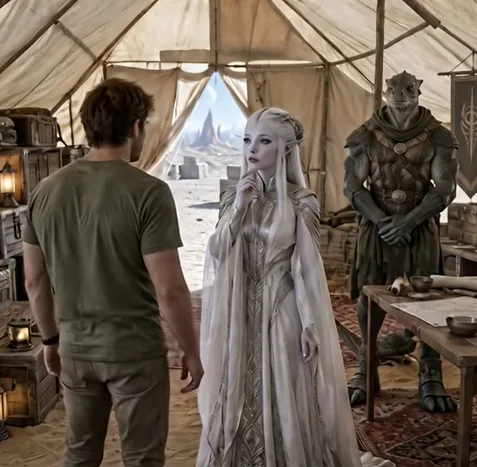
The canvas walls of the desert tent fluttered against the dry wind, trapping an absolute, suffocating silence inside
The word “chose” landed in his chest like a thrown knife, and for a long moment Kael Varrin did not trust himself to breathe.
He had walked into this camp of his own free will, or so he had believed for nine days of hard travel across the Sunless Dunes.
He had followed the rumor of a peace table, the whisper that an elven queen and the reptilian clans of the Sarrak had finally put down their spears.
Now the tent felt less like a negotiating chamber and more like the inside of a closed fist.
“Your Majesty,” Kael said carefully, drawing his hand back from the map and letting his fingers unclench one by one.
“I think I have misjudged the nature of this meeting.”
“You have misjudged a great many things, Kael of Harrowmere,” the queen said, and at last she turned from the horizon to face him.
Her eyes were the pale gray of winter dawn, and they held no cruelty, only a vast and ancient weariness that unsettled him far more than anger would have.
“But that is not a crime,” she added softly.
“It is only the beginning of a very long story.”
The reptilian guard shifted his weight, and the leather of his armor creaked in the stillness.
He was a tall, lean warrior with ash-green scales, a notched crest along his skull, and a faded blue sash tied around his left arm.
“Queen Ilvaren,” he rasped, “the boy is frightened, and frightened men make poor listeners.”
“I am not a boy,” Kael said, “and I am not frightened.”
“Your pulse is hammering in your throat like a trapped bird,” the guard replied without malice.
“I can see it from here, human, and there is no shame in it.”
Kael’s face flushed hot, and despite himself he almost smiled, because the creature had said it the way an old sergeant might say it to a recruit.
“What is your name?” he asked.
“Thessk,” said the guard.
“Captain of the Dune Wardens, sworn to the queen’s safety, and presently sworn to your safety as well.”
“My safety?” Kael repeated.
Queen Ilvaren lifted one slender hand, and Thessk fell silent at once, bowing his scaled head.
She glided to the table and laid her fingertips on the edge of the map, and the gold embroidery of her sleeve whispered across the parchment.
“Sit, Kael,” she said.
“There is tea, and bread, and a story that I would rather tell you across a table than across a blade.”
He hesitated, and then, because there was nothing else to do and because some stubborn instinct told him that she meant it, he lowered himself onto a cushioned stool.
Thessk poured the tea from a copper pot into three small clay cups, and the steam rose carrying the scent of dried orange peel and desert mint.
Kael took the cup in both hands, and its warmth soaked into his cold, dusty palms.
“You believe you were summoned here by a rumor,” the queen began.
“A rumor of peace between my people and the Sarrak, carried by a trader at the Harrowmere market.”
“Yes,” Kael said slowly.
“A man named Doru sold me the news along with a bag of figs.”
“Doru works for me,” Ilvaren said simply.
Kael set down his cup before he could spill it.
“I needed a human, one with no ties to any king or general, who would cross the dunes without an escort and arrive with nothing to hide,” she continued.
“Your reputation as a mapmaker is known even in the elven courts, Kael, and I have read your charts of the southern wastes with great admiration.”
“My charts?” he said, bewildered.
“They are the only accurate maps of the Sunless Dunes in existence,” said Thessk, with open respect.
“We have been using copies for three years, and they have saved the lives of many of my wardens.”
Kael stared at the two of them, and the fear in his chest began to loosen into something stranger and more fragile.
“Then why the secrecy?” he asked.
“Why bring me here as though I were being herded?”
The queen’s expression grew grave, and she looked toward the tent flap, where the wind pushed a thin ribbon of sand across the threshold.
“Because there are those in my own court who would prefer that this meeting never happen,” she said quietly.
“And there are those among your people, in the throne room at Harrowmere, who would profit from another century of war.”
“If they had known your purpose, you would never have reached the dunes.”
A chill crawled down Kael’s spine, and he remembered the two riders who had trailed him for the first three days of his journey, and how they had suddenly vanished near the salt flats.
“Those riders,” he said.
“They were yours.”
“They were Thessk’s,” said the queen.
“They guarded you from a distance, and they dealt with the men who followed you.”
“Dealt with,” Kael repeated faintly.
“Disarmed and sent home with a headache and a warning,” Thessk said, and his slit pupils narrowed in what Kael suddenly realized was amusement.
“We are not butchers, human, whatever your songs say.”
Kael let out a shaky laugh and rubbed his face with both hands.
“I think I would like to hear the whole story now,” he said.
“All of it, from the beginning.”
Ilvaren folded her pale hands in her lap, and for a moment the weariness in her face deepened until she looked like a statue of grief.
“Two hundred years ago,” she said, “the elves of the Silverwood and the Sarrak of the dunes were allies, bound by an oath that was older than any kingdom of men.”
“Then a plague swept the borderlands, and a human king named Aldric the Pale told his people that it had been spread by Sarrak sorcery.”
“It was a lie, but it was a useful one, because it gave him a reason to seize the river valleys and the trade routes.”
“The war that followed killed half a million souls,” Thessk added in a low voice, “and my grandfather’s grandfather was among them.”
“And my husband,” said the queen.
Kael looked up sharply.
“He was a general of the Silverwood, a gentle man who hated fighting,” she said, and her voice trembled, so faintly that only someone listening closely would have heard it.
“He fell at the Battle of Thornwash, a hundred and twelve years ago, and I have been trying to end this war ever since.”
A hundred and twelve years.
Kael realized, with a slow, dizzy shock, that the woman in front of him had been grieving for longer than his own kingdom had kept written records of his family.
“I am so sorry,” he said, and he meant it with his whole heart.
“I did not know.”
“You could not have,” she replied gently.
“No human remembers, and no human was ever taught the truth.”
She nodded to Thessk, and the captain reached into a leather satchel and drew out a bundle of brittle, yellowed pages bound in faded blue ribbon.
He laid it on the table beside the map, and the smell of old dust and ancient ink drifted up between them.
“These are the original letters of King Aldric,” Thessk said.
“They were found three months ago in a collapsed vault beneath the ruins of Thornwash, and they prove that the plague was a natural sickness, and that Aldric knew it.”
“He wrote to his own advisors that the blame would serve him better than the cure.”
Kael touched the topmost page with trembling fingers, and the fragile paper crackled under his skin.
The handwriting was cramped and elegant, and the words, when he read them, made his stomach turn.
It was all there, the cold calculation, the deliberate sacrifice of thousands, the shameless planning of a war that need never have been fought.
“Dear gods,” he whispered.
“My people have built monuments to this man.”
“I know,” said Ilvaren.
“There is one in the square at Harrowmere, a great white statue of Aldric with his hand raised in blessing.”
“I have seen it with my own eyes, in disguise, on a night when the market was empty.”
Kael could not speak, and he sat with the ancient letters beneath his hands while the wind sighed against the canvas.
“I need these letters to be seen by your people,” the queen said at last.
“Not by their king, who will burn them, and not by their generals, who will bury them, but by ordinary men and women, in the open, where the truth cannot be quietly smothered.”
“And I need someone to carry them, someone whom the people of Harrowmere already trust.”
“A mapmaker,” Kael said slowly.
“A man who has never lied about where the roads go,” said Thessk.
Kael looked from the captain to the queen, and he felt the weight of the request settle onto his shoulders like a heavy cloak.
“They may not believe me,” he said.
“They may call me a traitor, and they may hang me from the same market square where Aldric’s statue stands.”
“That is possible,” Ilvaren said, and she did not soften it with a lie.
“I will not pretend otherwise, and I will not command you, Kael, because a command would make me no better than Aldric.”
“You walked into this tent believing you had chosen to come,” she added, and a trace of sadness touched her lips.
“I am sorry that the choice was partly arranged, but I promise you that what you choose now is wholly your own.”
The tent was silent, and outside, far off across the dunes, a lone desert bird called three high notes into the evening.
Kael thought of his small, cluttered workshop above the cartographer’s guild, with its maps pinned to every wall and its inkpots crowded on the windowsill.
He thought of his younger sister Mirelle, who sold apples near the north gate and had once cried because a stray dog had been kicked by a soldier.
He thought of the war, which had never touched him personally but had hollowed out every family he knew, taking sons and brothers and fathers to the border and sending back only letters and folded flags.
“I will do it,” he said.
His voice came out low and a little rough, and he cleared his throat and said it again, steadily.
“I will carry the letters to Harrowmere.”
Thessk bowed his head, and the queen closed her eyes, and for one moment a single bright tear slid down her pale cheek and fell onto the table.
“Thank you,” she whispered.
“You cannot know how long I have waited to hear a human say those words.”
They spent that night in the tent, going over the plan by the light of a single lamp.
Thessk spread out Kael’s own map and traced the safest route home, a winding path through the northern oases that avoided the royal roads.
“My wardens will travel with you as far as the border,” he said.
“After that, you walk alone, because a Sarrak soldier in a human town would start a riot.”
“I understand,” said Kael.
“But I have one request.”
“Name it,” said the queen.
“I would like to bring someone with me, at least for the last stretch,” Kael said.
“My sister Mirelle sells apples at the north gate, and she is the most stubborn woman in Harrowmere, and I would trust her with my life.”
“Then she shall be told, in time,” Ilvaren said.
“But carefully, Kael, and not before you are home.”
Dawn arrived pale and golden over the dunes, and the three of them stood together at the mouth of the tent, watching the sun lift out of the sand like a coin rising from a dark purse.
Thessk tied a faded blue sash around Kael’s arm, the same color as the one on his own.
“A warden’s mark,” the captain said gruffly.
“It will not protect you from men, but it will remind you that you are not alone.”
Kael touched the soft cloth, and his eyes stung.
“Thank you, Captain,” he said.
“I did not expect to find a friend in the desert.”
“Neither did I,” said Thessk, and his scaled face split into something that was unmistakably a grin.
The queen stepped forward and laid one cool, slender hand against Kael’s cheek.
“Go safely, mapmaker,” she said.
“Draw us a road home.”
The journey north took twenty-two days.
Kael traveled by night and rested by day, wrapped in a gray cloak, with the leather satchel of ancient letters strapped tight against his chest.
Four Sarrak wardens walked with him through the oases, silent, watchful, and unfailingly kind, and by the third night he had learned all their names.
There was Dree, a young scout who sang under her breath in a soft, hissing language when she thought nobody was listening.
There was old Korvash, whose scales had faded to the color of river clay, and who taught Kael how to find water by watching the flight of sandgrouse at dusk.
There was Ssira, a quiet archer who carved tiny birds from scraps of driftwood and gave one to Kael on the last night without a word.
He kept it in his pocket, and every time he touched it, he remembered that the monsters of his childhood songs had hands that could whittle a wren.
At the border, among the stony hills where the dunes gave way to farmland, the wardens stopped and stood in a row on a rocky ridge.
“Here we leave you,” Dree said, and her yellow eyes were bright with something that looked very like tears.
“Walk well, Kael of Harrowmere.”
“Live well,” Kael answered, because it was the Sarrak farewell that Korvash had taught him, and the old warden’s scaled face crinkled with pleasure.
He walked the last miles alone, with the sun on his back and the satchel heavy against his heart.
Harrowmere appeared at dusk on the twenty-third day, a sprawl of red tile roofs and smoking chimneys beneath the gray shoulder of the northern hills.
He crossed the north gate with the crowd of returning farmers, and he heard a familiar, scolding voice calling out apple prices in the lamplit market.
“Fresh red apples, two coppers a pound, best in the city, don’t squeeze them unless you mean to buy them!”
Kael’s throat closed, and he walked up behind the stall and stood quietly until his sister turned and saw him.
Mirelle dropped the apple she was holding, and it rolled across the cobblestones and came to rest against his boot.
“Kael,” she said, and her face crumpled.
“You have been gone for two months, you idiot, I thought you were dead in a ditch.”
“I was in a ditch for a few nights,” he admitted, and she flung her arms around him so hard that the satchel dug painfully into his ribs.
“You smell like camel,” she sobbed into his coat.
“I walked beside one for a week,” he said, laughing, and he held her until her shoulders stopped shaking.
That night, in the cramped kitchen above her stall, with a pot of lentil soup bubbling on the stove, he told her everything.
She listened without interrupting, her hands wrapped around a chipped mug, her dark eyes growing wider and wider.
When he laid the ancient letters on the table, she touched the faded ribbon with the tip of one finger and was silent for a very long time.
“Aldric’s statue,” she said at last, “stands six steps from my stall.”
“I have swept the pigeon droppings off its feet every Sunday for nine years.”
“I know,” said Kael.
“I am sorry.”
“Do not be sorry,” Mirelle said, and her voice hardened with a fierce, shining resolve.
“Be useful, and tell me what you need.”
They spent a week preparing.
Mirelle gathered a handful of trusted friends, a schoolteacher, a retired captain with a wooden leg, a baker’s widow, and a printer named Oswin who owned a creaking press in a cellar near the river.
Kael copied the letters by hand, with his careful mapmaker’s script, and Oswin set them in type and printed three hundred sheets on cheap gray paper.
They worked by candlelight with the shutters drawn, and they spoke in whispers, and every night Kael half expected soldiers to kick down the door.
But the soldiers did not come, and on the eighth morning, as the sun rose gold over the red rooftops, the sheets were ready.
The city woke to find them everywhere, pinned to doors, tucked beneath bread loaves, slipped into the pockets of cloaks hanging in the taverns.
Mirelle stood beside the statue of Aldric in the market square at dawn, with a stack of the gray pages in her arms, and she began to read aloud.
“My loyal friends,” she read, her clear voice ringing across the cobbles, “the plague will serve us better than the cure.”
A baker paused with his tray of rolls.
A pair of washerwomen set down their baskets.
A shabby old man on a bench lifted his head and listened with his mouth slightly open.
She read the whole letter, word by word, and by the time she reached the end, a crowd had gathered, hundreds of them, standing in a hush of morning light.
“This is a forgery,” shouted a stout man in a velvet coat, pushing forward with his face red.
“These are Sarrak lies, meant to poison us against our own king!”
“Then look at the ink, sir,” said Kael, stepping up beside his sister with the original letters held high in his hands.
“These pages were found in a sealed vault beneath Thornwash, and the seal is the royal seal of Aldric the Pale.”
“Any scholar in this city can confirm it, and I invite every one of them to come and look.”
The crowd murmured, and the stout man blustered, and an old woman with a cane tottered forward and peered at the brittle paper.
“My grandmother lost three brothers at Thornwash,” she said in a cracked voice.
“She used to say that the plague began in the king’s own stables, long before any Sarrak crossed the river.”
“Everyone told her she was mad.”
“She was not mad,” said Kael gently.
“She was telling the truth, and nobody listened.”
The old woman’s eyes filled with tears, and she pressed her gnarled hand to her mouth.
A murmur rose and spread across the square like wind across a field, and then, slowly, a young man at the edge of the crowd climbed onto the base of the statue.
He was a soldier, still in his faded uniform, with a long scar across one cheek, and he stared at the white stone face of Aldric as though seeing it for the first time.
“My brother died at the border last winter,” he said, and his voice cracked.
“They told us it was for the kingdom, and I believed them.”
He pulled off his cap and threw it to the ground.
“I’m done believing them,” he said.
The crowd roared, a ragged, grieving, furious sound, and for a moment Kael feared it would become a mob.
But Mirelle lifted her hands, and the retired captain with the wooden leg planted his cane and shouted for order, and the schoolteacher stepped forward and called for calm.
“We will not burn anything,” the teacher said, in the clear voice of a woman accustomed to quieting a room.
“We will not hurt anyone, because that would make us no better than the man who started this.”
“We will take these letters to the high court, in open daylight, and we will demand the truth be read aloud.”
“And we will invite the Sarrak and the elves to come and hear it.”
The crowd quieted, and they began to nod, and a long, slow wave of agreement rolled through the square.
They marched to the high court that afternoon, thousands strong, carrying the gray pages above their heads like banners.
The young king, Edric, a thin, anxious man of twenty-six who had inherited the war from his father, met them on the steps of the great stone hall with a face the color of ash.
“I did not know,” he said, when the letters had been read aloud, and his voice shook.
“I swear to you, I did not know.”
“Then you have a choice, Your Majesty,” said Kael, bowing low.
“You can burn the truth, as your ancestors would have done, or you can stand before your people and set it right.”
Edric stared at the crowd, and at the soldier with the scarred cheek, and at the old woman with her cane, and something in his young, tired face gave way.
“Send word to the dunes,” he said hoarsely.
“Send word to the Silverwood.”
“Tell them that the King of Harrowmere requests a council of peace.”
The council convened on the first day of autumn, in a great white pavilion raised on the plain between the three realms.
Kael stood at the edge of the tent in his best coat, with a faded blue sash tied around his arm, and he watched the delegations arrive beneath a sky of clear gold.
The elves came first, in a shimmering procession of silver banners and white horses, with Queen Ilvaren riding at their head in a gown of pale, gleaming silk.
Behind them came the Sarrak, tall and proud and silent, with Captain Thessk at the front in polished leather, and Dree and Korvash and Ssira marching at his side.
Last came the humans, King Edric in a plain gray cloak, with a crowd of ordinary citizens walking behind him, farmers and merchants and soldiers and washerwomen, and at the very back, a girl with a basket of apples.
The three sovereigns faced one another across the long wooden table, and for a long moment nobody spoke.
Then Queen Ilvaren rose, and her pale eyes found Kael’s across the pavilion, and she smiled, a small, luminous, ancient smile that seemed to lift a hundred and twelve years of grief from her shoulders.
“Two hundred years ago,” she said, in her cool, ringing voice, “we shared an oath.”
“I would like to remember it together.”
King Edric stood, and Captain Thessk rose beside her, and the three of them laid their hands upon the map that Kael had drawn, spread out across the table with the roads and rivers of all three lands inked in his careful hand.
“We swear,” they said together, “to make this map a map of peace.”
A great shout went up from the crowd, and the elves wept, and the Sarrak hissed their ringing, joyful cry, and the humans threw their hats into the air.
Mirelle slipped her arm through Kael’s and leaned her head against his shoulder.
“Look at what you did,” she whispered.
“We did,” he said.
“All of us, together, every one.”
When the ceremony ended and the pavilion began to empty, Thessk found him by the tent flap and clasped his forearm in the warrior’s grip.
“You have a gift for crossing borders, mapmaker,” the captain said, grinning.
“What will you do now?”
Kael considered it, and he looked out across the green plain, where children of all three peoples were already chasing one another through the grass.
“I think,” he said slowly, “that I should like to draw the rest of the map.”
He spent the next ten years doing exactly that.
He traveled with Dree and Korvash through the red canyons of the Sarrak, and with the elven rangers through the silver forests of the Silverwood, and he charted every river and trail and mountain pass with patient, loving care.
The roads he drew became the roads that merchants and pilgrims and lovers walked, and the border posts he marked were replaced by marketplaces where three languages mingled in the air like music.
Mirelle opened an orchard on the shore of the river Aldwyn, and she sold her apples to elven traders and Sarrak healers alike, and she fell in love with a quiet elven botanist named Teliel, who laughed at her scolding and never once argued back.
The statue of Aldric the Pale was taken down in the square, and in its place the people raised a fountain, with a plain stone basin and a single bronze map set into the rim, so that every child who drank from it could trace the roads of the world beneath their fingertips.
Queen Ilvaren lived to see it, and on a bright morning in spring, she walked through the market of Harrowmere in a simple blue dress, with no crown and no guards, and stopped before the fountain.
Kael, grayer now at the temples, stood beside her with a roll of parchment under his arm.
“I have finished it,” he said.
“The last map, the one that joins all three kingdoms.”
He unrolled it on the stone rim, and the queen looked down at the delicate tracery of roads and rivers and the tiny golden stars he had inked at every place where the three peoples now met.
Her eyes filled, and her lips trembled, and she laid her hand gently over his.
“You have drawn us a road home,” she said.
“I told you once that I could not command you, Kael, and I have never stopped being grateful that you chose.”
“I did not choose alone,” he said, smiling.
“I had a queen who wept at the right moment, a captain who tied a sash around my arm, and a sister who read a stranger’s letter to a hundred strangers in the square.”
“The best choices are never made alone,” said Ilvaren.
Beside the fountain, Thessk had arrived, stooped a little now with age, his ash-green scales dulled to the color of old pewter, but his crest still held high.
Dree and Korvash and Ssira stood behind him, and Mirelle came hurrying across the market with a basket of apples on her hip and Teliel following with a bundle of herbs.
They gathered in a loose circle around the fountain, elf and Sarrak and human, with the spring sun pouring gold over the stones.
A child ran past, laughing, a small girl with pointed ears and a human boy chasing her with a kite shaped like a dragon.
They tumbled into the fountain’s spray, shrieking with delight, and the whole market laughed with them.
Kael felt a small, familiar weight in his pocket, and he drew out the little driftwood wren that Ssira had carved so many years ago.
He set it on the rim of the fountain, beside the bronze map, and the archer smiled her quiet smile.
“The desert tent seems very far away,” he said softly.
“Not so far,” Thessk replied, with a twitch of his tail.
“I still remember how you looked, human, standing with your fist clenched over the table and your heart beating like a trapped bird.”
“And I remember what you said about me,” Kael said.
“Let him keep thinking it.”
The old captain laughed, a rich, rasping sound that rolled across the square.
“I was wrong,” he said.
“You chose, mapmaker, and you chose well.”
The sun climbed higher, and the fountain sang, and the roads of three kingdoms stretched out from that one bright square like the spokes of a great and golden wheel.
Kael lifted his face to the warmth, and he closed his eyes, and for the first time in his life he felt the whole wide world lying open and welcoming before him.
The wars were over, the maps were drawn, and the long, patient road of peace had only just begun.
And as the laughter of children rose into the spring air, he smiled, and he whispered the words that every traveler dreams of saying at last.
“We’re home.”