The biker sudden tears upon seeing my photo didn’t make sense until he whispered that my grandfather’s grave was actually empty
The locket felt impossibly heavy in my small hand, and the photograph inside seemed to breathe in the flashing red and blue light.
It was my face, and yet it was not, because the girl in the picture wore her dark hair pinned back with a ribbon and her eyes were wide and frightened, as though the camera had caught her just before she was taken somewhere she did not want to go.
“My mother died when I was a baby,” I whispered.
“Uncle Arthur said she was sick, and that she went to sleep and never woke up.”
“Arthur says a lot of things,” Jack said gently, and he did not let go of my hand.
“But your mother woke up every morning for nine more years, Chloe, in a place with locked doors and barred windows, and she never stopped asking for you.”
The word nine fell into me like a stone into a well, and I listened for the splash and heard only a long, hollow echo.
Behind us, the federal agents were loading Arthur into the back of a black cruiser while he screamed that he would sue every one of them.
A tall woman in a navy windbreaker detached herself from the group and walked toward us across the shimmering gravel, with a badge on her belt and a manila folder pressed against her chest.
She had short gray hair and tired, kind eyes, and she crouched down in front of me so that we were level, the way grown-ups only do when they mean what they say.
“Chloe, my name is Special Agent Nora Delgado,” she said softly.
“I have been looking for you for a very long time, and I am so glad that you are safe.”
“Are you going to take me away?” I asked, and my lip began to quiver again.
“No, sweetheart,” she said.
“I am going to take you to someone who has been waiting for you, and Jack will come with us the whole way, if you want him to.”
I looked up at the big biker with the silver beard and the wet blue eyes, and I tightened my fingers around his thumb.
“I want him to,” I said.
Jack let out a breath that shook his whole chest, and he pressed the back of his wrist to his mouth.
“Then I’m not going anywhere, little one,” he said.
Agent Delgado stood and spoke quietly into her radio, and one of the cruisers pulled around to the front of the lemonade stand and opened its rear door.
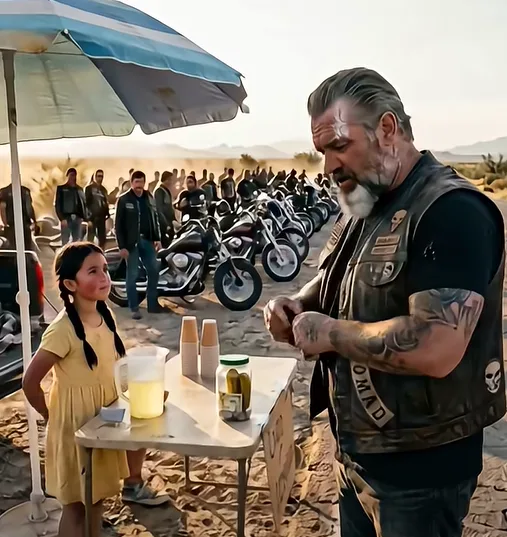
I hesitated, and I looked back at my wobbly card table, at the plastic pitcher and the stack of paper cups and the hand-painted sign that said Lemonade 25¢.
“My quarter,” I said.
“I never got to keep it.”
Jack’s face crumpled, and he laughed and sobbed at the same time, and he scooped the hundred-dollar bill off the table and folded it into my palm.
“You keep that too,” he said.
“Every cent, Chloe, and you buy whatever you want with it, and I will never ask where it went.”
I tucked the bill into the pocket of my sundress beside the locket, and I let him lift me into the back seat of the cruiser as though I weighed nothing at all.
The ride lasted an hour, across the flat gold desert and up into a range of low red hills, with the dozen bikers rumbling behind us in a long, slow, protective line.
Jack sat beside me, and I watched his huge scarred hand resting on the seat between us, and after a while I put my own small hand on top of it.
“Jack,” I said, “how did you know my daddy?”
He was quiet for a long moment, and when he spoke his voice was low and rough.
“Your daddy was my best friend,” he said.
“His name was Daniel Whitaker, and he was the funniest, kindest, most stubborn man I ever met, and he rode a blue Indian motorcycle that he named Beatrice.”
“Beatrice,” I repeated, and I giggled in spite of everything.
“He said she was the only woman who never argued with him,” said Jack, and his eyes shone.
“We grew up together in a little town called Dry Creek, and we swore that we would ride Route 66 from one end to the other the summer we turned thirty.”
“He never made it,” I said quietly.
“The crash,” said Jack.
“Everyone told you it was an accident, a truck on a wet road, and I believed it too for a long time.”
“But it was not,” Agent Delgado said from the front seat, and she turned halfway around.
“Chloe, your father found something, and it is the reason your family was torn apart.”
She opened the manila folder on her lap, and she did not hand it to me, because I was only ten, but she held it so that I could see the first page.
It was a photograph of a long yellow ranch house with a red barn, and a wide white gate with the words Whitaker Springs arched above it in iron letters.
“That is your family’s ranch,” she said.
“Your grandfather, Elias Whitaker, built it with his own hands, and it sits on the best natural spring in three counties.”
“A company called Harlan Water wanted that spring, and your uncle Arthur wanted the money that the company was willing to pay.”
“But the ranch was left to your father, not Arthur, and your father refused to sell.”
My stomach turned cold, and I stared at the picture of the house where I had grown up, with its sagging porch and its fig tree and the window where I always watched for the mail truck.
“Arthur killed my daddy,” I said.
“Arthur arranged for your father’s brakes to fail,” said Agent Delgado, very gently.
“We have a mechanic who has finally agreed to testify, and we have a bank record that shows a payment two days before the crash.”
Tears slid down my cheeks, and Jack put his arm around my shoulders and pulled me against his vest, which smelled of leather and sun and engine oil.
“And Grandpa?” I asked, into the leather.
“Where is he?”
“Alive,” said Jack, and the word broke open in his throat.
“He is alive, Chloe, and he has spent ten years in a care home two states away, under a false name, because Arthur told the doctors that he had gone senile and signed him away.”
I lifted my head so fast that I bumped Jack’s chin.
“Alive?” I said.
“But the funeral, and the headstone, and the money I was saving.”
“Arthur needed a grave to show the world,” said Delgado.
“A headstone with no body beneath it, and a story about a heart attack, so that nobody would ever ask where the old man had gone.”
“I have been saving for his headstone for two years,” I whispered.
“I sold lemonade every summer, and I did chores for Mrs. Pruitt next door, and I counted the dollars every night.”
“I know, baby,” said Jack, and his face was wet.
“That is why I cried when I saw you, because you were trying to buy a gravestone for a man who was sitting in a rocking chair, asking every nurse whether his granddaughter had come.”
The cruiser rolled to a stop in front of a low white building with green shutters and a wide, shady porch, and a sign out front read Willow Rest Care Home.
Rows of rose bushes lined the walk, heavy with late blooms, and a wind chime tinkled somewhere near the door.
My legs would not move, and I sat in the seat with my heart pounding so loudly that I thought the whole car must hear it.
“I’m scared,” I said.
“I know,” said Jack.
“So am I.”
He opened the door and stepped out, and he held out his hand, and after a long moment I took it.
We walked up the path together, with the bikers standing in a respectful line along the fence and the agents hanging back by the cars.
The front door opened before we reached it, and a plump nurse in lavender scrubs stood there with her hand over her mouth and tears running down her cheeks.
“Are you Chloe?” she whispered.
“Yes, ma’am,” I said.
“Oh, thank God,” she said, and she stepped aside.
“He has been waiting on that porch every afternoon for ten years.”
She led us through a bright hallway that smelled of lemon polish, and out through a screen door onto a back veranda overlooking a green lawn and a row of tall cottonwoods.
At the far end, in a wooden rocking chair with a plaid blanket over his knees, sat an old man with white hair and a white mustache and thin, spotted hands folded in his lap.
He was staring out at the trees, and he did not turn around.
“Mr. Elias,” said the nurse softly, “you have a visitor.”
“I do not have visitors,” said the old man in a dry, faraway voice.
“Everyone I loved has gone.”
“Grandpa,” I said.
His hands stopped moving.
For a long, terrible moment he did not turn his head, and I thought that he had not heard me, or that he did not know the word.
Then he rose, slowly, with a hand on the arm of the chair, and he turned around.
His eyes were the same warm brown as my father’s, behind thick glasses, and they traveled over my face and the yellow sundress and the locket in my hand, and they filled.
“Chloe Rose,” he said.
“My little Chloe Rose.”
I let go of Jack and ran, across the boards of the veranda with my sandals slapping, and I threw myself against him so hard that he staggered.
His arms closed around me, thin and trembling and stronger than I expected, and I buried my face in his cardigan, which smelled of peppermint and soap.
“I looked for you,” he said, over and over, with his lips against my hair.
“I wrote letters, and nobody mailed them, and I told them I had a granddaughter, and they said it was the confusion.”
“I never forgot you, not for one day, not for one hour.”
“I know, Grandpa,” I sobbed.
“I know, I know, I know.”
He rocked me from side to side the way he had when I was four years old and afraid of thunder, and over the top of my head I saw Jack standing at the edge of the veranda with his hat crushed in both hands and his shoulders shaking.
“Jackson Reed,” Grandpa said, looking up, and his voice trembled with amazement.
“Is that you, boy?”
“Yes, sir,” Jack said hoarsely.
“It’s me.”
“You got old,” said Grandpa.
“You got older,” said Jack, and the two of them started laughing, helpless, tearful laughter, and the old man held out one arm, and Jack crossed the boards in three strides and fell to his knees beside the rocking chair.
They held each other with me caught between them, a tiny girl and an ancient man and a giant in a leather vest, and the cottonwoods whispered in the wind.
That evening the nurses brought a tray of sandwiches and sweet tea out to the veranda, and the bikers filed in, a dozen big, shy, rumpled people who did not know what to do with their hands.
They sat on the steps and the railings and the grass, and Grandpa told them stories about my father as a boy, how he had once tried to ride a calf, and how he had named every chicken on the ranch after a movie star.
“He called one of them Humphrey Bogart,” Grandpa said, wheezing with laughter.
“And Humphrey chased the mailman for five years.”
I sat on a cushion at his feet with my head against his knee, and every so often he reached down and stroked my hair as though to make sure that I was still there.
When the stars came out, Agent Delgado sat beside me on the top step and spoke in a low voice, so that only I could hear.
“Chloe,” she said, “there is one more thing, and you can hear it tomorrow if you want.”
“Is it about my mother?” I asked.
She nodded, and her eyes were gentle.
“I want to hear it now,” I said.
“I think I have waited long enough.”
She drew a breath and opened the manila folder again, and this time she took out a single sheet of paper and a small, creased photograph.
“Your mother’s name is Lena Whitaker,” she said.
“She was twenty-six when Arthur had her committed to the Harlan State Asylum, claiming that she was unstable and dangerous, and that she would harm you.”
“He forged the signatures of two doctors, and the real reason was that she had found a copy of your father’s will and tried to take it to a lawyer.”
“I have been told that she is dead,” I said.
“You were told that by a man who lied about everything else,” said Delgado.
“Chloe, she is not dead.”
The world went very still, and the wind chimes stopped, and I could not hear the crickets or the voices of the bikers or my own breath.
“She is alive,” said Delgado, “and she has been living in a long-term ward at the state hospital for nine years, and there is a transport van on its way here as we speak.”
“I was going to wait until morning,” she added, with a rueful smile.
“But I do not think any of us can wait.”
I did not remember standing up, but I was on my feet, and Jack was beside me, and Grandpa was reaching for my hand from his chair.
Headlights swept across the gravel drive, and a white van with a red cross on the door rolled slowly up to the veranda steps and stopped.
The side door slid open, and a nurse in a blue uniform stepped out first and turned to offer her arm.
A woman climbed carefully down onto the gravel, thin and pale, with long brown hair going gray at the temples and a plain cotton dress that hung loosely from her shoulders.
She stood in the glow of the porch light with her hands pressed against her stomach and her eyes lowered, like someone who had learned not to expect anything good.
Then she lifted her head, and I saw my own face, older and tired and unbelievably gentle, looking back at me.
“Mama,” I said.
It was a word I had never used, and it came out of my mouth like a bird that had been shut inside me for ten years.
Her lips parted, and her hand flew up to her throat, and she took one step, and another, and then she was running, her bare feet slapping the gravel, and I was running too.
We collided at the bottom of the steps, and she dropped to her knees and wrapped her arms around me with a strength that lifted me off the ground.
“Chloe,” she sobbed.
“My baby, my little girl, my Chloe Rose.”
She kissed my hair and my forehead and my wet cheeks, and she held my face between her hands and stared at me as though memorizing every freckle.
“You are so big,” she said.
“You were a baby, and now you are so big, and I missed it, I missed all of it.”
“You are here now,” I said, and I was crying so hard that the words came out in pieces.
“You are here now, Mama, and I am never going to let go.”
She laughed, a thin, cracked, beautiful sound, and she pulled me tighter, and the porch light buzzed above us while moths circled in the gold.
Behind us, Grandpa had risen from his chair with Jack’s help, and he stood at the top of the steps with his hand over his heart.
“Lena,” he said, in a voice that shook.
“My daughter.”
Her head turned, and she looked up at him, and her face crumpled completely.
“Papa,” she whispered.
“I thought you were dead.”
“I thought you were too,” he said, and he came down the steps one slow stair at a time, and she rose, still holding me, and the three of us stood in a knot at the bottom while the wind sighed through the cottonwoods.
Nobody spoke for a very long time, and nobody needed to.
The bikers had gotten to their feet along the veranda, and I saw rough men and women wiping their eyes on their sleeves, and Agent Delgado was smiling with tears streaming down her cheeks.
Jack stood a little apart with the silver locket in his hand, and Mama noticed him and went very still.
“Jackson,” she said.
“Hello, Lena,” he said, and his voice cracked.
“I kept it safe.”
He held out the locket, and she took it with trembling fingers and opened it, and she looked at the tiny photograph of herself at twenty-six and then at me.
“Daniel gave me this on the day I told him that I was expecting you,” she said softly.
“He said that I should carry it so that you would always know what your mother looked like when she was happy.”
“I was not happy in that picture,” I said, looking at it again.
“You were afraid.”
“That was the day Arthur threatened me,” Mama said.
“Your father took the photograph to remind me that I was braver than I felt.”
She closed the locket, and she pressed it into my palm and folded my fingers over it.
“Now it is yours,” she said.
“And you can carry the whole story.”
The trial of Arthur Whitaker took place in the autumn, in the same county courthouse where my father’s funeral had once been announced in a small black-bordered notice.
I sat in the front row in a blue dress that Mama had sewn for me, with Grandpa’s hand in my left and Jack’s in my right, and my feet did not quite reach the floor.
Arthur sat at the defense table in an expensive gray suit, and he looked smaller than I remembered, and every few minutes he glanced at the door as though hoping someone would come and rescue him.
The prosecutor, a sharp, silver-haired man named Mr. Okonkwo, laid out the case slowly and carefully, with a mechanic and a bank clerk and a retired doctor who had finally found the courage to admit that he had signed the commitment papers without ever examining my mother.
Then he called Mama to the stand.
She walked up with her shoulders straight and her chin high, and she swore the oath in a clear voice that I had learned to love, and she told the jury what it had been like to wake up every morning for nine years behind a locked door.
She did not cry, and she did not raise her voice, and the whole courtroom listened as though she were reading a prayer.
When she finished, the judge, a stern old woman with spectacles, was dabbing at her eyes with a tissue, and several people in the gallery were openly weeping.
Arthur’s lawyer rose to cross-examine her, and he opened his mouth and then closed it again, and finally he said, “No questions, Your Honor.”
The jury was out for two hours.
When they returned, the foreman, a young man in a corduroy jacket, read the verdicts without looking up from the paper.
“On the charge of murder in the first degree, guilty.”
“On the charge of fraud and forgery, guilty.”
“On the charge of unlawful imprisonment, guilty.”
Arthur slumped in his chair, and for the first time I saw something real in his face, not hatred or anger, only a gray, hollow fear.
The judge sentenced him to life in prison, and when the bailiffs led him past our row, he stopped and looked down at me.
“Chloe,” he said, and his voice was a rasp.
I looked back at him and held my mother’s hand, and I felt no anger at all, only a calm, clear sadness, like the sky after a storm.
“I hope you find a way to be sorry,” I said.
He opened his mouth, and nothing came out, and the bailiff tugged his elbow, and he was gone.
Outside on the courthouse steps, the autumn wind was sweet and cool, and the leaves of the maple trees drifted down like handfuls of gold coins.
A hundred people had gathered, neighbors and ranchers and old friends of my father’s, and when we came out, they began to applaud.
An elderly woman pressed a jar of peach preserves into my hands, and a boy my own age shyly offered me a handful of marbles, and a big, bearded rancher took off his hat and told Grandpa that he was sorry for every one of the ten years.
“Thank you,” Grandpa said, with tears running down his face.
“Thank you all for coming.”
We went home that afternoon, the whole family together in the back of Jack’s big truck, with a dozen motorcycles rumbling behind us like a parade.
The gate at Whitaker Springs stood open, and the iron letters curved above us in the sunlight, and the long yellow house waited at the end of the drive with its windows shining.
Someone, I never found out who, had hung a banner across the porch that said Welcome Home in clumsy purple paint.
Mama stopped in the doorway with her hand on the frame, and she stood there a long time, breathing in the smell of old wood and woodsmoke.
“It is exactly the same,” she said.
“It is exactly the same, and it feels like a dream.”
“It is not a dream, Mama,” I said, and I took her hand.
“I promise.”
We moved through the rooms together, touching the walls and the old piano and the kitchen table where my father had once carved his initials, and in every corner I felt the ghost of a happy family that had been waiting to be called back.
In the kitchen window, the fig tree stood heavy with fruit, and Mama plucked one and split it in half and handed me the sweet pink center.
“Your father planted that the day we were married,” she said.
“He said that it would outlive us all.”
“It did,” I said.
“It is still here.”
“So are we,” she said, and she smiled, and it was the most beautiful thing I had ever seen.
The winter that followed was quiet and gentle, with a fire in the stone hearth every evening and the smell of cinnamon rolls drifting through the rooms.
Mama had to learn how to live again, slowly, and there were mornings when she woke in a panic and could not remember where she was.
On those mornings, I climbed into bed beside her and held her hand and said, “You are home, Mama, you are home, you are home,” until her breathing eased and she smiled.
Grandpa took to sitting on the porch in the sunshine with a cup of hot cocoa and a pile of old photographs, telling anyone who walked by about my father and the chicken named Humphrey.
Jack moved into the old foreman’s cottage at the edge of the property, and the bikers came on weekends and helped to repair the barn and the fence and the windmill, with the dogged, cheerful clumsiness of men who had never held a hammer for a good reason before.
One snowy afternoon in December, I found Jack in the barn, sitting on an upturned bucket with a small wooden box in his lap.
“What is that?” I asked.
He looked up, and his eyes were red, and he gave me a sheepish smile.
“I have been meaning to give you this,” he said.
“I did not know how.”
He handed me the box, and I opened the lid, and inside lay a small, battered tin sign, hand-painted in faded blue letters.
Beatrice, it read.
“It was your father’s,” said Jack.
“He had it bolted to the front fender of his motorcycle, and I took it off the day he died, and I have kept it for ten years.”
“I thought that you should have it.”
I ran my fingers over the dented metal, and my throat tightened.
“Where is Beatrice?” I asked.
“In the shed behind the cottage,” said Jack, and he laughed, rough and wet.
“I rebuilt her, bolt by bolt, with parts from three different junkyards, and she runs like a dream.”
“I was waiting for the day you were old enough to ride behind me,” he added.
“That day might be a while yet.”
“How long?” I said.
“Oh, about six years,” he said.
“But I can wait.”
I flung my arms around his neck, and he held me, and the snow fell silently outside the barn door in great white flakes.
“Jack,” I said into his collar.
“Yes, little one?”
“I am glad it was a quarter,” I said.
“If you had walked past my stand, I would never have found you.”
“No,” he said, and his voice thickened.
“But I think I would have found you anyway, Chloe Rose, because I would never have stopped looking.”
When spring came, the fields turned emerald, and wildflowers burst along the creek bank in yellow and violet waves.
Mama planted a garden behind the house, rows of beans and squash and sunflowers taller than I was, and she hummed as she worked, a low, wandering tune I had never heard.
“What is that song?” I asked her one afternoon.
“A lullaby,” she said, and she smiled with her eyes closed.
“I sang it to you every night for the first four months of your life, and I sang it to the walls of that hospital every night for nine years, hoping that somehow you could hear.”
“I heard it,” I said.
“In my dreams, I always heard a woman singing.”
She stopped and stared at me, and tears welled in her eyes, and then she began to sing it again, softly, and I leaned my head against her shoulder and listened.
That summer, on a hot, bright Saturday in June, I set up a new lemonade stand at the end of the long gravel drive.
It was a proper stand, with a striped awning and a carved wooden counter that Jack and the bikers had built, and a hand-painted sign that Grandpa had lettered himself in shaky, careful strokes.
Lemonade, it read.
A Quarter, Or Whatever You Can Spare.
Proceeds to the Dry Creek Children’s Fund.
We had started the fund in the spring, with Jack’s hundred-dollar bill as the first donation, to help kids who had lost their families to lies and legal trouble.
By midsummer it had grown to eleven thousand dollars, and a lawyer in town had volunteered to help us find the children who needed it most.
I stood behind the counter in my yellow sundress, the same one, a little too short now, and I poured lemonade into paper cups for a line of customers that stretched all the way to the road.
Bikers, ranchers, schoolteachers, and families from three counties waited patiently in the sun, and when they reached the front, most of them paid far more than a quarter.
Near the end of the afternoon, a battered old pickup rolled to a stop at the edge of the drive, and a thin, nervous boy of about eleven climbed out of the cab.
He wore a faded T-shirt and no shoes, and he clutched a single crumpled dollar bill in his fist as though it were a treasure.
“Is it true that you help kids?” he whispered, when he reached the front of the line.
I came around the counter and knelt so that we were eye to eye, the way Agent Delgado had once done for me.
“It is true,” I said.
“What is your name?”
“Tobias,” he said.
“My dad died, and my uncle says that the farm is his now, and I do not have anywhere to go.”
My heart turned over, and I took his hand.
“Tobias,” I said, “you have somewhere to go right now.”
I looked up and saw Mama standing on the porch with her hand shading her eyes, and Grandpa in his rocking chair, and Jack leaning against the fence with a grin spreading across his weathered face.
“Come and have some lemonade,” I said, “and then we will figure it out together.”
He drank two cups, and he ate three sandwiches, and when the sun began to sink behind the cottonwoods, he fell asleep on the porch swing with his head on Mama’s lap, and she stroked his hair and hummed the old lullaby.
Jack sat down beside me on the steps, and we watched the sky turn orange and rose and deep violet.
“You did that,” he said quietly.
“You saw him, and you stopped, and you listened.”
“You taught me,” I said.
“You stopped for a girl with a quarter.”
He put his arm around my shoulders, and I leaned into his side, and the warm wind carried the scent of fig leaves and sunflowers and the faint sweetness of lemons.
Across the yard, the iron gate stood open beneath the arch of Whitaker Springs, and beyond it the long road to Route 66 shimmered in the last of the light, empty and golden and endless.
I thought of the girl behind the wobbly card table, clutching her quarter, sure that the world had forgotten her.
I wished that I could whisper to her across the years that the road was long, and the sun was hot, and the way was lonely, but that someone was coming, a big, scary, wonderful someone with a silver beard and a heart like a open door.
“We are home,” I said softly.
“We are,” said Jack, and he kissed the top of my head.
On the porch, Mama’s lullaby drifted out over the darkening fields, and Grandpa began to hum along, off-key, and from somewhere inside the house came the clatter of a dinner being laid on the table.
The first stars blinked awake above the cottonwoods, small and bright and certain, and the whole world seemed to exhale.
I closed my eyes and let the music wash over me, and for the first time in my life I knew without a doubt that every road I had ever feared had been leading me here.
Home, at last, in the warm gold dusk, with my family all around me, and the light left burning in every window.