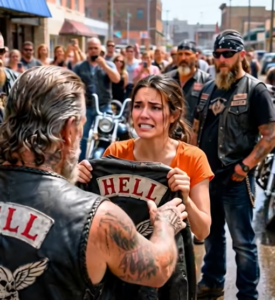
The afternoon sun beat down mercilessly on the dusty pavement, reflecting off the rows of gleaming chrome motorcycles parked along the curb
The brass key was warm from the old man’s pocket, and it lay in my palm like a small piece of sun.
“Say that again,” I whispered.
“He’s alive, kid.” The grizzled biker’s voice was a rusty gate, low and careful. “Has been the whole time. Your daddy made me swear on my own mother’s grave not to tell a soul until Ghost was in cuffs.”
The street seemed to tilt. Behind us, agents were folding Ghost into the back of an SUV while he screamed that it was all lies, and the crowd’s phones were still raised, a hundred little glass eyes catching everything.
My name is Wren Hayes, I am twenty-one years old, and I had spent three years believing my father was either a thief or a corpse.
“Who are you?” I asked.
“Amos Tully. Folks call me Pops.” He took off his helmet, and underneath was a lined, kind, sunburned face and a tuft of white hair. “I rode with Tom for thirty years. I was the one who found out what Ghost was doing, and I was the one too scared to say it out loud.”
“You knew.”
“I suspected. Then I knew. Then I did nothing for a while, and I’ll carry that.” His jaw trembled. “But the night Ghost took your father to the Calloway mine, I followed them. After Ghost’s men left, I went down the shaft with a rope and a lantern.”
“He was alive?”
“Barely. Broken leg, cracked ribs, hypothermic. I carried him out on my back.” Pops wiped his eyes with a gloved knuckle. “He made me hide him. He said if Ghost knew, he’d come for you and your mama.”
I put my hand over my mouth.
Mama had died believing it. She had died with her hand in mine, whispering his name, and he had been alive eleven miles away.
“Why didn’t he come?” My voice broke. “Why didn’t he come to her funeral?”
“He did,” Pops said gently. “He stood at the back in a gray cap, behind the cottonwoods. I held him up. He wept so hard he nearly pulled me over.”
A sob tore out of me, and I pressed my forehead against the old man’s vest, and he held me clumsily, patting my back with a hand like a baseball mitt.
“Take me to him,” I said.
“That’s what the key is for.”
A woman in a navy windbreaker came toward us across the pavement, tall, gray-braided, with a badge clipped to her belt and tired, gentle eyes.
“Ms. Hayes,” she said. “Special Agent Naomi Brandt. I’m the one who’s been reading your anonymous tips for a month.”
“The ledger tips.”
“The ones that turned out to be exactly right.” She smiled faintly. “I’d like to drive you and Mr. Tully myself. Ghost’s people have friends, and I’d rather you not ride alone.”
“The ledger,” I said. “It isn’t in the toolbox. I lied.”
“I know. I figured it out about four minutes before you did.” She nodded at the jacket in my arms. “May I?”
I handed it over, confused.
She turned the leather collar inside out and ran her thumbnail along a seam, and a thin flat square of plastic slid out into her palm.
“Micro-SD card,” she said. “Sewn into the lining. Your father is a very careful man.”
I stared. I had worn that jacket to bed for three years.
We drove out of town at four in the afternoon, into the badlands, along a road so rutted that the SUV groaned over every rock. The land rolled away on both sides in gold and rust, with mesas standing like ships in the haze.
Pops sat beside me in the back seat, quiet, turning his helmet in his hands.
“Tell me about him,” I said. “The three years. Where has he been?”
“A line shack up in the Ridgeback country. Eighty miles from anywhere.” Pops almost smiled. “He grew a garden. Beans, mostly. He talks to the goats.”
“Goats?”
“Four of them. Names every one after a woman he’s loved. There’s a Wren.”
I laughed, and it came out wet, and I pressed my knuckles to my lips.
“He wrote you a hundred letters,” Pops said. “Never sent a one. They’re in a coffee can.”
Agent Brandt cleared her throat gently from the front seat.
“There’s something you should know, Ms. Hayes. Your father hasn’t just been hiding. For two years he’s been feeding the Bureau everything. Pops carried the notes down the mountain. Every payoff, every false invoice, every dead drop. He built this case from a line shack.”
“He did.”
“With a pencil and a very bad knee.”
A watery smile spread across my face.
“That sounds like him,” I said.
The shack stood at the end of a long dirt track, a sagging little cabin with a tin roof and a green door, backed by a crooked garden and a fence strung with tin cans. Smoke rose from the chimney. A pair of goats stood on the porch roof, chewing, regarding us with total indifference.
I stood at the gate, with the brass key in my fist, and could not make my legs move.
“Go on,” Pops said softly.
“What if he doesn’t know me?”
“Kid, he’s got your school picture nailed above the stove.”
I walked up the path.
The door opened before I reached it.
A man stood there, thinner than I remembered, with gray in his beard and a deep scar through his left eyebrow, leaning on a cane whittled from a tree branch. He wore a patched flannel shirt and wool socks, and his eyes, those warm brown eyes, were wide and wet and unbelieving.
“Wren,” my father said.
The word came out of him like something breaking.
“Hi, Dad,” I said.
I do not remember crossing the porch. I remember the smell of woodsmoke and coffee and goat, and the rough flannel against my face, and his arms closing around me, shaking and strong, and the sound of a man weeping like a child.
“My girl,” he kept saying. “My brave, brave girl.”
“You were dead.”
“I know.”
“Mama died.”
“I know, baby. I know. I’d have given anything.” His voice cracked wide open. “I stood in the trees. I couldn’t even go to her.”
“Pops told me.”
“I wanted to run out. I wanted to so badly that I bit through my cheek.”
“I’m angry,” I said into his chest.
“You should be.”
“I’m so angry.”
“Be as angry as you like.”
“And I missed you so much I couldn’t breathe.”
“Me too,” my father whispered. “Me too, Wren. Me too.”
We stood in the doorway until our legs gave out, and then we sat down together on the porch step, and a goat wandered over and began to eat the hem of my jacket.
That’s Wren, I thought wildly. That’s the goat named Wren.
I laughed until I cried, and my father laughed with me, and for a long while neither of us could speak.
The trial began in October and lasted three months.
Ghost, whose real name was Dale Voss, sat at the defense table in a county-issue suit with five lawyers fanned around him, and for the first two weeks he wore a sneer. Then the card from my father’s jacket was played on the courtroom screen, and the ledger scrolled across it, page after page after page. Names. Dates. Payments to a sheriff, two county commissioners, a judge. Every dollar Ghost had stolen from the brotherhood and every man he had paid to look away.
His sneer curdled.
My father testified for five days.
He walked to the stand on his cane, in a borrowed suit that hung loose on him, and took the oath in a voice that carried to the back of the room. He described the night at the Calloway mine, the ride in the truck bed, the cold, the dark, the fall. He described it plainly, without anger, like a man reading a weather report.
When the defense lawyer asked why he had waited three years to come forward, he looked straight at the jury.
“Because every day I stayed hidden, my daughter stayed alive,” he said. “I’d have waited thirty.”
The room was so silent I could hear the radiator tick.
“And now?”
“Now she’s grown,” my father said, and his eyes found me in the front row. “And she came and found me anyway.”
I put my face in my hands.
The jury deliberated for three days.
Guilty. Every count.
Ghost, Dale Voss, was sentenced to life without parole, and his lieutenants to thirty and forty years, and the sheriff who had swept my mother’s grief under a rug resigned in disgrace before the verdict. The judge, a stern woman with silver spectacles, spoke for a long time about trust and badges and the cost of silence.
When it was over, my father stood slowly, on his cane, and turned to face the gallery.
The back rows were filled with bikers.
Two hundred of them, gray-bearded and tough-faced, in clean leather vests, who had come from three states to sit in a courtroom and be counted. They rose together, silently, and took off their caps and helmets and held them against their hearts.
My father’s mouth trembled.
“Brothers,” he said, and could not say more.
Pops stepped forward from the front row, wiping his eyes with his sleeve.
“Tom Hayes,” he said, in a voice like gravel. “The club’s been without a president for three years. We held a vote last night. It was unanimous.”
“Pops, no.”
“Two hundred to nothing.”
“I’m not a leader. I’m a mechanic with a bad knee.”
“That’s the best kind,” said Pops.
The room broke into laughter and cheering, and my father covered his face with both hands, and I threw my arms around his neck in front of the whole courthouse.
He refused, of course.
He accepted something smaller. A seat at the table, he said, and a say in the charter, and a promise from every man that the club would never again be anything but honest.
We rewrote it that winter, in the old clubhouse, around a scarred oak table with two hundred voices arguing at once and a pot of coffee that never ran dry. The first line, drafted by my father in pencil on a yellow legal pad, said simply: We look after each other.
The second line, written in my handwriting, said: And anyone who needs it.
We opened the doors every Saturday after that.
Nobody had to join. They only had to come in. A widow with a broken furnace, a teenager with a bad car, a trucker stranded in a snowstorm, an old man who just wanted company. The bikers fixed, hauled, fed, and listened, and the front porch filled with people the way a pond fills with spring rain.
In April, my father and I took the goats down from the shack.
It took a borrowed trailer and four hours and a great deal of bargaining, because the goats were opinionated, and the one called Wren had to be bribed with an apple. We settled them in a paddock behind our old house, the small gray-shingled place at the edge of town where my mother had died.
I had not been inside since the funeral.
I stood on the porch with my hand on the door, afraid of what I would find, and my father stood beside me, leaning on his cane.
“We don’t have to,” he said.
“I want to.”
“Then we do it together.”
We pushed the door open.
The house was dusty and dim, with white sheets draped over the furniture and a long stripe of afternoon sun falling across the kitchen floor. It smelled faintly of lavender. On the windowsill above the sink, in a cracked blue pot, a geranium had somehow survived three years of neglect and was blooming a stubborn, brilliant red.
“Oh,” I breathed.
“She always said that plant was immortal,” my father whispered.
“It’s alive.”
“It’s alive.”
I touched one scarlet petal, and my eyes filled, and he put his arm around my shoulders.
We stood there a long while in the silent, sunlit kitchen, and I felt my mother very near, as though she had stepped just out of the room.
“Is she proud of us?” I asked.
“I think so.”
“Do you think she knows?”
My father looked at the geranium, and the sun on its red petals, and his face softened.
“I think,” he said slowly, “she’s been holding the porch light for three years. And tonight she can finally turn it off.”
That evening we ate dinner on the back steps, the two of us and Pops, with a pot of beans and a loaf of bread and the goats complaining in the paddock. The sky turned gold, then rose, then deep violet. The first stars came out above the roofline, small and clear.
Pops told the story of the rope and the lantern, and my father told the story of the goats, and I told the story of the day I walked up to Ghost in the street with a ruined jacket in my arms and my heart in my throat.
“Weakest you’ve ever looked,” Pops said. “And the bravest.”
“I was terrified.”
“That’s what brave is.”
“Dad says that.”
“Your dad stole it from me,” said Pops, and my father laughed, a warm, cracked, rolling sound, the first I had heard in three years that was not wrapped in grief.
I leaned against his shoulder.
The air smelled of woodsmoke and cut grass and rain far off, and somewhere on the highway a motorcycle engine rumbled, deep and steady, like a heartbeat rolling across the dark.
I closed my eyes.
For three years I had stood at the edge of an empty road, certain that nobody was coming. I had been wrong. Somebody had been carrying a lantern the whole time, down a long shaft, through the cold, out into the light.
“Dad?” I said.
“Mm?”
“Thank you for staying alive.”
His arm tightened around me.
“Thank you,” he whispered, “for coming to get me.”
The porch light glowed warm and yellow above us. Down the road, the engine faded, and the stars came out one by one, and the long dark night that had hung over our family finally, quietly, folded itself away.